Project Planning and Budgeting: Analysis and Deliverable Report

Verified

Added on  2020/03/04

|6
|801
|108
Report
AI Summary
This report provides an analysis of project planning and budgeting, focusing on quality cost and work breakdown structures. It begins with a deliverable report, discussing the importance of quality cost in assessing resource utilization for maintaining service and product quality. The report categorizes quality costs into prevention, appraisal, internal failure, and external failure costs, illustrating their impact on project outcomes. The case study of Polyproducts Incorporated is used to apply the concepts, analyzing employee salaries, overhead projections, and the evaluation of a project proposal from Capital Corporation. The marketing group's role in assessing market viability and competitive advantages is highlighted, along with the final decision-making process based on the project's profitability and viability. References to relevant literature are included to support the analysis.
Document Page
Running head: PROJECT PLANNING AND BUDGETING
Project planning and budgeting
Name of the student
Name of the university
Author note
tabler-icon-diamond-filled.svg

Paraphrase This Document

Need a fresh take? Get an instant paraphrase of this document with our AI Paraphraser
Document Page
1PROJECT PLANNING AND BUDGETING
Table of Contents
Deliverable report:.....................................................................................................................2
Work breakdown with cost breakdown structure.......................................................................4
Reference....................................................................................................................................5
Document Page
2PROJECT PLANNING AND BUDGETING
Deliverable report:
Quality cost assist the organization to analyse the level to which resources utilised by
the company for the activities for maintaining the service quality and the product quality and
for protecting the cost that considers the internal as well as internal failures and the reason
behind that. Quality cost does not involve just upgrading of the perceived value of any
product to the higher standard, rather it includes delivering and creating the product that
fulfils the customer’s expectation (Farooq et al., 2017). Therefore, if a customer allocates
lower amount, he cannot expect air conditioning and leather seats rather he can expect his
vehicle to operate properly. The quality is regarded as a vehicle for the function, instead of
the luxury experiences. Quality costs majorly fall under the following four categories –
Prevention cost – the prevention cost is incurred for preventing the project from the
project from the quality problem. This cost is the least expensive kind of cost and
therefore, highly recommended. This cost includes proper training of the employees
for assembling the products and for the statistical procedure control. Further, it
includes the cost related to supplier certification as well as the product design.
Focussing on the prevention cost is likely to decrease the preventable wastes costs as
the wastes never take place.
Appraisal cost – as same as the prevention cost, appraisal cost is also incurred to
prevent the project from the project from the quality problem. This is done through
various kinds of inspection (Kaplan & Atkinson, 2015). It involves the least expensive
activities like investigation of outgoing as well as incoming parts of the workstations
by the production workers that catches the issues faster as compared to other kinds of
inspection. Various other appraisal cost involve the goods destruction cost as the part
Document Page
3PROJECT PLANNING AND BUDGETING
of testing process, depreciation of the test equipment and the supervision if testing
staff.
Cost of internal failure – the cost of internal failure is expensed while any defective
product is manufactured. This reveals in reworked or scrapped forms for the goods.
The cost involved with reworking goods is the part of internal failure cost.
Cost of external failure – cost incurred under the external failure cost while any
defective product is manufactured, however, the cost under this is far extensive as it
involves the product recall cost, field service, warranty claims, legal costs, potentiality
cost and the associated costs with the lawsuit of customer (Sarkar & Moon, 2014). It
further involves significant unquantifiable cost that is the cost involved with loosing
the customers.
Based on the given case study of Polyproducts Incorporated, it is recognized that the
company is the leader in producing the rubber components and they employ 800 employees
and the employees are organized by the company through matrix structure. It is found that
under Exhibit I, projections the employee’s salaries are revealed and on the other hand,
projected overhead are revealed under Exhibit II. Further, they got an offer from Capital
Corporation to evaluate the viability of the project and they are expected to analyse the
marketplace for establishing the strategy regarding whether they will be able to achieve the
competitive advantages over the competitors or not. The task will be performed by the
marketing group of the company. For evaluation, marketing group will prepare the
prospectus after taking into consideration four competitive entities. Finally, after make the
comparison with the competitors, if the project proposal of the company seems profitable
and viable, Polyproducts Incorporated accept the offer from the Capital Corporation.
tabler-icon-diamond-filled.svg

Paraphrase This Document

Need a fresh take? Get an instant paraphrase of this document with our AI Paraphraser
Document Page
4PROJECT PLANNING AND BUDGETING
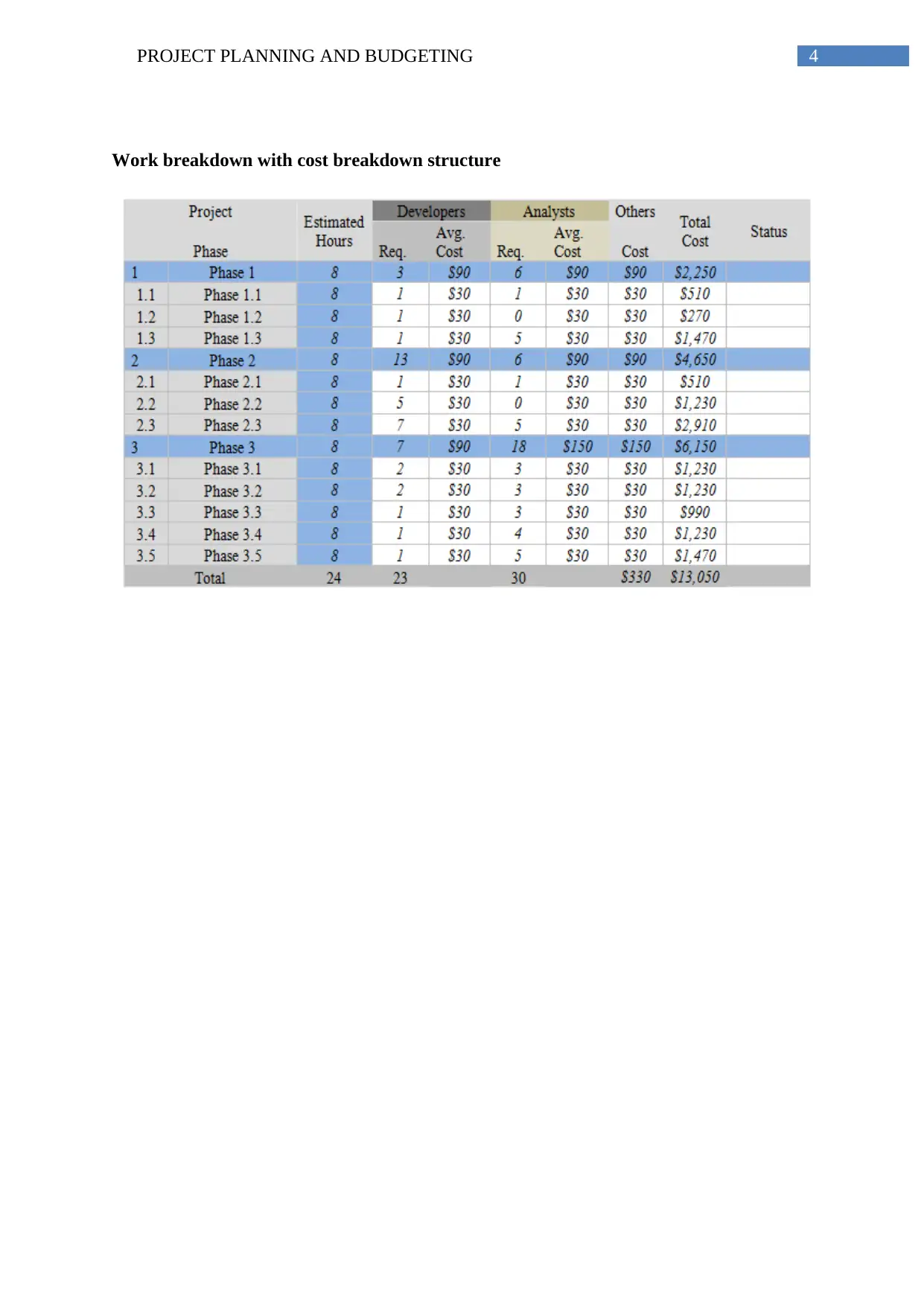
Work breakdown with cost breakdown structure
Document Page
5PROJECT PLANNING AND BUDGETING
Reference
Farooq, M. A., Kirchain, R., Novoa, H., & Araujo, A. (2017). Cost of Quality: Evaluating
Cost-Quality Trade-Offs for Inspection Strategies of Manufacturing
Processes. International Journal of Production Economics.
Kaplan, R. S., & Atkinson, A. A. (2015). Advanced management accounting. PHI Learning.
Sarkar, B., & Moon, I. (2014). Improved quality, setup cost reduction, and variable backorder
costs in an imperfect production process. International journal of production
economics, 155, 204-213.
chevron_up_icon
1 out of 6
circle_padding
hide_on_mobile
zoom_out_icon
[object Object]