Project Report: Budgeting, Forecasting, and Financial Analysis
VerifiedAdded on 2021/10/06
|9
|1819
|58
Project
AI Summary
This project report provides a comprehensive overview of budgeting and forecasting techniques. It addresses key concepts such as the purpose and objectives of budgeting and forecasting, key performance indicators (KPIs), and ethical considerations in financial reporting. The report delves into various aspects of budgeting, including sales and purchase forecasting, fixed and variable costs, and different forecasting techniques like zero-based and top-down budgeting. It also discusses the importance of communication, budgetary control, the accrual principle, and the double-entry bookkeeping system. Furthermore, it highlights the significance of statistical analysis, market position analysis, and corporate governance in the budgeting process. The report includes student appendices with a budget report template, risk management policy, balance sheet, and performance report template, along with sample emails to an assessor and a bank manager. The report concludes with a list of references used in the project.
Running Head: Manage Budgets and Forecasts
1
Project Report: Manage Budgets and Forecasts
(TASK 1)
1
Project Report: Manage Budgets and Forecasts
(TASK 1)
Paraphrase This Document
Need a fresh take? Get an instant paraphrase of this document with our AI Paraphraser

Manage Budgets and Forecasts
2
Assessment Task 1:
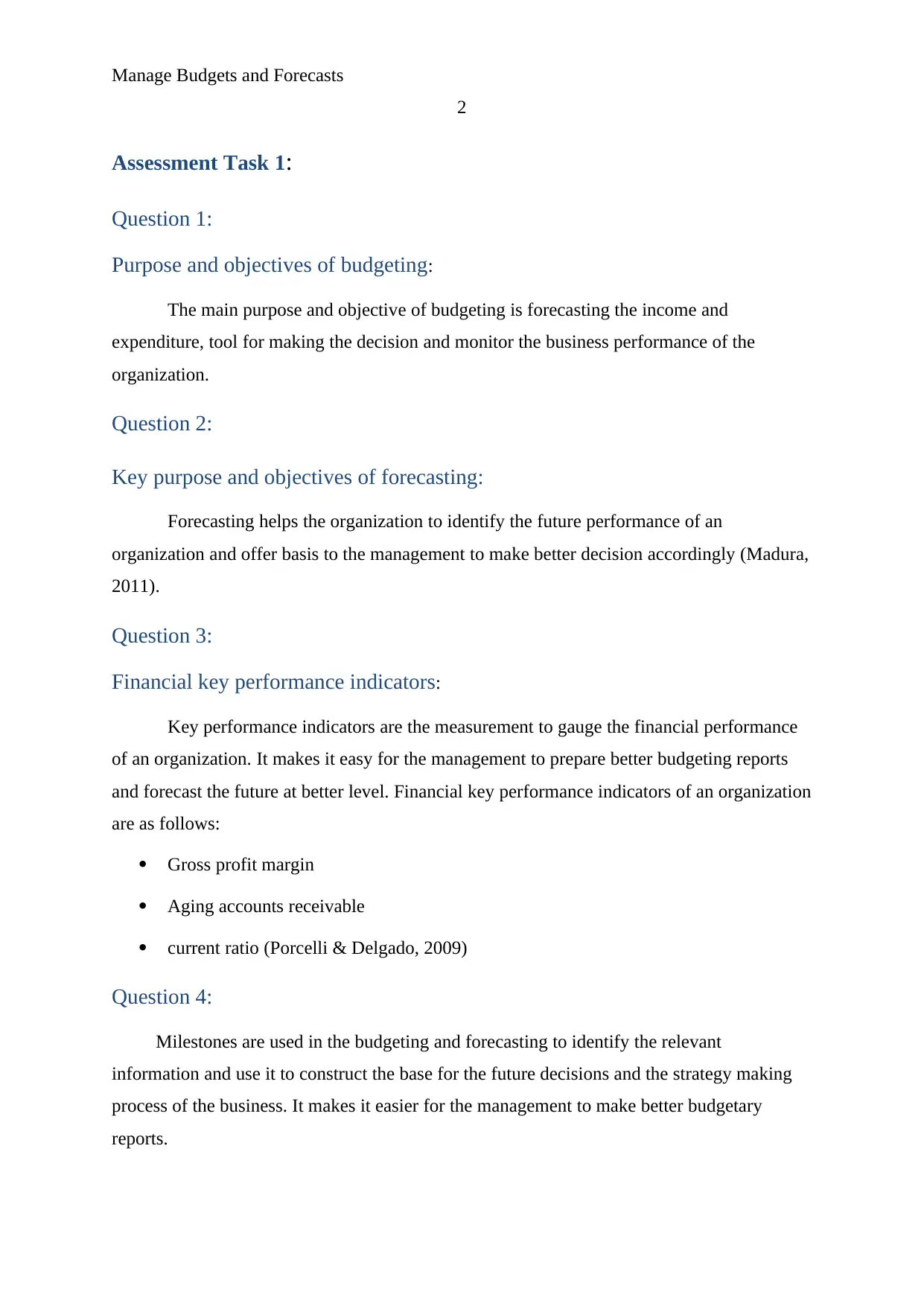
Question 1:
Purpose and objectives of budgeting:
The main purpose and objective of budgeting is forecasting the income and
expenditure, tool for making the decision and monitor the business performance of the
organization.
Question 2:
Key purpose and objectives of forecasting:
Forecasting helps the organization to identify the future performance of an
organization and offer basis to the management to make better decision accordingly (Madura,
2011).
Question 3:
Financial key performance indicators:
Key performance indicators are the measurement to gauge the financial performance
of an organization. It makes it easy for the management to prepare better budgeting reports
and forecast the future at better level. Financial key performance indicators of an organization
are as follows:
Gross profit margin
Aging accounts receivable
current ratio (Porcelli & Delgado, 2009)
Question 4:
Milestones are used in the budgeting and forecasting to identify the relevant
information and use it to construct the base for the future decisions and the strategy making
process of the business. It makes it easier for the management to make better budgetary
reports.
2
Assessment Task 1:
Question 1:
Purpose and objectives of budgeting:
The main purpose and objective of budgeting is forecasting the income and
expenditure, tool for making the decision and monitor the business performance of the
organization.
Question 2:
Key purpose and objectives of forecasting:
Forecasting helps the organization to identify the future performance of an
organization and offer basis to the management to make better decision accordingly (Madura,
2011).
Question 3:
Financial key performance indicators:
Key performance indicators are the measurement to gauge the financial performance
of an organization. It makes it easy for the management to prepare better budgeting reports
and forecast the future at better level. Financial key performance indicators of an organization
are as follows:
Gross profit margin
Aging accounts receivable
current ratio (Porcelli & Delgado, 2009)
Question 4:
Milestones are used in the budgeting and forecasting to identify the relevant
information and use it to construct the base for the future decisions and the strategy making
process of the business. It makes it easier for the management to make better budgetary
reports.

Manage Budgets and Forecasts
3
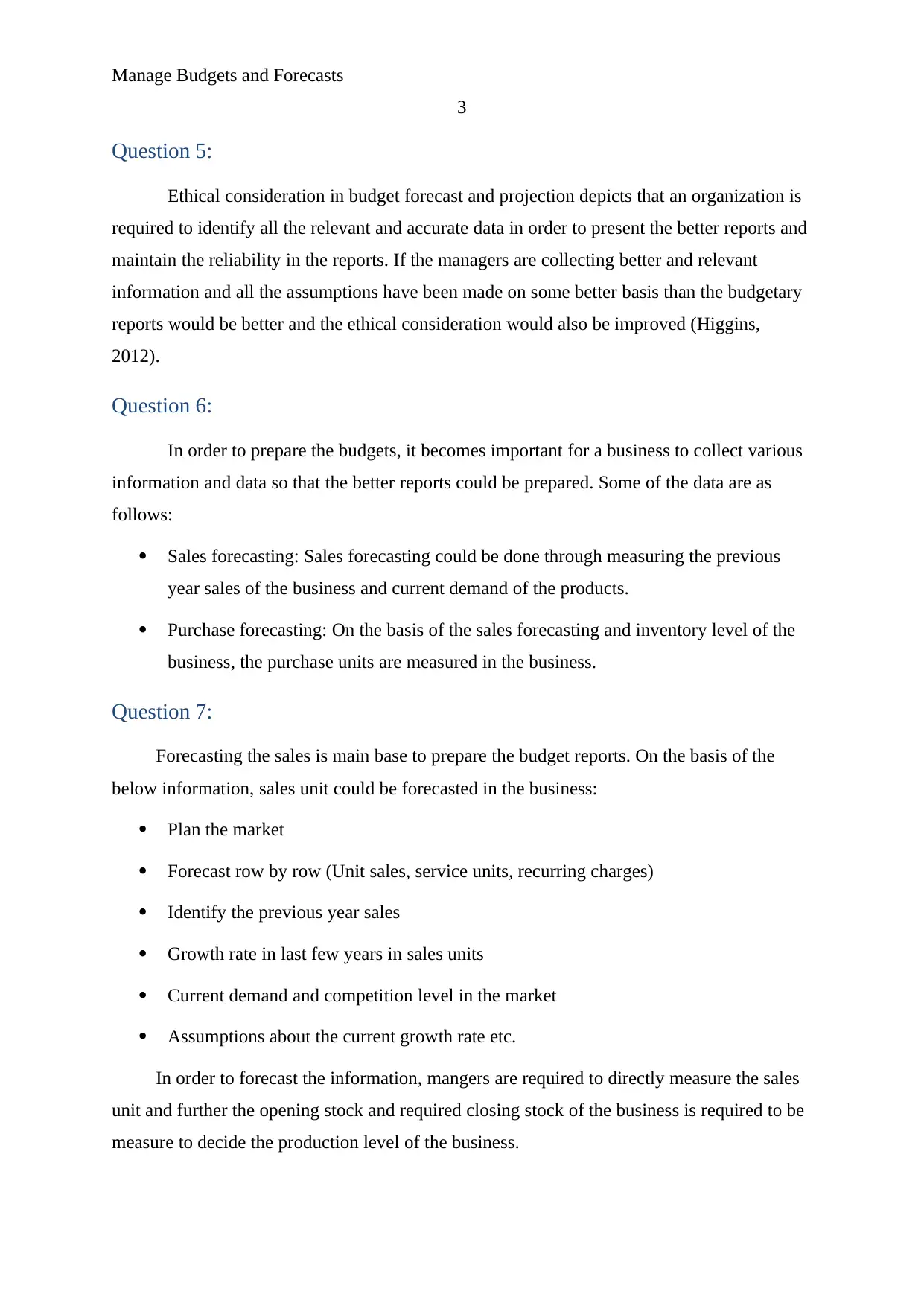
Question 5:
Ethical consideration in budget forecast and projection depicts that an organization is
required to identify all the relevant and accurate data in order to present the better reports and
maintain the reliability in the reports. If the managers are collecting better and relevant
information and all the assumptions have been made on some better basis than the budgetary
reports would be better and the ethical consideration would also be improved (Higgins,
2012).
Question 6:
In order to prepare the budgets, it becomes important for a business to collect various
information and data so that the better reports could be prepared. Some of the data are as
follows:
Sales forecasting: Sales forecasting could be done through measuring the previous
year sales of the business and current demand of the products.
Purchase forecasting: On the basis of the sales forecasting and inventory level of the
business, the purchase units are measured in the business.
Question 7:
Forecasting the sales is main base to prepare the budget reports. On the basis of the
below information, sales unit could be forecasted in the business:
Plan the market
Forecast row by row (Unit sales, service units, recurring charges)
Identify the previous year sales
Growth rate in last few years in sales units
Current demand and competition level in the market
Assumptions about the current growth rate etc.
In order to forecast the information, mangers are required to directly measure the sales
unit and further the opening stock and required closing stock of the business is required to be
measure to decide the production level of the business.
3
Question 5:
Ethical consideration in budget forecast and projection depicts that an organization is
required to identify all the relevant and accurate data in order to present the better reports and
maintain the reliability in the reports. If the managers are collecting better and relevant
information and all the assumptions have been made on some better basis than the budgetary
reports would be better and the ethical consideration would also be improved (Higgins,
2012).
Question 6:
In order to prepare the budgets, it becomes important for a business to collect various
information and data so that the better reports could be prepared. Some of the data are as
follows:
Sales forecasting: Sales forecasting could be done through measuring the previous
year sales of the business and current demand of the products.
Purchase forecasting: On the basis of the sales forecasting and inventory level of the
business, the purchase units are measured in the business.
Question 7:
Forecasting the sales is main base to prepare the budget reports. On the basis of the
below information, sales unit could be forecasted in the business:
Plan the market
Forecast row by row (Unit sales, service units, recurring charges)
Identify the previous year sales
Growth rate in last few years in sales units
Current demand and competition level in the market
Assumptions about the current growth rate etc.
In order to forecast the information, mangers are required to directly measure the sales
unit and further the opening stock and required closing stock of the business is required to be
measure to decide the production level of the business.
⊘ This is a preview!⊘
Do you want full access?
Subscribe today to unlock all pages.

Trusted by 1+ million students worldwide

Manage Budgets and Forecasts
4
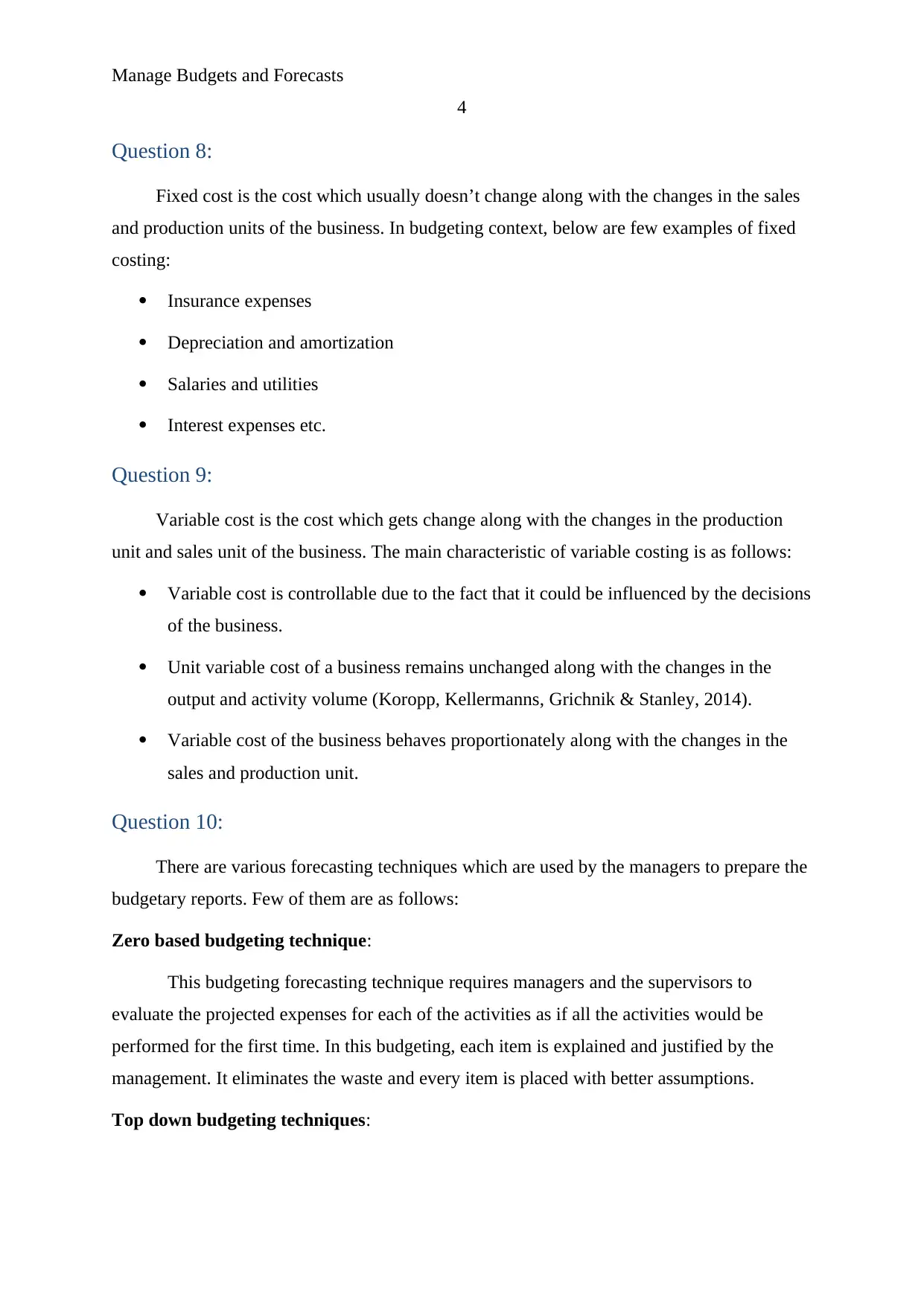
Question 8:
Fixed cost is the cost which usually doesn’t change along with the changes in the sales
and production units of the business. In budgeting context, below are few examples of fixed
costing:
Insurance expenses
Depreciation and amortization
Salaries and utilities
Interest expenses etc.
Question 9:
Variable cost is the cost which gets change along with the changes in the production
unit and sales unit of the business. The main characteristic of variable costing is as follows:
Variable cost is controllable due to the fact that it could be influenced by the decisions
of the business.
Unit variable cost of a business remains unchanged along with the changes in the
output and activity volume (Koropp, Kellermanns, Grichnik & Stanley, 2014).
Variable cost of the business behaves proportionately along with the changes in the
sales and production unit.
Question 10:
There are various forecasting techniques which are used by the managers to prepare the
budgetary reports. Few of them are as follows:
Zero based budgeting technique:
This budgeting forecasting technique requires managers and the supervisors to
evaluate the projected expenses for each of the activities as if all the activities would be
performed for the first time. In this budgeting, each item is explained and justified by the
management. It eliminates the waste and every item is placed with better assumptions.
Top down budgeting techniques:
4
Question 8:
Fixed cost is the cost which usually doesn’t change along with the changes in the sales
and production units of the business. In budgeting context, below are few examples of fixed
costing:
Insurance expenses
Depreciation and amortization
Salaries and utilities
Interest expenses etc.
Question 9:
Variable cost is the cost which gets change along with the changes in the production
unit and sales unit of the business. The main characteristic of variable costing is as follows:
Variable cost is controllable due to the fact that it could be influenced by the decisions
of the business.
Unit variable cost of a business remains unchanged along with the changes in the
output and activity volume (Koropp, Kellermanns, Grichnik & Stanley, 2014).
Variable cost of the business behaves proportionately along with the changes in the
sales and production unit.
Question 10:
There are various forecasting techniques which are used by the managers to prepare the
budgetary reports. Few of them are as follows:
Zero based budgeting technique:
This budgeting forecasting technique requires managers and the supervisors to
evaluate the projected expenses for each of the activities as if all the activities would be
performed for the first time. In this budgeting, each item is explained and justified by the
management. It eliminates the waste and every item is placed with better assumptions.
Top down budgeting techniques:
Paraphrase This Document
Need a fresh take? Get an instant paraphrase of this document with our AI Paraphraser

Manage Budgets and Forecasts
5
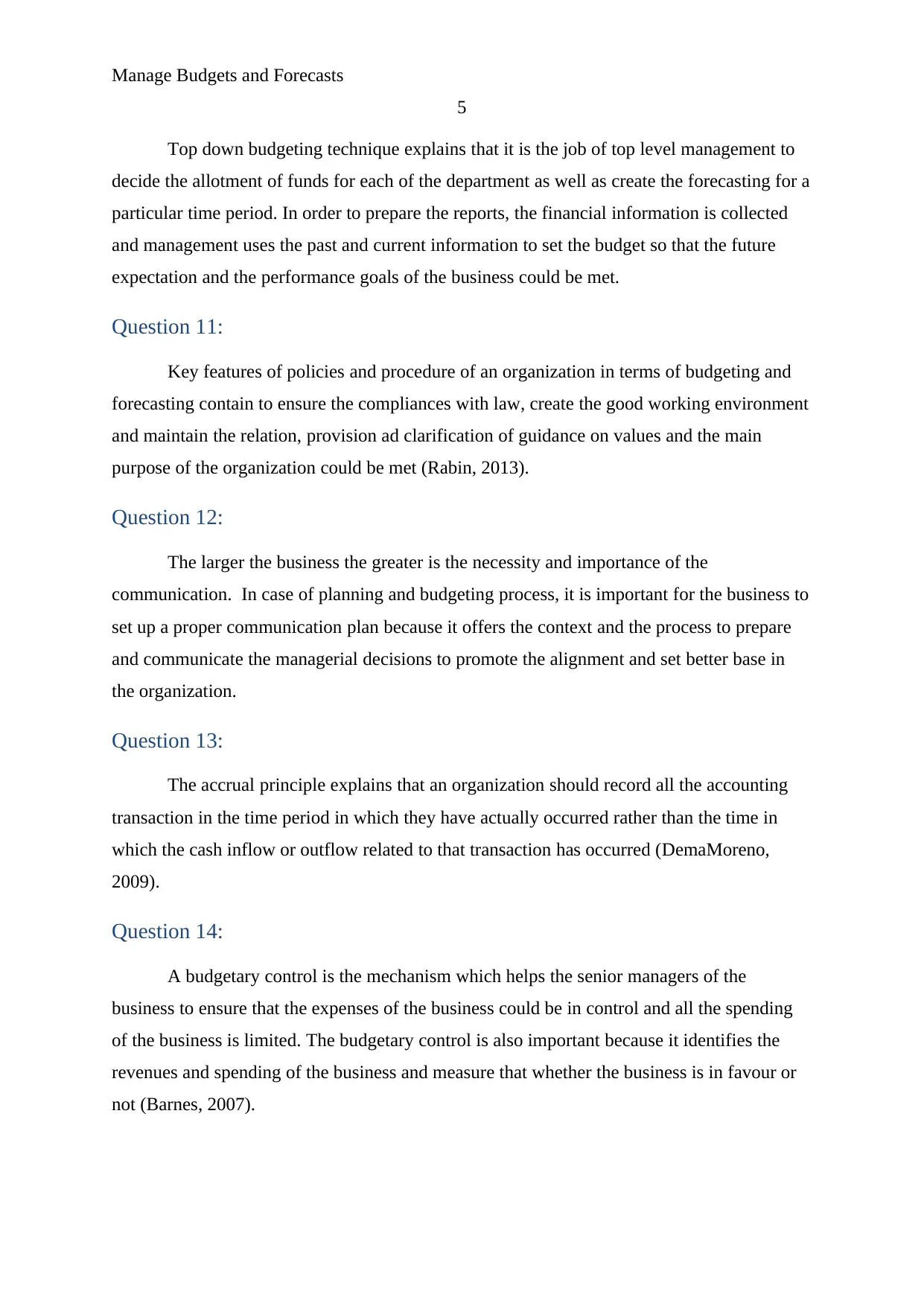
Top down budgeting technique explains that it is the job of top level management to
decide the allotment of funds for each of the department as well as create the forecasting for a
particular time period. In order to prepare the reports, the financial information is collected
and management uses the past and current information to set the budget so that the future
expectation and the performance goals of the business could be met.
Question 11:
Key features of policies and procedure of an organization in terms of budgeting and
forecasting contain to ensure the compliances with law, create the good working environment
and maintain the relation, provision ad clarification of guidance on values and the main
purpose of the organization could be met (Rabin, 2013).
Question 12:
The larger the business the greater is the necessity and importance of the
communication. In case of planning and budgeting process, it is important for the business to
set up a proper communication plan because it offers the context and the process to prepare
and communicate the managerial decisions to promote the alignment and set better base in
the organization.
Question 13:
The accrual principle explains that an organization should record all the accounting
transaction in the time period in which they have actually occurred rather than the time in
which the cash inflow or outflow related to that transaction has occurred (DemaMoreno,
2009).
Question 14:
A budgetary control is the mechanism which helps the senior managers of the
business to ensure that the expenses of the business could be in control and all the spending
of the business is limited. The budgetary control is also important because it identifies the
revenues and spending of the business and measure that whether the business is in favour or
not (Barnes, 2007).
5
Top down budgeting technique explains that it is the job of top level management to
decide the allotment of funds for each of the department as well as create the forecasting for a
particular time period. In order to prepare the reports, the financial information is collected
and management uses the past and current information to set the budget so that the future
expectation and the performance goals of the business could be met.
Question 11:
Key features of policies and procedure of an organization in terms of budgeting and
forecasting contain to ensure the compliances with law, create the good working environment
and maintain the relation, provision ad clarification of guidance on values and the main
purpose of the organization could be met (Rabin, 2013).
Question 12:
The larger the business the greater is the necessity and importance of the
communication. In case of planning and budgeting process, it is important for the business to
set up a proper communication plan because it offers the context and the process to prepare
and communicate the managerial decisions to promote the alignment and set better base in
the organization.
Question 13:
The accrual principle explains that an organization should record all the accounting
transaction in the time period in which they have actually occurred rather than the time in
which the cash inflow or outflow related to that transaction has occurred (DemaMoreno,
2009).
Question 14:
A budgetary control is the mechanism which helps the senior managers of the
business to ensure that the expenses of the business could be in control and all the spending
of the business is limited. The budgetary control is also important because it identifies the
revenues and spending of the business and measure that whether the business is in favour or
not (Barnes, 2007).

Manage Budgets and Forecasts
6
Question 15:
The double entry bookkeeping system explains that each of the transaction would
involve two or more than two accounts. It works on the below given equation:
Assets = liabilities + stockholder’s equity
For example, if a business borrows the loan from the bank than the cash account and
liability account of the business would be increased.
Question 16:
Statistic analysis principle depicts that all the statistical measures and the concepts
must be taken care while preparing the reports so that the organization goal could be met. The
main objective of statistic analysis is to make inferences about the samples and the other data.
Measure of variance explains about the difference among the actual data and the budgeted
data of the business (Chandra, 2011). It makes it easier for the business to make better
decisions.
Question 17:
It is quite important for the business and managers to identify the market position and
the current trend in the market while preparing the budgetary reports because it helps the
managers to make better assumptions and reach over the main goal of the business.
Question 18:
Corporate governance helps the business to intend and increase the accountability of
the business. It improves the shareholder’s value in the business and protects the interest of
other stakeholders of the business through offering them the accountability and corporate
performance (Rose & Hudgins, 2012).
6
Question 15:
The double entry bookkeeping system explains that each of the transaction would
involve two or more than two accounts. It works on the below given equation:
Assets = liabilities + stockholder’s equity
For example, if a business borrows the loan from the bank than the cash account and
liability account of the business would be increased.
Question 16:
Statistic analysis principle depicts that all the statistical measures and the concepts
must be taken care while preparing the reports so that the organization goal could be met. The
main objective of statistic analysis is to make inferences about the samples and the other data.
Measure of variance explains about the difference among the actual data and the budgeted
data of the business (Chandra, 2011). It makes it easier for the business to make better
decisions.
Question 17:
It is quite important for the business and managers to identify the market position and
the current trend in the market while preparing the budgetary reports because it helps the
managers to make better assumptions and reach over the main goal of the business.
Question 18:
Corporate governance helps the business to intend and increase the accountability of
the business. It improves the shareholder’s value in the business and protects the interest of
other stakeholders of the business through offering them the accountability and corporate
performance (Rose & Hudgins, 2012).
⊘ This is a preview!⊘
Do you want full access?
Subscribe today to unlock all pages.

Trusted by 1+ million students worldwide

Manage Budgets and Forecasts
7
Task 2:
Student Appendices
Green Cat Budget Risk Management
Policy and Procedures
Balance Sheet
Budget Report Template
Mail to assessor:
To: Beverly
Subject: Budgetary reports evaluation
Dear Beverly,
I have gone through the entire case and it has been found that the budgetary reports of the
business were quite better. The business has been able to even generate more revenue than
expected and because of it, the goodwill of the business has been improved more in the
market. The entire details could be found in the below attached files:
Regards,
Company managers.
7
Task 2:
Student Appendices
Green Cat Budget Risk Management
Policy and Procedures
Balance Sheet
Budget Report Template
Mail to assessor:
To: Beverly
Subject: Budgetary reports evaluation
Dear Beverly,
I have gone through the entire case and it has been found that the budgetary reports of the
business were quite better. The business has been able to even generate more revenue than
expected and because of it, the goodwill of the business has been improved more in the
market. The entire details could be found in the below attached files:
Regards,
Company managers.
Paraphrase This Document
Need a fresh take? Get an instant paraphrase of this document with our AI Paraphraser

Manage Budgets and Forecasts
8
Mail to Bank manager:
To: Bank manager
Subject: Budgetary reports evaluation
Dear Bank manager,
We are attaching the details of our organization along with this mail. Our organization has
performed outstanding in last quarter and the market trends explain that in near future, the
performance of the organization would be improved much. Please evaluate the files and
sanction the loan worth $ 5,00,000.
Regards,
Company managers.
Task 3:
Student Appendices
Performance Report Template
8
Mail to Bank manager:
To: Bank manager
Subject: Budgetary reports evaluation
Dear Bank manager,
We are attaching the details of our organization along with this mail. Our organization has
performed outstanding in last quarter and the market trends explain that in near future, the
performance of the organization would be improved much. Please evaluate the files and
sanction the loan worth $ 5,00,000.
Regards,
Company managers.
Task 3:
Student Appendices
Performance Report Template

Manage Budgets and Forecasts
9
References:
Barnes, P. (2007), The Analysis and Use of Financial Ratios: A Review Article, Journal of
Business Finance & Accounting, 14 (4), p. 449-461
Chandra, P. (2011). Financial management. Tata McGraw-Hill Education.
DemaMoreno, S. (2009). Behind the negotiations: Financial decision-making processes in
Spanish dual-income couples. Feminist Economics, 15(1), 27-56.
Higgins, R. C. (2012). Analysis for marketing management. McGraw-Hill/Irwin.
Koropp, C., Kellermanns, F. W., Grichnik, D., & Stanley, L. (2014). Financial decision
making in family firms: An adaptation of the theory of planned behavior. Family
Business Review, 27(4), 307-327.
Madura, J. (2011). International financial management. Cengage Learning.
Porcelli, A. J., & Delgado, M. R. (2009). Acute stress modulates risk taking in financial
decision making. Psychological Science, 20(3), 278-283.
Rabin, M. (2013). Risk aversion and expected-utility theory: A calibration theorem.
In Handbook of the Fundamentals of Financial Decision Making: Part I (pp. 241-252).
Rose, P. S., & Hudgins, S. C. (2012). Bank management & financial services. McGraw-Hill
Education.
9
References:
Barnes, P. (2007), The Analysis and Use of Financial Ratios: A Review Article, Journal of
Business Finance & Accounting, 14 (4), p. 449-461
Chandra, P. (2011). Financial management. Tata McGraw-Hill Education.
DemaMoreno, S. (2009). Behind the negotiations: Financial decision-making processes in
Spanish dual-income couples. Feminist Economics, 15(1), 27-56.
Higgins, R. C. (2012). Analysis for marketing management. McGraw-Hill/Irwin.
Koropp, C., Kellermanns, F. W., Grichnik, D., & Stanley, L. (2014). Financial decision
making in family firms: An adaptation of the theory of planned behavior. Family
Business Review, 27(4), 307-327.
Madura, J. (2011). International financial management. Cengage Learning.
Porcelli, A. J., & Delgado, M. R. (2009). Acute stress modulates risk taking in financial
decision making. Psychological Science, 20(3), 278-283.
Rabin, M. (2013). Risk aversion and expected-utility theory: A calibration theorem.
In Handbook of the Fundamentals of Financial Decision Making: Part I (pp. 241-252).
Rose, P. S., & Hudgins, S. C. (2012). Bank management & financial services. McGraw-Hill
Education.
⊘ This is a preview!⊘
Do you want full access?
Subscribe today to unlock all pages.

Trusted by 1+ million students worldwide
1 out of 9
Related Documents
Your All-in-One AI-Powered Toolkit for Academic Success.
+13062052269
info@desklib.com
Available 24*7 on WhatsApp / Email
Unlock your academic potential
Copyright © 2020–2026 A2Z Services. All Rights Reserved. Developed and managed by ZUCOL.