Queensland Health: Project Claims, RBP Model & Procurement Report
VerifiedAdded on 2023/04/21
|21
|3858
|316
Report
AI Summary
This report provides a detailed analysis of project claims and damages, focusing on the Relationship Based Procurement (RBP) model and its application, particularly in the context of collaborative project procurement arrangements. Part A explores the RBP model through the lens of Wittgenstein's Idea of Family Resemblance, discussing the 16 identified elements of the model and their core attributes. It emphasizes the importance of KPIs in project management and the five themes for evaluating Platform Foundation facilities. Part B delves into a claims and damages report, specifically referencing the Queensland Health Payroll Program. It itemizes subthemes and KSAEs (Knowledge, Skills, Attributes, and Experience) to mitigate project claims and damages, focusing on platform foundation elements like motivation, context, and joint governance structure. The report highlights the need for technical, project management, business solution, and relational KSAEs to maximize effectiveness and reduce potential project failures. This document is a student contribution available on Desklib, a platform offering study tools and solved assignments.

Running head: Project Claims And Damages Report.
PROJECT CLAIMS AND DAMAGES REPORT
PROJECT CLAIMS AND DAMAGES REPORT

Paraphrase This Document
Need a fresh take? Get an instant paraphrase of this document with our AI Paraphraser
Project Claims And Damages Report 1
Table of Contents
Part A...............................................................................................................................................2
Introduction......................................................................................................................................2
RBP model with the application of Wittgenstein Idea of Family Resemblance.............................2
Understanding and discussion of the elements of the RBP model..................................................4
Conclusion.......................................................................................................................................9
Part B.............................................................................................................................................10
1.1 Platform Foundation...................................................................................................10
1.2 Behavioral factors................................................................................................................13
1.3 Processes, routines, and means......................................................................................16
References......................................................................................................................................20
Table of Contents
Part A...............................................................................................................................................2
Introduction......................................................................................................................................2
RBP model with the application of Wittgenstein Idea of Family Resemblance.............................2
Understanding and discussion of the elements of the RBP model..................................................4
Conclusion.......................................................................................................................................9
Part B.............................................................................................................................................10
1.1 Platform Foundation...................................................................................................10
1.2 Behavioral factors................................................................................................................13
1.3 Processes, routines, and means......................................................................................16
References......................................................................................................................................20
Project Claims And Damages Report 2
Part A
Introduction
Project management deals with planning, overall execution, control, and closing of a
project undertaken by a particular team or organisation. Lloyd-Walker & Walker (2015) regard
RBP or Relationship Based Procurement as a vital concept concerning the paper. The model has
been discussed in the book with regards to multiple forms and relationship such as strategic
partnering, project partnering and more. About 16 elements have been identified with regards to
the RBP model thus presented in the book. A discussion of the RBP model with the application
of the Wittgenstein Idea of Family Resemblance has been performed in this study, along with a
discussion of the 16 identified elements of the model.
RBP model with the application of Wittgenstein Idea of Family Resemblance
According to Ludwig Wittgenstein, common, relatable features prevalent among a group
of people primarily define the concept of Family Resemblance and serve as the basis for
identifying the aspects of project partnering. It may be mentioned in this context that the general
components of family resemblance by Wittgenstein, is applied to the concept of project
partnering. According to scholars, there has been a complex network of overlapping similarities,
which can further be grouped under a concept that is considered complex in nature. It may be
stated in this regards that the validation for relating the concept of Family Resemblance by
Wittgenstein for the RBP model is evident in the core attributes of the concept. The project
partnering may be based on the attribute measures which are discussed later in this paper.
Part A
Introduction
Project management deals with planning, overall execution, control, and closing of a
project undertaken by a particular team or organisation. Lloyd-Walker & Walker (2015) regard
RBP or Relationship Based Procurement as a vital concept concerning the paper. The model has
been discussed in the book with regards to multiple forms and relationship such as strategic
partnering, project partnering and more. About 16 elements have been identified with regards to
the RBP model thus presented in the book. A discussion of the RBP model with the application
of the Wittgenstein Idea of Family Resemblance has been performed in this study, along with a
discussion of the 16 identified elements of the model.
RBP model with the application of Wittgenstein Idea of Family Resemblance
According to Ludwig Wittgenstein, common, relatable features prevalent among a group
of people primarily define the concept of Family Resemblance and serve as the basis for
identifying the aspects of project partnering. It may be mentioned in this context that the general
components of family resemblance by Wittgenstein, is applied to the concept of project
partnering. According to scholars, there has been a complex network of overlapping similarities,
which can further be grouped under a concept that is considered complex in nature. It may be
stated in this regards that the validation for relating the concept of Family Resemblance by
Wittgenstein for the RBP model is evident in the core attributes of the concept. The project
partnering may be based on the attribute measures which are discussed later in this paper.
⊘ This is a preview!⊘
Do you want full access?
Subscribe today to unlock all pages.

Trusted by 1+ million students worldwide
Project Claims And Damages Report 3
Moreover, it is to be taken into account that the relevance of the ‘family traits’ can be related to
the project regarding case study data or the partnering literature of an analogy.
Scholars mention the use of construction of ‘flowers’ for explaining the concept of a
component which is ever-present in the project. In addition to that, the ‘petals;’ are used for
demonstrating the components in a project which are not completely developed or have not been
completely discarded either. A Wittgenstein-style model has been implemented to undertake the
learning of the development of the RBP model.
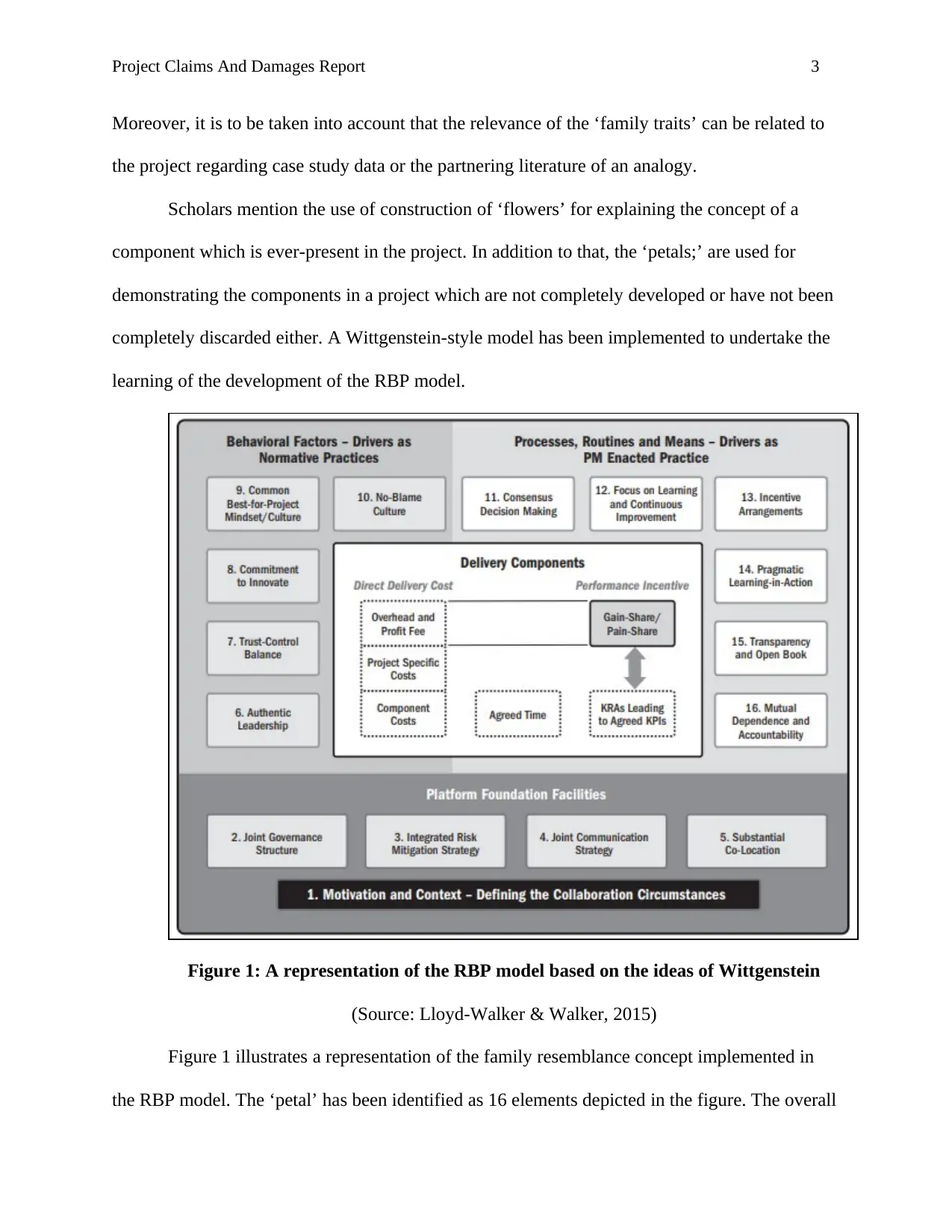
Figure 1: A representation of the RBP model based on the ideas of Wittgenstein
(Source: Lloyd-Walker & Walker, 2015)
Figure 1 illustrates a representation of the family resemblance concept implemented in
the RBP model. The ‘petal’ has been identified as 16 elements depicted in the figure. The overall
Moreover, it is to be taken into account that the relevance of the ‘family traits’ can be related to
the project regarding case study data or the partnering literature of an analogy.
Scholars mention the use of construction of ‘flowers’ for explaining the concept of a
component which is ever-present in the project. In addition to that, the ‘petals;’ are used for
demonstrating the components in a project which are not completely developed or have not been
completely discarded either. A Wittgenstein-style model has been implemented to undertake the
learning of the development of the RBP model.
Figure 1: A representation of the RBP model based on the ideas of Wittgenstein
(Source: Lloyd-Walker & Walker, 2015)
Figure 1 illustrates a representation of the family resemblance concept implemented in
the RBP model. The ‘petal’ has been identified as 16 elements depicted in the figure. The overall
Paraphrase This Document
Need a fresh take? Get an instant paraphrase of this document with our AI Paraphraser
Project Claims And Damages Report 4
components are 16 in number; subdivided through three categories to accommodate the core
attributes identified for the Resource-based Procurement procedures. These elements can be
considered for identifying relevant classes of RBP. The central part of the figure demonstrates
the stamen of a flower, which indicates the components related to project delivery. The KPIs
constitute an integral part of project management, as it aids in ascertaining the performance of
the project and the team. The KPIs are often related to the constraints, which can be cost, time
and more.
In addition to that, 5 themes have been chiefly identified for evaluating the Platform
Foundation facilities for the elements. The themes identified are motivation and context,
integrated strategies for risk mitigation, joint governance structure, substantial co-location and
strategies for joint communication. To assess the components, further subdivisions have been
made. Additionally, it is to be taken into account that other factors, such as behavioural factors,
processes, and routines have been considered for the further evaluation of the elements. A
discussion of the understanding of the 16 elements of the RBP model has been elaborately
performed in the later stages of this study.
Understanding and discussion of the elements of the RBP model
Project partnering has formerly been classified with the aid of the RBP model which
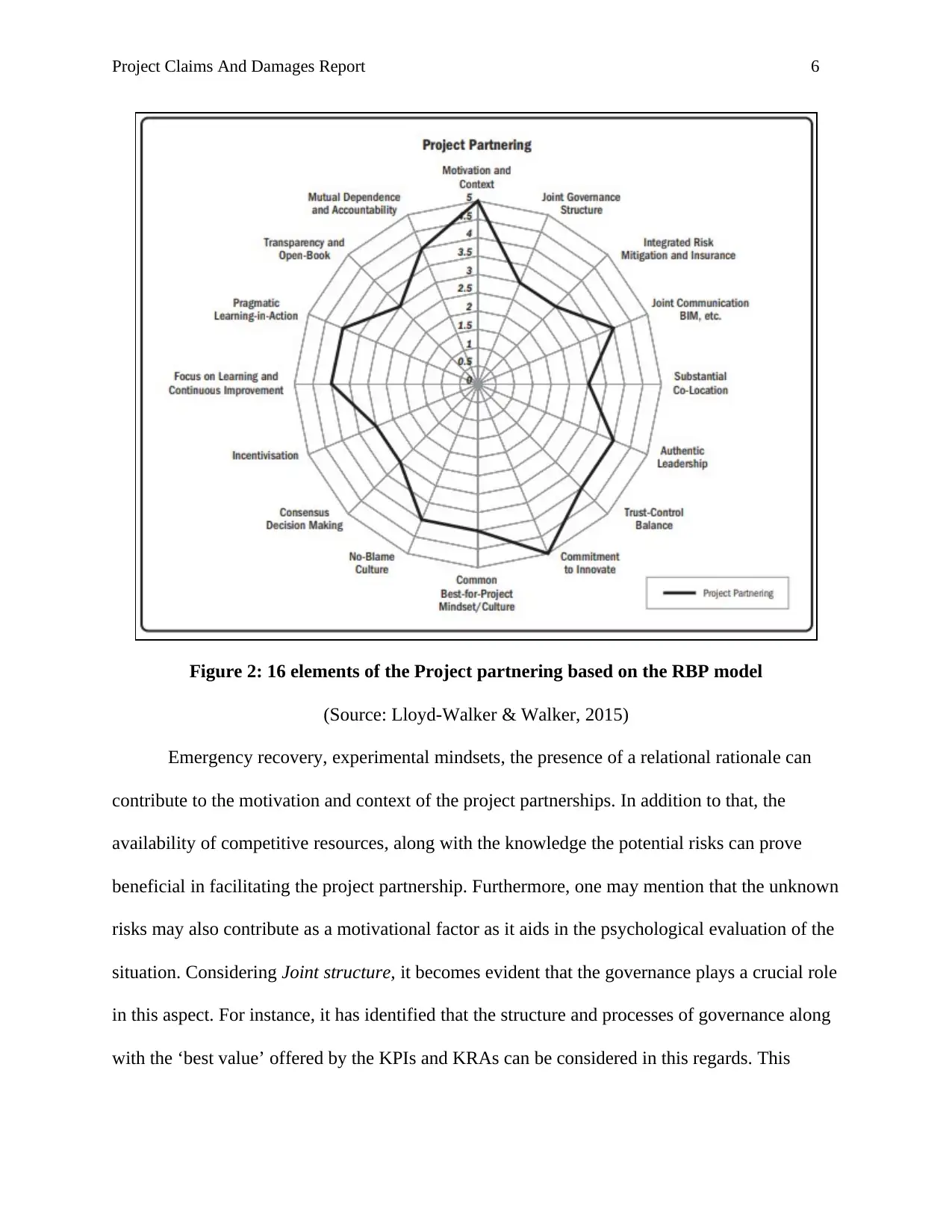
implements the concept of family resemblance. Figure 2 outlines the ratings as well as the 16
elements identified, which are as follows:
Motivation and context
Integrated risk insurance and mitigation
Joint governance structure
components are 16 in number; subdivided through three categories to accommodate the core
attributes identified for the Resource-based Procurement procedures. These elements can be
considered for identifying relevant classes of RBP. The central part of the figure demonstrates
the stamen of a flower, which indicates the components related to project delivery. The KPIs
constitute an integral part of project management, as it aids in ascertaining the performance of
the project and the team. The KPIs are often related to the constraints, which can be cost, time
and more.
In addition to that, 5 themes have been chiefly identified for evaluating the Platform
Foundation facilities for the elements. The themes identified are motivation and context,
integrated strategies for risk mitigation, joint governance structure, substantial co-location and
strategies for joint communication. To assess the components, further subdivisions have been
made. Additionally, it is to be taken into account that other factors, such as behavioural factors,
processes, and routines have been considered for the further evaluation of the elements. A
discussion of the understanding of the 16 elements of the RBP model has been elaborately
performed in the later stages of this study.
Understanding and discussion of the elements of the RBP model
Project partnering has formerly been classified with the aid of the RBP model which
implements the concept of family resemblance. Figure 2 outlines the ratings as well as the 16
elements identified, which are as follows:
Motivation and context
Integrated risk insurance and mitigation
Joint governance structure
Project Claims And Damages Report 5
Substantial co-location
Joint communication
Balance of Trust-control
Authentic leadership
Common Best-for-project culture or mindset
No-blame culture
Commitment to innovation
Incentivisation
Pragmatic learning-in-action
Consensus decision-making
Mutual accountability and dependence
Focus on consistent learning and continual improvement
Transparency
It is to be noted that each of the components so identified has been characterised as a part of the
project partnering and ratings have been provided for the better assessment of the progress.
Tables presented in the book by Lloyd-Walker & Walker (2015), represent the themes and the
sub-themes identified under each of the elements segregated. Considering the first element, it
may be mentioned that the motivation and context may be defined as the potential circumstances,
which may be responsible for the collaboration between the project partners. The factors
shortlisted under this category can be the Best value, which represents ‘value’ and not cost. KPIs
and KRAs can be implemented in this aspect to evaluate the purpose of the project.
Substantial co-location
Joint communication
Balance of Trust-control
Authentic leadership
Common Best-for-project culture or mindset
No-blame culture
Commitment to innovation
Incentivisation
Pragmatic learning-in-action
Consensus decision-making
Mutual accountability and dependence
Focus on consistent learning and continual improvement
Transparency
It is to be noted that each of the components so identified has been characterised as a part of the
project partnering and ratings have been provided for the better assessment of the progress.
Tables presented in the book by Lloyd-Walker & Walker (2015), represent the themes and the
sub-themes identified under each of the elements segregated. Considering the first element, it
may be mentioned that the motivation and context may be defined as the potential circumstances,
which may be responsible for the collaboration between the project partners. The factors
shortlisted under this category can be the Best value, which represents ‘value’ and not cost. KPIs
and KRAs can be implemented in this aspect to evaluate the purpose of the project.
⊘ This is a preview!⊘
Do you want full access?
Subscribe today to unlock all pages.
Trusted by 1+ million students worldwide
Project Claims And Damages Report 6
Figure 2: 16 elements of the Project partnering based on the RBP model
(Source: Lloyd-Walker & Walker, 2015)
Emergency recovery, experimental mindsets, the presence of a relational rationale can
contribute to the motivation and context of the project partnerships. In addition to that, the
availability of competitive resources, along with the knowledge the potential risks can prove
beneficial in facilitating the project partnership. Furthermore, one may mention that the unknown
risks may also contribute as a motivational factor as it aids in the psychological evaluation of the
situation. Considering Joint structure, it becomes evident that the governance plays a crucial role
in this aspect. For instance, it has identified that the structure and processes of governance along
with the ‘best value’ offered by the KPIs and KRAs can be considered in this regards. This
Figure 2: 16 elements of the Project partnering based on the RBP model
(Source: Lloyd-Walker & Walker, 2015)
Emergency recovery, experimental mindsets, the presence of a relational rationale can
contribute to the motivation and context of the project partnerships. In addition to that, the
availability of competitive resources, along with the knowledge the potential risks can prove
beneficial in facilitating the project partnership. Furthermore, one may mention that the unknown
risks may also contribute as a motivational factor as it aids in the psychological evaluation of the
situation. Considering Joint structure, it becomes evident that the governance plays a crucial role
in this aspect. For instance, it has identified that the structure and processes of governance along
with the ‘best value’ offered by the KPIs and KRAs can be considered in this regards. This
Paraphrase This Document
Need a fresh take? Get an instant paraphrase of this document with our AI Paraphraser
Project Claims And Damages Report 7
particular element is responsible for the development of the concept for understanding the
communication and collaboration between teams for the execution of the project.
The integrated risk mitigation strategy focuses on the understanding of the management
of risks known and unknown for gaining a potential advantage and an insurance policy. The
actions to be undertaken in this regards include risk mitigation strategies, risk-sharing
conversations, and systems integration. The fourth element considered is a strategy for joint
communication, which can be facilitated by groupware ICT and other common systems and
processes, which may influence the concept of a mutual understanding. Furthermore, an
integrated common platform may be performed through the implementation of BIM tools. The
fifth element substantial co-location can be through building common understanding and
relationships, which can be undertaken through physical co-location and hierarchical
mechanisms of integration.
Authentic leadership can be promoted through the involvement of the supply chain team leaders
and supporting the design, considering the project culture as well. The characteristics thus
identified in this regards include appreciativeness, reflectiveness, wisdom, resilience,
authenticity and more. Considering the Trust-Control balance, it may be stated that the
transparent accountability for a project task as well as the discussion of sensitive matters can be
promoted through this element. Autonomy, safe workplace cultures, and a trust-building
relationship may be encouraged in this aspect. Commitment to innovation can be facilitated
through the testing, experimenting and prototyping of the project, which the team works on.
Common best-for-project culture and mindset may be influenced by aligning the common goals
of the team members along with the recruitment of support and undertaking the challenge for
proving one's excellence. Lastly, promoting a No-blame culture for the project may be
particular element is responsible for the development of the concept for understanding the
communication and collaboration between teams for the execution of the project.
The integrated risk mitigation strategy focuses on the understanding of the management
of risks known and unknown for gaining a potential advantage and an insurance policy. The
actions to be undertaken in this regards include risk mitigation strategies, risk-sharing
conversations, and systems integration. The fourth element considered is a strategy for joint
communication, which can be facilitated by groupware ICT and other common systems and
processes, which may influence the concept of a mutual understanding. Furthermore, an
integrated common platform may be performed through the implementation of BIM tools. The
fifth element substantial co-location can be through building common understanding and
relationships, which can be undertaken through physical co-location and hierarchical
mechanisms of integration.
Authentic leadership can be promoted through the involvement of the supply chain team leaders
and supporting the design, considering the project culture as well. The characteristics thus
identified in this regards include appreciativeness, reflectiveness, wisdom, resilience,
authenticity and more. Considering the Trust-Control balance, it may be stated that the
transparent accountability for a project task as well as the discussion of sensitive matters can be
promoted through this element. Autonomy, safe workplace cultures, and a trust-building
relationship may be encouraged in this aspect. Commitment to innovation can be facilitated
through the testing, experimenting and prototyping of the project, which the team works on.
Common best-for-project culture and mindset may be influenced by aligning the common goals
of the team members along with the recruitment of support and undertaking the challenge for
proving one's excellence. Lastly, promoting a No-blame culture for the project may be
Project Claims And Damages Report 8
undertaken through the behavioural, organisation and contractual mechanisms as well as the
provision of a rationale for implementing the culture.
Consensus decision-making can be implemented in the project environment through the
prevention of implementation of cultural drivers such as a collectivist culture. Furthermore,
inhibiting the factors, which may lead to suppressing the action taking and consensus decision-
making, are to be thoroughly reviewed. Learning and consistent improvement may be achieved
through the consideration of the KPAs and KPIs, which serve as benchmarks for the
performance regarding the project. The capacity to cope and adapt to the newer ideas and
concepts may be undertaken as well as undertaking a culture of skills and learning development.
Incentivisation can be undertaken, regarding the management of the tension prevalent between
incentivisation and innovation.
Pragmatic learning-in-action is undertaken through facilitating actions such as coaching
and mentoring, along with action learning. Furthermore, the Transparency in the project can be
maintained through the maintenance of the accountability and the transparency of operations in a
project environment. In addition to that, it may be stated in this context that the agreement to
accept scrutiny and audits may contribute to the facilitation of the process. Lastly, mutual
dependence and accountability are facilitated according to Lloyd-Walker & Walker, (2015), by
identifying the factors for mutual dependence as well as enhancing the enablers and countering
the inhibiting factors for mutual dependence. Undertaking these activities may lead to the cross-
collaboration between teams.
undertaken through the behavioural, organisation and contractual mechanisms as well as the
provision of a rationale for implementing the culture.
Consensus decision-making can be implemented in the project environment through the
prevention of implementation of cultural drivers such as a collectivist culture. Furthermore,
inhibiting the factors, which may lead to suppressing the action taking and consensus decision-
making, are to be thoroughly reviewed. Learning and consistent improvement may be achieved
through the consideration of the KPAs and KPIs, which serve as benchmarks for the
performance regarding the project. The capacity to cope and adapt to the newer ideas and
concepts may be undertaken as well as undertaking a culture of skills and learning development.
Incentivisation can be undertaken, regarding the management of the tension prevalent between
incentivisation and innovation.
Pragmatic learning-in-action is undertaken through facilitating actions such as coaching
and mentoring, along with action learning. Furthermore, the Transparency in the project can be
maintained through the maintenance of the accountability and the transparency of operations in a
project environment. In addition to that, it may be stated in this context that the agreement to
accept scrutiny and audits may contribute to the facilitation of the process. Lastly, mutual
dependence and accountability are facilitated according to Lloyd-Walker & Walker, (2015), by
identifying the factors for mutual dependence as well as enhancing the enablers and countering
the inhibiting factors for mutual dependence. Undertaking these activities may lead to the cross-
collaboration between teams.
⊘ This is a preview!⊘
Do you want full access?
Subscribe today to unlock all pages.
Trusted by 1+ million students worldwide
Project Claims And Damages Report 9
Conclusion
This study reflects the concepts presented in the book “Collaborative project
procurement arrangements” which highlights the relevant practices to improve the scope for
project management. There are 16 elements which have been identified by the author regarding
the Relationship Based Procurement model mentioned in the book. Furthermore, the RBP model
takes the concept of Family Resemblance into account, which has been discussed in this paper.
Conclusion
This study reflects the concepts presented in the book “Collaborative project
procurement arrangements” which highlights the relevant practices to improve the scope for
project management. There are 16 elements which have been identified by the author regarding
the Relationship Based Procurement model mentioned in the book. Furthermore, the RBP model
takes the concept of Family Resemblance into account, which has been discussed in this paper.
Paraphrase This Document
Need a fresh take? Get an instant paraphrase of this document with our AI Paraphraser
Project Claims And Damages Report 10
Part B
1.1 Platform Foundation
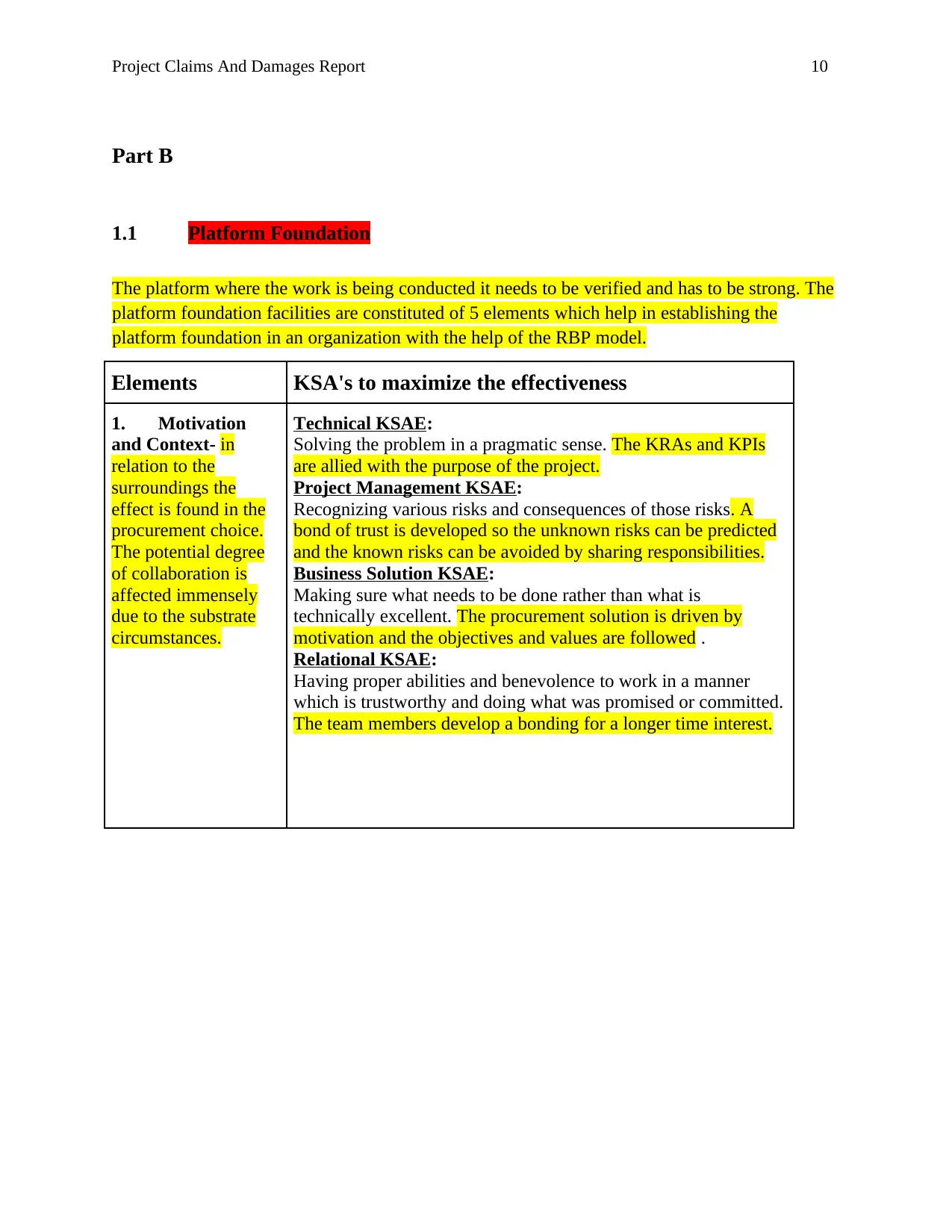
The platform where the work is being conducted it needs to be verified and has to be strong. The
platform foundation facilities are constituted of 5 elements which help in establishing the
platform foundation in an organization with the help of the RBP model.
Elements KSA's to maximize the effectiveness
1. Motivation
and Context- in
relation to the
surroundings the
effect is found in the
procurement choice.
The potential degree
of collaboration is
affected immensely
due to the substrate
circumstances.
Technical KSAE:
Solving the problem in a pragmatic sense. The KRAs and KPIs
are allied with the purpose of the project.
Project Management KSAE:
Recognizing various risks and consequences of those risks. A
bond of trust is developed so the unknown risks can be predicted
and the known risks can be avoided by sharing responsibilities.
Business Solution KSAE:
Making sure what needs to be done rather than what is
technically excellent. The procurement solution is driven by
motivation and the objectives and values are followed .
Relational KSAE:
Having proper abilities and benevolence to work in a manner
which is trustworthy and doing what was promised or committed.
The team members develop a bonding for a longer time interest.
Part B
1.1 Platform Foundation
The platform where the work is being conducted it needs to be verified and has to be strong. The
platform foundation facilities are constituted of 5 elements which help in establishing the
platform foundation in an organization with the help of the RBP model.
Elements KSA's to maximize the effectiveness
1. Motivation
and Context- in
relation to the
surroundings the
effect is found in the
procurement choice.
The potential degree
of collaboration is
affected immensely
due to the substrate
circumstances.
Technical KSAE:
Solving the problem in a pragmatic sense. The KRAs and KPIs
are allied with the purpose of the project.
Project Management KSAE:
Recognizing various risks and consequences of those risks. A
bond of trust is developed so the unknown risks can be predicted
and the known risks can be avoided by sharing responsibilities.
Business Solution KSAE:
Making sure what needs to be done rather than what is
technically excellent. The procurement solution is driven by
motivation and the objectives and values are followed .
Relational KSAE:
Having proper abilities and benevolence to work in a manner
which is trustworthy and doing what was promised or committed.
The team members develop a bonding for a longer time interest.
Project Claims And Damages Report 11
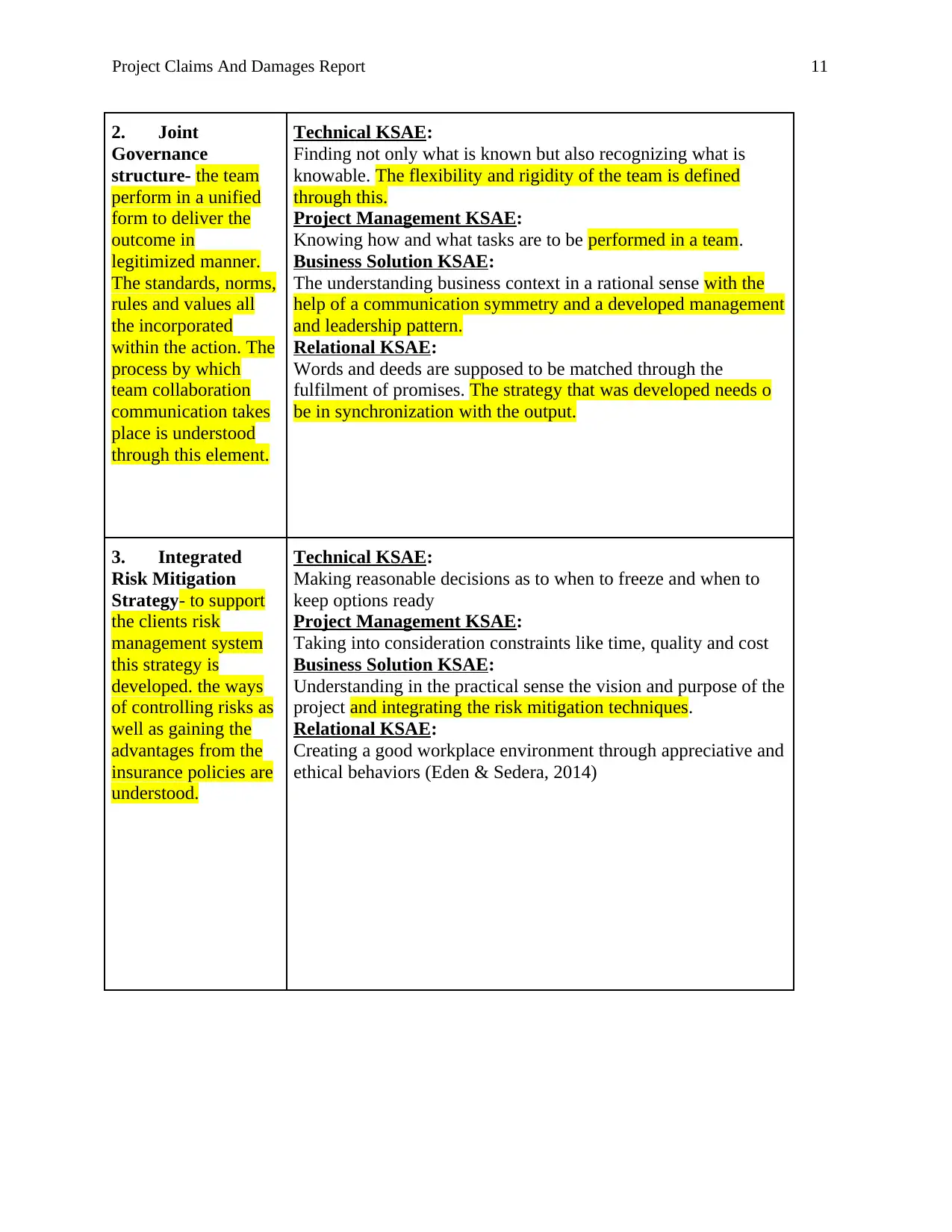
2. Joint
Governance
structure- the team
perform in a unified
form to deliver the
outcome in
legitimized manner.
The standards, norms,
rules and values all
the incorporated
within the action. The
process by which
team collaboration
communication takes
place is understood
through this element.
Technical KSAE:
Finding not only what is known but also recognizing what is
knowable. The flexibility and rigidity of the team is defined
through this.
Project Management KSAE:
Knowing how and what tasks are to be performed in a team.
Business Solution KSAE:
The understanding business context in a rational sense with the
help of a communication symmetry and a developed management
and leadership pattern.
Relational KSAE:
Words and deeds are supposed to be matched through the
fulfilment of promises. The strategy that was developed needs o
be in synchronization with the output.
3. Integrated
Risk Mitigation
Strategy- to support
the clients risk
management system
this strategy is
developed. the ways
of controlling risks as
well as gaining the
advantages from the
insurance policies are
understood.
Technical KSAE:
Making reasonable decisions as to when to freeze and when to
keep options ready
Project Management KSAE:
Taking into consideration constraints like time, quality and cost
Business Solution KSAE:
Understanding in the practical sense the vision and purpose of the
project and integrating the risk mitigation techniques.
Relational KSAE:
Creating a good workplace environment through appreciative and
ethical behaviors (Eden & Sedera, 2014)
2. Joint
Governance
structure- the team
perform in a unified
form to deliver the
outcome in
legitimized manner.
The standards, norms,
rules and values all
the incorporated
within the action. The
process by which
team collaboration
communication takes
place is understood
through this element.
Technical KSAE:
Finding not only what is known but also recognizing what is
knowable. The flexibility and rigidity of the team is defined
through this.
Project Management KSAE:
Knowing how and what tasks are to be performed in a team.
Business Solution KSAE:
The understanding business context in a rational sense with the
help of a communication symmetry and a developed management
and leadership pattern.
Relational KSAE:
Words and deeds are supposed to be matched through the
fulfilment of promises. The strategy that was developed needs o
be in synchronization with the output.
3. Integrated
Risk Mitigation
Strategy- to support
the clients risk
management system
this strategy is
developed. the ways
of controlling risks as
well as gaining the
advantages from the
insurance policies are
understood.
Technical KSAE:
Making reasonable decisions as to when to freeze and when to
keep options ready
Project Management KSAE:
Taking into consideration constraints like time, quality and cost
Business Solution KSAE:
Understanding in the practical sense the vision and purpose of the
project and integrating the risk mitigation techniques.
Relational KSAE:
Creating a good workplace environment through appreciative and
ethical behaviors (Eden & Sedera, 2014)
⊘ This is a preview!⊘
Do you want full access?
Subscribe today to unlock all pages.
Trusted by 1+ million students worldwide

1 out of 21


Your All-in-One AI-Powered Toolkit for Academic Success.
+13062052269
info@desklib.com
Available 24*7 on WhatsApp / Email
![[object Object]](/_next/static/media/star-bottom.7253800d.svg)
Unlock your academic potential
Copyright © 2020–2026 A2Z Services. All Rights Reserved. Developed and managed by ZUCOL.