Project Communication Impact on LAP Project Performance Study
VerifiedAdded on 2023/04/22
|9
|3916
|455
Report
AI Summary
This report investigates the impact of project communication on project performance, specifically within Land Acquisition Projects (LAP) under the Ministry of Urban Development and Natural Resources. The study explores the core contributions of project communication and its effects on project schedule, cost, and quality. It outlines the research questions, objectives, and methodology, including empirical survey methods, qualitative analysis, and logistic regression. Data sources such as the Akaike Information Criteria (AIC) and statistical software like R and SPSS are utilized for data collection and analysis. The research aims to understand the benefits of project communication, identify its impact on project performance, and address challenges in urban development and natural resource management. The report anticipates outcomes related to improving project communication strategies and enhancing overall project success. It uses data from a survey of 2000 landowners in Malaysia, analyzed using SPSS to assess the relationship between project communication and project outcomes.
1
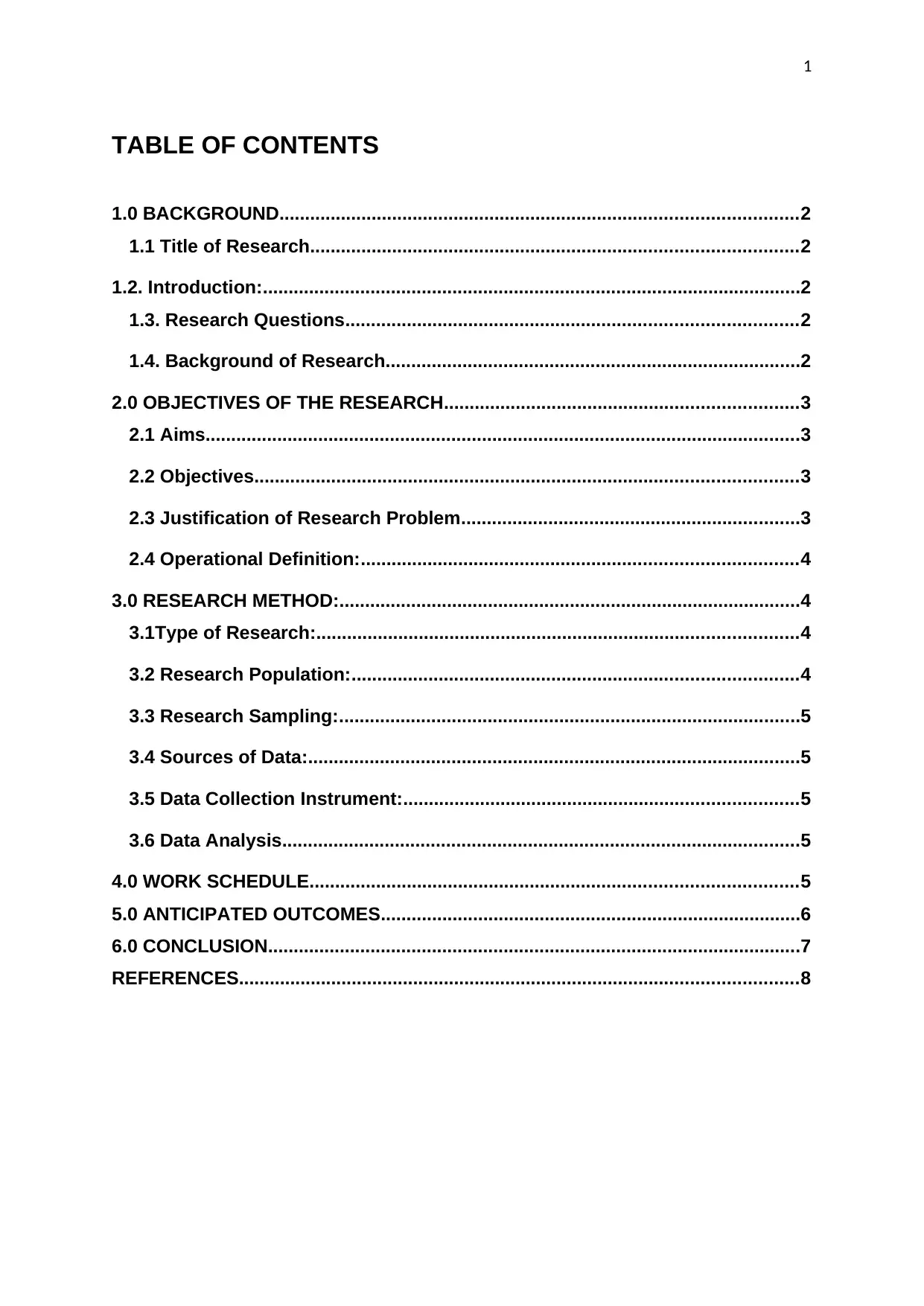
TABLE OF CONTENTS
1.0 BACKGROUND.....................................................................................................2
1.1 Title of Research...............................................................................................2
1.2. Introduction:.........................................................................................................2
1.3. Research Questions........................................................................................2
1.4. Background of Research.................................................................................2
2.0 OBJECTIVES OF THE RESEARCH.....................................................................3
2.1 Aims....................................................................................................................3
2.2 Objectives..........................................................................................................3
2.3 Justification of Research Problem..................................................................3
2.4 Operational Definition:.....................................................................................4
3.0 RESEARCH METHOD:..........................................................................................4
3.1Type of Research:..............................................................................................4
3.2 Research Population:.......................................................................................4
3.3 Research Sampling:..........................................................................................5
3.4 Sources of Data:................................................................................................5
3.5 Data Collection Instrument:.............................................................................5
3.6 Data Analysis.....................................................................................................5
4.0 WORK SCHEDULE...............................................................................................5
5.0 ANTICIPATED OUTCOMES..................................................................................6
6.0 CONCLUSION........................................................................................................7
REFERENCES.............................................................................................................8
TABLE OF CONTENTS
1.0 BACKGROUND.....................................................................................................2
1.1 Title of Research...............................................................................................2
1.2. Introduction:.........................................................................................................2
1.3. Research Questions........................................................................................2
1.4. Background of Research.................................................................................2
2.0 OBJECTIVES OF THE RESEARCH.....................................................................3
2.1 Aims....................................................................................................................3
2.2 Objectives..........................................................................................................3
2.3 Justification of Research Problem..................................................................3
2.4 Operational Definition:.....................................................................................4
3.0 RESEARCH METHOD:..........................................................................................4
3.1Type of Research:..............................................................................................4
3.2 Research Population:.......................................................................................4
3.3 Research Sampling:..........................................................................................5
3.4 Sources of Data:................................................................................................5
3.5 Data Collection Instrument:.............................................................................5
3.6 Data Analysis.....................................................................................................5
4.0 WORK SCHEDULE...............................................................................................5
5.0 ANTICIPATED OUTCOMES..................................................................................6
6.0 CONCLUSION........................................................................................................7
REFERENCES.............................................................................................................8

Paraphrase This Document
Need a fresh take? Get an instant paraphrase of this document with our AI Paraphraser
2
1.0 BACKGROUND
1.1 Title of Research
A Study on the Impact of Project Communication on Project Performance With
Special Reference To Land Acquisition Project (LAP) By Land And Survey Department
Under Ministry Of Urban Development And Natural Resources
1.2. Introduction:
At Malaysia, the land acquisition includes the taking away of land compulsorily. This
is commonly done against the will of landowners. The Malaysian law needs the state to pay
compensation adequately. Further, it must be reminded sufficient compensation is not
defined in the statue. Unlike land purchasing, it is the forcible take-over on different
government-owned private owned land. The Land is acquired to server practical public
purpose. The land acquisition for different development works is a common practice in
various countries. It has boosted national growth. For instance the exercise of land
acquisition is of the farm lands for creating particular financial zones.
In this study, the land acquisition project from the side of “Land and Survey
Department” within the “Urban Development and Natural Resources” are considered. Here,
the research questions, background, aims, objectives, research methods are demonstrated.
Further, various kinds of researches, population, sampling, data sources, data collection
tools and data analysis are also analysed.
1.3. Research Questions
(a) What is the core contribution of Project communication?
(b) What are the impacts of Project communication on project performance?
(c) How this has been particularly affecting project schedule project cost and project
quality?
1.4. Background of Research
The urban development is the basis for upcoming generations. This is because it
helps in indicating the longevity of the area. The project management includes the
development of an urban area (Chen et al. 2017). It fulfils the necessities of the current
generation, preserves and protects the scenario of future generations. Besides, the natural
resource development and management project includes six elements that are tasked for
addressing particular institutional and technical aspects. This involves land laws, land
administration, geodetic survey, resource management, strategic management and
planning. There is a necessity to control internally, every land consolidation and resettlement
and acquisition activities. This has been taking place for every scheme and considering
meaningful measures as there is any happening (Vanclay et al. 2017). Further, there is a
necessity to assure that the land acquired or any resettlement might result from the
outcomes.
1.0 BACKGROUND
1.1 Title of Research
A Study on the Impact of Project Communication on Project Performance With
Special Reference To Land Acquisition Project (LAP) By Land And Survey Department
Under Ministry Of Urban Development And Natural Resources
1.2. Introduction:
At Malaysia, the land acquisition includes the taking away of land compulsorily. This
is commonly done against the will of landowners. The Malaysian law needs the state to pay
compensation adequately. Further, it must be reminded sufficient compensation is not
defined in the statue. Unlike land purchasing, it is the forcible take-over on different
government-owned private owned land. The Land is acquired to server practical public
purpose. The land acquisition for different development works is a common practice in
various countries. It has boosted national growth. For instance the exercise of land
acquisition is of the farm lands for creating particular financial zones.
In this study, the land acquisition project from the side of “Land and Survey
Department” within the “Urban Development and Natural Resources” are considered. Here,
the research questions, background, aims, objectives, research methods are demonstrated.
Further, various kinds of researches, population, sampling, data sources, data collection
tools and data analysis are also analysed.
1.3. Research Questions
(a) What is the core contribution of Project communication?
(b) What are the impacts of Project communication on project performance?
(c) How this has been particularly affecting project schedule project cost and project
quality?
1.4. Background of Research
The urban development is the basis for upcoming generations. This is because it
helps in indicating the longevity of the area. The project management includes the
development of an urban area (Chen et al. 2017). It fulfils the necessities of the current
generation, preserves and protects the scenario of future generations. Besides, the natural
resource development and management project includes six elements that are tasked for
addressing particular institutional and technical aspects. This involves land laws, land
administration, geodetic survey, resource management, strategic management and
planning. There is a necessity to control internally, every land consolidation and resettlement
and acquisition activities. This has been taking place for every scheme and considering
meaningful measures as there is any happening (Vanclay et al. 2017). Further, there is a
necessity to assure that the land acquired or any resettlement might result from the
outcomes.
3
However, it must be reminded that to meet the necessities of urban development, the
main aim is to investigate the elements that are hindering the success of the project. A
framework should be developed concerning primary sectors of concern of stakeholders.
Besides, the project must reveal consultation, lack of communication and political instability.
Further, it must also fight with nepotism by political officials, failure and lack top adhere to
the regulations of the project and lack of standardization of project design. Moreover, it also
involves the lack of proper continuity of various factors that have been inhibiting the project
sustainability. On the other hand, as far as the development of natural resources is
concerned, policy formulation, performance monitoring, planning coordination,
communication, education and information is to be involved. This must also include
management and organization for strategic management and planning. Then, regarding
resource management, the natural resource management information system,
environmental monitoring and resource use planning are to be considered. Then for geodetic
survey the standard reference point around the nation is to be established. Regarding land
administration, a real property tax analysis, integrated social forestry, agrarian reform and
cadastral survey is to be done. For the land laws, the environmental protection law and
natural resource management are to be done. Lastly, for the computerization and developing
of microcomputer-based mining tiles, the research must be helpful to deploy the effective
database and administration system.
2.0 OBJECTIVES OF THE RESEARCH
2.1 Aims
The aims of the project include the understanding of central contribution of project
communication. Then it includes the effect of project communication over the performance of
project. This includes project quality and project costs.
The various factors of the current study include the factors helpful to identify the
project communication in LAP project. Next, the effects of project communication over
project performance over the project schedule are needed to be determined. Further, effects
of project communication over the project cost and project performance is needed to be
measured. Lastly, the effects of the project communication on project performance over the
quality are determined in the study.
2.2 Objectives
To understand primary benefits of Project communication.
To identify the impact of Project communication on project performance
However, it must be reminded that to meet the necessities of urban development, the
main aim is to investigate the elements that are hindering the success of the project. A
framework should be developed concerning primary sectors of concern of stakeholders.
Besides, the project must reveal consultation, lack of communication and political instability.
Further, it must also fight with nepotism by political officials, failure and lack top adhere to
the regulations of the project and lack of standardization of project design. Moreover, it also
involves the lack of proper continuity of various factors that have been inhibiting the project
sustainability. On the other hand, as far as the development of natural resources is
concerned, policy formulation, performance monitoring, planning coordination,
communication, education and information is to be involved. This must also include
management and organization for strategic management and planning. Then, regarding
resource management, the natural resource management information system,
environmental monitoring and resource use planning are to be considered. Then for geodetic
survey the standard reference point around the nation is to be established. Regarding land
administration, a real property tax analysis, integrated social forestry, agrarian reform and
cadastral survey is to be done. For the land laws, the environmental protection law and
natural resource management are to be done. Lastly, for the computerization and developing
of microcomputer-based mining tiles, the research must be helpful to deploy the effective
database and administration system.
2.0 OBJECTIVES OF THE RESEARCH
2.1 Aims
The aims of the project include the understanding of central contribution of project
communication. Then it includes the effect of project communication over the performance of
project. This includes project quality and project costs.
The various factors of the current study include the factors helpful to identify the
project communication in LAP project. Next, the effects of project communication over
project performance over the project schedule are needed to be determined. Further, effects
of project communication over the project cost and project performance is needed to be
measured. Lastly, the effects of the project communication on project performance over the
quality are determined in the study.
2.2 Objectives
To understand primary benefits of Project communication.
To identify the impact of Project communication on project performance
⊘ This is a preview!⊘
Do you want full access?
Subscribe today to unlock all pages.

Trusted by 1+ million students worldwide
4
2.3 Problem Statement:
This includes the following:
The project management is the method to manage every aspect of a project. This starts
from inception to closing, through the help of structured and scientific methodology. Besides,
it is seen as the concern with controlling various discrete packages for activities to gain
particular objectives.In the context of project management, the communication systems are
the frameworks helping in exchange of experience, skills and knowledge. The project
performance can be seen as the measure to track scope, cost and time. This is enhanced
through proper project communication (Jamalludin et al. 2016). This clarifies project activities
and helps the stakeholders to get involved in projects. The land acquisition project refers to
the method through which the private land is acquired for industrialization, developing
infrastructural facilities and urbanization of private land (Cramb and Deanna Ferraro et al.
2016). Moreover, it provides compensation to various affected landowners and resettlement
and rehabilitation. The finding of adequate and proper land is the problem with the state.
Besides, compensation at market rate is needed to be provided before the project
commencement (Breu et al. 2016). Further, the accelerating of entire economic development
of the state and focus of the government is also a barrier in the present case. This plan
includes how project communication must be provided with particular information regarding
quality, cost and schedule to be best delivered. Besides, the communication channels to be
used for providing the data is also included in the relationship (Dell’Angelo et al. 2017). Here,
the initial source of quality cost of the loss of experienced due to poor quality. This is known
as failure cost. Next, there is the source of quality cost. This is the investment to develop
quality and value of prevention. The quality management is done through the help of the
same type of quality requirements regarding project deliverables. This delivers the direction
to manage quality and validate what is suitable (Liu et al. 2015). In order to manage quality,
the project managers have been using the cost-benefit analysis for refining tasks through
lowering expenses, developing products and needs of less rework.
2.4 Operational Definition:
The project communication has been playing a vital role to keep the projects on
tasks. This must specify communication that includes frequency and methods. This varies as
per the necessities of the project. To understand the reason behind the plan of project
communication is helpful for managers to under the goals of plans.
3.0 RESEARCH METHOD:
3.1Type of Research:
The present research consists of the empirical survey study. Here the research
methods are qualitative or logistic regression analysis. Further, the viewpoints of owners are
ascertained here through questionnaires. The advantage of the agreement process is
investigated through material oriented analysis of the contents of various documents.
Moreover, the primary elements to look for, in this study includes answering the particular
research questions. It also defines the phenomenon, behaviour and population to be
studied. Besides, it describes the process utilized in the study including selection criteria,
testing instruments and controls. The SPSS or “Statistical Package for the Social Sciences”
is used here for complicated statistical data analysis. Its statistical program has been
providing the plethora of primary statistical functions. This also include bivariate statistics,
2.3 Problem Statement:
This includes the following:
The project management is the method to manage every aspect of a project. This starts
from inception to closing, through the help of structured and scientific methodology. Besides,
it is seen as the concern with controlling various discrete packages for activities to gain
particular objectives.In the context of project management, the communication systems are
the frameworks helping in exchange of experience, skills and knowledge. The project
performance can be seen as the measure to track scope, cost and time. This is enhanced
through proper project communication (Jamalludin et al. 2016). This clarifies project activities
and helps the stakeholders to get involved in projects. The land acquisition project refers to
the method through which the private land is acquired for industrialization, developing
infrastructural facilities and urbanization of private land (Cramb and Deanna Ferraro et al.
2016). Moreover, it provides compensation to various affected landowners and resettlement
and rehabilitation. The finding of adequate and proper land is the problem with the state.
Besides, compensation at market rate is needed to be provided before the project
commencement (Breu et al. 2016). Further, the accelerating of entire economic development
of the state and focus of the government is also a barrier in the present case. This plan
includes how project communication must be provided with particular information regarding
quality, cost and schedule to be best delivered. Besides, the communication channels to be
used for providing the data is also included in the relationship (Dell’Angelo et al. 2017). Here,
the initial source of quality cost of the loss of experienced due to poor quality. This is known
as failure cost. Next, there is the source of quality cost. This is the investment to develop
quality and value of prevention. The quality management is done through the help of the
same type of quality requirements regarding project deliverables. This delivers the direction
to manage quality and validate what is suitable (Liu et al. 2015). In order to manage quality,
the project managers have been using the cost-benefit analysis for refining tasks through
lowering expenses, developing products and needs of less rework.
2.4 Operational Definition:
The project communication has been playing a vital role to keep the projects on
tasks. This must specify communication that includes frequency and methods. This varies as
per the necessities of the project. To understand the reason behind the plan of project
communication is helpful for managers to under the goals of plans.
3.0 RESEARCH METHOD:
3.1Type of Research:
The present research consists of the empirical survey study. Here the research
methods are qualitative or logistic regression analysis. Further, the viewpoints of owners are
ascertained here through questionnaires. The advantage of the agreement process is
investigated through material oriented analysis of the contents of various documents.
Moreover, the primary elements to look for, in this study includes answering the particular
research questions. It also defines the phenomenon, behaviour and population to be
studied. Besides, it describes the process utilized in the study including selection criteria,
testing instruments and controls. The SPSS or “Statistical Package for the Social Sciences”
is used here for complicated statistical data analysis. Its statistical program has been
providing the plethora of primary statistical functions. This also include bivariate statistics,
Paraphrase This Document
Need a fresh take? Get an instant paraphrase of this document with our AI Paraphraser
5
cross tabulation and frequencies. Moreover, its Modeler program, also helps on creating and
validating predictive models through innovative statistical processes. Its Text Analytics for
survey is helpful for survey administrator to uncover the effective insights from reactions to
different survey queries. Moreover, its Visualization Designer approach permits to utilize the
data in creating the broad varieties of visuals such as radial boxplots and charts with
simplicity.
3.2 Research Population:
Here, about 2000 landowners at Malaysia are considered for the above survey.
3.3 Research Sampling:
The research is done by plotting the graph. This highlights the logistic regression
curve (Verburg et al. 2015). This is available as there is one single type of independent
variable. Here, the sample size is provided with the number and proportion of various cases
with positive and negative results. Here, let p be the minimum of the proportions of positive
and negative cases in the overall population. Here, k is the number of covariates or the
number of independent variables. Here the minimum of cases involves the following.
N= 10 k/p
3.4 Sources of Data:
The source of data is the AIC or Akaike Information Criteria. This is the analogous
metric of the R^2 adjusted in logistic regression. This is the calculation of fit. This has been
penalizing model for the various quantity of model coefficients (Roesli, Asep Heri and Siti
Rahayu 2017). This one must prefer model having least AIC value. This is the estimator of
the relative quality of various statistical models for particular set of data. Provided with the
collection for data, AIC is helpful to estimate the quality of every model that is relative to their
models. In this way, AIC delivers the ways of mode selection. This is based on information
theory. AIC determines the relative data that is lost by any specific model. Less the
information is lost by a model, the AIC is found to be dealing with various trade-offs between
the efficiency and simplicity of the model.
3.5 Data Collection Instrument:
Here, the statistical software package R is utilized. Here, the capability of analysing
and interpreting data is the increasing complex factor to drive commercial success and
innovation. This includes the maximising of operational affectivity, knowing the base of
customer and controlling the quality monitoring that needs the data and capability to
investigate that. R is a programming language and environment of free software. This is for
various graphics and statistical computing that is supported by R Foundation meant for
Statistical Computing. This is broadly utilized among various data miners and statisticians o
develop data analysis and statistical software. R and is libraries has been deploying broad
several of graphical and statistical techniques. This includes nonlinear and linear modelling,
different classical statistic tests, clustering, classifications and time-series analysis.
cross tabulation and frequencies. Moreover, its Modeler program, also helps on creating and
validating predictive models through innovative statistical processes. Its Text Analytics for
survey is helpful for survey administrator to uncover the effective insights from reactions to
different survey queries. Moreover, its Visualization Designer approach permits to utilize the
data in creating the broad varieties of visuals such as radial boxplots and charts with
simplicity.
3.2 Research Population:
Here, about 2000 landowners at Malaysia are considered for the above survey.
3.3 Research Sampling:
The research is done by plotting the graph. This highlights the logistic regression
curve (Verburg et al. 2015). This is available as there is one single type of independent
variable. Here, the sample size is provided with the number and proportion of various cases
with positive and negative results. Here, let p be the minimum of the proportions of positive
and negative cases in the overall population. Here, k is the number of covariates or the
number of independent variables. Here the minimum of cases involves the following.
N= 10 k/p
3.4 Sources of Data:
The source of data is the AIC or Akaike Information Criteria. This is the analogous
metric of the R^2 adjusted in logistic regression. This is the calculation of fit. This has been
penalizing model for the various quantity of model coefficients (Roesli, Asep Heri and Siti
Rahayu 2017). This one must prefer model having least AIC value. This is the estimator of
the relative quality of various statistical models for particular set of data. Provided with the
collection for data, AIC is helpful to estimate the quality of every model that is relative to their
models. In this way, AIC delivers the ways of mode selection. This is based on information
theory. AIC determines the relative data that is lost by any specific model. Less the
information is lost by a model, the AIC is found to be dealing with various trade-offs between
the efficiency and simplicity of the model.
3.5 Data Collection Instrument:
Here, the statistical software package R is utilized. Here, the capability of analysing
and interpreting data is the increasing complex factor to drive commercial success and
innovation. This includes the maximising of operational affectivity, knowing the base of
customer and controlling the quality monitoring that needs the data and capability to
investigate that. R is a programming language and environment of free software. This is for
various graphics and statistical computing that is supported by R Foundation meant for
Statistical Computing. This is broadly utilized among various data miners and statisticians o
develop data analysis and statistical software. R and is libraries has been deploying broad
several of graphical and statistical techniques. This includes nonlinear and linear modelling,
different classical statistic tests, clustering, classifications and time-series analysis.
6
3.6 Data Analysis
The logistic regression model is created including every kind of explanatory
variables. This includes treatment and age. Here, the type of model having every variable is
involved as a saturated model and complete model. This is the most effective starting option
has one adequate sample size and few numbers of variables for including various elements.
They are challenges with sample size and the inclusion of variable. The SPSS software is
the tool to make better cessions about the data. Here it is used for data analysis. This is
helpful for the user to fill the missing blanks. It is helpful to create better models and data
estimation. Here, the analysis is done ion 2000 land owners. The data from the above
collected survey is gathered through SurveyGizmo to be exported to SPSS. This is done for
in-depth analysis. Further, exporting the survey data to the proprietary of SPPS in .SAV
forma has made the overall process to pull, manipulate and examine the data easily.
Moreover, SPSS has automatically setting up and importing the designated names of
variable names, titles, value labels, meanings and least performance needed from
researchers.
4.0 WORK SCHEDULE
Task Name Duration Start
Work Schedule for the present land acquisition
project
14.8 wks Wed 8/29/18
Writing research questions in theoretical and
operational format
1 wk Wed 8/29/18
Designing or defining the present study 14 days Wed 9/5/18
Nested and Crossed Factors 2 days Wed 9/5/18
Finding confounders and control variables 4 days Fri 9/7/18
Analyzing Longitudinal or repeated
measurements
4 days Thu 9/13/18
Simple random sampling 4 days Wed 9/19/18
Choose variables to answer research questions
and finding level of measurement
2 wks Tue 9/25/18
Conducting user training 1 wk Tue 10/9/18
Calculating different sample size estimations 1 wk Tue 10/16/18
Refining the model 3 wks Tue 10/23/18
Refining predictors and check model fit 1 wk Tue 10/23/18
Test assumptions 1 wk Tue 10/30/18
Checking for and resolving data issues 1 wk Tue 11/6/18
Interpreting results 4 wks Tue 11/13/18
3.6 Data Analysis
The logistic regression model is created including every kind of explanatory
variables. This includes treatment and age. Here, the type of model having every variable is
involved as a saturated model and complete model. This is the most effective starting option
has one adequate sample size and few numbers of variables for including various elements.
They are challenges with sample size and the inclusion of variable. The SPSS software is
the tool to make better cessions about the data. Here it is used for data analysis. This is
helpful for the user to fill the missing blanks. It is helpful to create better models and data
estimation. Here, the analysis is done ion 2000 land owners. The data from the above
collected survey is gathered through SurveyGizmo to be exported to SPSS. This is done for
in-depth analysis. Further, exporting the survey data to the proprietary of SPPS in .SAV
forma has made the overall process to pull, manipulate and examine the data easily.
Moreover, SPSS has automatically setting up and importing the designated names of
variable names, titles, value labels, meanings and least performance needed from
researchers.
4.0 WORK SCHEDULE
Task Name Duration Start
Work Schedule for the present land acquisition
project
14.8 wks Wed 8/29/18
Writing research questions in theoretical and
operational format
1 wk Wed 8/29/18
Designing or defining the present study 14 days Wed 9/5/18
Nested and Crossed Factors 2 days Wed 9/5/18
Finding confounders and control variables 4 days Fri 9/7/18
Analyzing Longitudinal or repeated
measurements
4 days Thu 9/13/18
Simple random sampling 4 days Wed 9/19/18
Choose variables to answer research questions
and finding level of measurement
2 wks Tue 9/25/18
Conducting user training 1 wk Tue 10/9/18
Calculating different sample size estimations 1 wk Tue 10/16/18
Refining the model 3 wks Tue 10/23/18
Refining predictors and check model fit 1 wk Tue 10/23/18
Test assumptions 1 wk Tue 10/30/18
Checking for and resolving data issues 1 wk Tue 11/6/18
Interpreting results 4 wks Tue 11/13/18
⊘ This is a preview!⊘
Do you want full access?
Subscribe today to unlock all pages.
Trusted by 1+ million students worldwide
7
Figure 1: “Gantt Chart for the current study on Land Acquisition”
(Source: Created by Author)
5.0 ANTICIPATED OUTCOMES
The requests and complaints from various landowners at Malaysia are collected
through this research. Then, there requests and complaints are concluded and reviewed.
Further, necessary feedback is provided to various related parties. As selected and owned
by private persons, various amount of legal information and right holders are gathered how
they utilize the land. In the current project communication of the land acquisition project, the
schedule is been listing the deliverables, activities and project milestones. This is expected
with start and finish dates. The various hypotheses are demonstrated below.
The investors who have been acquiring this land have consisted of financial
and technical ability and efficiency of intent in long terms.
The economic and financial assessment of those investments are competent
on the basis of reasonable assumptions with robust in standard the sensitive
analysis.
The proper resources and current properties are not recognized properly.
The potential resource and property rights are to be identified formally.
The potential environment and social externalities are to be dealt and
diagnosed as per accepted standards.
The method of project and site selection, Scrutiny and projected design to
transparent and open relevant issues instead of creating the cost of
transaction and delays.
Here, the cost estimation is also utilized for preparing the baseline of project cost.
This is the point based on milestone to compare the analysis of actual cost performance of
projects. Moreover, the cost estimating is the overall assimilation of involved costs to finish
the land acquisition project successfully. Besides, the project quality management of this
project is the overall activity and process required for determining and achieving the quality
of project. Apart from this the project quality is seen as the service of products. This has the
capability for performing satisfactorily and is necessary for the expected purpose.
As there is the current structure on any suitable land, the individuals utilizing the
structure and how long they have received impact from the project is determined. Besides,
the research helps in understanding as there is any non-agricultural usage on the chosen
land, the affected people and how fat and the time of their people affected can be also be
determined. Moreover, the vulnerable teams among the project-affected people are also
Figure 1: “Gantt Chart for the current study on Land Acquisition”
(Source: Created by Author)
5.0 ANTICIPATED OUTCOMES
The requests and complaints from various landowners at Malaysia are collected
through this research. Then, there requests and complaints are concluded and reviewed.
Further, necessary feedback is provided to various related parties. As selected and owned
by private persons, various amount of legal information and right holders are gathered how
they utilize the land. In the current project communication of the land acquisition project, the
schedule is been listing the deliverables, activities and project milestones. This is expected
with start and finish dates. The various hypotheses are demonstrated below.
The investors who have been acquiring this land have consisted of financial
and technical ability and efficiency of intent in long terms.
The economic and financial assessment of those investments are competent
on the basis of reasonable assumptions with robust in standard the sensitive
analysis.
The proper resources and current properties are not recognized properly.
The potential resource and property rights are to be identified formally.
The potential environment and social externalities are to be dealt and
diagnosed as per accepted standards.
The method of project and site selection, Scrutiny and projected design to
transparent and open relevant issues instead of creating the cost of
transaction and delays.
Here, the cost estimation is also utilized for preparing the baseline of project cost.
This is the point based on milestone to compare the analysis of actual cost performance of
projects. Moreover, the cost estimating is the overall assimilation of involved costs to finish
the land acquisition project successfully. Besides, the project quality management of this
project is the overall activity and process required for determining and achieving the quality
of project. Apart from this the project quality is seen as the service of products. This has the
capability for performing satisfactorily and is necessary for the expected purpose.
As there is the current structure on any suitable land, the individuals utilizing the
structure and how long they have received impact from the project is determined. Besides,
the research helps in understanding as there is any non-agricultural usage on the chosen
land, the affected people and how fat and the time of their people affected can be also be
determined. Moreover, the vulnerable teams among the project-affected people are also
Paraphrase This Document
Need a fresh take? Get an instant paraphrase of this document with our AI Paraphraser
8
identified through the project. Further, proper criteria needed to be satisfied for pursuant of
compensation to national legislation is also found out here. Further, the study has been
useful to review the complete land acquisition process. Further, the results also feed into
irrigation modernization tasks. The outcomes, pending grievances and primary issues and in
compliance are related to land acquisition addressed. Further, the outputs are helpful to
supply corrective measures and suggestions as there are some unresolved grievances or
any. Apart from this, in this land acquisition project, the consultation process and community
engagement which is in line to project stakeholder engagement plans or SEP and various
mechanisms of grievances have been redressing different mechanisms at every level.
6.0 CONCLUSION
The above study helps in understanding how the consultation methods with users
and owners of land subjected to land acquisition are liable for consultations. This also
includes means and channels to be utilized for informing the project regarding affected
people externally and internally. Regarding external factors the present political issues and
to impend the issues are determined above. Next, the vital current and impending economic
factors are to be found out. Further, the cultural and social aspects vital for the achievement
and technological trends and innovations to be occurring are determined here. Besides,
different legal issues and environmental challenges to the core business are indicated in the
study. Moreover the study helps in understanding that internally leadership is a vital factor.
Though typical conference has formal structure with vision and mission statements sated
clearly, various negative and cultural assumptions has been resulting from various
approaches of leaderships. However, it must be reminded that the transparent and steady
communication is a challenge. As the project leader of this land acquisition project develops
the scenario where the project statuses and information can be shared smarty this develops
the exchanges around all levels. In order to deploy the effective scenario of communication,
the above study is important. Using all the communication technologies, the project leaders
can use the best options regarding the internal factors fitting the needs and the team.
Moreover, the research is helpful to data on the grievance system in place and how that
functions and who is liable for the parties and get complaints at a local level. Further, the
results help in determining how and what frequency has been the land acquisition to be
monitored and by whom. Besides, the areas covered by monitoring activity and the work
schedule and estimated budget envisaged for the land acquisition tasks. Moreover, the
study is helpful to understand how the external factors like irrigation facilities and other
consolidation activities must be like from the project.
REFERENCES
Breu, Thomas, Christoph Bader, Peter Messerli, Andreas Heinimann, Stephan Rist, and
Sandra Eckert. "Large-scale land acquisition and its effects on the water balance in
investor and host countries." PloS one 11, no. 3 (2016): e0150901.
Chen, Yangfen, Xiande Li, Lijuan Wang, and Shihai Wang. "Is China different from other
investors in global land acquisition? Some observations from existing deals in
China’s Going Global Strategy." Land Use Policy 60 (2017): 362-372.
identified through the project. Further, proper criteria needed to be satisfied for pursuant of
compensation to national legislation is also found out here. Further, the study has been
useful to review the complete land acquisition process. Further, the results also feed into
irrigation modernization tasks. The outcomes, pending grievances and primary issues and in
compliance are related to land acquisition addressed. Further, the outputs are helpful to
supply corrective measures and suggestions as there are some unresolved grievances or
any. Apart from this, in this land acquisition project, the consultation process and community
engagement which is in line to project stakeholder engagement plans or SEP and various
mechanisms of grievances have been redressing different mechanisms at every level.
6.0 CONCLUSION
The above study helps in understanding how the consultation methods with users
and owners of land subjected to land acquisition are liable for consultations. This also
includes means and channels to be utilized for informing the project regarding affected
people externally and internally. Regarding external factors the present political issues and
to impend the issues are determined above. Next, the vital current and impending economic
factors are to be found out. Further, the cultural and social aspects vital for the achievement
and technological trends and innovations to be occurring are determined here. Besides,
different legal issues and environmental challenges to the core business are indicated in the
study. Moreover the study helps in understanding that internally leadership is a vital factor.
Though typical conference has formal structure with vision and mission statements sated
clearly, various negative and cultural assumptions has been resulting from various
approaches of leaderships. However, it must be reminded that the transparent and steady
communication is a challenge. As the project leader of this land acquisition project develops
the scenario where the project statuses and information can be shared smarty this develops
the exchanges around all levels. In order to deploy the effective scenario of communication,
the above study is important. Using all the communication technologies, the project leaders
can use the best options regarding the internal factors fitting the needs and the team.
Moreover, the research is helpful to data on the grievance system in place and how that
functions and who is liable for the parties and get complaints at a local level. Further, the
results help in determining how and what frequency has been the land acquisition to be
monitored and by whom. Besides, the areas covered by monitoring activity and the work
schedule and estimated budget envisaged for the land acquisition tasks. Moreover, the
study is helpful to understand how the external factors like irrigation facilities and other
consolidation activities must be like from the project.
REFERENCES
Breu, Thomas, Christoph Bader, Peter Messerli, Andreas Heinimann, Stephan Rist, and
Sandra Eckert. "Large-scale land acquisition and its effects on the water balance in
investor and host countries." PloS one 11, no. 3 (2016): e0150901.
Chen, Yangfen, Xiande Li, Lijuan Wang, and Shihai Wang. "Is China different from other
investors in global land acquisition? Some observations from existing deals in
China’s Going Global Strategy." Land Use Policy 60 (2017): 362-372.
9
Cramb, Rob A., and Deanna Ferraro. "Custom and capital: A financial appraisal of
alternative arrangements for large-scale oil palm development on customary land in
Sarawak, Malaysia." Malaysian Journal of Economic Studies 49, no. 1 (2017): 49-69.
Dell’Angelo, Jampel, Paolo D’Odorico, Maria Cristina Rulli, and Philippe Marchand. "The
tragedy of the grabbed commons: coercion and dispossession in the global land
rush." World Development 92 (2017): 1-12.
Hassan, Abdul. "Land acquisition for public purpose under Fiji Law." Routledge Handbook of
Contemporary Issues in Expropriation (2018): 247-261.
Jamalludin, Nor Aisyah, Farah Zaini, and Khadijah Hussin. "Development of Underground
Land in Malaysia: The Need for Master Plan of Urban Underground Land
Development." Procedia-Social and Behavioral Sciences 219 (2016): 394-400.
Liu, Junying, Fanye Meng, and Richard Fellows. "An exploratory study of understanding
project risk management from the perspective of national culture." International
Journal of Project Management 33, no. 3 (2015): 564-575.
Roesli, M., Asep Heri, and Siti Rahayu. "Authority of Land Procurement Committee In The
Implementation of Compensation For Land Acquisition." YURISDIKSI: Jurnal
Wacana Hukum Dan Sains 10, no. 2 (2017): 46-59.
Vanclay, Frank. "Project-induced displacement and resettlement: from impoverishment risks
to an opportunity for development?." Impact Assessment and Project Appraisal 35,
no. 1 (2017): 3-21.
Verburg, Peter H., Neville Crossman, Erle C. Ellis, Andreas Heinimann, Patrick Hostert, Ole
Mertz, Harini Nagendra et al. "Land system science and sustainable development of
the earth system: A global land project perspective." Anthropocene 12 (2015): 29-41.
Yang, Zan, and Shuping Wu. "Land acquisition outcome, developer risk attitude and land
development timing." The Journal of Real Estate Finance and Economics (2018): 1-
39.
Yenneti, Komali, Rosie Day, and Oleg Golubchikov. "Spatial justice and the land politics of
renewables: Dispossessing vulnerable communities through solar energy mega-
projects." Geoforum 76 (2016): 90-99.
Cramb, Rob A., and Deanna Ferraro. "Custom and capital: A financial appraisal of
alternative arrangements for large-scale oil palm development on customary land in
Sarawak, Malaysia." Malaysian Journal of Economic Studies 49, no. 1 (2017): 49-69.
Dell’Angelo, Jampel, Paolo D’Odorico, Maria Cristina Rulli, and Philippe Marchand. "The
tragedy of the grabbed commons: coercion and dispossession in the global land
rush." World Development 92 (2017): 1-12.
Hassan, Abdul. "Land acquisition for public purpose under Fiji Law." Routledge Handbook of
Contemporary Issues in Expropriation (2018): 247-261.
Jamalludin, Nor Aisyah, Farah Zaini, and Khadijah Hussin. "Development of Underground
Land in Malaysia: The Need for Master Plan of Urban Underground Land
Development." Procedia-Social and Behavioral Sciences 219 (2016): 394-400.
Liu, Junying, Fanye Meng, and Richard Fellows. "An exploratory study of understanding
project risk management from the perspective of national culture." International
Journal of Project Management 33, no. 3 (2015): 564-575.
Roesli, M., Asep Heri, and Siti Rahayu. "Authority of Land Procurement Committee In The
Implementation of Compensation For Land Acquisition." YURISDIKSI: Jurnal
Wacana Hukum Dan Sains 10, no. 2 (2017): 46-59.
Vanclay, Frank. "Project-induced displacement and resettlement: from impoverishment risks
to an opportunity for development?." Impact Assessment and Project Appraisal 35,
no. 1 (2017): 3-21.
Verburg, Peter H., Neville Crossman, Erle C. Ellis, Andreas Heinimann, Patrick Hostert, Ole
Mertz, Harini Nagendra et al. "Land system science and sustainable development of
the earth system: A global land project perspective." Anthropocene 12 (2015): 29-41.
Yang, Zan, and Shuping Wu. "Land acquisition outcome, developer risk attitude and land
development timing." The Journal of Real Estate Finance and Economics (2018): 1-
39.
Yenneti, Komali, Rosie Day, and Oleg Golubchikov. "Spatial justice and the land politics of
renewables: Dispossessing vulnerable communities through solar energy mega-
projects." Geoforum 76 (2016): 90-99.
⊘ This is a preview!⊘
Do you want full access?
Subscribe today to unlock all pages.
Trusted by 1+ million students worldwide

1 out of 9


Related Documents


Your All-in-One AI-Powered Toolkit for Academic Success.
+13062052269
info@desklib.com
Available 24*7 on WhatsApp / Email
![[object Object]](/_next/static/media/star-bottom.7253800d.svg)
Unlock your academic potential
Copyright © 2020–2026 A2Z Services. All Rights Reserved. Developed and managed by ZUCOL.