Project Communication and Project Performance: A Literature Review
VerifiedAdded on 2023/05/29
|15
|4246
|465
Literature Review
AI Summary
This literature review examines the critical role of project communication in project management and its direct impact on project performance. It begins by defining project management and exploring various perspectives on the subject. The review then delves into the importance of effective communication systems, both internal and external, highlighting their significance for project success. A key focus is the relationship between project communication and project performance metrics like cost, schedule, and quality, with specific examples drawn from Land Acquisition Projects (LAP). The study identifies barriers to effective communication in LAP and emphasizes the need for clear, consistent communication to facilitate stakeholder buy-in and project success. The review incorporates models like the Shannon-Weaver communication model and discusses various communication capabilities essential for managing projects effectively. It also explores the emotional and cognitive aspects of project communication, emphasizing how it fosters attachment and responsibility among team members. The review concludes by underscoring the positive correlation between project communication and successful project outcomes, providing valuable insights for project managers and stakeholders.
Running head: PROJECT COMMUNICATION AND PROJECT PERFORMANCE
PROJECT COMMUNICATION AND PROJECT PERFORMANCE
Name of the Student:
Name of the University:
Author note:
PROJECT COMMUNICATION AND PROJECT PERFORMANCE
Name of the Student:
Name of the University:
Author note:

Paraphrase This Document
Need a fresh take? Get an instant paraphrase of this document with our AI Paraphraser
1PROJECT COMMUNICATION AND PROJECT PERFORMANCE
Table of Contents
Literature Review.......................................................................................................................3
Definition of Project Management and the different perspectives.........................................3
Project Communication..........................................................................................................4
Communication System.........................................................................................................5
Project Communication and Project Performance.................................................................7
Land Acquisition Projects (LAP)...........................................................................................8
Barriers to effective project communication in Project Success of LAP...............................8
Project Communication and Project Schedule, Project Cost and Project Quality.................9
References:...............................................................................................................................13
Table of Contents
Literature Review.......................................................................................................................3
Definition of Project Management and the different perspectives.........................................3
Project Communication..........................................................................................................4
Communication System.........................................................................................................5
Project Communication and Project Performance.................................................................7
Land Acquisition Projects (LAP)...........................................................................................8
Barriers to effective project communication in Project Success of LAP...............................8
Project Communication and Project Schedule, Project Cost and Project Quality.................9
References:...............................................................................................................................13
2PROJECT COMMUNICATION AND PROJECT PERFORMANCE
Literature Review
Different literary works to explain the importance of project communication and its
impact on the project performance has been examined in this section. It has shed light on
different perspectives of different scholars and researchers on this topic. Much emphasis has
been laid on the importance of communication on the performance and success of projects
like the Land Acquisition Project (LAP) by the Land and Survey department under the
Ministry of Urban Development and Natural Resources. It is also to mention that the main
aim of this literature review is to demonstrate an understanding of the core contribution of
effective project communication on successful project management. With the same, it also
shed light on the impact of project communication on the different project performance
constraints like Project Cost, Project Schedule and Project Quality.
Definition of Project Management and the different perspectives
Prior to discussion on the importance of project communication and its relations with
the performance of any project, a clear understanding of the project management along with
that of its meaning is very important. Project management is one of the fast growing
disciplines within most of the organisations and businesses in contemporary world.
According to Atkinson (2014), Project management is concerned with the entire organisation,
irrespective of being private or public authority. However, to discuss about management of a
project, it is very important to understand what is ‘project’. Projects refer to the temporary
organisations that have to be done with the lower risks, goods and cost management. Also, as
stated by Little (2017), projects are the works that have strong focus of goals to accomplish.
Project management can be defined as the “structured and formalized way of managing
change in a rigorous way” (Kerzner 2018). As per Heldman (2018), it is “the applications of
skills, knowledge, tools, and techniques to project activities to meet project requirements”.
Literature Review
Different literary works to explain the importance of project communication and its
impact on the project performance has been examined in this section. It has shed light on
different perspectives of different scholars and researchers on this topic. Much emphasis has
been laid on the importance of communication on the performance and success of projects
like the Land Acquisition Project (LAP) by the Land and Survey department under the
Ministry of Urban Development and Natural Resources. It is also to mention that the main
aim of this literature review is to demonstrate an understanding of the core contribution of
effective project communication on successful project management. With the same, it also
shed light on the impact of project communication on the different project performance
constraints like Project Cost, Project Schedule and Project Quality.
Definition of Project Management and the different perspectives
Prior to discussion on the importance of project communication and its relations with
the performance of any project, a clear understanding of the project management along with
that of its meaning is very important. Project management is one of the fast growing
disciplines within most of the organisations and businesses in contemporary world.
According to Atkinson (2014), Project management is concerned with the entire organisation,
irrespective of being private or public authority. However, to discuss about management of a
project, it is very important to understand what is ‘project’. Projects refer to the temporary
organisations that have to be done with the lower risks, goods and cost management. Also, as
stated by Little (2017), projects are the works that have strong focus of goals to accomplish.
Project management can be defined as the “structured and formalized way of managing
change in a rigorous way” (Kerzner 2018). As per Heldman (2018), it is “the applications of
skills, knowledge, tools, and techniques to project activities to meet project requirements”.
⊘ This is a preview!⊘
Do you want full access?
Subscribe today to unlock all pages.

Trusted by 1+ million students worldwide
3PROJECT COMMUNICATION AND PROJECT PERFORMANCE
Project Communication
Communication is very crucial to keep everyone updated on the progress of a
particular project. With the same, it also helps in facilitating the buy-in and the ownership of
the key project milestones and decisions. According to Todorovic (2015), the skill and the
ability to communicate clearly regarding a particular project could be the major difference in
between the failure and the success in the project management. Marchewka (2014) in this
context have stated that, consistent and clear communication should be the standard of
sharing the details and information about any project. It is to mention that communication in
projects, especially when they are big projects like the Land Acquisition Projects (LAP). The
larger the projects are, the more is communication significant for the final outcome. The
processes of communication of the projects are characterised by the performance report, the
forecasts, updates, the requested changes as well as the organisational process. It is to state
that one of the key process of communication is- exchanging the information in a way that it
would socialise the staffs and the other employees involved in the project by coordination
socialisation and mutual understanding. This is because Communication is the “the nervous
system of any organized group and the glue that hold organization together” (Cacciattolo
2015).
Moreover, the goals of communication are defined by the shareholders’ interests. At
the time of executing the project, the ability of the project manager for communicating is very
important for the success of the entire project. It is also to state that the crucial task for the
project managers is communicating with the stakeholders (Schwalbe 2015). However, it is
also to note that this does not mean that successful communication would always lead to
successful persuasion of the project but it is very crucial for ensuring right exchange of the
right information. In the present dynamic world, communication is considered to be a
constant element for managing the projects. Several research study in this field by Brienza et
Project Communication
Communication is very crucial to keep everyone updated on the progress of a
particular project. With the same, it also helps in facilitating the buy-in and the ownership of
the key project milestones and decisions. According to Todorovic (2015), the skill and the
ability to communicate clearly regarding a particular project could be the major difference in
between the failure and the success in the project management. Marchewka (2014) in this
context have stated that, consistent and clear communication should be the standard of
sharing the details and information about any project. It is to mention that communication in
projects, especially when they are big projects like the Land Acquisition Projects (LAP). The
larger the projects are, the more is communication significant for the final outcome. The
processes of communication of the projects are characterised by the performance report, the
forecasts, updates, the requested changes as well as the organisational process. It is to state
that one of the key process of communication is- exchanging the information in a way that it
would socialise the staffs and the other employees involved in the project by coordination
socialisation and mutual understanding. This is because Communication is the “the nervous
system of any organized group and the glue that hold organization together” (Cacciattolo
2015).
Moreover, the goals of communication are defined by the shareholders’ interests. At
the time of executing the project, the ability of the project manager for communicating is very
important for the success of the entire project. It is also to state that the crucial task for the
project managers is communicating with the stakeholders (Schwalbe 2015). However, it is
also to note that this does not mean that successful communication would always lead to
successful persuasion of the project but it is very crucial for ensuring right exchange of the
right information. In the present dynamic world, communication is considered to be a
constant element for managing the projects. Several research study in this field by Brienza et
Paraphrase This Document
Need a fresh take? Get an instant paraphrase of this document with our AI Paraphraser
4PROJECT COMMUNICATION AND PROJECT PERFORMANCE
al. (2015) have demonstrated that quality communication comes from the parts of high
project officials and that could be complete, credible, timely and accurate for the successful
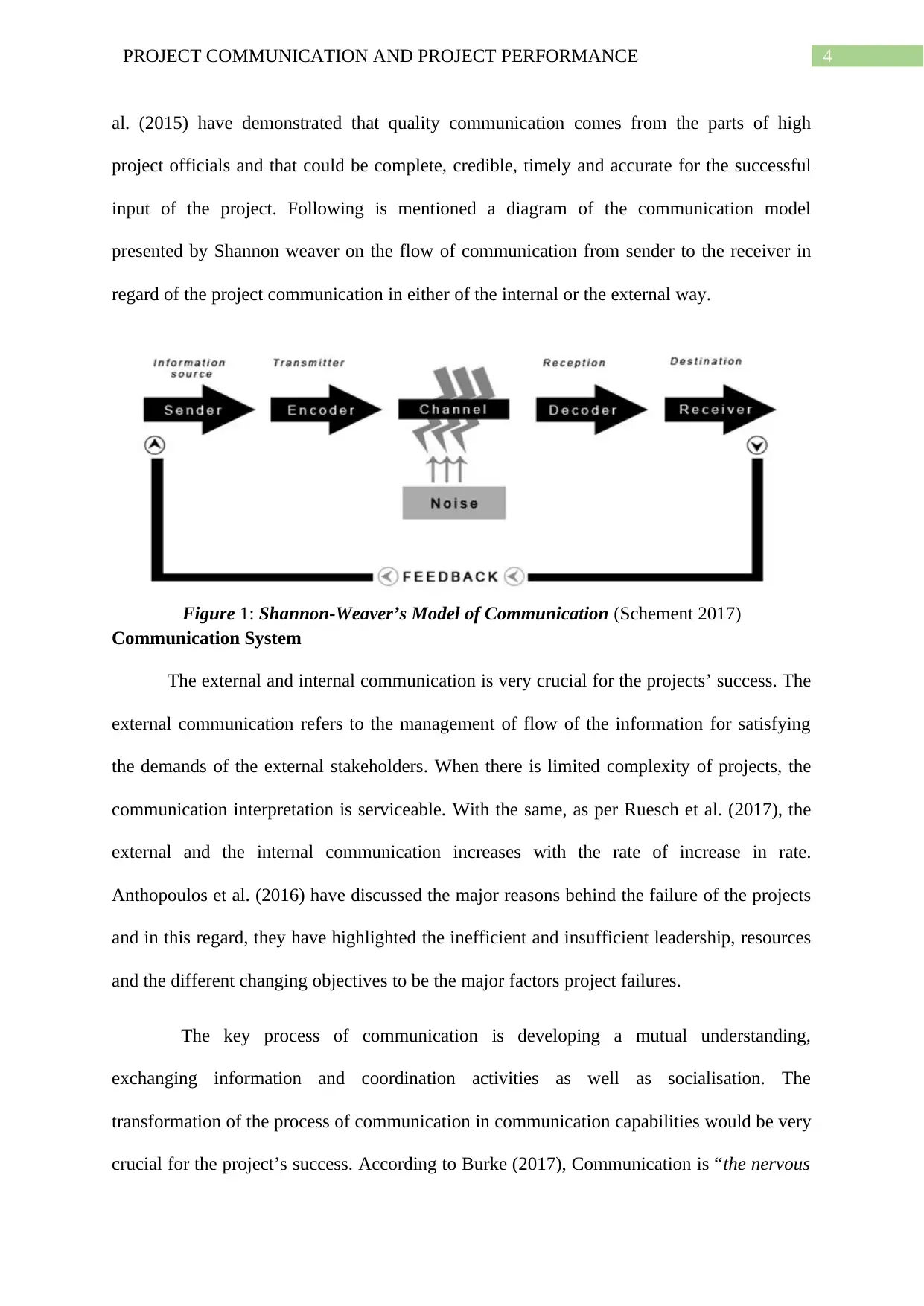
input of the project. Following is mentioned a diagram of the communication model
presented by Shannon weaver on the flow of communication from sender to the receiver in
regard of the project communication in either of the internal or the external way.
Figure 1: Shannon-Weaver’s Model of Communication (Schement 2017)
Communication System
The external and internal communication is very crucial for the projects’ success. The
external communication refers to the management of flow of the information for satisfying
the demands of the external stakeholders. When there is limited complexity of projects, the
communication interpretation is serviceable. With the same, as per Ruesch et al. (2017), the
external and the internal communication increases with the rate of increase in rate.
Anthopoulos et al. (2016) have discussed the major reasons behind the failure of the projects
and in this regard, they have highlighted the inefficient and insufficient leadership, resources
and the different changing objectives to be the major factors project failures.
The key process of communication is developing a mutual understanding,
exchanging information and coordination activities as well as socialisation. The
transformation of the process of communication in communication capabilities would be very
crucial for the project’s success. According to Burke (2017), Communication is “the nervous
al. (2015) have demonstrated that quality communication comes from the parts of high
project officials and that could be complete, credible, timely and accurate for the successful
input of the project. Following is mentioned a diagram of the communication model
presented by Shannon weaver on the flow of communication from sender to the receiver in
regard of the project communication in either of the internal or the external way.
Figure 1: Shannon-Weaver’s Model of Communication (Schement 2017)
Communication System
The external and internal communication is very crucial for the projects’ success. The
external communication refers to the management of flow of the information for satisfying
the demands of the external stakeholders. When there is limited complexity of projects, the
communication interpretation is serviceable. With the same, as per Ruesch et al. (2017), the
external and the internal communication increases with the rate of increase in rate.
Anthopoulos et al. (2016) have discussed the major reasons behind the failure of the projects
and in this regard, they have highlighted the inefficient and insufficient leadership, resources
and the different changing objectives to be the major factors project failures.
The key process of communication is developing a mutual understanding,
exchanging information and coordination activities as well as socialisation. The
transformation of the process of communication in communication capabilities would be very
crucial for the project’s success. According to Burke (2017), Communication is “the nervous
5PROJECT COMMUNICATION AND PROJECT PERFORMANCE
system of any organized groups that holds organization as a glue”; and communication
capabilities are “the system of communication that combines economic communication,
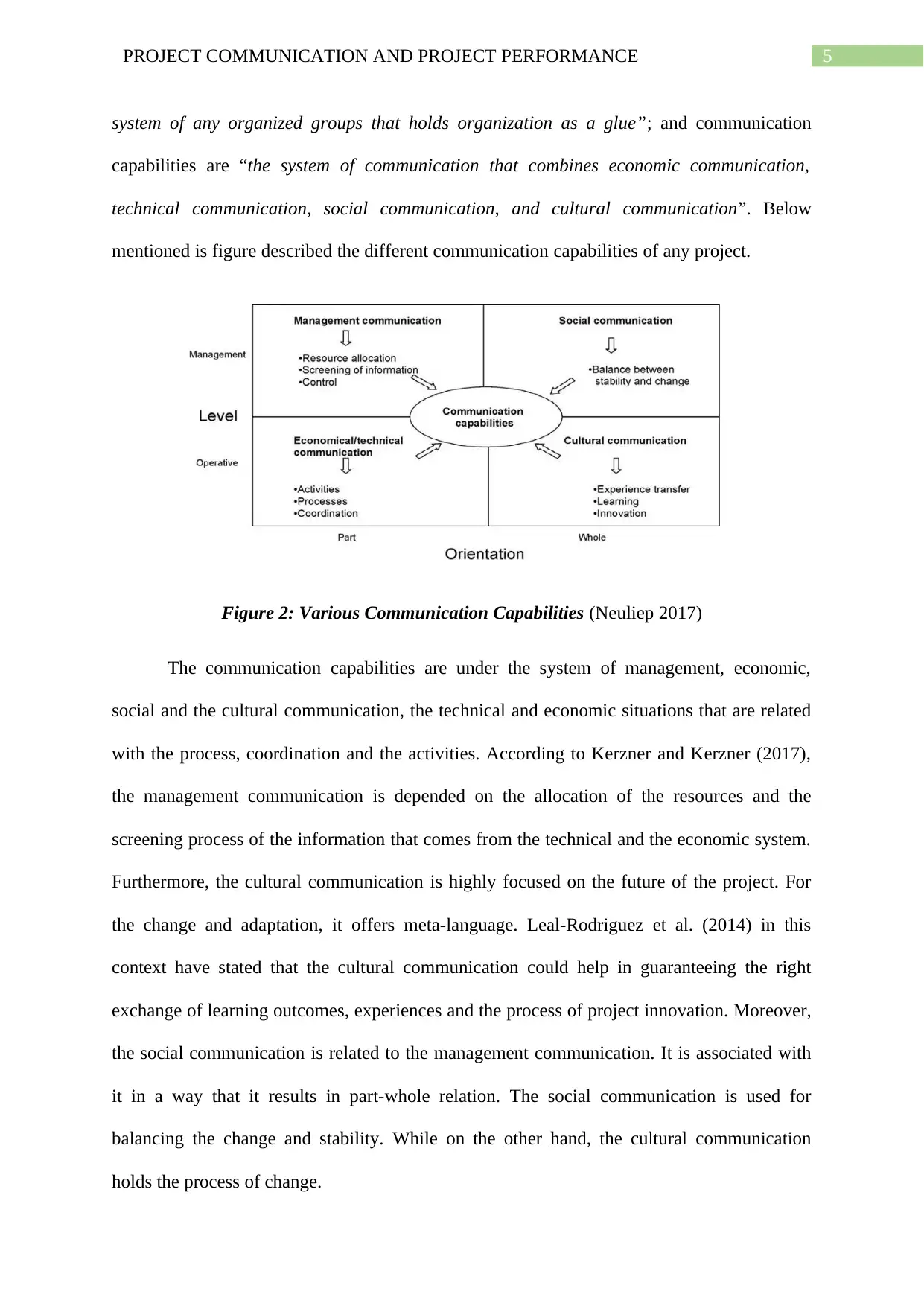
technical communication, social communication, and cultural communication”. Below
mentioned is figure described the different communication capabilities of any project.
Figure 2: Various Communication Capabilities (Neuliep 2017)
The communication capabilities are under the system of management, economic,
social and the cultural communication, the technical and economic situations that are related
with the process, coordination and the activities. According to Kerzner and Kerzner (2017),
the management communication is depended on the allocation of the resources and the
screening process of the information that comes from the technical and the economic system.
Furthermore, the cultural communication is highly focused on the future of the project. For
the change and adaptation, it offers meta-language. Leal-Rodriguez et al. (2014) in this
context have stated that the cultural communication could help in guaranteeing the right
exchange of learning outcomes, experiences and the process of project innovation. Moreover,
the social communication is related to the management communication. It is associated with
it in a way that it results in part-whole relation. The social communication is used for
balancing the change and stability. While on the other hand, the cultural communication
holds the process of change.
system of any organized groups that holds organization as a glue”; and communication
capabilities are “the system of communication that combines economic communication,
technical communication, social communication, and cultural communication”. Below
mentioned is figure described the different communication capabilities of any project.
Figure 2: Various Communication Capabilities (Neuliep 2017)
The communication capabilities are under the system of management, economic,
social and the cultural communication, the technical and economic situations that are related
with the process, coordination and the activities. According to Kerzner and Kerzner (2017),
the management communication is depended on the allocation of the resources and the
screening process of the information that comes from the technical and the economic system.
Furthermore, the cultural communication is highly focused on the future of the project. For
the change and adaptation, it offers meta-language. Leal-Rodriguez et al. (2014) in this
context have stated that the cultural communication could help in guaranteeing the right
exchange of learning outcomes, experiences and the process of project innovation. Moreover,
the social communication is related to the management communication. It is associated with
it in a way that it results in part-whole relation. The social communication is used for
balancing the change and stability. While on the other hand, the cultural communication
holds the process of change.
⊘ This is a preview!⊘
Do you want full access?
Subscribe today to unlock all pages.
Trusted by 1+ million students worldwide
6PROJECT COMMUNICATION AND PROJECT PERFORMANCE
Project Communication and Project Performance
There are several studies on this area that have revealed that project communication is
one of the important factors for the project performance. The affective and cognitive theory
of Rezvani et. al. (2016) have suggested that when a team member or a project manager who
have high need for self-esteem, along with some volunteers for working on a project and
communicates what their intentions are for associating within the project, they automatically
get attached with the project in order to ensure that it finally succeed. This is because they
derive a sense of satisfaction from the success of such a philanthropic engagements. This
suggests the fact that successful and effective project communication developed a sense of
attachment and responsibility in between the project tasks and the stakeholders who make a
person feel indebted to the project. Hence, this in turn creates an environment for the
individual team members for acting in absence of much coercion and control for the project.
Under these situations, it is to note that the emotional attachment that the person feels with
the very project drives him or her to work and this is fostered by means of communication.
With the same, Floricel, Michela and Piperca (2016), too have claimed that there is always a
positive relation in between the project communication and the ultimate project performance
and its outcome.
With the same, there is also a need for sufficient channels of communication that
enable effective communication regarding the project with the team members. It is one of the
extremely important element for the overall success of project communication. As per
Kerzner (2017), project communication not only refers to the mechanisms of feedback but is
also very necessary for the exchange of information with both of the clients and the rest of
the goals of the project the changing policies along with the procedures. Hence,
communication is not only important within the project team, but is also very important for
ensuring better understanding of the project in between the team and the rest other
Project Communication and Project Performance
There are several studies on this area that have revealed that project communication is
one of the important factors for the project performance. The affective and cognitive theory
of Rezvani et. al. (2016) have suggested that when a team member or a project manager who
have high need for self-esteem, along with some volunteers for working on a project and
communicates what their intentions are for associating within the project, they automatically
get attached with the project in order to ensure that it finally succeed. This is because they
derive a sense of satisfaction from the success of such a philanthropic engagements. This
suggests the fact that successful and effective project communication developed a sense of
attachment and responsibility in between the project tasks and the stakeholders who make a
person feel indebted to the project. Hence, this in turn creates an environment for the
individual team members for acting in absence of much coercion and control for the project.
Under these situations, it is to note that the emotional attachment that the person feels with
the very project drives him or her to work and this is fostered by means of communication.
With the same, Floricel, Michela and Piperca (2016), too have claimed that there is always a
positive relation in between the project communication and the ultimate project performance
and its outcome.
With the same, there is also a need for sufficient channels of communication that
enable effective communication regarding the project with the team members. It is one of the
extremely important element for the overall success of project communication. As per
Kerzner (2017), project communication not only refers to the mechanisms of feedback but is
also very necessary for the exchange of information with both of the clients and the rest of
the goals of the project the changing policies along with the procedures. Hence,
communication is not only important within the project team, but is also very important for
ensuring better understanding of the project in between the team and the rest other
Paraphrase This Document
Need a fresh take? Get an instant paraphrase of this document with our AI Paraphraser
7PROJECT COMMUNICATION AND PROJECT PERFORMANCE
departments of the organisations. Therefore, it is to state that there is a very productive and
positive relationship in between the project performance and project communication.
Land Acquisition Projects (LAP)
Land Acquisition Projects (LAP) are the projects that include the activity of
purchasing or donating any land for recreational areas, critical habitat areas, open space or
greenways. They are of two different types. They are community recreation and open space
or critical habitat (Lanz, Gerber and Haller 2018). The Community recreation project include
the acquisition of lands for serving the community, neighbourhood and the recreation needs.
These projects provide for accessing or enhancing the access of the common people to lakes,
rivers or streams. With the same, several properties might be acquired for both passive and
active recreation use for creating a new recreation areas and new parks as well as for
expanding any of the already existing recreational sites. On the other hand, the open space
type of LAP are the projects that protect the critical habitat or the open space for the
ecosystems and the important and endangered species. With the same, sometimes, they also
include the land, which have huge connectivity for the other protected lands with different
types of topography and many microclimates for supporting the biodiversity of the species.
Barriers to effective project communication in Project Success of LAP
According to Muszynska et al. (2015), there are several barriers that a project
manager or a leader of a project team of LAP could face while managing the project of Land
acquisition. They are dependent on the political, cultural and linguistic departments.
According to them, when there is involvement of several groups, such as in the projects
regarding Land Acquisition, there is high possibility of power games and some vested interest
to come into play. They come in the successful success of the project. These political barriers
usually takes place among the upper ranks of the organisational hierarchy. The project
managers should therefore make some special efforts for being aware of the important
departments of the organisations. Therefore, it is to state that there is a very productive and
positive relationship in between the project performance and project communication.
Land Acquisition Projects (LAP)
Land Acquisition Projects (LAP) are the projects that include the activity of
purchasing or donating any land for recreational areas, critical habitat areas, open space or
greenways. They are of two different types. They are community recreation and open space
or critical habitat (Lanz, Gerber and Haller 2018). The Community recreation project include
the acquisition of lands for serving the community, neighbourhood and the recreation needs.
These projects provide for accessing or enhancing the access of the common people to lakes,
rivers or streams. With the same, several properties might be acquired for both passive and
active recreation use for creating a new recreation areas and new parks as well as for
expanding any of the already existing recreational sites. On the other hand, the open space
type of LAP are the projects that protect the critical habitat or the open space for the
ecosystems and the important and endangered species. With the same, sometimes, they also
include the land, which have huge connectivity for the other protected lands with different
types of topography and many microclimates for supporting the biodiversity of the species.
Barriers to effective project communication in Project Success of LAP
According to Muszynska et al. (2015), there are several barriers that a project
manager or a leader of a project team of LAP could face while managing the project of Land
acquisition. They are dependent on the political, cultural and linguistic departments.
According to them, when there is involvement of several groups, such as in the projects
regarding Land Acquisition, there is high possibility of power games and some vested interest
to come into play. They come in the successful success of the project. These political barriers
usually takes place among the upper ranks of the organisational hierarchy. The project
managers should therefore make some special efforts for being aware of the important
8PROJECT COMMUNICATION AND PROJECT PERFORMANCE
political players in the project. They should be working hard for gaining their buy-ins and
confidence on the goals of the project. The next comes the barrier from the part of the
organisational culture. It is to state that the organisational culture is the totality of the values
and the assumptions that are held within any company. However, in this regard,
communication at the interface in between any two organisation with highly differing culture
could be very difficult. For instance, one might expect some differences in the opinions at the
LAP planning session that involve a very forward-looking, risk averse and conservative
customers. With the same, among the teams that are geographically distributed, the
differences in between the regional cultures comes into existence. Such things could manifest
themselves in vast range of ways like that of the differences in social attributes and language
fluency along with the change in the behaviours. Therefore, Heldman (2018) have suggested
that the project managers along with the team members should be aware of such existence of
any differences. They should also welcome and allow them in the communications of the
projects.
Moreover, the linguistic barrier to communication is also very important to take into
consideration and understood by the project managers and the other team members of the
project. When several specialists from different areas collaboratively discuss the matters in
relation to the very project, there is often a tendency of each of the side to make certain
assumptions. They often do that tactically on the basis of a common understanding of the
specialised field. It often results in incomplete as well as incorrect project communication.
Project Communication and Project Schedule, Project Cost and Project Quality
On any project, especially LAP (Land Acquisition Projects), there are different
project constraints that compete for the attention of the project team and project manager.
These constraints are some of the critical elements of project performance and its success.
These constraints are Project Schedule, Project Quality and Project Cost. Project Schedule is
political players in the project. They should be working hard for gaining their buy-ins and
confidence on the goals of the project. The next comes the barrier from the part of the
organisational culture. It is to state that the organisational culture is the totality of the values
and the assumptions that are held within any company. However, in this regard,
communication at the interface in between any two organisation with highly differing culture
could be very difficult. For instance, one might expect some differences in the opinions at the
LAP planning session that involve a very forward-looking, risk averse and conservative
customers. With the same, among the teams that are geographically distributed, the
differences in between the regional cultures comes into existence. Such things could manifest
themselves in vast range of ways like that of the differences in social attributes and language
fluency along with the change in the behaviours. Therefore, Heldman (2018) have suggested
that the project managers along with the team members should be aware of such existence of
any differences. They should also welcome and allow them in the communications of the
projects.
Moreover, the linguistic barrier to communication is also very important to take into
consideration and understood by the project managers and the other team members of the
project. When several specialists from different areas collaboratively discuss the matters in
relation to the very project, there is often a tendency of each of the side to make certain
assumptions. They often do that tactically on the basis of a common understanding of the
specialised field. It often results in incomplete as well as incorrect project communication.
Project Communication and Project Schedule, Project Cost and Project Quality
On any project, especially LAP (Land Acquisition Projects), there are different
project constraints that compete for the attention of the project team and project manager.
These constraints are some of the critical elements of project performance and its success.
These constraints are Project Schedule, Project Quality and Project Cost. Project Schedule is
⊘ This is a preview!⊘
Do you want full access?
Subscribe today to unlock all pages.
Trusted by 1+ million students worldwide
9PROJECT COMMUNICATION AND PROJECT PERFORMANCE
one of the focus area of project performance for any project team and manager. It can be
considered as one of the legs of the project constraint polygon. Without project scheduling,
the project team could never know the right progress of the project. It is to note that in any
project management, the project schedule is regarded as a document that is used for the
process of planning, executing, monitoring and communicating the delivery of the
stakeholders’ scope. Project schedule represents the plan of delivering the scope of the
project over time. It could referred to as a chart of the working elements that is associated
with the schedule date of when the elements and the milestones of the project is planned to
take place. With the same, for guiding the work, this schedule is taken into consideration for
ensuring successful communication with all the involved stakeholders of the project when
some work elements and the events of the project are supposed to be achieved. With the
same, according to Fleming and Koppelman (2016), project schedules are the tools that
related the different elements of a project with the resources that are required for
accomplishing the work. Effective Project communication in during the scheduling of the
project is very crucial for effective project management. Communication would led to right
exchange of right information in a way that it would socialise the project team members and
the other stakeholders involved in the project by coordination socialisation and mutual
understanding.
Moreover, project cost refers to the budget that is approved for the project and this
comprise of all the required expenses that are necessary for the delivery of the project.
According to Heldman (2018), Project cost is “a financial plan for all project expenditures
(cost). Success in project budget management depends on, amongst other things, the creation
of a comprehensive, consistent, and reliable project budget”. Within the Land Acquisition
Projects, the project managers need to maintain a balance in between not running out of the
money and not underspending as because of the fact that there are many projects that receive
one of the focus area of project performance for any project team and manager. It can be
considered as one of the legs of the project constraint polygon. Without project scheduling,
the project team could never know the right progress of the project. It is to note that in any
project management, the project schedule is regarded as a document that is used for the
process of planning, executing, monitoring and communicating the delivery of the
stakeholders’ scope. Project schedule represents the plan of delivering the scope of the
project over time. It could referred to as a chart of the working elements that is associated
with the schedule date of when the elements and the milestones of the project is planned to
take place. With the same, for guiding the work, this schedule is taken into consideration for
ensuring successful communication with all the involved stakeholders of the project when
some work elements and the events of the project are supposed to be achieved. With the
same, according to Fleming and Koppelman (2016), project schedules are the tools that
related the different elements of a project with the resources that are required for
accomplishing the work. Effective Project communication in during the scheduling of the
project is very crucial for effective project management. Communication would led to right
exchange of right information in a way that it would socialise the project team members and
the other stakeholders involved in the project by coordination socialisation and mutual
understanding.
Moreover, project cost refers to the budget that is approved for the project and this
comprise of all the required expenses that are necessary for the delivery of the project.
According to Heldman (2018), Project cost is “a financial plan for all project expenditures
(cost). Success in project budget management depends on, amongst other things, the creation
of a comprehensive, consistent, and reliable project budget”. Within the Land Acquisition
Projects, the project managers need to maintain a balance in between not running out of the
money and not underspending as because of the fact that there are many projects that receive
Paraphrase This Document
Need a fresh take? Get an instant paraphrase of this document with our AI Paraphraser
10PROJECT COMMUNICATION AND PROJECT PERFORMANCE
funds and grants that have contract clauses with an approach to the project funds. For
effective creation of budget plans, here too, project communication plays a significant role.
Without communication, budgets and costs are executed in poor manner and this in turn
could result in rush in the last minute for spending the allocated funds. With proper
communication a great range of details are provided to the project team and the managers and
other relevant stakeholders of the project. This level of detail and information ensure a
project manager to evaluate the project cost performance of the very project, right from the
top to the bottom.
The project quality management refers to the process of management of the project by
means of developing policy for supporting some quality management systems. As stated by
Mir and Pinnington (2014), Quality management of a project refers to a continuous process
of improving the activity based on the requirement of the project. It helps in meeting the
expectations of the stakeholders. Planning a project communication management involves the
activity of determining best approaches for communicating the actual needs of the
stakeholders. It is the project manager, who determines the most effective methods of
communication with the different stakeholders of the project.
Hence, it is to state that effective project communication is always the foundation of
Land Acquisition Projects. The Land Acquisition projects are the projects that involve the
activities of either purchasing or donating any land for recreational areas, critical habitat
areas, open space or greenways. These are one of the very complicated projects as they
involve many different stakeholders. Effective project communication is always the
foundation of successful projects and so is for the part of the LAP as well. Maintaining an
open, proper and regular channels for communication with every level of project teams and
stakeholders in very important for ensuring a smooth flow of the instructions. It is very
important for the part of the project manager to update the project Board about the status of
funds and grants that have contract clauses with an approach to the project funds. For
effective creation of budget plans, here too, project communication plays a significant role.
Without communication, budgets and costs are executed in poor manner and this in turn
could result in rush in the last minute for spending the allocated funds. With proper
communication a great range of details are provided to the project team and the managers and
other relevant stakeholders of the project. This level of detail and information ensure a
project manager to evaluate the project cost performance of the very project, right from the
top to the bottom.
The project quality management refers to the process of management of the project by
means of developing policy for supporting some quality management systems. As stated by
Mir and Pinnington (2014), Quality management of a project refers to a continuous process
of improving the activity based on the requirement of the project. It helps in meeting the
expectations of the stakeholders. Planning a project communication management involves the
activity of determining best approaches for communicating the actual needs of the
stakeholders. It is the project manager, who determines the most effective methods of
communication with the different stakeholders of the project.
Hence, it is to state that effective project communication is always the foundation of
Land Acquisition Projects. The Land Acquisition projects are the projects that involve the
activities of either purchasing or donating any land for recreational areas, critical habitat
areas, open space or greenways. These are one of the very complicated projects as they
involve many different stakeholders. Effective project communication is always the
foundation of successful projects and so is for the part of the LAP as well. Maintaining an
open, proper and regular channels for communication with every level of project teams and
stakeholders in very important for ensuring a smooth flow of the instructions. It is very
important for the part of the project manager to update the project Board about the status of
11PROJECT COMMUNICATION AND PROJECT PERFORMANCE
the project and its progress. These boards generally comprise of the representatives and the
executives from the supplier and the user. This helps in keeping a track of the changes and
identifying the risks in the successful completion of the project. Heldman (2018) has regarded
communication as the lifeblood of any project. Moreover, good project communication could
help in uniting the team members and the project stakeholders for a successful and effective
project objective, budget and planning of the project strategy. It also helps in enabling
everyone to get involved in the project for understanding their roles and this sometimes,
might make them more prone to support the very project. It is also to mention that successful
and effective project communication automatically develop a sense of attachment and
responsibility in between the project tasks and the stakeholders that make a person feel
indebted to the project. With the same, it also creates an environment for the individual team
members for acting in absence of much coercion and control for the project.
the project and its progress. These boards generally comprise of the representatives and the
executives from the supplier and the user. This helps in keeping a track of the changes and
identifying the risks in the successful completion of the project. Heldman (2018) has regarded
communication as the lifeblood of any project. Moreover, good project communication could
help in uniting the team members and the project stakeholders for a successful and effective
project objective, budget and planning of the project strategy. It also helps in enabling
everyone to get involved in the project for understanding their roles and this sometimes,
might make them more prone to support the very project. It is also to mention that successful
and effective project communication automatically develop a sense of attachment and
responsibility in between the project tasks and the stakeholders that make a person feel
indebted to the project. With the same, it also creates an environment for the individual team
members for acting in absence of much coercion and control for the project.
⊘ This is a preview!⊘
Do you want full access?
Subscribe today to unlock all pages.
Trusted by 1+ million students worldwide

1 out of 15


Related Documents


Your All-in-One AI-Powered Toolkit for Academic Success.
+13062052269
info@desklib.com
Available 24*7 on WhatsApp / Email
![[object Object]](/_next/static/media/star-bottom.7253800d.svg)
Unlock your academic potential
Copyright © 2020–2026 A2Z Services. All Rights Reserved. Developed and managed by ZUCOL.