Project Management Case Study: Choosing the Right Estimation Technique
VerifiedAdded on 2020/11/23
|14
|4635
|410
Case Study
AI Summary
This case study examines project management practices, focusing on the estimation techniques employed by a project manager named Barbara. The case revolves around a project won through competitive bidding, highlighting the importance of accurate time and cost estimations. The assignment delves into two primary estimation techniques: Three-point estimation, which considers optimistic, pessimistic, and most likely estimates, and Analogy estimation, which leverages historical data and past project experiences. The case illustrates how Barbara, faced with conflicting estimations and potential project delays, evaluates the suitability of each technique. Through a discussion with a team member, she realizes the limitations of Three-point estimation in accounting for project complexity, and the advantages of Analogy estimation in providing a more realistic timeline. The analysis emphasizes the role of a project manager in selecting the appropriate estimation technique based on project specifics, historical data, and the need to mitigate risks. It highlights the importance of considering project complexity and experience in making informed decisions about project timelines and resource allocation. The case concludes with Barbara's decision to adopt Analogy estimation, leading to a more accurate assessment of the project's duration.
Cases in project
management
management

Paraphrase This Document
Need a fresh take? Get an instant paraphrase of this document with our AI Paraphraser
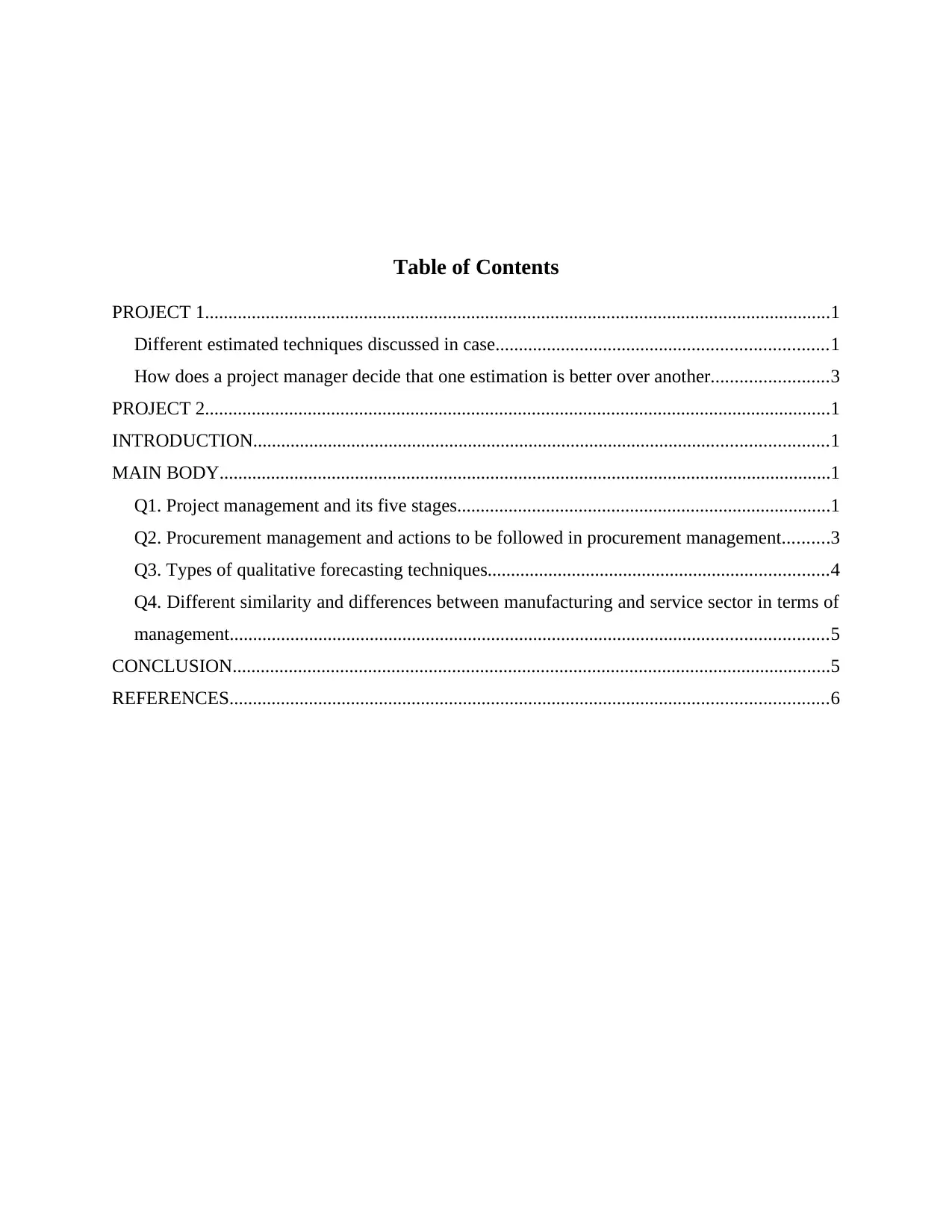
Table of Contents
PROJECT 1......................................................................................................................................1
Different estimated techniques discussed in case.......................................................................1
How does a project manager decide that one estimation is better over another.........................3
PROJECT 2......................................................................................................................................1
INTRODUCTION...........................................................................................................................1
MAIN BODY...................................................................................................................................1
Q1. Project management and its five stages................................................................................1
Q2. Procurement management and actions to be followed in procurement management..........3
Q3. Types of qualitative forecasting techniques.........................................................................4
Q4. Different similarity and differences between manufacturing and service sector in terms of
management................................................................................................................................5
CONCLUSION................................................................................................................................5
REFERENCES................................................................................................................................6
PROJECT 1......................................................................................................................................1
Different estimated techniques discussed in case.......................................................................1
How does a project manager decide that one estimation is better over another.........................3
PROJECT 2......................................................................................................................................1
INTRODUCTION...........................................................................................................................1
MAIN BODY...................................................................................................................................1
Q1. Project management and its five stages................................................................................1
Q2. Procurement management and actions to be followed in procurement management..........3
Q3. Types of qualitative forecasting techniques.........................................................................4
Q4. Different similarity and differences between manufacturing and service sector in terms of
management................................................................................................................................5
CONCLUSION................................................................................................................................5
REFERENCES................................................................................................................................6
PROJECT 1
Different estimated techniques discussed in case
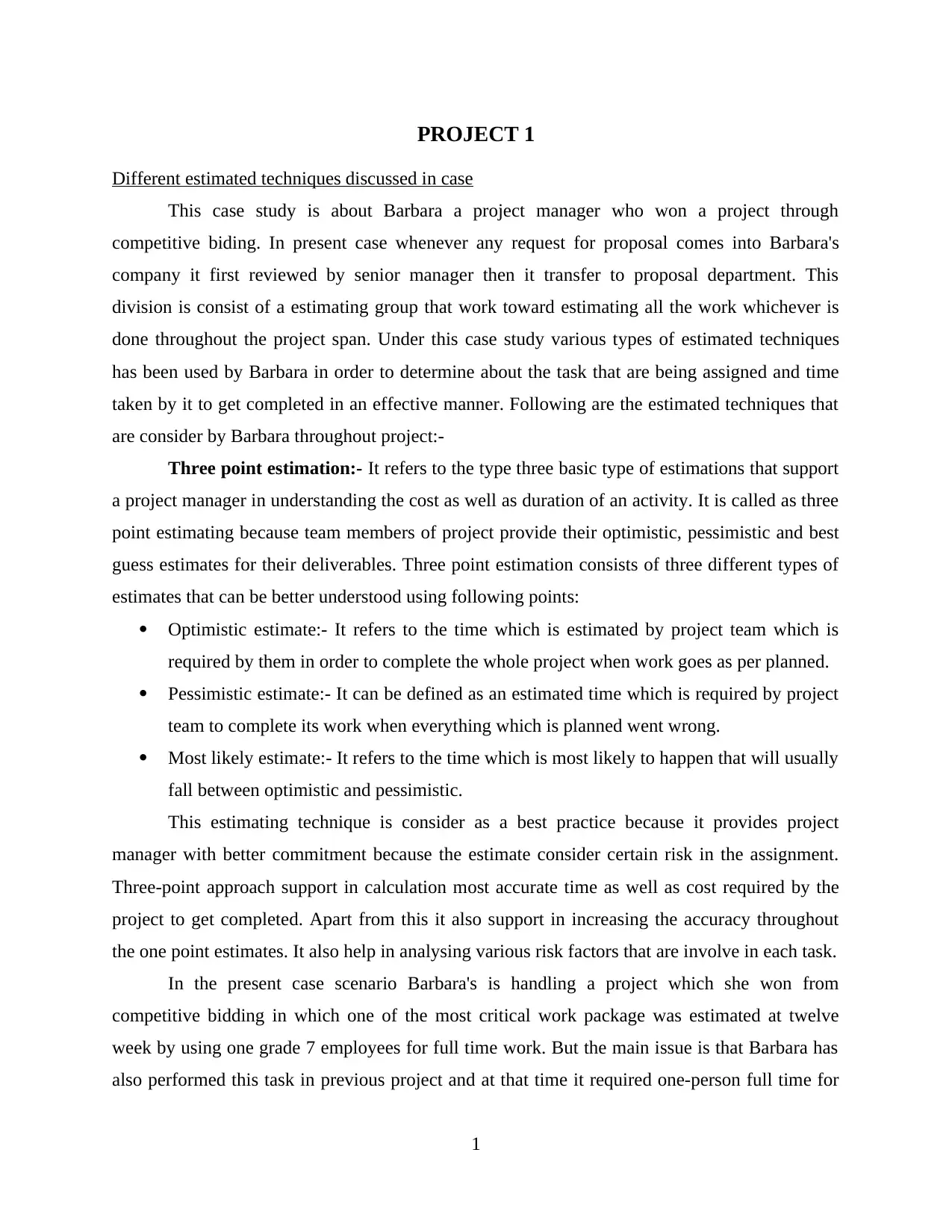
This case study is about Barbara a project manager who won a project through
competitive biding. In present case whenever any request for proposal comes into Barbara's
company it first reviewed by senior manager then it transfer to proposal department. This
division is consist of a estimating group that work toward estimating all the work whichever is
done throughout the project span. Under this case study various types of estimated techniques
has been used by Barbara in order to determine about the task that are being assigned and time
taken by it to get completed in an effective manner. Following are the estimated techniques that
are consider by Barbara throughout project:-
Three point estimation:- It refers to the type three basic type of estimations that support
a project manager in understanding the cost as well as duration of an activity. It is called as three
point estimating because team members of project provide their optimistic, pessimistic and best
guess estimates for their deliverables. Three point estimation consists of three different types of
estimates that can be better understood using following points:
Optimistic estimate:- It refers to the time which is estimated by project team which is
required by them in order to complete the whole project when work goes as per planned.
Pessimistic estimate:- It can be defined as an estimated time which is required by project
team to complete its work when everything which is planned went wrong.
Most likely estimate:- It refers to the time which is most likely to happen that will usually
fall between optimistic and pessimistic.
This estimating technique is consider as a best practice because it provides project
manager with better commitment because the estimate consider certain risk in the assignment.
Three-point approach support in calculation most accurate time as well as cost required by the
project to get completed. Apart from this it also support in increasing the accuracy throughout
the one point estimates. It also help in analysing various risk factors that are involve in each task.
In the present case scenario Barbara's is handling a project which she won from
competitive bidding in which one of the most critical work package was estimated at twelve
week by using one grade 7 employees for full time work. But the main issue is that Barbara has
also performed this task in previous project and at that time it required one-person full time for
1
Different estimated techniques discussed in case
This case study is about Barbara a project manager who won a project through
competitive biding. In present case whenever any request for proposal comes into Barbara's
company it first reviewed by senior manager then it transfer to proposal department. This
division is consist of a estimating group that work toward estimating all the work whichever is
done throughout the project span. Under this case study various types of estimated techniques
has been used by Barbara in order to determine about the task that are being assigned and time
taken by it to get completed in an effective manner. Following are the estimated techniques that
are consider by Barbara throughout project:-
Three point estimation:- It refers to the type three basic type of estimations that support
a project manager in understanding the cost as well as duration of an activity. It is called as three
point estimating because team members of project provide their optimistic, pessimistic and best
guess estimates for their deliverables. Three point estimation consists of three different types of
estimates that can be better understood using following points:
Optimistic estimate:- It refers to the time which is estimated by project team which is
required by them in order to complete the whole project when work goes as per planned.
Pessimistic estimate:- It can be defined as an estimated time which is required by project
team to complete its work when everything which is planned went wrong.
Most likely estimate:- It refers to the time which is most likely to happen that will usually
fall between optimistic and pessimistic.
This estimating technique is consider as a best practice because it provides project
manager with better commitment because the estimate consider certain risk in the assignment.
Three-point approach support in calculation most accurate time as well as cost required by the
project to get completed. Apart from this it also support in increasing the accuracy throughout
the one point estimates. It also help in analysing various risk factors that are involve in each task.
In the present case scenario Barbara's is handling a project which she won from
competitive bidding in which one of the most critical work package was estimated at twelve
week by using one grade 7 employees for full time work. But the main issue is that Barbara has
also performed this task in previous project and at that time it required one-person full time for
1
⊘ This is a preview!⊘
Do you want full access?
Subscribe today to unlock all pages.

Trusted by 1+ million students worldwide
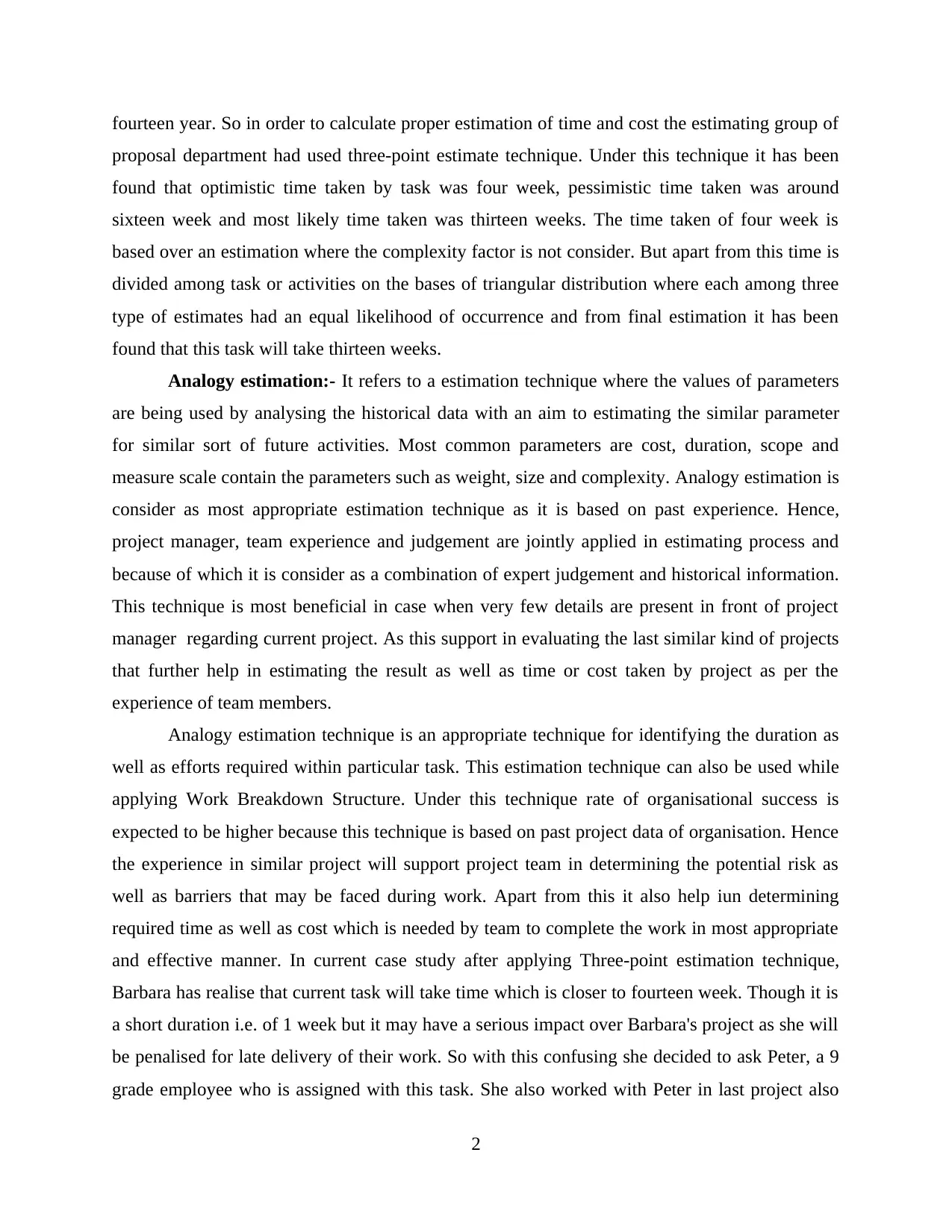
fourteen year. So in order to calculate proper estimation of time and cost the estimating group of
proposal department had used three-point estimate technique. Under this technique it has been
found that optimistic time taken by task was four week, pessimistic time taken was around
sixteen week and most likely time taken was thirteen weeks. The time taken of four week is
based over an estimation where the complexity factor is not consider. But apart from this time is
divided among task or activities on the bases of triangular distribution where each among three
type of estimates had an equal likelihood of occurrence and from final estimation it has been
found that this task will take thirteen weeks.
Analogy estimation:- It refers to a estimation technique where the values of parameters
are being used by analysing the historical data with an aim to estimating the similar parameter
for similar sort of future activities. Most common parameters are cost, duration, scope and
measure scale contain the parameters such as weight, size and complexity. Analogy estimation is
consider as most appropriate estimation technique as it is based on past experience. Hence,
project manager, team experience and judgement are jointly applied in estimating process and
because of which it is consider as a combination of expert judgement and historical information.
This technique is most beneficial in case when very few details are present in front of project
manager regarding current project. As this support in evaluating the last similar kind of projects
that further help in estimating the result as well as time or cost taken by project as per the
experience of team members.
Analogy estimation technique is an appropriate technique for identifying the duration as
well as efforts required within particular task. This estimation technique can also be used while
applying Work Breakdown Structure. Under this technique rate of organisational success is
expected to be higher because this technique is based on past project data of organisation. Hence
the experience in similar project will support project team in determining the potential risk as
well as barriers that may be faced during work. Apart from this it also help iun determining
required time as well as cost which is needed by team to complete the work in most appropriate
and effective manner. In current case study after applying Three-point estimation technique,
Barbara has realise that current task will take time which is closer to fourteen week. Though it is
a short duration i.e. of 1 week but it may have a serious impact over Barbara's project as she will
be penalised for late delivery of their work. So with this confusing she decided to ask Peter, a 9
grade employee who is assigned with this task. She also worked with Peter in last project also
2
proposal department had used three-point estimate technique. Under this technique it has been
found that optimistic time taken by task was four week, pessimistic time taken was around
sixteen week and most likely time taken was thirteen weeks. The time taken of four week is
based over an estimation where the complexity factor is not consider. But apart from this time is
divided among task or activities on the bases of triangular distribution where each among three
type of estimates had an equal likelihood of occurrence and from final estimation it has been
found that this task will take thirteen weeks.
Analogy estimation:- It refers to a estimation technique where the values of parameters
are being used by analysing the historical data with an aim to estimating the similar parameter
for similar sort of future activities. Most common parameters are cost, duration, scope and
measure scale contain the parameters such as weight, size and complexity. Analogy estimation is
consider as most appropriate estimation technique as it is based on past experience. Hence,
project manager, team experience and judgement are jointly applied in estimating process and
because of which it is consider as a combination of expert judgement and historical information.
This technique is most beneficial in case when very few details are present in front of project
manager regarding current project. As this support in evaluating the last similar kind of projects
that further help in estimating the result as well as time or cost taken by project as per the
experience of team members.
Analogy estimation technique is an appropriate technique for identifying the duration as
well as efforts required within particular task. This estimation technique can also be used while
applying Work Breakdown Structure. Under this technique rate of organisational success is
expected to be higher because this technique is based on past project data of organisation. Hence
the experience in similar project will support project team in determining the potential risk as
well as barriers that may be faced during work. Apart from this it also help iun determining
required time as well as cost which is needed by team to complete the work in most appropriate
and effective manner. In current case study after applying Three-point estimation technique,
Barbara has realise that current task will take time which is closer to fourteen week. Though it is
a short duration i.e. of 1 week but it may have a serious impact over Barbara's project as she will
be penalised for late delivery of their work. So with this confusing she decided to ask Peter, a 9
grade employee who is assigned with this task. She also worked with Peter in last project also
2
Paraphrase This Document
Need a fresh take? Get an instant paraphrase of this document with our AI Paraphraser
and from this discussion Barbara came to know that Three-point estimation technique is being
applied without considering the complexity of project. But Analogy estimation technique
consider the complexity of project and judge the time taken by project on the bases of historical
data as well as past experience of project team. By estimating project through Analogy
estimation technique it has been determined that I would take sixteen to seventeen week which is
very much closer to reality and it is impossible to complete this task in twelve week. Apart from
this, adding more people to this project will not support in shortening the schedule of project but
it may further worsen the situation.
How does a project manager decide that one estimation is better over another
In current case study, Barbara is a project manager who get a project through competitive
bidding. So, whenever any project won by the company in which Barbara work is first send to a
committee consists of senior managers who review the request for proposal and once it get
accepted by them it is then transfer to Proposal department which handle all the estimation
related work. In current project there are two types of estimation techniques are discussed that
are Three-point estimation and Analogy estimation.
Three-point estimation is a technique which focuses over optimistic as well as pessimistic
estimation in order to determine the ideal estimate value of particular task within a project. This
estimation technique focuses toward determining the cost as well as time taken by particular task
with in the project so that it can be completed quickly and in most effective manner. Apart from
this it also help in analysing about various risk that may be faced by team member while
conducting the project. This information can be used to identify the addition cost which is
required to complete the task effectively. On the other hand, Analogy estimation is a technique
which generally uses parametric value collected from historical data in order to estimate the
similar parameters for future activity. This technique is generally consider as the combination of
expertise judgement as well as historical information.
Analogy estimation technique is also consider the complexity involve in project and then
perform estimation to find out the duration of project completion along with efforts that are
required to be made for particular task. But Three-point estimation focuses more over completing
the task over project deadline and avoid considering complexity involve in project. In addition to
this analogy technique uses a little information about current project and consider the details as
well as experience of past project of similar kind. Apart from this Three-point estimation require
3
applied without considering the complexity of project. But Analogy estimation technique
consider the complexity of project and judge the time taken by project on the bases of historical
data as well as past experience of project team. By estimating project through Analogy
estimation technique it has been determined that I would take sixteen to seventeen week which is
very much closer to reality and it is impossible to complete this task in twelve week. Apart from
this, adding more people to this project will not support in shortening the schedule of project but
it may further worsen the situation.
How does a project manager decide that one estimation is better over another
In current case study, Barbara is a project manager who get a project through competitive
bidding. So, whenever any project won by the company in which Barbara work is first send to a
committee consists of senior managers who review the request for proposal and once it get
accepted by them it is then transfer to Proposal department which handle all the estimation
related work. In current project there are two types of estimation techniques are discussed that
are Three-point estimation and Analogy estimation.
Three-point estimation is a technique which focuses over optimistic as well as pessimistic
estimation in order to determine the ideal estimate value of particular task within a project. This
estimation technique focuses toward determining the cost as well as time taken by particular task
with in the project so that it can be completed quickly and in most effective manner. Apart from
this it also help in analysing about various risk that may be faced by team member while
conducting the project. This information can be used to identify the addition cost which is
required to complete the task effectively. On the other hand, Analogy estimation is a technique
which generally uses parametric value collected from historical data in order to estimate the
similar parameters for future activity. This technique is generally consider as the combination of
expertise judgement as well as historical information.
Analogy estimation technique is also consider the complexity involve in project and then
perform estimation to find out the duration of project completion along with efforts that are
required to be made for particular task. But Three-point estimation focuses more over completing
the task over project deadline and avoid considering complexity involve in project. In addition to
this analogy technique uses a little information about current project and consider the details as
well as experience of past project of similar kind. Apart from this Three-point estimation require
3
a detail information regarding the current project in order to perform accurate estimation about
project.
In presented case study of Barbara, it has been given that the project which she won
contain an important task and time as well as cost is estimated by team that it will take 12 week
when work is done by the 7 employees of one grade. This estimation is done with the help of
Three-point estimation in which optimistic time is 4 week, pessimistic time was 16 week and
most likely time is around 13 week. But Barbara is confused with this estimation because she
already had done similar type of task in previous project. She believe that this estimation is way
off the mark as only very small project could be able to completed in four weeks. Hence, the
estimation team doesn't consider any complexity factor while determining the cost as well as
duration of project. Barbara from her past experience has doubt that it will take time which is
closer to 14 week and this difference may have an huge impact over project and may also lead to
penalisation when client get late delivery. So, for this she discussed the whole scenario with an
employee Peter who is also involved in the project and was with Barbara in her last project.
According to him, analogy estimation technique would be more better for the project if
complexity factors are required to be consider. Using analogy technique and by comparing
complexity it has been estimated that the current project will require 16-17 week to get
completed effectively.
So, Barbara can determine better technique one over another by comparing the result
which both the techniques will provide as well as criteria that are considered while estimating the
cost and duration. The estimation is done on the basis of both the techniques but three-point
technique is not considering complexity factor which is most essential part of the project which
may affect the quality of undertaking. On the other hand Analogy technique is considering all the
complexity factors that may arises while working over project and if ignored then it may lead to
delay in project deadline which result in penalisation. Therefore by comparing both the
techniques it has been determined by Barbara that Analogy technique is much better then three-
point estimation technique. This has been determined by Barbara after having a discussion with
Peter and evaluating the project on the bases of past experience she have in regard with similar
project. From the conversation she get to know that it is not possible to complete that task within
the project in 12 week as this may affect the quality of work as well as result of task done. In
addition to this it is also not possible to complete the task in estimated time of 12 week even after
4
project.
In presented case study of Barbara, it has been given that the project which she won
contain an important task and time as well as cost is estimated by team that it will take 12 week
when work is done by the 7 employees of one grade. This estimation is done with the help of
Three-point estimation in which optimistic time is 4 week, pessimistic time was 16 week and
most likely time is around 13 week. But Barbara is confused with this estimation because she
already had done similar type of task in previous project. She believe that this estimation is way
off the mark as only very small project could be able to completed in four weeks. Hence, the
estimation team doesn't consider any complexity factor while determining the cost as well as
duration of project. Barbara from her past experience has doubt that it will take time which is
closer to 14 week and this difference may have an huge impact over project and may also lead to
penalisation when client get late delivery. So, for this she discussed the whole scenario with an
employee Peter who is also involved in the project and was with Barbara in her last project.
According to him, analogy estimation technique would be more better for the project if
complexity factors are required to be consider. Using analogy technique and by comparing
complexity it has been estimated that the current project will require 16-17 week to get
completed effectively.
So, Barbara can determine better technique one over another by comparing the result
which both the techniques will provide as well as criteria that are considered while estimating the
cost and duration. The estimation is done on the basis of both the techniques but three-point
technique is not considering complexity factor which is most essential part of the project which
may affect the quality of undertaking. On the other hand Analogy technique is considering all the
complexity factors that may arises while working over project and if ignored then it may lead to
delay in project deadline which result in penalisation. Therefore by comparing both the
techniques it has been determined by Barbara that Analogy technique is much better then three-
point estimation technique. This has been determined by Barbara after having a discussion with
Peter and evaluating the project on the bases of past experience she have in regard with similar
project. From the conversation she get to know that it is not possible to complete that task within
the project in 12 week as this may affect the quality of work as well as result of task done. In
addition to this it is also not possible to complete the task in estimated time of 12 week even after
4
⊘ This is a preview!⊘
Do you want full access?
Subscribe today to unlock all pages.
Trusted by 1+ million students worldwide
increasing the number of people within team as it will not be able to minimise the schedule. But
it may even worsen the situation and project will not be able to deliver the desired result. In
addition to this, Analogy technique is based on past experience which support project manager in
determining the potential risk that may be faced by its team while conducting the project. Apart
from this it also help in identifying different way through which these errors can be rectified or
minimised from their work so that project can be completed in effective manner.
In addition to this client demand regarding the project also affect the selection of
estimation techniques. In case when customer want its project to done quickly and delivery over
the deadline given by them then Three-point estimation technique is more suitable as it consider
all the three estimates as an equal likelihood of occurrence. This technique help in completing
the task in required time but cost is higher as some time project manager has to involve more
resources to complete that project quickly. But despite of this when customer demanded for the
quality work in project and doesn't require it to be done in less time then Barbara must consider
Analogy technique as it estimate the duration or cost on the bases of past experience of team
member in similar project and historical data.
5
it may even worsen the situation and project will not be able to deliver the desired result. In
addition to this, Analogy technique is based on past experience which support project manager in
determining the potential risk that may be faced by its team while conducting the project. Apart
from this it also help in identifying different way through which these errors can be rectified or
minimised from their work so that project can be completed in effective manner.
In addition to this client demand regarding the project also affect the selection of
estimation techniques. In case when customer want its project to done quickly and delivery over
the deadline given by them then Three-point estimation technique is more suitable as it consider
all the three estimates as an equal likelihood of occurrence. This technique help in completing
the task in required time but cost is higher as some time project manager has to involve more
resources to complete that project quickly. But despite of this when customer demanded for the
quality work in project and doesn't require it to be done in less time then Barbara must consider
Analogy technique as it estimate the duration or cost on the bases of past experience of team
member in similar project and historical data.
5
Paraphrase This Document
Need a fresh take? Get an instant paraphrase of this document with our AI Paraphraser
PROJECT 2
INTRODUCTION
Project management refers to process in which proper planning, execution of project
activities are done. This also helps in controlling project activities which is relevant for achieving
aims and objectives. There are different activities which are related to project such as planning of
operations, making availability of resources, etc. Hence it is responsibility of project manager to
make changes which are relevant for completion of project within specified time (Bryde,
Broquetas and Volm, 2013). In project management plan, there are some techniques such as
defining the reason behind such activities, management of risk, implementation of management
techniques, etc. are considered under this project management plan. In this report, there is
discussion about project management case of Barbara's case and in this case there is discussion
about different techniques such as Three Point Estimation and Analogy Estimation. In this
report, there is discussion about stages of project management, procurement management and
steps taken for procurement management, techniques for forecasting different circumstances and
at last it focuses on similarity and differences in manufacturing and service sector.
MAIN BODY
Q1. Project management and its five stages
Project management refers to process under which different aspects has to be covered for
completion of project in effective manner. With the help of project management, there is proper
knowledge about actions which has to be taken for undergoing and completion of project. Project
manager has knowledge about change in techniques which is important and relevant for
completion of project. There are many activities such as introduction, planning for activities, etc.
which are performed by number of individuals.
There is use of different techniques such as PERT, Analogy Estimation, etc. In project
management, there is proper planning which provides information about pursuing actions which
assist in completion of research within specified time (Harrison and Lock, 2017). Project
management covers some major areas i.e. cost, time, scope, quality, communication, human
resource, risk management, etc. With taking care of this concept, it is easy to make changes
which is relevant and significant for dealing with external environment changes.
INTRODUCTION
Project management refers to process in which proper planning, execution of project
activities are done. This also helps in controlling project activities which is relevant for achieving
aims and objectives. There are different activities which are related to project such as planning of
operations, making availability of resources, etc. Hence it is responsibility of project manager to
make changes which are relevant for completion of project within specified time (Bryde,
Broquetas and Volm, 2013). In project management plan, there are some techniques such as
defining the reason behind such activities, management of risk, implementation of management
techniques, etc. are considered under this project management plan. In this report, there is
discussion about project management case of Barbara's case and in this case there is discussion
about different techniques such as Three Point Estimation and Analogy Estimation. In this
report, there is discussion about stages of project management, procurement management and
steps taken for procurement management, techniques for forecasting different circumstances and
at last it focuses on similarity and differences in manufacturing and service sector.
MAIN BODY
Q1. Project management and its five stages
Project management refers to process under which different aspects has to be covered for
completion of project in effective manner. With the help of project management, there is proper
knowledge about actions which has to be taken for undergoing and completion of project. Project
manager has knowledge about change in techniques which is important and relevant for
completion of project. There are many activities such as introduction, planning for activities, etc.
which are performed by number of individuals.
There is use of different techniques such as PERT, Analogy Estimation, etc. In project
management, there is proper planning which provides information about pursuing actions which
assist in completion of research within specified time (Harrison and Lock, 2017). Project
management covers some major areas i.e. cost, time, scope, quality, communication, human
resource, risk management, etc. With taking care of this concept, it is easy to make changes
which is relevant and significant for dealing with external environment changes.
Project management can be understood with the help of five stages. They are discussed as
under-
Project initiation Phase- This is the first stage under which helps to start first project. In
this stage, it is responsibility of stakeholders and decide changes which are relevant for
performing operations in effective manner. There is requirement of planning related to pursuing
actions for completion of project. Hence this is done in this stage, so actions are performed in
order to complete project actions in specified manner.
Project Planning Phase- After initiation, planning occurs. There are many activities
which helps to complete project. Hence this can be done with the help of techniques such as
PERT, Analogy Estimation, Three point estimation, etc. This can be done with the help of Gantt
Chart, planning for resources, dates, Work Break down structure, etc. which gives a particular
way to complete project. Thee is risk in completion of project, hence it is responsibility of
project manager to analyse risk and perform appropriate actions which is significant for attaining
project goals and objectives (Hill, 2013).
Project Execution phase- After planning, execution stage occurs. In this stage, there is
pursuing actions for attaining goals and objectives. In this stage, manager has to properly analyse
the changes which are taking place in external environment. This is relevant and significant for
achieving aims and objectives of project and complete it within specified time according to set
benchmarks. This is the stage which makes project failure or success hence this must be done in
most appropriate and relevant manner.
Project Monitoring and Control Phase- This is the stage under which actions are taken
to deal with changes according to external environment. There are many changes which are
taking place in external environment, so it is responsibility of project manager to monitor and
control use of resources. With monitoring and controlling, it is easy to perform operations which
is relevant and significant for analysing changes and implement it in better and effective manner.
Project Closure Phase- At last, this is the stage in which closure of project is done. With
proper planning and monitoring, it is easy to close project which is relevant and significant to
analyse changes. This is the stage which shows that project is completed and targets are achieved
(Kerzner and Kerzner, 2017).
2
under-
Project initiation Phase- This is the first stage under which helps to start first project. In
this stage, it is responsibility of stakeholders and decide changes which are relevant for
performing operations in effective manner. There is requirement of planning related to pursuing
actions for completion of project. Hence this is done in this stage, so actions are performed in
order to complete project actions in specified manner.
Project Planning Phase- After initiation, planning occurs. There are many activities
which helps to complete project. Hence this can be done with the help of techniques such as
PERT, Analogy Estimation, Three point estimation, etc. This can be done with the help of Gantt
Chart, planning for resources, dates, Work Break down structure, etc. which gives a particular
way to complete project. Thee is risk in completion of project, hence it is responsibility of
project manager to analyse risk and perform appropriate actions which is significant for attaining
project goals and objectives (Hill, 2013).
Project Execution phase- After planning, execution stage occurs. In this stage, there is
pursuing actions for attaining goals and objectives. In this stage, manager has to properly analyse
the changes which are taking place in external environment. This is relevant and significant for
achieving aims and objectives of project and complete it within specified time according to set
benchmarks. This is the stage which makes project failure or success hence this must be done in
most appropriate and relevant manner.
Project Monitoring and Control Phase- This is the stage under which actions are taken
to deal with changes according to external environment. There are many changes which are
taking place in external environment, so it is responsibility of project manager to monitor and
control use of resources. With monitoring and controlling, it is easy to perform operations which
is relevant and significant for analysing changes and implement it in better and effective manner.
Project Closure Phase- At last, this is the stage in which closure of project is done. With
proper planning and monitoring, it is easy to close project which is relevant and significant to
analyse changes. This is the stage which shows that project is completed and targets are achieved
(Kerzner and Kerzner, 2017).
2
⊘ This is a preview!⊘
Do you want full access?
Subscribe today to unlock all pages.
Trusted by 1+ million students worldwide
Q2. Procurement management and actions to be followed in procurement management
Meaning of procurement management- It refers to a process which is relevant and
significant to collecting material from one place to another and this is relevant for achieving
project aims and objectives. Project requires different material which helps to collect material
from different sources and then manage them to collect it at some specific place for completion
of specific time. This is the process which assist in completing projects with some specific time
and required in order attain targets. Procurement management is done by different organisation
which is significant for managing business operations in order to complete task within specified
time. This also helps in performing operations such as purchase, stock management, sales
according to requirement and take actions which is selected and required for attaining targets of
project. As per case study of Barbara's, it is easy to perform operations and complete project
within specified time, so there are less possibilities of getting fired due to imperfection in
attaining objectives (Lechler, Edington and Gao, 2012).
Actions to be followed in procurement management
Procurement management of business operations can be done with some specific actions
which are discussed as under-
Specification- This is the first step in procurement management. In this step, there is
communication among purchase department and project manger. This helps to maintain proper
balance at stock and hence carrying and storage cost is maintained. This step helps to maintain
proper relations with external parties of association.
Selection- There are many suppliers which helps to get raw material. Hence it is
responsibility of project manager to select best vendor from market which supplies material as
per requirement and of specified quality. Under this step, there are some measures which are
considered such as cost, set benchmarks, delivery, quality of product, etc.
Contracting- In this stage, there is contract among project manager and external parties.
Hence there is legal documentation which provides knowledge about deliver date, ordering date,
etc. There re some specific terms and conditions which are associated with goods and legal abide
by both the parties of contract. Terms and conditions of project are considered by both the parties
and in case of any issue, this contract is used as legal document (Martens and Carvalho, 2016).
Control- In order to make procurement successful, there is requirement of controlling
purchase and payment activities. There are regular meetings which assist in knowing views of
3
Meaning of procurement management- It refers to a process which is relevant and
significant to collecting material from one place to another and this is relevant for achieving
project aims and objectives. Project requires different material which helps to collect material
from different sources and then manage them to collect it at some specific place for completion
of specific time. This is the process which assist in completing projects with some specific time
and required in order attain targets. Procurement management is done by different organisation
which is significant for managing business operations in order to complete task within specified
time. This also helps in performing operations such as purchase, stock management, sales
according to requirement and take actions which is selected and required for attaining targets of
project. As per case study of Barbara's, it is easy to perform operations and complete project
within specified time, so there are less possibilities of getting fired due to imperfection in
attaining objectives (Lechler, Edington and Gao, 2012).
Actions to be followed in procurement management
Procurement management of business operations can be done with some specific actions
which are discussed as under-
Specification- This is the first step in procurement management. In this step, there is
communication among purchase department and project manger. This helps to maintain proper
balance at stock and hence carrying and storage cost is maintained. This step helps to maintain
proper relations with external parties of association.
Selection- There are many suppliers which helps to get raw material. Hence it is
responsibility of project manager to select best vendor from market which supplies material as
per requirement and of specified quality. Under this step, there are some measures which are
considered such as cost, set benchmarks, delivery, quality of product, etc.
Contracting- In this stage, there is contract among project manager and external parties.
Hence there is legal documentation which provides knowledge about deliver date, ordering date,
etc. There re some specific terms and conditions which are associated with goods and legal abide
by both the parties of contract. Terms and conditions of project are considered by both the parties
and in case of any issue, this contract is used as legal document (Martens and Carvalho, 2016).
Control- In order to make procurement successful, there is requirement of controlling
purchase and payment activities. There are regular meetings which assist in knowing views of
3
Paraphrase This Document
Need a fresh take? Get an instant paraphrase of this document with our AI Paraphraser
external parties of company. This assist in making changes in performing actions which is
relevant maintaining cost and approved with prior decision of both the parties. Controlling helps
to make changes which makes actions in successful implementation of project operations.
Measurement- At last, there is measurement which is done for getting positive impact on
achieving aims and objectives of projects. Measurement helps in attaining project and client's
satisfaction can be achieved. Meetings, seminars are organised under which there is approval of
KPI which is significant for making changes according to satisfaction and attaining objectives of
projects.
Q3. Types of qualitative forecasting techniques
In organisation, there are many situations which become positive and negative for
performing operations. It is responsibility of manager to implement and apply changes which is
relevant and significant for getting better outcomes from project. Qualitative methods is based on
opinion and judgements which helps to give appropriate recommendations on this basis.
Qualitative techniques has four different methods which are discussed as under-
Executive opinions- There are some key personnel who have idea regarding working
style, resource required, etc. related to project. Hence in order to collect data their opinion
matters and this provides information about rends which is happening and information provided
under this method is based on experience of executives (Mkrttchian and Stephanova, 2013).
Delphi technique- As per this method, there is panel of expert's under which information
is provided related to project as per their perception. There is no close decision about these
members, so possibilities of getting majority decision is less and individual ideas can be judged.
Consumer surveys- Consumer survey is the best techniques because in this method, there
is information which is relevant for performing operations according to consumer demands.
Hence information is collected with the help of ultimate stakeholders. Data which is collected
with consumers are used to accomplish project.
In order to identification best technique according to circumstances, it is responsibility of
managers of organisation. There are various situations which arise in organisation and affects
business operations. Hence managers of organisation analyse influence of different factors such
relevance of matter, price related to project, time period, occurrence of project, etc. which affects
decisions of managers (Pemsel and Wiewiora, 2013). Above mentioned techniques are relevant
4
relevant maintaining cost and approved with prior decision of both the parties. Controlling helps
to make changes which makes actions in successful implementation of project operations.
Measurement- At last, there is measurement which is done for getting positive impact on
achieving aims and objectives of projects. Measurement helps in attaining project and client's
satisfaction can be achieved. Meetings, seminars are organised under which there is approval of
KPI which is significant for making changes according to satisfaction and attaining objectives of
projects.
Q3. Types of qualitative forecasting techniques
In organisation, there are many situations which become positive and negative for
performing operations. It is responsibility of manager to implement and apply changes which is
relevant and significant for getting better outcomes from project. Qualitative methods is based on
opinion and judgements which helps to give appropriate recommendations on this basis.
Qualitative techniques has four different methods which are discussed as under-
Executive opinions- There are some key personnel who have idea regarding working
style, resource required, etc. related to project. Hence in order to collect data their opinion
matters and this provides information about rends which is happening and information provided
under this method is based on experience of executives (Mkrttchian and Stephanova, 2013).
Delphi technique- As per this method, there is panel of expert's under which information
is provided related to project as per their perception. There is no close decision about these
members, so possibilities of getting majority decision is less and individual ideas can be judged.
Consumer surveys- Consumer survey is the best techniques because in this method, there
is information which is relevant for performing operations according to consumer demands.
Hence information is collected with the help of ultimate stakeholders. Data which is collected
with consumers are used to accomplish project.
In order to identification best technique according to circumstances, it is responsibility of
managers of organisation. There are various situations which arise in organisation and affects
business operations. Hence managers of organisation analyse influence of different factors such
relevance of matter, price related to project, time period, occurrence of project, etc. which affects
decisions of managers (Pemsel and Wiewiora, 2013). Above mentioned techniques are relevant
4
for organisation because thee are based on past experience, perception of expert's and consumer
overview, so these things are relevant for getting positive results from projects.
As per the view of manager of an organisation techniques which are analysed above
effectively used within an organisation and served all the objectives effectively.
Q4. Different similarity and differences between manufacturing and service sector in terms of
management
Operations management refers to the process which helps in administration of
commercial activities which aims at getting efficiency in terms of best quality product and
services to consumers. There is difference in manufacturing and service sector in terms of
physical and non physical aspects. There is discussion about manufacturing and service sector
which affects operations management of project activities. Some of them are discussed as under-
Basis Manufacturing sector Service sector
Tangible output In this sector, there are some
tangible output which can be
manage, touch and seen easily.
While in service sector, there
are no tangible output. There
are services which can be felt.
Customisation vs.
Standardisation
In this sector, there is standard
form under which products are
manufactured and produced to
consumers.
While in this case, there is
facility of customisation which
assist in providing satisfaction
to consumers.
There are some similarity in manufacturing and service sector which are discussed as
under-
Both these sector work in processing changes which are carry forward from primary
sector.
Both the sector works and manage operations according to customer demand and works
to attain provide them satisfaction (Walker, 2015).
CONCLUSION
From the above discussion, it is clear that there are five steps of managing projects which
helps to get positive outcome from it. Specification, Selection, Contracting, Control,
Measurement are the stages which helps in getting proper return from external parties and project
5
overview, so these things are relevant for getting positive results from projects.
As per the view of manager of an organisation techniques which are analysed above
effectively used within an organisation and served all the objectives effectively.
Q4. Different similarity and differences between manufacturing and service sector in terms of
management
Operations management refers to the process which helps in administration of
commercial activities which aims at getting efficiency in terms of best quality product and
services to consumers. There is difference in manufacturing and service sector in terms of
physical and non physical aspects. There is discussion about manufacturing and service sector
which affects operations management of project activities. Some of them are discussed as under-
Basis Manufacturing sector Service sector
Tangible output In this sector, there are some
tangible output which can be
manage, touch and seen easily.
While in service sector, there
are no tangible output. There
are services which can be felt.
Customisation vs.
Standardisation
In this sector, there is standard
form under which products are
manufactured and produced to
consumers.
While in this case, there is
facility of customisation which
assist in providing satisfaction
to consumers.
There are some similarity in manufacturing and service sector which are discussed as
under-
Both these sector work in processing changes which are carry forward from primary
sector.
Both the sector works and manage operations according to customer demand and works
to attain provide them satisfaction (Walker, 2015).
CONCLUSION
From the above discussion, it is clear that there are five steps of managing projects which
helps to get positive outcome from it. Specification, Selection, Contracting, Control,
Measurement are the stages which helps in getting proper return from external parties and project
5
⊘ This is a preview!⊘
Do you want full access?
Subscribe today to unlock all pages.
Trusted by 1+ million students worldwide

1 out of 14


Related Documents


Your All-in-One AI-Powered Toolkit for Academic Success.
+13062052269
info@desklib.com
Available 24*7 on WhatsApp / Email
![[object Object]](/_next/static/media/star-bottom.7253800d.svg)
Unlock your academic potential
Copyright © 2020–2026 A2Z Services. All Rights Reserved. Developed and managed by ZUCOL.