Project Execution Planning, Risk Management, and Stakeholder Analysis
VerifiedAdded on 2023/01/11
|9
|2532
|98
Report
AI Summary
This report delves into the critical aspects of project execution planning and management. It begins by identifying and categorizing project stakeholders, differentiating between internal and external groups and illustrating their influence through a power-interest matrix. The report then focuses on quality management, detailing the use of tools such as flowcharts, check sheets, and cause-and-effect diagrams to ensure project quality. Furthermore, it outlines a comprehensive procurement management plan. The report also addresses risk management, offering specific recommendations for mitigating risks within the Youth Rugby project, such as referee unavailability and player conflicts. Finally, the report concludes with an evaluation of different models for the Saint Pedro Health Centre using EMV (Expected Monetary Value) analysis to determine the most profitable option.
PROJECT EXECUTION
PLANNING AND
MANAGEMENT
PLANNING AND
MANAGEMENT

Paraphrase This Document
Need a fresh take? Get an instant paraphrase of this document with our AI Paraphraser
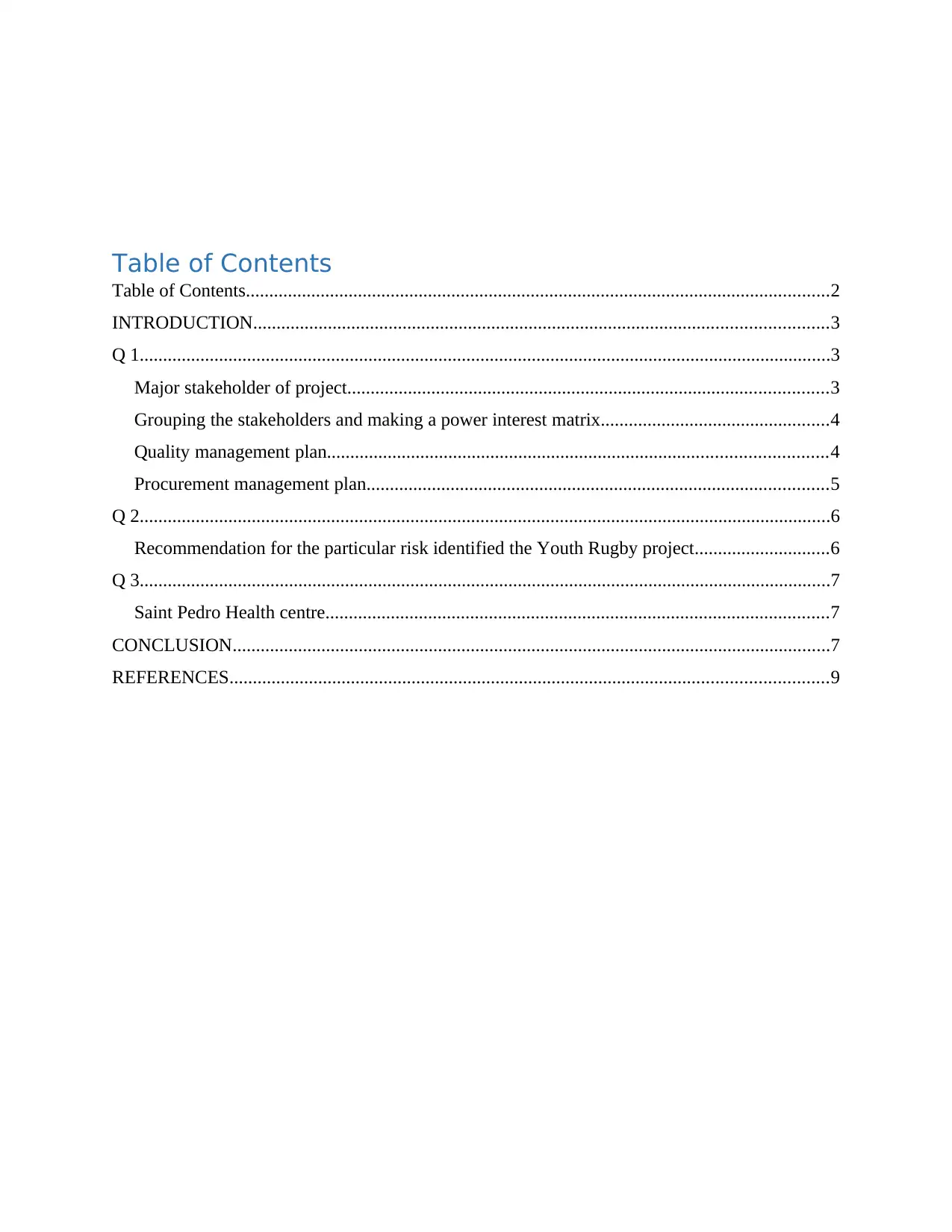
Table of Contents
Table of Contents.............................................................................................................................2
INTRODUCTION...........................................................................................................................3
Q 1....................................................................................................................................................3
Major stakeholder of project.......................................................................................................3
Grouping the stakeholders and making a power interest matrix.................................................4
Quality management plan...........................................................................................................4
Procurement management plan...................................................................................................5
Q 2....................................................................................................................................................6
Recommendation for the particular risk identified the Youth Rugby project.............................6
Q 3....................................................................................................................................................7
Saint Pedro Health centre............................................................................................................7
CONCLUSION................................................................................................................................7
REFERENCES................................................................................................................................9
Table of Contents.............................................................................................................................2
INTRODUCTION...........................................................................................................................3
Q 1....................................................................................................................................................3
Major stakeholder of project.......................................................................................................3
Grouping the stakeholders and making a power interest matrix.................................................4
Quality management plan...........................................................................................................4
Procurement management plan...................................................................................................5
Q 2....................................................................................................................................................6
Recommendation for the particular risk identified the Youth Rugby project.............................6
Q 3....................................................................................................................................................7
Saint Pedro Health centre............................................................................................................7
CONCLUSION................................................................................................................................7
REFERENCES................................................................................................................................9
INTRODUCTION
The project execution and planning is the most important step for the success of the
project. This is majorly pertaining to the fact that if the project will not be planned in effective
manner then this will not be successful and also the execution of the project will not be
successful (O’Connor, O’Brien and Choi, 2016). Hence, for the success of the project the most
important thing is the proper planning of the project and for this the proper analysis of the project
need to be done. The present report will outline the different stakeholders of the project. Also,
further the different recommendation will be provided to the risks which were identified in the
project. In the end the different model will be evaluated in order to select one good model on
basis of EMV.
Q 1
Major stakeholder of project
The stakeholders of the project are referred to as the people who are interested in the
success of the project to a great extent. There are many different types of stakeholder who are
interested in the successful completion of the whole project and attainment of all aims and
objectives of the project. Thus, for project of overall construction of the new international airport
in Western Sydney the stakeholders are as follows-
Project manager- these are the major stakeholder as if the manager will not be competent
then the project will not be successful. Hence, for this the manager needs to be expert and
knowledgeable.
Project sponsor- this is also a type of stakeholder which is responsible for providing the
finance for the completion of the project. Without money the project cannot be accomplished so
this is also a major stakeholder.
Project team- this is also an important stakeholder as these are the people who actually
perform the work of the project. Without these people also the project cannot be completed as if
the people will not be there then no work will be undertaken (Zhang, Xie and Li, 2019).
Consumers- these are the major stakeholder for the success of the project and this is
majorly pertaining to the reason that when it comes to success then it means satisfied consumers
and for this the consumer is the major stakeholder.
The project execution and planning is the most important step for the success of the
project. This is majorly pertaining to the fact that if the project will not be planned in effective
manner then this will not be successful and also the execution of the project will not be
successful (O’Connor, O’Brien and Choi, 2016). Hence, for the success of the project the most
important thing is the proper planning of the project and for this the proper analysis of the project
need to be done. The present report will outline the different stakeholders of the project. Also,
further the different recommendation will be provided to the risks which were identified in the
project. In the end the different model will be evaluated in order to select one good model on
basis of EMV.
Q 1
Major stakeholder of project
The stakeholders of the project are referred to as the people who are interested in the
success of the project to a great extent. There are many different types of stakeholder who are
interested in the successful completion of the whole project and attainment of all aims and
objectives of the project. Thus, for project of overall construction of the new international airport
in Western Sydney the stakeholders are as follows-
Project manager- these are the major stakeholder as if the manager will not be competent
then the project will not be successful. Hence, for this the manager needs to be expert and
knowledgeable.
Project sponsor- this is also a type of stakeholder which is responsible for providing the
finance for the completion of the project. Without money the project cannot be accomplished so
this is also a major stakeholder.
Project team- this is also an important stakeholder as these are the people who actually
perform the work of the project. Without these people also the project cannot be completed as if
the people will not be there then no work will be undertaken (Zhang, Xie and Li, 2019).
Consumers- these are the major stakeholder for the success of the project and this is
majorly pertaining to the reason that when it comes to success then it means satisfied consumers
and for this the consumer is the major stakeholder.
⊘ This is a preview!⊘
Do you want full access?
Subscribe today to unlock all pages.

Trusted by 1+ million students worldwide
Resource allocator- this is also an important stakeholder within the project as these are
the people who are responsible for allocating the limited resources for the effective use of the
limited and scarce resources.
Grouping the stakeholders and making a power interest matrix
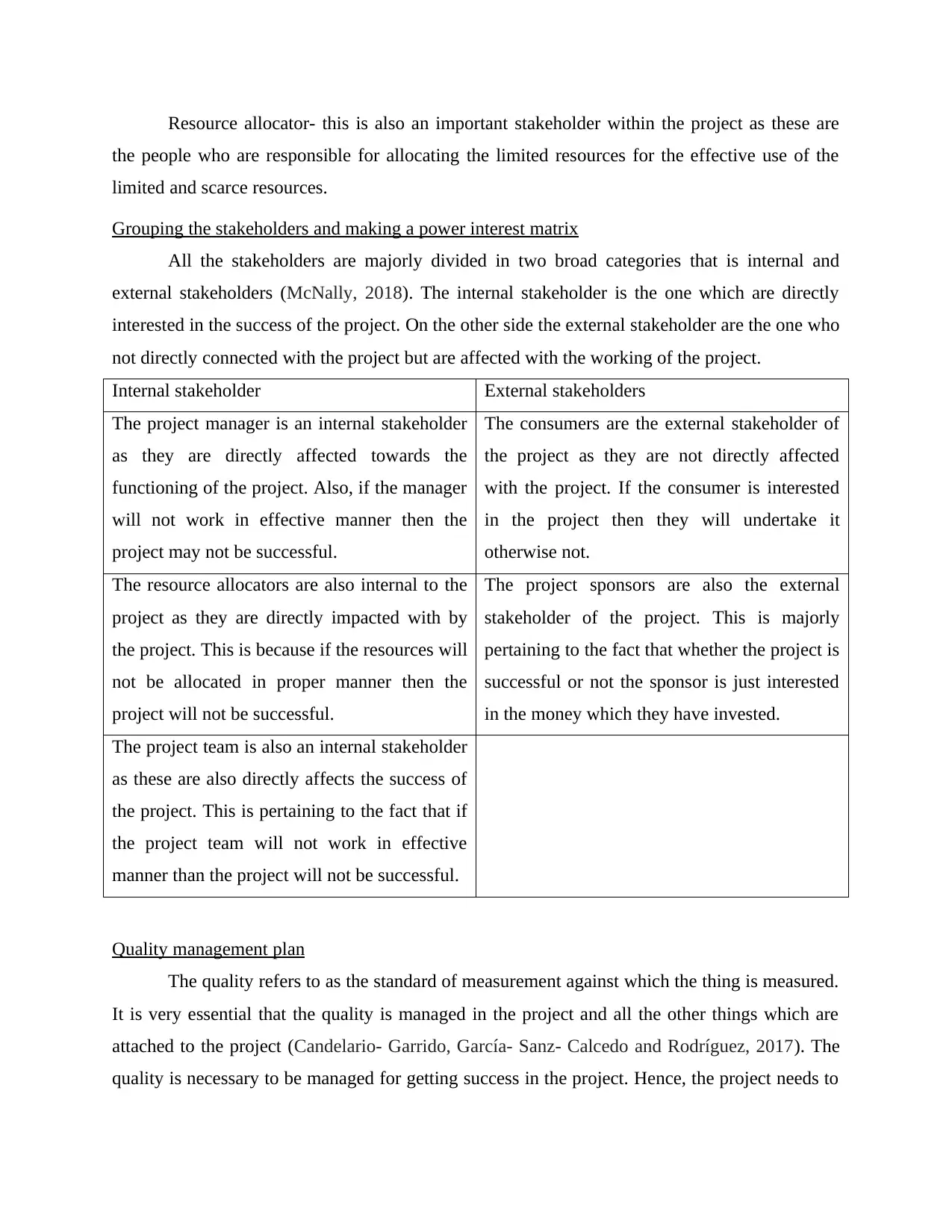
All the stakeholders are majorly divided in two broad categories that is internal and
external stakeholders (McNally, 2018). The internal stakeholder is the one which are directly
interested in the success of the project. On the other side the external stakeholder are the one who
not directly connected with the project but are affected with the working of the project.
Internal stakeholder External stakeholders
The project manager is an internal stakeholder
as they are directly affected towards the
functioning of the project. Also, if the manager
will not work in effective manner then the
project may not be successful.
The consumers are the external stakeholder of
the project as they are not directly affected
with the project. If the consumer is interested
in the project then they will undertake it
otherwise not.
The resource allocators are also internal to the
project as they are directly impacted with by
the project. This is because if the resources will
not be allocated in proper manner then the
project will not be successful.
The project sponsors are also the external
stakeholder of the project. This is majorly
pertaining to the fact that whether the project is
successful or not the sponsor is just interested
in the money which they have invested.
The project team is also an internal stakeholder
as these are also directly affects the success of
the project. This is pertaining to the fact that if
the project team will not work in effective
manner than the project will not be successful.
Quality management plan
The quality refers to as the standard of measurement against which the thing is measured.
It is very essential that the quality is managed in the project and all the other things which are
attached to the project (Candelario- Garrido, García- Sanz- Calcedo and Rodríguez, 2017). The
quality is necessary to be managed for getting success in the project. Hence, the project needs to
the people who are responsible for allocating the limited resources for the effective use of the
limited and scarce resources.
Grouping the stakeholders and making a power interest matrix
All the stakeholders are majorly divided in two broad categories that is internal and
external stakeholders (McNally, 2018). The internal stakeholder is the one which are directly
interested in the success of the project. On the other side the external stakeholder are the one who
not directly connected with the project but are affected with the working of the project.
Internal stakeholder External stakeholders
The project manager is an internal stakeholder
as they are directly affected towards the
functioning of the project. Also, if the manager
will not work in effective manner then the
project may not be successful.
The consumers are the external stakeholder of
the project as they are not directly affected
with the project. If the consumer is interested
in the project then they will undertake it
otherwise not.
The resource allocators are also internal to the
project as they are directly impacted with by
the project. This is because if the resources will
not be allocated in proper manner then the
project will not be successful.
The project sponsors are also the external
stakeholder of the project. This is majorly
pertaining to the fact that whether the project is
successful or not the sponsor is just interested
in the money which they have invested.
The project team is also an internal stakeholder
as these are also directly affects the success of
the project. This is pertaining to the fact that if
the project team will not work in effective
manner than the project will not be successful.
Quality management plan
The quality refers to as the standard of measurement against which the thing is measured.
It is very essential that the quality is managed in the project and all the other things which are
attached to the project (Candelario- Garrido, García- Sanz- Calcedo and Rodríguez, 2017). The
quality is necessary to be managed for getting success in the project. Hence, the project needs to
Paraphrase This Document
Need a fresh take? Get an instant paraphrase of this document with our AI Paraphraser
be good in quality as this will help the company in gaining good position in the highly
competitive market. Also, the quality will ensure that the company or the project gets successful
and in effective and efficient manner. Hence, the major quality management tools that will be
helpful in the completion of the project are as follows-
The first tool for the quality management within the project management and execution is
the use of flowchart. This is majorly because of the reason that the flowchart is a tool which
helps the project in managing the whole process in the form of a flow chart. This states that the
whole process undertaken in the completion of the project is shown or displayed in form of the
flow chart. The flow chart is a sequential diagram which display out all the steps involved in the
completion of any of the project. This help in assuring the quality of the project as this outline
the whole process step by step and this help the company in making the project in the same
manner as displayed within the flowchart.
Another major important tool for the quality management of the project is the check
sheet. This check sheet is the basic quality tool which is used by the project team in collecting
the data. This check sheet might be used in tracking the number of time any particular incident
has taken place in the whole project (Tonchia, 2018). For instance the project manager can check
that how much time the same question has been asked by the people working on the project. This
will help the project head in assessing the fact that in what areas the company need to work in
order to make the employees understand the project in more effective and reliable manner. All
these information that is what is the common problem which is being faced by the company in
managing the project are recorded and then analysis of this is taken as why the same problem is
being encountered several times.
Another major important tool for the quality management is the cause and effect that is
fish bone method. This is a diagram which helps the company in analysing the problem with help
of a fish bone. For using this tool the project head first need to analyse the problem which is
being faced by the project. Under this method all the causes of the problem are listed in form of
the causes. The major reason for using this method for quality control is that this will help the
company in finding the method of solving the problem in effective manner.
Procurement management plan
The procurement management plan is referred to as the overall management of the
project. This is a document which describes that how all the requirement or the items of
competitive market. Also, the quality will ensure that the company or the project gets successful
and in effective and efficient manner. Hence, the major quality management tools that will be
helpful in the completion of the project are as follows-
The first tool for the quality management within the project management and execution is
the use of flowchart. This is majorly because of the reason that the flowchart is a tool which
helps the project in managing the whole process in the form of a flow chart. This states that the
whole process undertaken in the completion of the project is shown or displayed in form of the
flow chart. The flow chart is a sequential diagram which display out all the steps involved in the
completion of any of the project. This help in assuring the quality of the project as this outline
the whole process step by step and this help the company in making the project in the same
manner as displayed within the flowchart.
Another major important tool for the quality management of the project is the check
sheet. This check sheet is the basic quality tool which is used by the project team in collecting
the data. This check sheet might be used in tracking the number of time any particular incident
has taken place in the whole project (Tonchia, 2018). For instance the project manager can check
that how much time the same question has been asked by the people working on the project. This
will help the project head in assessing the fact that in what areas the company need to work in
order to make the employees understand the project in more effective and reliable manner. All
these information that is what is the common problem which is being faced by the company in
managing the project are recorded and then analysis of this is taken as why the same problem is
being encountered several times.
Another major important tool for the quality management is the cause and effect that is
fish bone method. This is a diagram which helps the company in analysing the problem with help
of a fish bone. For using this tool the project head first need to analyse the problem which is
being faced by the project. Under this method all the causes of the problem are listed in form of
the causes. The major reason for using this method for quality control is that this will help the
company in finding the method of solving the problem in effective manner.
Procurement management plan
The procurement management plan is referred to as the overall management of the
project. This is a document which describes that how all the requirement or the items of
necessity will be procured and managed in the completion of the project. This plan provides a
brief overview of all the requirements of the project and which is essential for the success of the
project. The procurement management process includes the following-
The first step is to initiate a request and this includes requesting the suppliers to provide for their
quotation and tender so that the project can decide which supplier to go (Kjersem, Jünge and
Emblemsvåg, 2017).
Next step is to develop the requirement of the project that is what the technical requirements are,
quality that will be required for the project, and the limitation which will restrict the working
capacity of the project.
The next step will be to approve the request of the most suitable tender or the quotation provided
by the suppliers.
Further the next step is to have purchasing authority and then to purchase the required amount of
material and then the proposal is reviewed and approves.
Hence, the contract is signed between both the project manager and the supplier of the material
and in this manner the materials and required things are procured with help of this procurement
management plan in effective and efficient manner.
Q 2
Recommendation for the particular risk identified the Youth Rugby project
Risk is an uncertain event which may or may not happen depending on any of the future event.
But for the success of any project it is very essential that they study the risk.
Referees failing to show up at designated games- this risk can be mitigated with help that the tam
hire a substitute referee which can be called if the actual referee does not show up at the time of
designated game.
Fighting between teams- this is a major risk which can affect the whole game and the team work.
Hence, to minimise this risk it is recommended to the team that they must organize an informal
meeting of the players so that they can know each other better and there will not be any fights or
problems (Golini, Corti and Landoni, 2017).
Pivotal error committed by a referee that determines the outcome of game- this can be mitigated
by providing effective training to the referee so that they do not commit any error at time of
giving outcome for the game.
brief overview of all the requirements of the project and which is essential for the success of the
project. The procurement management process includes the following-
The first step is to initiate a request and this includes requesting the suppliers to provide for their
quotation and tender so that the project can decide which supplier to go (Kjersem, Jünge and
Emblemsvåg, 2017).
Next step is to develop the requirement of the project that is what the technical requirements are,
quality that will be required for the project, and the limitation which will restrict the working
capacity of the project.
The next step will be to approve the request of the most suitable tender or the quotation provided
by the suppliers.
Further the next step is to have purchasing authority and then to purchase the required amount of
material and then the proposal is reviewed and approves.
Hence, the contract is signed between both the project manager and the supplier of the material
and in this manner the materials and required things are procured with help of this procurement
management plan in effective and efficient manner.
Q 2
Recommendation for the particular risk identified the Youth Rugby project
Risk is an uncertain event which may or may not happen depending on any of the future event.
But for the success of any project it is very essential that they study the risk.
Referees failing to show up at designated games- this risk can be mitigated with help that the tam
hire a substitute referee which can be called if the actual referee does not show up at the time of
designated game.
Fighting between teams- this is a major risk which can affect the whole game and the team work.
Hence, to minimise this risk it is recommended to the team that they must organize an informal
meeting of the players so that they can know each other better and there will not be any fights or
problems (Golini, Corti and Landoni, 2017).
Pivotal error committed by a referee that determines the outcome of game- this can be mitigated
by providing effective training to the referee so that they do not commit any error at time of
giving outcome for the game.
⊘ This is a preview!⊘
Do you want full access?
Subscribe today to unlock all pages.
Trusted by 1+ million students worldwide
Abusive behaviour along the sidelines by parents- this can be mitigated by educating the parent
the importance of the game and the benefit which their child can get with this and this will
reduce the abusive behaviour of the parents.
Inadequate parking – for this risk the mitigating step can be hiring the nearby place in order to
make it parking at time when the parking is full.
Not enough team sign up for different age brackets- for this the mitigating step is to promote the
Youth Rugby project with innovative and creative manner. This is because this will attract more
of the people and this will increase the sign up for different age bracket.
Serious injury- for this mitigation step could be hiring a medical staff and providing for
emergency first aid and related kit so at time of serious injury it can be used (Abdi, Taghipour
and Khamooshi, 2018).
Q 3
Saint Pedro Health centre
100 120 140 Total
Model 1 4000 3000 5600 12600
Model 2 3200 3600 4800 11600
Model 3 2400 3200 8400 14000
With the help of the above payoff table it is clear that if Saint Pedro health centre will go for the
model 3. This is majorly pertaining to the fact that this model is providing highest EMV. This is
because if the health centre is expecting 100 patients per hour or 120 or 140 then the total EMV
is the highest for model 3. Thus, this will be more profitable in comparison with the other two
models.
CONCLUSION
In the end it is concluded that managing and planning for the project is very essential. The
present report stated that if the planning and its execution are not proper then the project will not
be successful. Thus, the report stated that the stakeholders are also very essential for the project
and it was seen that there are two types of stakeholder that is internal and external. Also, it was
seen that managing quality is also very necessary and for this, three different tools that is flow
chart, fish bone and many other tools was used. Also the different risk and their mitigation were
the importance of the game and the benefit which their child can get with this and this will
reduce the abusive behaviour of the parents.
Inadequate parking – for this risk the mitigating step can be hiring the nearby place in order to
make it parking at time when the parking is full.
Not enough team sign up for different age brackets- for this the mitigating step is to promote the
Youth Rugby project with innovative and creative manner. This is because this will attract more
of the people and this will increase the sign up for different age bracket.
Serious injury- for this mitigation step could be hiring a medical staff and providing for
emergency first aid and related kit so at time of serious injury it can be used (Abdi, Taghipour
and Khamooshi, 2018).
Q 3
Saint Pedro Health centre
100 120 140 Total
Model 1 4000 3000 5600 12600
Model 2 3200 3600 4800 11600
Model 3 2400 3200 8400 14000
With the help of the above payoff table it is clear that if Saint Pedro health centre will go for the
model 3. This is majorly pertaining to the fact that this model is providing highest EMV. This is
because if the health centre is expecting 100 patients per hour or 120 or 140 then the total EMV
is the highest for model 3. Thus, this will be more profitable in comparison with the other two
models.
CONCLUSION
In the end it is concluded that managing and planning for the project is very essential. The
present report stated that if the planning and its execution are not proper then the project will not
be successful. Thus, the report stated that the stakeholders are also very essential for the project
and it was seen that there are two types of stakeholder that is internal and external. Also, it was
seen that managing quality is also very necessary and for this, three different tools that is flow
chart, fish bone and many other tools was used. Also the different risk and their mitigation were
Paraphrase This Document
Need a fresh take? Get an instant paraphrase of this document with our AI Paraphraser

outlined. In the end with help of EMV and payoff matrix the suitable model was selected which
was model 3.
was model 3.
REFERENCES
Books and Journals
Abdi, A., Taghipour, S. and Khamooshi, H., 2018. Corrigendum to “A model to control
environmental performance of project execution process based on greenhouse gas
emissions using earned value management”[Int. J. Proj. Manag. 36 (3)(April 2018) 397-
413]. International Journal of Project Management. 36(8). pp.1047-1049.
Candelario-Garrido, A., García-Sanz-Calcedo, J. and Rodríguez, A.M.R., 2017. A quantitative
analysis on the feasibility of 4D planning graphic systems versus conventional systems
in building projects. Sustainable cities and society. 35. pp.378-384.
Golini, R., Corti, B. and Landoni, P., 2017. More efficient project execution and evaluation with
logical framework and project cycle management: evidence from international
development projects. Impact Assessment and Project Appraisal. 35(2). pp.128-138.
Kjersem, K., Jünge, G.H. and Emblemsvåg, J., 2017, September. Project Execution Strategy and
Planning Challenges. In IFIP International Conference on Advances in Production
Management Systems (pp. 243-250). Springer, Cham.
McNally, J.S., 2018. NO PAIN, NO GAIN? Effective planning, change management, project
execution, and strong leadership can help you limit the pain and achieve
success. Strategic Finance. 100(5). pp.34-40.
O’Connor, J.T., O’Brien, W.J. and Choi, J.O., 2016. Industrial project execution planning:
Modularization versus stick-built. Practice periodical on structural design and
construction. 21(1). p.04015014.
Tonchia, S., 2018. Project Execution. In Industrial Project Management (pp. 241-267). Springer,
Berlin, Heidelberg.
Zhang, J., Xie, H. and Li, H., 2019. Improvement of students problem-solving skills through
project execution planning in civil engineering and construction management
education. Engineering, Construction and Architectural Management.
Books and Journals
Abdi, A., Taghipour, S. and Khamooshi, H., 2018. Corrigendum to “A model to control
environmental performance of project execution process based on greenhouse gas
emissions using earned value management”[Int. J. Proj. Manag. 36 (3)(April 2018) 397-
413]. International Journal of Project Management. 36(8). pp.1047-1049.
Candelario-Garrido, A., García-Sanz-Calcedo, J. and Rodríguez, A.M.R., 2017. A quantitative
analysis on the feasibility of 4D planning graphic systems versus conventional systems
in building projects. Sustainable cities and society. 35. pp.378-384.
Golini, R., Corti, B. and Landoni, P., 2017. More efficient project execution and evaluation with
logical framework and project cycle management: evidence from international
development projects. Impact Assessment and Project Appraisal. 35(2). pp.128-138.
Kjersem, K., Jünge, G.H. and Emblemsvåg, J., 2017, September. Project Execution Strategy and
Planning Challenges. In IFIP International Conference on Advances in Production
Management Systems (pp. 243-250). Springer, Cham.
McNally, J.S., 2018. NO PAIN, NO GAIN? Effective planning, change management, project
execution, and strong leadership can help you limit the pain and achieve
success. Strategic Finance. 100(5). pp.34-40.
O’Connor, J.T., O’Brien, W.J. and Choi, J.O., 2016. Industrial project execution planning:
Modularization versus stick-built. Practice periodical on structural design and
construction. 21(1). p.04015014.
Tonchia, S., 2018. Project Execution. In Industrial Project Management (pp. 241-267). Springer,
Berlin, Heidelberg.
Zhang, J., Xie, H. and Li, H., 2019. Improvement of students problem-solving skills through
project execution planning in civil engineering and construction management
education. Engineering, Construction and Architectural Management.
⊘ This is a preview!⊘
Do you want full access?
Subscribe today to unlock all pages.
Trusted by 1+ million students worldwide

1 out of 9


Related Documents


Your All-in-One AI-Powered Toolkit for Academic Success.
+13062052269
info@desklib.com
Available 24*7 on WhatsApp / Email
![[object Object]](/_next/static/media/star-bottom.7253800d.svg)
Unlock your academic potential
Copyright © 2020–2026 A2Z Services. All Rights Reserved. Developed and managed by ZUCOL.