Project and Financial Management: Case Studies and Risk Analysis

Verified

Added on  2021/04/17

|10
|1910
|72
Project
AI Summary
This project management assignment analyzes real-world case studies, focusing on Fletcher Construction's Sky Tower project and a failing product line scenario. It covers project initiation, planning, execution, and closure, including network diagrams, critical path analysis, and risk management strategies. The assignment delves into the roles and responsibilities of a project manager, emphasizing the importance of meeting triple constraints (quality, schedule, and cost). It evaluates the effectiveness of risk management plans, proposes improvements, and addresses risks associated with multicultural teams and communication, offering mitigation strategies for successful project leadership. The document includes references to relevant project management literature.
Document Page
Running head: PROJECT AND FINANCIAL MANAGEMENT 1
Project and Financial Management
Name
Institution
tabler-icon-diamond-filled.svg

Paraphrase This Document

Need a fresh take? Get an instant paraphrase of this document with our AI Paraphraser
Document Page
PROJECT AND FINANCIAL MANAGEMENT 2
QUESTION-1)
a. Brief overview
Fletcher construction built Auckland’s Sky Tower. It was the 12th tallest tower in
the globe. Indeed, taller than the Eiffel Tower but it was completed on schedule. It
was built on a site that occupied an entire central Auckland block. The project
initially seemed impossible in 1994 but Fletcher Construction set out to
accomplish it and manage it on schedule. The client was Sky Tower Casino Ltd
and the budget of the project was $69 million. The contract type was ‘construction
only’. The project was completed on February 1997 in Auckland.
b. Need of project manager
Fletcher Construction needed a project manager to undertake the following roles:
Phase 1 (initiation): the project manager was required to define the goal of the
project. Phase 2 (Planning): The project manager was required to plan in a manner
that he identified the work required to reach the defined goals. Phase 3
(Execution): The project manager was required to lead the support teams while
controlling what was taking place (Bredillet, Tywoniak & Dwivedula, 2015). He
was, therefore, needed to closely monitor both resources and workers. Phase 4
(Completion): The project manager was required to be involved in ensuring that
the project was completed satisfactorily. He was required to ensure that the
objectives of the client were kept in mind at all times and satisfied.
c. Fundamental project management responsibilities
The project management responsibility is to manage resources to make sure that
the project is completed to the desired specifications, within budget and on time.
Another project management responsibility is to schedule individual tasks
alongside activities within every stage of the project and making sure that such
Document Page
PROJECT AND FINANCIAL MANAGEMENT 3
tasks deliver as agreed to prevent a knock-on effect on the whole schedule
(Walker, 2015). Another hands-on responsibility is the coordination of several
diverse department to ensure that the best is got from the workers by establishing
positive relationships (Martinelli & Milosevic, 2016).
d. Triple constraints
Fletcher Constructions were highly successful in meeting the triple constraints of
quality, schedule and costs as the firm spearheading the project of building the
Sky Tower. Fletcher Construction did this by recognizing the importance of
helping clients save money and get maximum value from project budget. They
suggested various approaches and engaged external companies to work with them
to guarantee increasingly cost-effective solutions. They monitored the costs
throughout the project to make sure that the pre-determined budget could be met.
They agreed on any alterations that could affect the initial price. This enabled
Fletcher Construction and its client to make sure that investors in their respective
firms received a sufficient ROI. Fletcher Construction ensured quality from
workers via positive relationships’ creation. They placed substantial significance
on employing, training as well as retaining skilled and loyal workers. Moreover,
Fletcher Construction built up valued partnerships with subcontractors and
suppliers.
QUESTION-2)
XYZ Ltd Failing Product Line
I. Activity Description Predecessor Duration Weeks
II. Understand the problem - 4
III. Research Solutions II 6
Document Page
PROJECT AND FINANCIAL MANAGEMENT 4
IV. Allocate resources III 4
V. Prototyping III 10
VI. Machining IV 10
VII. Testing IV 10
VIII. Manufacturing V, VI, VII 5
a) Network diagram
EST
(b)
LST
(c)
EFT
(d)
LFT
(e)
SLACK
TIME (f)
II 0 0 4 4 0
III 4 4 10 10 0
IV 10 10 14 14 0
V 10 14 20 24 4
VI 14 14 24 24 0
VII 14 14 24 24 0
VIII 24 24 29 29 0
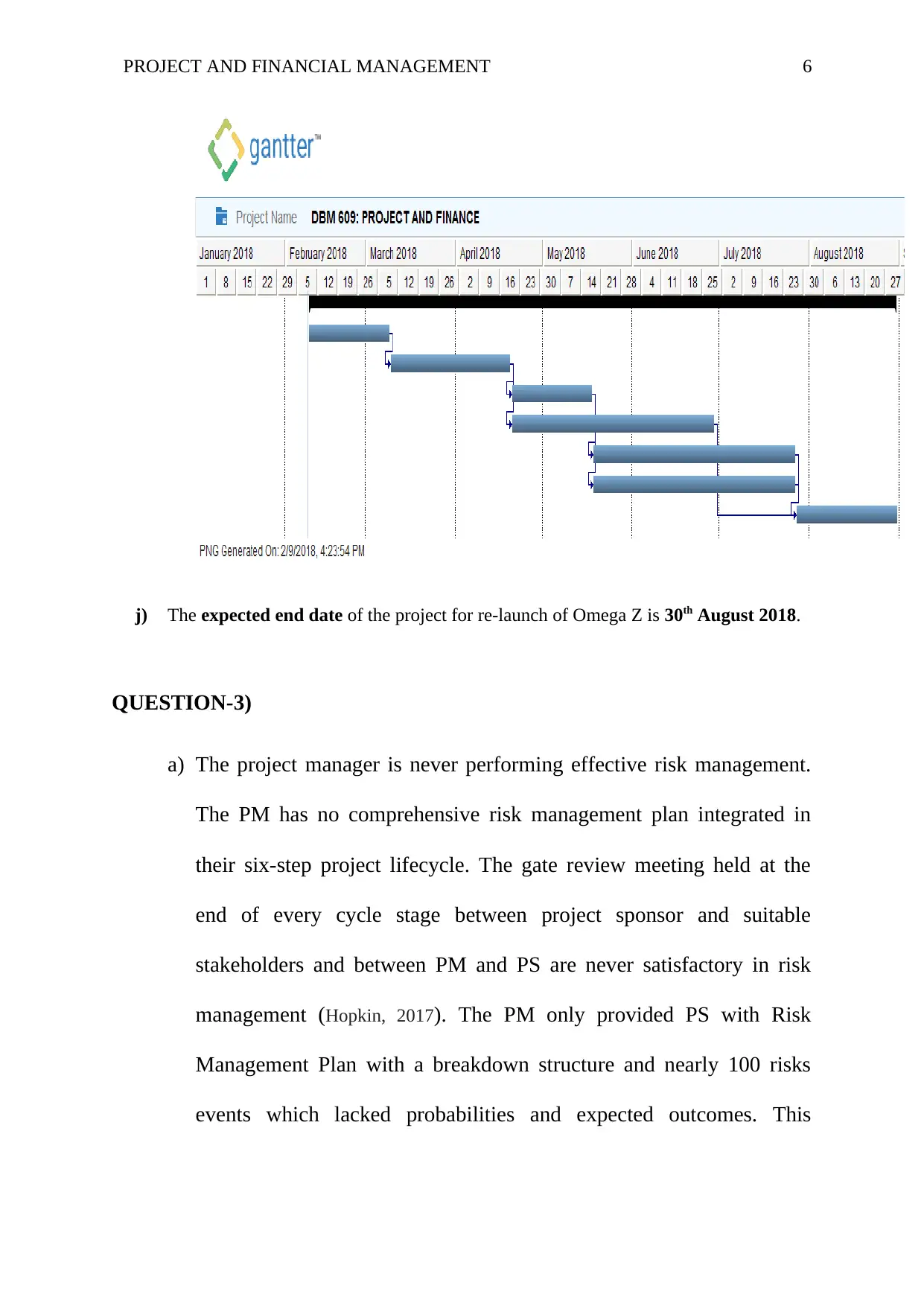
g) Critical Path for re-launch of Omega Z is as follows:
II, III, IV, (VI, VII), VIII.
h) Duration of critical path is the sum of time needed to finish the each activity of the
critical path.
II + III + IV + (VI, VII) + VIII = Critical Path Duration
tabler-icon-diamond-filled.svg

Paraphrase This Document

Need a fresh take? Get an instant paraphrase of this document with our AI Paraphraser
Document Page
PROJECT AND FINANCIAL MANAGEMENT 5
4 + 6 + 4 + 10 + 5 = 29 weeks.
i)
Document Page
PROJECT AND FINANCIAL MANAGEMENT 6
j) The expected end date of the project for re-launch of Omega Z is 30th August 2018.
QUESTION-3)
a) The project manager is never performing effective risk management.
The PM has no comprehensive risk management plan integrated in
their six-step project lifecycle. The gate review meeting held at the
end of every cycle stage between project sponsor and suitable
stakeholders and between PM and PS are never satisfactory in risk
management (Hopkin, 2017). The PM only provided PS with Risk
Management Plan with a breakdown structure and nearly 100 risks
events which lacked probabilities and expected outcomes. This
Document Page
PROJECT AND FINANCIAL MANAGEMENT 7
example shows clearly that the risk management is ineffective as it
ranked no risk yet it is done at a costly budget (Kerzner & Kerzner, 2017).
b) The large number of identified risk events can be more effectively
managed by the project manager when he assigns probabilities and
expected outcomes/damages at the identification stages so that the risk
can be ranked and prioritized for mitigation against, acceptance,
avoidance, or transfer. This will help the manager effectively identify
and define the risks the project is exposed to and map incidents
effectively (Haimes, 2015). Moreover, it will help PM easily determine
the level of threats and focus only on such risks with greatest potential
of affecting project performance.
c) Norfolk & Chance project management methodology must be
modified to include a comprehensive risk management plan. The
methodology should be cut down to four phases: initiation, planning,
execution and closure. Under this new methodology, the initiation
phase (replaces preliminary planning) will include: development of a
business case, feasibility study, project charter, project team and stage
review. Under planning phase (replaces detailed planning), the project
plan, resource plan, financial plan, quality, plan, risk plan, acceptance
plan, communication plan, and procurement plan are created.
Contracting suppliers is then done and the phase is reviewed. Under
execution phase (merges design selection, prototyping, testing/buyoff
tabler-icon-diamond-filled.svg

Paraphrase This Document

Need a fresh take? Get an instant paraphrase of this document with our AI Paraphraser
Document Page
PROJECT AND FINANCIAL MANAGEMENT 8
and production), deliverables are built and monitoring and control are
done. Further, time-, cost-, quality-, change-, risk-, issue-,
procurement-, acceptance- and communication management are
performed. Under closure stage, project closure is performed and
project completion is reviewed.
OUESTION-4)
a) Risk total for major risk factors that impact the successful leading of new
projects for Norfolk & Hope Ltd. Are:
Risks Identified risk factors Probability Impact Severity
1 Communication
misunderstandings
4.5 5.0 22.5
2 Cultural differences in work
expectations
4.5 4.0 18
3 Cultural perceptions 2.5 4.5 11.25
4 Multicultural team dynamics 4.0 3.5 14
5 Issues in virtual relationship
building
2.5 3.5 8.75
6 Time zone differences 3.5 2.5 8.75
7 Differences in technologies 2.5 2.0 5
b) Impact vs probability
c)
Document Page
PROJECT AND FINANCIAL MANAGEMENT 9
Risk Category
Communication misunderstandings Mitigated against
Cultural diff. in work expectations Mitigated against
Cultural Perception Mitigated against
Multicultural Team Dynamics Mitigated against
Issues in virtual rel. buildings Transferred
Time Zone differences Accepted
Differences in Technologies Accepted
Risk management:
Communication misunderstandings: The companies should develop a
communication plan and chain of command. This will ensure that the
communication is effective and followed to mitigate against misunderstandings.
Cultural differences in work expectations: The firms should acknowledge
cultural diversities in their workplaces and ensure that the goals are left to each
individuals to set his or hers. This will ensure an individual has his or her goal to
achieve without competing at same level.
Cultural Perception: The organizations should ensure that they employ diverse
staff so that there is no negative perception. This will ensure that they attract
diverse clients as the organization will be perceived as diverse and inclusive
(Davis, 2014).
Document Page
PROJECT AND FINANCIAL MANAGEMENT 10
Multicultural Team Dynamics: The organization must ensure that every team
formed adheres to cultural diversity to ensure that each team work in a
harmonious way rather than grouping people of same culture in one team
(Meraner & Finger, 2016).
Issues in virtual relationships buildings: The organization must ensure that they
have virtual teams in the organization whereby each person’s input is accounted
for in the final decision (Haimes, 2015). By this, each person will feel valued in
the organization and will give his or her best.
Time Zone differences: This has to be accepted in the organization as it cannot be
changed. The organization must, however, try to work based on the best that can
be achieved regardless of differences in time zone.
Differences in Technologies: With daily advances in technology, the organization
must ensure that they remain updated by using the latest technologies.
REFERENCES
Bredillet, C., Tywoniak, S., & Dwivedula, R. (2015). What is a good project manager? An
Aristotelian perspective. International Journal of Project Management, 33(2), 254-
266.
Davis, K. (2014). Different stakeholder groups and their perceptions of project
success. International journal of project management, 32(2), 189-201.
Haimes, Y. Y. (2015). Risk modeling, assessment, and management. John Wiley & Sons.
Hopkin, P. (2017). Fundamentals of risk management: understanding, evaluating and
implementing effective risk management. Kogan Page Publishers.
Kerzner, H., & Kerzner, H. R. (2017). Project management: a systems approach to planning,
scheduling, and controlling. John Wiley & Sons.
chevron_up_icon
1 out of 10
circle_padding
hide_on_mobile
zoom_out_icon
[object Object]