Analyzing Project Governance Impact on Project Success in Yemen
VerifiedAdded on 2023/06/04
|25
|7678
|208
Report
AI Summary
This report delves into the critical role of project governance in determining the success of projects, particularly within the context of NGOs operating in Yemen. The introduction establishes the importance of project governance, highlighting its impact on aligning organizational structures, ensuring control, mitigating risks, and facilitating decision-making. The problem statement identifies challenges faced by NGOs in managing resources, addressing poverty, and improving living standards. Research questions explore the relationship between project governance and success, the roles of contractual and relational governance, project orientation, and project management. The objectives aim to evaluate the impact of project governance, identify key relationships, and propose improvements to NGO operational plans. The literature review examines the contributions of various authors on the link between project governance and project success, emphasizing the importance of effective resource management and project management methodologies. The report is organized into chapters that cover the introduction, literature review, methodology, findings, discussion, and conclusion, providing a comprehensive analysis of project governance's impact on project outcomes.

Project Management

Paraphrase This Document
Need a fresh take? Get an instant paraphrase of this document with our AI Paraphraser
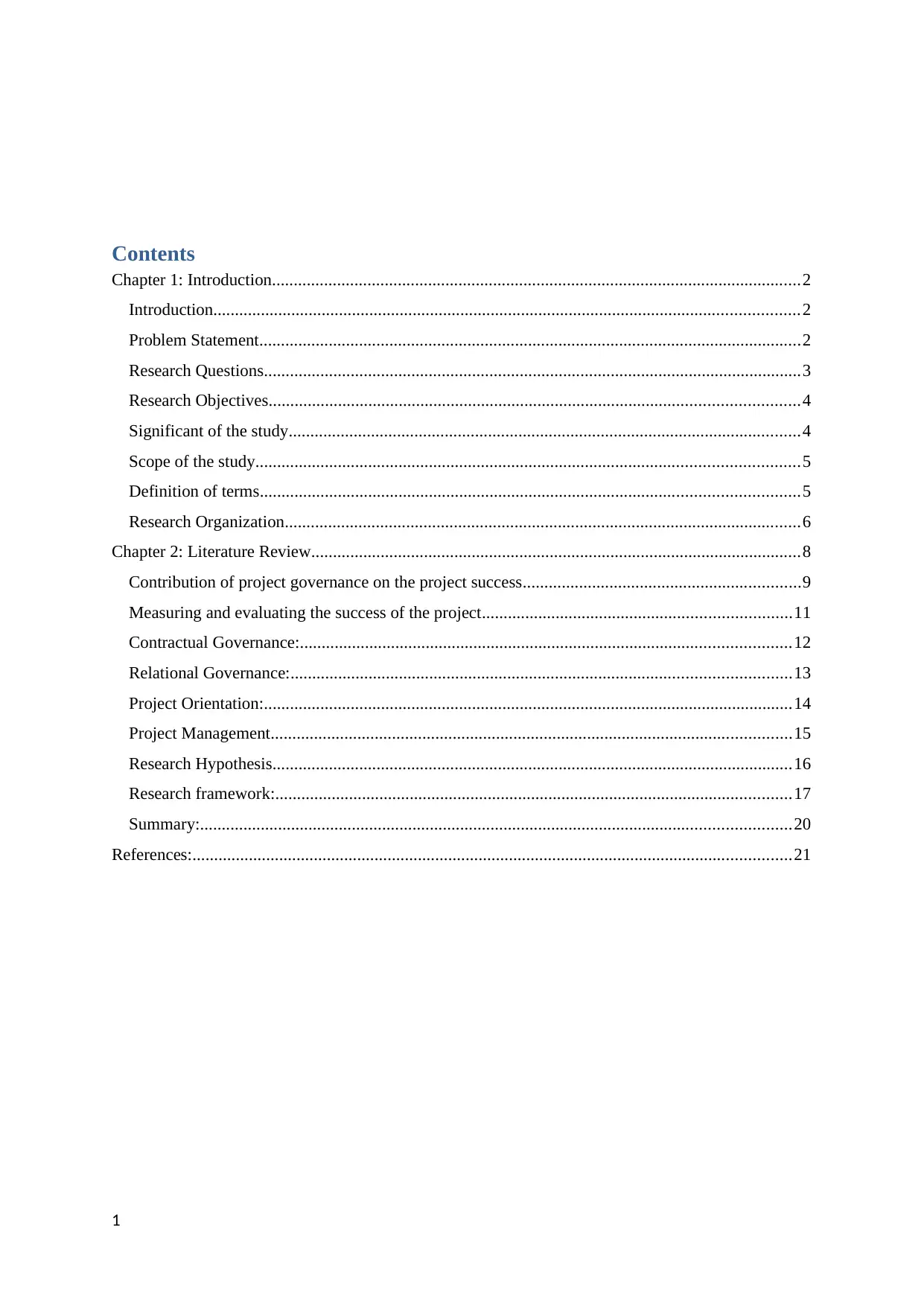
Contents
Chapter 1: Introduction..........................................................................................................................2
Introduction.......................................................................................................................................2
Problem Statement.............................................................................................................................2
Research Questions............................................................................................................................3
Research Objectives..........................................................................................................................4
Significant of the study......................................................................................................................4
Scope of the study.............................................................................................................................5
Definition of terms............................................................................................................................5
Research Organization.......................................................................................................................6
Chapter 2: Literature Review.................................................................................................................8
Contribution of project governance on the project success................................................................9
Measuring and evaluating the success of the project.......................................................................11
Contractual Governance:.................................................................................................................12
Relational Governance:...................................................................................................................13
Project Orientation:..........................................................................................................................14
Project Management........................................................................................................................15
Research Hypothesis........................................................................................................................16
Research framework:.......................................................................................................................17
Summary:........................................................................................................................................20
References:..........................................................................................................................................21
1
Chapter 1: Introduction..........................................................................................................................2
Introduction.......................................................................................................................................2
Problem Statement.............................................................................................................................2
Research Questions............................................................................................................................3
Research Objectives..........................................................................................................................4
Significant of the study......................................................................................................................4
Scope of the study.............................................................................................................................5
Definition of terms............................................................................................................................5
Research Organization.......................................................................................................................6
Chapter 2: Literature Review.................................................................................................................8
Contribution of project governance on the project success................................................................9
Measuring and evaluating the success of the project.......................................................................11
Contractual Governance:.................................................................................................................12
Relational Governance:...................................................................................................................13
Project Orientation:..........................................................................................................................14
Project Management........................................................................................................................15
Research Hypothesis........................................................................................................................16
Research framework:.......................................................................................................................17
Summary:........................................................................................................................................20
References:..........................................................................................................................................21
1
Chapter 1: Introduction
Introduction
The project governance is the function and methodology which is adopted by the project
development program for aligning the organization hierarchical structure, ensuring control
measurements, identification of risks, and elaborating decision of the project manager. There
is a direct relationship between the project governances and project success. The project can
be successfully completed within the given timeframe and cost if effective control policies
and principles of project governance are implied for the orientation of the project
development life cycle. In recent years, it has been researched that the aim of the project
owner is to provide longevity to the project life by deploying the policies and principles of
project governance by improving the work development process implemented by the
undertaken projects. The feasibility study of the project success and profit gained by the
settlement of the issues and chaos of the local NGO’s working in Yemen by implementing
the framework of project governance principles and policies on the development process of
project life cycle program. The systematic study of NGOs operational plan helps in analysing
the efficiency of the project governance on controlling the project activities and sub-
activities. The correlation and inter-dependencies of the contractual governance, relational
governance, project orientation, and project management focuses on estimating the efficiency
of the project output and the effective organization of the process and procedures lay down
by the NGOs operating in the Yemen for the development of the people. The research study
helps in analysing the feasibility of project governance in relation to the operational plan
implemented by the local NGOs of Yemen for the people development and growth. The
success factors of project governance, contractual governance, relational governance, project
orientation and project management can be measured in terms of political stability and
leadership managed in the operational plan of NGO, learning new innovation for improving
the working plan of the Organizations, managing the supply and demand of resources for
providing the effective services to the stakeholders, and management of funds from foreign
investors in the development of NGOs of Yemen. The framework of project governance
helps in improving the working capability and controlling of project activities to achieve the
growth of local people residing in Yemen.
Problem Statement
The problem domain which exists with the project development life cycle is to establish
project governance parameters for analysing and validating the return on investment achieved
2
Introduction
The project governance is the function and methodology which is adopted by the project
development program for aligning the organization hierarchical structure, ensuring control
measurements, identification of risks, and elaborating decision of the project manager. There
is a direct relationship between the project governances and project success. The project can
be successfully completed within the given timeframe and cost if effective control policies
and principles of project governance are implied for the orientation of the project
development life cycle. In recent years, it has been researched that the aim of the project
owner is to provide longevity to the project life by deploying the policies and principles of
project governance by improving the work development process implemented by the
undertaken projects. The feasibility study of the project success and profit gained by the
settlement of the issues and chaos of the local NGO’s working in Yemen by implementing
the framework of project governance principles and policies on the development process of
project life cycle program. The systematic study of NGOs operational plan helps in analysing
the efficiency of the project governance on controlling the project activities and sub-
activities. The correlation and inter-dependencies of the contractual governance, relational
governance, project orientation, and project management focuses on estimating the efficiency
of the project output and the effective organization of the process and procedures lay down
by the NGOs operating in the Yemen for the development of the people. The research study
helps in analysing the feasibility of project governance in relation to the operational plan
implemented by the local NGOs of Yemen for the people development and growth. The
success factors of project governance, contractual governance, relational governance, project
orientation and project management can be measured in terms of political stability and
leadership managed in the operational plan of NGO, learning new innovation for improving
the working plan of the Organizations, managing the supply and demand of resources for
providing the effective services to the stakeholders, and management of funds from foreign
investors in the development of NGOs of Yemen. The framework of project governance
helps in improving the working capability and controlling of project activities to achieve the
growth of local people residing in Yemen.
Problem Statement
The problem domain which exists with the project development life cycle is to establish
project governance parameters for analysing and validating the return on investment achieved
2
⊘ This is a preview!⊘
Do you want full access?
Subscribe today to unlock all pages.

Trusted by 1+ million students worldwide
in completing the project. The project manager faces problem in identifying the complexities
associated with the development and designing of the undertaken project. The systematic
organization of the project activities should be designed in the direction of achieving goals
and objectives of the project. The NGOs of Yemen are facing problem in managing the
resources supply and demand for the development of the people due to inefficiency of the
contractors and the monitoring of the local government. The innovations are required in
improving the flaws and gaps which exists in the operational plan of the NGO operating in
Yemen. The Yemen is facing problems in managing the level of poverty in the local people
of the rural areas, lack of education, vulnerabilities associated in providing medical facilities
to the people, poor infrastructure of the rural areas, lower rate of return on investment
(Biesenthal, and Wilden, 2014). The project management methodologies deployed by the
local NGOs in the current working structure are inefficient in managing development and
improvement in the living standards of the people due to the lack of project governance and
active participation of the local government. It is required to develop effective plan for
implementing the framework of project governance for managing, monitoring, and
controlling the project activities with respect to the improvement in the public development
program used by the NGOs of Yemen.
Research Questions
The research questions which are designed for the undertaken research study are as follows:
What are the impacts of project governance on the project success?
What is the relationship between project governance and project success?
What are the impacts of project governance on the project success of NGO’s
operating in Yemen?
What is the role of Contractual governance and Relational governance in completing
project successfully?
What is the role of Project orientation in governing the project?
What is the role of project management in governing the project completion?
How the improvement in the NGOs operating plan can be done by deploying the
project governance principles?
3
associated with the development and designing of the undertaken project. The systematic
organization of the project activities should be designed in the direction of achieving goals
and objectives of the project. The NGOs of Yemen are facing problem in managing the
resources supply and demand for the development of the people due to inefficiency of the
contractors and the monitoring of the local government. The innovations are required in
improving the flaws and gaps which exists in the operational plan of the NGO operating in
Yemen. The Yemen is facing problems in managing the level of poverty in the local people
of the rural areas, lack of education, vulnerabilities associated in providing medical facilities
to the people, poor infrastructure of the rural areas, lower rate of return on investment
(Biesenthal, and Wilden, 2014). The project management methodologies deployed by the
local NGOs in the current working structure are inefficient in managing development and
improvement in the living standards of the people due to the lack of project governance and
active participation of the local government. It is required to develop effective plan for
implementing the framework of project governance for managing, monitoring, and
controlling the project activities with respect to the improvement in the public development
program used by the NGOs of Yemen.
Research Questions
The research questions which are designed for the undertaken research study are as follows:
What are the impacts of project governance on the project success?
What is the relationship between project governance and project success?
What are the impacts of project governance on the project success of NGO’s
operating in Yemen?
What is the role of Contractual governance and Relational governance in completing
project successfully?
What is the role of Project orientation in governing the project?
What is the role of project management in governing the project completion?
How the improvement in the NGOs operating plan can be done by deploying the
project governance principles?
3
Paraphrase This Document
Need a fresh take? Get an instant paraphrase of this document with our AI Paraphraser
Research Objectives
The objective of the research is to evaluate the impact of project governance on the project
success of NGOs operating in the region of Yemen. Some of the objectives of the research
study are highlighted below:
Evaluation of the impacts of project governance on the project success
Identification of the relationship between project governance and project success
Analysis of the impacts of project governance on the project success of NGO’s
operating in Yemen
Identification of the role of Contractual governance and Relational governance in
completing project successfully
Defining the role of Project orientation in governing the project
Defining the role of project management in governing the project completion
Significance and improvements in the NGOs operating plan can be done by deploying
the project governance principles
Significant of the study
The research study helps in improving the operational plan implemented by the NGO’s
operating in Yemen by deploying the project governance policies, principles, and framework
within the working culture of the enterprise. The project governance policy structure and
framework had a direct relationship with the project success. The research study helps in
signifies the problem faced by the NGO in deploying the development program for the local
and rural people residing in Yemen. The people of Yemen are not able to get the required and
basic education, no health services and facilities, no management of funds, no active
participation of local government, and others. The feasibility analysis of the operational plan
implemented by the NGOs helps in evaluating the gaps and flaws which exists in the current
working model used for improving the condition of rural people in Yemen. It provides new
opportunities to implement rules, policies, principles, and framework of the project
governance to manage effective control over the project activities used for the development
of the rural people of Yemen. The systematic organization of the project activities should be
designed in the direction of achieving goals and objectives of the project. The complexities of
the project manager can be effectively resoled by deploying the rules of project governance in
the project life cycle. The decision making capabilities of the project manager can be
improved which helps in managing funds for the NGOs operations from the local government
for improving the development process of the local people.
4
The objective of the research is to evaluate the impact of project governance on the project
success of NGOs operating in the region of Yemen. Some of the objectives of the research
study are highlighted below:
Evaluation of the impacts of project governance on the project success
Identification of the relationship between project governance and project success
Analysis of the impacts of project governance on the project success of NGO’s
operating in Yemen
Identification of the role of Contractual governance and Relational governance in
completing project successfully
Defining the role of Project orientation in governing the project
Defining the role of project management in governing the project completion
Significance and improvements in the NGOs operating plan can be done by deploying
the project governance principles
Significant of the study
The research study helps in improving the operational plan implemented by the NGO’s
operating in Yemen by deploying the project governance policies, principles, and framework
within the working culture of the enterprise. The project governance policy structure and
framework had a direct relationship with the project success. The research study helps in
signifies the problem faced by the NGO in deploying the development program for the local
and rural people residing in Yemen. The people of Yemen are not able to get the required and
basic education, no health services and facilities, no management of funds, no active
participation of local government, and others. The feasibility analysis of the operational plan
implemented by the NGOs helps in evaluating the gaps and flaws which exists in the current
working model used for improving the condition of rural people in Yemen. It provides new
opportunities to implement rules, policies, principles, and framework of the project
governance to manage effective control over the project activities used for the development
of the rural people of Yemen. The systematic organization of the project activities should be
designed in the direction of achieving goals and objectives of the project. The complexities of
the project manager can be effectively resoled by deploying the rules of project governance in
the project life cycle. The decision making capabilities of the project manager can be
improved which helps in managing funds for the NGOs operations from the local government
for improving the development process of the local people.
4
Scope of the study
The scope of the research study provides new opportunities to the project management
policies implemented by the NGOs working in Yemen for uplifting the standard of the local
and rural people. The study of the NGOs working helps in analysing the gaps which exist in
the public and private sectors for completing the given tasks of the undertaken project. The
focus of the research is to analyse the efficiency of implementing the project governance
policies and framework in the improving the operational plan and project management
methodologies in completing project successfully. The evaluation of the risks and uncertainty
associated with the project results in completing the project on time and cost. The positive
relationship can be monitored and controlled between the project governance and project
success. The focus should be given on significance and improvements in the NGOs operating
plan can be done by deploying the project governance principles The privilege should be
given to the identification of efficiency in laying down the project orientation plan and
contractual governance to build effective relationship between the working of public and
private sectors for improving the condition of operational plan implemented by the NGOs in
Yemen.
Definition of terms
Project Governance: The project governance is defined as the systematic analysis of the
project elements for measuring the accountabilities, authorization, control, and
responsibilities provided to the internal and external stakeholders for completing the
undertaken project.
Project Success: The project success is the measurement of level of satisfaction achieved in
the customers with the deployment and completion of the project.
Contractual Governance: The Contractual governance is the agreement signed between the
internal and external stakeholders for finishing the tasks within time, cost, and quality.
Relational Governance: The relational governance is used for analysing the coordination,
cooperation, and interdependencies of the project management units for achieving project
success.
Project Orientation: The project orientation is the framework which is used for defining the
processes and procedures used for completing the given tasks with efficiency and
effectiveness.
5
The scope of the research study provides new opportunities to the project management
policies implemented by the NGOs working in Yemen for uplifting the standard of the local
and rural people. The study of the NGOs working helps in analysing the gaps which exist in
the public and private sectors for completing the given tasks of the undertaken project. The
focus of the research is to analyse the efficiency of implementing the project governance
policies and framework in the improving the operational plan and project management
methodologies in completing project successfully. The evaluation of the risks and uncertainty
associated with the project results in completing the project on time and cost. The positive
relationship can be monitored and controlled between the project governance and project
success. The focus should be given on significance and improvements in the NGOs operating
plan can be done by deploying the project governance principles The privilege should be
given to the identification of efficiency in laying down the project orientation plan and
contractual governance to build effective relationship between the working of public and
private sectors for improving the condition of operational plan implemented by the NGOs in
Yemen.
Definition of terms
Project Governance: The project governance is defined as the systematic analysis of the
project elements for measuring the accountabilities, authorization, control, and
responsibilities provided to the internal and external stakeholders for completing the
undertaken project.
Project Success: The project success is the measurement of level of satisfaction achieved in
the customers with the deployment and completion of the project.
Contractual Governance: The Contractual governance is the agreement signed between the
internal and external stakeholders for finishing the tasks within time, cost, and quality.
Relational Governance: The relational governance is used for analysing the coordination,
cooperation, and interdependencies of the project management units for achieving project
success.
Project Orientation: The project orientation is the framework which is used for defining the
processes and procedures used for completing the given tasks with efficiency and
effectiveness.
5
⊘ This is a preview!⊘
Do you want full access?
Subscribe today to unlock all pages.
Trusted by 1+ million students worldwide
Project Management: The project management is the systematic sequencing of planning,
organizing, staffing, designing, requirement gathering, development, testing, and
implementation process for completing the project successfully.
Research Organization
The organization of the research helps in analysing the facts and figures related to the project
governance in improving the performance of the NGOs operational plan deployed in Yemen
for the development of the local and rural people. The research study starts with the setting of
research agendas and research questions for systematic analysing the impact of project
governance on project success (Nabhani, 2018). In the research program, the data is collected
from the literature review and case study of NGOs working in Yemen to know the
consequences of project governance in improving the performance of the undertaken project.
The literary sources help in collecting details of the facts and figures collected by the
different authors in their research work. The research is organized into six chapters such as:
Chapter 1 focuses on highlighting the introduction to the research agenda for analysing the
impact of project governance on the project success. The definitions of different terms used
in the project are explained in the introduction section only.
Chapter 2 focuses on collecting data from literary sources on analysing the condition of
operational plan implemented by the NGOs for improving the condition of the rural people
residing in Yemen. The project governance helps in the development of effective
management plan and project schedule so that the project can be completed successfully. The
literature review focuses on the research work carried out by the different researcher in the
direction of project governance, contractual governance, relational governance, project
orientation, and project management.
Chapter 3 focuses on methodology undertaken for collecting the data from different sources.
The reliability of the data collected should be tested
Chapter 4 focuses on identifying the findings and results of the undertaken research and data
collected from the literature sources.
Chapter 5 focuses on drawing discussion on the implementation of project governance for
improving the working efficiency of the NGOs operating in Yemen. The conclusion section
helps in highlighting the role played by the project governance for the effective development
of the operational plan.
6
organizing, staffing, designing, requirement gathering, development, testing, and
implementation process for completing the project successfully.
Research Organization
The organization of the research helps in analysing the facts and figures related to the project
governance in improving the performance of the NGOs operational plan deployed in Yemen
for the development of the local and rural people. The research study starts with the setting of
research agendas and research questions for systematic analysing the impact of project
governance on project success (Nabhani, 2018). In the research program, the data is collected
from the literature review and case study of NGOs working in Yemen to know the
consequences of project governance in improving the performance of the undertaken project.
The literary sources help in collecting details of the facts and figures collected by the
different authors in their research work. The research is organized into six chapters such as:
Chapter 1 focuses on highlighting the introduction to the research agenda for analysing the
impact of project governance on the project success. The definitions of different terms used
in the project are explained in the introduction section only.
Chapter 2 focuses on collecting data from literary sources on analysing the condition of
operational plan implemented by the NGOs for improving the condition of the rural people
residing in Yemen. The project governance helps in the development of effective
management plan and project schedule so that the project can be completed successfully. The
literature review focuses on the research work carried out by the different researcher in the
direction of project governance, contractual governance, relational governance, project
orientation, and project management.
Chapter 3 focuses on methodology undertaken for collecting the data from different sources.
The reliability of the data collected should be tested
Chapter 4 focuses on identifying the findings and results of the undertaken research and data
collected from the literature sources.
Chapter 5 focuses on drawing discussion on the implementation of project governance for
improving the working efficiency of the NGOs operating in Yemen. The conclusion section
helps in highlighting the role played by the project governance for the effective development
of the operational plan.
6
Paraphrase This Document
Need a fresh take? Get an instant paraphrase of this document with our AI Paraphraser

Chapter 2: Literature Review
The contribution of different authors in the direction of analysing the relationship which exist
between the project governance and project success in their research work helps in providing
7
The contribution of different authors in the direction of analysing the relationship which exist
between the project governance and project success in their research work helps in providing
7
a guidance for knowing the impact of project governance in improving the project
management process and completing the tasks successfully (Muller and Joslin, 2010). The
authors highlight the efficiency of the project governance in improving the performance of
the organization by managing resources with respect to the demand raised by the
participating units in managing their work on time. The positive relationship between the
project governance and project management methodology helps in completing the project
successfully within the pre-defined resources, cost, and time to achieve the quality of the end
products (Tomomitsu, Carvalho, and Moraes, 2016). The project governance can be defined
as the systematic analysis of the project elements for measuring the accountabilities,
authorization, control, and responsibilities provided to the internal and external stakeholders
for completing the undertaken project. The project management is the fundamental approach
deployed by the organization for scheduling the activities in the direction of project
objectives and goals. The project vision and clear specification of the project goal are the
basic requisites for forecasting the project success. The outcome of the project can be
measured by analysing the project methodology undertaken for completing the tasks and
scheduled activities. The inefficiency and inactive participation complexities associated with
the project management process can be resolved by deploying the framework of project
governance. The new opportunities can be created by implementing the policies of
contractual and relational governance model for improving the relationship between control
structure and project management program. The ambiguity and uncertainty associated with
the operational plan should be recognised early in the project phases so that relevant control
measures can be drawn for initiating the development process of the project. The standard
approach should be designed for designing the success criteria to accomplish the tasks within
the given timeline (Shankar and Kaye, 2008). The project success is the evaluation of the end
product which can be achieved by measuring the efficiency of the undertaken project
methodologies and satisfaction level of the end users. The structural characteristics of the
project should be measured for measuring the rate of success. The project governance is the
organization of the project development program for managing the correlation between the
system management, authorities and control, allocation of resources, coordination and
cooperation among the project activities and working of the stakeholders, and managing
requirement of the project execution phase (Naeem, Khanzada, Mubashir, and Sohail, 2018).
The objective evaluation of the governance framework helps in analysing the flaws and gaps
in the control measures deployed for monitoring the success parameters of the project. The
investigation of the project management methodologies for developing the project
8
management process and completing the tasks successfully (Muller and Joslin, 2010). The
authors highlight the efficiency of the project governance in improving the performance of
the organization by managing resources with respect to the demand raised by the
participating units in managing their work on time. The positive relationship between the
project governance and project management methodology helps in completing the project
successfully within the pre-defined resources, cost, and time to achieve the quality of the end
products (Tomomitsu, Carvalho, and Moraes, 2016). The project governance can be defined
as the systematic analysis of the project elements for measuring the accountabilities,
authorization, control, and responsibilities provided to the internal and external stakeholders
for completing the undertaken project. The project management is the fundamental approach
deployed by the organization for scheduling the activities in the direction of project
objectives and goals. The project vision and clear specification of the project goal are the
basic requisites for forecasting the project success. The outcome of the project can be
measured by analysing the project methodology undertaken for completing the tasks and
scheduled activities. The inefficiency and inactive participation complexities associated with
the project management process can be resolved by deploying the framework of project
governance. The new opportunities can be created by implementing the policies of
contractual and relational governance model for improving the relationship between control
structure and project management program. The ambiguity and uncertainty associated with
the operational plan should be recognised early in the project phases so that relevant control
measures can be drawn for initiating the development process of the project. The standard
approach should be designed for designing the success criteria to accomplish the tasks within
the given timeline (Shankar and Kaye, 2008). The project success is the evaluation of the end
product which can be achieved by measuring the efficiency of the undertaken project
methodologies and satisfaction level of the end users. The structural characteristics of the
project should be measured for measuring the rate of success. The project governance is the
organization of the project development program for managing the correlation between the
system management, authorities and control, allocation of resources, coordination and
cooperation among the project activities and working of the stakeholders, and managing
requirement of the project execution phase (Naeem, Khanzada, Mubashir, and Sohail, 2018).
The objective evaluation of the governance framework helps in analysing the flaws and gaps
in the control measures deployed for monitoring the success parameters of the project. The
investigation of the project management methodologies for developing the project
8
⊘ This is a preview!⊘
Do you want full access?
Subscribe today to unlock all pages.
Trusted by 1+ million students worldwide
governance model helps in retrieving the project success as the end product. The governance
paradigm is constructed on assumptions so that the activities can be completed as desired.
The empirical testing of the project is used for analysing the level of contribution given by
the development program of the project.
Contribution of project governance on the project success
The validity of the project success is realised by the framework adopted for incorporating the
project development lifecycle for accomplishing the tasks with ease. The broadcasting of the
project leadership helps in monitoring the flow of information between the different
departments and stakeholders of the project. The performance of the project can be measured
in terms of the alignment of project activities with the corporate performance of the business
units. The assumptions should be made for deploying the policies and controls for governing
the project in the direction of project success parameters. The maximum output can be
retrieved from the stakeholders by providing them authorization, control, and required
resources. The control parameters are used for governing the project requirement in
approaching the success of the project. The leadership style adopted by the project manager
in the development of the project plays a vital role in managing team cooperation and
coordination among the internal and external stakeholders of the project. The outcome of the
project is used for balancing the stakeholder diversified requirement for completing the given
tasks. The privilege should be given to the identification of project governance principles for
completing the tasks successfully. The decision making capability of the project manager can
be improved by incorporating project governance principles in the leadership style developed
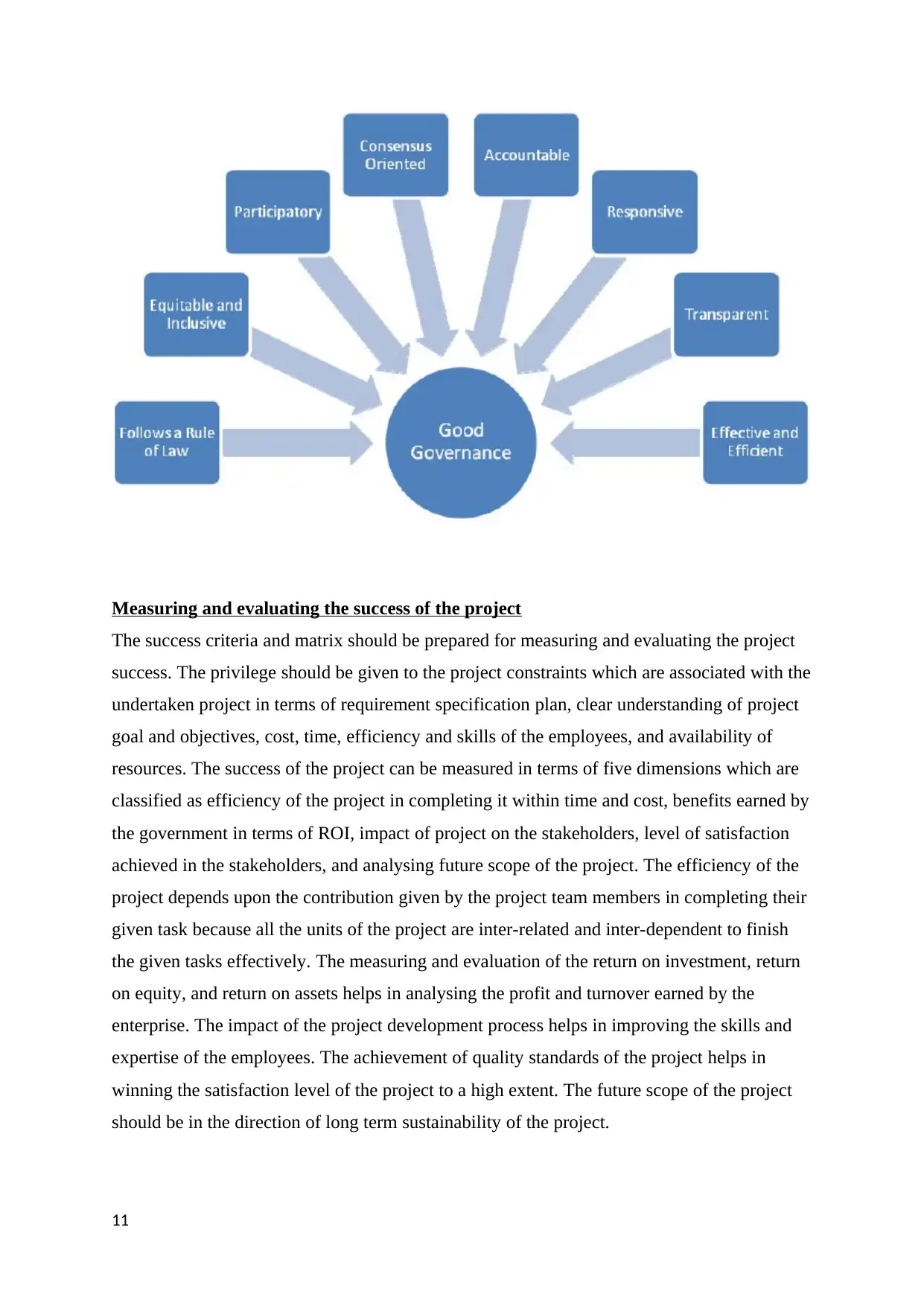
for completing the project. The good governance of the project can be judged by following
characteristics:
Participation: The project manager should focus on analysing the active participation of the
internal and external employees in the development process of the project. The need and
requirement of the project can be completed by the approaching the division of work among
the member participants according to their capabilities, will-power, and efficiency.
Consensus Orientation: The interest of the member participants should be evaluated in the
development of the project. The growth of the project depends upon the interaction and
dependences among the different units of the project.
9
paradigm is constructed on assumptions so that the activities can be completed as desired.
The empirical testing of the project is used for analysing the level of contribution given by
the development program of the project.
Contribution of project governance on the project success
The validity of the project success is realised by the framework adopted for incorporating the
project development lifecycle for accomplishing the tasks with ease. The broadcasting of the
project leadership helps in monitoring the flow of information between the different
departments and stakeholders of the project. The performance of the project can be measured
in terms of the alignment of project activities with the corporate performance of the business
units. The assumptions should be made for deploying the policies and controls for governing
the project in the direction of project success parameters. The maximum output can be
retrieved from the stakeholders by providing them authorization, control, and required
resources. The control parameters are used for governing the project requirement in
approaching the success of the project. The leadership style adopted by the project manager
in the development of the project plays a vital role in managing team cooperation and
coordination among the internal and external stakeholders of the project. The outcome of the
project is used for balancing the stakeholder diversified requirement for completing the given
tasks. The privilege should be given to the identification of project governance principles for
completing the tasks successfully. The decision making capability of the project manager can
be improved by incorporating project governance principles in the leadership style developed
for completing the project. The good governance of the project can be judged by following
characteristics:
Participation: The project manager should focus on analysing the active participation of the
internal and external employees in the development process of the project. The need and
requirement of the project can be completed by the approaching the division of work among
the member participants according to their capabilities, will-power, and efficiency.
Consensus Orientation: The interest of the member participants should be evaluated in the
development of the project. The growth of the project depends upon the interaction and
dependences among the different units of the project.
9
Paraphrase This Document
Need a fresh take? Get an instant paraphrase of this document with our AI Paraphraser

Accountability: The focus should be given on the dependency of the decision making policies
for the systematic growth of the project according to the planned schedule. The effective
decision should be taken by the authorised parties in completing the given tasks.
Transparency: The transparency should be managed in the clear specification of the goals and
objectives of the project. The rules and regulations should be imposed for taking effective
decision in the betterment of the project for managing resources to the demanding units
(Dunna, and Burela, 2010).
Responsiveness: The stakeholders should be given responsibilities for completing their
required work within the given time, cost, and resources. The quality of the output should
matched with the quality standards. The good governance helps in managing required
authorities and control for completing the responsibilities with efficiency and control
(Anderson, Kvalnes, and Muller, 2013).
Efficiencies and effectiveness: The stakeholders requirement should be fulfilled for
completing the given tasks with efficiencies and effectiveness. The privilege should be given
to the distribution of the resources among the member participants and stakeholders (Ahmad,
2014).
Inclusion of Equitability: The equal opportunities should be provided to all the members of
the project team to show their calibre in completing the given tasks with efficiency. The anti-
discrimination policies should be deployed within the working culture of the organization to
get effective results of the good governance (Joslin and Muller, 2014).
Rules and regulations: The policy structure should be developed which specifies the
company’s rules and regulations in completing the given tasks. The legal framework of
policies structure should be deployed within the operational plan of the organization.
The following diagram shows the model for characteristics of good project governance
principles:
10
for the systematic growth of the project according to the planned schedule. The effective
decision should be taken by the authorised parties in completing the given tasks.
Transparency: The transparency should be managed in the clear specification of the goals and
objectives of the project. The rules and regulations should be imposed for taking effective
decision in the betterment of the project for managing resources to the demanding units
(Dunna, and Burela, 2010).
Responsiveness: The stakeholders should be given responsibilities for completing their
required work within the given time, cost, and resources. The quality of the output should
matched with the quality standards. The good governance helps in managing required
authorities and control for completing the responsibilities with efficiency and control
(Anderson, Kvalnes, and Muller, 2013).
Efficiencies and effectiveness: The stakeholders requirement should be fulfilled for
completing the given tasks with efficiencies and effectiveness. The privilege should be given
to the distribution of the resources among the member participants and stakeholders (Ahmad,
2014).
Inclusion of Equitability: The equal opportunities should be provided to all the members of
the project team to show their calibre in completing the given tasks with efficiency. The anti-
discrimination policies should be deployed within the working culture of the organization to
get effective results of the good governance (Joslin and Muller, 2014).
Rules and regulations: The policy structure should be developed which specifies the
company’s rules and regulations in completing the given tasks. The legal framework of
policies structure should be deployed within the operational plan of the organization.
The following diagram shows the model for characteristics of good project governance
principles:
10
Measuring and evaluating the success of the project
The success criteria and matrix should be prepared for measuring and evaluating the project
success. The privilege should be given to the project constraints which are associated with the
undertaken project in terms of requirement specification plan, clear understanding of project
goal and objectives, cost, time, efficiency and skills of the employees, and availability of
resources. The success of the project can be measured in terms of five dimensions which are
classified as efficiency of the project in completing it within time and cost, benefits earned by
the government in terms of ROI, impact of project on the stakeholders, level of satisfaction
achieved in the stakeholders, and analysing future scope of the project. The efficiency of the
project depends upon the contribution given by the project team members in completing their
given task because all the units of the project are inter-related and inter-dependent to finish
the given tasks effectively. The measuring and evaluation of the return on investment, return
on equity, and return on assets helps in analysing the profit and turnover earned by the
enterprise. The impact of the project development process helps in improving the skills and
expertise of the employees. The achievement of quality standards of the project helps in
winning the satisfaction level of the project to a high extent. The future scope of the project
should be in the direction of long term sustainability of the project.
11
The success criteria and matrix should be prepared for measuring and evaluating the project
success. The privilege should be given to the project constraints which are associated with the
undertaken project in terms of requirement specification plan, clear understanding of project
goal and objectives, cost, time, efficiency and skills of the employees, and availability of
resources. The success of the project can be measured in terms of five dimensions which are
classified as efficiency of the project in completing it within time and cost, benefits earned by
the government in terms of ROI, impact of project on the stakeholders, level of satisfaction
achieved in the stakeholders, and analysing future scope of the project. The efficiency of the
project depends upon the contribution given by the project team members in completing their
given task because all the units of the project are inter-related and inter-dependent to finish
the given tasks effectively. The measuring and evaluation of the return on investment, return
on equity, and return on assets helps in analysing the profit and turnover earned by the
enterprise. The impact of the project development process helps in improving the skills and
expertise of the employees. The achievement of quality standards of the project helps in
winning the satisfaction level of the project to a high extent. The future scope of the project
should be in the direction of long term sustainability of the project.
11
⊘ This is a preview!⊘
Do you want full access?
Subscribe today to unlock all pages.
Trusted by 1+ million students worldwide

1 out of 25


Related Documents


Your All-in-One AI-Powered Toolkit for Academic Success.
+13062052269
info@desklib.com
Available 24*7 on WhatsApp / Email
![[object Object]](/_next/static/media/star-bottom.7253800d.svg)
Unlock your academic potential
Copyright © 2020–2026 A2Z Services. All Rights Reserved. Developed and managed by ZUCOL.