Project Management Report: Canned Soup Product Development Project
VerifiedAdded on 2023/01/10
|28
|5777
|2
Report
AI Summary
This project management report details the development of a new canned soup product. The report begins with an introduction outlining the project's objectives, which involve research, development, marketing, and manufacturing. The project context is established, emphasizing the need for a detailed plan presented to senior management and a budget of £2.5 million with a set timeframe. The rationale for the proposed plan and chosen methods is then discussed, highlighting the use of various research techniques. These techniques include a PESTLE analysis, Work Breakdown Structure (WBS), Gantt chart, risk analysis, Responsibility Assignment Matrix (RACI), and stakeholder management strategy. Each technique is described in detail, providing insights into political, economic, socio-cultural, technological, legal, and environmental factors affecting the project. The WBS breaks down the project into phases: initiation, planning, launch and execution, performance and control, and closure. The Gantt chart outlines the project timeline, and the report concludes with recommendations and a conclusion summarizing the findings. Appendices include supporting data for the analyses.
PROJECT MANAGEMENT
1
1

Paraphrase This Document
Need a fresh take? Get an instant paraphrase of this document with our AI Paraphraser
Table of Contents
Introduction......................................................................................................................................3
Project context.................................................................................................................................3
Rationale for proposed plan and choice of methods........................................................................4
1. Technique 1: PESTLE Analysis..................................................................................................5
2. Technique 2: Work Breakdown Structure to analyze the project components...........................6
3. Technique 3: Gantt chart for the project......................................................................................7
4. Technique 4: Undertake a Risk Analysis for the project and identify a Risk Management......11
5. Technique 5: Responsibility, Accountability, Consulted and Informed (RACI) Matrix for the
Project............................................................................................................................................12
6. Technique 6: Stakeholder Management Strategy for the key project stakeholders...................14
Recommendation...........................................................................................................................17
Conclusion.....................................................................................................................................18
References......................................................................................................................................19
Appendix: 1: Pestle Analysis.........................................................................................................22
Appendix 2: WBS..........................................................................................................................22
Appendix 3: Gantt chart and project schedule...............................................................................23
Appendix 4: Risk analysis strategy or process..............................................................................24
Appendix 5: RACI Matrix.............................................................................................................25
Appendix 6: Stakeholder Management strategy............................................................................26
2
Introduction......................................................................................................................................3
Project context.................................................................................................................................3
Rationale for proposed plan and choice of methods........................................................................4
1. Technique 1: PESTLE Analysis..................................................................................................5
2. Technique 2: Work Breakdown Structure to analyze the project components...........................6
3. Technique 3: Gantt chart for the project......................................................................................7
4. Technique 4: Undertake a Risk Analysis for the project and identify a Risk Management......11
5. Technique 5: Responsibility, Accountability, Consulted and Informed (RACI) Matrix for the
Project............................................................................................................................................12
6. Technique 6: Stakeholder Management Strategy for the key project stakeholders...................14
Recommendation...........................................................................................................................17
Conclusion.....................................................................................................................................18
References......................................................................................................................................19
Appendix: 1: Pestle Analysis.........................................................................................................22
Appendix 2: WBS..........................................................................................................................22
Appendix 3: Gantt chart and project schedule...............................................................................23
Appendix 4: Risk analysis strategy or process..............................................................................24
Appendix 5: RACI Matrix.............................................................................................................25
Appendix 6: Stakeholder Management strategy............................................................................26
2
Introduction
The primary motive and objective of the project development are involved with the research and
development, marketing and the manufacturing of the new canned products manufactured by a
major food manufacturer of the country. The project plan will be developed by the project
designers, and that will be presented to the senior management team of the organization, which
will lead the whole scenario for the further research development and the production or
manufacturing of the products. On the other hand, it has been further realized that with the help
of the project development, the overall scenario and the phenomenon of the market can be
further realized that will further lead for more design process and design research methods.
Moreover, it can be noted that the minimum budget for the project has been £2.5 million and the
project also should be delivered within the actual time frame with the advanced quality and also
with the increased responsiveness towards the project (Andersen, 2016).
On the other hand, it has been further realized that in the project, the project context has been
given along with the rationale for the proposed plan and choice of the methods. In order to carry
out a project, different research methods have been used and that have been used for some
particular reasons. Thus, the particular reasons for using those research methods have been
described in this research study. Furthermore, the project context is also one of the important
parts of the project development. In the project context, the basic theme or the subject of the
study has been engraved, and on that same theme and the subject, the whole discussion of the
project is pillared upon (Badewi, 2016).
Project context
It can be further observed that the main project context is about the new project development,
which is consisting of different review points and the activities. The activities are very necessary
for gathering more information and data for solving out the difficulty of the projects. The project
plan will be developed by the project designers, and that will be presented to the senior
management team of the organization, which will lead the whole scenario for the further research
development and the production or manufacturing of the products. Furthermore, it has been
observed that interspersed between the two decisions will be reviewed for developing the next
stage of the project and thus heading the project towards the prior completion within the desired
time frame. Moreover, it can be further recognized that some of the researchers do not allow to
3
The primary motive and objective of the project development are involved with the research and
development, marketing and the manufacturing of the new canned products manufactured by a
major food manufacturer of the country. The project plan will be developed by the project
designers, and that will be presented to the senior management team of the organization, which
will lead the whole scenario for the further research development and the production or
manufacturing of the products. On the other hand, it has been further realized that with the help
of the project development, the overall scenario and the phenomenon of the market can be
further realized that will further lead for more design process and design research methods.
Moreover, it can be noted that the minimum budget for the project has been £2.5 million and the
project also should be delivered within the actual time frame with the advanced quality and also
with the increased responsiveness towards the project (Andersen, 2016).
On the other hand, it has been further realized that in the project, the project context has been
given along with the rationale for the proposed plan and choice of the methods. In order to carry
out a project, different research methods have been used and that have been used for some
particular reasons. Thus, the particular reasons for using those research methods have been
described in this research study. Furthermore, the project context is also one of the important
parts of the project development. In the project context, the basic theme or the subject of the
study has been engraved, and on that same theme and the subject, the whole discussion of the
project is pillared upon (Badewi, 2016).
Project context
It can be further observed that the main project context is about the new project development,
which is consisting of different review points and the activities. The activities are very necessary
for gathering more information and data for solving out the difficulty of the projects. The project
plan will be developed by the project designers, and that will be presented to the senior
management team of the organization, which will lead the whole scenario for the further research
development and the production or manufacturing of the products. Furthermore, it has been
observed that interspersed between the two decisions will be reviewed for developing the next
stage of the project and thus heading the project towards the prior completion within the desired
time frame. Moreover, it can be further recognized that some of the researchers do not allow to
3
⊘ This is a preview!⊘
Do you want full access?
Subscribe today to unlock all pages.

Trusted by 1+ million students worldwide
end the project until the previous gathering of all the noted information for the full completion of
the project (Bjorvatn & Wald, 2018).
On the other hand, it has been further realized that with the help of the project development, the
overall scenario and the phenomenon of the market will be further realized that will further lead
for more design process and design research methods. It can be further noticed that the reviewing
of the core assignment or the project will be done for the controlling the risk, prioritizing the
project and also allocating the same amount of resources for leading the tea for the cross-
disciplinary access (de Carvalho et al., 2015). In the case of the project development, it has been
further noted that the review of the team has been typical for the cross-disciplinary actions,
comprising of some of the senior managers from the research and development, finance and
marketing department. On the other hand, it has been further noticed that, the senior managers of
the organization has given sharp direction to the research designers to follow the review practices
method as it has been considered as one of the traditional methods and for the last four years, all
the project developers have been following the same steps and methods for reviewing their own
projects (Carvalho & Rabechini Junior, 2015).
It has been further noted that the present project development will be based on the reviews of the
425 product development and the management association members; those have primarily
focused on the three main elements and manners. Those are the testing of the initial screening of
the project. Development and the prior testing of the project and the commercialization of the
research project (Montoya et al., 2009)
Rationale for proposed plan and choice of methods
Moreover, it has been further noticed that the budget of the project is much comfortable for the
designers and thus the conduction of the primary research will be possible. In this paper, it can
be noted that there are three themes of the research project and it is behind the conduction of the
primary research. The three research criteria are the development of the research theories and the
review points and also a detailed analysis of the review criteria. Moreover, the decision makers
of the review committee have also been proved proficient and competent for the core
enhancement of radical and incremental projects all over the world (Todorović et al., 2015).
On the other hand, it has been further realized that in the project, the project context has been
given along with the rationale for the proposed plan and choice of the methods (Svejvig &
Andersen, 2015). In order to carry out a project, different research methods have been used and
4
the project (Bjorvatn & Wald, 2018).
On the other hand, it has been further realized that with the help of the project development, the
overall scenario and the phenomenon of the market will be further realized that will further lead
for more design process and design research methods. It can be further noticed that the reviewing
of the core assignment or the project will be done for the controlling the risk, prioritizing the
project and also allocating the same amount of resources for leading the tea for the cross-
disciplinary access (de Carvalho et al., 2015). In the case of the project development, it has been
further noted that the review of the team has been typical for the cross-disciplinary actions,
comprising of some of the senior managers from the research and development, finance and
marketing department. On the other hand, it has been further noticed that, the senior managers of
the organization has given sharp direction to the research designers to follow the review practices
method as it has been considered as one of the traditional methods and for the last four years, all
the project developers have been following the same steps and methods for reviewing their own
projects (Carvalho & Rabechini Junior, 2015).
It has been further noted that the present project development will be based on the reviews of the
425 product development and the management association members; those have primarily
focused on the three main elements and manners. Those are the testing of the initial screening of
the project. Development and the prior testing of the project and the commercialization of the
research project (Montoya et al., 2009)
Rationale for proposed plan and choice of methods
Moreover, it has been further noticed that the budget of the project is much comfortable for the
designers and thus the conduction of the primary research will be possible. In this paper, it can
be noted that there are three themes of the research project and it is behind the conduction of the
primary research. The three research criteria are the development of the research theories and the
review points and also a detailed analysis of the review criteria. Moreover, the decision makers
of the review committee have also been proved proficient and competent for the core
enhancement of radical and incremental projects all over the world (Todorović et al., 2015).
On the other hand, it has been further realized that in the project, the project context has been
given along with the rationale for the proposed plan and choice of the methods (Svejvig &
Andersen, 2015). In order to carry out a project, different research methods have been used and
4
Paraphrase This Document
Need a fresh take? Get an instant paraphrase of this document with our AI Paraphraser
that have been used for some particular reasons. Another main reason behind the development of
the project is the reviewing of the NPD projects with the help of the Product Development &
Management Association (PDMA) members (Cha et al., 2018).
Thus, the particular reasons for using those research methods have been described in this
research study. Furthermore, the project context is also one of the important parts of the project
development. In the project context, the basic theme or the subject of the study has been
engraved, and on that same theme and the subject, the whole discussion of the project is pillared
upon (Heagney, 2016).
1. Technique 1: PESTLE Analysis
Political: Britain's referendum to leave the European Union (EU) has distorted the political
scenario of this country. On another hand, high corruption level and terrorism activities might
influence the expected outcome of this plan. It can also be said that the food manufacturing
industry of the UK might also face some trade-related issues for this Brexit issue.
Economic: The food manufacturing industry of this country has been expanded significantly.
Hence, it is observed that the UK Government has taken effective initiatives to minimize the
scarcity of the foods. Therefore, it is also observed that the UK economy is effectively dependent
on the food industry. Therefore, introducing new soups might play effective roles in developing
the economy of this country.
Socio-cultural: A recent research has identified that more than a billion people in the UK are the
victim of insufficient calories. Besides these, approximately a quarter portion of the people in
this country is facing the issue of obesity. Hence, the introduction of healthy soup will help the
company to influence the buying behavior of consumers.
Technological: To improve access to the food system and maintaining safety, multiple types of
equipment have been developed. Therefore, an example can be drawn from the recent
introduction of Artificial Intelligence (AI), which has helped the food manufacturing industry to
reach new heights.
Legal: The proposed product should comply with the regulatory guidelines provided by the
Government of the UK. Hence, it is essential for the project manager to meet the quality
standards of products.
5
the project is the reviewing of the NPD projects with the help of the Product Development &
Management Association (PDMA) members (Cha et al., 2018).
Thus, the particular reasons for using those research methods have been described in this
research study. Furthermore, the project context is also one of the important parts of the project
development. In the project context, the basic theme or the subject of the study has been
engraved, and on that same theme and the subject, the whole discussion of the project is pillared
upon (Heagney, 2016).
1. Technique 1: PESTLE Analysis
Political: Britain's referendum to leave the European Union (EU) has distorted the political
scenario of this country. On another hand, high corruption level and terrorism activities might
influence the expected outcome of this plan. It can also be said that the food manufacturing
industry of the UK might also face some trade-related issues for this Brexit issue.
Economic: The food manufacturing industry of this country has been expanded significantly.
Hence, it is observed that the UK Government has taken effective initiatives to minimize the
scarcity of the foods. Therefore, it is also observed that the UK economy is effectively dependent
on the food industry. Therefore, introducing new soups might play effective roles in developing
the economy of this country.
Socio-cultural: A recent research has identified that more than a billion people in the UK are the
victim of insufficient calories. Besides these, approximately a quarter portion of the people in
this country is facing the issue of obesity. Hence, the introduction of healthy soup will help the
company to influence the buying behavior of consumers.
Technological: To improve access to the food system and maintaining safety, multiple types of
equipment have been developed. Therefore, an example can be drawn from the recent
introduction of Artificial Intelligence (AI), which has helped the food manufacturing industry to
reach new heights.
Legal: The proposed product should comply with the regulatory guidelines provided by the
Government of the UK. Hence, it is essential for the project manager to meet the quality
standards of products.
5
Environmental: The product development team should focus on keeping the environment safe.
Hence, multiple environment protection acts should be followed, while packaging and
manufacturing the product.
2. Technique 2: Work Breakdown Structure to analyze the project components
In order to make the product, a market success many steps need to be followed, and the work can
be broken down as given below:
Phase 1: Project Initiation
Market research is the main prospect of this stage. The proposed product is basically ready for
the canned soup that consumers can warm and consume (Hoda & Murugesan, 2016). The market
currently has many such products, and this new line of soups which are proposed to be excellent
soups need to be well researched with the needs and demands of the market in order to be a
successful product.
Phase 2: Project Planning
Planning and finalizing the product and flavors to be offered is the second phase of this project.
The research team will need to find the trends from the survey and come up with the final
product plan along with the menu or the flavors of the soup that will be offered (Hornstein,
2015).
Phase 3: Launch and execution
Recruitment of manpower and development of production facility planning can be implemented
in this phase (Joslin & Muller, 2015). Launching and executing of the planning are the two of the
most important parts of the entire process where the team and facility that will be used for
developing the product will be finalized. Manpower would include the entire team from market
procurers to chefs to marketing personnel to goods handling and transportation team.
Phase 4: Performance and control
Production, packaging, and marketing of the product need to be done in this phase. The
penultimate step will be the production of the soup and the packaging of the soup along with its
marketing. This step will ensure the success of the product to a large extent as the final product is
being produced and the quality of the product will be of essential importance. Then comes the
packaging of the product which again is very important because if the product packaging is
attractive, then consumers tend to get attracted to it and thus sales generally happen to be on the
higher side (Kerzner & Kerzner, 2017). Next is marketing of the product, in today’s world
6
Hence, multiple environment protection acts should be followed, while packaging and
manufacturing the product.
2. Technique 2: Work Breakdown Structure to analyze the project components
In order to make the product, a market success many steps need to be followed, and the work can
be broken down as given below:
Phase 1: Project Initiation
Market research is the main prospect of this stage. The proposed product is basically ready for
the canned soup that consumers can warm and consume (Hoda & Murugesan, 2016). The market
currently has many such products, and this new line of soups which are proposed to be excellent
soups need to be well researched with the needs and demands of the market in order to be a
successful product.
Phase 2: Project Planning
Planning and finalizing the product and flavors to be offered is the second phase of this project.
The research team will need to find the trends from the survey and come up with the final
product plan along with the menu or the flavors of the soup that will be offered (Hornstein,
2015).
Phase 3: Launch and execution
Recruitment of manpower and development of production facility planning can be implemented
in this phase (Joslin & Muller, 2015). Launching and executing of the planning are the two of the
most important parts of the entire process where the team and facility that will be used for
developing the product will be finalized. Manpower would include the entire team from market
procurers to chefs to marketing personnel to goods handling and transportation team.
Phase 4: Performance and control
Production, packaging, and marketing of the product need to be done in this phase. The
penultimate step will be the production of the soup and the packaging of the soup along with its
marketing. This step will ensure the success of the product to a large extent as the final product is
being produced and the quality of the product will be of essential importance. Then comes the
packaging of the product which again is very important because if the product packaging is
attractive, then consumers tend to get attracted to it and thus sales generally happen to be on the
higher side (Kerzner & Kerzner, 2017). Next is marketing of the product, in today’s world
6
⊘ This is a preview!⊘
Do you want full access?
Subscribe today to unlock all pages.
Trusted by 1+ million students worldwide
marketing is the key and success of any product depends massively on the marketing campaign
run by the promoting company during its lifetime. Marketing begins well before the actual
production of the product and continues throughout the lifetime of the product thus marketing
along with a quality product are undoubtedly the two fundamental pillars for the success of a
product.
Phase 5: Project closure
Inventory handling and transportation of products is the final phase of this project. The final step
that will ensure that the product is always available as per the market demands and smooth stock
maintenance of the product happen at the manufacturing end along with convenient
transportation also happens as per needed at various locations where the product will be sold
(Kivilä et al., 2017).
3. Technique 3: Gantt chart for the project
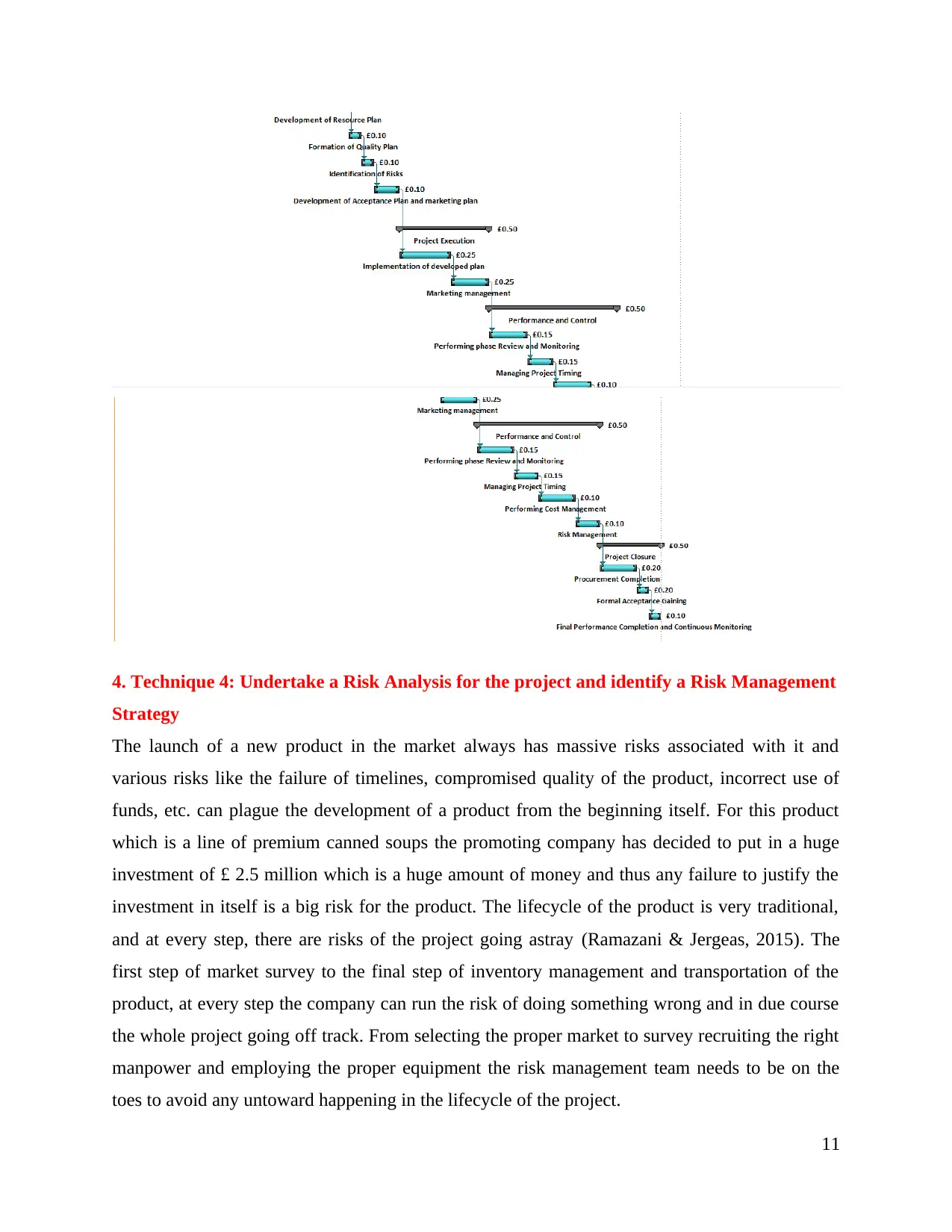
Figure 1: Gantt chart
The timeline of a project is of quintessential importance and in general the timelines of any
project is mostly stringent so is the case with this project as the promoting company needs to
make sure that the finished product can be available in the market for the consumers at the
shortest possible time (Kivilä et al., 2017). On the other side the promoting company does not
want to hurry to make the product available in the market as that might mean under-researched
product or low-quality product which is not acceptable for the company, The company has made
7
run by the promoting company during its lifetime. Marketing begins well before the actual
production of the product and continues throughout the lifetime of the product thus marketing
along with a quality product are undoubtedly the two fundamental pillars for the success of a
product.
Phase 5: Project closure
Inventory handling and transportation of products is the final phase of this project. The final step
that will ensure that the product is always available as per the market demands and smooth stock
maintenance of the product happen at the manufacturing end along with convenient
transportation also happens as per needed at various locations where the product will be sold
(Kivilä et al., 2017).
3. Technique 3: Gantt chart for the project
Figure 1: Gantt chart
The timeline of a project is of quintessential importance and in general the timelines of any
project is mostly stringent so is the case with this project as the promoting company needs to
make sure that the finished product can be available in the market for the consumers at the
shortest possible time (Kivilä et al., 2017). On the other side the promoting company does not
want to hurry to make the product available in the market as that might mean under-researched
product or low-quality product which is not acceptable for the company, The company has made
7
Paraphrase This Document
Need a fresh take? Get an instant paraphrase of this document with our AI Paraphraser
sure that the product is going to be placed in the market as premium canned soup and thus the
company is ready to make all necessary efforts to justify the premium tag on the product (Meng
& Boyd, 2017). Timeline or project schedule has been attached in the Appendix.
The timeline for the product has been very carefully planned and the market survey which is
going to be the pillar on which the entire project is going to stand has been given ample amount
of time of 4 weeks and another 2 weeks have been provided to the timeline of a market survey in
order to ensure that the data collected from the survey can be properly analyzed and applied to
the development of the product. Then one the basis of the data from the market survey the
planning of the product will be done in the next three weeks. It is also during this time that the
manpower recruitment will happen. Post the manpower recruitment the development of the
production facility will happen over the next four weeks (Papke-Shields & Boyer-Wright, 2017).
The production facility will be prepared as per the final plan of the product, and accordingly, the
equipment required will be installed. During the time the production facility is being prepared
small sample batches of proposed products will be made and tested in a smaller test production
unit. By the time the production facility is ready, the final selection of products will also be
ready, and the production, packaging, and marketing will start henceforth. Post 2 weeks of
production the materials will be stored, and shipping to sales points will begin, and the lifecycle
of the project will begin in full swing (Qazi, et al., 2016). In order to ensure that all the timelines
are properly maintained and taken care of the company will gain much ease by following a Gantt
chart for the timelines of the product and over time necessary corrections to the timelines can be
made as per the situation at that point of time.
Project Components Duration Budget
Project Name Project Management of research, development,
manufacturing, and marketing of new canned
products for a major food manufacturer
187 Days £2.5
million
8
company is ready to make all necessary efforts to justify the premium tag on the product (Meng
& Boyd, 2017). Timeline or project schedule has been attached in the Appendix.
The timeline for the product has been very carefully planned and the market survey which is
going to be the pillar on which the entire project is going to stand has been given ample amount
of time of 4 weeks and another 2 weeks have been provided to the timeline of a market survey in
order to ensure that the data collected from the survey can be properly analyzed and applied to
the development of the product. Then one the basis of the data from the market survey the
planning of the product will be done in the next three weeks. It is also during this time that the
manpower recruitment will happen. Post the manpower recruitment the development of the
production facility will happen over the next four weeks (Papke-Shields & Boyer-Wright, 2017).
The production facility will be prepared as per the final plan of the product, and accordingly, the
equipment required will be installed. During the time the production facility is being prepared
small sample batches of proposed products will be made and tested in a smaller test production
unit. By the time the production facility is ready, the final selection of products will also be
ready, and the production, packaging, and marketing will start henceforth. Post 2 weeks of
production the materials will be stored, and shipping to sales points will begin, and the lifecycle
of the project will begin in full swing (Qazi, et al., 2016). In order to ensure that all the timelines
are properly maintained and taken care of the company will gain much ease by following a Gantt
chart for the timelines of the product and over time necessary corrections to the timelines can be
made as per the situation at that point of time.
Project Components Duration Budget
Project Name Project Management of research, development,
manufacturing, and marketing of new canned
products for a major food manufacturer
187 Days £2.5
million
8
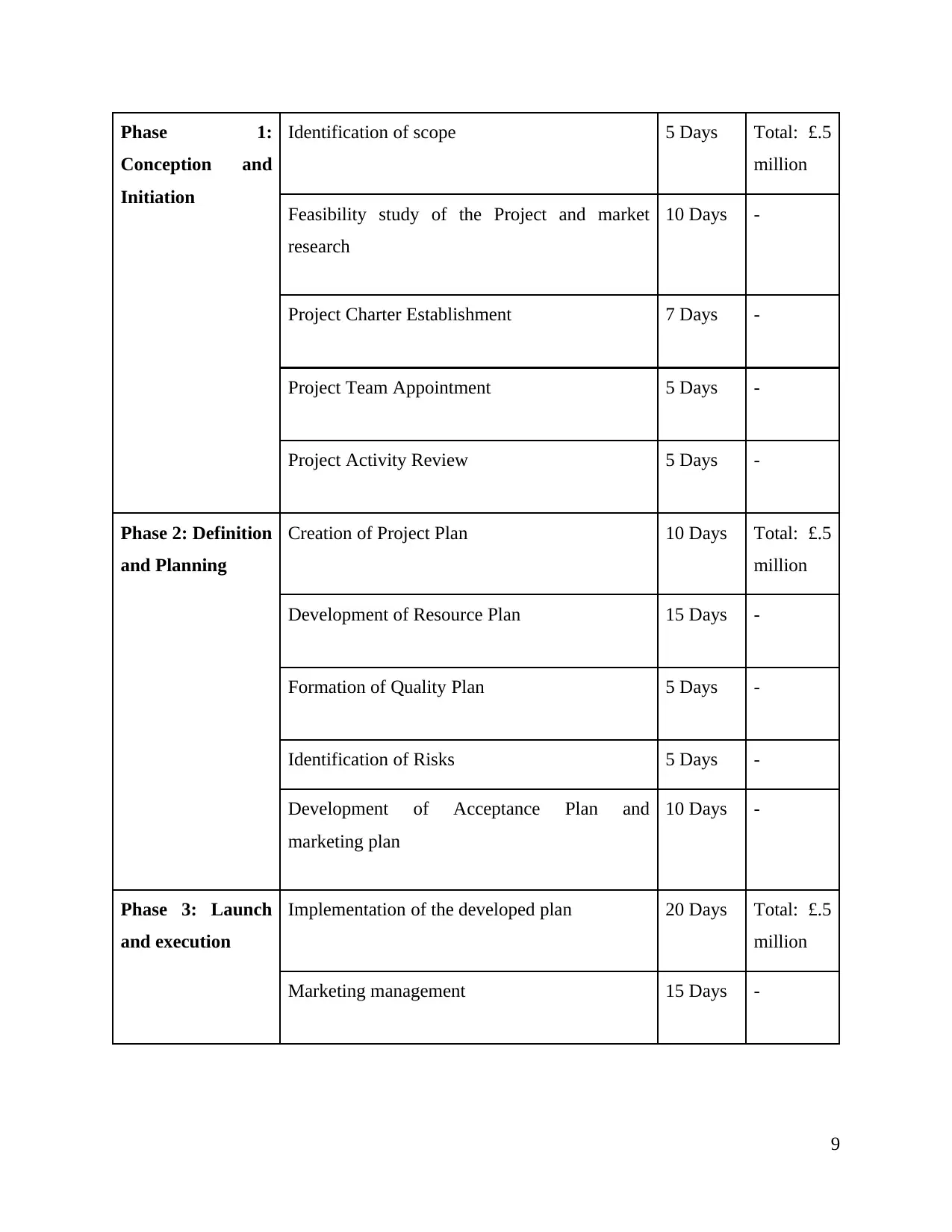
Phase 1:
Conception and
Initiation
Identification of scope 5 Days Total: £.5
million
Feasibility study of the Project and market
research
10 Days -
Project Charter Establishment 7 Days -
Project Team Appointment 5 Days -
Project Activity Review 5 Days -
Phase 2: Definition
and Planning
Creation of Project Plan 10 Days Total: £.5
million
Development of Resource Plan 15 Days -
Formation of Quality Plan 5 Days -
Identification of Risks 5 Days -
Development of Acceptance Plan and
marketing plan
10 Days -
Phase 3: Launch
and execution
Implementation of the developed plan 20 Days Total: £.5
million
Marketing management 15 Days -
9
Conception and
Initiation
Identification of scope 5 Days Total: £.5
million
Feasibility study of the Project and market
research
10 Days -
Project Charter Establishment 7 Days -
Project Team Appointment 5 Days -
Project Activity Review 5 Days -
Phase 2: Definition
and Planning
Creation of Project Plan 10 Days Total: £.5
million
Development of Resource Plan 15 Days -
Formation of Quality Plan 5 Days -
Identification of Risks 5 Days -
Development of Acceptance Plan and
marketing plan
10 Days -
Phase 3: Launch
and execution
Implementation of the developed plan 20 Days Total: £.5
million
Marketing management 15 Days -
9
⊘ This is a preview!⊘
Do you want full access?
Subscribe today to unlock all pages.
Trusted by 1+ million students worldwide
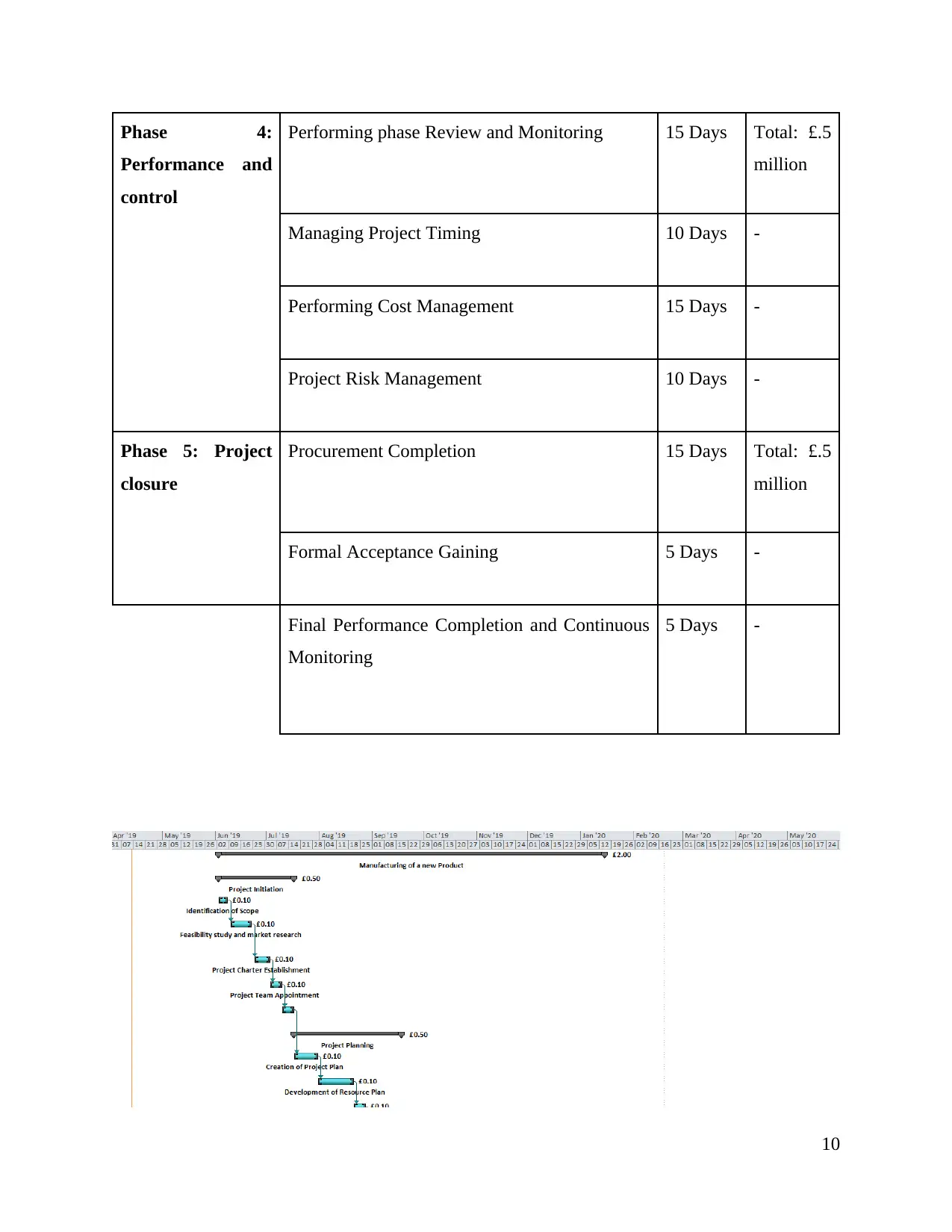
Phase 4:
Performance and
control
Performing phase Review and Monitoring 15 Days Total: £.5
million
Managing Project Timing 10 Days -
Performing Cost Management 15 Days -
Project Risk Management 10 Days -
Phase 5: Project
closure
Procurement Completion 15 Days Total: £.5
million
Formal Acceptance Gaining 5 Days -
Final Performance Completion and Continuous
Monitoring
5 Days -
10
Performance and
control
Performing phase Review and Monitoring 15 Days Total: £.5
million
Managing Project Timing 10 Days -
Performing Cost Management 15 Days -
Project Risk Management 10 Days -
Phase 5: Project
closure
Procurement Completion 15 Days Total: £.5
million
Formal Acceptance Gaining 5 Days -
Final Performance Completion and Continuous
Monitoring
5 Days -
10
Paraphrase This Document
Need a fresh take? Get an instant paraphrase of this document with our AI Paraphraser
4. Technique 4: Undertake a Risk Analysis for the project and identify a Risk Management
Strategy
The launch of a new product in the market always has massive risks associated with it and
various risks like the failure of timelines, compromised quality of the product, incorrect use of
funds, etc. can plague the development of a product from the beginning itself. For this product
which is a line of premium canned soups the promoting company has decided to put in a huge
investment of £ 2.5 million which is a huge amount of money and thus any failure to justify the
investment in itself is a big risk for the product. The lifecycle of the product is very traditional,
and at every step, there are risks of the project going astray (Ramazani & Jergeas, 2015). The
first step of market survey to the final step of inventory management and transportation of the
product, at every step the company can run the risk of doing something wrong and in due course
the whole project going off track. From selecting the proper market to survey recruiting the right
manpower and employing the proper equipment the risk management team needs to be on the
toes to avoid any untoward happening in the lifecycle of the project.
11
Strategy
The launch of a new product in the market always has massive risks associated with it and
various risks like the failure of timelines, compromised quality of the product, incorrect use of
funds, etc. can plague the development of a product from the beginning itself. For this product
which is a line of premium canned soups the promoting company has decided to put in a huge
investment of £ 2.5 million which is a huge amount of money and thus any failure to justify the
investment in itself is a big risk for the product. The lifecycle of the product is very traditional,
and at every step, there are risks of the project going astray (Ramazani & Jergeas, 2015). The
first step of market survey to the final step of inventory management and transportation of the
product, at every step the company can run the risk of doing something wrong and in due course
the whole project going off track. From selecting the proper market to survey recruiting the right
manpower and employing the proper equipment the risk management team needs to be on the
toes to avoid any untoward happening in the lifecycle of the project.
11
An effective risk management strategy is essential to identify and mitigate the risks if possible
and if outright mitigation of the risks is not possible then at least there can be strategies in place
to minimize the impact of the risk on the project. For this reason, a dedicated team must be in
place to watch out from internal risks like slow work by employees to incorrect equipment in
work and also from any external risk like wrong marketing strategy or selection of the wrong
vendors to procure raw materials for the products (Serra & Kunc, 2015). Whenever the risk
management team finds any risk factor, they must immediately try to mitigate for reducing the
risk. Find alternate ways to do work which are running into some operational risk is an age-old
and effective risk management strategy and the same can be very effectively applied to this
project. Overall the project will have ample operational and planning related risks associated
with it till its first few batches of production and the risk management team will need to be on
the toes to watch out for and mitigate the risks at the earliest (Sunder, 2016)
5. Technique 5: Responsibility, Accountability, Consulted and Informed (RACI) Matrix for
the Project
In a project life cycle, proper identification of role and responsibility of the project team plays a
vital role as the overall success rate of the project depends on the proper work activity of the
team members (Sarangee, et al., 2018). RACI, or Responsibility, Accountability, Consulted and
Informed Matrix, is just the identification as well as the distribution of task based on the phase of
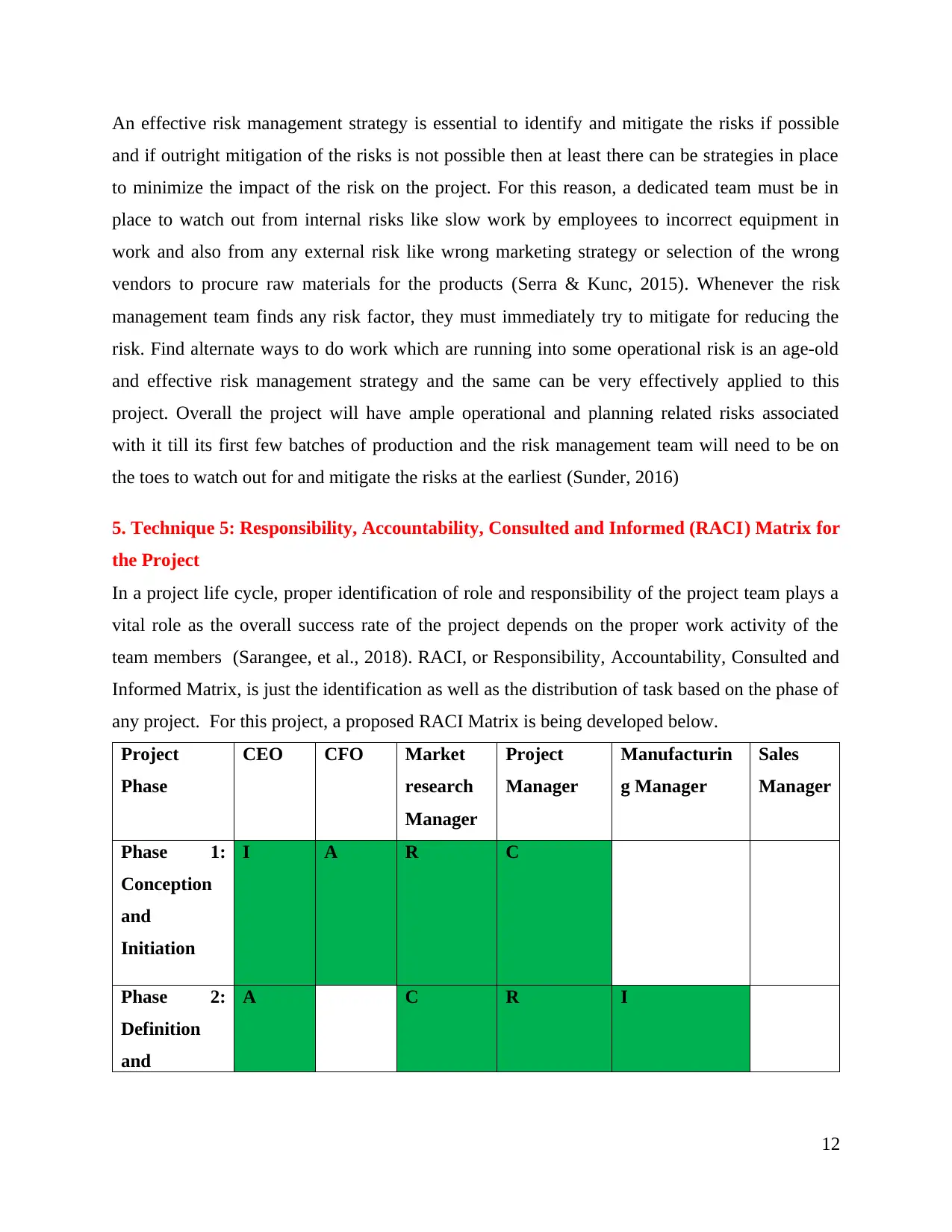
any project. For this project, a proposed RACI Matrix is being developed below.
Project
Phase
CEO CFO Market
research
Manager
Project
Manager
Manufacturin
g Manager
Sales
Manager
Phase 1:
Conception
and
Initiation
I A R C
Phase 2:
Definition
and
A C R I
12
and if outright mitigation of the risks is not possible then at least there can be strategies in place
to minimize the impact of the risk on the project. For this reason, a dedicated team must be in
place to watch out from internal risks like slow work by employees to incorrect equipment in
work and also from any external risk like wrong marketing strategy or selection of the wrong
vendors to procure raw materials for the products (Serra & Kunc, 2015). Whenever the risk
management team finds any risk factor, they must immediately try to mitigate for reducing the
risk. Find alternate ways to do work which are running into some operational risk is an age-old
and effective risk management strategy and the same can be very effectively applied to this
project. Overall the project will have ample operational and planning related risks associated
with it till its first few batches of production and the risk management team will need to be on
the toes to watch out for and mitigate the risks at the earliest (Sunder, 2016)
5. Technique 5: Responsibility, Accountability, Consulted and Informed (RACI) Matrix for
the Project
In a project life cycle, proper identification of role and responsibility of the project team plays a
vital role as the overall success rate of the project depends on the proper work activity of the
team members (Sarangee, et al., 2018). RACI, or Responsibility, Accountability, Consulted and
Informed Matrix, is just the identification as well as the distribution of task based on the phase of
any project. For this project, a proposed RACI Matrix is being developed below.
Project
Phase
CEO CFO Market
research
Manager
Project
Manager
Manufacturin
g Manager
Sales
Manager
Phase 1:
Conception
and
Initiation
I A R C
Phase 2:
Definition
and
A C R I
12
⊘ This is a preview!⊘
Do you want full access?
Subscribe today to unlock all pages.
Trusted by 1+ million students worldwide

1 out of 28


Related Documents


Your All-in-One AI-Powered Toolkit for Academic Success.
+13062052269
info@desklib.com
Available 24*7 on WhatsApp / Email
![[object Object]](/_next/static/media/star-bottom.7253800d.svg)
Unlock your academic potential
Copyright © 2020–2026 A2Z Services. All Rights Reserved. Developed and managed by ZUCOL.