Project Management Methodologies: A Comparison and Analysis

Verified

Added on Ā 2020/04/13

|6
|1310
|122
Report
AI Summary
This report provides a comprehensive overview of project management methodologies, focusing on the comparison between PMBOK and PRINCE2. It defines project methodologies and their importance in guiding project members through planning, design, and implementation. The report highlights the key differences between PMBOK and PRINCE2, including their definitions, knowledge areas, focus, and principles. It further explores the application of PRINCE2 within the project life cycle, detailing the various stages such as starting the project, initiating, directing, controlling, managing stage boundaries, managing product delivery, and closing the project. The report emphasizes the systematic and disciplined approach of project methodologies in ensuring successful project completion, as well as the importance of effective decision-making and problem-solving within project management.
Document Page
Running head: PROJECT MANAGEMENT METHODOLOGIES
Project Management Methodologies
Name of Student-
Name of University-
Author Note-
tabler-icon-diamond-filled.svg

Paraphrase This Document

Need a fresh take? Get an instant paraphrase of this document with our AI Paraphraser
Document Page
1PROJECT MANAGEMENT METHODOLOGIES
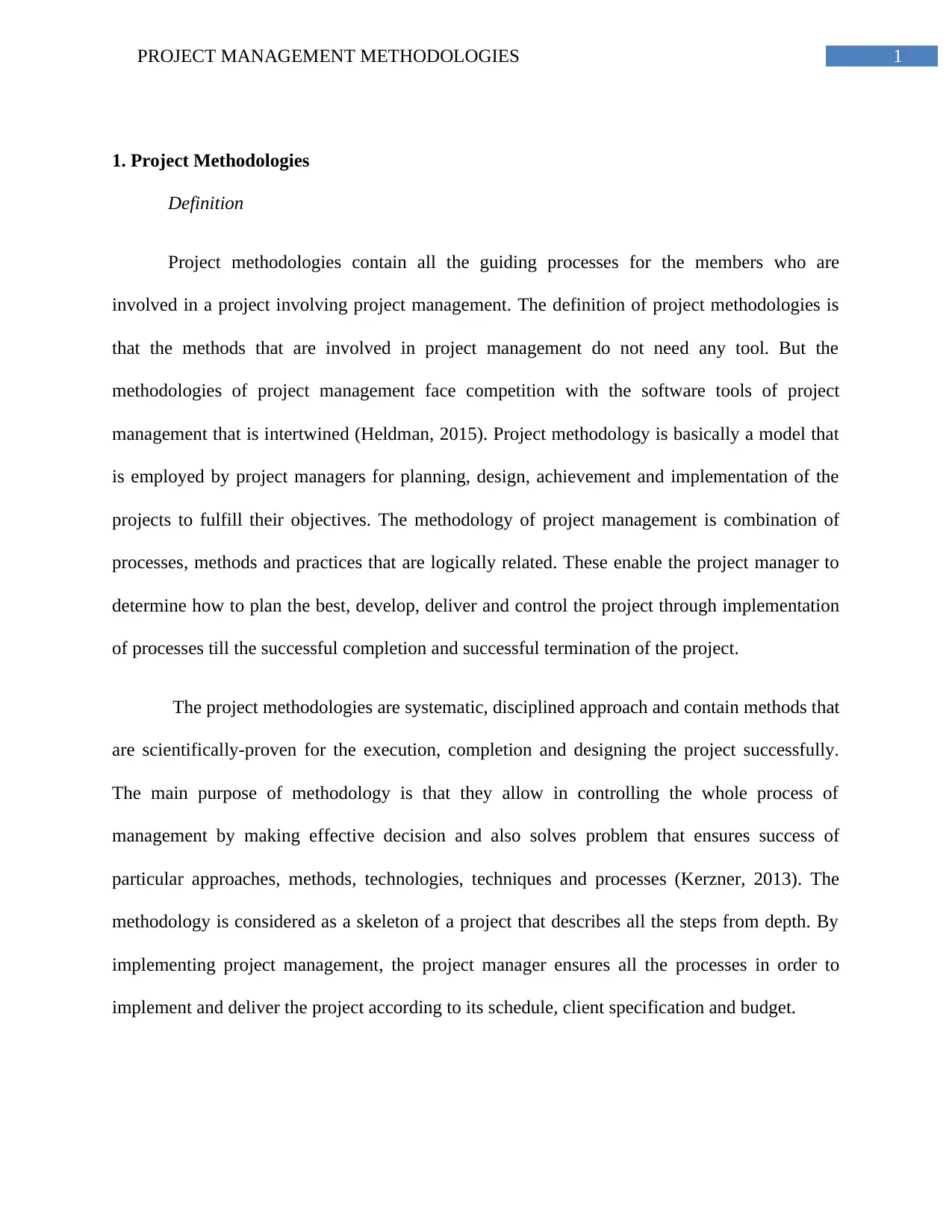
1. Project Methodologies
Definition
Project methodologies contain all the guiding processes for the members who are
involved in a project involving project management. The definition of project methodologies is
that the methods that are involved in project management do not need any tool. But the
methodologies of project management face competition with the software tools of project
management that is intertwined (Heldman, 2015). Project methodology is basically a model that
is employed by project managers for planning, design, achievement and implementation of the
projects to fulfill their objectives. The methodology of project management is combination of
processes, methods and practices that are logically related. These enable the project manager to
determine how to plan the best, develop, deliver and control the project through implementation
of processes till the successful completion and successful termination of the project.
The project methodologies are systematic, disciplined approach and contain methods that
are scientifically-proven for the execution, completion and designing the project successfully.
The main purpose of methodology is that they allow in controlling the whole process of
management by making effective decision and also solves problem that ensures success of
particular approaches, methods, technologies, techniques and processes (Kerzner, 2013). The
methodology is considered as a skeleton of a project that describes all the steps from depth. By
implementing project management, the project manager ensures all the processes in order to
implement and deliver the project according to its schedule, client specification and budget.
Document Page
2PROJECT MANAGEMENT METHODOLOGIES
Role of Project Methodologies in Project Management
Project management is a collection of relevant knowledge that is structured to make
change in methodologies. Project methodologies in project management help in managing
projects that are involved in an organization. Project methodologies in a project management
does not describe the exact algorithm about how the changing is to be made or about how to
manage a particular project but methodologies provide a wide overview of different processes,
rules, methods and standards (Leach, 2014). Managing the projects means performing and
describing activities that are needed to meet the objectives of making some change in the project.
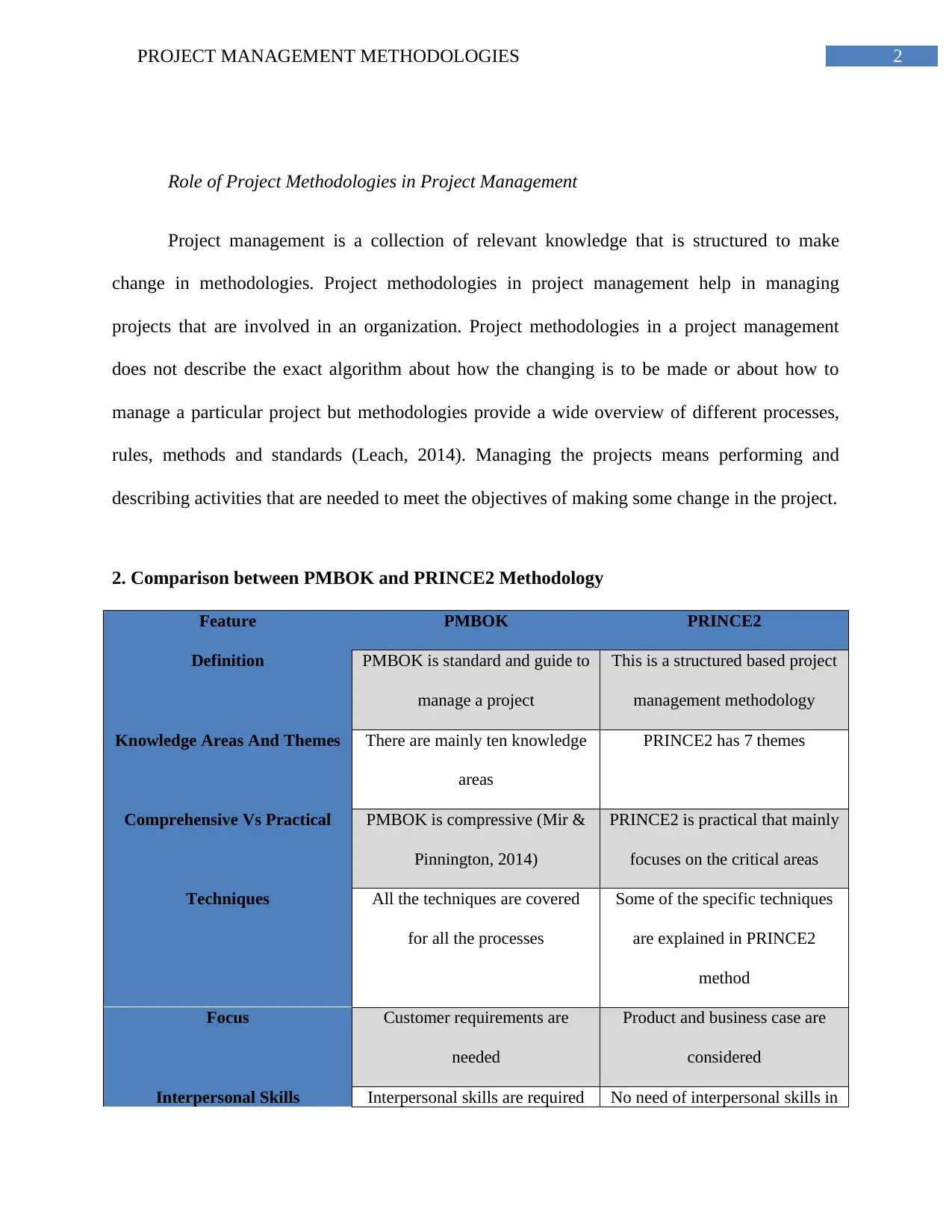
2. Comparison between PMBOK and PRINCE2 Methodology
Feature PMBOK PRINCE2
Definition PMBOK is standard and guide to
manage a project
This is a structured based project
management methodology
Knowledge Areas And Themes There are mainly ten knowledge
areas
PRINCE2 has 7 themes
Comprehensive Vs Practical PMBOK is compressive (Mir &
Pinnington, 2014)
PRINCE2 is practical that mainly
focuses on the critical areas
Techniques All the techniques are covered
for all the processes
Some of the specific techniques
are explained in PRINCE2
method
Focus Customer requirements are
needed
Product and business case are
considered
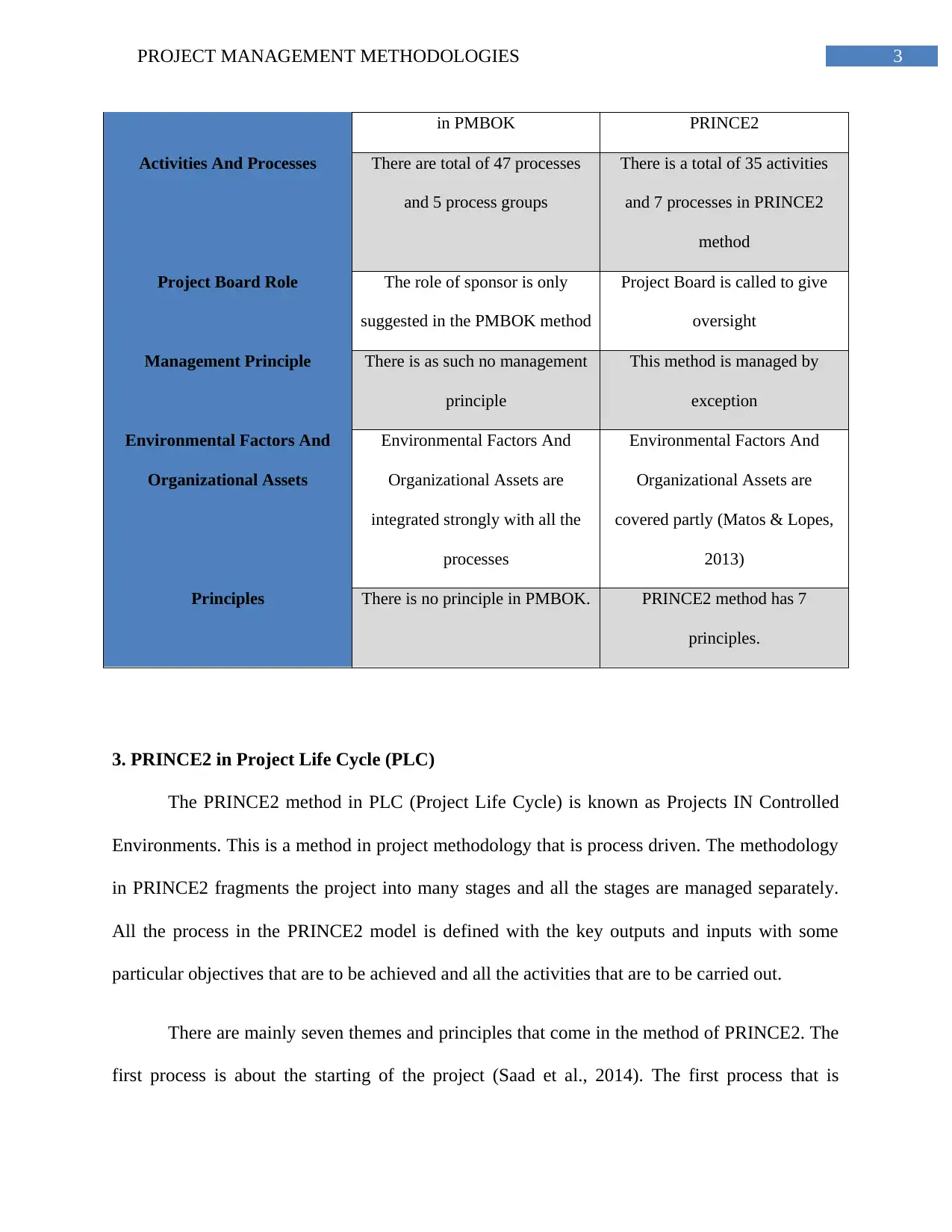
Interpersonal Skills Interpersonal skills are required No need of interpersonal skills in
Document Page
3PROJECT MANAGEMENT METHODOLOGIES
in PMBOK PRINCE2
Activities And Processes There are total of 47 processes
and 5 process groups
There is a total of 35 activities
and 7 processes in PRINCE2
method
Project Board Role The role of sponsor is only
suggested in the PMBOK method
Project Board is called to give
oversight
Management Principle There is as such no management
principle
This method is managed by
exception
Environmental Factors And
Organizational Assets
Environmental Factors And
Organizational Assets are
integrated strongly with all the
processes
Environmental Factors And
Organizational Assets are
covered partly (Matos & Lopes,
2013)
Principles There is no principle in PMBOK. PRINCE2 method has 7
principles.
3. PRINCE2 in Project Life Cycle (PLC)
The PRINCE2 method in PLC (Project Life Cycle) is known as Projects IN Controlled
Environments. This is a method in project methodology that is process driven. The methodology
in PRINCE2 fragments the project into many stages and all the stages are managed separately.
All the process in the PRINCE2 model is defined with the key outputs and inputs with some
particular objectives that are to be achieved and all the activities that are to be carried out.
There are mainly seven themes and principles that come in the method of PRINCE2. The
first process is about the starting of the project (Saad et al., 2014). The first process that is
tabler-icon-diamond-filled.svg

Paraphrase This Document

Need a fresh take? Get an instant paraphrase of this document with our AI Paraphraser
Document Page
4PROJECT MANAGEMENT METHODOLOGIES
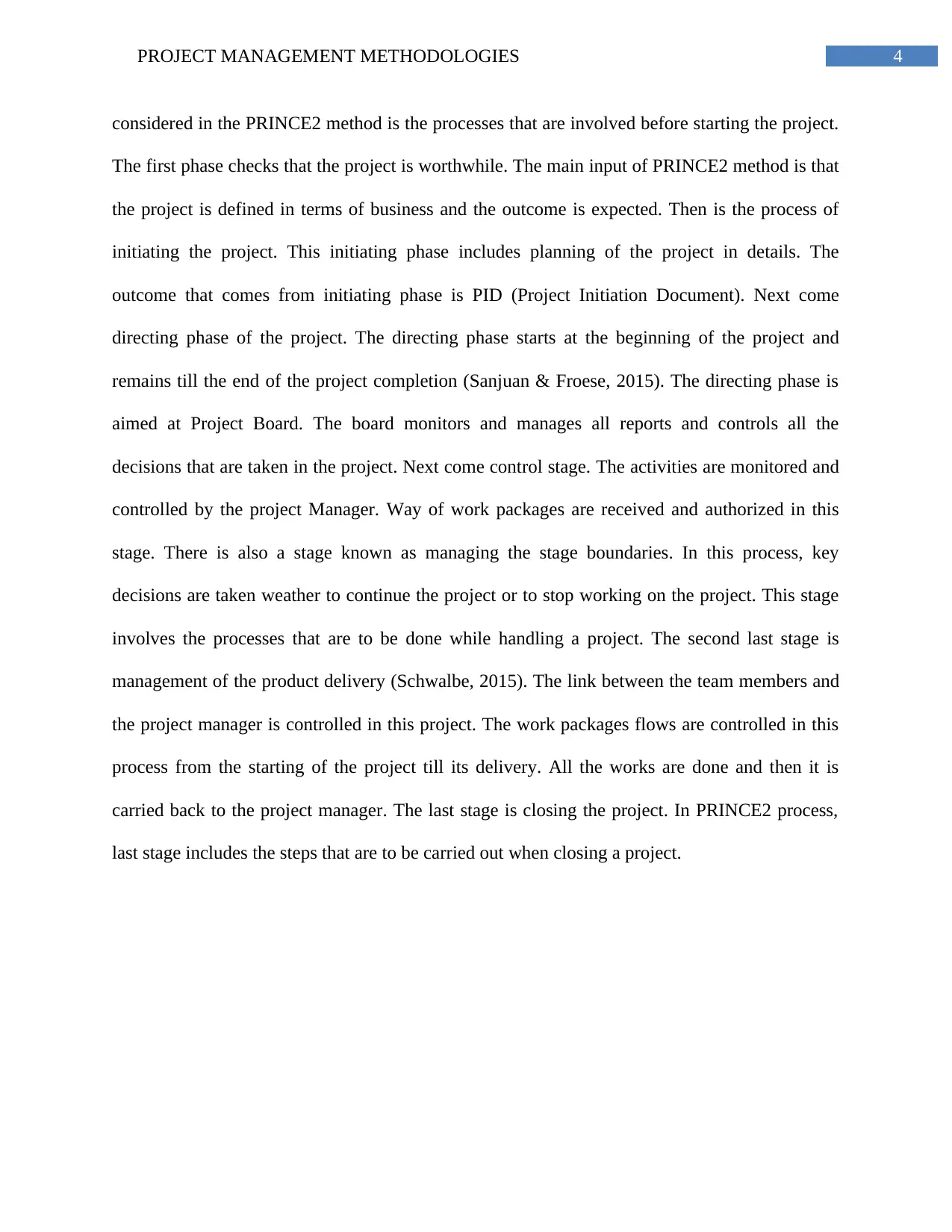
considered in the PRINCE2 method is the processes that are involved before starting the project.
The first phase checks that the project is worthwhile. The main input of PRINCE2 method is that
the project is defined in terms of business and the outcome is expected. Then is the process of
initiating the project. This initiating phase includes planning of the project in details. The
outcome that comes from initiating phase is PID (Project Initiation Document). Next come
directing phase of the project. The directing phase starts at the beginning of the project and
remains till the end of the project completion (Sanjuan & Froese, 2015). The directing phase is
aimed at Project Board. The board monitors and manages all reports and controls all the
decisions that are taken in the project. Next come control stage. The activities are monitored and
controlled by the project Manager. Way of work packages are received and authorized in this
stage. There is also a stage known as managing the stage boundaries. In this process, key
decisions are taken weather to continue the project or to stop working on the project. This stage
involves the processes that are to be done while handling a project. The second last stage is
management of the product delivery (Schwalbe, 2015). The link between the team members and
the project manager is controlled in this project. The work packages flows are controlled in this
process from the starting of the project till its delivery. All the works are done and then it is
carried back to the project manager. The last stage is closing the project. In PRINCE2 process,
last stage includes the steps that are to be carried out when closing a project.
Document Page
5PROJECT MANAGEMENT METHODOLOGIES
References
Heldman, K. (2015). PMP project management professional exam deluxe study guide: updated
for the 2015 Exam. John Wiley & Sons.
Kerzner, H. (2013). Project management: a systems approach to planning, scheduling, and
controlling. John Wiley & Sons.
Leach, L. P. (2014). Critical chain project management. Artech House.
Matos, S., & Lopes, E. (2013). Prince2 or PMBOK–a question of choice. Procedia
Technology, 9, 787-794.
Mir, F. A., & Pinnington, A. H. (2014). Exploring the value of project management: linking
project management performance and project success. International journal of project
management, 32(2), 202-217.
Saad, S., Ibrahim, A., Asma, O., Khan, M. S., & Akhter, J. (2014). PRINCE2 MEthodology: AN
INNovAtIvE WAy foR IMPRovINg PERfoRMANCE of MAlAysIAN AutoMotIvE
INdustRy. The Journal of Technology Management and Technopreneurship
(JTMT), 1(1).
Sanjuan, A. G., & Froese, T. (2015). Principles, characteristics, and methodology to develop a
project management assessment tool at the construction project level.
Schwalbe, K. (2015). Information technology project management. Cengage Learning.
chevron_up_icon
1 out of 6
circle_padding
hide_on_mobile
zoom_out_icon
[object Object]