University Project Report: Conflict in Project Management, ISYS5001
VerifiedAdded on 2023/01/16
|21
|5059
|56
Report
AI Summary
This research report delves into the critical issue of conflict within project management, examining its various causes, including differing priorities, communication breakdowns, and personality clashes among team members. The report provides a comprehensive overview of conflict, starting with an introduction, literature review, and background analysis. It explores the dynamics of conflict, its impact on project outcomes, and the importance of effective conflict resolution strategies. The report also offers a detailed analysis of the present findings and analysis, along with a literature review related to conflict and mentions a personal perspective and opinion based on the review. The report further discusses the benefits and drawbacks of conflict in organizational settings, providing insights into the dynamics of conflict and strategies for project managers to navigate these challenges effectively. Recommendations for conflict avoidance are also provided. The research incorporates multiple sources to provide a well-rounded perspective on this complex issue.
Running head: MANAGEMENT
Business Project Management
Name of the Student:
Name of the University:
Author Note:
Business Project Management
Name of the Student:
Name of the University:
Author Note:

Paraphrase This Document
Need a fresh take? Get an instant paraphrase of this document with our AI Paraphraser
1MANAGEMENT
Executive Summary:
The aim of the report is to focuses on the aspect of the conflict that arises in project management
thereby leading to the loss of the productivity, unwillingness of collaborations and the loss of
creativity. Conflict might arise at the starting of a new project or during the build up stage of the
project due to various reasons. The report aims at finding the reasons for conflict along with
finding the ways of conflict resolution. The report commences with an introduction along with a
mention of the scope for the literature review. The report then puts forward a background with a
mention of the present findings and analysis and information. The report also mentions a
literature review related to conflict and mentions a personal perspective and opinion based on the
review. The report also has a mention the limitations of the research report. One is also able to
find recommendations related to avoidance of conflict in project management. Lastly, the report
also has a self reflective part at the end that mentions the personal experience in doing the
research report.
Executive Summary:
The aim of the report is to focuses on the aspect of the conflict that arises in project management
thereby leading to the loss of the productivity, unwillingness of collaborations and the loss of
creativity. Conflict might arise at the starting of a new project or during the build up stage of the
project due to various reasons. The report aims at finding the reasons for conflict along with
finding the ways of conflict resolution. The report commences with an introduction along with a
mention of the scope for the literature review. The report then puts forward a background with a
mention of the present findings and analysis and information. The report also mentions a
literature review related to conflict and mentions a personal perspective and opinion based on the
review. The report also has a mention the limitations of the research report. One is also able to
find recommendations related to avoidance of conflict in project management. Lastly, the report
also has a self reflective part at the end that mentions the personal experience in doing the
research report.
2MANAGEMENT
Table of Contents
1.0 Introduction:..............................................................................................................................3
2.0 Scope for Literature Review:.....................................................................................................4
3.0 Background................................................................................................................................4
3.1 Present Findings in Detail..........................................................................................................4
3.2 Analysis and Interpretations......................................................................................................5
4. Discussions:.................................................................................................................................6
4.1 Literature Review Related to Conflict.......................................................................................6
4.2 Adding Voice and Perspective to the Literature Review.........................................................13
4.3 Limitations of the Report.........................................................................................................14
6.0 Conclusion:..............................................................................................................................15
References:....................................................................................................................................17
Appendices:...................................................................................................................................18
Table of Contents
1.0 Introduction:..............................................................................................................................3
2.0 Scope for Literature Review:.....................................................................................................4
3.0 Background................................................................................................................................4
3.1 Present Findings in Detail..........................................................................................................4
3.2 Analysis and Interpretations......................................................................................................5
4. Discussions:.................................................................................................................................6
4.1 Literature Review Related to Conflict.......................................................................................6
4.2 Adding Voice and Perspective to the Literature Review.........................................................13
4.3 Limitations of the Report.........................................................................................................14
6.0 Conclusion:..............................................................................................................................15
References:....................................................................................................................................17
Appendices:...................................................................................................................................18
⊘ This is a preview!⊘
Do you want full access?
Subscribe today to unlock all pages.

Trusted by 1+ million students worldwide
3MANAGEMENT
1.0 Introduction:
The report aims at providing an insight into the aspect of conflict in a project
management. Project management refers to the application of the skills, tools, techniques and
knowledge in order to project the activities for meeting the requirements of the project. The
project managers however strives in meeting the triple constraint that includes time, project
scopes and the cost goals while facilitating the whole process in meeting the expectations and
the needs of the stakeholders of a project. The tools and techniques of the project management
however assist the project managers and his team in the different aspects of the project
management. Some of these tools include the scope statement, project charter, Gantt chart,
network diagrams, scheduling of critical chain and earned value management and the cost
estimates. On the other hand, organizational project management represents the framework
where the portfolio program and the project management remain integrated with the
organizational enablers for achieving the strategic objectives.
The report here primarily focuses on the conflict that arises from the confusion of
beginning a newer project. This happens since at the beginning there are various procedures and
policies that are yet to be formed and objectives yet to be finalized. It is however difficult to
remove conflict at this particular stage. Conflict might also arise at the build up stage due to
admin procedures and schedules, project priorities and extension from past program phase. The
report commences with a background analysis presenting the findings in detail. The report even
puts forward a literature review related to the conflict with a personal opinion and perspective.
There report also puts across limitations along with a mention of the recommendations. One is
also able to find a self reflection section in the report.
2.0 Scope for Literature Review:
Main Headings Scope for Literature Review
Key Terms Project Management, Conflict, Methods,
Advantages
Databases ScienceDirect, Proquest, Researchgate,
1.0 Introduction:
The report aims at providing an insight into the aspect of conflict in a project
management. Project management refers to the application of the skills, tools, techniques and
knowledge in order to project the activities for meeting the requirements of the project. The
project managers however strives in meeting the triple constraint that includes time, project
scopes and the cost goals while facilitating the whole process in meeting the expectations and
the needs of the stakeholders of a project. The tools and techniques of the project management
however assist the project managers and his team in the different aspects of the project
management. Some of these tools include the scope statement, project charter, Gantt chart,
network diagrams, scheduling of critical chain and earned value management and the cost
estimates. On the other hand, organizational project management represents the framework
where the portfolio program and the project management remain integrated with the
organizational enablers for achieving the strategic objectives.
The report here primarily focuses on the conflict that arises from the confusion of
beginning a newer project. This happens since at the beginning there are various procedures and
policies that are yet to be formed and objectives yet to be finalized. It is however difficult to
remove conflict at this particular stage. Conflict might also arise at the build up stage due to
admin procedures and schedules, project priorities and extension from past program phase. The
report commences with a background analysis presenting the findings in detail. The report even
puts forward a literature review related to the conflict with a personal opinion and perspective.
There report also puts across limitations along with a mention of the recommendations. One is
also able to find a self reflection section in the report.
2.0 Scope for Literature Review:
Main Headings Scope for Literature Review
Key Terms Project Management, Conflict, Methods,
Advantages
Databases ScienceDirect, Proquest, Researchgate,
Paraphrase This Document
Need a fresh take? Get an instant paraphrase of this document with our AI Paraphraser
4MANAGEMENT
Scifinder, SpringerLink, Wiley Online Library.
Journals Harvard Business, Journal of Information
System and Journal of Project Management.
3.0 Background
3.1 Present Findings in Detail
According to the present findings put forward by North Carolina State University, it has
been found that conflict represents an inevitable part of the project management. The possibility
of conflict in the information systems of the development projects is higher since it takes into
account individuals from the various orientations and backgrounds who are working together for
the completion of the task. It has been found that the cause of the conflict has primarily been due
to the attitudes, values, expectations, needs and perception, personalities and the resources.
Effective skills will aid the managers in effectively resolving and handling conflict thereby
leading to productive organization.
In another study, Prieto- Remon et al. (2014) provided an insight into the conflict
resolution. Through an in depth analysis of implicit and relevant aspects of the conflict, the study
focuses on the examinations of the key strategies that helps in solving the common
disagreements adopted by the different sources of the conflict. The researchers tested the data
collected from business and academic world. It was indicated through the research that the
project managers adopts a compromising and confronting style in most of the cases and
highlights the influence of the degree factor on the issues undertaken with project teams.
Yet another study put across by Sudhakar (2015), the aim lay in identifying the occurring
reasons of the conflicts in the projects and the techniques adopted in resolving conflicts. From a
secondary research, the researchers found a wide many reasons in for occurrence of the conflict.
In the order of preference, the researcher, put across close to forty techniques for resolution of
conflict , the most frequent of them includes withdrawal/avoidance, compromise, confront or
problem solve, smoothen and accommodate.
Scifinder, SpringerLink, Wiley Online Library.
Journals Harvard Business, Journal of Information
System and Journal of Project Management.
3.0 Background
3.1 Present Findings in Detail
According to the present findings put forward by North Carolina State University, it has
been found that conflict represents an inevitable part of the project management. The possibility
of conflict in the information systems of the development projects is higher since it takes into
account individuals from the various orientations and backgrounds who are working together for
the completion of the task. It has been found that the cause of the conflict has primarily been due
to the attitudes, values, expectations, needs and perception, personalities and the resources.
Effective skills will aid the managers in effectively resolving and handling conflict thereby
leading to productive organization.
In another study, Prieto- Remon et al. (2014) provided an insight into the conflict
resolution. Through an in depth analysis of implicit and relevant aspects of the conflict, the study
focuses on the examinations of the key strategies that helps in solving the common
disagreements adopted by the different sources of the conflict. The researchers tested the data
collected from business and academic world. It was indicated through the research that the
project managers adopts a compromising and confronting style in most of the cases and
highlights the influence of the degree factor on the issues undertaken with project teams.
Yet another study put across by Sudhakar (2015), the aim lay in identifying the occurring
reasons of the conflicts in the projects and the techniques adopted in resolving conflicts. From a
secondary research, the researchers found a wide many reasons in for occurrence of the conflict.
In the order of preference, the researcher, put across close to forty techniques for resolution of
conflict , the most frequent of them includes withdrawal/avoidance, compromise, confront or
problem solve, smoothen and accommodate.
5MANAGEMENT
A present study according to Leach (2014) provides an insight into the fact that enforcing
and embracing conflict leads to better management of projects. Organizations can do this by
dividing conflicts into the personal and the professional conflict. Personal conflicts usually arise
from the clashing values and personalities while the professional conflict is related to the work. It
is often the case that both become intertwined with the conflict resting on either of the
categories. He thus mentioned that professional conflict represents positive conflict when devoid
of the personal conflict.
3.2 Analysis and Interpretations
Previously, there have been various researches on the aspect of conflict in project
management. Thus conflicts between two parties are the odds about how they do certain things.
However, from the above analysis it has become clear that the workplace conflicts are unhealthy
and have a major role in derailing the project. It can also be clearly understood that conflicts are
an inherent part of project management. In fact, every project is believed to have two types of
people, the ‘yes’ people and the ‘no’ people. Conflict is the effect that results from the meeting
of these two kinds of people. It can also be said here, that all the conflicts are not same and they
do not lead to a negative influence (Sonnentag, Unger and Nägel 2013). At times, a friction in
the form of a conflict can ignite a newer idea or approach. Conflict might arise due to the
different approaches, changing priorities, unmet expectations, different time zone and ego(5). It
is therefore a challenge to work with the teams that are frequently on disagreement or where the
two people within the team are in conflict since effects work.
It has also been understood from the analysis of the present study that there exists a
problem with an unresolved conflict at the workplace. The first and foremost problem with a
conflicting team remains in the problem of leadership. If not checked the conflict gets escalated
thereby making the workplace toxic. It can seem like no one is in charge thereby making the
morale and the work suffer. It is therefore necessary to not only manage the team but reflect on
the areas through which the work can be kept on track. It is therefore not enough in sitting back
and blaming the team members for the poor conduct. Hence, it is vital to work collectively and
adopt means in resolving issues (Reio and Trudel 2013).
A present study according to Leach (2014) provides an insight into the fact that enforcing
and embracing conflict leads to better management of projects. Organizations can do this by
dividing conflicts into the personal and the professional conflict. Personal conflicts usually arise
from the clashing values and personalities while the professional conflict is related to the work. It
is often the case that both become intertwined with the conflict resting on either of the
categories. He thus mentioned that professional conflict represents positive conflict when devoid
of the personal conflict.
3.2 Analysis and Interpretations
Previously, there have been various researches on the aspect of conflict in project
management. Thus conflicts between two parties are the odds about how they do certain things.
However, from the above analysis it has become clear that the workplace conflicts are unhealthy
and have a major role in derailing the project. It can also be clearly understood that conflicts are
an inherent part of project management. In fact, every project is believed to have two types of
people, the ‘yes’ people and the ‘no’ people. Conflict is the effect that results from the meeting
of these two kinds of people. It can also be said here, that all the conflicts are not same and they
do not lead to a negative influence (Sonnentag, Unger and Nägel 2013). At times, a friction in
the form of a conflict can ignite a newer idea or approach. Conflict might arise due to the
different approaches, changing priorities, unmet expectations, different time zone and ego(5). It
is therefore a challenge to work with the teams that are frequently on disagreement or where the
two people within the team are in conflict since effects work.
It has also been understood from the analysis of the present study that there exists a
problem with an unresolved conflict at the workplace. The first and foremost problem with a
conflicting team remains in the problem of leadership. If not checked the conflict gets escalated
thereby making the workplace toxic. It can seem like no one is in charge thereby making the
morale and the work suffer. It is therefore necessary to not only manage the team but reflect on
the areas through which the work can be kept on track. It is therefore not enough in sitting back
and blaming the team members for the poor conduct. Hence, it is vital to work collectively and
adopt means in resolving issues (Reio and Trudel 2013).
⊘ This is a preview!⊘
Do you want full access?
Subscribe today to unlock all pages.
Trusted by 1+ million students worldwide
6MANAGEMENT
4. Discussions:
4.1 Literature Review Related to Conflict
According to Kerzner and Kerzner (2017) project management refers to the
methodological approach of achieving the agreed results with a particular time frame through the
help of defined resources. It involves the application of the knowledge skills, techniques and
tools to wider activities for meeting the project requirements. Project management is quite
helpful in the achievement of the objectives through planning, organizing, controlling,
monitoring and correcting project initiatives (Larson and Gray 2017). These activities sometimes
give rise to conflict. It might arise due to the difference in the perception, beliefs and opinion
amongst the people. In other words, conflict arises due to the presence of the incompatible
thoughts, goals or emotions amongst the individuals that result in disagreement and opposition.
According to Abiodun (2014), conflict is defined as the perceived difference between the two
parties thereby resulting in the mutual opposition. Conflict that involves the project teams or
group can prove to be detrimental for the performance of the project. The project managers
often experiences interfaces of the conflicts that stems from the incompatible requirements of the
various projects of the various stakeholders of the project. Here, each of the groups puts across
difference in attitude towards the project that gives rise to interface conflicts.
4. Discussions:
4.1 Literature Review Related to Conflict
According to Kerzner and Kerzner (2017) project management refers to the
methodological approach of achieving the agreed results with a particular time frame through the
help of defined resources. It involves the application of the knowledge skills, techniques and
tools to wider activities for meeting the project requirements. Project management is quite
helpful in the achievement of the objectives through planning, organizing, controlling,
monitoring and correcting project initiatives (Larson and Gray 2017). These activities sometimes
give rise to conflict. It might arise due to the difference in the perception, beliefs and opinion
amongst the people. In other words, conflict arises due to the presence of the incompatible
thoughts, goals or emotions amongst the individuals that result in disagreement and opposition.
According to Abiodun (2014), conflict is defined as the perceived difference between the two
parties thereby resulting in the mutual opposition. Conflict that involves the project teams or
group can prove to be detrimental for the performance of the project. The project managers
often experiences interfaces of the conflicts that stems from the incompatible requirements of the
various projects of the various stakeholders of the project. Here, each of the groups puts across
difference in attitude towards the project that gives rise to interface conflicts.
Paraphrase This Document
Need a fresh take? Get an instant paraphrase of this document with our AI Paraphraser
7MANAGEMENT
Figure 1: Life Cycle of Conflict
Source: (Lyons and Kuron 2014)
According to Coombs and Avrunin (2013), there are various advantages of conflict that
are constructive and healthy to the organization. It can be aided in the development of the
individuals and the improvement of the organization through building of individual assets of the
members. Conflict can also portray the underlying issues and force the people in confronting the
possible defects in solution and choosing a better one. Conflict enhances the understanding of the
goals, needs and the real interest and induces the ongoing communication. Besides, it also helps
in the prevention of the premature and the inappropriate resolution of the conflict. Constructive
conflict happens when the people change and grows personally from conflict. Such conflicts
enhance the involvement of the individuals, cohesiveness amongst the team members and find a
solution to the identified problem.
Abellán and Bossé (2018) put across some of the drawbacks of conflict that stems from
the organizational culture or the mentality of the workers there preventing a successful
resolution. Heated conflicts lead to stressful working relationships. It is actually problematic
when the employees with the team do not like one another. Personal conflicts within the work
Figure 1: Life Cycle of Conflict
Source: (Lyons and Kuron 2014)
According to Coombs and Avrunin (2013), there are various advantages of conflict that
are constructive and healthy to the organization. It can be aided in the development of the
individuals and the improvement of the organization through building of individual assets of the
members. Conflict can also portray the underlying issues and force the people in confronting the
possible defects in solution and choosing a better one. Conflict enhances the understanding of the
goals, needs and the real interest and induces the ongoing communication. Besides, it also helps
in the prevention of the premature and the inappropriate resolution of the conflict. Constructive
conflict happens when the people change and grows personally from conflict. Such conflicts
enhance the involvement of the individuals, cohesiveness amongst the team members and find a
solution to the identified problem.
Abellán and Bossé (2018) put across some of the drawbacks of conflict that stems from
the organizational culture or the mentality of the workers there preventing a successful
resolution. Heated conflicts lead to stressful working relationships. It is actually problematic
when the employees with the team do not like one another. Personal conflicts within the work
8MANAGEMENT
teams prevent collaborative communication with the stress distracting every worker from
optimally carrying out the role. Besides, conflicts are not only costly but time consuming for the
organizations. Besides, it has been found that managers spends majority of the time in resolving
the conflicts. The conflicts also contribute in determining the reasons for the maximum
resignations. Turnover that results from the conflicts are costlier as companies need to hire,
recruit and train newer employees. Further, there are also lost knowledge that goes away with
resigning workers. There are certain project management firms where the cost of replacement of
the single workers exceeds annual salary for that particular position.
Gasiorek and Giles (2013) stated that conflict has a dynamics and the project managers
should understand it before trying to resolve it. The internal characteristics of the conflict
includes the perception of the goal, perception of others, viewing action of others, definition of
the problem, internal group dynamics and communication. It is therefore important to note the
following:
Perception of goal becomes problem when the success is competitive. The focus is then
placed on solution instead of attainment of goals.
Perception of other leads to conflict creation when the persistent attitude is ‘us versus
them’. Emphasis on the similarities and the differences is enforced thereby leading to the
division within the group.
Viewing of the actions of others can be a problem when situations are competitive and
not cooperative. Behavior can however remain suspicious within the competitive
environment.
Definition of the problem might result in the conflict when size of problem remains
escalated, issues misconstrued and there is loss of original issues.
Communication within the competitive environment causes mistrust and the information
may often be lacking or withheld. Besides the communication might not be honest and
open.
There is immense negativity in the internal group dynamics with a centralized group
structure. Here there is emphasis on conformity and the tasks dominate over the needs of
team members.
teams prevent collaborative communication with the stress distracting every worker from
optimally carrying out the role. Besides, conflicts are not only costly but time consuming for the
organizations. Besides, it has been found that managers spends majority of the time in resolving
the conflicts. The conflicts also contribute in determining the reasons for the maximum
resignations. Turnover that results from the conflicts are costlier as companies need to hire,
recruit and train newer employees. Further, there are also lost knowledge that goes away with
resigning workers. There are certain project management firms where the cost of replacement of
the single workers exceeds annual salary for that particular position.
Gasiorek and Giles (2013) stated that conflict has a dynamics and the project managers
should understand it before trying to resolve it. The internal characteristics of the conflict
includes the perception of the goal, perception of others, viewing action of others, definition of
the problem, internal group dynamics and communication. It is therefore important to note the
following:
Perception of goal becomes problem when the success is competitive. The focus is then
placed on solution instead of attainment of goals.
Perception of other leads to conflict creation when the persistent attitude is ‘us versus
them’. Emphasis on the similarities and the differences is enforced thereby leading to the
division within the group.
Viewing of the actions of others can be a problem when situations are competitive and
not cooperative. Behavior can however remain suspicious within the competitive
environment.
Definition of the problem might result in the conflict when size of problem remains
escalated, issues misconstrued and there is loss of original issues.
Communication within the competitive environment causes mistrust and the information
may often be lacking or withheld. Besides the communication might not be honest and
open.
There is immense negativity in the internal group dynamics with a centralized group
structure. Here there is emphasis on conformity and the tasks dominate over the needs of
team members.
⊘ This is a preview!⊘
Do you want full access?
Subscribe today to unlock all pages.
Trusted by 1+ million students worldwide
9MANAGEMENT
Bakker et al. (2013) however mentioned that these characteristics strongly influence
behavioral style of the member thereby effecting potential outcome of conflict. The project
manager can accomplish success through the project team by motivating the people involved
within the budget, time, quality and the customer satisfaction. It has however been found that
according to Schlaerth, Ensari, and Christian (2013), the project manager can make use of the
skills related to leadership, stakeholder’s relationship, management and the style of the conflict
management for achieving the project objectives through motivating team in ameliorating the
conflict during the life cycle of the project. Besides, the project manager should focus on the
constructive style of conflict management. Saeed el al. (2014) put across that conflict represents
part of the human reciprocal activity that requires the different uses of the conflict management
style adopted by Project manager for maintaining harmony with organization. Van der Vliert
(2013) provided an insight into the five common styles of managing conflict that includes
confronting, compromising, dominating, avoiding and accommodating.
Prause and Mujtaba (2015) observed that confronting the conflict management style in the
project management comes across as the situation that allows the resolution of the conflicts
between the two parties resulting in win-win situation. The style involves straight and clear
communication. Thus, confrontation has been proved as one of the efficient style of conflict
management that encourages openness and synthesis of clear information from a party to
another. According to Leon-Perez et al. (2015), compromising is viewed as bargaining for
solving pending conflicts that satisfies both the parties and caters towards unequivocal resolve. It
is better to use when the parties requires to win and there is no enough time, the crucial necessity
of maintaining relationship and both the parties either gain or lose something. On the other hand,
Katz and Flynn (2013) mentioned accommodating every individual thereby coming to an
agreement and allegiance of parties involved in the conflict that results in long lasting solution
thereby resulting in win-win situation. The dominating conflict management style refers to the
condition where higher concern is shown towards a particular person and lower concern towards
the others thereby indicating the establishment of one idea over the others leading to win-lose
situation. The project manager uses the technique in becoming an authoritarian and the project
suffers consequences. Nevertheless, Spaho (2013) mentioned that avoiding represented a
Bakker et al. (2013) however mentioned that these characteristics strongly influence
behavioral style of the member thereby effecting potential outcome of conflict. The project
manager can accomplish success through the project team by motivating the people involved
within the budget, time, quality and the customer satisfaction. It has however been found that
according to Schlaerth, Ensari, and Christian (2013), the project manager can make use of the
skills related to leadership, stakeholder’s relationship, management and the style of the conflict
management for achieving the project objectives through motivating team in ameliorating the
conflict during the life cycle of the project. Besides, the project manager should focus on the
constructive style of conflict management. Saeed el al. (2014) put across that conflict represents
part of the human reciprocal activity that requires the different uses of the conflict management
style adopted by Project manager for maintaining harmony with organization. Van der Vliert
(2013) provided an insight into the five common styles of managing conflict that includes
confronting, compromising, dominating, avoiding and accommodating.
Prause and Mujtaba (2015) observed that confronting the conflict management style in the
project management comes across as the situation that allows the resolution of the conflicts
between the two parties resulting in win-win situation. The style involves straight and clear
communication. Thus, confrontation has been proved as one of the efficient style of conflict
management that encourages openness and synthesis of clear information from a party to
another. According to Leon-Perez et al. (2015), compromising is viewed as bargaining for
solving pending conflicts that satisfies both the parties and caters towards unequivocal resolve. It
is better to use when the parties requires to win and there is no enough time, the crucial necessity
of maintaining relationship and both the parties either gain or lose something. On the other hand,
Katz and Flynn (2013) mentioned accommodating every individual thereby coming to an
agreement and allegiance of parties involved in the conflict that results in long lasting solution
thereby resulting in win-win situation. The dominating conflict management style refers to the
condition where higher concern is shown towards a particular person and lower concern towards
the others thereby indicating the establishment of one idea over the others leading to win-lose
situation. The project manager uses the technique in becoming an authoritarian and the project
suffers consequences. Nevertheless, Spaho (2013) mentioned that avoiding represented a
Paraphrase This Document
Need a fresh take? Get an instant paraphrase of this document with our AI Paraphraser
10MANAGEMENT
situation of the conflict avoidance whenever it arises. It is in fact a passive response towards the
conflict where concern for both parties’ remains ignored.
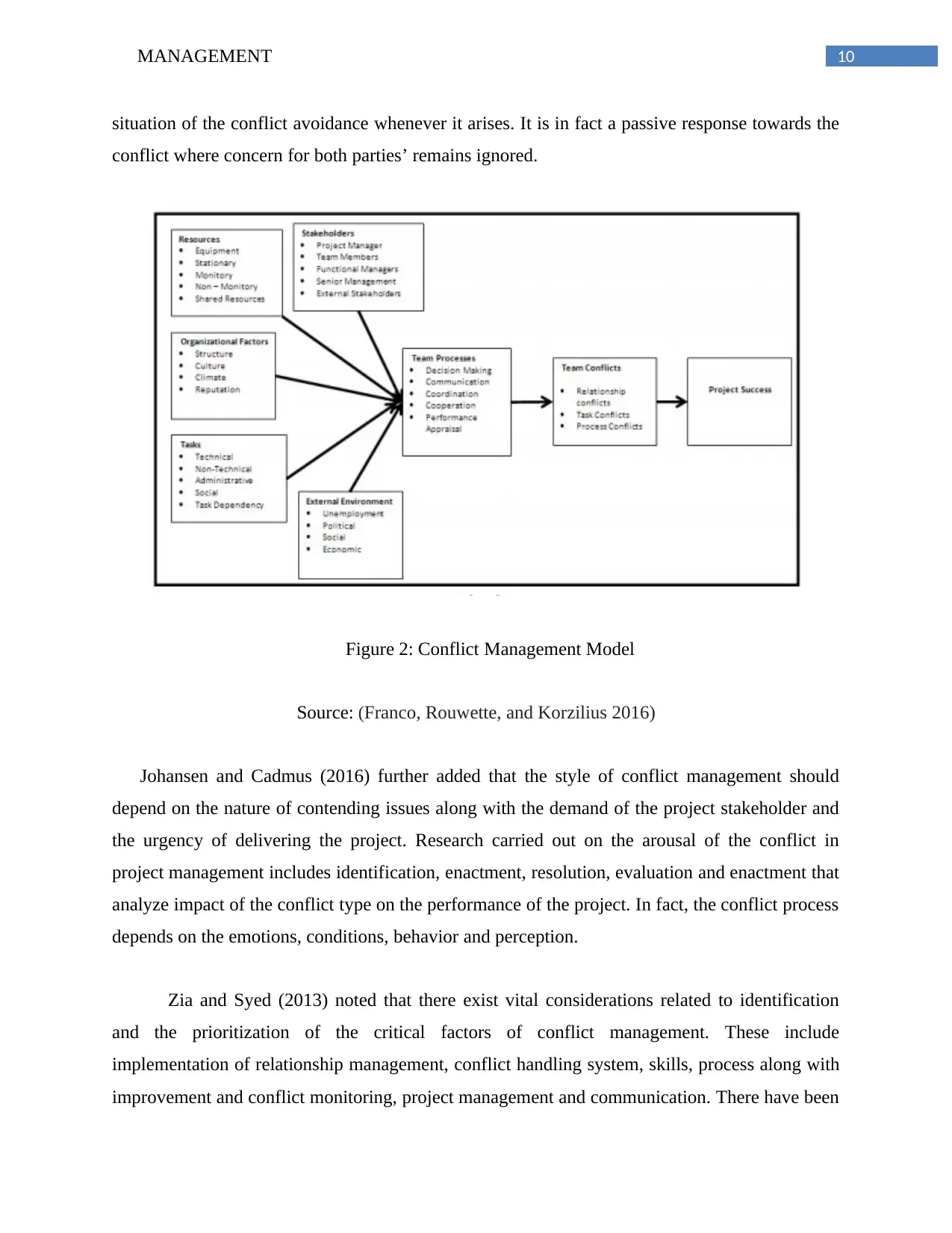
Figure 2: Conflict Management Model
Source: (Franco, Rouwette, and Korzilius 2016)
Johansen and Cadmus (2016) further added that the style of conflict management should
depend on the nature of contending issues along with the demand of the project stakeholder and
the urgency of delivering the project. Research carried out on the arousal of the conflict in
project management includes identification, enactment, resolution, evaluation and enactment that
analyze impact of the conflict type on the performance of the project. In fact, the conflict process
depends on the emotions, conditions, behavior and perception.
Zia and Syed (2013) noted that there exist vital considerations related to identification
and the prioritization of the critical factors of conflict management. These include
implementation of relationship management, conflict handling system, skills, process along with
improvement and conflict monitoring, project management and communication. There have been
situation of the conflict avoidance whenever it arises. It is in fact a passive response towards the
conflict where concern for both parties’ remains ignored.
Figure 2: Conflict Management Model
Source: (Franco, Rouwette, and Korzilius 2016)
Johansen and Cadmus (2016) further added that the style of conflict management should
depend on the nature of contending issues along with the demand of the project stakeholder and
the urgency of delivering the project. Research carried out on the arousal of the conflict in
project management includes identification, enactment, resolution, evaluation and enactment that
analyze impact of the conflict type on the performance of the project. In fact, the conflict process
depends on the emotions, conditions, behavior and perception.
Zia and Syed (2013) noted that there exist vital considerations related to identification
and the prioritization of the critical factors of conflict management. These include
implementation of relationship management, conflict handling system, skills, process along with
improvement and conflict monitoring, project management and communication. There have been
11MANAGEMENT
some authors who undertook an analysis of the contingency perspective of the conflict in the
projects and organization through identification of the imperative for accessing the negative and
positive effects of the conflict on the success of the project team. There are other authors who
have put forward discussions on the conflict value and the importance of the project portraying
that the conflict is multifaceted. Way, Jimmieson, and Bordia (2016) analyzed impact of the
conflicts on the project team depending on the conflict sources and thereby proposed specific
strategies for every scenario. They however affirmed that conflict stimulated change, improved
communication, encouraged innovation and creativity thereby increasing the group cohesiveness
and performance. Nevertheless, conflict has a different perspective that increases the stress,
lowers the morale and the job satisfaction and can result in failure of the project. As discussed
above, conflict management is considered as a vital competency for the project managers.
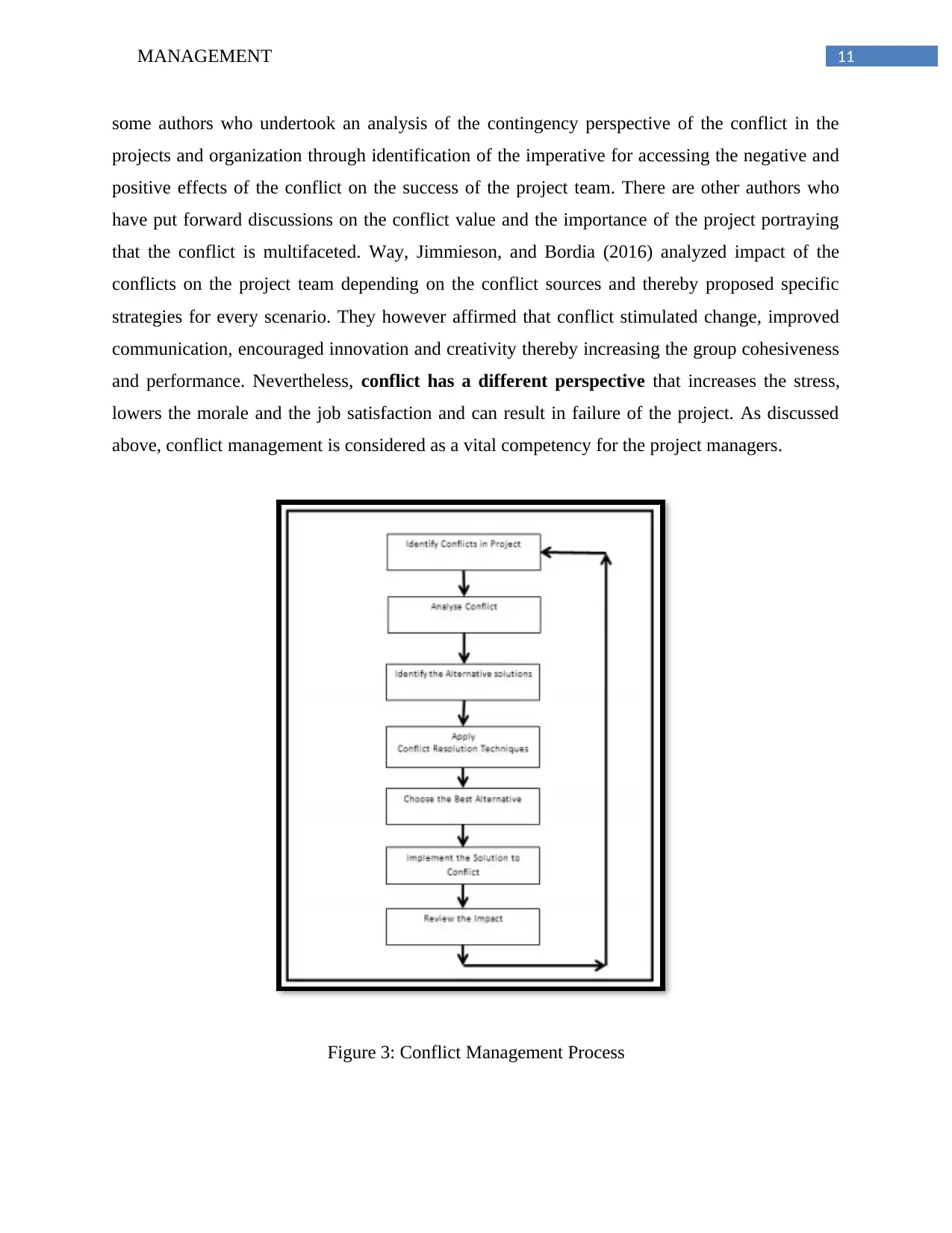
Figure 3: Conflict Management Process
some authors who undertook an analysis of the contingency perspective of the conflict in the
projects and organization through identification of the imperative for accessing the negative and
positive effects of the conflict on the success of the project team. There are other authors who
have put forward discussions on the conflict value and the importance of the project portraying
that the conflict is multifaceted. Way, Jimmieson, and Bordia (2016) analyzed impact of the
conflicts on the project team depending on the conflict sources and thereby proposed specific
strategies for every scenario. They however affirmed that conflict stimulated change, improved
communication, encouraged innovation and creativity thereby increasing the group cohesiveness
and performance. Nevertheless, conflict has a different perspective that increases the stress,
lowers the morale and the job satisfaction and can result in failure of the project. As discussed
above, conflict management is considered as a vital competency for the project managers.
Figure 3: Conflict Management Process
⊘ This is a preview!⊘
Do you want full access?
Subscribe today to unlock all pages.
Trusted by 1+ million students worldwide

1 out of 21


Related Documents


Your All-in-One AI-Powered Toolkit for Academic Success.
+13062052269
info@desklib.com
Available 24*7 on WhatsApp / Email
![[object Object]](/_next/static/media/star-bottom.7253800d.svg)
Unlock your academic potential
Copyright © 2020–2026 A2Z Services. All Rights Reserved. Developed and managed by ZUCOL.