Project Management Report: Integration, Stakeholders, Scope
VerifiedAdded on 2020/02/24
|27
|5743
|211
Report
AI Summary
This report provides a detailed overview of project management, covering essential elements such as integration, stakeholders, scope, resources, time, cost, risk, quality, procurement, and communication. It defines each aspect, explaining its importance within the project lifecycle. The report explores project integration management, encompassing the coordination of project activities, and stakeholder management, focusing on identifying and addressing stakeholder needs. Project scope management is discussed in terms of defining project boundaries and objectives, while resource management emphasizes organizing and managing project teams and deliverables. Time management is presented as the process of completing projects within deadlines, and cost management focuses on budgeting and financial control. Furthermore, the report addresses risk management, quality management, procurement management, and communication management, providing a comprehensive understanding of project management principles and their practical application. Each section includes a definition, and how it applies to the course.
MANAGING PROJECT
MP 49002 Managing Projects Spring 2017 version 0.0 page 1 of 27
MP 49002 Managing Projects Spring 2017 version 0.0 page 1 of 27

Paraphrase This Document
Need a fresh take? Get an instant paraphrase of this document with our AI Paraphraser
TABLE OF CONTENTS
1 Integration.....................................................................................................................................3
1.1 Definition of Project Integration Management.................................................................3
1.2 How does this apply to my work in this course?..............................................................3
2 Stakeholders..................................................................................................................................5
2.1 Definition of Project Stakeholder Management................................................................5
2.2 How does this apply to my work in this course?..............................................................5
3 Scope.............................................................................................................................................7
3.1 Definition of Project Scope Management.........................................................................7
3.2 How does this apply to my work in this course?..............................................................7
4 Resources......................................................................................................................................9
4.1 Definition of Project Resource Management....................................................................9
4.2 How does this apply to my work in this course?............................................................10
5 Time............................................................................................................................................11
5.1 Definition of Project Time Management........................................................................11
5.2 How does this apply to my work in this course?............................................................11
6 Cost.............................................................................................................................................13
6.1 Definition of Project Cost Management.........................................................................13
6.2 How does this apply to my work in this course?............................................................13
7 Risk.............................................................................................................................................14
7.1 Definition of Project Risk Management.........................................................................14
7.2 How does this apply to my work in this course?............................................................14
8 Quality.........................................................................................................................................17
8.1 Definition of Project Quality Management.....................................................................17
8.2 How does this apply to my work in this course?............................................................17
9 Procurement................................................................................................................................19
9.1 Definition of Project Procurement Management............................................................19
9.2 How does this apply to my work in this course?............................................................19
10 Communication.......................................................................................................................21
10.1 Definition of Project Communication Management...................................................21
10.2 How does this apply to my work in this course?.........................................................21
11 Conclusions.............................................................................................................................23
MP 49002 Managing Projects Spring 2017 version 0.0 page 2 of 27
1 Integration.....................................................................................................................................3
1.1 Definition of Project Integration Management.................................................................3
1.2 How does this apply to my work in this course?..............................................................3
2 Stakeholders..................................................................................................................................5
2.1 Definition of Project Stakeholder Management................................................................5
2.2 How does this apply to my work in this course?..............................................................5
3 Scope.............................................................................................................................................7
3.1 Definition of Project Scope Management.........................................................................7
3.2 How does this apply to my work in this course?..............................................................7
4 Resources......................................................................................................................................9
4.1 Definition of Project Resource Management....................................................................9
4.2 How does this apply to my work in this course?............................................................10
5 Time............................................................................................................................................11
5.1 Definition of Project Time Management........................................................................11
5.2 How does this apply to my work in this course?............................................................11
6 Cost.............................................................................................................................................13
6.1 Definition of Project Cost Management.........................................................................13
6.2 How does this apply to my work in this course?............................................................13
7 Risk.............................................................................................................................................14
7.1 Definition of Project Risk Management.........................................................................14
7.2 How does this apply to my work in this course?............................................................14
8 Quality.........................................................................................................................................17
8.1 Definition of Project Quality Management.....................................................................17
8.2 How does this apply to my work in this course?............................................................17
9 Procurement................................................................................................................................19
9.1 Definition of Project Procurement Management............................................................19
9.2 How does this apply to my work in this course?............................................................19
10 Communication.......................................................................................................................21
10.1 Definition of Project Communication Management...................................................21
10.2 How does this apply to my work in this course?.........................................................21
11 Conclusions.............................................................................................................................23
MP 49002 Managing Projects Spring 2017 version 0.0 page 2 of 27
12 References...............................................................................................................................24
1 Integration
Integration is the process which helps in the identification and combining as well as coordinating all
the activities and processes related to the project. It is related to the project as it helps in managing
all the data and correlating each and every activity (TACHIKAWA, MARUYAMA and
NAKAMURA, 2013). This will help the project manager in managing the project and availing
appropriate set of information related to various aspects of the project. It is required that appropriate
set of information should be provided so that the project could be managed and it could be
completed within the required frameworks.
1.1 Definition of Project Integration Management
Collection of the processes which are required to make an assurance that all the elements of the
project could be coordinated in a proper way is known as project integration management. It is
required that all the information related to the project should be properly evaluated and collected so
that coordination could be developed (Samset and Volden, 2016). This type of activity helps in
fulfilling the requirements and completing the project on the basis of the plans developed.
1.2 How does this apply to my work in this course?
Project Integration Management is the process with the effect of which proper and relevant set of
information related to all the project aspects is gathered (Indelicato, 2009). It is the process with the
effect of which a project manager could make an assurance to bring a quality to the project.
Availability of the information helps in the smooth processing of the work with the effect of which
risk of uncertainties gets reduced and a support system is developed for the project team members.
It will help in enhancing the knowledge related to all the aspects of the project (Hoyle, 2013).
It will provide a set direction moving on which will help in bringing quality to the same and will
help in managing the work according to the framework.
Project Integration Management Processes
MP 49002 Managing Projects Spring 2017 version 0.0 page 3 of 27
1 Integration
Integration is the process which helps in the identification and combining as well as coordinating all
the activities and processes related to the project. It is related to the project as it helps in managing
all the data and correlating each and every activity (TACHIKAWA, MARUYAMA and
NAKAMURA, 2013). This will help the project manager in managing the project and availing
appropriate set of information related to various aspects of the project. It is required that appropriate
set of information should be provided so that the project could be managed and it could be
completed within the required frameworks.
1.1 Definition of Project Integration Management
Collection of the processes which are required to make an assurance that all the elements of the
project could be coordinated in a proper way is known as project integration management. It is
required that all the information related to the project should be properly evaluated and collected so
that coordination could be developed (Samset and Volden, 2016). This type of activity helps in
fulfilling the requirements and completing the project on the basis of the plans developed.
1.2 How does this apply to my work in this course?
Project Integration Management is the process with the effect of which proper and relevant set of
information related to all the project aspects is gathered (Indelicato, 2009). It is the process with the
effect of which a project manager could make an assurance to bring a quality to the project.
Availability of the information helps in the smooth processing of the work with the effect of which
risk of uncertainties gets reduced and a support system is developed for the project team members.
It will help in enhancing the knowledge related to all the aspects of the project (Hoyle, 2013).
It will provide a set direction moving on which will help in bringing quality to the same and will
help in managing the work according to the framework.
Project Integration Management Processes
MP 49002 Managing Projects Spring 2017 version 0.0 page 3 of 27
⊘ This is a preview!⊘
Do you want full access?
Subscribe today to unlock all pages.

Trusted by 1+ million students worldwide
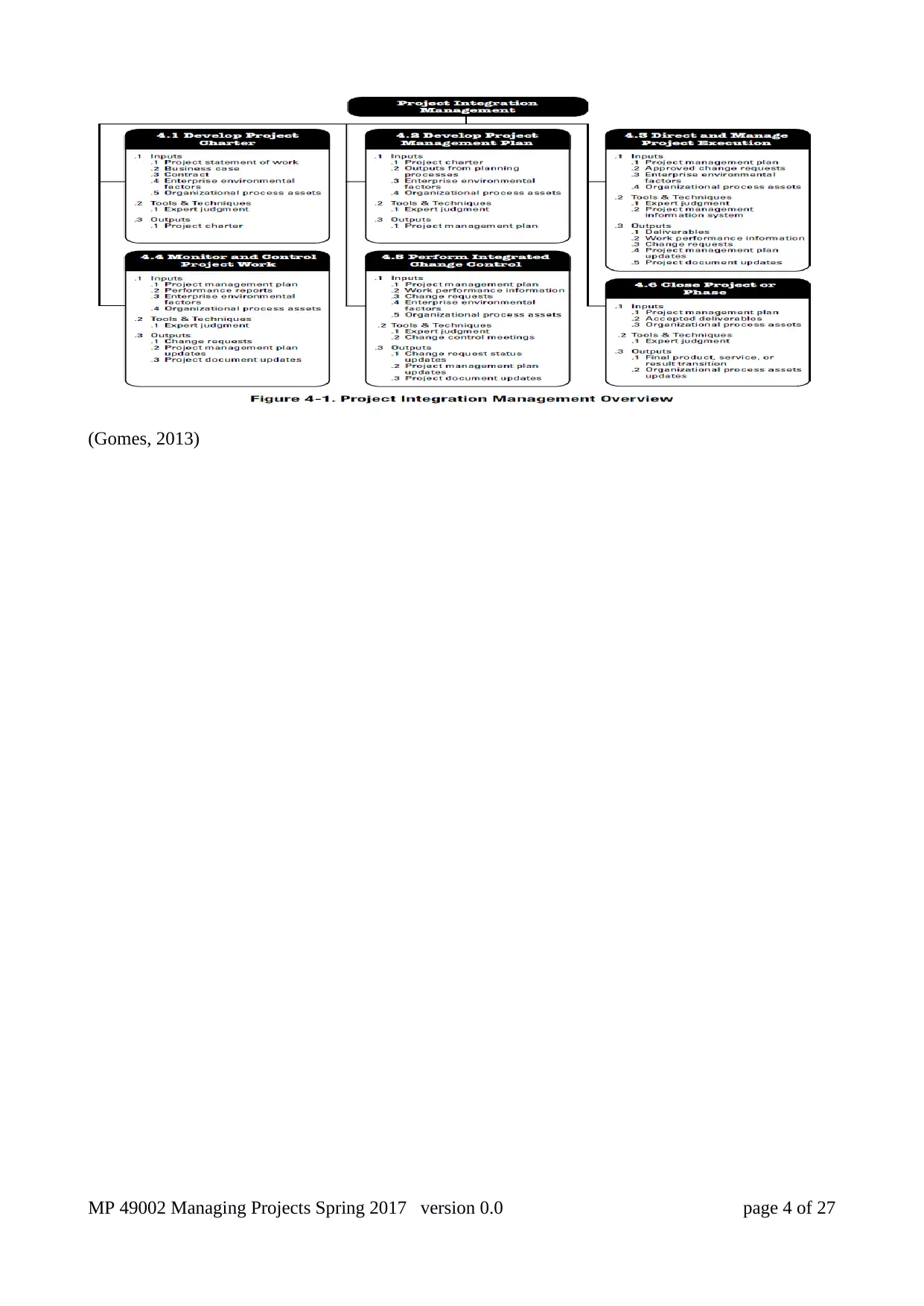
(Gomes, 2013)
MP 49002 Managing Projects Spring 2017 version 0.0 page 4 of 27
MP 49002 Managing Projects Spring 2017 version 0.0 page 4 of 27
Paraphrase This Document
Need a fresh take? Get an instant paraphrase of this document with our AI Paraphraser
2 Stakeholders
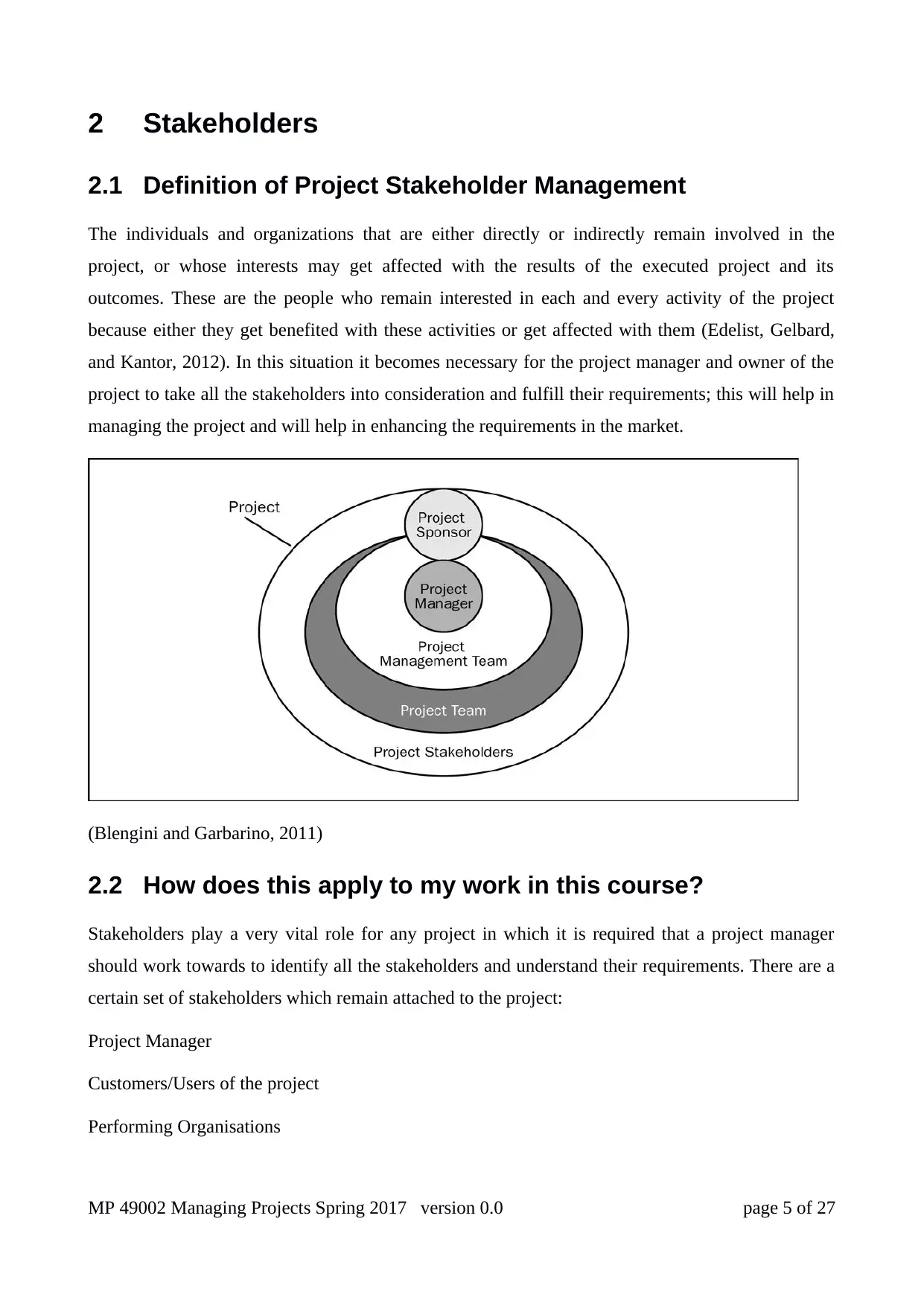
2.1 Definition of Project Stakeholder Management
The individuals and organizations that are either directly or indirectly remain involved in the
project, or whose interests may get affected with the results of the executed project and its
outcomes. These are the people who remain interested in each and every activity of the project
because either they get benefited with these activities or get affected with them (Edelist, Gelbard,
and Kantor, 2012). In this situation it becomes necessary for the project manager and owner of the
project to take all the stakeholders into consideration and fulfill their requirements; this will help in
managing the project and will help in enhancing the requirements in the market.
(Blengini and Garbarino, 2011)
2.2 How does this apply to my work in this course?
Stakeholders play a very vital role for any project in which it is required that a project manager
should work towards to identify all the stakeholders and understand their requirements. There are a
certain set of stakeholders which remain attached to the project:
Project Manager
Customers/Users of the project
Performing Organisations
MP 49002 Managing Projects Spring 2017 version 0.0 page 5 of 27
2.1 Definition of Project Stakeholder Management
The individuals and organizations that are either directly or indirectly remain involved in the
project, or whose interests may get affected with the results of the executed project and its
outcomes. These are the people who remain interested in each and every activity of the project
because either they get benefited with these activities or get affected with them (Edelist, Gelbard,
and Kantor, 2012). In this situation it becomes necessary for the project manager and owner of the
project to take all the stakeholders into consideration and fulfill their requirements; this will help in
managing the project and will help in enhancing the requirements in the market.
(Blengini and Garbarino, 2011)
2.2 How does this apply to my work in this course?
Stakeholders play a very vital role for any project in which it is required that a project manager
should work towards to identify all the stakeholders and understand their requirements. There are a
certain set of stakeholders which remain attached to the project:
Project Manager
Customers/Users of the project
Performing Organisations
MP 49002 Managing Projects Spring 2017 version 0.0 page 5 of 27
Project Team Members
Project Management Team (Brioso, 2010)
Sponsor
Influencer
Government
These are some of the stakeholders who remain attached to the project, it is required that a project
manager should take all the stakeholders into consideration who are either directly or indirectly
related to the project. They are the people who also provide an effective set of support to the project
with the effect of which it could be managed and get completed in a proper way.
Undertaking these stakeholders will help in evaluating all the relevant set of information related to
the project and will help in delivering the same to the target population (Brioso, 2015).
MP 49002 Managing Projects Spring 2017 version 0.0 page 6 of 27
Project Management Team (Brioso, 2010)
Sponsor
Influencer
Government
These are some of the stakeholders who remain attached to the project, it is required that a project
manager should take all the stakeholders into consideration who are either directly or indirectly
related to the project. They are the people who also provide an effective set of support to the project
with the effect of which it could be managed and get completed in a proper way.
Undertaking these stakeholders will help in evaluating all the relevant set of information related to
the project and will help in delivering the same to the target population (Brioso, 2015).
MP 49002 Managing Projects Spring 2017 version 0.0 page 6 of 27
⊘ This is a preview!⊘
Do you want full access?
Subscribe today to unlock all pages.
Trusted by 1+ million students worldwide
3 Scope
3.1 Definition of Project Scope Management
The activity with the help of which boundaries of the project could be determined is known as
project scope (Edelist, Gelbard and Kantor, 2012). It is required that relevant set of project scope
should be determined by the project manager. The project scope also helps in defining the
objectives and the relevance of the same. Defining project scope helps the project management
enhancing its validity and provides a proper set of framework for the same. It is necessary for a
project manager to determine the scope of the project so as to ensure that its validity and reliability
could get enhanced in the market and assurance could be made that it will help in managing all the
aspects and will provide a relevant set of support for future success (Gomes, 2013).
3.2 How does this apply to my work in this course?
Project scope helps in delivering a proper set of information related to the reasons behind adopting
the project or initiating the same (Hoyle, 2013). There are a various set of aspects which are being
determined by a project scope, these aspects are:
It helps in determining the objectives of the project
It helps in determining requirements of the project and its characteristics
Project acceptance criteria are determined
Setting boundaries
Project deliverables are determined (Indelicato, 2009)
Project constraints are determined
Assumptions related to the project are made
Risks related to the project are determined
Milestones are scheduled
Work Breakdown structure is initiated
Cost of the project is estimated
Project configuration is done
MP 49002 Managing Projects Spring 2017 version 0.0 page 7 of 27
3.1 Definition of Project Scope Management
The activity with the help of which boundaries of the project could be determined is known as
project scope (Edelist, Gelbard and Kantor, 2012). It is required that relevant set of project scope
should be determined by the project manager. The project scope also helps in defining the
objectives and the relevance of the same. Defining project scope helps the project management
enhancing its validity and provides a proper set of framework for the same. It is necessary for a
project manager to determine the scope of the project so as to ensure that its validity and reliability
could get enhanced in the market and assurance could be made that it will help in managing all the
aspects and will provide a relevant set of support for future success (Gomes, 2013).
3.2 How does this apply to my work in this course?
Project scope helps in delivering a proper set of information related to the reasons behind adopting
the project or initiating the same (Hoyle, 2013). There are a various set of aspects which are being
determined by a project scope, these aspects are:
It helps in determining the objectives of the project
It helps in determining requirements of the project and its characteristics
Project acceptance criteria are determined
Setting boundaries
Project deliverables are determined (Indelicato, 2009)
Project constraints are determined
Assumptions related to the project are made
Risks related to the project are determined
Milestones are scheduled
Work Breakdown structure is initiated
Cost of the project is estimated
Project configuration is done
MP 49002 Managing Projects Spring 2017 version 0.0 page 7 of 27
Paraphrase This Document
Need a fresh take? Get an instant paraphrase of this document with our AI Paraphraser

These are the aspects which are being determined which helps in developing a proper set of
blueprint for the project. Developing a blueprint for the project helps in managing the things in a
more effective way and making the decision of whether the project should be initiated or not and
whether the investments should be made by the project manager in the project or not (Jamali and
Oveisi, 2016).
MP 49002 Managing Projects Spring 2017 version 0.0 page 8 of 27
blueprint for the project. Developing a blueprint for the project helps in managing the things in a
more effective way and making the decision of whether the project should be initiated or not and
whether the investments should be made by the project manager in the project or not (Jamali and
Oveisi, 2016).
MP 49002 Managing Projects Spring 2017 version 0.0 page 8 of 27
4 Resources
4.1 Definition of Project Resource Management
The processes that help in organizing and managing the project team and all the deliverables
required in the project are known as project resource management. It is necessary that a project
which is being initiated and planned should have a proper set of human resource as well as
deliverables which will be used in it (Rose, 2008). Failure to gather all the deliverables and a
relevant number of human resources will have a huge impact on the project and will lead to delayed
services. Hence, project resource management should be taken into consideration and a list should
be developed which could help in fulfilling all the requirements of the project.
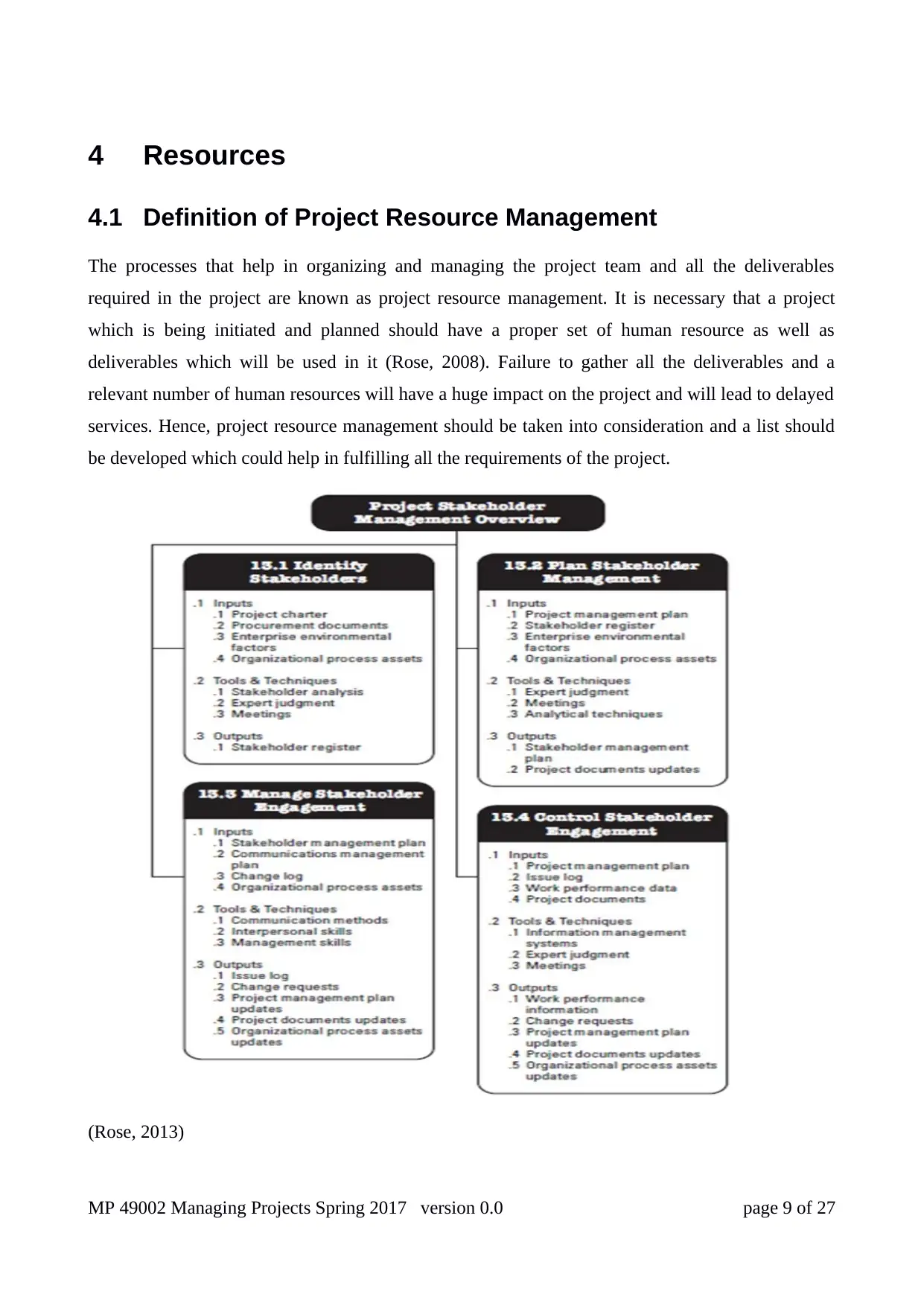
(Rose, 2013)
MP 49002 Managing Projects Spring 2017 version 0.0 page 9 of 27
4.1 Definition of Project Resource Management
The processes that help in organizing and managing the project team and all the deliverables
required in the project are known as project resource management. It is necessary that a project
which is being initiated and planned should have a proper set of human resource as well as
deliverables which will be used in it (Rose, 2008). Failure to gather all the deliverables and a
relevant number of human resources will have a huge impact on the project and will lead to delayed
services. Hence, project resource management should be taken into consideration and a list should
be developed which could help in fulfilling all the requirements of the project.
(Rose, 2013)
MP 49002 Managing Projects Spring 2017 version 0.0 page 9 of 27
⊘ This is a preview!⊘
Do you want full access?
Subscribe today to unlock all pages.
Trusted by 1+ million students worldwide
4.2 How does this apply to my work in this course?
Project resource planning is an important aspect of any project required to be taken into
consideration by the project manager. Human resource planning is one of the aspects which are
required to be kept on the priority. Human resource planning helps in determining the number of
people required to fulfill the requirements of the project (Saleh Al-Freidi, 2015). There are various
tools and techniques which will be required to be taken into consideration so as to plan human
resource in a proper way these tools and techniques are:
Organisational chart and position description so that each and every human resource should remain
informed that what work is to be processed and who will report whom and take orders
Networking of the human resource is another aspect which is required to be taken into
consideration. In this, a human network will be created so as to maintain the information system so
that it could flow in a proper way and work could be processed in a proper way (Santos, 2008).
The organizational theory is also required to be taken into consideration; it will help in analyzing
the behavior of the team and the people working on the project.
Developing a project team is also attached with human resource planning (Samset and Volden,
2016). It is necessary that people working on the project should develop a mutual understanding and
should prefer to work as a team rather than working individually. Such type of activity will help in
developing coordination among the people working on the project and will help in completing the
project in a more effective way.
Training is also required to be provided to all the team members. This will help in refining their
skills and knowledge and will provide a set direction for the growth and will help in managing
things in a better way (TACHIKAWA, MARUYAMA and NAKAMURA, 2013).
MP 49002 Managing Projects Spring 2017 version 0.0 page 10 of 27
Project resource planning is an important aspect of any project required to be taken into
consideration by the project manager. Human resource planning is one of the aspects which are
required to be kept on the priority. Human resource planning helps in determining the number of
people required to fulfill the requirements of the project (Saleh Al-Freidi, 2015). There are various
tools and techniques which will be required to be taken into consideration so as to plan human
resource in a proper way these tools and techniques are:
Organisational chart and position description so that each and every human resource should remain
informed that what work is to be processed and who will report whom and take orders
Networking of the human resource is another aspect which is required to be taken into
consideration. In this, a human network will be created so as to maintain the information system so
that it could flow in a proper way and work could be processed in a proper way (Santos, 2008).
The organizational theory is also required to be taken into consideration; it will help in analyzing
the behavior of the team and the people working on the project.
Developing a project team is also attached with human resource planning (Samset and Volden,
2016). It is necessary that people working on the project should develop a mutual understanding and
should prefer to work as a team rather than working individually. Such type of activity will help in
developing coordination among the people working on the project and will help in completing the
project in a more effective way.
Training is also required to be provided to all the team members. This will help in refining their
skills and knowledge and will provide a set direction for the growth and will help in managing
things in a better way (TACHIKAWA, MARUYAMA and NAKAMURA, 2013).
MP 49002 Managing Projects Spring 2017 version 0.0 page 10 of 27
Paraphrase This Document
Need a fresh take? Get an instant paraphrase of this document with our AI Paraphraser
5 Time
5.1 Definition of Project Time Management
The process which is required so as to actively complete and accomplish all the projects within the
deadlines is known as project time management. Each and every activity and success, as well as the
failure of the project, depends upon the time. It is required that all the project aspects should be
taken into consideration and time should be allotted to each aspect. Making a plan to complete each
and every activity within the provided time will help the project manager in completing the project
in a proper way (Tavan and Hosseini, 2016). Time management will also help in managing project
cost and reduce the occurrence of unnecessary expenses.
5.2 How does this apply to my work in this course?
Time management activity process includes a various set of aspects these aspects are as follows:
(Varajão, Colomo-Palacios and Silva, 2017)
MP 49002 Managing Projects Spring 2017 version 0.0 page 11 of 27
5.1 Definition of Project Time Management
The process which is required so as to actively complete and accomplish all the projects within the
deadlines is known as project time management. Each and every activity and success, as well as the
failure of the project, depends upon the time. It is required that all the project aspects should be
taken into consideration and time should be allotted to each aspect. Making a plan to complete each
and every activity within the provided time will help the project manager in completing the project
in a proper way (Tavan and Hosseini, 2016). Time management will also help in managing project
cost and reduce the occurrence of unnecessary expenses.
5.2 How does this apply to my work in this course?
Time management activity process includes a various set of aspects these aspects are as follows:
(Varajão, Colomo-Palacios and Silva, 2017)
MP 49002 Managing Projects Spring 2017 version 0.0 page 11 of 27
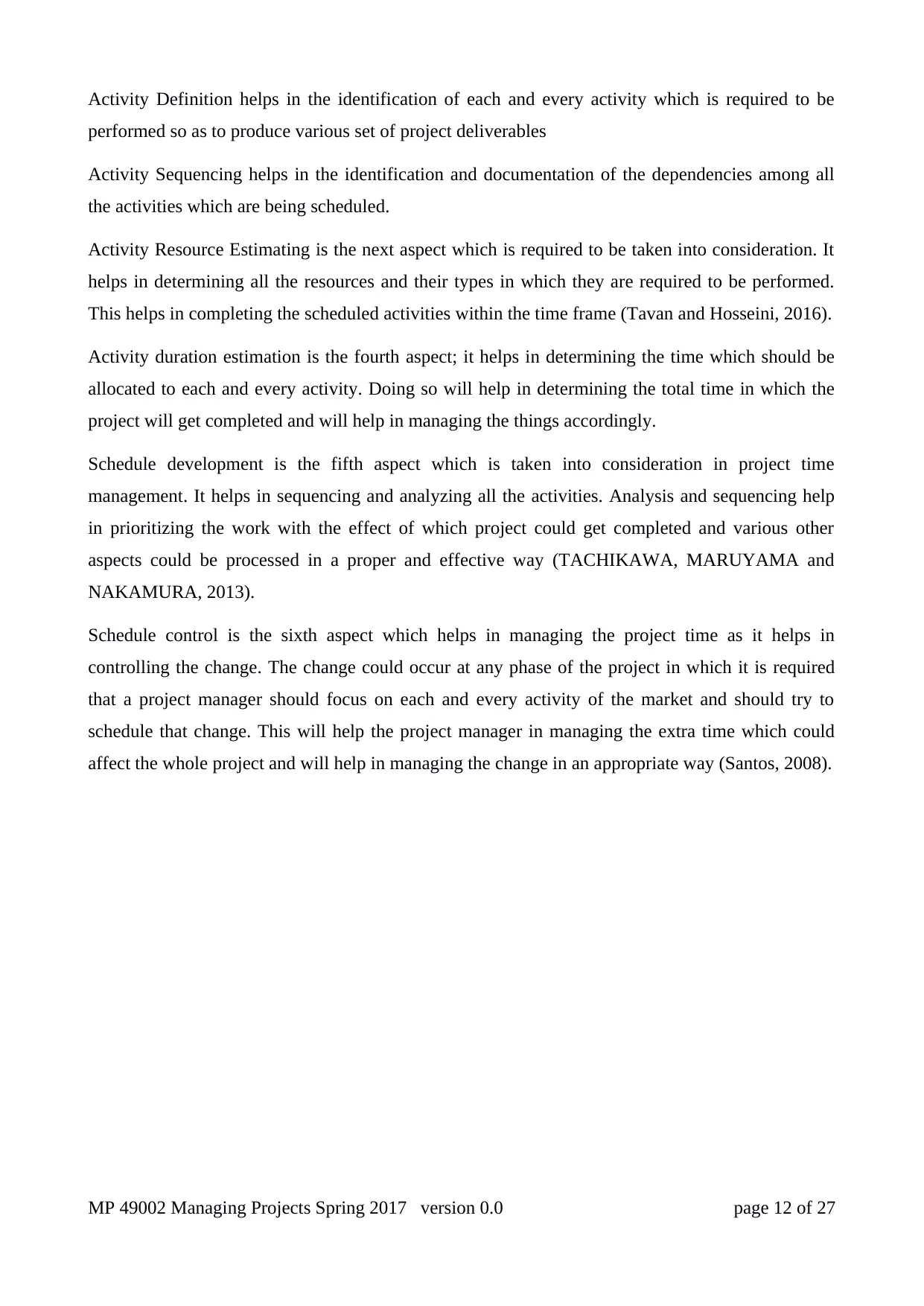
Activity Definition helps in the identification of each and every activity which is required to be
performed so as to produce various set of project deliverables
Activity Sequencing helps in the identification and documentation of the dependencies among all
the activities which are being scheduled.
Activity Resource Estimating is the next aspect which is required to be taken into consideration. It
helps in determining all the resources and their types in which they are required to be performed.
This helps in completing the scheduled activities within the time frame (Tavan and Hosseini, 2016).
Activity duration estimation is the fourth aspect; it helps in determining the time which should be
allocated to each and every activity. Doing so will help in determining the total time in which the
project will get completed and will help in managing the things accordingly.
Schedule development is the fifth aspect which is taken into consideration in project time
management. It helps in sequencing and analyzing all the activities. Analysis and sequencing help
in prioritizing the work with the effect of which project could get completed and various other
aspects could be processed in a proper and effective way (TACHIKAWA, MARUYAMA and
NAKAMURA, 2013).
Schedule control is the sixth aspect which helps in managing the project time as it helps in
controlling the change. The change could occur at any phase of the project in which it is required
that a project manager should focus on each and every activity of the market and should try to
schedule that change. This will help the project manager in managing the extra time which could
affect the whole project and will help in managing the change in an appropriate way (Santos, 2008).
MP 49002 Managing Projects Spring 2017 version 0.0 page 12 of 27
performed so as to produce various set of project deliverables
Activity Sequencing helps in the identification and documentation of the dependencies among all
the activities which are being scheduled.
Activity Resource Estimating is the next aspect which is required to be taken into consideration. It
helps in determining all the resources and their types in which they are required to be performed.
This helps in completing the scheduled activities within the time frame (Tavan and Hosseini, 2016).
Activity duration estimation is the fourth aspect; it helps in determining the time which should be
allocated to each and every activity. Doing so will help in determining the total time in which the
project will get completed and will help in managing the things accordingly.
Schedule development is the fifth aspect which is taken into consideration in project time
management. It helps in sequencing and analyzing all the activities. Analysis and sequencing help
in prioritizing the work with the effect of which project could get completed and various other
aspects could be processed in a proper and effective way (TACHIKAWA, MARUYAMA and
NAKAMURA, 2013).
Schedule control is the sixth aspect which helps in managing the project time as it helps in
controlling the change. The change could occur at any phase of the project in which it is required
that a project manager should focus on each and every activity of the market and should try to
schedule that change. This will help the project manager in managing the extra time which could
affect the whole project and will help in managing the change in an appropriate way (Santos, 2008).
MP 49002 Managing Projects Spring 2017 version 0.0 page 12 of 27
⊘ This is a preview!⊘
Do you want full access?
Subscribe today to unlock all pages.
Trusted by 1+ million students worldwide

1 out of 27


Related Documents


Your All-in-One AI-Powered Toolkit for Academic Success.
+13062052269
info@desklib.com
Available 24*7 on WhatsApp / Email
![[object Object]](/_next/static/media/star-bottom.7253800d.svg)
Unlock your academic potential
Copyright © 2020–2026 A2Z Services. All Rights Reserved. Developed and managed by ZUCOL.