Addressing Ethical Issues in Project Management: A Training Approach

Verified

Added on  2023/06/04

|7
|1327
|210
Report
AI Summary
This report delves into ethical issues within project management, specifically focusing on favoritism and prejudice, which can significantly impede project success. The introduction highlights the importance of ethical principles and their impact on business outcomes. The report identifies favoritism and prejudice as key ethical challenges, citing their negative effects on team dynamics, employee motivation, and overall project performance. The discussion emphasizes the need for managers to address these issues through fostering professionalism and providing comprehensive training programs. The report advocates for training as a primary solution, emphasizing its role in enhancing employee skills, promoting fairness, and improving project outcomes. The conclusion reiterates the detrimental effects of ethical breaches like favoritism and stresses the value of training and continuous learning in mitigating these challenges. The report references several academic sources to support its claims, providing a comprehensive overview of the ethical considerations in project management.

Document Page
PROJECT MANAGEMENT
tabler-icon-diamond-filled.svg

Paraphrase This Document

Need a fresh take? Get an instant paraphrase of this document with our AI Paraphraser
Document Page
Table of Contents
INTRODUCTION...........................................................................................................................1
ETHICAL ISSUES FOR PROJECTS MANAGERS......................................................................1
ACTION FOR RESOLVING THE ETHICAL ISSUE...................................................................2
TRAINING AS ETHICAL SOUND SOLUTION..........................................................................3
CONCLUSION................................................................................................................................4
REFERENCES................................................................................................................................5
Document Page
INTRODUCTION
The ethical issues affect the progress of the business to a great extent due to its direct
impact on the overall activities associated with the specific project (Kerzner and Kerzner, 2017).
In this context, the present report shed light on the importance of ethical principles through the
selection of two ethical issues and their solutions.
ETHICAL ISSUES FOR PROJECTS MANAGERS
On the basis of the provided video, the managers of the project face many ethical issues
in management of the specific project. These issues create the worst situation for the project
manager. For this purpose, the focus on ethical principles and considering them in the field of
project management leads the ultimate outcome. In this regard, the favouritism and prejudice is
the most significant ethical issue for the project managers. In this context, Ozler & Buyukarslan
(2011) asserted that by selecting relatives due to personal relationship, has direct impact on the
project progress as it increases the chances of selecting the wrong employees. They also
mentioned that favouritism is accountable for the rise of conflicts among team and forced the
employees to quit. Due to this, the organization may face problem of employee retention, poor
performance of job and wrong output and overall negative outcome. Moreover, the favouritism
affects the motivation in the team member which has the negative impact on the employees'
moral towards the projects.
On the other hand, the involvement of the manager in the prejudice, negatively influence
the operational structure of the company and creates the anomie in the organization (Moore,
Konrad & Hunt, 2010). This is because of the prejudice breaks the integrity of team member and
creates the unhealthy competitions between the favourite and ignored team member. Owing to
1
Document Page
this, this situation creates barrier in the activities of the projects. Thus, the focus on this ethical
issue is imperative in the project management.
ACTION FOR RESOLVING THE ETHICAL ISSUE
As per the above discussion, the favouritism has the huge negative impact on the project.
In order to resolve the favouritism as ethical issue, the project manager must take the below
mentioned actions and enhance the productivity of the project along with satisfaction among key
stakeholders
Foster professionalism-According to the video, honesty, respect, fairness and
responsibility are key factors which are accountable for enhancing the trust in the
employees. In this regard, in order to resolve the issue of favouritism in the organization,
the enhancement in the professionalism is helpful. Hereby, it upgrades the fairness and
responsibility in the management decision making of the organization. In this context, the
professionalism is key competency for effective project delivery wherein the reliable,
effective and informed foundation of project knowledge is built and reduce the potential
of unprofessionalism (Hodgson & Muzio, 2011). Owing to this, management creates the
professional environment in the organization. This is because it prevents the
unprofessional activity in the business process and helps managers to avoid the unfair
behaviour in the employees’ recruitment process.
Providing training- For handling favouritism issue in the organization and overcoming
its impact, the management provides the training to the team member of the project. Due
to this, the skilled and semi-skilled employees enhance their capabilities and perform
their task in an effective manner. In this context, Kerzner & Kerzner (2017) asserted that
the training in the team members improves the skill of the members and improve the
2
tabler-icon-diamond-filled.svg

Paraphrase This Document

Need a fresh take? Get an instant paraphrase of this document with our AI Paraphraser
Document Page
project success rate. Therefore, the offering training in the project’s team members,
correct the past mistake’s impact and improve the project performance.
TRAINING AS ETHICAL SOUND SOLUTION
By reviewing given two solutions, training is the standard method to overcome the
impact of ethical issues and enhances the employees’ skills. In this regard, several studies
revealed that the training improves the employees’ capabilities through which they effectively
execute their allocated task (Elnaga & Imran, 2013; Kerzner & Kerzner, 2017; Hameed &
Waheed, 2011). Hereby, the training enhances the confidence in the employees through
improving effective learning in the organization. This also overcome the issue related to
selection of less skilled workforce because they get chance to learn what is to be done.
On the flip side, sometimes the assessment of favouritism is very hard and to deal with
this issue, the training is the best method. This is because it deals with the actual problems. In
this regard, Ling, Qing & Shen (2014) asserted that training develop the basic understanding
among employees and at the same time they are informed regarding the expectations of projects
stakeholders or objectives of the business. This facilitates in working on the issues related to
favoritism because all workforce will go through the common parameters of learning procedure
that contribute towards the success of the project. Apart from this, on the basis of learning the
actual performance will be assessed through which knowledge level of workforce can be
assessed. This also provides an opportunity to further train the employees and accordingly work
on the issue related to favoritism.
3
Document Page
CONCLUSION
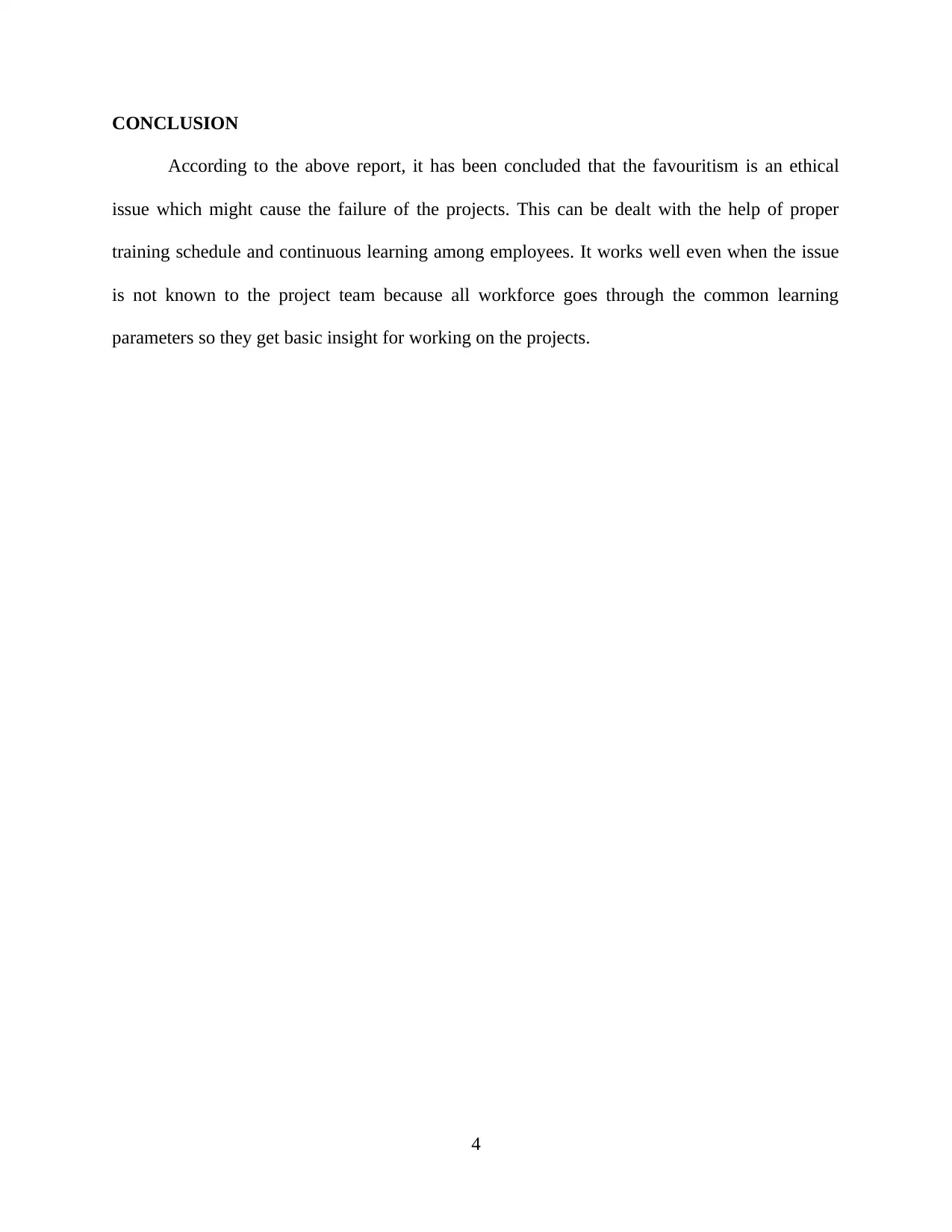
According to the above report, it has been concluded that the favouritism is an ethical
issue which might cause the failure of the projects. This can be dealt with the help of proper
training schedule and continuous learning among employees. It works well even when the issue
is not known to the project team because all workforce goes through the common learning
parameters so they get basic insight for working on the projects.
4
Document Page
REFERENCES
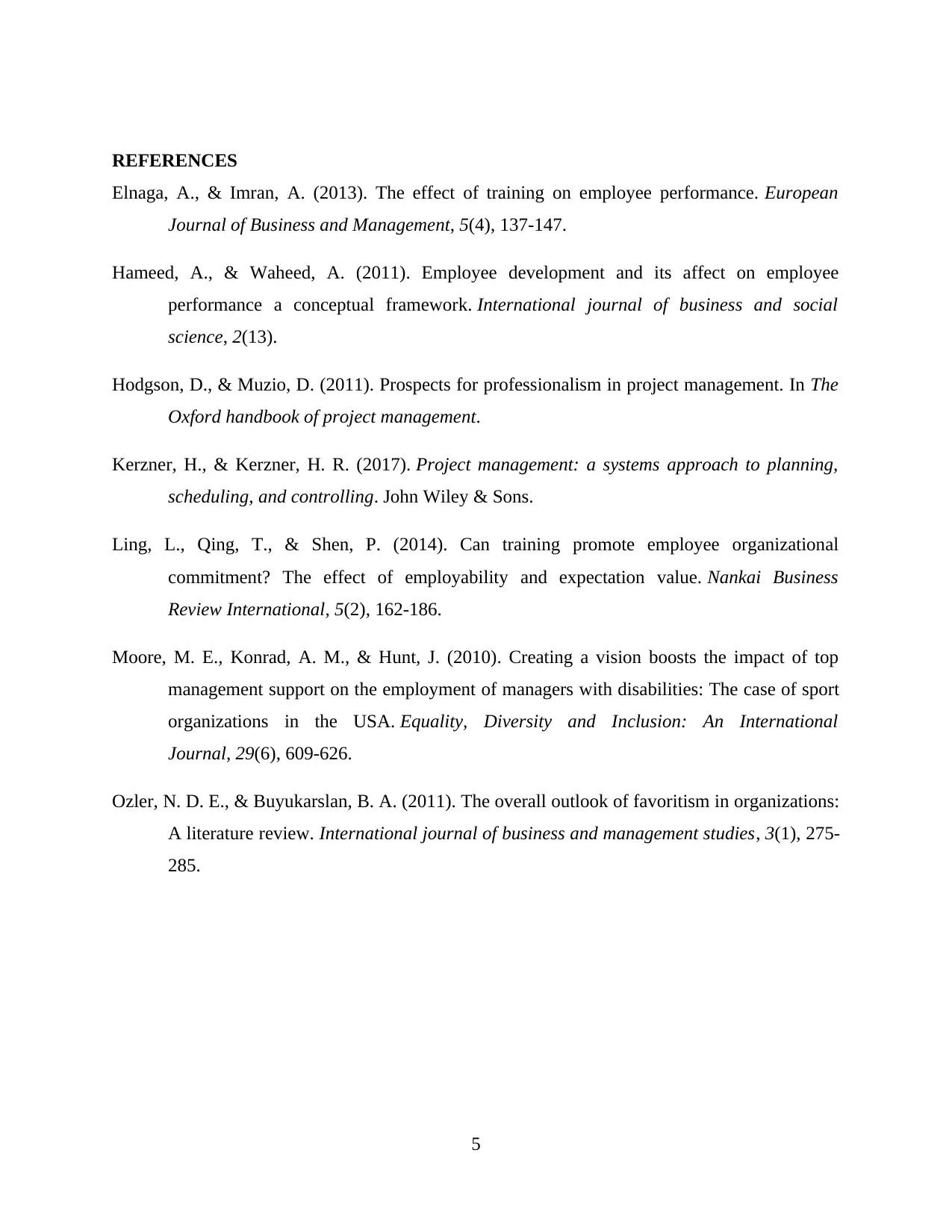
Elnaga, A., & Imran, A. (2013). The effect of training on employee performance. European
Journal of Business and Management, 5(4), 137-147.
Hameed, A., & Waheed, A. (2011). Employee development and its affect on employee
performance a conceptual framework. International journal of business and social
science, 2(13).
Hodgson, D., & Muzio, D. (2011). Prospects for professionalism in project management. In The
Oxford handbook of project management.
Kerzner, H., & Kerzner, H. R. (2017). Project management: a systems approach to planning,
scheduling, and controlling. John Wiley & Sons.
Ling, L., Qing, T., & Shen, P. (2014). Can training promote employee organizational
commitment? The effect of employability and expectation value. Nankai Business
Review International, 5(2), 162-186.
Moore, M. E., Konrad, A. M., & Hunt, J. (2010). Creating a vision boosts the impact of top
management support on the employment of managers with disabilities: The case of sport
organizations in the USA. Equality, Diversity and Inclusion: An International
Journal, 29(6), 609-626.
Ozler, N. D. E., & Buyukarslan, B. A. (2011). The overall outlook of favoritism in organizations:
A literature review. International journal of business and management studies, 3(1), 275-
285.
5
chevron_up_icon
1 out of 7
circle_padding
hide_on_mobile
zoom_out_icon
[object Object]