Undertake Project Work (BSBPMG522) Individual Assessment - Tutorial 1
VerifiedAdded on 2021/01/01
|33
|8625
|198
Homework Assignment
AI Summary
This document is a solution to an individual assessment for the BSBPMG522 unit, focusing on undertaking project work. The assessment covers various aspects of project management, including project management tools, scope definition, governance, activities lists, scheduling, budgeting, Gantt charts, and the critical path method. The document provides answers to questions about how project management tools contribute to a project, including identifying the appropriate tool for specific descriptions. It addresses the types of documents and information needed to clarify project scope, emphasizing the importance of both formal and informal documents such as project management plans, communication plans, and risk management documentation. Additionally, the assessment delves into risk identification within a project, outlining the key components of risk management and how to identify potential risks. The document also explores the relevance of organizational missions and goals to project objectives. Overall, the assessment aims to evaluate the student's understanding of project management principles and their ability to apply these principles in practical scenarios.
Tutorial Assessment 1
Individual Activity/Knowledge Test
V2018.4
Page 1 of 33
Individual Activity/Knowledge Test
V2018.4
Page 1 of 33

Paraphrase This Document
Need a fresh take? Get an instant paraphrase of this document with our AI Paraphraser
Unit: BSBPMG522 Undertake
project work
Assessment
Type: Individual
Activity/Knowled
ge Test
By submitting this Assessment I acknowledge my understanding of plagiarism
Plagiarism
All work must be done individually. Copied work will not be accepted and could
lead to an “academic non-performance” rating. Plagiarism by a student will result
in an automatic ‘NYS’, and as well as being recorded, may result in further
disciplinary action such as a student’s exclusion from a course. Plagiarism is
presenting and using someone else’s work, writings or ideas as your own with or
without their consent.
2
project work
Assessment
Type: Individual
Activity/Knowled
ge Test
By submitting this Assessment I acknowledge my understanding of plagiarism
Plagiarism
All work must be done individually. Copied work will not be accepted and could
lead to an “academic non-performance” rating. Plagiarism by a student will result
in an automatic ‘NYS’, and as well as being recorded, may result in further
disciplinary action such as a student’s exclusion from a course. Plagiarism is
presenting and using someone else’s work, writings or ideas as your own with or
without their consent.
2
I have read and agree to the assessment guidelines conditions below.
1. The purpose of this activity is to assess your knowledge and skills of the unit.
2. If you have any considerations that may affect your performance in the
assessment please inform your assessor immediately. Your assessor will
provide you with a suitable alternative to complete this assessment.
3. To gain competency for this assessment, demonstrate competency in activity
tasks by the due date.
4. Student downloads the assessment through Moodle.
5. Student completes the assessment cover page ensuring they have written
their name and student number. Online submission opens one week prior to
the due week and cut off date is set on Saturday at 11:55pm in the week of
due date.
6. In case of late submission, the student is only able to submit the assessment
with permission. The Student is first required to see student services and
make late submission fee payment before submitting the assessment after
due date. The student service officer issues the receipt and student is
required to see their Trainer to submit the assessment. The trainer will grant
an extension on Moodle for the student to re-submit their assessment.
7. The student will receive results within 2 weeks from the due week, resulting in
a determination of Satisfactory (S) or Not Yet Satisfactory (NYS) for the task
and this result will be displayed on Moodle.
8. In case of ‘NYS’ (not yet satisfactory) result of the assessment, the student is
given an opportunity to re-attempt and submit the assessment by an agreed
date with their assessor or as soon as possible within the duration of the unit.
The trainer will grant extension on Moodle for the student to re-submit their
assessment, cut off date of re-submission is Saturday at 11:55pm in week 8.
Re-attempted assessments submitted during the term will not incur penalty.
V2018.4
Page 3 of 33
1. The purpose of this activity is to assess your knowledge and skills of the unit.
2. If you have any considerations that may affect your performance in the
assessment please inform your assessor immediately. Your assessor will
provide you with a suitable alternative to complete this assessment.
3. To gain competency for this assessment, demonstrate competency in activity
tasks by the due date.
4. Student downloads the assessment through Moodle.
5. Student completes the assessment cover page ensuring they have written
their name and student number. Online submission opens one week prior to
the due week and cut off date is set on Saturday at 11:55pm in the week of
due date.
6. In case of late submission, the student is only able to submit the assessment
with permission. The Student is first required to see student services and
make late submission fee payment before submitting the assessment after
due date. The student service officer issues the receipt and student is
required to see their Trainer to submit the assessment. The trainer will grant
an extension on Moodle for the student to re-submit their assessment.
7. The student will receive results within 2 weeks from the due week, resulting in
a determination of Satisfactory (S) or Not Yet Satisfactory (NYS) for the task
and this result will be displayed on Moodle.
8. In case of ‘NYS’ (not yet satisfactory) result of the assessment, the student is
given an opportunity to re-attempt and submit the assessment by an agreed
date with their assessor or as soon as possible within the duration of the unit.
The trainer will grant extension on Moodle for the student to re-submit their
assessment, cut off date of re-submission is Saturday at 11:55pm in week 8.
Re-attempted assessments submitted during the term will not incur penalty.
V2018.4
Page 3 of 33
⊘ This is a preview!⊘
Do you want full access?
Subscribe today to unlock all pages.

Trusted by 1+ million students worldwide
9. The re-attempted work must address the specific performance tasks beyond
doubt for the assessor to issue a satisfactory (S) result. The system allows the
student to re-attempt online twice within the duration of the unit. The
Student is required to meet their assessor before submitting the third re-
attempt. The assessor will grant extension manually only by request. A repeat
NYS outcome could lead to an administration fee.
10. Any re-submission or late submission occurring during week 8, the student
is required to see their trainer before submitting the late or re-assessment.
The trainer will grant an extension on Moodle by request only and the
submission will be closed on Saturday at 11:55pm in week 8.
11. Any re-submission or late submission occurring during week 9, the student
is required to see their trainer before submitting the late or re-assessment.
The trainer will grant extension on Moodle by request only for 15 minutes.
Therefore students should be ready to submit their assessment before going
to see the trainer.
12. All work must be done individually. Copied work will not be accepted and
could lead to an academic "non-performance” rating. See below about
Plagiarism.
Plagiarism
Plagiarism by a student will result in an automatic ‘NYS’, and as well as being
recorded, may result in further disciplinary action such as a student’s
exclusion from a course. Plagiarism is presenting and using someone else’s
work, writings or ideas as your own with or without their consent.
Some examples of plagiarism as follows
Presenting work by another individual as one’s own unintentionally
Handing in assessments markedly similar to or copied from another
student
4
doubt for the assessor to issue a satisfactory (S) result. The system allows the
student to re-attempt online twice within the duration of the unit. The
Student is required to meet their assessor before submitting the third re-
attempt. The assessor will grant extension manually only by request. A repeat
NYS outcome could lead to an administration fee.
10. Any re-submission or late submission occurring during week 8, the student
is required to see their trainer before submitting the late or re-assessment.
The trainer will grant an extension on Moodle by request only and the
submission will be closed on Saturday at 11:55pm in week 8.
11. Any re-submission or late submission occurring during week 9, the student
is required to see their trainer before submitting the late or re-assessment.
The trainer will grant extension on Moodle by request only for 15 minutes.
Therefore students should be ready to submit their assessment before going
to see the trainer.
12. All work must be done individually. Copied work will not be accepted and
could lead to an academic "non-performance” rating. See below about
Plagiarism.
Plagiarism
Plagiarism by a student will result in an automatic ‘NYS’, and as well as being
recorded, may result in further disciplinary action such as a student’s
exclusion from a course. Plagiarism is presenting and using someone else’s
work, writings or ideas as your own with or without their consent.
Some examples of plagiarism as follows
Presenting work by another individual as one’s own unintentionally
Handing in assessments markedly similar to or copied from another
student
4
Paraphrase This Document
Need a fresh take? Get an instant paraphrase of this document with our AI Paraphraser
Handing in assessments without the sufficient acknowledgement of
sources used, including assessments taken totally or in part from the
Internet
13. Appeal process - If you feel the decision made by your assessor was
incorrect please refer to your Student Handbook for information on
assessment appeals for the required steps to appeal this decision. Download
the assessment you want to appeal and complete the appeal box in Feedback
Evaluation Sheet by signing as to whether you wish to appeal. You are
required to hand the hard copy in to student services.
requirements
If an assessment is not submitted in accordance with the submission
requirements then it will be deemed as being non-compliant. Non-compliant
submissions result in pending on being marked and /or recorded NYS.
All must be done by PDF file. The Student is required to convert word file
assessments, PowerPoint presentation and other attachments to PDF
before submitting unless the evidence is required to submit its original
format (eg. word or excel).
The first page in the file must be cover page. Both the cover page must
contain student name and student number.
The Student is allowed by default to upload up to five documents on each
submission. You must upload each file separately. You must not upload zip
file.
Submissions from overseas are not allowed as students are required to be
in Australia to attend their regular classes.
1. .
I have read and agree to the assessment guideline conditions above.
V2018.4
Page 5 of 33
sources used, including assessments taken totally or in part from the
Internet
13. Appeal process - If you feel the decision made by your assessor was
incorrect please refer to your Student Handbook for information on
assessment appeals for the required steps to appeal this decision. Download
the assessment you want to appeal and complete the appeal box in Feedback
Evaluation Sheet by signing as to whether you wish to appeal. You are
required to hand the hard copy in to student services.
requirements
If an assessment is not submitted in accordance with the submission
requirements then it will be deemed as being non-compliant. Non-compliant
submissions result in pending on being marked and /or recorded NYS.
All must be done by PDF file. The Student is required to convert word file
assessments, PowerPoint presentation and other attachments to PDF
before submitting unless the evidence is required to submit its original
format (eg. word or excel).
The first page in the file must be cover page. Both the cover page must
contain student name and student number.
The Student is allowed by default to upload up to five documents on each
submission. You must upload each file separately. You must not upload zip
file.
Submissions from overseas are not allowed as students are required to be
in Australia to attend their regular classes.
1. .
I have read and agree to the assessment guideline conditions above.
V2018.4
Page 5 of 33
Task Description
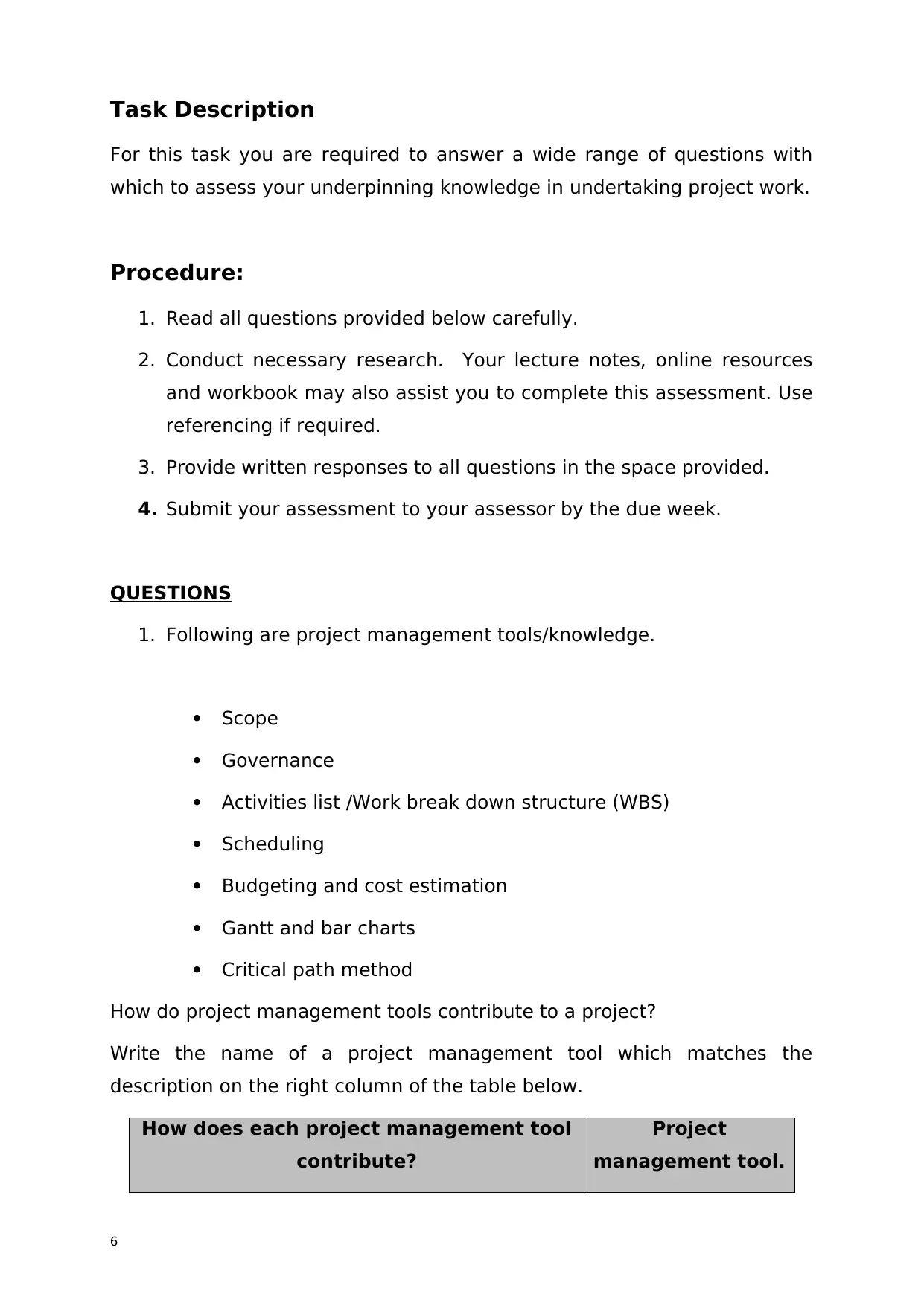
For this task you are required to answer a wide range of questions with
which to assess your underpinning knowledge in undertaking project work.
Procedure:
1. Read all questions provided below carefully.
2. Conduct necessary research. Your lecture notes, online resources
and workbook may also assist you to complete this assessment. Use
referencing if required.
3. Provide written responses to all questions in the space provided.
4. Submit your assessment to your assessor by the due week.
QUESTIONS
1. Following are project management tools/knowledge.
Scope
Governance
Activities list /Work break down structure (WBS)
Scheduling
Budgeting and cost estimation
Gantt and bar charts
Critical path method
How do project management tools contribute to a project?
Write the name of a project management tool which matches the
description on the right column of the table below.
How does each project management tool
contribute?
Project
management tool.
6
For this task you are required to answer a wide range of questions with
which to assess your underpinning knowledge in undertaking project work.
Procedure:
1. Read all questions provided below carefully.
2. Conduct necessary research. Your lecture notes, online resources
and workbook may also assist you to complete this assessment. Use
referencing if required.
3. Provide written responses to all questions in the space provided.
4. Submit your assessment to your assessor by the due week.
QUESTIONS
1. Following are project management tools/knowledge.
Scope
Governance
Activities list /Work break down structure (WBS)
Scheduling
Budgeting and cost estimation
Gantt and bar charts
Critical path method
How do project management tools contribute to a project?
Write the name of a project management tool which matches the
description on the right column of the table below.
How does each project management tool
contribute?
Project
management tool.
6
⊘ This is a preview!⊘
Do you want full access?
Subscribe today to unlock all pages.
Trusted by 1+ million students worldwide
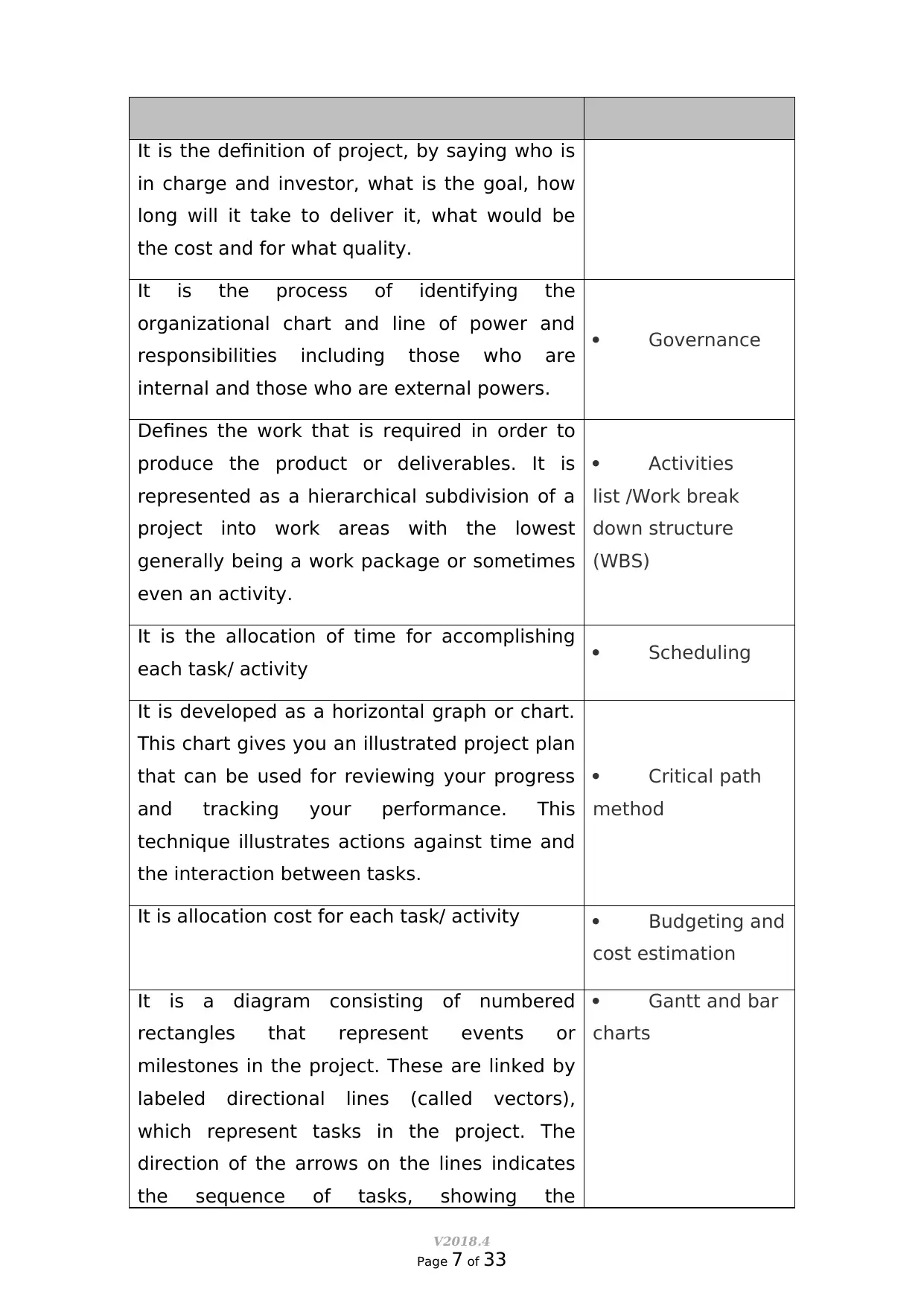
It is the definition of project, by saying who is
in charge and investor, what is the goal, how
long will it take to deliver it, what would be
the cost and for what quality.
It is the process of identifying the
organizational chart and line of power and
responsibilities including those who are
internal and those who are external powers.
Governance
Defines the work that is required in order to
produce the product or deliverables. It is
represented as a hierarchical subdivision of a
project into work areas with the lowest
generally being a work package or sometimes
even an activity.
Activities
list /Work break
down structure
(WBS)
It is the allocation of time for accomplishing
each task/ activity Scheduling
It is developed as a horizontal graph or chart.
This chart gives you an illustrated project plan
that can be used for reviewing your progress
and tracking your performance. This
technique illustrates actions against time and
the interaction between tasks.
Critical path
method
It is allocation cost for each task/ activity Budgeting and
cost estimation
It is a diagram consisting of numbered
rectangles that represent events or
milestones in the project. These are linked by
labeled directional lines (called vectors),
which represent tasks in the project. The
direction of the arrows on the lines indicates
the sequence of tasks, showing the
Gantt and bar
charts
V2018.4
Page 7 of 33
in charge and investor, what is the goal, how
long will it take to deliver it, what would be
the cost and for what quality.
It is the process of identifying the
organizational chart and line of power and
responsibilities including those who are
internal and those who are external powers.
Governance
Defines the work that is required in order to
produce the product or deliverables. It is
represented as a hierarchical subdivision of a
project into work areas with the lowest
generally being a work package or sometimes
even an activity.
Activities
list /Work break
down structure
(WBS)
It is the allocation of time for accomplishing
each task/ activity Scheduling
It is developed as a horizontal graph or chart.
This chart gives you an illustrated project plan
that can be used for reviewing your progress
and tracking your performance. This
technique illustrates actions against time and
the interaction between tasks.
Critical path
method
It is allocation cost for each task/ activity Budgeting and
cost estimation
It is a diagram consisting of numbered
rectangles that represent events or
milestones in the project. These are linked by
labeled directional lines (called vectors),
which represent tasks in the project. The
direction of the arrows on the lines indicates
the sequence of tasks, showing the
Gantt and bar
charts
V2018.4
Page 7 of 33
Paraphrase This Document
Need a fresh take? Get an instant paraphrase of this document with our AI Paraphraser
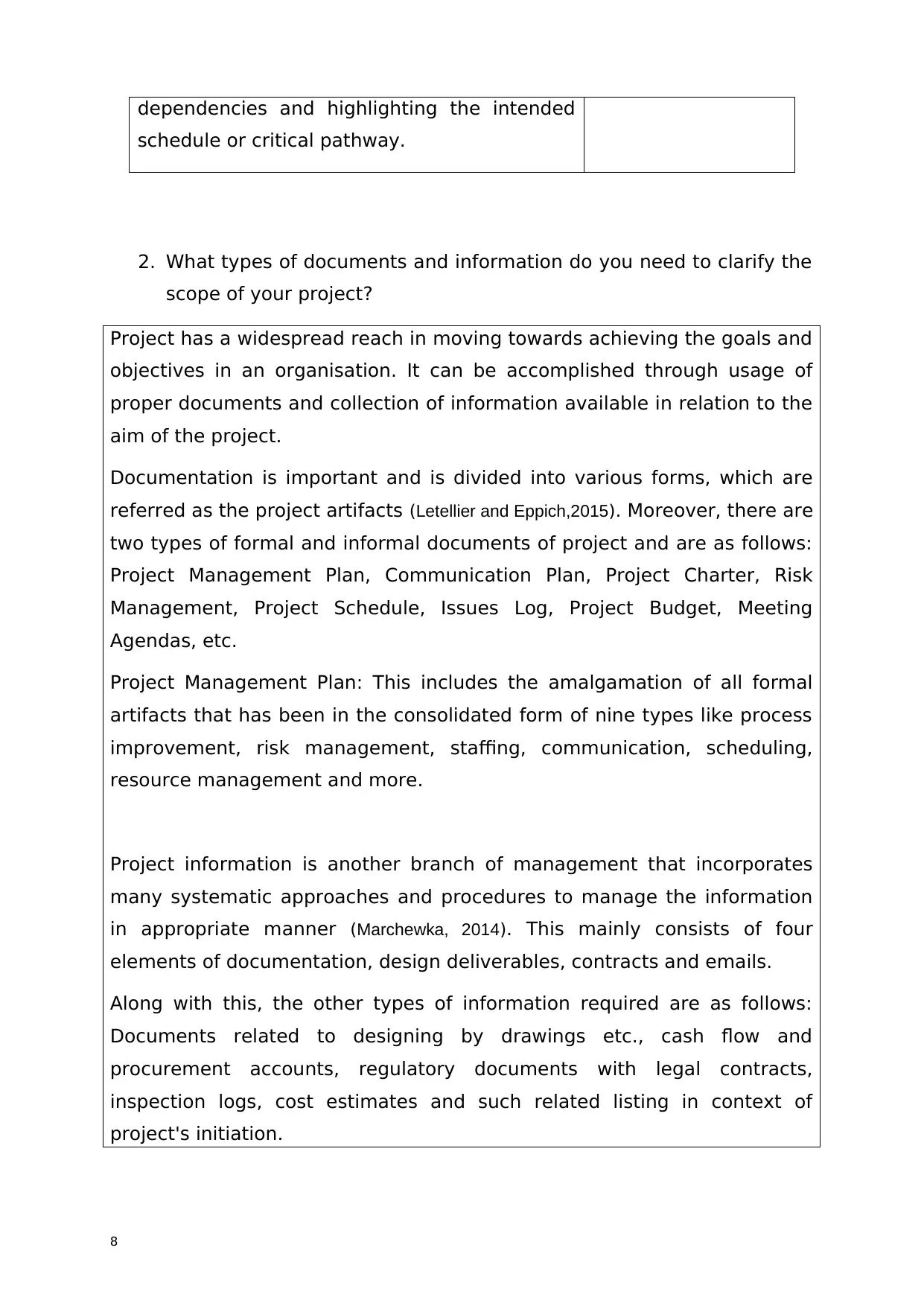
dependencies and highlighting the intended
schedule or critical pathway.
2. What types of documents and information do you need to clarify the
scope of your project?
Project has a widespread reach in moving towards achieving the goals and
objectives in an organisation. It can be accomplished through usage of
proper documents and collection of information available in relation to the
aim of the project.
Documentation is important and is divided into various forms, which are
referred as the project artifacts (Letellier and Eppich,2015). Moreover, there are
two types of formal and informal documents of project and are as follows:
Project Management Plan, Communication Plan, Project Charter, Risk
Management, Project Schedule, Issues Log, Project Budget, Meeting
Agendas, etc.
Project Management Plan: This includes the amalgamation of all formal
artifacts that has been in the consolidated form of nine types like process
improvement, risk management, staffing, communication, scheduling,
resource management and more.
Project information is another branch of management that incorporates
many systematic approaches and procedures to manage the information
in appropriate manner (Marchewka, 2014). This mainly consists of four
elements of documentation, design deliverables, contracts and emails.
Along with this, the other types of information required are as follows:
Documents related to designing by drawings etc., cash flow and
procurement accounts, regulatory documents with legal contracts,
inspection logs, cost estimates and such related listing in context of
project's initiation.
8
schedule or critical pathway.
2. What types of documents and information do you need to clarify the
scope of your project?
Project has a widespread reach in moving towards achieving the goals and
objectives in an organisation. It can be accomplished through usage of
proper documents and collection of information available in relation to the
aim of the project.
Documentation is important and is divided into various forms, which are
referred as the project artifacts (Letellier and Eppich,2015). Moreover, there are
two types of formal and informal documents of project and are as follows:
Project Management Plan, Communication Plan, Project Charter, Risk
Management, Project Schedule, Issues Log, Project Budget, Meeting
Agendas, etc.
Project Management Plan: This includes the amalgamation of all formal
artifacts that has been in the consolidated form of nine types like process
improvement, risk management, staffing, communication, scheduling,
resource management and more.
Project information is another branch of management that incorporates
many systematic approaches and procedures to manage the information
in appropriate manner (Marchewka, 2014). This mainly consists of four
elements of documentation, design deliverables, contracts and emails.
Along with this, the other types of information required are as follows:
Documents related to designing by drawings etc., cash flow and
procurement accounts, regulatory documents with legal contracts,
inspection logs, cost estimates and such related listing in context of
project's initiation.
8
Additionally, this consists of WBS, design documents, sign-offs, change
requests, scope charter etc. in order to track project.
3. Risk assessment of your project/s is a necessary part of a project.
How do you identify the risk for your project?
Risk Management is defined as the organisational policy that lays
emphasis on optimisation of allocated resources by enhancing the
productivity and increasing profitability in terms of low rate of failure.
Moreover, this risk can be refereed as the uncertain situation that has an
impact on the overall assessment of the project's failure or success (Nieto-
Morote and Ruz-Vila, 2011). Here, risk can have an influence on all aspects of
project, that is resources, processes, technology and people.
This can be categorised into the following:
Risk Event- This emphasis on the conditions and situational assessment of
the project's working speed that might lead towards any unexpected
occurrence of event.
Risk Time frame- During the progression of the project, such events can
take place and incur losses at the organisational context.
Probability- There is always a 50-50 chances for such accident, incident or
mis-happenings that might affect the entire progression of the project
management. It sometimes leads to incomplete tasks or stoppage
Impact- It indicates towards the certainty of the risk and its related
outcomes.
Factors- This affects the understanding of those parameters which
accelerated the type of risk during the completion of project.
Furthermore, this management of risk can be done on both qualitative and
quantitative methods. In this, quantitative methodologies are useful in
determination of measurable units with the help of various numerical
V2018.4
Page 9 of 33
requests, scope charter etc. in order to track project.
3. Risk assessment of your project/s is a necessary part of a project.
How do you identify the risk for your project?
Risk Management is defined as the organisational policy that lays
emphasis on optimisation of allocated resources by enhancing the
productivity and increasing profitability in terms of low rate of failure.
Moreover, this risk can be refereed as the uncertain situation that has an
impact on the overall assessment of the project's failure or success (Nieto-
Morote and Ruz-Vila, 2011). Here, risk can have an influence on all aspects of
project, that is resources, processes, technology and people.
This can be categorised into the following:
Risk Event- This emphasis on the conditions and situational assessment of
the project's working speed that might lead towards any unexpected
occurrence of event.
Risk Time frame- During the progression of the project, such events can
take place and incur losses at the organisational context.
Probability- There is always a 50-50 chances for such accident, incident or
mis-happenings that might affect the entire progression of the project
management. It sometimes leads to incomplete tasks or stoppage
Impact- It indicates towards the certainty of the risk and its related
outcomes.
Factors- This affects the understanding of those parameters which
accelerated the type of risk during the completion of project.
Furthermore, this management of risk can be done on both qualitative and
quantitative methods. In this, quantitative methodologies are useful in
determination of measurable units with the help of various numerical
V2018.4
Page 9 of 33
⊘ This is a preview!⊘
Do you want full access?
Subscribe today to unlock all pages.
Trusted by 1+ million students worldwide
approaches for sustainability factor (Suter II, 2016). Whereas on the other
hand, qualitative methods are applicable to evaluate the attributes in
descriptive manner for quantifying the outcomes in context of the possible
options available to complete the tasks.
4. How missions and goals of the operation are relevant to the project
goal’s that you took over?
Mission is referred as the official statement of an organisation in context of
their attainment of vision or goal. Whereas goal is defined as the target
that is tangible entity and can be achieved through collective strategic
measures to gain profits in terms of monetary, satisfaction etc(Defining
and articulating your vision, mission and values, 2014).
Both mission and goals have facilitated the organisation with a set
objectivity by laying the foundation of roadmap with specific timeline and
budgeting. In addition to this, this articulation must be done on the basis
of factors like support from the company's employees, staff, personnel and
shareholders; guidance from current trends and other competitors and
more.
Moreover, the operations' management has put insights on the
authenticity attached with defining the mission and goals in relation to the
project that would assist in motivating the employees for completion of
tasks in the real time with maximising the allocated resources (Patanakul
and Shenhar, 2012). Henceforth, it provides the path with cost effectiveness
and time efficiency.
5. How will you set below the process and procedures to manage your
project?
10
hand, qualitative methods are applicable to evaluate the attributes in
descriptive manner for quantifying the outcomes in context of the possible
options available to complete the tasks.
4. How missions and goals of the operation are relevant to the project
goal’s that you took over?
Mission is referred as the official statement of an organisation in context of
their attainment of vision or goal. Whereas goal is defined as the target
that is tangible entity and can be achieved through collective strategic
measures to gain profits in terms of monetary, satisfaction etc(Defining
and articulating your vision, mission and values, 2014).
Both mission and goals have facilitated the organisation with a set
objectivity by laying the foundation of roadmap with specific timeline and
budgeting. In addition to this, this articulation must be done on the basis
of factors like support from the company's employees, staff, personnel and
shareholders; guidance from current trends and other competitors and
more.
Moreover, the operations' management has put insights on the
authenticity attached with defining the mission and goals in relation to the
project that would assist in motivating the employees for completion of
tasks in the real time with maximising the allocated resources (Patanakul
and Shenhar, 2012). Henceforth, it provides the path with cost effectiveness
and time efficiency.
5. How will you set below the process and procedures to manage your
project?
10
Paraphrase This Document
Need a fresh take? Get an instant paraphrase of this document with our AI Paraphraser
5.1 Lines of authority and approvals
Lines of authority can be defined as the responsibilities of individuals
for establishments of business environment and the included working
practices. It includes about the relationship between the superiors and
subordinates to make decision making easier by segregating the tasks
in proper manner.
In this regard, it can be inferred that the authority which has been
given to pass down orders to their subordinate staff to complete
work/tasks in given time-frame by officially sanctioning it under legal
aspects' comes under the approvals part (Authority and DIRECTOR, 2014).
5.2 Quality assurance
This is the activity that determine the quality parameters to be fulfilled
by management of various activities and procedures to deliver the
project time-scale with appropriate and proper qualitative product or
service. Here, in this regard, there are many tools and techniques used.
For example, ISO 9000 which has been defines as per the assurance of
quality to provide the confidences of fulfilling the requirements in
context of quality
5.3 Human Resources
It is one of the important departments in an organisation which deals
directly with the recruitment and selection process of people. Along
with, they are responsible for distribution of resources, finance and
such related component of project management (Bailey and et.al., 2018).
They are also vital for maintenance of relationships among the task-
force and bridge the gap between the upper management and lower
level at company.
V2018.4
Page 11 of 33
Lines of authority can be defined as the responsibilities of individuals
for establishments of business environment and the included working
practices. It includes about the relationship between the superiors and
subordinates to make decision making easier by segregating the tasks
in proper manner.
In this regard, it can be inferred that the authority which has been
given to pass down orders to their subordinate staff to complete
work/tasks in given time-frame by officially sanctioning it under legal
aspects' comes under the approvals part (Authority and DIRECTOR, 2014).
5.2 Quality assurance
This is the activity that determine the quality parameters to be fulfilled
by management of various activities and procedures to deliver the
project time-scale with appropriate and proper qualitative product or
service. Here, in this regard, there are many tools and techniques used.
For example, ISO 9000 which has been defines as per the assurance of
quality to provide the confidences of fulfilling the requirements in
context of quality
5.3 Human Resources
It is one of the important departments in an organisation which deals
directly with the recruitment and selection process of people. Along
with, they are responsible for distribution of resources, finance and
such related component of project management (Bailey and et.al., 2018).
They are also vital for maintenance of relationships among the task-
force and bridge the gap between the upper management and lower
level at company.
V2018.4
Page 11 of 33
5.4 Budgets and finance
Finance is an important component for initiation of project. Along with,
budgeting determines the total estimated amount of capital that will be
implemented to execute the project smoothly and without any
obstacles. It indicates the calculation part of all the metrics that are
necessary for the improvisations in the performance management for
completion of tasks.
5.5 Record keeping and reporting
Record keeping is that component in the project management that put
insights on the total assessment of the ongoing procedures during the
project to match it with the estimated time-scale through WBS etc
(Lawson,2014). However, reporting would enlighten the managers and
employers about the further requirements to complete the project on time
including labour, costing, materials availability etc
6. What are the legislative and regulatory expectations in respect to
your project in Australia?
Legislative and regulatory expectation is the necessary for the business
process in Australia therefore, each and every organisation follows the
rules and regulation for managing the business aspects in proper ways.
The Australia government is more concern about the policies and laws
because this regulation provide the equal rights to their employee. There
are different types of laws applicable in Australia such as Archives
regulation, privacy act and freedom of information act etc. there are the
important rules and regulation that applicable in the business process to
manage the overall performance. For developing the business, Australia
follows the law jurisdiction rules and regulation that help for business
process and expand all over the world. It is required for the firms to
register as public and private companies. This is important for organisation
12
Finance is an important component for initiation of project. Along with,
budgeting determines the total estimated amount of capital that will be
implemented to execute the project smoothly and without any
obstacles. It indicates the calculation part of all the metrics that are
necessary for the improvisations in the performance management for
completion of tasks.
5.5 Record keeping and reporting
Record keeping is that component in the project management that put
insights on the total assessment of the ongoing procedures during the
project to match it with the estimated time-scale through WBS etc
(Lawson,2014). However, reporting would enlighten the managers and
employers about the further requirements to complete the project on time
including labour, costing, materials availability etc
6. What are the legislative and regulatory expectations in respect to
your project in Australia?
Legislative and regulatory expectation is the necessary for the business
process in Australia therefore, each and every organisation follows the
rules and regulation for managing the business aspects in proper ways.
The Australia government is more concern about the policies and laws
because this regulation provide the equal rights to their employee. There
are different types of laws applicable in Australia such as Archives
regulation, privacy act and freedom of information act etc. there are the
important rules and regulation that applicable in the business process to
manage the overall performance. For developing the business, Australia
follows the law jurisdiction rules and regulation that help for business
process and expand all over the world. It is required for the firms to
register as public and private companies. This is important for organisation
12
⊘ This is a preview!⊘
Do you want full access?
Subscribe today to unlock all pages.
Trusted by 1+ million students worldwide

1 out of 33


Related Documents


Your All-in-One AI-Powered Toolkit for Academic Success.
+13062052269
info@desklib.com
Available 24*7 on WhatsApp / Email
![[object Object]](/_next/static/media/star-bottom.7253800d.svg)
Unlock your academic potential
Copyright © 2020–2026 A2Z Services. All Rights Reserved. Developed and managed by ZUCOL.