Project Management: ProjectLibre WBS, Gantt Chart, and Cost Analysis

Verified

Added on  2022/11/18

|3
|505
|422
Practical Assignment
AI Summary
This assignment assesses two work breakdown structures (WBS) and Gantt charts created using ProjectLibre. The first work, a rock garden project, demonstrates a well-structured WBS with clear summary tasks, sub-tasks, and proper sequencing, including design phases and implementation. The Gantt chart accurately assigns durations and resources, with reasonable cost allocations. The second project, the “Public Local Stage,” reveals shortcomings in WBS definition, with insufficient sub-tasks and undefined task dependencies. The assignment highlights the importance of detailed WBS, proper task sequencing, and accurate duration estimation for effective project management. The analysis emphasizes the need for improvement in the second project by redefining tasks and establishing dependencies to create a realistic project timeline and cost assessment.
Document Page
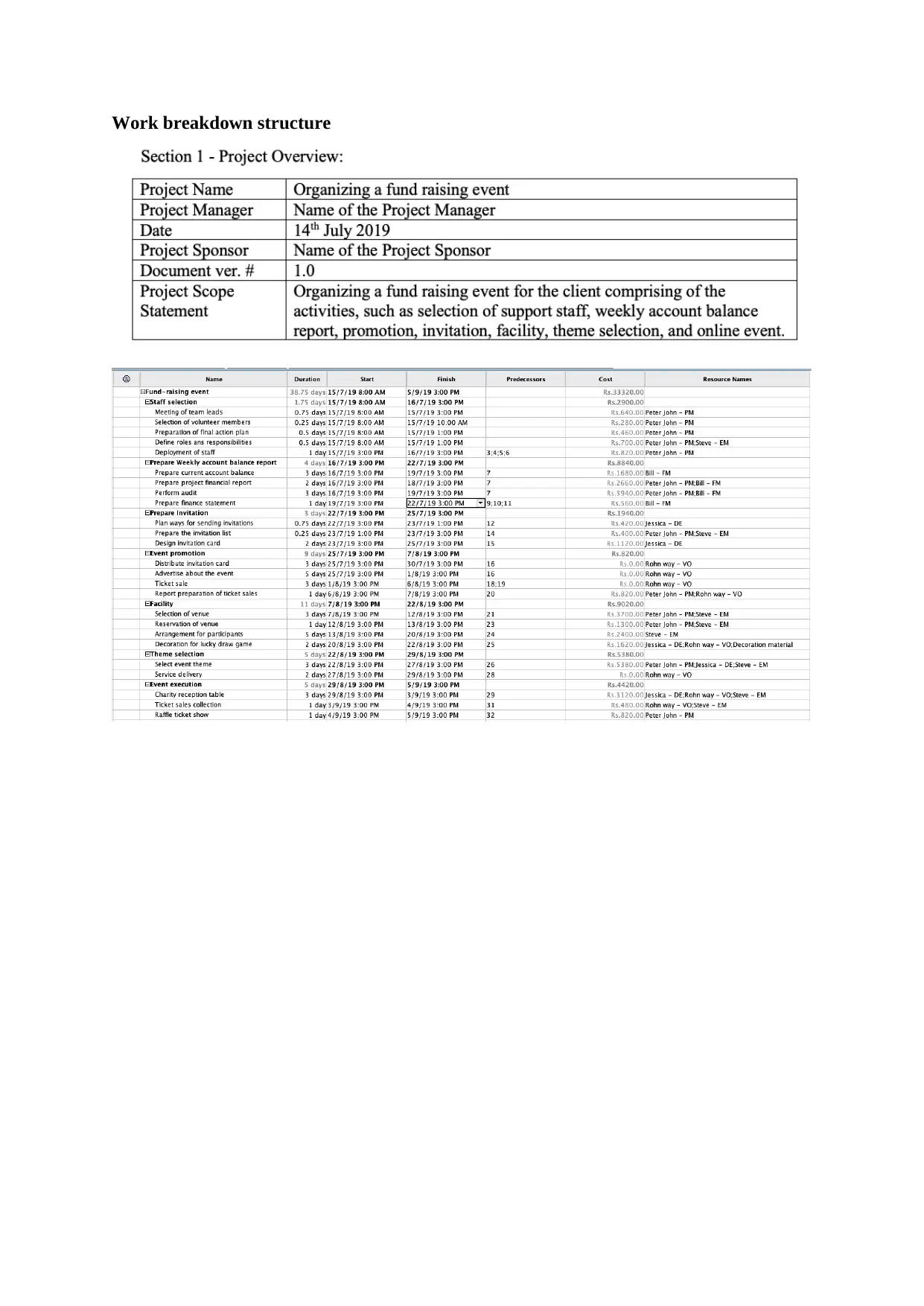
Work breakdown structure
tabler-icon-diamond-filled.svg

Paraphrase This Document

Need a fresh take? Get an instant paraphrase of this document with our AI Paraphraser
Document Page
Work #1:
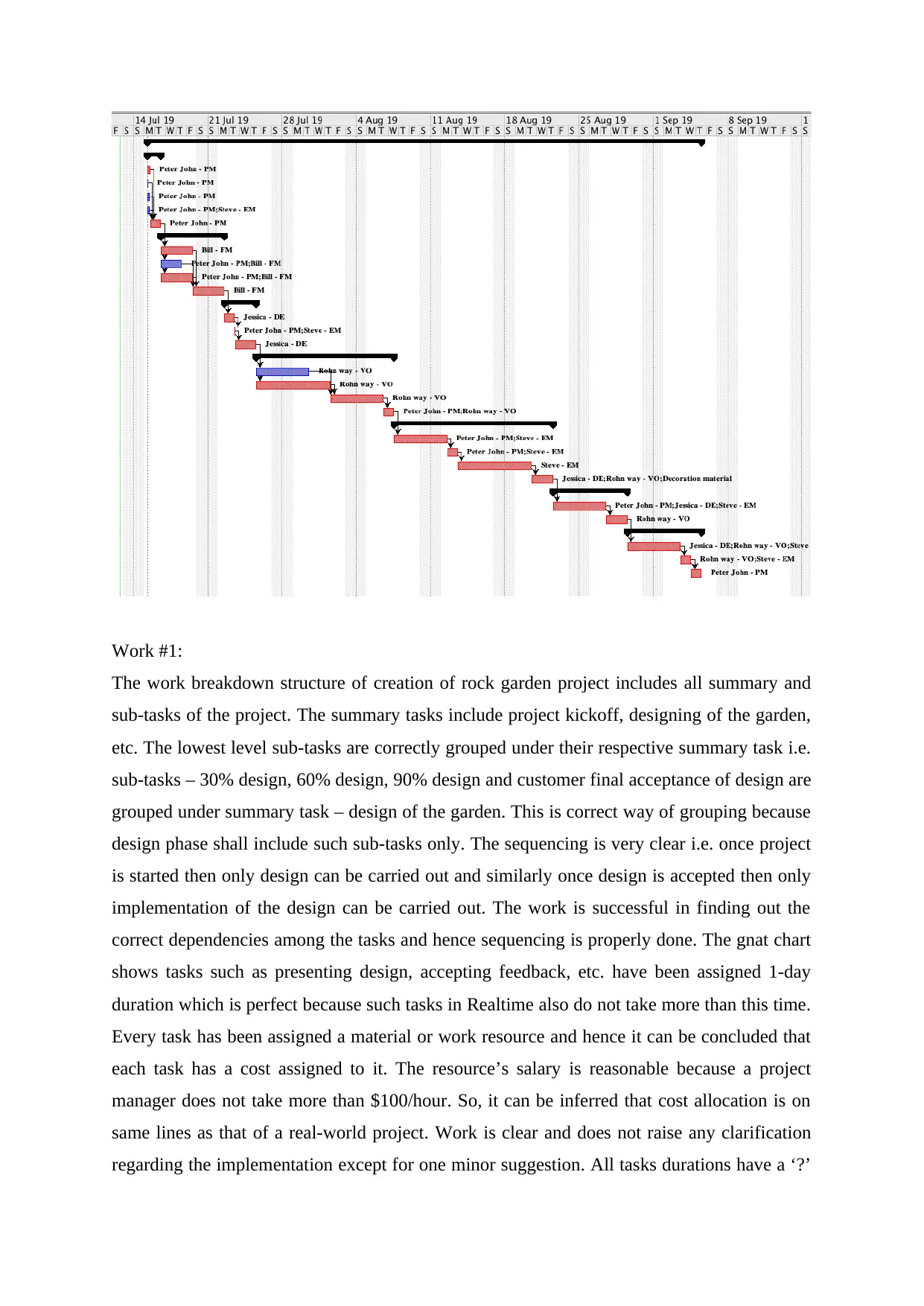
The work breakdown structure of creation of rock garden project includes all summary and
sub-tasks of the project. The summary tasks include project kickoff, designing of the garden,
etc. The lowest level sub-tasks are correctly grouped under their respective summary task i.e.
sub-tasks – 30% design, 60% design, 90% design and customer final acceptance of design are
grouped under summary task – design of the garden. This is correct way of grouping because
design phase shall include such sub-tasks only. The sequencing is very clear i.e. once project
is started then only design can be carried out and similarly once design is accepted then only
implementation of the design can be carried out. The work is successful in finding out the
correct dependencies among the tasks and hence sequencing is properly done. The gnat chart
shows tasks such as presenting design, accepting feedback, etc. have been assigned 1-day
duration which is perfect because such tasks in Realtime also do not take more than this time.
Every task has been assigned a material or work resource and hence it can be concluded that
each task has a cost assigned to it. The resource’s salary is reasonable because a project
manager does not take more than $100/hour. So, it can be inferred that cost allocation is on
same lines as that of a real-world project. Work is clear and does not raise any clarification
regarding the implementation except for one minor suggestion. All tasks durations have a ‘?’
Document Page
attached to them. It can be resolved by manually typing the duration ‘1 day’ in the duration
column.
Work #2: In the “Public Local Stage” project, summary tasks and sub-tasks are not defined to
the lowest level appropriately. The number of sub-tasks defined are also less for this
complicated project. For instance: Meet and discuss project summary task should be broken
down to further more sub-tasks such as finalize roles and responsibilities of the required staff,
check whether such staff is already available and allocate the defined roles to the staff. This
summary task should also have a sub-task “Recruitment of staff”. Secondly, the predecessors
are not defined in the Gantt chart i.e. there are no dependencies among the tasks. This is the
biggest lacking point in the project. Also, many durations are not clear. For instance: task# 20
takes 7 days. But it is not an executing task or closing task. Then it is not appropriate this task
to take 7 days. In order to resolve them, the work should be re-analyzed and dependencies
among the tasks should be defined. This will help in framing the duration of the individual
tasks.
chevron_up_icon
1 out of 3
circle_padding
hide_on_mobile
zoom_out_icon
[object Object]