Project Management Methodologies: Agile, Waterfall, PRINCE2 Analysis
VerifiedAdded on 2023/01/11
|7
|2009
|55
Project
AI Summary
This project delves into the realm of project management methodologies, comparing and contrasting three prominent approaches: Agile, Waterfall, and PRINCE2. The analysis begins with an introduction to project management, defining its core principles and the various methodologies employed to ensure successful project completion. The main body of the project provides a detailed examination of each methodology, highlighting their respective strengths and weaknesses. Agile's iterative and flexible nature is contrasted with Waterfall's sequential, phase-based approach and PRINCE2's structured, process-oriented framework. The project then presents a case study involving the refurbishment and redevelopment of Chapman Hall, and based on the analysis, recommends PRINCE2 as the most suitable methodology for this specific project due to its structured nature and suitability for projects with defined requirements and budgets. The project emphasizes the importance of risk management within the chosen methodology. The conclusion summarizes the findings, reiterating the comparative analysis and the rationale behind the recommendation of PRINCE2, underlining its potential for successful project outcomes and risk mitigation. The project is concluded with a comprehensive list of references, including books and journal articles.
PROJECT MANAGEMENT
PROJECT 3
PROJECT 3
Paraphrase This Document
Need a fresh take? Get an instant paraphrase of this document with our AI Paraphraser

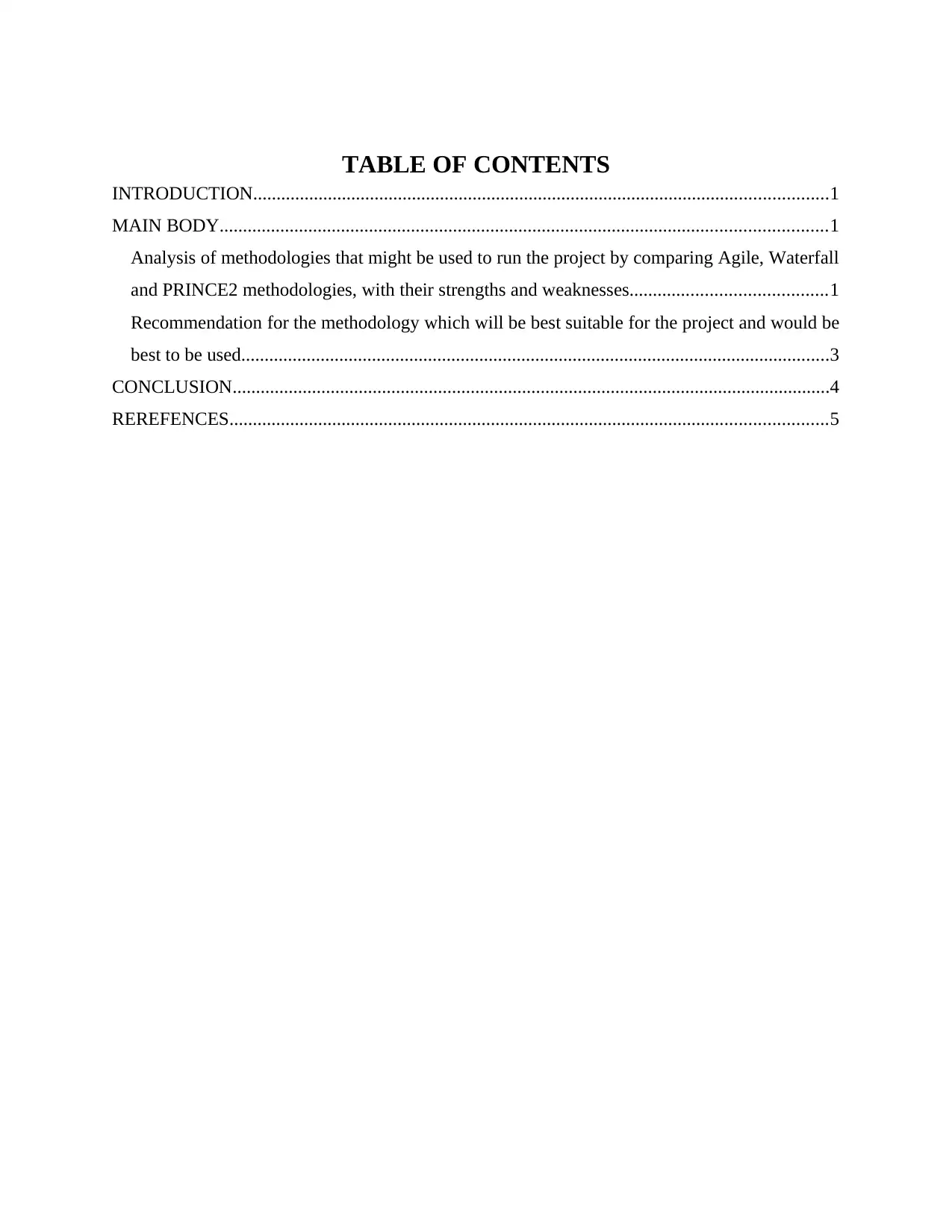
TABLE OF CONTENTS
INTRODUCTION...........................................................................................................................1
MAIN BODY..................................................................................................................................1
Analysis of methodologies that might be used to run the project by comparing Agile, Waterfall
and PRINCE2 methodologies, with their strengths and weaknesses..........................................1
Recommendation for the methodology which will be best suitable for the project and would be
best to be used..............................................................................................................................3
CONCLUSION................................................................................................................................4
REREFENCES................................................................................................................................5
INTRODUCTION...........................................................................................................................1
MAIN BODY..................................................................................................................................1
Analysis of methodologies that might be used to run the project by comparing Agile, Waterfall
and PRINCE2 methodologies, with their strengths and weaknesses..........................................1
Recommendation for the methodology which will be best suitable for the project and would be
best to be used..............................................................................................................................3
CONCLUSION................................................................................................................................4
REREFENCES................................................................................................................................5

INTRODUCTION
Project management can be defined as a kind of practise of initiating, planning,
executing, controlling, and closing a project successfully by meeting requirements and criteria
specified by the client. There are various kinds of methodologies of project management that can
be used to complete a project successfully (Gray and et. al., 2018). This project is based upon a
case study of university who wants to improve space available for business students and for this
thy want to refurbishment and redevelopment of the Chapman Hall in Queen’s Building and
complete the project in specific budget of £100k. this project will lay emphasis on choosing
appropriate and best methodology for complete the project successfully.
MAIN BODY
Analysis of methodologies that might be used to run the project by comparing Agile, Waterfall
and PRINCE2 methodologies, with their strengths and weaknesses
Project management methodologies can be defined as a strict combination of logically
related practises, processes and methods and ways in which planning, development and delivery
of a project is done throughout the continuous implementation process until and unless project is
either completed successfully or terminated. There are various kinds of project methodologies
that can be used to run and compensate the project of refurbishment and redevelopment of the
Chapman Hall in Queen’s Building successfully. All the methodologies have their own strengths
and weaknesses and can be used for projects as per the needs and requirements of the project.
There are many methodologies but three of them are most commonly used, such as: Agile,
waterfall and PRINCE2. All the three methodologies are used for different purposes and has
their own strengths and weakness.
Agile: It is one of the most commonly used and recognizable project management methodology.
This methodology is best suited for the projects that are incremental and iterative. It is a kind of
method in which solution to every problem evolve through collaborative efforts of cross-
functional teams, self- organization and their customers. this methodology was developed in
order to overcome weaknesses of waterfall methodology (Baptista and et. al., 2016). Agile
methodology has its own values and principles of Agile manifesto. These values and principles
are developed so that project can be developed in a better and appropriate manner with a proper
measurable and structured manner so that project can be completed in an iterative manner. Some
of the main principles of the Agile methodology are: Accommodation of change requirements
1
Project management can be defined as a kind of practise of initiating, planning,
executing, controlling, and closing a project successfully by meeting requirements and criteria
specified by the client. There are various kinds of methodologies of project management that can
be used to complete a project successfully (Gray and et. al., 2018). This project is based upon a
case study of university who wants to improve space available for business students and for this
thy want to refurbishment and redevelopment of the Chapman Hall in Queen’s Building and
complete the project in specific budget of £100k. this project will lay emphasis on choosing
appropriate and best methodology for complete the project successfully.
MAIN BODY
Analysis of methodologies that might be used to run the project by comparing Agile, Waterfall
and PRINCE2 methodologies, with their strengths and weaknesses
Project management methodologies can be defined as a strict combination of logically
related practises, processes and methods and ways in which planning, development and delivery
of a project is done throughout the continuous implementation process until and unless project is
either completed successfully or terminated. There are various kinds of project methodologies
that can be used to run and compensate the project of refurbishment and redevelopment of the
Chapman Hall in Queen’s Building successfully. All the methodologies have their own strengths
and weaknesses and can be used for projects as per the needs and requirements of the project.
There are many methodologies but three of them are most commonly used, such as: Agile,
waterfall and PRINCE2. All the three methodologies are used for different purposes and has
their own strengths and weakness.
Agile: It is one of the most commonly used and recognizable project management methodology.
This methodology is best suited for the projects that are incremental and iterative. It is a kind of
method in which solution to every problem evolve through collaborative efforts of cross-
functional teams, self- organization and their customers. this methodology was developed in
order to overcome weaknesses of waterfall methodology (Baptista and et. al., 2016). Agile
methodology has its own values and principles of Agile manifesto. These values and principles
are developed so that project can be developed in a better and appropriate manner with a proper
measurable and structured manner so that project can be completed in an iterative manner. Some
of the main principles of the Agile methodology are: Accommodation of change requirements
1
⊘ This is a preview!⊘
Do you want full access?
Subscribe today to unlock all pages.

Trusted by 1+ million students worldwide

should be done throughout the development process. Small project deliveries should be done
frequently in order to increase overall customer satisfaction. Face to face interaction should be
enabled. Consistent development pace should be maintained. All the minute details should be
focused on in order to complete the project successfully.
Strengths: this methodology is highly flexible and consist of short cycles which helps in
delivering the project frequently to the customer. There is no need to waste time and
resources on full development of the project as full project can be rejected by the client.
There is continuous interaction between the stakeholders of the project (Matos and et. al.,
2019). Whole team would be in touch with the customers and other stakeholders and would
be continuously interacting with them. It helps in avoiding tools of documentation, only
necessary and important documentations are developed. Iterations also helps in achieving
better results. Team size is majority of times small i.e. approximately 5 to 9 members are
involved within a team for development of the project. It further helps in assuring overall
quality of the project as development is done in short cycle.
Weakness: Agile methodology has some weaknesses as well such as- many times problem
within workflow coordination might arise which might become of the main weak point of the
project because of which risk associated with the project such as financial risk or market risk
can increase. Planning of the project might be difficulty at the early stage of the project. As it
is a refurbishment and redevelopment project it is important to have a well- defined planning
at easily stage. This refurbishment and redevelopment project require log term planning
which is another weakness of this method.
Waterfall: One of the oldest and traditional project management methodology is waterfall
methodology. It is a sequential or linear approach which focusses on progress of the project in
one single direction. This methodology has some fixed phases though which a project is
completed. However, there some limitation of this project and if these limitations are fulfilled
only them this project becomes suitable to be used, such as: this methodology lacks flexibility, it
cannot adopt changes at later stages of the project, all the requirements should be cleared at early
stage of the project (Silva, Pérez and Puentes, 2018). It has a fixed physical environment because
of which it becomes quite expensive. Team using this methodology will only be able to move to
next stage of development only if they successfully complete current or previous stage of
development. It is one of those methodologies that focuses majorly upon documentation, this is
2
frequently in order to increase overall customer satisfaction. Face to face interaction should be
enabled. Consistent development pace should be maintained. All the minute details should be
focused on in order to complete the project successfully.
Strengths: this methodology is highly flexible and consist of short cycles which helps in
delivering the project frequently to the customer. There is no need to waste time and
resources on full development of the project as full project can be rejected by the client.
There is continuous interaction between the stakeholders of the project (Matos and et. al.,
2019). Whole team would be in touch with the customers and other stakeholders and would
be continuously interacting with them. It helps in avoiding tools of documentation, only
necessary and important documentations are developed. Iterations also helps in achieving
better results. Team size is majority of times small i.e. approximately 5 to 9 members are
involved within a team for development of the project. It further helps in assuring overall
quality of the project as development is done in short cycle.
Weakness: Agile methodology has some weaknesses as well such as- many times problem
within workflow coordination might arise which might become of the main weak point of the
project because of which risk associated with the project such as financial risk or market risk
can increase. Planning of the project might be difficulty at the early stage of the project. As it
is a refurbishment and redevelopment project it is important to have a well- defined planning
at easily stage. This refurbishment and redevelopment project require log term planning
which is another weakness of this method.
Waterfall: One of the oldest and traditional project management methodology is waterfall
methodology. It is a sequential or linear approach which focusses on progress of the project in
one single direction. This methodology has some fixed phases though which a project is
completed. However, there some limitation of this project and if these limitations are fulfilled
only them this project becomes suitable to be used, such as: this methodology lacks flexibility, it
cannot adopt changes at later stages of the project, all the requirements should be cleared at early
stage of the project (Silva, Pérez and Puentes, 2018). It has a fixed physical environment because
of which it becomes quite expensive. Team using this methodology will only be able to move to
next stage of development only if they successfully complete current or previous stage of
development. It is one of those methodologies that focuses majorly upon documentation, this is
2
Paraphrase This Document
Need a fresh take? Get an instant paraphrase of this document with our AI Paraphraser

majorly because if a worker leaves the project in the middle of project development then it does
not hamper the project in fact, another person can directly replace them and take their place and
continue from the place they left. This project has its own strengths and weakness, such as:
Strengths: One of the main strengths of this project is that till the previous stage of
development is not complete, next stage is not started. It is one of the best suited approach
for project in which requirements are fixed.
Weaknesses: if any kind of error occurs then it can be foxed only while the project is in that
particular state, changes cannot be accepted at later stages. Valuable client feedback cannot
be included in the middle of the project.
PRINCE2: It is a full stack waterfall project management methodology which includes
principles, themes and processes that are created by UK government. It is a process- oriented
methodology which is divided into multiple stages (Misopoulos and et. al., 2018). This
methodology defines input and output at every stage. This methodology can be used for large
and predictable projects. It has its own strengths and weaknesses, such as:
Strengths: It helps in maintaining knowledge bank that can be utilized in critical situations.
At various stages of PRINCE2 risk is focused on so that project can be complete
successfully. All the outputs of the project are measurable by outweighs benefits (Abdulla,
Alhashimi and Hamdan, 2019).
Weaknesses: this model has its own weaknesses as well such as: Prince2 needs a huge
amount of time for planning and designing. Prince2 is more on documentation and standard
templates oriented because of which documentation at each level increases.
Recommendation for the methodology which will be best suitable for the project and would be
best to be used
Methodology which is best suitable for the project is PRINCE2. As the name suggests that
it is a methodology that can be used in controlled environment. It is one of the most suitable
project methodologies that can be used for refurbishment and redevelopment of the Chapman
Hall in Queen’s Building because of various reasons: one of the most common reason is that it is
suitable for organizations that has a fixed organizational structure and university as a fixed
organizational structure. It is suitable for the project as overall requirements of the project have
already been defined with budget. Management of this project can be done easily and
successfully as whole project is divided into five main stages that are: project initiation,
3
not hamper the project in fact, another person can directly replace them and take their place and
continue from the place they left. This project has its own strengths and weakness, such as:
Strengths: One of the main strengths of this project is that till the previous stage of
development is not complete, next stage is not started. It is one of the best suited approach
for project in which requirements are fixed.
Weaknesses: if any kind of error occurs then it can be foxed only while the project is in that
particular state, changes cannot be accepted at later stages. Valuable client feedback cannot
be included in the middle of the project.
PRINCE2: It is a full stack waterfall project management methodology which includes
principles, themes and processes that are created by UK government. It is a process- oriented
methodology which is divided into multiple stages (Misopoulos and et. al., 2018). This
methodology defines input and output at every stage. This methodology can be used for large
and predictable projects. It has its own strengths and weaknesses, such as:
Strengths: It helps in maintaining knowledge bank that can be utilized in critical situations.
At various stages of PRINCE2 risk is focused on so that project can be complete
successfully. All the outputs of the project are measurable by outweighs benefits (Abdulla,
Alhashimi and Hamdan, 2019).
Weaknesses: this model has its own weaknesses as well such as: Prince2 needs a huge
amount of time for planning and designing. Prince2 is more on documentation and standard
templates oriented because of which documentation at each level increases.
Recommendation for the methodology which will be best suitable for the project and would be
best to be used
Methodology which is best suitable for the project is PRINCE2. As the name suggests that
it is a methodology that can be used in controlled environment. It is one of the most suitable
project methodologies that can be used for refurbishment and redevelopment of the Chapman
Hall in Queen’s Building because of various reasons: one of the most common reason is that it is
suitable for organizations that has a fixed organizational structure and university as a fixed
organizational structure. It is suitable for the project as overall requirements of the project have
already been defined with budget. Management of this project can be done easily and
successfully as whole project is divided into five main stages that are: project initiation,
3

planning, implementation, project monitoring and closure. Not only this, all the requirements of
the project have already been defined at project planning stage which will further help in
completing the project successfully. It is also suitable for the project because it is flexible enough
to allow the team to control and organize the project at start, middle or end of the project. It also
helps the project manager to risk management as well. All kinds of risk identified can be
managed and reduced with the help of this methodology. Failure chances of refurbishment and
redevelopment project will also reduce with the help of this project. For successfully risk
management project manager develops risk register so that risk mitigation actions can be taken
on time and project can be completed on time in an effective manner at every stage of the project
because of which success chances of the project increases.
CONCLUSION
From the above project it has been summarized that there are three main types of project
management methodologies: agile, waterfall and PRINC2 that can be used for refurbishment and
redevelopment project of the Chapman Hall in Queen’s Building of the university. All the three
methodologies have their own strengths and weakness because of which suitability of the
methodologies for the project varies. It has been summarized that out of all the three
methodologies PRINCE2 methodology is most appropriate and suitable methodology for the
project as it will also help in providing a chance of risk management within the project which
will further help in completing the project successfully.
4
the project have already been defined at project planning stage which will further help in
completing the project successfully. It is also suitable for the project because it is flexible enough
to allow the team to control and organize the project at start, middle or end of the project. It also
helps the project manager to risk management as well. All kinds of risk identified can be
managed and reduced with the help of this methodology. Failure chances of refurbishment and
redevelopment project will also reduce with the help of this project. For successfully risk
management project manager develops risk register so that risk mitigation actions can be taken
on time and project can be completed on time in an effective manner at every stage of the project
because of which success chances of the project increases.
CONCLUSION
From the above project it has been summarized that there are three main types of project
management methodologies: agile, waterfall and PRINC2 that can be used for refurbishment and
redevelopment project of the Chapman Hall in Queen’s Building of the university. All the three
methodologies have their own strengths and weakness because of which suitability of the
methodologies for the project varies. It has been summarized that out of all the three
methodologies PRINCE2 methodology is most appropriate and suitable methodology for the
project as it will also help in providing a chance of risk management within the project which
will further help in completing the project successfully.
4
⊘ This is a preview!⊘
Do you want full access?
Subscribe today to unlock all pages.

Trusted by 1+ million students worldwide

REREFENCES
Books and journals
Abdulla, H., Alhashimi, M. and Hamdan, A.M., 2019. The Impact of Project Management
Methodologies on Project Success: A Case Study of the Oil and Gas Industry in the
Kingdom of Bahrain. In Handbook of Research on Implementing Knowledge
Management Strategy in the Public Sector (pp. 418-437). IGI Global.
Baptista, A., and et. al., 2016. Project management methodologies as main tool for current
challenges in global economy driving historical changes. Journal of Advanced
Management Science. 4(2).
Gray, J., and et. al., 2018. A Comparative Analysis of Agile Project Management
Methodologies. Annals of the Master of Science in Computer Science and Information
Systems at UNC Wilmington. 12(1).
Matos, P.V., and et. al., 2019. The adoption of project management methodologies and tools by
NGDOs: A mixed methods perspective. Journal of Business Research. 101. pp.651-659.
Misopoulos, F., and et. al., 2018. Addressing organisational pressures as drivers towards
sustainability in manufacturing projects and project management
methodologies. Sustainability. 10(6). p.2098.
Silva, H.C., Pérez, T.V. and Puentes, M.R., 2018, November. Adoption of project management
methodologies in Colombia project manager’s perspective. In Journal of Physics:
Conference Series (Vol. 1126, No. 1, p. 012032). IOP Publishing.
5
Books and journals
Abdulla, H., Alhashimi, M. and Hamdan, A.M., 2019. The Impact of Project Management
Methodologies on Project Success: A Case Study of the Oil and Gas Industry in the
Kingdom of Bahrain. In Handbook of Research on Implementing Knowledge
Management Strategy in the Public Sector (pp. 418-437). IGI Global.
Baptista, A., and et. al., 2016. Project management methodologies as main tool for current
challenges in global economy driving historical changes. Journal of Advanced
Management Science. 4(2).
Gray, J., and et. al., 2018. A Comparative Analysis of Agile Project Management
Methodologies. Annals of the Master of Science in Computer Science and Information
Systems at UNC Wilmington. 12(1).
Matos, P.V., and et. al., 2019. The adoption of project management methodologies and tools by
NGDOs: A mixed methods perspective. Journal of Business Research. 101. pp.651-659.
Misopoulos, F., and et. al., 2018. Addressing organisational pressures as drivers towards
sustainability in manufacturing projects and project management
methodologies. Sustainability. 10(6). p.2098.
Silva, H.C., Pérez, T.V. and Puentes, M.R., 2018, November. Adoption of project management
methodologies in Colombia project manager’s perspective. In Journal of Physics:
Conference Series (Vol. 1126, No. 1, p. 012032). IOP Publishing.
5
1 out of 7
Related Documents
Your All-in-One AI-Powered Toolkit for Academic Success.
+13062052269
info@desklib.com
Available 24*7 on WhatsApp / Email
Unlock your academic potential
Copyright © 2020–2026 A2Z Services. All Rights Reserved. Developed and managed by ZUCOL.