Analysis of Project Management Methodologies: PRINCE2 and Waterfall
VerifiedAdded on 2023/04/17
|6
|888
|476
Report
AI Summary
This report provides a comprehensive analysis of project management methodologies, focusing on PRINCE2 and Waterfall. It defines methodology, emphasizing its role in project management, and highlights the importance of a well-defined methodology for ensuring projects are completed on time, within budget, and according to client specifications. The report details the features of PRINCE2, including its focus on business justification, organizational structure, and risk management. It also explains the Waterfall methodology, which involves executing projects in linear stages with extensive documentation. A comparison between PRINCE2 and Waterfall is provided, highlighting their differences in approach and suitability for various projects. The report also touches on the project management life cycle, including initiation, planning, execution, and closure phases. The document is available on Desklib, a platform offering study tools for students.

Running head: PROJECT MANAGEMENT METHODOLOGIES
PROJECT MANAGEMENT METHODOLOGIES
Name of Student
Name of University
Author’s Note
PROJECT MANAGEMENT METHODOLOGIES
Name of Student
Name of University
Author’s Note
Paraphrase This Document
Need a fresh take? Get an instant paraphrase of this document with our AI Paraphraser

1PROJECT MANAGEMENT METHODOLOGIES
Definition of Methodology
Methodology can be defined as a system of various broad rules or principles from where
certain procedures or methods might be derived. This is done in order to interrupt as well as
solve various issues within the scope of a specific discipline. Methodology is not considered as
formula similar to an algorithm, inspite it is used as a set of practices. Methodology describes the
procedure using which a specific project is carried out (Kerzner & Kerzner, 2017). It contains
details regarding the collection of data and using is for the purpose of carrying out a research.
Methodologies are concerned regarding the science of procedures and methods.
Role of PM in project management
A well defined as well as very strictly defined methodology in order to manage a specific
project would provide a specific firm guaranteeing that the job would be done within time,
budget as well as considering the specifications of every client (Binder, 2016). Project
management methodology can be used in order to simplify the realization of business benefits as
well as organize the particular work in a unique and structured entity. Project methodologies are
effective with the help of proper communication as well as collaboration. Project methodology
can be defined as a particular combination of practices that are logically related, processes and
methods which determine the ways to plan, control, develop and then deliver project with the
help of continuous implementation process (Hornstein, 2015). This is done till the project is
successfully implemented.
Two processes of PM
There are various processes of project methodology; the two of them that would be
discussed in this assignment are as follows
Definition of Methodology
Methodology can be defined as a system of various broad rules or principles from where
certain procedures or methods might be derived. This is done in order to interrupt as well as
solve various issues within the scope of a specific discipline. Methodology is not considered as
formula similar to an algorithm, inspite it is used as a set of practices. Methodology describes the
procedure using which a specific project is carried out (Kerzner & Kerzner, 2017). It contains
details regarding the collection of data and using is for the purpose of carrying out a research.
Methodologies are concerned regarding the science of procedures and methods.
Role of PM in project management
A well defined as well as very strictly defined methodology in order to manage a specific
project would provide a specific firm guaranteeing that the job would be done within time,
budget as well as considering the specifications of every client (Binder, 2016). Project
management methodology can be used in order to simplify the realization of business benefits as
well as organize the particular work in a unique and structured entity. Project methodologies are
effective with the help of proper communication as well as collaboration. Project methodology
can be defined as a particular combination of practices that are logically related, processes and
methods which determine the ways to plan, control, develop and then deliver project with the
help of continuous implementation process (Hornstein, 2015). This is done till the project is
successfully implemented.
Two processes of PM
There are various processes of project methodology; the two of them that would be
discussed in this assignment are as follows

2PROJECT MANAGEMENT METHODOLOGIES
PRINCE 2: PRINCE 2 can be defined as a structured project management methodology.
PRINCE 2 is usually a method that is process-based in nature; it is utilized for undertaking an
effective project management. This methodology has been widely recognized as well as
practiced in the fields of private sector across the world (Kerzner, 2018). The basic features of
PRINCE 2 focuses on the concept of business justification which defines the structure of a
particular organization for project management team and then uses an approach that is product-
based. PRINCE 2 has been providing good control on the project resources and then excels at the
management of business as well as project risk in an effective manner.
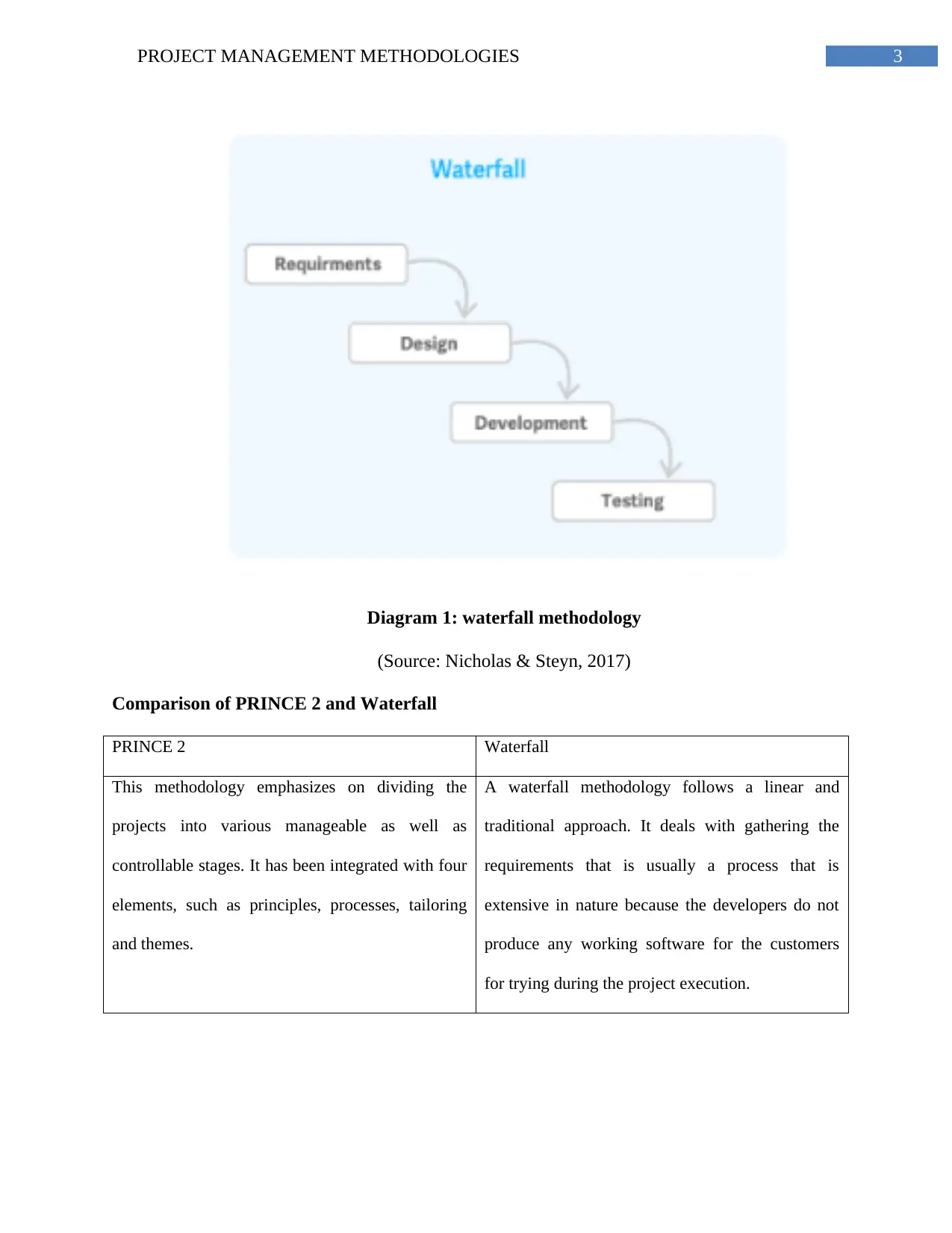
Waterfall: the waterfall methodology can be used in order to implement a specific
project, using this methodology a project is initiated and completed in various stages and moves
step by step towards the release of consumers. The project is executed in a linear manner using
the waterfall methodology (Joslin & Müller, 2015). Waterfall methodology makes the execution
of a project successful using various processes; these processes include extensive documentation,
gaining knowledge by the employees within the organization, team members are allowed to plan
their time in a better way, not receiving any input from the clients, it helps in measuring the
resources, makes designing easier and many more.
PRINCE 2: PRINCE 2 can be defined as a structured project management methodology.
PRINCE 2 is usually a method that is process-based in nature; it is utilized for undertaking an
effective project management. This methodology has been widely recognized as well as
practiced in the fields of private sector across the world (Kerzner, 2018). The basic features of
PRINCE 2 focuses on the concept of business justification which defines the structure of a
particular organization for project management team and then uses an approach that is product-
based. PRINCE 2 has been providing good control on the project resources and then excels at the
management of business as well as project risk in an effective manner.
Waterfall: the waterfall methodology can be used in order to implement a specific
project, using this methodology a project is initiated and completed in various stages and moves
step by step towards the release of consumers. The project is executed in a linear manner using
the waterfall methodology (Joslin & Müller, 2015). Waterfall methodology makes the execution
of a project successful using various processes; these processes include extensive documentation,
gaining knowledge by the employees within the organization, team members are allowed to plan
their time in a better way, not receiving any input from the clients, it helps in measuring the
resources, makes designing easier and many more.
⊘ This is a preview!⊘
Do you want full access?
Subscribe today to unlock all pages.

Trusted by 1+ million students worldwide

3PROJECT MANAGEMENT METHODOLOGIES
Diagram 1: waterfall methodology
(Source: Nicholas & Steyn, 2017)
Comparison of PRINCE 2 and Waterfall
PRINCE 2 Waterfall
This methodology emphasizes on dividing the
projects into various manageable as well as
controllable stages. It has been integrated with four
elements, such as principles, processes, tailoring
and themes.
A waterfall methodology follows a linear and
traditional approach. It deals with gathering the
requirements that is usually a process that is
extensive in nature because the developers do not
produce any working software for the customers
for trying during the project execution.
Diagram 1: waterfall methodology
(Source: Nicholas & Steyn, 2017)
Comparison of PRINCE 2 and Waterfall
PRINCE 2 Waterfall
This methodology emphasizes on dividing the
projects into various manageable as well as
controllable stages. It has been integrated with four
elements, such as principles, processes, tailoring
and themes.
A waterfall methodology follows a linear and
traditional approach. It deals with gathering the
requirements that is usually a process that is
extensive in nature because the developers do not
produce any working software for the customers
for trying during the project execution.
Paraphrase This Document
Need a fresh take? Get an instant paraphrase of this document with our AI Paraphraser

4PROJECT MANAGEMENT METHODOLOGIES
It provides a single standard approach towards the
projects. It is also easy to use hence it s utilized by
global organizations and government organizations.
It focuses on quality instead of speed; it suits to the
projects that are not urgent.
Table 1: differences between waterfall and PRINCE 2
(Source: Kerzner & Kerzner, 2017)
PLC
The project management life cycle consists of various phases; these phases include
initiation, planning, execution and closure. These phases have their contribution towards the
success of failure of the project. The initiation of stage includes the initial steps that are carried
out in a specific project; the planning stage consists of activities regarding planning of the entire
project (Binder, 2016). The execution phase includes the activities that are performed while
executing the planned project. The closure stage is the final stage and it consists of activities that
are undertaken in order to close the ongoing project.
It provides a single standard approach towards the
projects. It is also easy to use hence it s utilized by
global organizations and government organizations.
It focuses on quality instead of speed; it suits to the
projects that are not urgent.
Table 1: differences between waterfall and PRINCE 2
(Source: Kerzner & Kerzner, 2017)
PLC
The project management life cycle consists of various phases; these phases include
initiation, planning, execution and closure. These phases have their contribution towards the
success of failure of the project. The initiation of stage includes the initial steps that are carried
out in a specific project; the planning stage consists of activities regarding planning of the entire
project (Binder, 2016). The execution phase includes the activities that are performed while
executing the planned project. The closure stage is the final stage and it consists of activities that
are undertaken in order to close the ongoing project.

5PROJECT MANAGEMENT METHODOLOGIES
References
Binder, J. (2016). Global project management: communication, collaboration and management
across borders. Routledge.
Hornstein, H. A. (2015). The integration of project management and organizational change
management is now a necessity. International Journal of Project Management, 33(2),
291-298.
Joslin, R., & Müller, R. (2015). Relationships between a project management methodology and
project success in different project governance contexts. International Journal of Project
Management, 33(6), 1377-1392.
Kerzner, H. (2018). Project management best practices: Achieving global excellence. John
Wiley & Sons.
Kerzner, H., & Kerzner, H. R. (2017). Project management: a systems approach to planning,
scheduling, and controlling. John Wiley & Sons.
Nicholas, J. M., & Steyn, H. (2017). Project management for engineering, business and
technology. Routledge.
References
Binder, J. (2016). Global project management: communication, collaboration and management
across borders. Routledge.
Hornstein, H. A. (2015). The integration of project management and organizational change
management is now a necessity. International Journal of Project Management, 33(2),
291-298.
Joslin, R., & Müller, R. (2015). Relationships between a project management methodology and
project success in different project governance contexts. International Journal of Project
Management, 33(6), 1377-1392.
Kerzner, H. (2018). Project management best practices: Achieving global excellence. John
Wiley & Sons.
Kerzner, H., & Kerzner, H. R. (2017). Project management: a systems approach to planning,
scheduling, and controlling. John Wiley & Sons.
Nicholas, J. M., & Steyn, H. (2017). Project management for engineering, business and
technology. Routledge.
⊘ This is a preview!⊘
Do you want full access?
Subscribe today to unlock all pages.

Trusted by 1+ million students worldwide
1 out of 6
Related Documents
Your All-in-One AI-Powered Toolkit for Academic Success.
+13062052269
info@desklib.com
Available 24*7 on WhatsApp / Email
Unlock your academic potential
Copyright © 2020–2025 A2Z Services. All Rights Reserved. Developed and managed by ZUCOL.