Project and Portfolio Management Office: Roles, Traits and Software

Verified

Added on  2023/06/04

|4
|713
|390
Report
AI Summary
This report provides an overview of project and portfolio management, emphasizing the role and characteristics of the Project Management Office (PMO). It defines project management as the integration of time, cost, scope, and risk, highlighting the use of software like MS Project for individual projects. Portfolio management, managed by PMOs, involves managing complex projects and programs through resource allocation and market analysis. The report discusses the traits of effective PMOs, including transparency, consistency, and problem-solving skills, and differentiates between project management (making projects right) and portfolio management (making the right projects). It also contrasts project management software (MS Project) with portfolio management solutions like Planview, which aids in risk identification and resource allocation, stressing the importance of portfolio management before project implementation. Desklib offers a wealth of similar solved assignments for students.
Document Page
Running Head: PORTFOLIO MANAGEMENT OFFICE
Project Management and Portfolio Management
Name of the student:
Name of the university:
Author note:
tabler-icon-diamond-filled.svg

Paraphrase This Document

Need a fresh take? Get an instant paraphrase of this document with our AI Paraphraser
Document Page
1PORTFOLIO MANAGEMENT OFFICE
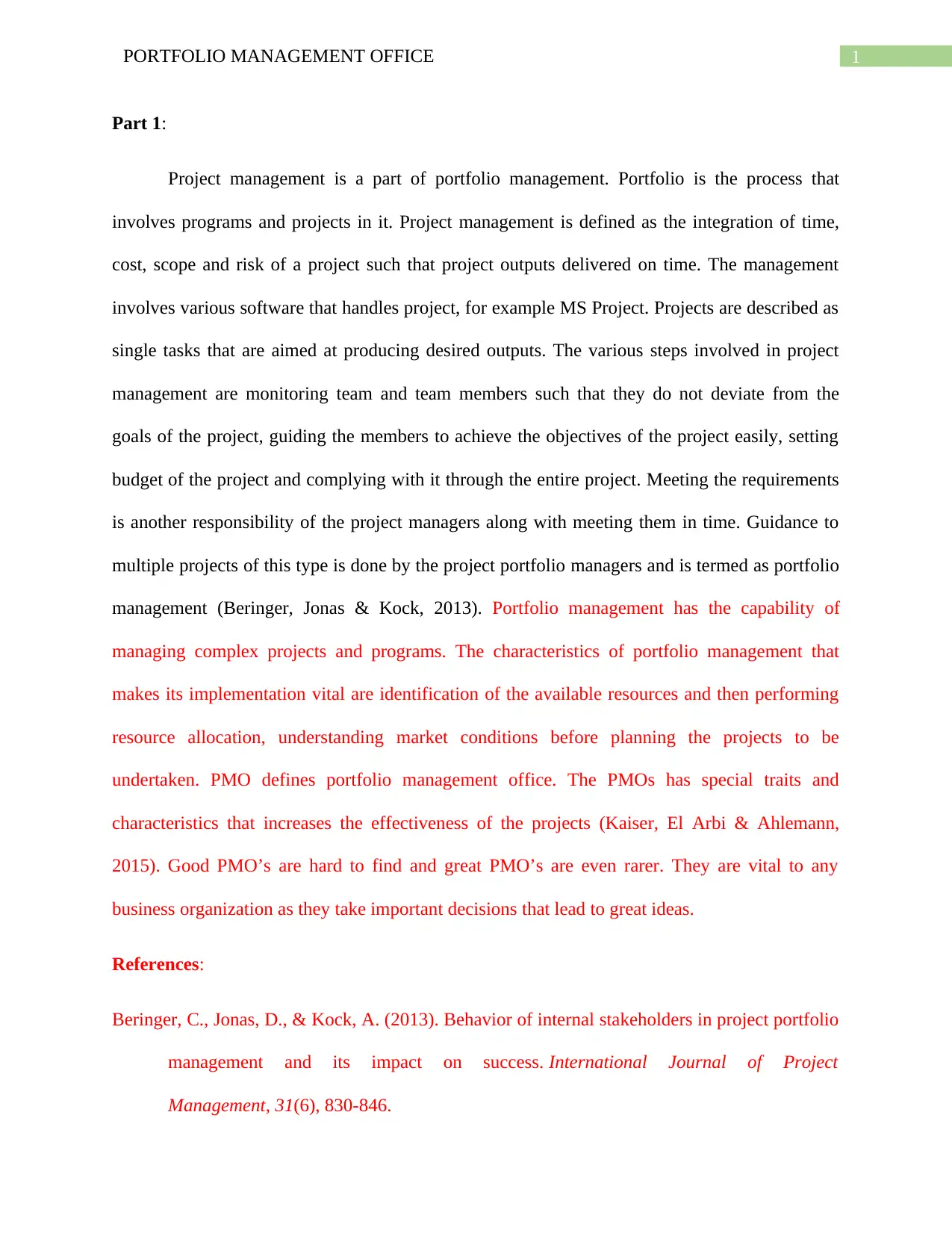
Part 1:
Project management is a part of portfolio management. Portfolio is the process that
involves programs and projects in it. Project management is defined as the integration of time,
cost, scope and risk of a project such that project outputs delivered on time. The management
involves various software that handles project, for example MS Project. Projects are described as
single tasks that are aimed at producing desired outputs. The various steps involved in project
management are monitoring team and team members such that they do not deviate from the
goals of the project, guiding the members to achieve the objectives of the project easily, setting
budget of the project and complying with it through the entire project. Meeting the requirements
is another responsibility of the project managers along with meeting them in time. Guidance to
multiple projects of this type is done by the project portfolio managers and is termed as portfolio
management (Beringer, Jonas & Kock, 2013). Portfolio management has the capability of
managing complex projects and programs. The characteristics of portfolio management that
makes its implementation vital are identification of the available resources and then performing
resource allocation, understanding market conditions before planning the projects to be
undertaken. PMO defines portfolio management office. The PMOs has special traits and
characteristics that increases the effectiveness of the projects (Kaiser, El Arbi & Ahlemann,
2015). Good PMO’s are hard to find and great PMO’s are even rarer. They are vital to any
business organization as they take important decisions that lead to great ideas.
References:
Beringer, C., Jonas, D., & Kock, A. (2013). Behavior of internal stakeholders in project portfolio
management and its impact on success. International Journal of Project
Management, 31(6), 830-846.
Document Page
2PORTFOLIO MANAGEMENT OFFICE
Kaiser, M. G., El Arbi, F., & Ahlemann, F. (2015). Successful project portfolio management
beyond project selection techniques: Understanding the role of structural
alignment. International Journal of Project Management, 33(1), 126-139.
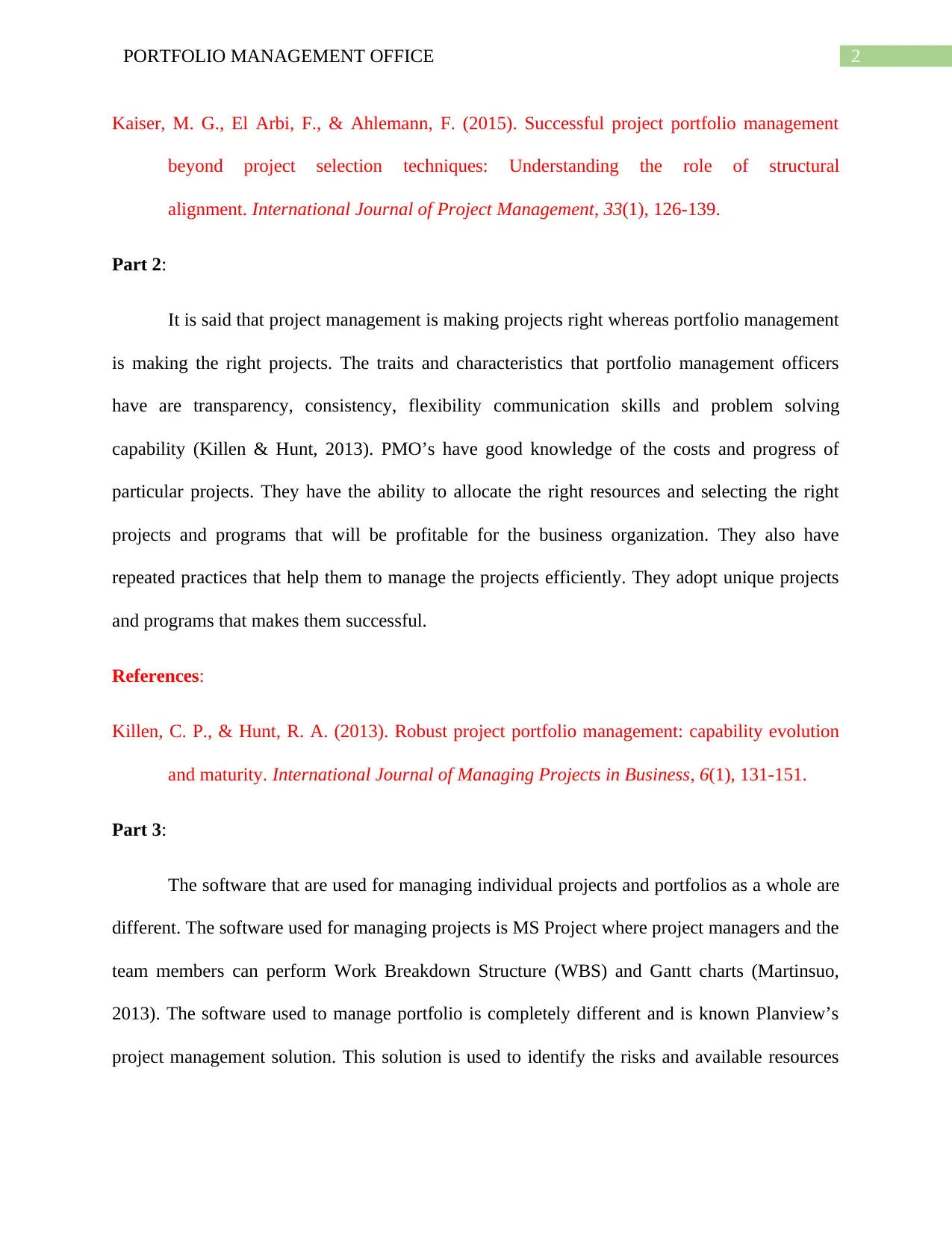
Part 2:
It is said that project management is making projects right whereas portfolio management
is making the right projects. The traits and characteristics that portfolio management officers
have are transparency, consistency, flexibility communication skills and problem solving
capability (Killen & Hunt, 2013). PMO’s have good knowledge of the costs and progress of
particular projects. They have the ability to allocate the right resources and selecting the right
projects and programs that will be profitable for the business organization. They also have
repeated practices that help them to manage the projects efficiently. They adopt unique projects
and programs that makes them successful.
References:
Killen, C. P., & Hunt, R. A. (2013). Robust project portfolio management: capability evolution
and maturity. International Journal of Managing Projects in Business, 6(1), 131-151.
Part 3:
The software that are used for managing individual projects and portfolios as a whole are
different. The software used for managing projects is MS Project where project managers and the
team members can perform Work Breakdown Structure (WBS) and Gantt charts (Martinsuo,
2013). The software used to manage portfolio is completely different and is known Planview’s
project management solution. This solution is used to identify the risks and available resources
Document Page
3PORTFOLIO MANAGEMENT OFFICE
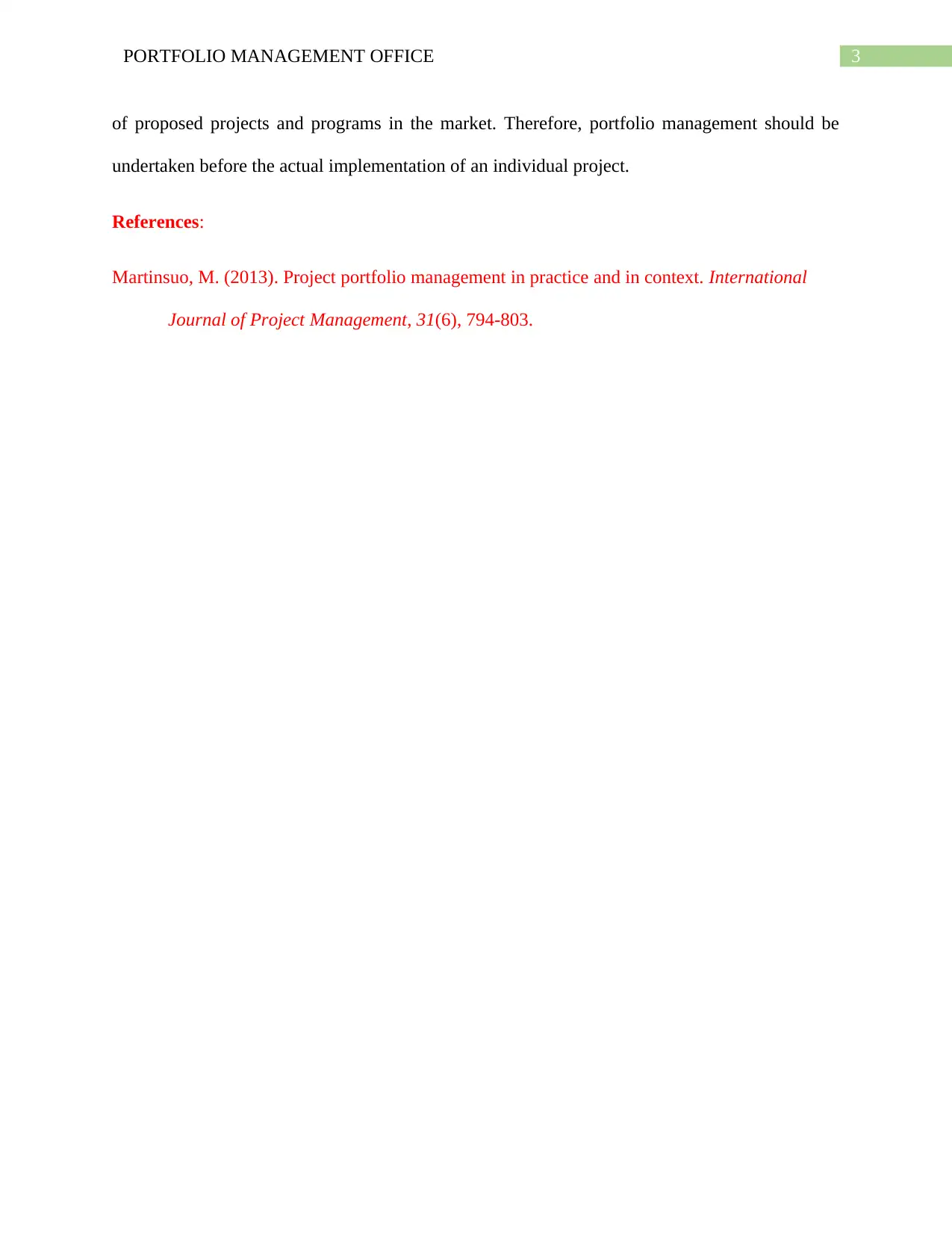
of proposed projects and programs in the market. Therefore, portfolio management should be
undertaken before the actual implementation of an individual project.
References:
Martinsuo, M. (2013). Project portfolio management in practice and in context. International
Journal of Project Management, 31(6), 794-803.
chevron_up_icon
1 out of 4
circle_padding
hide_on_mobile
zoom_out_icon
[object Object]