Requirements Planning and Stakeholder Register: Project Planning

Verified

Added on  2020/02/24

|8
|794
|70
Report
AI Summary
This report focuses on project planning, specifically addressing requirements planning and stakeholder management within the context of Central Queensland University (CQU). It begins by outlining the importance of recognizing traditional landowners and incorporating their perspectives in project decisions. The report then discusses requirements gathering, emphasizing the need for a structured approach to define and manage project scope, such as signage design and production. A requirements tracking document, including responsibilities, prioritization, and versioning, is proposed to manage project needs effectively. Furthermore, the report details a prioritization process, highlighting the MoSCoW technique (Must, Should, Could, Won't) for categorizing requirements based on their importance. The project executive's role in this process is also emphasized. The report references project management literature and provides a template for a requirements management plan, ensuring a structured and organized approach to project execution.
Document Page
Project Planning 1
REQUIREMENTS PLANNING AND STAKEHOLDER REGISTER
By Name
Course
Instructor
Institution
Location
Date
tabler-icon-diamond-filled.svg

Paraphrase This Document

Need a fresh take? Get an instant paraphrase of this document with our AI Paraphraser
Document Page
Project Planning 2
Requirements Management Plan-Central Queensland University
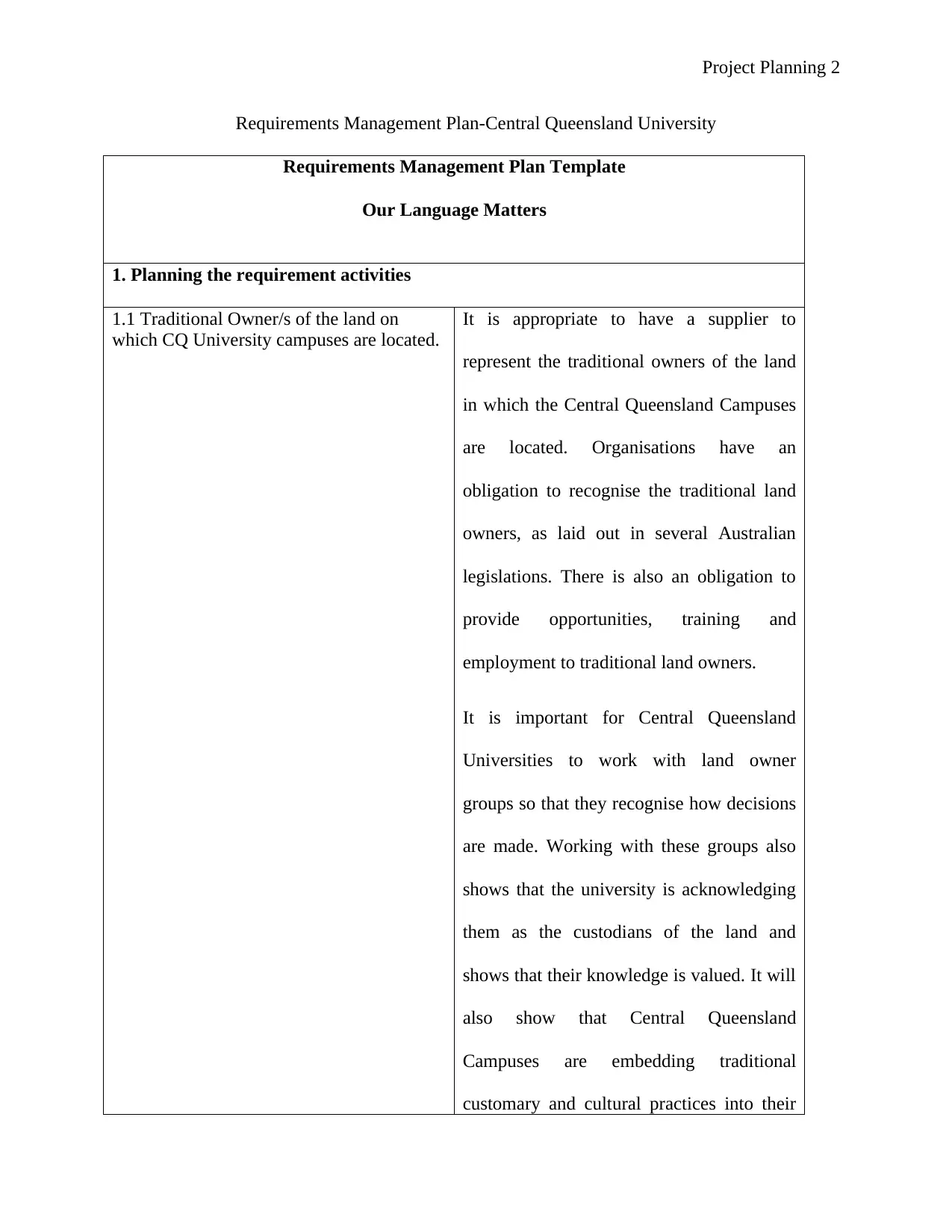
Requirements Management Plan Template
Our Language Matters
1. Planning the requirement activities
1.1 Traditional Owner/s of the land on
which CQ University campuses are located.
It is appropriate to have a supplier to
represent the traditional owners of the land
in which the Central Queensland Campuses
are located. Organisations have an
obligation to recognise the traditional land
owners, as laid out in several Australian
legislations. There is also an obligation to
provide opportunities, training and
employment to traditional land owners.
It is important for Central Queensland
Universities to work with land owner
groups so that they recognise how decisions
are made. Working with these groups also
shows that the university is acknowledging
them as the custodians of the land and
shows that their knowledge is valued. It will
also show that Central Queensland
Campuses are embedding traditional
customary and cultural practices into their
Document Page
Project Planning 3
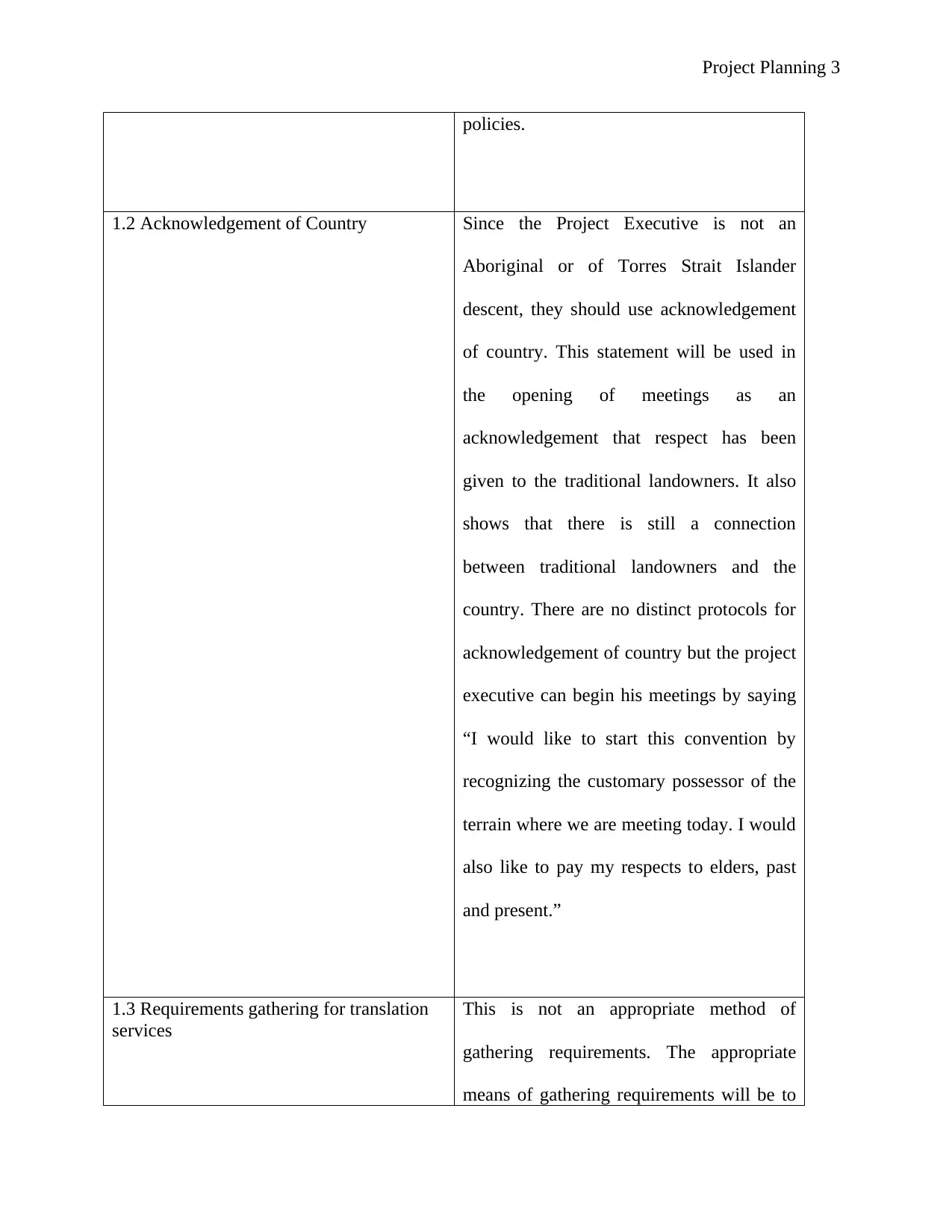
policies.
1.2 Acknowledgement of Country Since the Project Executive is not an
Aboriginal or of Torres Strait Islander
descent, they should use acknowledgement
of country. This statement will be used in
the opening of meetings as an
acknowledgement that respect has been
given to the traditional landowners. It also
shows that there is still a connection
between traditional landowners and the
country. There are no distinct protocols for
acknowledgement of country but the project
executive can begin his meetings by saying
“I would like to start this convention by
recognizing the customary possessor of the
terrain where we are meeting today. I would
also like to pay my respects to elders, past
and present.”
1.3 Requirements gathering for translation
services
This is not an appropriate method of
gathering requirements. The appropriate
means of gathering requirements will be to
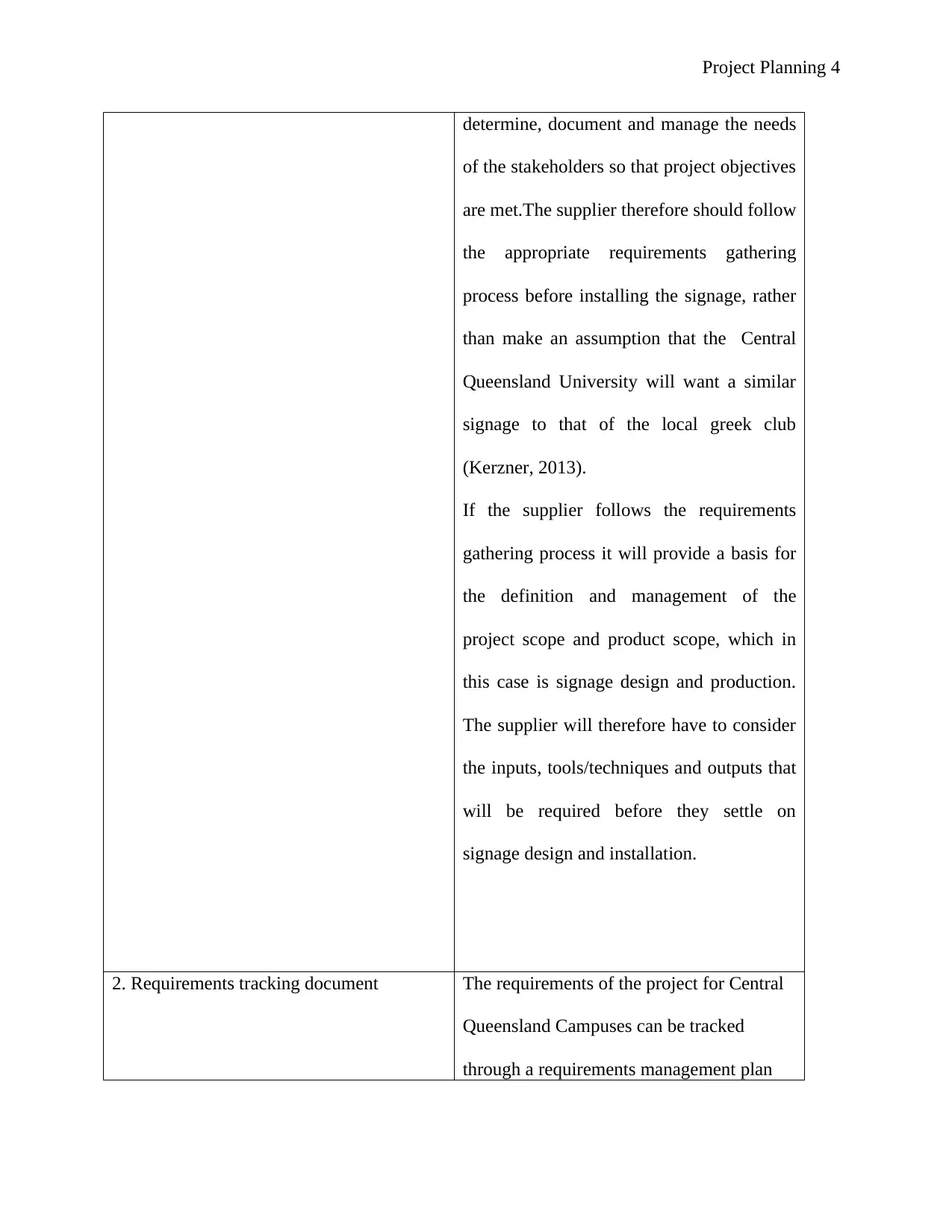
Document Page
Project Planning 4
determine, document and manage the needs
of the stakeholders so that project objectives
are met.The supplier therefore should follow
the appropriate requirements gathering
process before installing the signage, rather
than make an assumption that the Central
Queensland University will want a similar
signage to that of the local greek club
(Kerzner, 2013).
If the supplier follows the requirements
gathering process it will provide a basis for
the definition and management of the
project scope and product scope, which in
this case is signage design and production.
The supplier will therefore have to consider
the inputs, tools/techniques and outputs that
will be required before they settle on
signage design and installation.
2. Requirements tracking document The requirements of the project for Central
Queensland Campuses can be tracked
through a requirements management plan
tabler-icon-diamond-filled.svg

Paraphrase This Document

Need a fresh take? Get an instant paraphrase of this document with our AI Paraphraser
Document Page
Project Planning 5
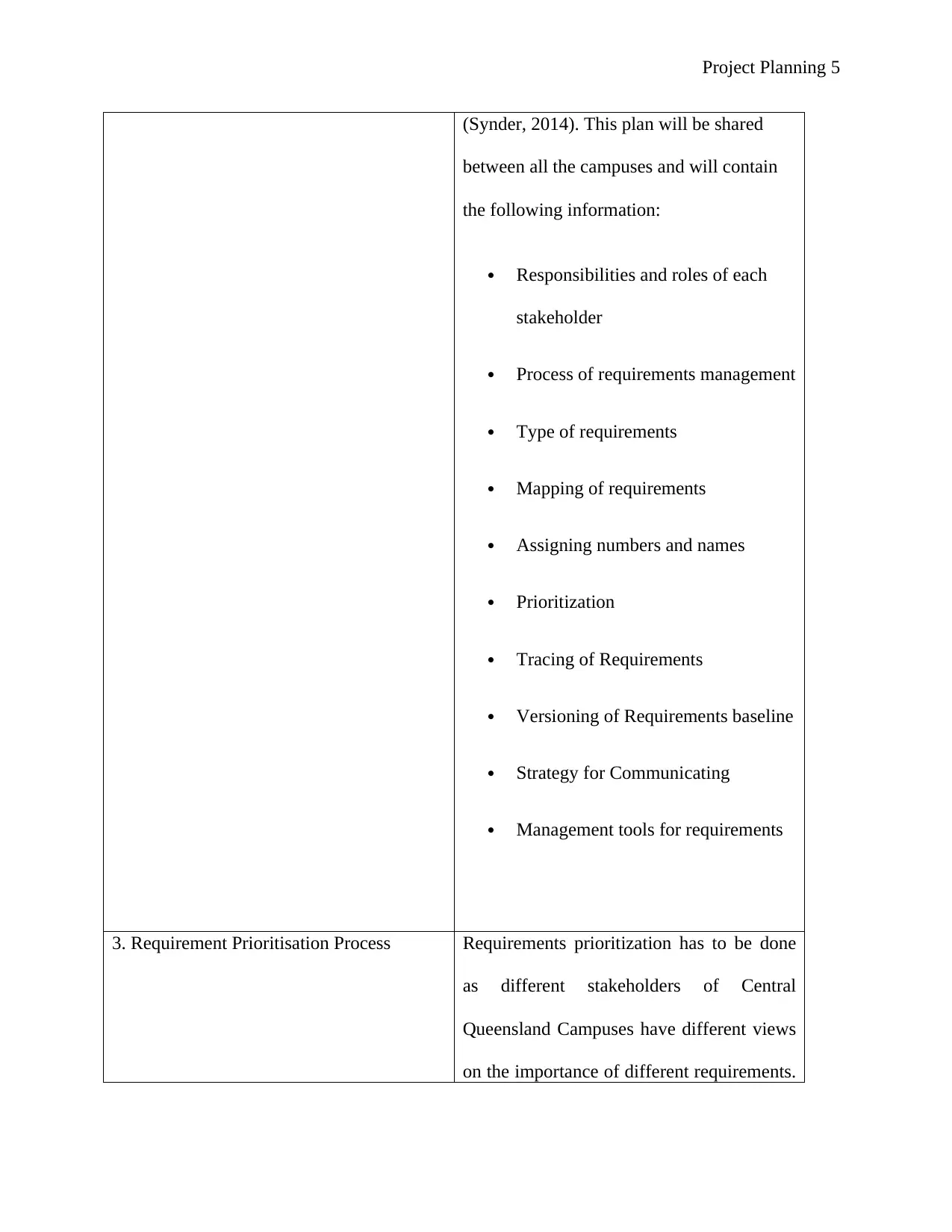
(Synder, 2014). This plan will be shared
between all the campuses and will contain
the following information:
Responsibilities and roles of each
stakeholder
Process of requirements management
Type of requirements
Mapping of requirements
Assigning numbers and names
Prioritization
Tracing of Requirements
Versioning of Requirements baseline
Strategy for Communicating
Management tools for requirements
3. Requirement Prioritisation Process Requirements prioritization has to be done
as different stakeholders of Central
Queensland Campuses have different views
on the importance of different requirements.
Document Page
Project Planning 6
The stakeholders may also not have an
understanding of the scale, period and price
impacts of their requirements on the
university project. Collaboration among all
the stakeholders will be needed in the
development of priorities (Kerzner, 2013).
The project executive will group the project
requirements into high, medium and low
priority, based on importance of
requirements. The size and complexity of
the project must be considered before
requirements are prioritised.
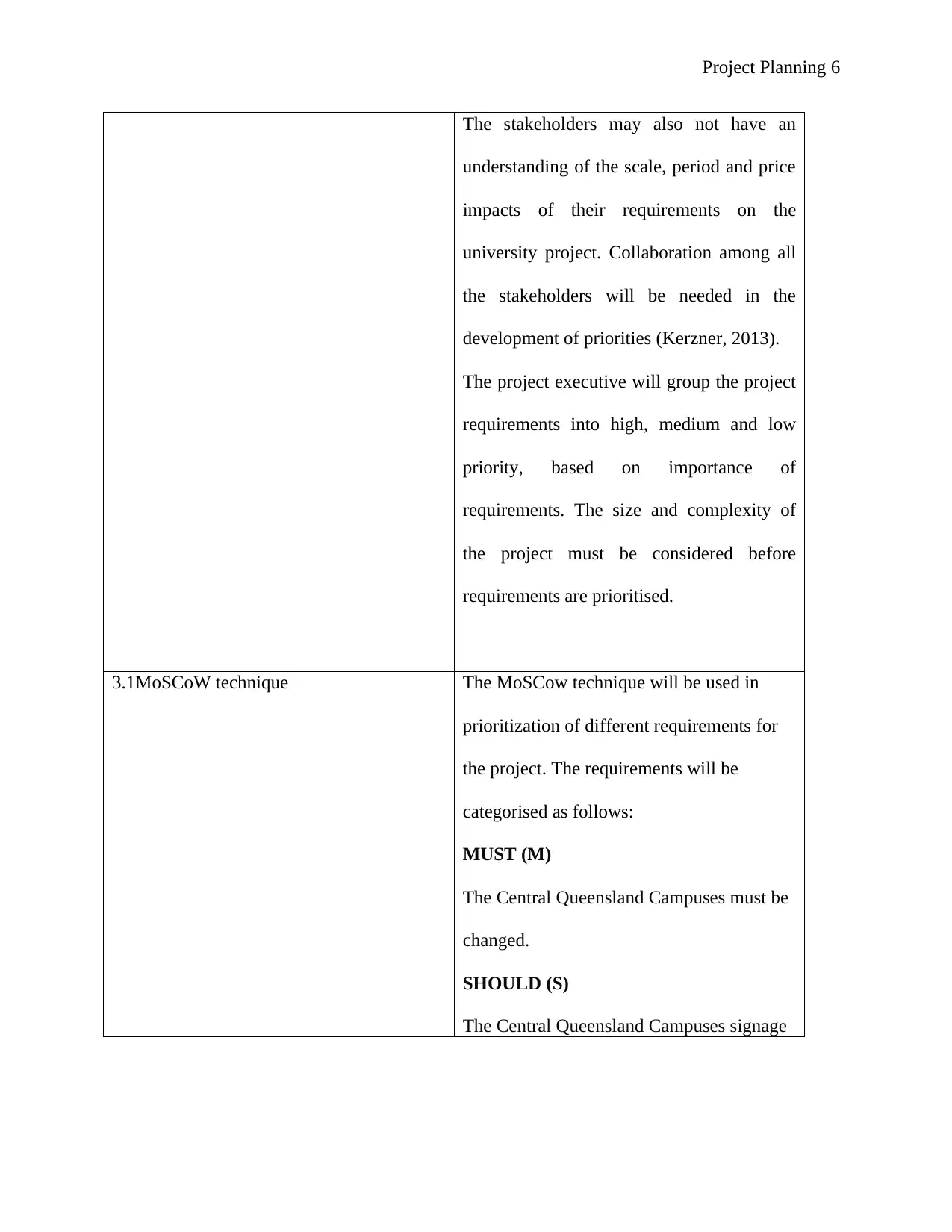
3.1MoSCoW technique The MoSCow technique will be used in
prioritization of different requirements for
the project. The requirements will be
categorised as follows:
MUST (M)
The Central Queensland Campuses must be
changed.
SHOULD (S)
The Central Queensland Campuses signage
Document Page
Project Planning 7
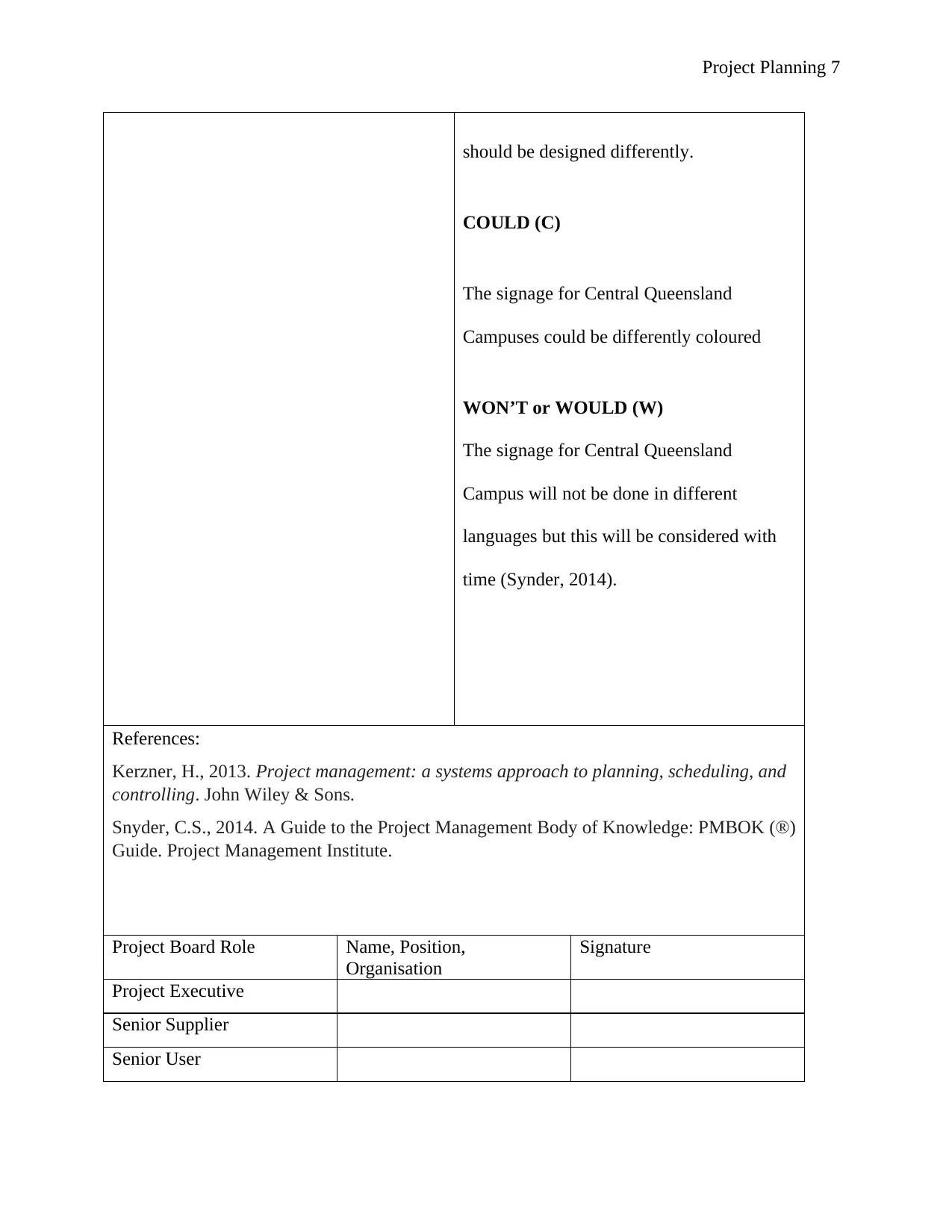
should be designed differently.
COULD (C)
The signage for Central Queensland
Campuses could be differently coloured
WON’T or WOULD (W)
The signage for Central Queensland
Campus will not be done in different
languages but this will be considered with
time (Synder, 2014).
References:
Kerzner, H., 2013. Project management: a systems approach to planning, scheduling, and
controlling. John Wiley & Sons.
Snyder, C.S., 2014. A Guide to the Project Management Body of Knowledge: PMBOK (®)
Guide. Project Management Institute.
Project Board Role Name, Position,
Organisation
Signature
Project Executive
Senior Supplier
Senior User
tabler-icon-diamond-filled.svg

Paraphrase This Document

Need a fresh take? Get an instant paraphrase of this document with our AI Paraphraser
Document Page
Project Planning 8
chevron_up_icon
1 out of 8
circle_padding
hide_on_mobile
zoom_out_icon
[object Object]