Project Management Case Study: Analyzing the Impact of Multitasking

Verified

Added on  2022/11/18

|4
|733
|112
Case Study
AI Summary
This case study examines the problems of multitasking in project management, focusing on how it impacts resource availability and project scheduling. It explores the challenges faced by project teams when members are involved in multiple projects simultaneously, leading to confusion in resource allocation and difficulties in estimating task durations. The study analyzes the statement that multitasking is unavoidable for the average employee in modern organizations, providing reasons for its accuracy. It delves into how multitasking decouples activity duration estimates from project schedules due to divided attention and the allocation of time across multiple tasks. The conclusion emphasizes the prevalence of multitasking in organizations, its potential to cause delays and resource allocation issues, and the difference between work hours and project timelines. The assignment highlights the importance of understanding the implications of multitasking for effective project management.
Document Page
Running head: MULTITASKING 1
Project Management.
Student’s name:
Name of the institution:
Date:
tabler-icon-diamond-filled.svg

Paraphrase This Document

Need a fresh take? Get an instant paraphrase of this document with our AI Paraphraser
Document Page
Running head: MULTITASKING 2
Introduction.
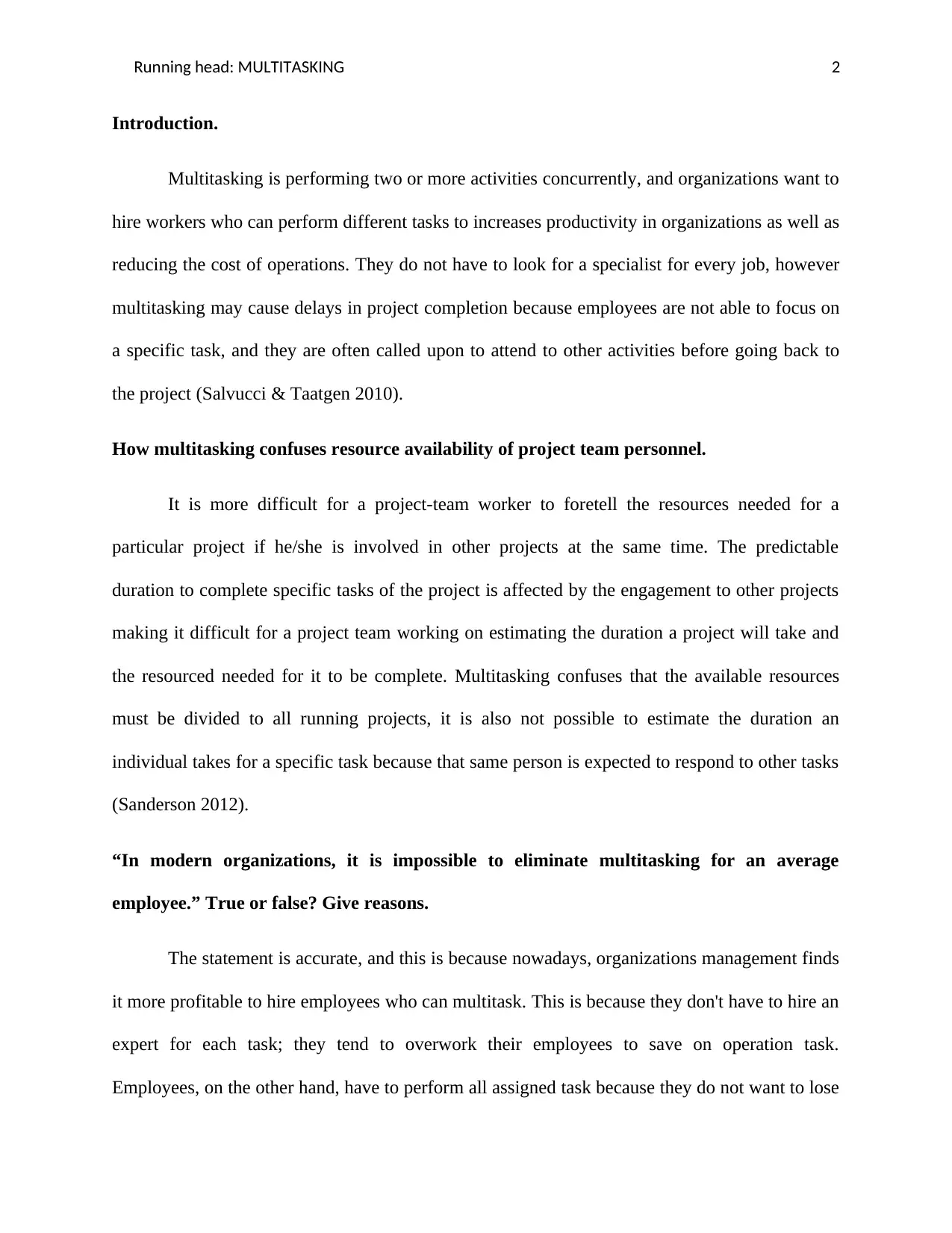
Multitasking is performing two or more activities concurrently, and organizations want to
hire workers who can perform different tasks to increases productivity in organizations as well as
reducing the cost of operations. They do not have to look for a specialist for every job, however
multitasking may cause delays in project completion because employees are not able to focus on
a specific task, and they are often called upon to attend to other activities before going back to
the project (Salvucci & Taatgen 2010).
How multitasking confuses resource availability of project team personnel.
It is more difficult for a project-team worker to foretell the resources needed for a
particular project if he/she is involved in other projects at the same time. The predictable
duration to complete specific tasks of the project is affected by the engagement to other projects
making it difficult for a project team working on estimating the duration a project will take and
the resourced needed for it to be complete. Multitasking confuses that the available resources
must be divided to all running projects, it is also not possible to estimate the duration an
individual takes for a specific task because that same person is expected to respond to other tasks
(Sanderson 2012).
“In modern organizations, it is impossible to eliminate multitasking for an average
employee.” True or false? Give reasons.
The statement is accurate, and this is because nowadays, organizations management finds
it more profitable to hire employees who can multitask. This is because they don't have to hire an
expert for each task; they tend to overwork their employees to save on operation task.
Employees, on the other hand, have to perform all assigned task because they do not want to lose
Document Page
Running head: MULTITASKING 3
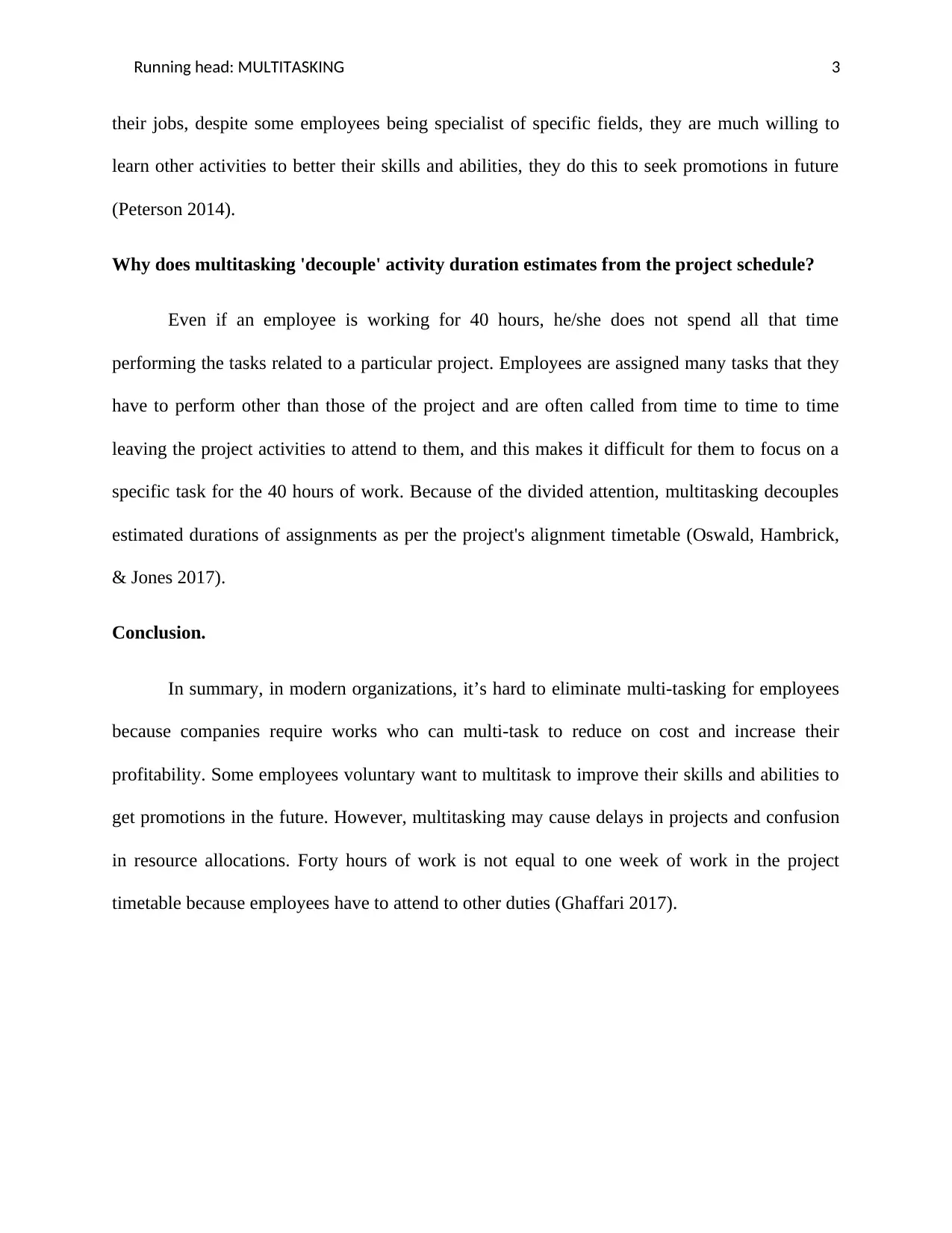
their jobs, despite some employees being specialist of specific fields, they are much willing to
learn other activities to better their skills and abilities, they do this to seek promotions in future
(Peterson 2014).
Why does multitasking 'decouple' activity duration estimates from the project schedule?
Even if an employee is working for 40 hours, he/she does not spend all that time
performing the tasks related to a particular project. Employees are assigned many tasks that they
have to perform other than those of the project and are often called from time to time to time
leaving the project activities to attend to them, and this makes it difficult for them to focus on a
specific task for the 40 hours of work. Because of the divided attention, multitasking decouples
estimated durations of assignments as per the project's alignment timetable (Oswald, Hambrick,
& Jones 2017).
Conclusion.
In summary, in modern organizations, it’s hard to eliminate multi-tasking for employees
because companies require works who can multi-task to reduce on cost and increase their
profitability. Some employees voluntary want to multitask to improve their skills and abilities to
get promotions in the future. However, multitasking may cause delays in projects and confusion
in resource allocations. Forty hours of work is not equal to one week of work in the project
timetable because employees have to attend to other duties (Ghaffari 2017).
Document Page
Running head: MULTITASKING 4
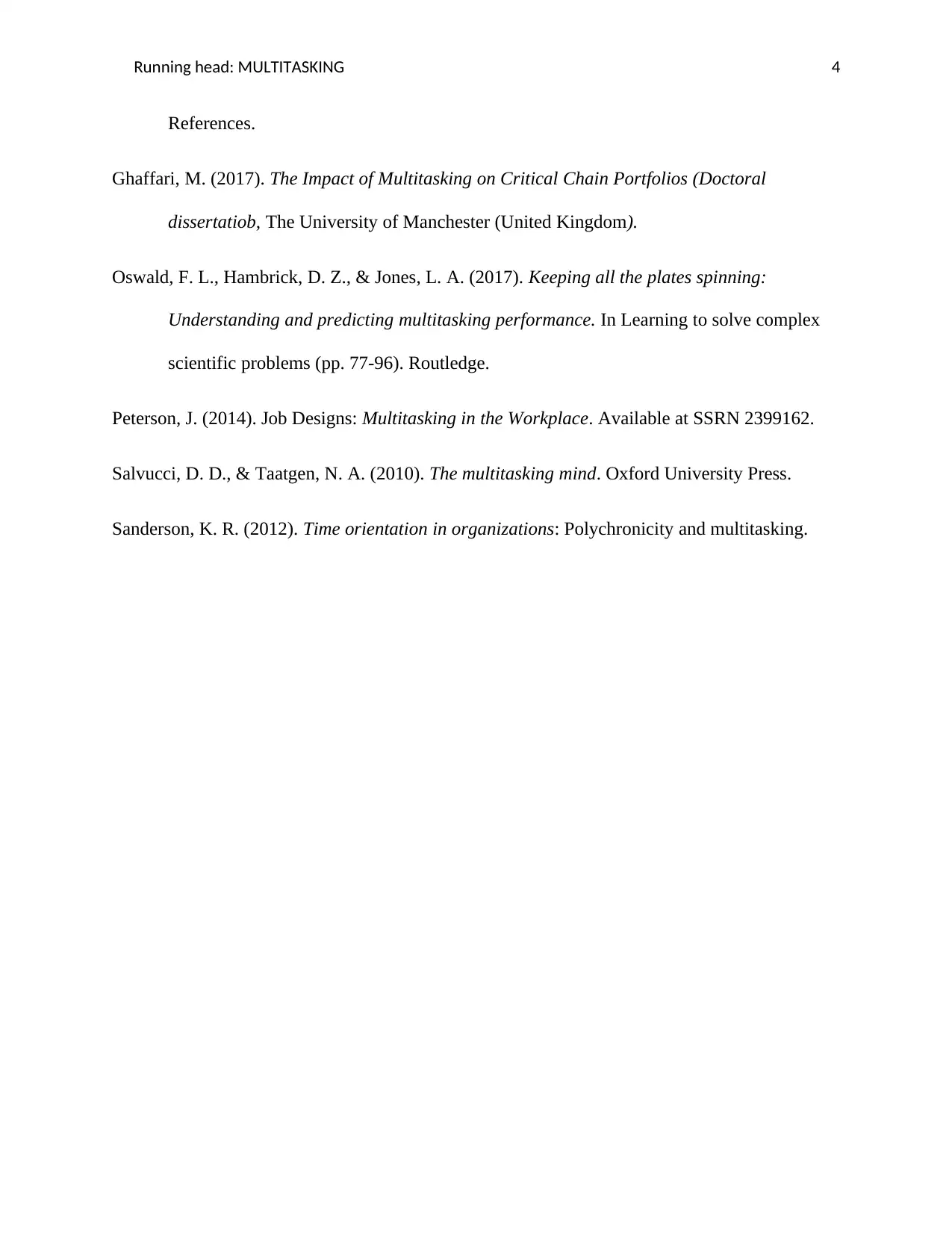
References.
Ghaffari, M. (2017). The Impact of Multitasking on Critical Chain Portfolios (Doctoral
dissertatiob, The University of Manchester (United Kingdom).
Oswald, F. L., Hambrick, D. Z., & Jones, L. A. (2017). Keeping all the plates spinning:
Understanding and predicting multitasking performance. In Learning to solve complex
scientific problems (pp. 77-96). Routledge.
Peterson, J. (2014). Job Designs: Multitasking in the Workplace. Available at SSRN 2399162.
Salvucci, D. D., & Taatgen, N. A. (2010). The multitasking mind. Oxford University Press.
Sanderson, K. R. (2012). Time orientation in organizations: Polychronicity and multitasking.
chevron_up_icon
1 out of 4
circle_padding
hide_on_mobile
zoom_out_icon
[object Object]