Project Management Report: Defining Parameters, Risks, and Costs

Verified

Added on  2023/06/04

|5
|941
|239
Report
AI Summary
This report provides a comprehensive analysis of project management principles, focusing on defining project parameters and the organizational resources crucial for project success. It explores the impact of budget allocation on project scope and the importance of aligning projects with organizational objectives. The report delves into key questions for project managers, factors affecting human resource allocation, and the use of project management tools like Gantt charts and logic networks. It also examines potential risks, including operational and financial risks, as well as WHS identification and mitigation strategies. Furthermore, the report differentiates between direct and indirect costs, providing a well-rounded understanding of project management fundamentals. The report concludes with a reference list of relevant sources.
Document Page
1
Project Management
tabler-icon-diamond-filled.svg

Paraphrase This Document

Need a fresh take? Get an instant paraphrase of this document with our AI Paraphraser
Document Page
2
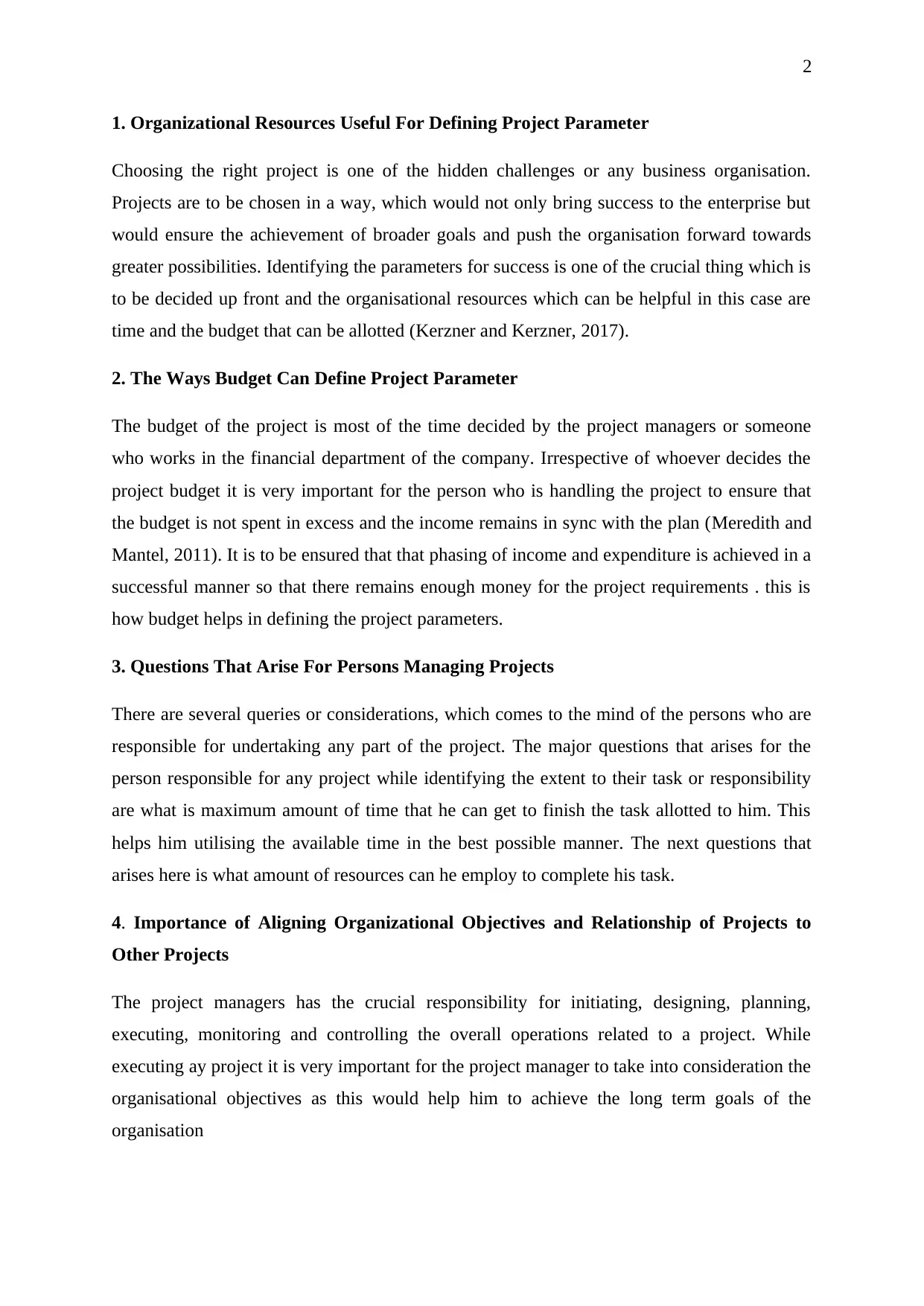
1. Organizational Resources Useful For Defining Project Parameter
Choosing the right project is one of the hidden challenges or any business organisation.
Projects are to be chosen in a way, which would not only bring success to the enterprise but
would ensure the achievement of broader goals and push the organisation forward towards
greater possibilities. Identifying the parameters for success is one of the crucial thing which is
to be decided up front and the organisational resources which can be helpful in this case are
time and the budget that can be allotted (Kerzner and Kerzner, 2017).
2. The Ways Budget Can Define Project Parameter
The budget of the project is most of the time decided by the project managers or someone
who works in the financial department of the company. Irrespective of whoever decides the
project budget it is very important for the person who is handling the project to ensure that
the budget is not spent in excess and the income remains in sync with the plan (Meredith and
Mantel, 2011). It is to be ensured that that phasing of income and expenditure is achieved in a
successful manner so that there remains enough money for the project requirements . this is
how budget helps in defining the project parameters.
3. Questions That Arise For Persons Managing Projects
There are several queries or considerations, which comes to the mind of the persons who are
responsible for undertaking any part of the project. The major questions that arises for the
person responsible for any project while identifying the extent to their task or responsibility
are what is maximum amount of time that he can get to finish the task allotted to him. This
helps him utilising the available time in the best possible manner. The next questions that
arises here is what amount of resources can he employ to complete his task.
4. Importance of Aligning Organizational Objectives and Relationship of Projects to
Other Projects
The project managers has the crucial responsibility for initiating, designing, planning,
executing, monitoring and controlling the overall operations related to a project. While
executing ay project it is very important for the project manager to take into consideration the
organisational objectives as this would help him to achieve the long term goals of the
organisation
Document Page
3
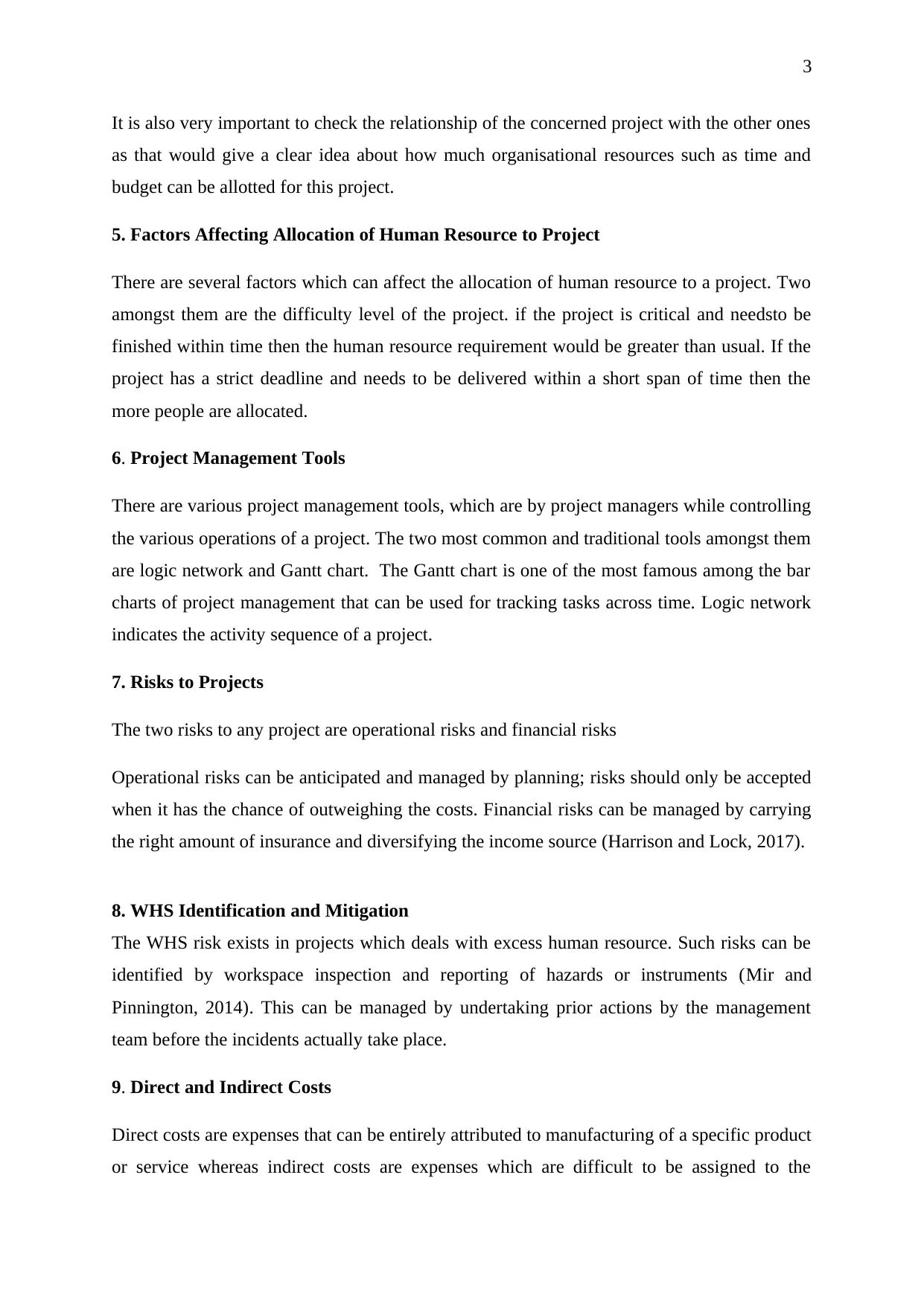
It is also very important to check the relationship of the concerned project with the other ones
as that would give a clear idea about how much organisational resources such as time and
budget can be allotted for this project.
5. Factors Affecting Allocation of Human Resource to Project
There are several factors which can affect the allocation of human resource to a project. Two
amongst them are the difficulty level of the project. if the project is critical and needsto be
finished within time then the human resource requirement would be greater than usual. If the
project has a strict deadline and needs to be delivered within a short span of time then the
more people are allocated.
6. Project Management Tools
There are various project management tools, which are by project managers while controlling
the various operations of a project. The two most common and traditional tools amongst them
are logic network and Gantt chart. The Gantt chart is one of the most famous among the bar
charts of project management that can be used for tracking tasks across time. Logic network
indicates the activity sequence of a project.
7. Risks to Projects
The two risks to any project are operational risks and financial risks
Operational risks can be anticipated and managed by planning; risks should only be accepted
when it has the chance of outweighing the costs. Financial risks can be managed by carrying
the right amount of insurance and diversifying the income source (Harrison and Lock, 2017).
8. WHS Identification and Mitigation
The WHS risk exists in projects which deals with excess human resource. Such risks can be
identified by workspace inspection and reporting of hazards or instruments (Mir and
Pinnington, 2014). This can be managed by undertaking prior actions by the management
team before the incidents actually take place.
9. Direct and Indirect Costs
Direct costs are expenses that can be entirely attributed to manufacturing of a specific product
or service whereas indirect costs are expenses which are difficult to be assigned to the
Document Page
4
production of any particular good or service. The example of direct costs are labour costs,
material costs etc. and indirect costs are depreciation, insurance etc.
tabler-icon-diamond-filled.svg

Paraphrase This Document

Need a fresh take? Get an instant paraphrase of this document with our AI Paraphraser
Document Page
5
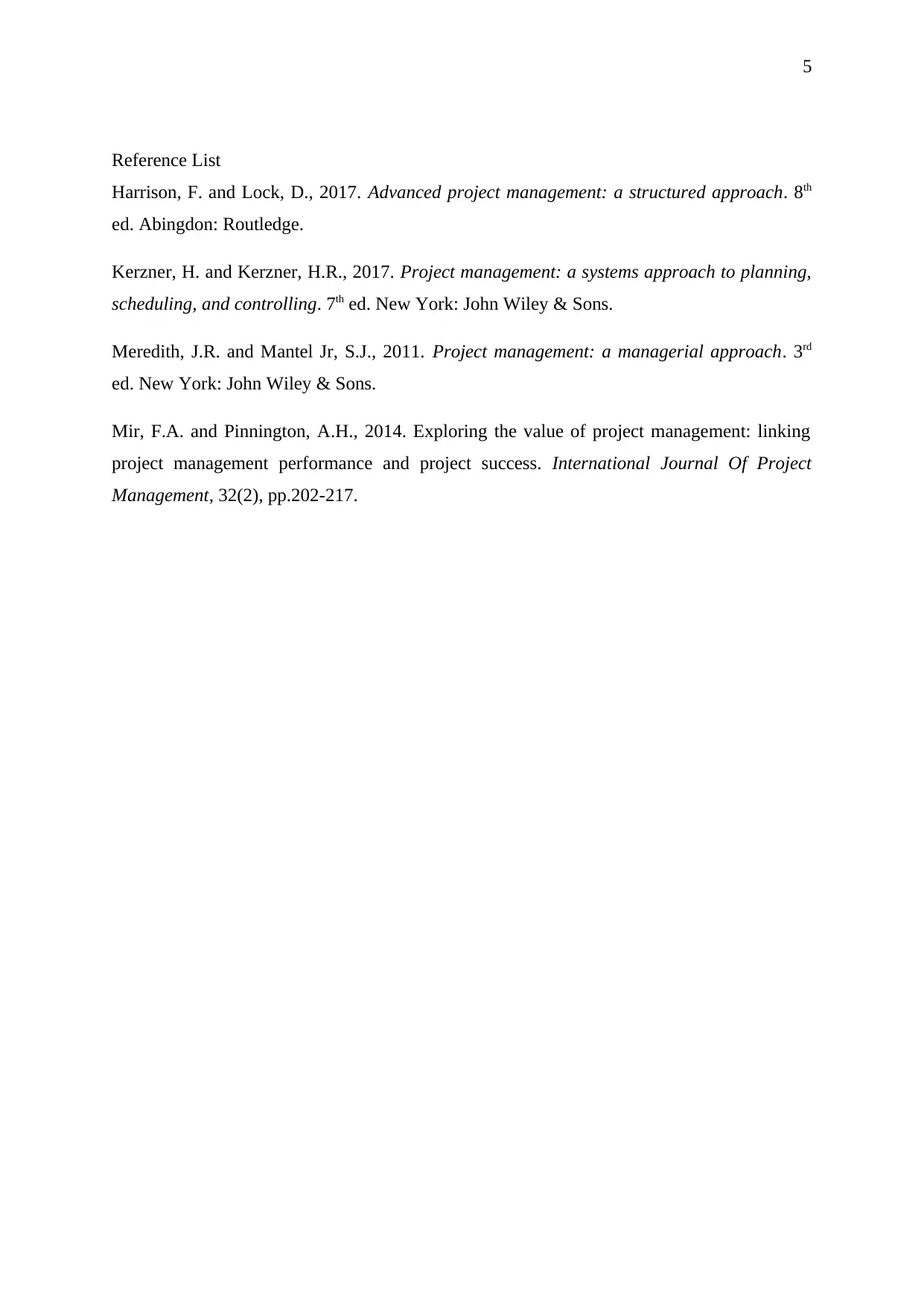
Reference List
Harrison, F. and Lock, D., 2017. Advanced project management: a structured approach. 8th
ed. Abingdon: Routledge.
Kerzner, H. and Kerzner, H.R., 2017. Project management: a systems approach to planning,
scheduling, and controlling. 7th ed. New York: John Wiley & Sons.
Meredith, J.R. and Mantel Jr, S.J., 2011. Project management: a managerial approach. 3rd
ed. New York: John Wiley & Sons.
Mir, F.A. and Pinnington, A.H., 2014. Exploring the value of project management: linking
project management performance and project success. International Journal Of Project
Management, 32(2), pp.202-217.
chevron_up_icon
1 out of 5
circle_padding
hide_on_mobile
zoom_out_icon
[object Object]