University Project: PROJ6003 Risk Management Report

Verified

Added on  2022/09/15

|6
|1260
|18
Report
AI Summary
This report, created as part of the PROJ6003 Project Execution and Control course, focuses on risk management within a project context. It begins with a case study analysis of the Robert L. Frank Construction Company, identifying key risks such as budget overruns, deadline delays, and quality compromises. The report then details a risk register and probability-impact matrix to assess and prioritize these risks. Furthermore, it proposes specific risk management strategies, including contingency budgets and adjusted deadlines. The report emphasizes the importance of stakeholder engagement in the risk management process, highlighting the need for reporting and feasibility analysis to mitigate potential issues. Finally, the report concludes with a bibliography of relevant sources on project risk management.
Document Page
Running Head: PROJECT EXECUTION AND CONTROL
PROJ6003 Project Execution and Control
Name of the Student
Name of the University
tabler-icon-diamond-filled.svg

Paraphrase This Document

Need a fresh take? Get an instant paraphrase of this document with our AI Paraphraser
Document Page
1PROJECT EXECUTION AND CONTROL
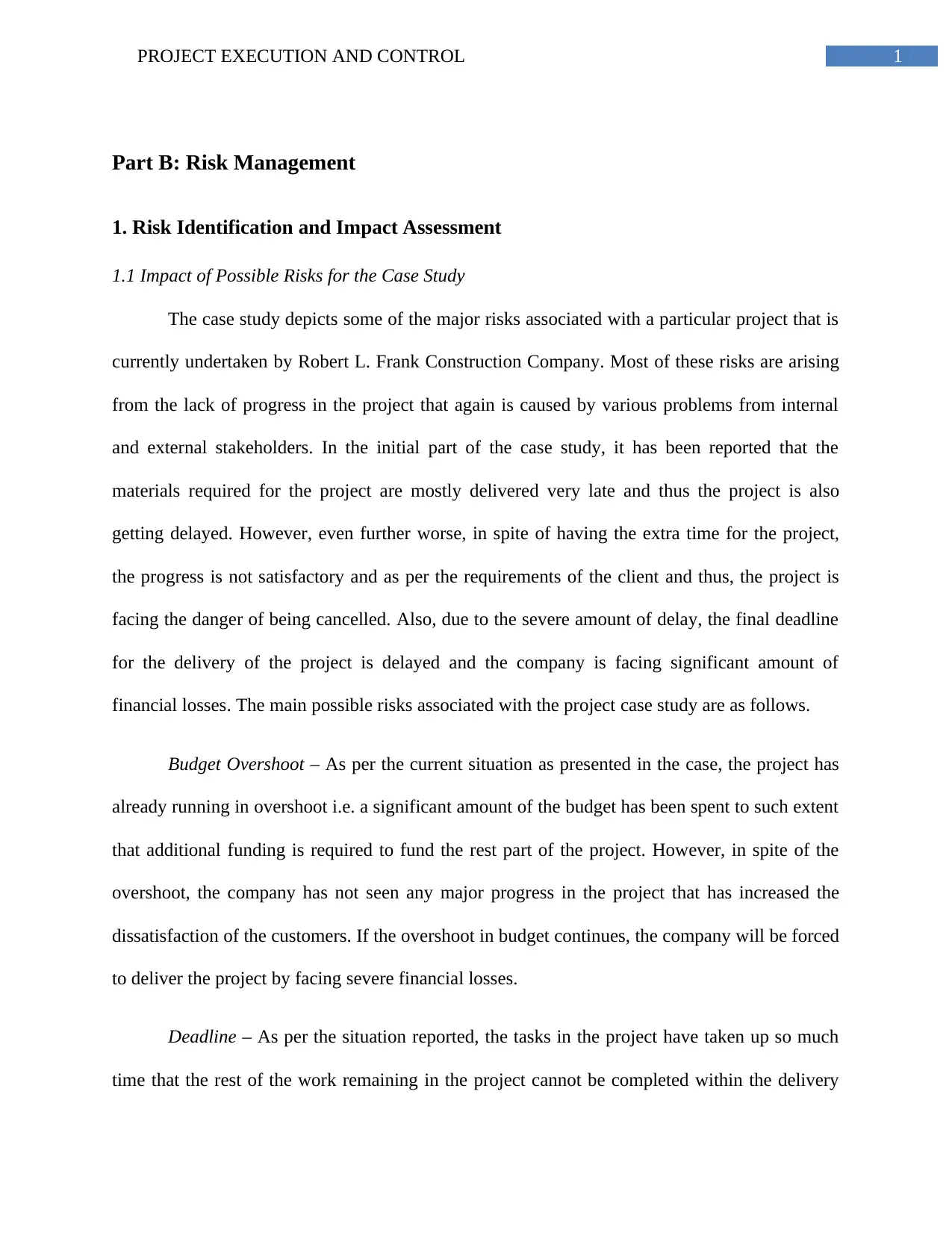
Part B: Risk Management
1. Risk Identification and Impact Assessment
1.1 Impact of Possible Risks for the Case Study
The case study depicts some of the major risks associated with a particular project that is
currently undertaken by Robert L. Frank Construction Company. Most of these risks are arising
from the lack of progress in the project that again is caused by various problems from internal
and external stakeholders. In the initial part of the case study, it has been reported that the
materials required for the project are mostly delivered very late and thus the project is also
getting delayed. However, even further worse, in spite of having the extra time for the project,
the progress is not satisfactory and as per the requirements of the client and thus, the project is
facing the danger of being cancelled. Also, due to the severe amount of delay, the final deadline
for the delivery of the project is delayed and the company is facing significant amount of
financial losses. The main possible risks associated with the project case study are as follows.
Budget Overshoot – As per the current situation as presented in the case, the project has
already running in overshoot i.e. a significant amount of the budget has been spent to such extent
that additional funding is required to fund the rest part of the project. However, in spite of the
overshoot, the company has not seen any major progress in the project that has increased the
dissatisfaction of the customers. If the overshoot in budget continues, the company will be forced
to deliver the project by facing severe financial losses.
Deadline – As per the situation reported, the tasks in the project have taken up so much
time that the rest of the work remaining in the project cannot be completed within the delivery
Document Page
2PROJECT EXECUTION AND CONTROL
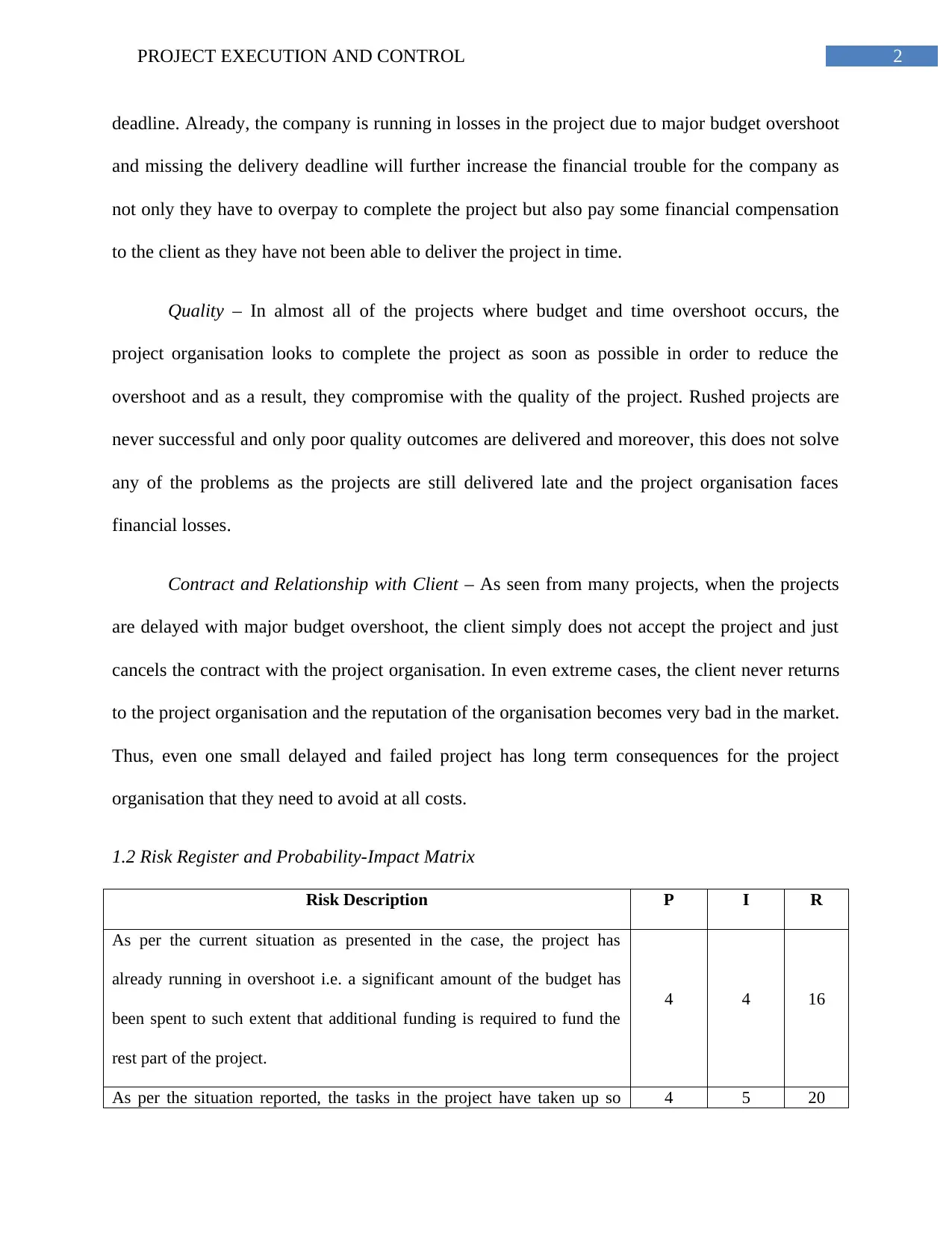
deadline. Already, the company is running in losses in the project due to major budget overshoot
and missing the delivery deadline will further increase the financial trouble for the company as
not only they have to overpay to complete the project but also pay some financial compensation
to the client as they have not been able to deliver the project in time.
Quality – In almost all of the projects where budget and time overshoot occurs, the
project organisation looks to complete the project as soon as possible in order to reduce the
overshoot and as a result, they compromise with the quality of the project. Rushed projects are
never successful and only poor quality outcomes are delivered and moreover, this does not solve
any of the problems as the projects are still delivered late and the project organisation faces
financial losses.
Contract and Relationship with Client – As seen from many projects, when the projects
are delayed with major budget overshoot, the client simply does not accept the project and just
cancels the contract with the project organisation. In even extreme cases, the client never returns
to the project organisation and the reputation of the organisation becomes very bad in the market.
Thus, even one small delayed and failed project has long term consequences for the project
organisation that they need to avoid at all costs.
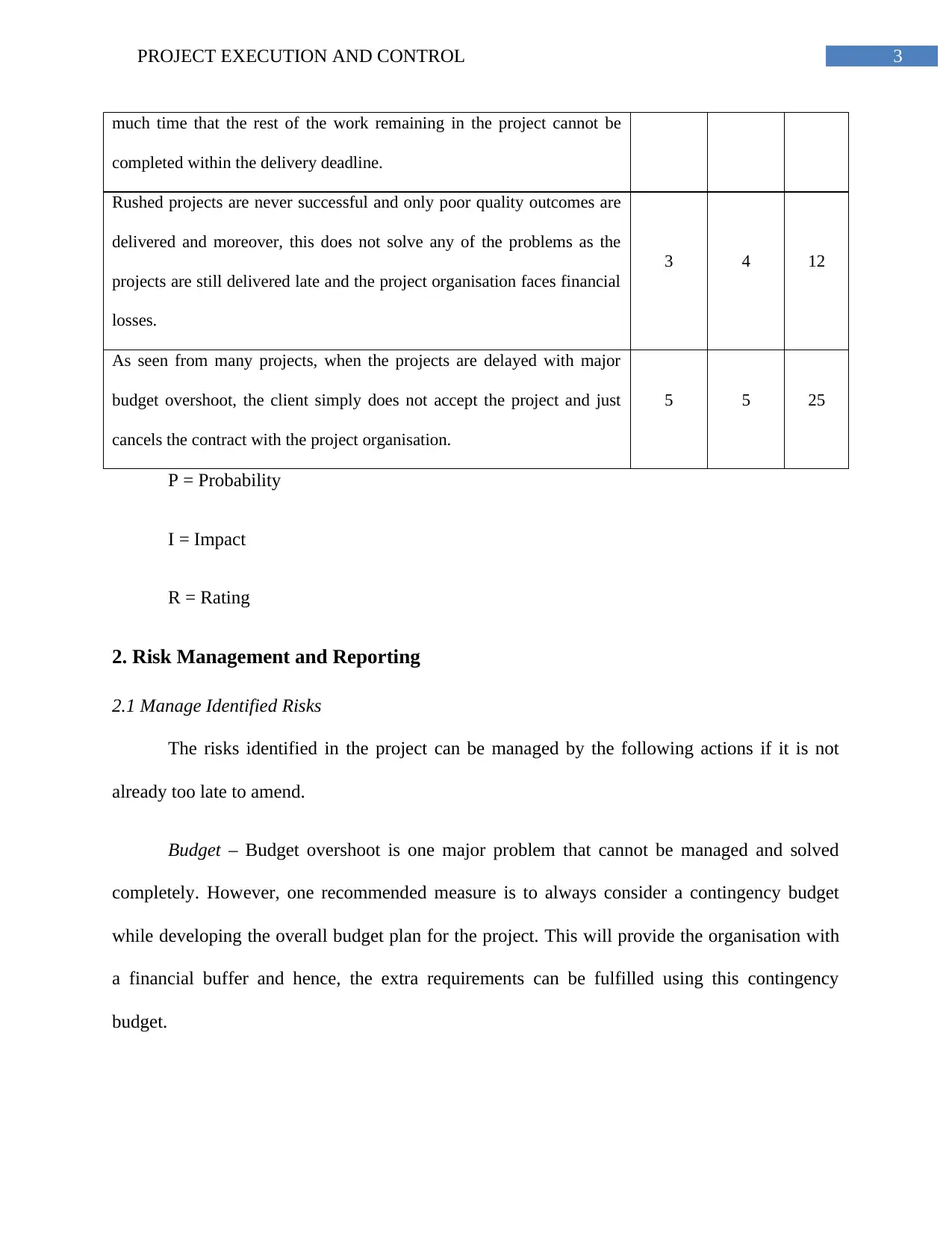
1.2 Risk Register and Probability-Impact Matrix
Risk Description P I R
As per the current situation as presented in the case, the project has
already running in overshoot i.e. a significant amount of the budget has
been spent to such extent that additional funding is required to fund the
rest part of the project.
4 4 16
As per the situation reported, the tasks in the project have taken up so 4 5 20
Document Page
3PROJECT EXECUTION AND CONTROL
much time that the rest of the work remaining in the project cannot be
completed within the delivery deadline.
Rushed projects are never successful and only poor quality outcomes are
delivered and moreover, this does not solve any of the problems as the
projects are still delivered late and the project organisation faces financial
losses.
3 4 12
As seen from many projects, when the projects are delayed with major
budget overshoot, the client simply does not accept the project and just
cancels the contract with the project organisation.
5 5 25
P = Probability
I = Impact
R = Rating
2. Risk Management and Reporting
2.1 Manage Identified Risks
The risks identified in the project can be managed by the following actions if it is not
already too late to amend.
Budget – Budget overshoot is one major problem that cannot be managed and solved
completely. However, one recommended measure is to always consider a contingency budget
while developing the overall budget plan for the project. This will provide the organisation with
a financial buffer and hence, the extra requirements can be fulfilled using this contingency
budget.
tabler-icon-diamond-filled.svg

Paraphrase This Document

Need a fresh take? Get an instant paraphrase of this document with our AI Paraphraser
Document Page
4PROJECT EXECUTION AND CONTROL
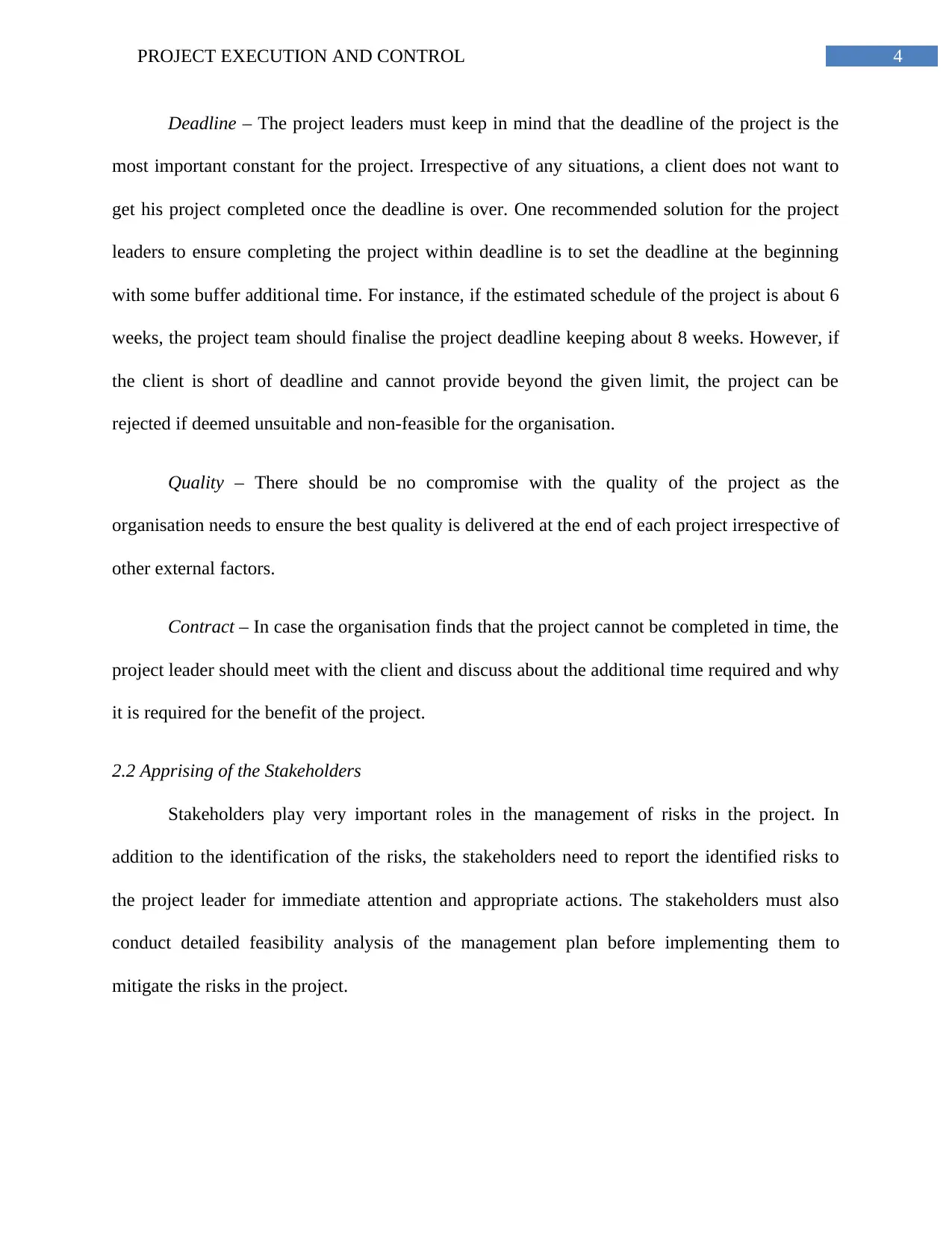
Deadline – The project leaders must keep in mind that the deadline of the project is the
most important constant for the project. Irrespective of any situations, a client does not want to
get his project completed once the deadline is over. One recommended solution for the project
leaders to ensure completing the project within deadline is to set the deadline at the beginning
with some buffer additional time. For instance, if the estimated schedule of the project is about 6
weeks, the project team should finalise the project deadline keeping about 8 weeks. However, if
the client is short of deadline and cannot provide beyond the given limit, the project can be
rejected if deemed unsuitable and non-feasible for the organisation.
Quality – There should be no compromise with the quality of the project as the
organisation needs to ensure the best quality is delivered at the end of each project irrespective of
other external factors.
Contract – In case the organisation finds that the project cannot be completed in time, the
project leader should meet with the client and discuss about the additional time required and why
it is required for the benefit of the project.
2.2 Apprising of the Stakeholders
Stakeholders play very important roles in the management of risks in the project. In
addition to the identification of the risks, the stakeholders need to report the identified risks to
the project leader for immediate attention and appropriate actions. The stakeholders must also
conduct detailed feasibility analysis of the management plan before implementing them to
mitigate the risks in the project.
Document Page
5PROJECT EXECUTION AND CONTROL
Bibliography
Cagliano, A. C., Grimaldi, S., & Rafele, C. (2015). Choosing project risk management
techniques. A theoretical framework. Journal of Risk Research, 18(2), 232-248.
Harris, E. (2017). Strategic project risk appraisal and management. Routledge.
Hopkinson, M. (2017). The project risk maturity model: Measuring and improving risk
management capability. Routledge.
Kliem, R. L., & Ludin, I. S. (2019). Reducing project risk. Routledge.
chevron_up_icon
1 out of 6
circle_padding
hide_on_mobile
zoom_out_icon
[object Object]