University Project Risk Management Report: ABC Pty. Ltd. Water Project
VerifiedAdded on 2022/10/02
|18
|4740
|281
Report
AI Summary
This report provides a comprehensive analysis of project risk management, specifically focusing on the proposed water treatment project of ABC Pty. Ltd. It begins with an executive summary outlining the importance of identifying, assessing, and mitigating various risks, including technological, personal, environmental, and financial risks, in the context of project financing. The report explores the identification of project risks at the planning stage, emphasizing its continuous nature and importance for successful project completion. It then delves into the assessment of risks, considering their probability and impact to calculate risk exposure. The discussion section classifies project risks into systematic and unsystematic categories, detailing the types of risks relevant to ABC Pty. Ltd., such as financial, business, operational, environmental, and technical risks. The report highlights the significance of financial risk in the project, emphasizing its connection to the financing model. Furthermore, it discusses the importance of risk management in project financing, the allocation of risks to SPV counterparties, and strategies for risk transfer and mitigation to ensure project success. The report concludes by summarizing ways to mitigate the identified risks for the success of the water treatment project.
Running Head: PROJECT RISK MANAGEMENT
PROJECT RISK MANAGEMENT
Name of the Students
Name of the University
Author Note
PROJECT RISK MANAGEMENT
Name of the Students
Name of the University
Author Note

Paraphrase This Document
Need a fresh take? Get an instant paraphrase of this document with our AI Paraphraser
1PROJECT RISK MANAGEMENT
Executive Summary
The purpose of preparing this paper is to focus on the risks associated with a project. The
identification of the risks, assessment of the risks, mitigation of the risks related to the
proposed water treatment project of ABC Pty. Ltd. is discussed in this paper. The financing
of a project depends largely on the risks of the project management and it is the duty of the
project manager to disclose those risks to the lenders and sponsors for making investments.
This report discusses about the different types of risks associated with the water treatment
project of ABC Pty. Ltd. like technological risks, personal risks, environmental risks and
financial risks along with the importance of risk management in project financing. Along
with these, the report is focused on the strategies related to allocation of risks to the
counterparts of SPV, insurers and the process of hedging. Lastly, it discusses about the ways
of mitigation of the identified risks for the success of the water treatment project.
Executive Summary
The purpose of preparing this paper is to focus on the risks associated with a project. The
identification of the risks, assessment of the risks, mitigation of the risks related to the
proposed water treatment project of ABC Pty. Ltd. is discussed in this paper. The financing
of a project depends largely on the risks of the project management and it is the duty of the
project manager to disclose those risks to the lenders and sponsors for making investments.
This report discusses about the different types of risks associated with the water treatment
project of ABC Pty. Ltd. like technological risks, personal risks, environmental risks and
financial risks along with the importance of risk management in project financing. Along
with these, the report is focused on the strategies related to allocation of risks to the
counterparts of SPV, insurers and the process of hedging. Lastly, it discusses about the ways
of mitigation of the identified risks for the success of the water treatment project.
2PROJECT RISK MANAGEMENT
Table of Contents
Introduction................................................................................................................................3
Approach....................................................................................................................................3
Identification of risks-............................................................................................................3
Assessment of risks................................................................................................................4
Discussion..................................................................................................................................4
Importance of Risk Management in Project Financing-........................................................7
Reducing the burden of risk-..................................................................................................8
Strategies of Risk Transfer and Risk Allocation-..................................................................8
Conclusion................................................................................................................................13
References-...............................................................................................................................14
Table of Contents
Introduction................................................................................................................................3
Approach....................................................................................................................................3
Identification of risks-............................................................................................................3
Assessment of risks................................................................................................................4
Discussion..................................................................................................................................4
Importance of Risk Management in Project Financing-........................................................7
Reducing the burden of risk-..................................................................................................8
Strategies of Risk Transfer and Risk Allocation-..................................................................8
Conclusion................................................................................................................................13
References-...............................................................................................................................14
⊘ This is a preview!⊘
Do you want full access?
Subscribe today to unlock all pages.

Trusted by 1+ million students worldwide
3PROJECT RISK MANAGEMENT
Introduction
ABC Pty. Ltd has approached few sponsors after a detailed evaluation of the
financing modelling of the project for the proposal of the water treatment facility. Before the
project is being financed by the sponsors it is necessary to identify the risks involved in the
proposed water treatment project which are commonly termed as project risks. A project can
be financed either by raising securities or by selling securities. These are known as “financial
instruments”. There are two types of financial instruments- equity financing and debt
financing. Equity financing is done by issuing either ordinary shares to the ordinary
shareholders who are also known as unsecured creditors or preference shares to the preferred
shareholders. Debt financing is done by taking short term debt or long term debt. Short term
debt includes trade credit, bank overdraft, bills and promissory notes whereas long term debt
includes bank loans and government bonds. Debentures and unsecured notes also fall under
the category of long term debt. Normally, the types of investors include banks, institutional
lenders, commercial finance companies, leasing companies, contractors and government. In
this case sty the risks are being allocated to the SPV counterparties. The paper also discusses
about the different types of risks like financial risks, business risks, operational risks,
environmental risks and technical risks involved in the proposed project of water treatment of
the ABC Pty. Ltd. along with the allocation and mitigation of those identified risks for
reducing the risk burden with the help of SPV and the importance of risk management in
financing a project.
Approach
Risks refers to occurrence of events which will make a negative impact on a project in
the future which may result in loss of the investments made by the investors and also
jeopardising the success of the project. In other words, there are certain external factors
Introduction
ABC Pty. Ltd has approached few sponsors after a detailed evaluation of the
financing modelling of the project for the proposal of the water treatment facility. Before the
project is being financed by the sponsors it is necessary to identify the risks involved in the
proposed water treatment project which are commonly termed as project risks. A project can
be financed either by raising securities or by selling securities. These are known as “financial
instruments”. There are two types of financial instruments- equity financing and debt
financing. Equity financing is done by issuing either ordinary shares to the ordinary
shareholders who are also known as unsecured creditors or preference shares to the preferred
shareholders. Debt financing is done by taking short term debt or long term debt. Short term
debt includes trade credit, bank overdraft, bills and promissory notes whereas long term debt
includes bank loans and government bonds. Debentures and unsecured notes also fall under
the category of long term debt. Normally, the types of investors include banks, institutional
lenders, commercial finance companies, leasing companies, contractors and government. In
this case sty the risks are being allocated to the SPV counterparties. The paper also discusses
about the different types of risks like financial risks, business risks, operational risks,
environmental risks and technical risks involved in the proposed project of water treatment of
the ABC Pty. Ltd. along with the allocation and mitigation of those identified risks for
reducing the risk burden with the help of SPV and the importance of risk management in
financing a project.
Approach
Risks refers to occurrence of events which will make a negative impact on a project in
the future which may result in loss of the investments made by the investors and also
jeopardising the success of the project. In other words, there are certain external factors
Paraphrase This Document
Need a fresh take? Get an instant paraphrase of this document with our AI Paraphraser
4PROJECT RISK MANAGEMENT
which play a vital role in determining the success of a project. These external factors can be
termed as risks associated with a project (Hillson and Murray-Webster, 2017).
Identification of risks-
The risks associated in a project are to be identified at a very early stage, preferably at
the stage of the planning of the project and should continue till the project is done. It is a
continuing process since there is no scientific calculation or formula for identifying the
underlying risks (Magni, et al., 2015). It is very important to identify the potential risks at the
initial stages for proper and successful completion of the project. The identification of the
risks associated with projects is considered as the most important process in the planning of
risk management. Nowadays, the project manager faces the problem of not having any brief
list or sample for identifying the occurrence of the risks. However, little amount of time
should be taken for identifying the associated risks otherwise it will hamper the project
duration (Kliem and Ludin, 2019). The main purpose of risk management in a project is to
increase the impact of positive events and decrease the impact of negative events.
Assessment of risks
Assessment of risks is considered as a part of identification of risks. For assessing the
risk management, the probability and impact of the occurrence of identifying risks are to be
considered (Sedunov, 2016). After the probability as well as the risk impact is determined,
the exposure of the risk of the project is calculated using the formula mentioned below-
Risk exposure = Probability of the identified risk * impact of the risk
The evaluation of risk involves the comparison of risk level identified in the initial
stage and the actual risks occurred during the making of the project. The reasons for
evaluating risks associated in a project is for the purpose of decision making. The decisions
are made on the basis of the results of the risk analysis (Pritchard and PMP, 2014).
which play a vital role in determining the success of a project. These external factors can be
termed as risks associated with a project (Hillson and Murray-Webster, 2017).
Identification of risks-
The risks associated in a project are to be identified at a very early stage, preferably at
the stage of the planning of the project and should continue till the project is done. It is a
continuing process since there is no scientific calculation or formula for identifying the
underlying risks (Magni, et al., 2015). It is very important to identify the potential risks at the
initial stages for proper and successful completion of the project. The identification of the
risks associated with projects is considered as the most important process in the planning of
risk management. Nowadays, the project manager faces the problem of not having any brief
list or sample for identifying the occurrence of the risks. However, little amount of time
should be taken for identifying the associated risks otherwise it will hamper the project
duration (Kliem and Ludin, 2019). The main purpose of risk management in a project is to
increase the impact of positive events and decrease the impact of negative events.
Assessment of risks
Assessment of risks is considered as a part of identification of risks. For assessing the
risk management, the probability and impact of the occurrence of identifying risks are to be
considered (Sedunov, 2016). After the probability as well as the risk impact is determined,
the exposure of the risk of the project is calculated using the formula mentioned below-
Risk exposure = Probability of the identified risk * impact of the risk
The evaluation of risk involves the comparison of risk level identified in the initial
stage and the actual risks occurred during the making of the project. The reasons for
evaluating risks associated in a project is for the purpose of decision making. The decisions
are made on the basis of the results of the risk analysis (Pritchard and PMP, 2014).
5PROJECT RISK MANAGEMENT
Discussion
ABC Pty Ltd has decided to start a new project of water treatment facilities for
providing clean water to the local community and for this it has approached many sponsors
for the purpose of financing of the said project. The company is also about to generate a
special purpose vehicle (SPV) in Australia for protecting the main organization from
bankruptcy. The financial feasibility of the proposed project has been evaluated with the help
of the Net Present Value (NPV) and Internal Rate of Return (IRR). With the help of these
calculations the interim board of ABC Pty Ltd evaluated the financial feasibility of the
project which will ultimately help to detect the risks associated with the project. Every
project is inherited with certain risks called project risks. The greater the number of risks the
greater will be the potential return (Harrison and Lock, 2017). These risks are to be identified
while planning the project so that proper evaluation can be done for mitigating the risks. The
risks associated with a project can be classified into-
1. Systematic Risks
2. Unsystematic Risks
Systematic risks are those kind of risks that cannot be avoided or easily mitigated. These
types of risks are also known as undiversifiable risks or market risks. The systematic risks
affect the entire market or a market segment. These risks cannot be predicted and avoided
completely, through the process of diversification or the process of hedging it can be
mitigated. The instances of systematic risks are interest rate risks which affects the value of
investment or cost of the finance, inflation risks and currency fluctuations (Cagliano,
Grimaldi and Rafele, 2015). On the other hand, unsystematic risks are those risks which can
be diversified hence it is also termed as diversifiable risk. Unlike systematic risks these risks
can be eliminated by diversifying the portfolio effectively. Though it is anticipated by the
investors few sources of systematic risks but it is not possible to anticipate its occurrence.
Discussion
ABC Pty Ltd has decided to start a new project of water treatment facilities for
providing clean water to the local community and for this it has approached many sponsors
for the purpose of financing of the said project. The company is also about to generate a
special purpose vehicle (SPV) in Australia for protecting the main organization from
bankruptcy. The financial feasibility of the proposed project has been evaluated with the help
of the Net Present Value (NPV) and Internal Rate of Return (IRR). With the help of these
calculations the interim board of ABC Pty Ltd evaluated the financial feasibility of the
project which will ultimately help to detect the risks associated with the project. Every
project is inherited with certain risks called project risks. The greater the number of risks the
greater will be the potential return (Harrison and Lock, 2017). These risks are to be identified
while planning the project so that proper evaluation can be done for mitigating the risks. The
risks associated with a project can be classified into-
1. Systematic Risks
2. Unsystematic Risks
Systematic risks are those kind of risks that cannot be avoided or easily mitigated. These
types of risks are also known as undiversifiable risks or market risks. The systematic risks
affect the entire market or a market segment. These risks cannot be predicted and avoided
completely, through the process of diversification or the process of hedging it can be
mitigated. The instances of systematic risks are interest rate risks which affects the value of
investment or cost of the finance, inflation risks and currency fluctuations (Cagliano,
Grimaldi and Rafele, 2015). On the other hand, unsystematic risks are those risks which can
be diversified hence it is also termed as diversifiable risk. Unlike systematic risks these risks
can be eliminated by diversifying the portfolio effectively. Though it is anticipated by the
investors few sources of systematic risks but it is not possible to anticipate its occurrence.
⊘ This is a preview!⊘
Do you want full access?
Subscribe today to unlock all pages.
Trusted by 1+ million students worldwide
6PROJECT RISK MANAGEMENT
There is no such formula to calculate the systematic risks but it can be calculated by
subtracting unsystematic risk from the total risk (Sadgrove, 2016). The types of systematic
risks are-
Financial Risk- Financial risk takes place when change is made in the capital
structure. It is also known as credit risk (Wu, Chen and Olson, 2014). Examples-
share capital, reserve and surplus
Business Risk- Business risk is also called liquidity risk and it arises after the selling
and buying of securities due to factors like business cycle and technological changes.
Business risk are of two types- asset liquidity risk and funding liquidity risk (Wu,
Chen and Olson, 2014).
Operational Risk- Operational risks are those risks which take place due to the
occurrence of human errors. It varies from industry to industry and these risks are
classified as people risk, legal risk, model risk and political risk (McNeil, Frey and
Embrechts, 2015).
Environmental Risk- Environmental risk refers to the risks which take place due to
extreme environmental conditions which may have adverse effect on the project or the
risks of making a negative impact on adjoining neighbourhood (Silvius and Schipper,
2014).
Technical Risk- Technical risks are those risks which arise from the technological
processes like designing, manufacturing and engineering (Cagliano, Grimaldi and
Rafele, 2015).
The types of risks which are significant to the case of ABC Pty. Ltd. are discussed below-
1. Project Risk- Project risk refers to an event or condition which is uncertain and the
occurrence of which has affected at least one of the main objectives of the project.
There is no such formula to calculate the systematic risks but it can be calculated by
subtracting unsystematic risk from the total risk (Sadgrove, 2016). The types of systematic
risks are-
Financial Risk- Financial risk takes place when change is made in the capital
structure. It is also known as credit risk (Wu, Chen and Olson, 2014). Examples-
share capital, reserve and surplus
Business Risk- Business risk is also called liquidity risk and it arises after the selling
and buying of securities due to factors like business cycle and technological changes.
Business risk are of two types- asset liquidity risk and funding liquidity risk (Wu,
Chen and Olson, 2014).
Operational Risk- Operational risks are those risks which take place due to the
occurrence of human errors. It varies from industry to industry and these risks are
classified as people risk, legal risk, model risk and political risk (McNeil, Frey and
Embrechts, 2015).
Environmental Risk- Environmental risk refers to the risks which take place due to
extreme environmental conditions which may have adverse effect on the project or the
risks of making a negative impact on adjoining neighbourhood (Silvius and Schipper,
2014).
Technical Risk- Technical risks are those risks which arise from the technological
processes like designing, manufacturing and engineering (Cagliano, Grimaldi and
Rafele, 2015).
The types of risks which are significant to the case of ABC Pty. Ltd. are discussed below-
1. Project Risk- Project risk refers to an event or condition which is uncertain and the
occurrence of which has affected at least one of the main objectives of the project.
Paraphrase This Document
Need a fresh take? Get an instant paraphrase of this document with our AI Paraphraser
7PROJECT RISK MANAGEMENT
Risk management helps in the identification of such risks along with assessment and
minimization of the impact of the risk on the project (Teller, Kock and Gemünden,
2014).
2. Personal Risks- Personal risk arises when there are issues related to the errors
committed by the employees and any other factor which prohibits the timely
completion of the project. There are hundreds of employees associated with one
project so human errors are likely to happen. Other than this, any personal mishap
between the stakeholders can lead to serious issue which limits the timely completion
of the project (Teller, J., Kock, A. and Gemünden, H.G., 2014).
3. Technology Risk- There is a constant change in the use of technologies (Teller, Kock
and Gemünden, 2014).. At the same time, it is also important to have an upgraded
software or hardware so that there are no such issues related to the working of the
technologies otherwise the project will be jeopardised.
4. Financial Risk- Financing of a project is the most part of a project. A non-financed
project is a wasted project. If a financier doesn’t provide funding or ceases the
financing process then it will be a risk for the project. Financial risk also includes
changes in government laws and regulations which is revised from time to time. Other
factors like inflation, interest rate changes, financial failure increases risks (Teller,
Kock and Gemünden, 2014).
Environmental Risk- For the success of projects like water treatment facility it is
important to properly assess the environmental issues. The place of the project should
be chosen in such a way that it does not provide any negative impact on the site at the
same time the work of the project should not make any negative impact to the
neighbourhood. All these factors can lead to non-functioning of the project (Silvius
and Schipper, 2014).
Risk management helps in the identification of such risks along with assessment and
minimization of the impact of the risk on the project (Teller, Kock and Gemünden,
2014).
2. Personal Risks- Personal risk arises when there are issues related to the errors
committed by the employees and any other factor which prohibits the timely
completion of the project. There are hundreds of employees associated with one
project so human errors are likely to happen. Other than this, any personal mishap
between the stakeholders can lead to serious issue which limits the timely completion
of the project (Teller, J., Kock, A. and Gemünden, H.G., 2014).
3. Technology Risk- There is a constant change in the use of technologies (Teller, Kock
and Gemünden, 2014).. At the same time, it is also important to have an upgraded
software or hardware so that there are no such issues related to the working of the
technologies otherwise the project will be jeopardised.
4. Financial Risk- Financing of a project is the most part of a project. A non-financed
project is a wasted project. If a financier doesn’t provide funding or ceases the
financing process then it will be a risk for the project. Financial risk also includes
changes in government laws and regulations which is revised from time to time. Other
factors like inflation, interest rate changes, financial failure increases risks (Teller,
Kock and Gemünden, 2014).
Environmental Risk- For the success of projects like water treatment facility it is
important to properly assess the environmental issues. The place of the project should
be chosen in such a way that it does not provide any negative impact on the site at the
same time the work of the project should not make any negative impact to the
neighbourhood. All these factors can lead to non-functioning of the project (Silvius
and Schipper, 2014).
8PROJECT RISK MANAGEMENT
Among the above mentioned risks, the financial risk is related to the ABC Pty. Ltd.’s water
treatment project. The reason for the same is explained below-
The type of risks which is significant to the case of ABC Pty. Ltd can be discussed with the
help of the financing model of the water treatment project. The initial investment in the
project includes management and operational costs which have been calculated adding the
input costs. The calculation of the net cash flow is done using the net present value method
(NPV) and project Internal Rate of Return (IRR). Net present value refers to the series of
cash flow that take place at different times. It helps for the evaluation and comparison of the
projects. The internal rate of return helps in the measurement of the rate of return of any
investment (Qazi, et al., 2016). In this case study the NPV and IRR is also computed using
the discounted rate. The result would give two outcomes, the best scenario and the worst
scenario. The worst scenario would give rise to risk since there would 10% decline in the
revenue with 10% escalation in the management and operational costs. The initial start-up
costs may lead to risks since the amount of initial investment is quite high and this can be
mitigated by negotiating the interest rate.
Importance of Risk Management in Project Financing-
Project financing refers to the financial support which has been arranged from
different lenders and sponsors. Project financing is done with the purpose of gaining
continuous cash flow in future. But this concept is limited by certain risks. If any risk is
detected in the project then it will affect the ability to repay the dividends, costs and debt
services to the multiple parties involved in project financing. This is extremely important to
identify, assess and mitigate the risks. For doing the same every project has a project manager
who looks after the risk management of the project (Carvalho and Rabechini Junior, 2015). If
the risk manager fails to anticipate the risks properly then hedging of risks cannot be done
properly therefore this will create a situation of shortfall of cash. Managing of risks is also
Among the above mentioned risks, the financial risk is related to the ABC Pty. Ltd.’s water
treatment project. The reason for the same is explained below-
The type of risks which is significant to the case of ABC Pty. Ltd can be discussed with the
help of the financing model of the water treatment project. The initial investment in the
project includes management and operational costs which have been calculated adding the
input costs. The calculation of the net cash flow is done using the net present value method
(NPV) and project Internal Rate of Return (IRR). Net present value refers to the series of
cash flow that take place at different times. It helps for the evaluation and comparison of the
projects. The internal rate of return helps in the measurement of the rate of return of any
investment (Qazi, et al., 2016). In this case study the NPV and IRR is also computed using
the discounted rate. The result would give two outcomes, the best scenario and the worst
scenario. The worst scenario would give rise to risk since there would 10% decline in the
revenue with 10% escalation in the management and operational costs. The initial start-up
costs may lead to risks since the amount of initial investment is quite high and this can be
mitigated by negotiating the interest rate.
Importance of Risk Management in Project Financing-
Project financing refers to the financial support which has been arranged from
different lenders and sponsors. Project financing is done with the purpose of gaining
continuous cash flow in future. But this concept is limited by certain risks. If any risk is
detected in the project then it will affect the ability to repay the dividends, costs and debt
services to the multiple parties involved in project financing. This is extremely important to
identify, assess and mitigate the risks. For doing the same every project has a project manager
who looks after the risk management of the project (Carvalho and Rabechini Junior, 2015). If
the risk manager fails to anticipate the risks properly then hedging of risks cannot be done
properly therefore this will create a situation of shortfall of cash. Managing of risks is also
⊘ This is a preview!⊘
Do you want full access?
Subscribe today to unlock all pages.
Trusted by 1+ million students worldwide
9PROJECT RISK MANAGEMENT
important from the point of view of the sponsors and lenders. Before making any financing or
investment they should have a proper knowledge of the detected risks, if any. The risks
associated with the project life cycle should be thoroughly reviewed and should be prepared
with the precautionary measures either to mitigate the risk or to weaken its impact (Hillson,
2017). The management of risks help in making the SWOT analysis of the project identifying
the strengths, weaknesses, opportunities and threats and helps to respond to the occurrence of
uncertain events.
Reducing the burden of risk-
The burden of the risks as well as cost of the risks can be reduced by shifting and
allocating the risks to different stakeholders. This can be done by spreading some risks to the
stakeholder and by allocating or shifting other risks to other stakeholders. The risks should be
allocated according to the willingness, preferences and the capacity of bearing risks as
different stakeholders have different willingness, preferences and capacity. For instance, a
risk which seems to be a burden to a stakeholder may become a matter of less concern to
another stakeholder who is more capable and willing to undertake that risk. In this way the
burden of the risk as well as the cost of the risk will be distributed which will help in gaining
economic efficiency since the overall cost burden of the risks is reduced as a result of shifting
and reallocation (Smith, Merna and Jobling, 2014). If risk allocation is not done properly it
can affect the cost significantly. Thus, it can be said that a better risk allocation strategy will
help in balancing the cost burden which would increase the economic advantage of the
project.
Strategies of Risk Transfer and Risk Allocation-
SPV or special purpose vehicle is used by companies for isolating the organisation
from risks especially, financial risks. It is a legal entity and it is used with the purpose of
transferring assets to SPV for management or it helps in financing large projects by lowering
important from the point of view of the sponsors and lenders. Before making any financing or
investment they should have a proper knowledge of the detected risks, if any. The risks
associated with the project life cycle should be thoroughly reviewed and should be prepared
with the precautionary measures either to mitigate the risk or to weaken its impact (Hillson,
2017). The management of risks help in making the SWOT analysis of the project identifying
the strengths, weaknesses, opportunities and threats and helps to respond to the occurrence of
uncertain events.
Reducing the burden of risk-
The burden of the risks as well as cost of the risks can be reduced by shifting and
allocating the risks to different stakeholders. This can be done by spreading some risks to the
stakeholder and by allocating or shifting other risks to other stakeholders. The risks should be
allocated according to the willingness, preferences and the capacity of bearing risks as
different stakeholders have different willingness, preferences and capacity. For instance, a
risk which seems to be a burden to a stakeholder may become a matter of less concern to
another stakeholder who is more capable and willing to undertake that risk. In this way the
burden of the risk as well as the cost of the risk will be distributed which will help in gaining
economic efficiency since the overall cost burden of the risks is reduced as a result of shifting
and reallocation (Smith, Merna and Jobling, 2014). If risk allocation is not done properly it
can affect the cost significantly. Thus, it can be said that a better risk allocation strategy will
help in balancing the cost burden which would increase the economic advantage of the
project.
Strategies of Risk Transfer and Risk Allocation-
SPV or special purpose vehicle is used by companies for isolating the organisation
from risks especially, financial risks. It is a legal entity and it is used with the purpose of
transferring assets to SPV for management or it helps in financing large projects by lowering
Paraphrase This Document
Need a fresh take? Get an instant paraphrase of this document with our AI Paraphraser
10PROJECT RISK MANAGEMENT
the risk of the firm (Carbonara, Costantino and Pellegrino, 2014). In this case study of ABC
Pty. Ltd. is about to generate a special purpose vehicle (SPV) which acts a subsidiary of the
company to protect the main organization from bankruptcy and it is used as a risk sharing
entity for the mitigation of risks associated in the water treatment project proposed by them.
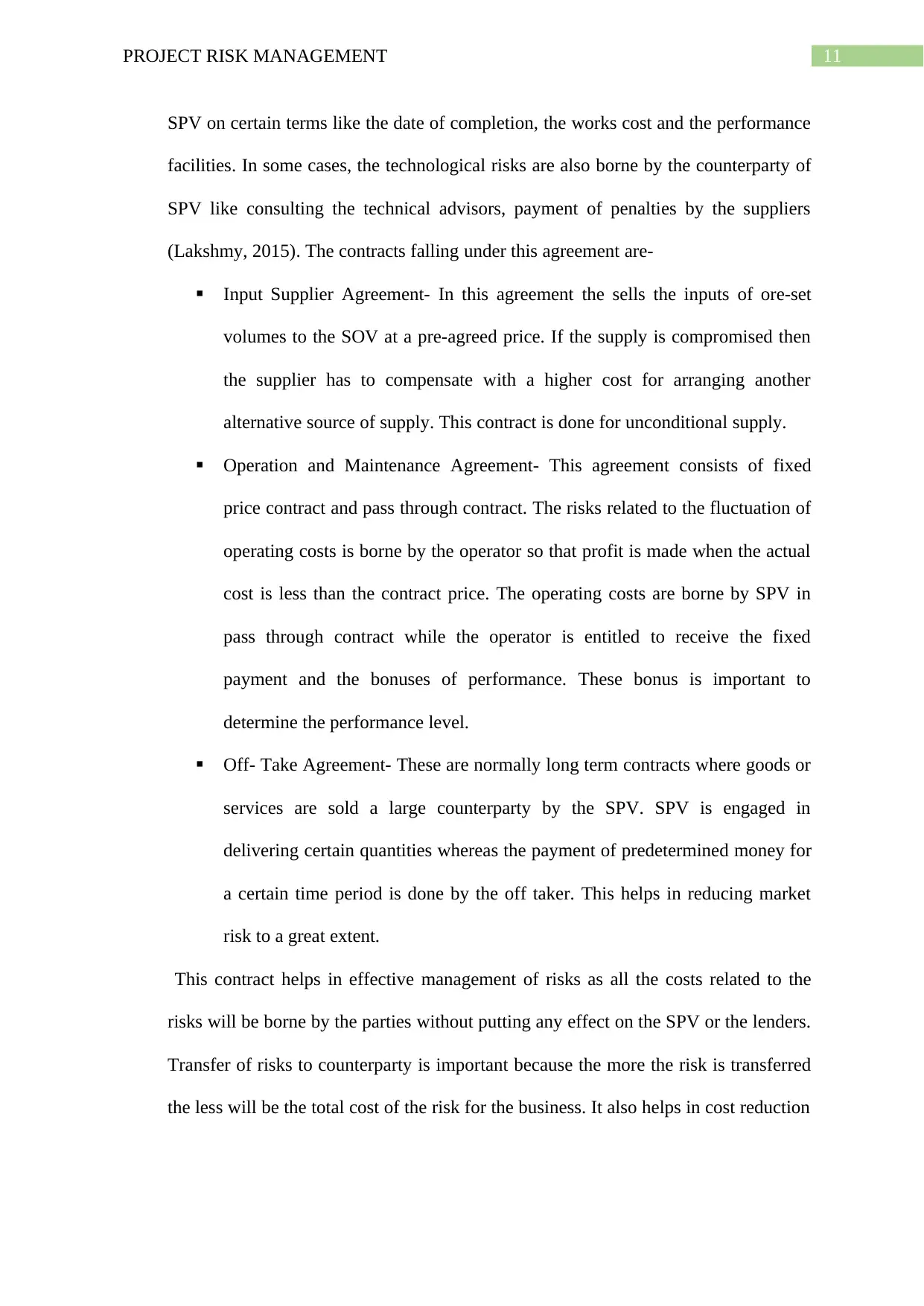
According to SPV, there are three basic strategies with which risks and its impact can
be mitigated (Regan, 2014.). Those three types of risks are discussed below-
The first strategy to reduce the impact of the risk is to allocating the risk to one of the
counterparty.
The second strategy of risk transfer deals with the transfer of risks to the insurer, the
professionals whose main business is concerned with dealing of risk management.
The third strategy deals with the retention of the risks done by the SPV sponsors. The
residual gains as well as losses are born by them.
It can also be explained with the help of a flowchart-
Transfer of risks to the counterparty-
SPV transfers the construction risks to the counterparty under an agreement of named
the EPC (TRUNKEY) Agreement. The contractor in return of payment guarantees
Total Risk
Allocation of risks to
counterparty
Allocation to insurers
Residual Risk borne by
SPV
Final loan
oppricing
the risk of the firm (Carbonara, Costantino and Pellegrino, 2014). In this case study of ABC
Pty. Ltd. is about to generate a special purpose vehicle (SPV) which acts a subsidiary of the
company to protect the main organization from bankruptcy and it is used as a risk sharing
entity for the mitigation of risks associated in the water treatment project proposed by them.
According to SPV, there are three basic strategies with which risks and its impact can
be mitigated (Regan, 2014.). Those three types of risks are discussed below-
The first strategy to reduce the impact of the risk is to allocating the risk to one of the
counterparty.
The second strategy of risk transfer deals with the transfer of risks to the insurer, the
professionals whose main business is concerned with dealing of risk management.
The third strategy deals with the retention of the risks done by the SPV sponsors. The
residual gains as well as losses are born by them.
It can also be explained with the help of a flowchart-
Transfer of risks to the counterparty-
SPV transfers the construction risks to the counterparty under an agreement of named
the EPC (TRUNKEY) Agreement. The contractor in return of payment guarantees
Total Risk
Allocation of risks to
counterparty
Allocation to insurers
Residual Risk borne by
SPV
Final loan
oppricing
11PROJECT RISK MANAGEMENT
SPV on certain terms like the date of completion, the works cost and the performance
facilities. In some cases, the technological risks are also borne by the counterparty of
SPV like consulting the technical advisors, payment of penalties by the suppliers
(Lakshmy, 2015). The contracts falling under this agreement are-
Input Supplier Agreement- In this agreement the sells the inputs of ore-set
volumes to the SOV at a pre-agreed price. If the supply is compromised then
the supplier has to compensate with a higher cost for arranging another
alternative source of supply. This contract is done for unconditional supply.
Operation and Maintenance Agreement- This agreement consists of fixed
price contract and pass through contract. The risks related to the fluctuation of
operating costs is borne by the operator so that profit is made when the actual
cost is less than the contract price. The operating costs are borne by SPV in
pass through contract while the operator is entitled to receive the fixed
payment and the bonuses of performance. These bonus is important to
determine the performance level.
Off- Take Agreement- These are normally long term contracts where goods or
services are sold a large counterparty by the SPV. SPV is engaged in
delivering certain quantities whereas the payment of predetermined money for
a certain time period is done by the off taker. This helps in reducing market
risk to a great extent.
This contract helps in effective management of risks as all the costs related to the
risks will be borne by the parties without putting any effect on the SPV or the lenders.
Transfer of risks to counterparty is important because the more the risk is transferred
the less will be the total cost of the risk for the business. It also helps in cost reduction
SPV on certain terms like the date of completion, the works cost and the performance
facilities. In some cases, the technological risks are also borne by the counterparty of
SPV like consulting the technical advisors, payment of penalties by the suppliers
(Lakshmy, 2015). The contracts falling under this agreement are-
Input Supplier Agreement- In this agreement the sells the inputs of ore-set
volumes to the SOV at a pre-agreed price. If the supply is compromised then
the supplier has to compensate with a higher cost for arranging another
alternative source of supply. This contract is done for unconditional supply.
Operation and Maintenance Agreement- This agreement consists of fixed
price contract and pass through contract. The risks related to the fluctuation of
operating costs is borne by the operator so that profit is made when the actual
cost is less than the contract price. The operating costs are borne by SPV in
pass through contract while the operator is entitled to receive the fixed
payment and the bonuses of performance. These bonus is important to
determine the performance level.
Off- Take Agreement- These are normally long term contracts where goods or
services are sold a large counterparty by the SPV. SPV is engaged in
delivering certain quantities whereas the payment of predetermined money for
a certain time period is done by the off taker. This helps in reducing market
risk to a great extent.
This contract helps in effective management of risks as all the costs related to the
risks will be borne by the parties without putting any effect on the SPV or the lenders.
Transfer of risks to counterparty is important because the more the risk is transferred
the less will be the total cost of the risk for the business. It also helps in cost reduction
⊘ This is a preview!⊘
Do you want full access?
Subscribe today to unlock all pages.
Trusted by 1+ million students worldwide

1 out of 18


Your All-in-One AI-Powered Toolkit for Academic Success.
+13062052269
info@desklib.com
Available 24*7 on WhatsApp / Email
![[object Object]](/_next/static/media/star-bottom.7253800d.svg)
Unlock your academic potential
Copyright © 2020–2026 A2Z Services. All Rights Reserved. Developed and managed by ZUCOL.