Project Management: Risk Register Report for QAHE Mobile App

Verified

Added on  2022/09/11

|9
|1022
|12
Report
AI Summary
This report presents a risk register developed for the QAHE recreation mobile application project. The risk register meticulously documents key risks, their severity, and probability of occurrence, along with proposed mitigation and contingency actions. Risks are categorized and assessed, including inherent schedule flaws, requirement inflation, insufficient budget, incorrect requirements specifications, design issues, procedural risks, internal team issues, non-supportive students, poor management, and technical issues. The report provides a detailed analysis of each risk, its potential impact, and the strategies employed to minimize its effects. Furthermore, the report emphasizes the importance of a risk register as a critical tool for effective project management, highlighting its role in identifying, documenting, and prioritizing risks to ensure successful project outcomes. The report references key literature on project risk management, including works by Lock (2014), Kendrick (2015), and Papke-Shields and Boyer-Wright (2017), and provides a case study example of the Queensland Health Payroll project to illustrate the consequences of inadequate risk management. The risk register also includes post-contingency severity and probability assessments, along with the scope and risk owner for each identified risk.

Document Page
Running head: RISK
Assessment 2
Name of Student
Name of University
Author Note
tabler-icon-diamond-filled.svg

Paraphrase This Document

Need a fresh take? Get an instant paraphrase of this document with our AI Paraphraser
Document Page
1
RISK
Risk Register
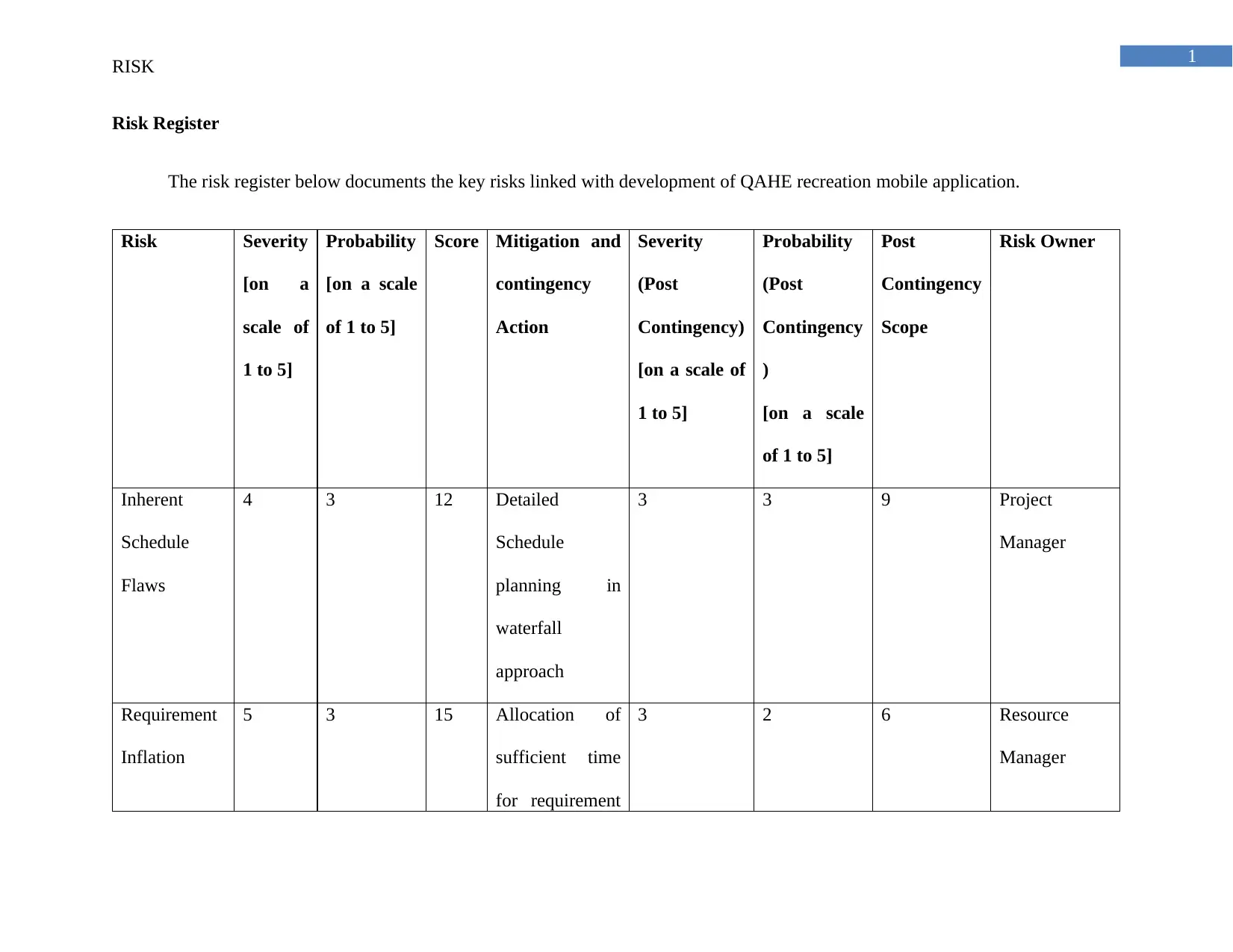
The risk register below documents the key risks linked with development of QAHE recreation mobile application.
Risk Severity
[on a
scale of
1 to 5]
Probability
[on a scale
of 1 to 5]
Score Mitigation and
contingency
Action
Severity
(Post
Contingency)
[on a scale of
1 to 5]
Probability
(Post
Contingency
)
[on a scale
of 1 to 5]
Post
Contingency
Scope
Risk Owner
Inherent
Schedule
Flaws
4 3 12 Detailed
Schedule
planning in
waterfall
approach
3 3 9 Project
Manager
Requirement
Inflation
5 3 15 Allocation of
sufficient time
for requirement
3 2 6 Resource
Manager
Document Page
2
RISK
specifications
Insufficient
Budget
4 4 16 Budget
calculation is
done at project
start and the
cost estimation
is done in such a
way that there is
less chances of
cost creep in the
project
4 2 8 Business
Analyst
Incorrect
Requirements
specifications
5 3 15 The detailed
specification of
the mobile
application is
taken from
student forum
5 2 10 Student Forum
Representative
Document Page
3
RISK
representative of
QAHE
Design Issues 3 3 9 An experienced
project team is
hired for
designing the
software
application
2 2 4 Software
engineer
Procedural
Risks
4 2 8 The
implementation
process is
thoroughly
monitored to
eliminate this
risk
2 1 2 Project
Manager
Internal Team
issues
5 4 20 A
communication
4 2 8 Project
tabler-icon-diamond-filled.svg

Paraphrase This Document

Need a fresh take? Get an instant paraphrase of this document with our AI Paraphraser
Document Page
4
RISK
plan is
developed for
effective
internal
communication
which will
reduce the
internal team
issues
Manager
Non
supportive
Students
4 2 8 The students are
made to
understand the
benefit and the
need of the
application
3 2 6 Student Forum
Representative
Poor
Management
5 3 15 An experienced
project manager
3 3 9 Project
Document Page
5
RISK
is selected for
execution of this
project
Manager
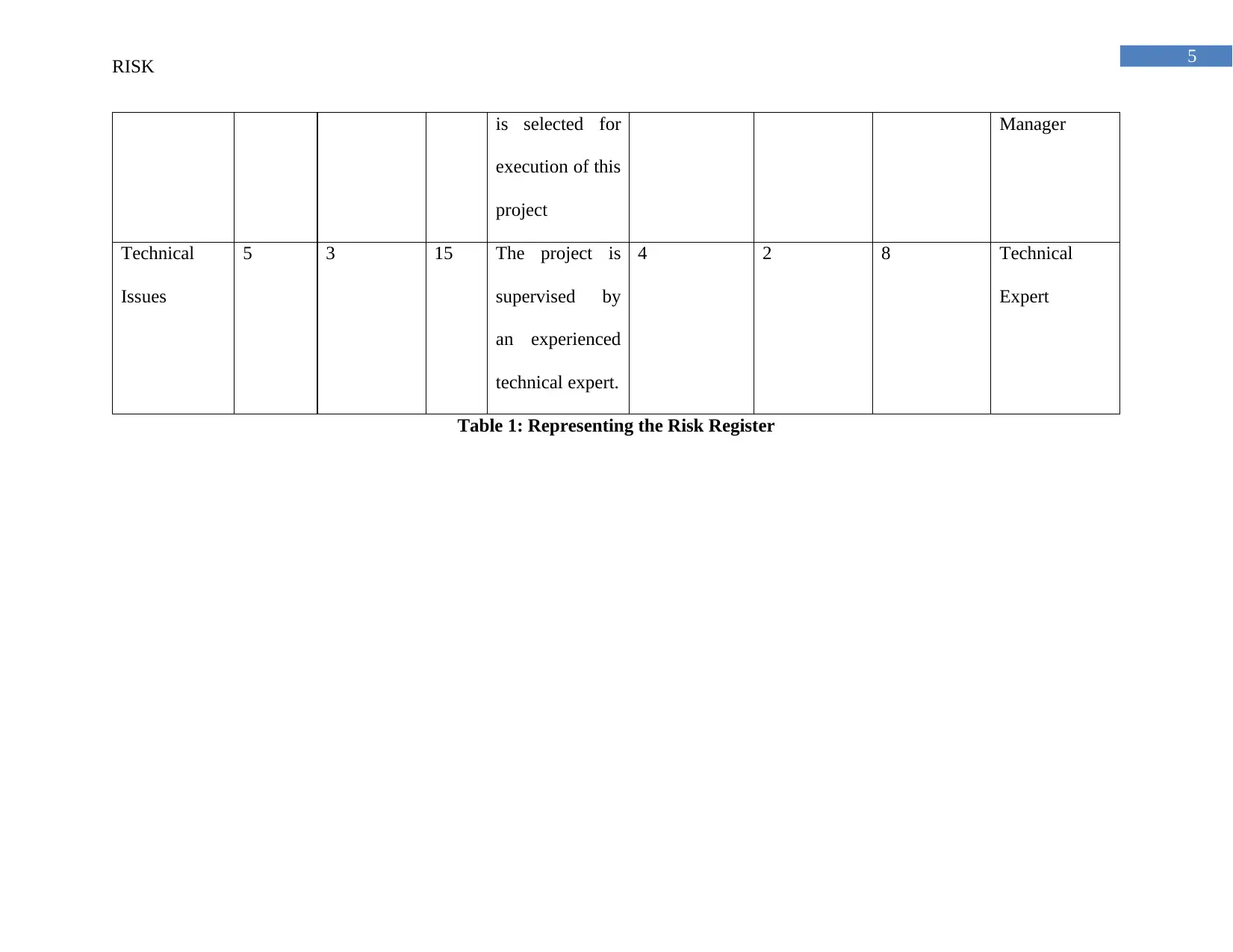
Technical
Issues
5 3 15 The project is
supervised by
an experienced
technical expert.
4 2 8 Technical
Expert
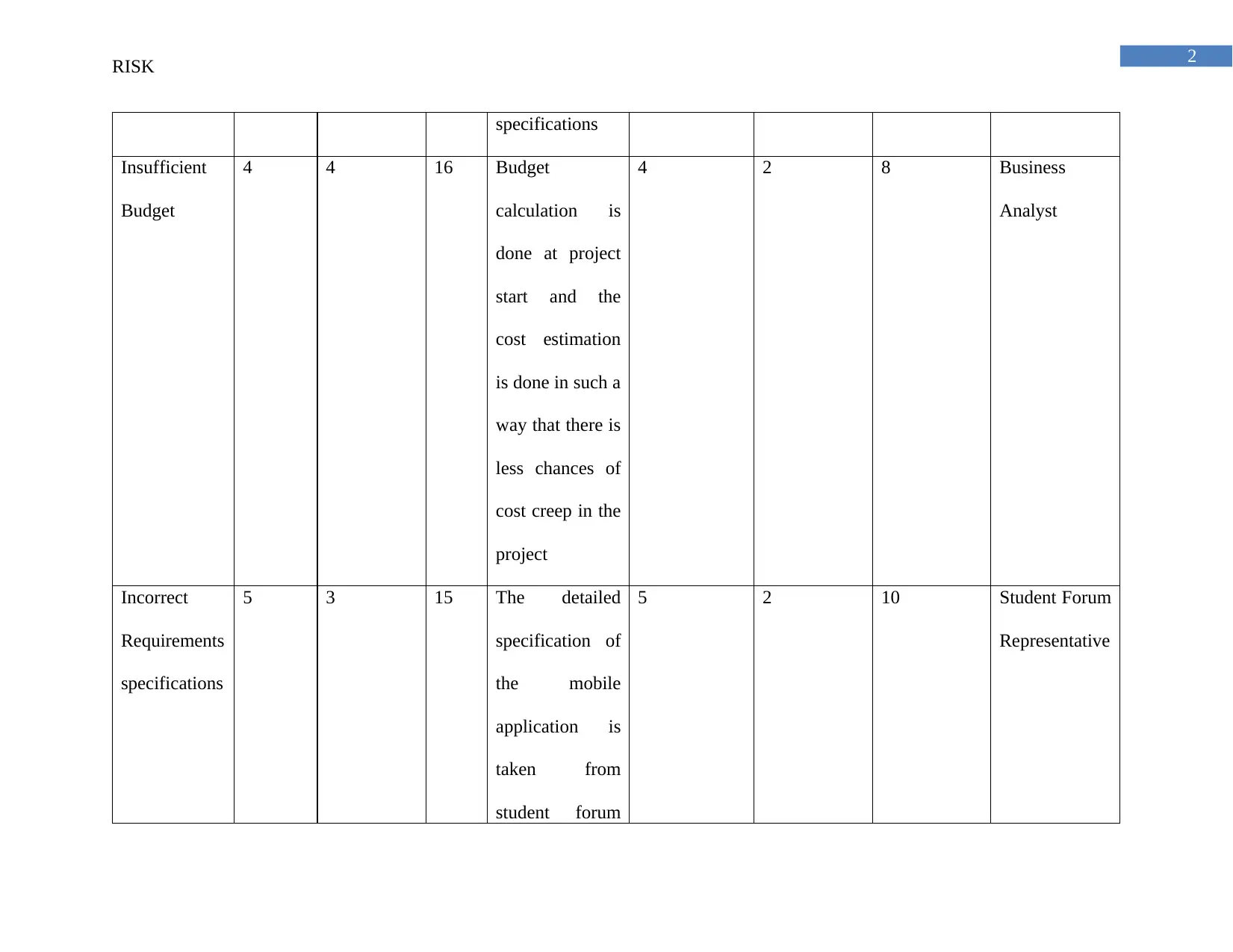
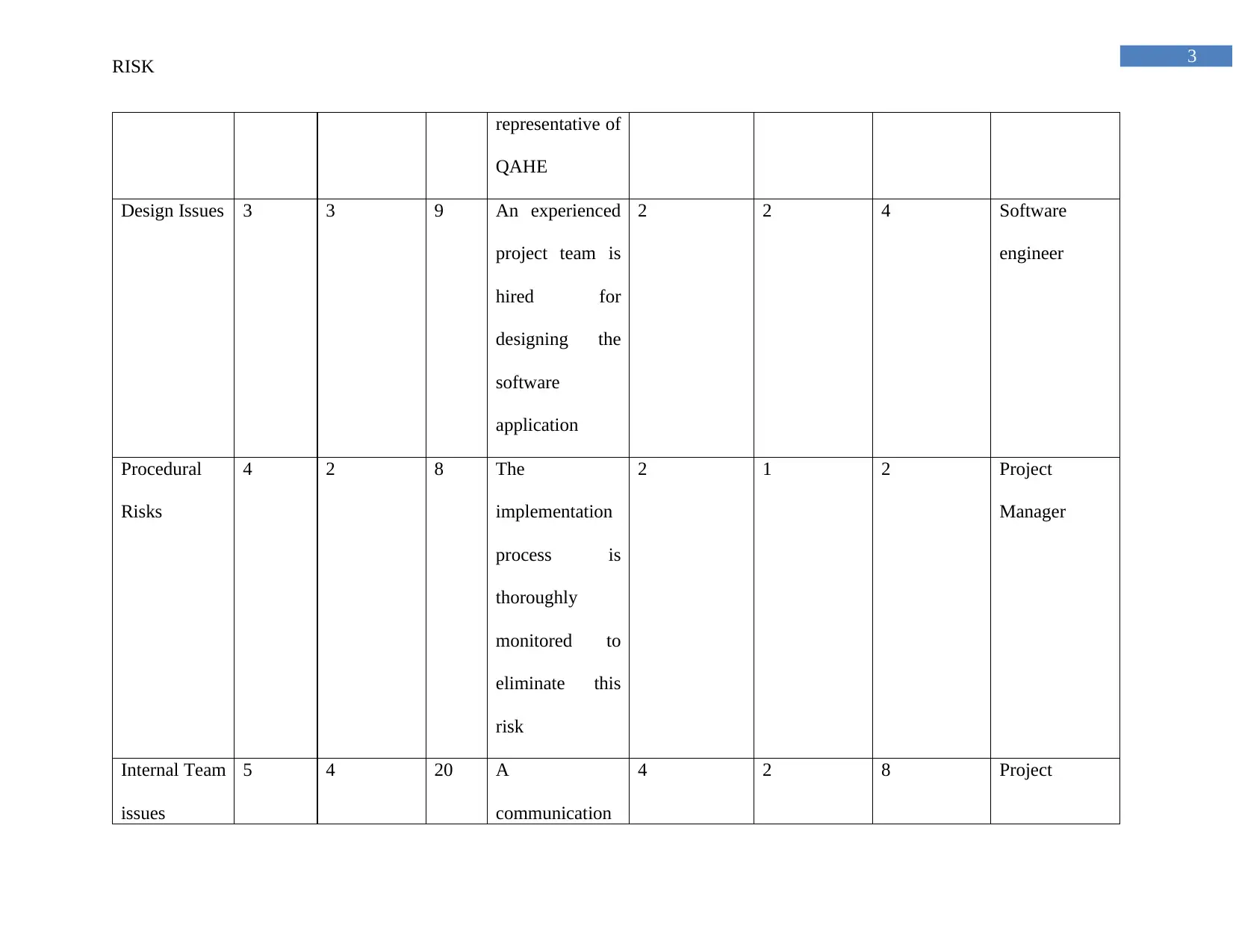
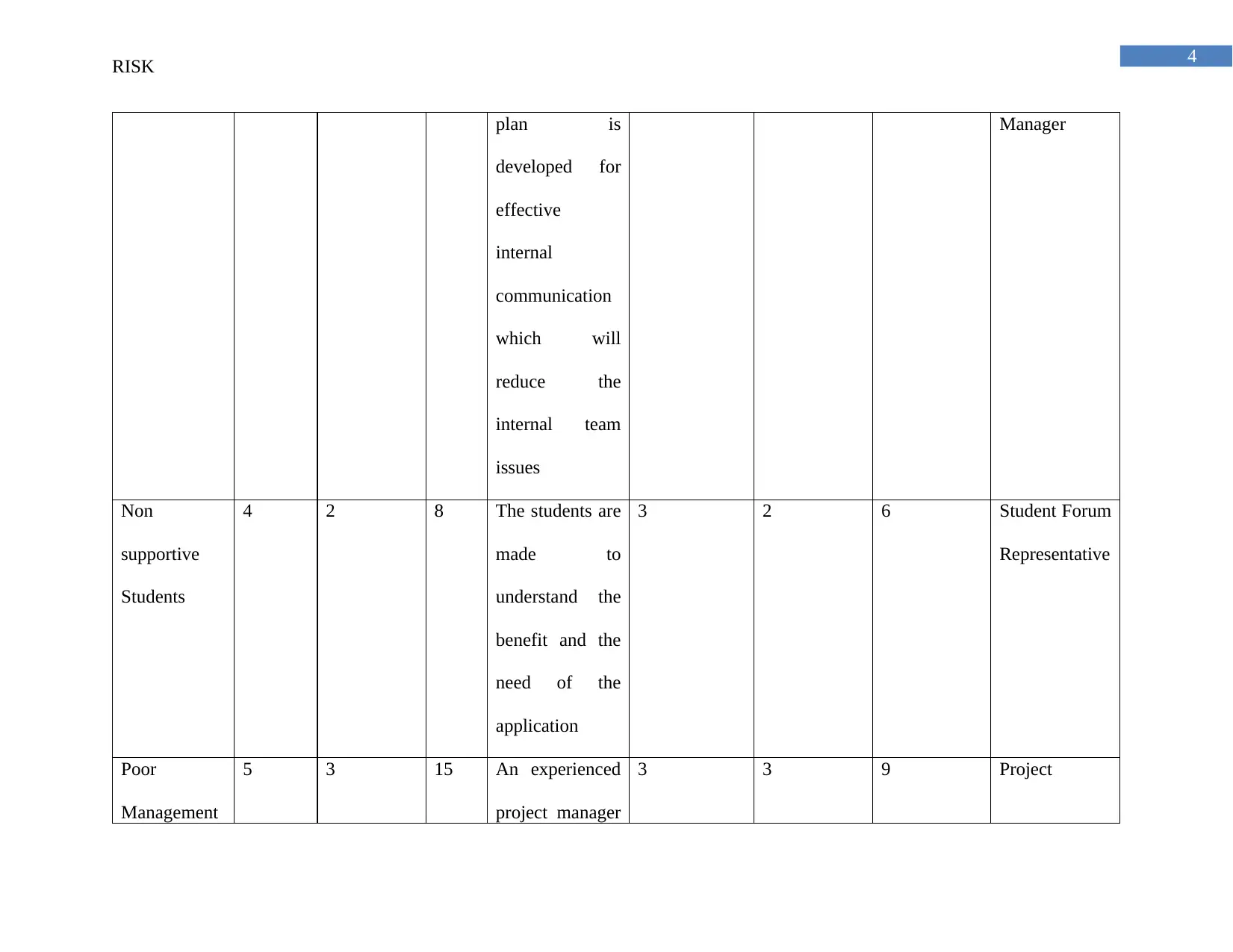
Table 1: Representing the Risk Register
Document Page
6
RISK
Importance of Risk Register
Risk register is a document and an effective risk management tool that helps in
identification and documentation of the major risks linked with a project (Lock 2014). Risk
register is a significant part of risk administration and management as it plots the influence of a
particular risk over the likelihood of that risk being present in the project. Risk register therefore
forms a crucial part of the overall plan for risk management.
A risk management plan in a project provides a detailed idea of the key risks linked with
a project and process in which those risks can be eliminated from the project. Risk register is a
critical tool of a risk management plan that documents the details of all the risks that might affect
the normal accomplishment of a project (Pritchard and PMP 2014). The risk register forms an
important part of a risk management plan as it allows the managers to prioritize the risks that are
required to be lessened first from the project (Kendrick 2015). The documentation of the details
of the risk in the risk register further helps in effective monitoring of those risks. A risk register
further helps in identification of the potential behavioral trends of the documented risks (Papke-
Shields and Boyer-Wright 2017). Proper monitoring of those risks helps in easier achievement of
the project objectives and further helps in continual improvement.
The risk register is a critical component of a risk management plan as the reviews from
risk registers helps in implementation of a better and safe work procedure in a project. Risk
registers are therefore more than a list of issues as it provides the manager with the operational
viability of the project. Improper risk management is often considered as a major cause of project
failure. For example, the Queensland Health Payroll (QHP) project was unsuccessful as the risk
of scope creep, budget and schedule could not be managed effectively (Eden and Sedera 2014).
tabler-icon-diamond-filled.svg

Paraphrase This Document

Need a fresh take? Get an instant paraphrase of this document with our AI Paraphraser
Document Page
7
RISK
There were issues with the risk management plan prepared that resulted in the uncontrollable
scope creep, delay in project completion and project exceeding the original budget by 300%.
Therefore, it can be indicated that risk registers provide the project team with a detailed
understanding of the key project issues that are required to be mitigated, managed or avoided.
The detailed documentation of the project risks prior to the start of the undertaken project work
leaves a scope of continuous improvements in a project and therefore, it is an important risk
management tool. A risk register is therefore used not only for gathering the information about
the identified hazards and risks (Kendrick 2015). Risks in a project is identified by different
means and the register documents the severity and the complexities of those issues in the project.
Risk in a project is identified with a number of different means and the register documents the
severity of the risk and the probability of occurrences of the risk. Risk register contributes to
successful management of the project risks and elimination of those risks in the project.
Document Page
8
RISK
References
Eden, R. and Sedera, D., 2014. The largest admitted IT project failure in the Southern
Hemisphere: a teaching case. In Proceedings of the 35th International Conference on
Information Systems: Building a Better World Through Information Systems. AISeL.
Kendrick, T., 2015. Identifying and managing project risk: essential tools for failure-proofing
your project. Amacom.
Lock, M.D., 2014. The essentials of project management. Ashgate Publishing, Ltd..
Papke-Shields, K.E. and Boyer-Wright, K.M., 2017. Strategic planning characteristics applied to
project management. International Journal of Project Management, 35(2), pp.169-179.
Pritchard, C.L. and PMP, P.R., 2014. Risk management: concepts and guidance. CRC Press.
chevron_up_icon
1 out of 9
circle_padding
hide_on_mobile
zoom_out_icon
[object Object]