Report on Minimum Velocity of a Projectile and its Implications

Verified

Added on  2022/12/27

|7
|1483
|4
Report
AI Summary
This report delves into the concept of minimum projectile velocity, often referred to as escape velocity, which is required for an object to overcome Earth's gravitational pull and escape into space. The report derives the formula for calculating escape velocity based on the laws of conservation of energy, gravitational force, and acceleration. It highlights that escape velocity is independent of the projectile's mass and depends primarily on the gravitational acceleration and radius of the planet from which the projectile is launched. The report also calculates the escape velocity for Earth, considering factors like gravitational acceleration and Earth's radius. It acknowledges the limitations of the derivation, particularly the neglect of air resistance, and suggests further research to incorporate this factor for real-world applications. The report concludes by emphasizing the significance of understanding escape velocity for space exploration and projectile design. Desklib provides access to similar solved assignments and resources for students.
Document Page
Minimum Velocity of a Projectile 1
MINIMUM VELOCITY OF A PROJECTILE
Name
Course
Professor
University
City/state
Date
tabler-icon-diamond-filled.svg

Paraphrase This Document

Need a fresh take? Get an instant paraphrase of this document with our AI Paraphraser
Document Page
Minimum Velocity of a Projectile 2
Minimum Velocity of a Projectile
Introduction
Typically, when an object is thrown upwards vertically, it goes up, reaches a certain height and
starts coming back to earth. The height that the object reaches before starting to come back
depends largely on the initial velocity of the object [1]. The reason why the objects comes back
is because of gravitational pull of the earth. However, an object can also be thrown upwards
vertically with a certain minimum initial velocity (known as escape velocity) such that it does
not come back. In such a case, the object will have overcome the earth’s gravitational pull and it
will be able to escape from the earth. Therefore escape velocity is the minimum velocity that an
object, such as a projectile, must attain so as to overcome the earth’s gravitational pull so that it
can escape into space. When the object attains escape velocity, it means that it has adequate
kinetic energy on its surface to enable it escape gravitational pull effect. The main purpose of
this report is to examine the escape velocity of a projectile by deriving its formula and using it to
calculating the exact value of escape velocity. This information can be used by scientists,
researchers, engineers and astronauts when studying and designing projectiles for various
purposes including space exploration. Projectiles can only reach targeted heights or destinations
if they are launched with the required minimum velocity or else they will travel to a certain
height and get pulled back to the earth.
Results
According to the law of conservation of energy, the sum of initial potential and kinetic energy is
equal to the sum of final potential and kinetic energy. The formula for calculating escape
Document Page
Minimum Velocity of a Projectile 3
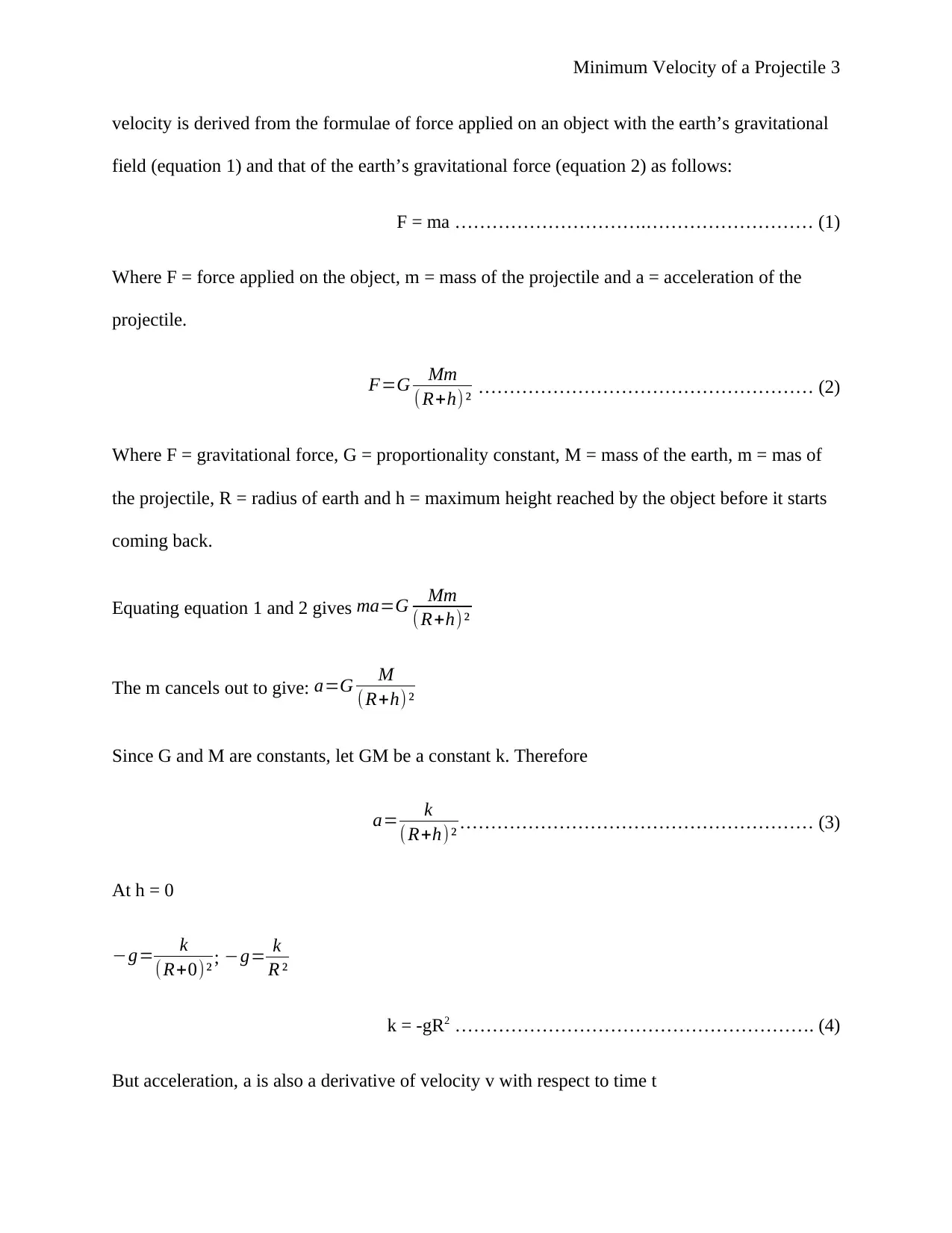
velocity is derived from the formulae of force applied on an object with the earth’s gravitational
field (equation 1) and that of the earth’s gravitational force (equation 2) as follows:
F = ma ………………………….……………………… (1)
Where F = force applied on the object, m = mass of the projectile and a = acceleration of the
projectile.
F=G Mm
( R+h) ² ……………………………………………… (2)
Where F = gravitational force, G = proportionality constant, M = mass of the earth, m = mas of
the projectile, R = radius of earth and h = maximum height reached by the object before it starts
coming back.
Equating equation 1 and 2 gives ma=G Mm
(R+h) ²
The m cancels out to give: a=G M
(R+h) ²
Since G and M are constants, let GM be a constant k. Therefore
a= k
(R+h) ² ………………………………………………… (3)
At h = 0
g= k
(R+0)² ; g= k
R ²
k = -gR2 …………………………………………………. (4)
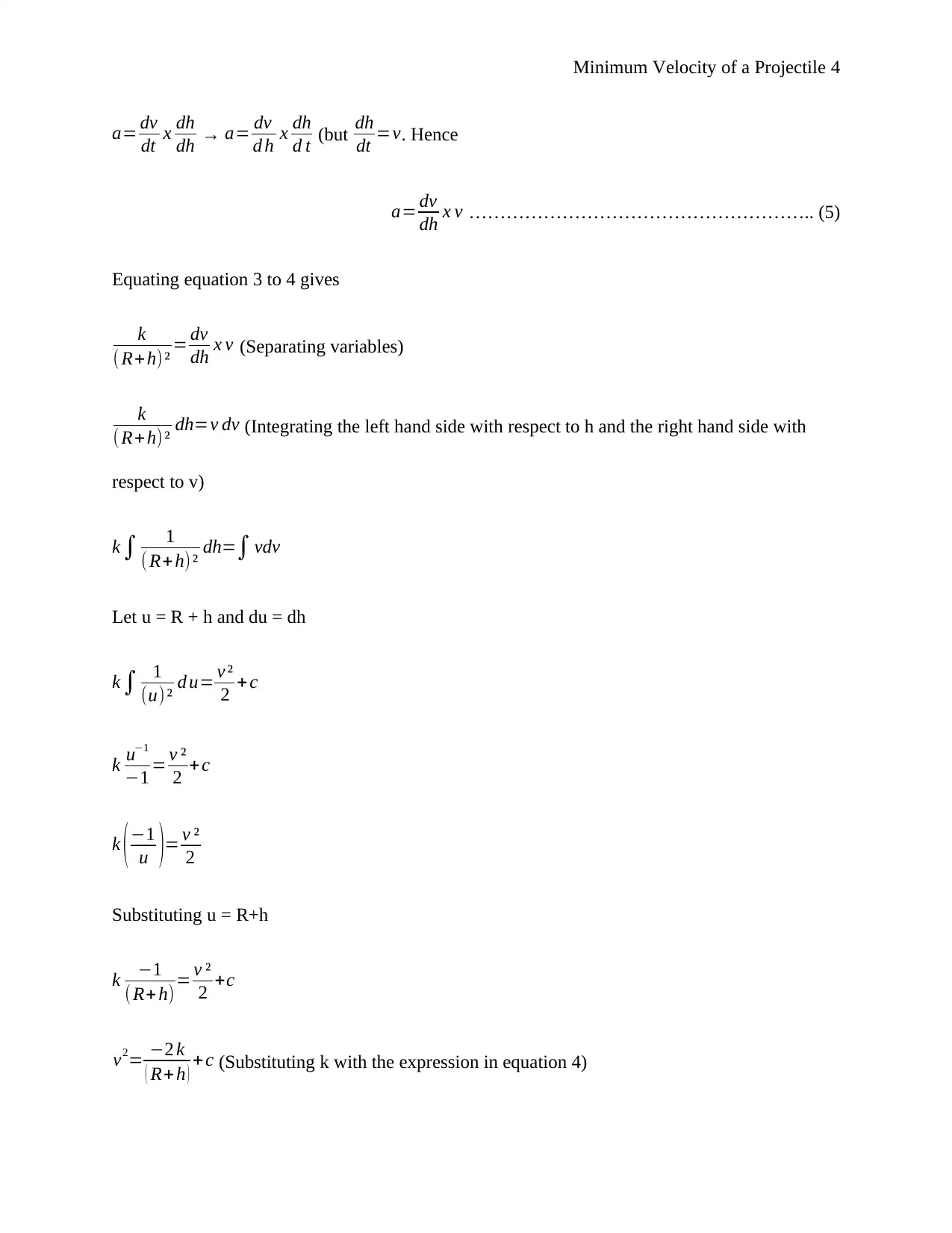
But acceleration, a is also a derivative of velocity v with respect to time t
Document Page
Minimum Velocity of a Projectile 4
a= dv
dt x dh
dh a= dv
d h x dh
d t (but dh
dt =v. Hence
a= dv
dh x v ……………………………………………….. (5)
Equating equation 3 to 4 gives
k
( R+ h) ² = dv
dh x v (Separating variables)
k
(R+h) ² dh=v dv (Integrating the left hand side with respect to h and the right hand side with
respect to v)
k 1
( R+ h) ² dh= vdv
Let u = R + h and du = dh
k 1
(u) ² d u= v ²
2 + c
k u1
1 = v ²
2 + c
k ( 1
u )= v ²
2
Substituting u = R+h
k 1
( R+ h)= v ²
2 +c
v2= 2 k
( R+ h ) + c (Substituting k with the expression in equation 4)
tabler-icon-diamond-filled.svg

Paraphrase This Document

Need a fresh take? Get an instant paraphrase of this document with our AI Paraphraser
Document Page
Minimum Velocity of a Projectile 5
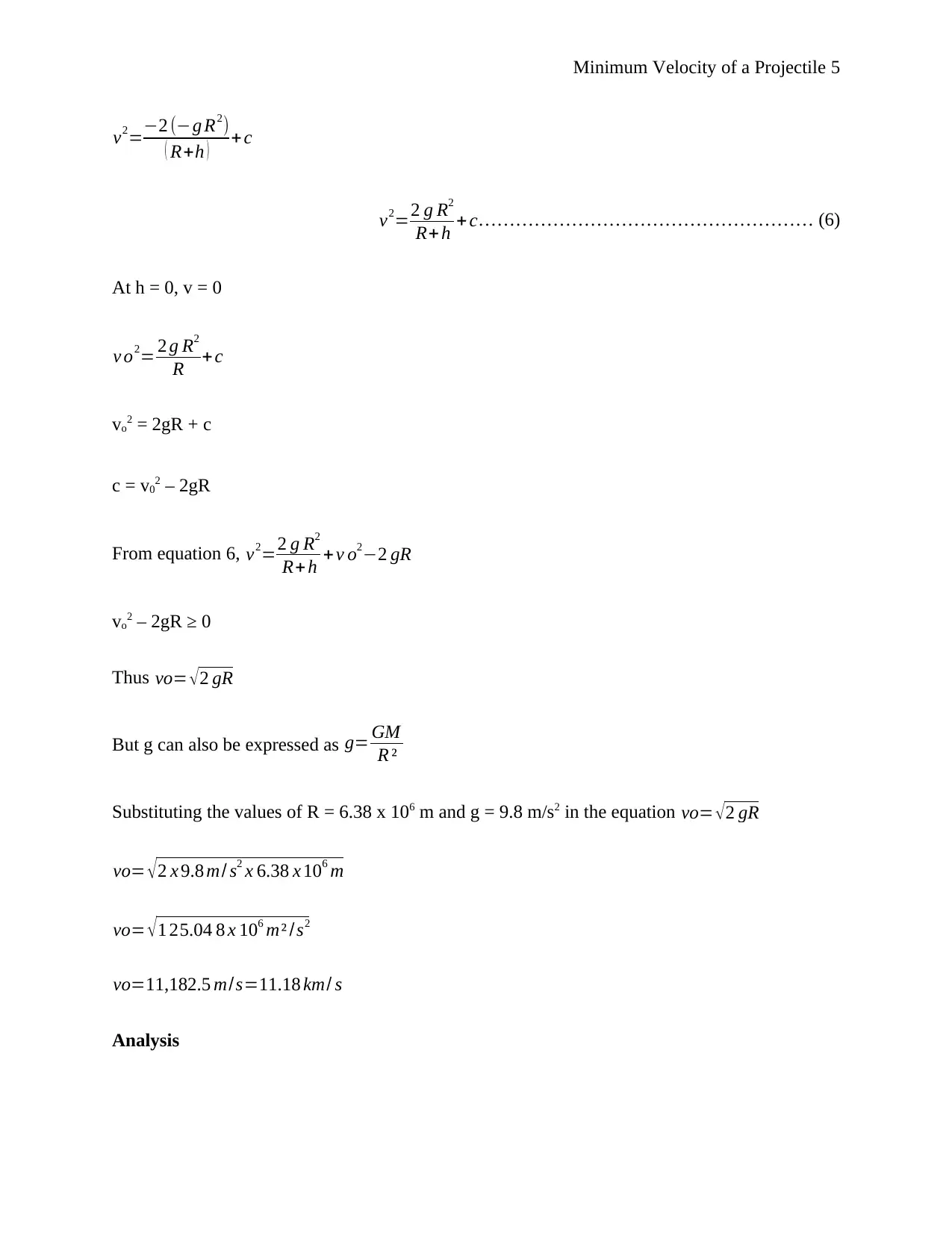
v2=2 (g R2)
( R+h ) + c
v2=2 g R2
R+ h + c……………………………………………… (6)
At h = 0, v = 0
v o2= 2 g R2
R + c
vo2 = 2gR + c
c = v02 – 2gR
From equation 6, v2=2 g R2
R+h +v o22 gR
vo2 – 2gR ≥ 0
Thus vo= 2 gR
But g can also be expressed as g= GM
R ²
Substituting the values of R = 6.38 x 10⁶ m and g = 9.8 m/s2 in the equation vo= 2 gR
vo= 2 x 9.8 m/ s2 x 6.38 x 106 m
vo= 1 25.04 8 x 10⁶ m² /s2
vo=11,182.5 m/s=11.18 km/ s
Analysis
Document Page
Minimum Velocity of a Projectile 6
An object can only escape the earth’s gravitational pull if its kinetic energy is equal to the work
that has been done against gravitational pull. This means that the magnitude of potential energy
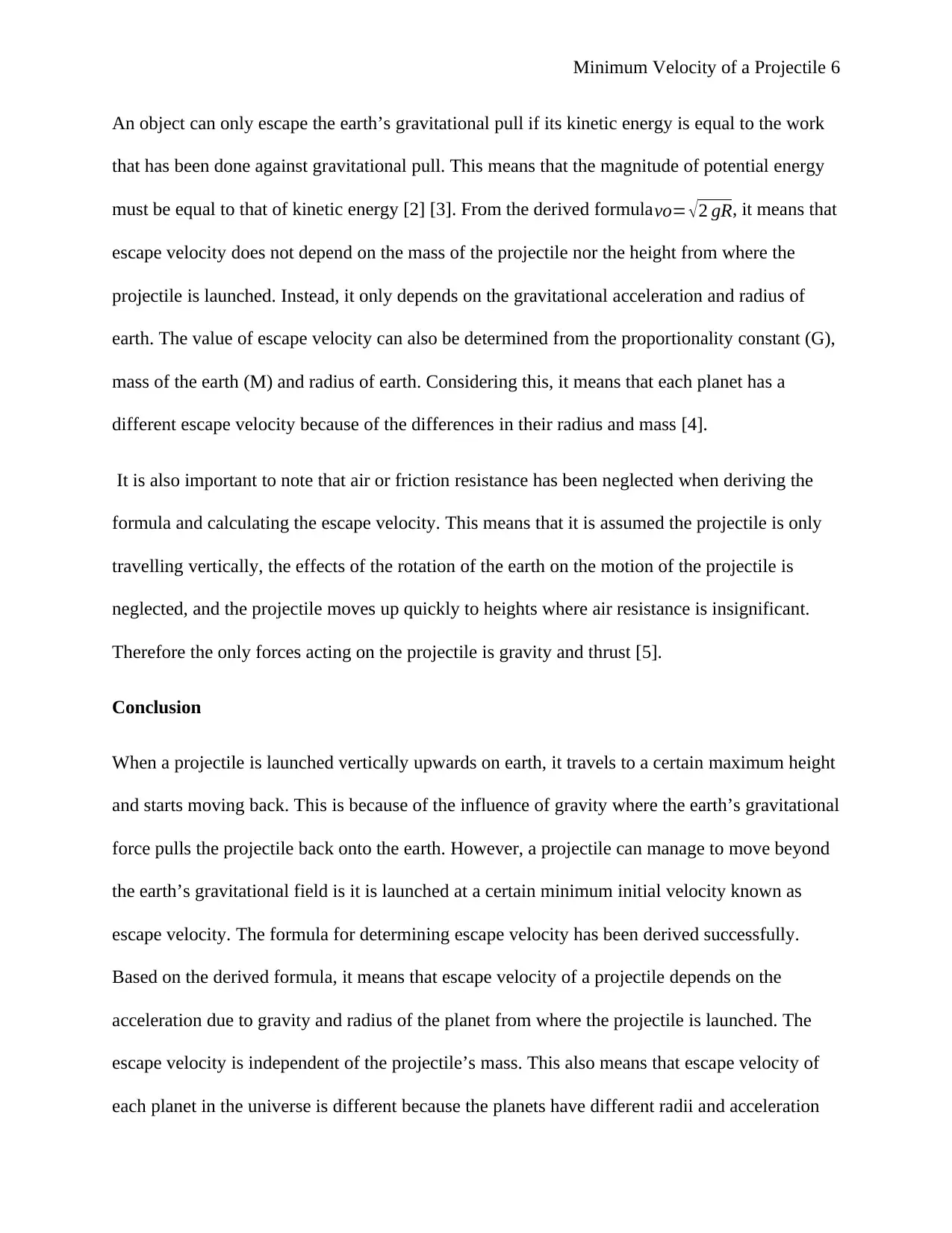
must be equal to that of kinetic energy [2] [3]. From the derived formulavo= 2 gR, it means that
escape velocity does not depend on the mass of the projectile nor the height from where the
projectile is launched. Instead, it only depends on the gravitational acceleration and radius of
earth. The value of escape velocity can also be determined from the proportionality constant (G),
mass of the earth (M) and radius of earth. Considering this, it means that each planet has a
different escape velocity because of the differences in their radius and mass [4].
It is also important to note that air or friction resistance has been neglected when deriving the
formula and calculating the escape velocity. This means that it is assumed the projectile is only
travelling vertically, the effects of the rotation of the earth on the motion of the projectile is
neglected, and the projectile moves up quickly to heights where air resistance is insignificant.
Therefore the only forces acting on the projectile is gravity and thrust [5].
Conclusion
When a projectile is launched vertically upwards on earth, it travels to a certain maximum height
and starts moving back. This is because of the influence of gravity where the earth’s gravitational
force pulls the projectile back onto the earth. However, a projectile can manage to move beyond
the earth’s gravitational field is it is launched at a certain minimum initial velocity known as
escape velocity. The formula for determining escape velocity has been derived successfully.
Based on the derived formula, it means that escape velocity of a projectile depends on the
acceleration due to gravity and radius of the planet from where the projectile is launched. The
escape velocity is independent of the projectile’s mass. This also means that escape velocity of
each planet in the universe is different because the planets have different radii and acceleration
Document Page
Minimum Velocity of a Projectile 7
due to gravity. One of the assumptions made when deriving the escape velocity is that the motion
of the projectile was not affected by air resistance. This is not true in real world because any
object moving through air experiences some frictional resistance. Therefore it is important for
scientists, researchers and engineers to find a way of integrating the air resistance factor when
deriving the formula for determining escape velocity in real life application.
References
[1] E. Butikov, "Orbits of satellites and trajectories of missiles," in Motions of celestial bodies, Bristol ,
UK, IOP Publishing, 2014, pp. 1-17.
[2] T. Dangol. (2019). Escape Velocity, it's Formula and Derivation [Online]. Available:
https://www.sciencetopia.net/physics/escape-velocity
[3] R. Nave. (n.d.) Escape Velocity [Online]. Available:
http://hyperphysics.phy-astr.gsu.edu/hbase/vesc.html
[4] National Aeronautics and Space Administration. (n.d.) Esape Velocity [Online]. Available:
https://nasa.fandom.com/wiki/Escape_velocity
[5] N. Vlacic, "Escape Velocity," Undergraduate Journal of Mathematical Modeling: One+Two, vol. 3, no.
1, pp. 1-7, 2010.
chevron_up_icon
1 out of 7
circle_padding
hide_on_mobile
zoom_out_icon
[object Object]