Individual Informal Workplace Learning: Report Analysis and Promotion
VerifiedAdded on 2020/02/24
|12
|3493
|51
Report
AI Summary
This report delves into the significance of individual informal workplace learning within organizations, highlighting its advantages and practical applications. It explores how individuals learn in the workplace, emphasizing methods like collaboration, experience-based learning, and feedback. The report identifies factors that either enable or constrain informal learning, including organizational climate, job structure, and individual characteristics such as age, gender, and educational background. It also examines the potential benefits of increased informal learning for both individuals and the organization, such as cost-effectiveness, flexibility, and enhanced knowledge sharing. The report concludes with recommendations for fostering a culture that promotes and supports informal learning, ultimately aiming to improve employee development and organizational performance.
Running head: Promoting Individual Informal Workplace Learning 1
Promoting Individual Informal Workplace Learning
Promoting Individual Informal Workplace Learning

Paraphrase This Document
Need a fresh take? Get an instant paraphrase of this document with our AI Paraphraser
Promoting Individual Informal Workplace Learning 2
Contents
Introduction......................................................................................................................................2
Findings...........................................................................................................................................2
The way in which individuals learn in the workplace.................................................................2
Factors enabling or constraining informal workplace learning...................................................4
Influence of individual characteristics on the effectiveness of informal workplace learning.....5
Potential benefits for individuals and the organisation of increased informal workplace
learning........................................................................................................................................6
Conclusion.......................................................................................................................................7
Recommendations............................................................................................................................8
References......................................................................................................................................10
Contents
Introduction......................................................................................................................................2
Findings...........................................................................................................................................2
The way in which individuals learn in the workplace.................................................................2
Factors enabling or constraining informal workplace learning...................................................4
Influence of individual characteristics on the effectiveness of informal workplace learning.....5
Potential benefits for individuals and the organisation of increased informal workplace
learning........................................................................................................................................6
Conclusion.......................................................................................................................................7
Recommendations............................................................................................................................8
References......................................................................................................................................10
Promoting Individual Informal Workplace Learning 3
Introduction
Informal learning is one of the most well-known and recognized aspect in the business
organisations in the present scenario as it offers a significant number of advantages to the
organisations. Informal learning is a training that offers increased level of freedom and flexibility
to the employees in learning new processes and approaches. It identifies the social implication of
learning from other individuals but has a wider scope for the individual aspect instead of
socialization. It focuses upon the learning which occurs in the surrounding environment and the
activities but with a more of formal objective and it occurs in an extended variety in comparison
with the formal training or learning (Le Clus, 2011). It is also called as learning from the
experiences as there is discussion and learning gained from the experiences of others and
oneself. In present time, the organisations are forming a workplace culture where there is more
of informal learning so that it can result in increased employee engagement, socialization,
effective working environment and development of innovative ideas and approaches (Cross,
2011). The key purpose behind developing this paper is to promote the individual informal
workplace learning so that the quality and the quantity of the individual learning could be
enhanced by the means of work. The report will throw lights upon aspects such as factors that
constrain or enable workplace learning, personal characteristics and its influence on learning,
potential advantages of learning and recommendations for increasing the level of informal
learning at the workplaces.
Findings
The way in which individuals learn in the workplace
In the present scenario, there exist high persformance organisations; there is an extensive need
that the employees must be prepared for the continuous changes, developments and growth.
There are some important and innovate ways to learn at work in terms of consultation and
experience. There are several other ways of informal learning which can be used in the
organisations that comprises of critical reflection i.e. when one learns from oneself, learning by
the interpersonal sources and learning from others (Ellström, 2011). The most significant way for
developing informal learning at the workplace without any expenses is through the employee
Introduction
Informal learning is one of the most well-known and recognized aspect in the business
organisations in the present scenario as it offers a significant number of advantages to the
organisations. Informal learning is a training that offers increased level of freedom and flexibility
to the employees in learning new processes and approaches. It identifies the social implication of
learning from other individuals but has a wider scope for the individual aspect instead of
socialization. It focuses upon the learning which occurs in the surrounding environment and the
activities but with a more of formal objective and it occurs in an extended variety in comparison
with the formal training or learning (Le Clus, 2011). It is also called as learning from the
experiences as there is discussion and learning gained from the experiences of others and
oneself. In present time, the organisations are forming a workplace culture where there is more
of informal learning so that it can result in increased employee engagement, socialization,
effective working environment and development of innovative ideas and approaches (Cross,
2011). The key purpose behind developing this paper is to promote the individual informal
workplace learning so that the quality and the quantity of the individual learning could be
enhanced by the means of work. The report will throw lights upon aspects such as factors that
constrain or enable workplace learning, personal characteristics and its influence on learning,
potential advantages of learning and recommendations for increasing the level of informal
learning at the workplaces.
Findings
The way in which individuals learn in the workplace
In the present scenario, there exist high persformance organisations; there is an extensive need
that the employees must be prepared for the continuous changes, developments and growth.
There are some important and innovate ways to learn at work in terms of consultation and
experience. There are several other ways of informal learning which can be used in the
organisations that comprises of critical reflection i.e. when one learns from oneself, learning by
the interpersonal sources and learning from others (Ellström, 2011). The most significant way for
developing informal learning at the workplace without any expenses is through the employee
⊘ This is a preview!⊘
Do you want full access?
Subscribe today to unlock all pages.

Trusted by 1+ million students worldwide
Promoting Individual Informal Workplace Learning 4
collaboration. As per this approach, all ten organisational employees collaborate and work as
team. There are team formations which help sharing of feedbacks, knowledge and experience
among the team members so that more innovative ideas can be generated and faster
accomplishment could take place (Ley, et al., 2013). This way of informal learning is also known
as cooperative learning where there takes place group learning by having passive and strong
discussions in groups to pass information with each other and have more appropriate ways of
performing tasks. Such way of informal learning helps in enhancement of both the quantity as
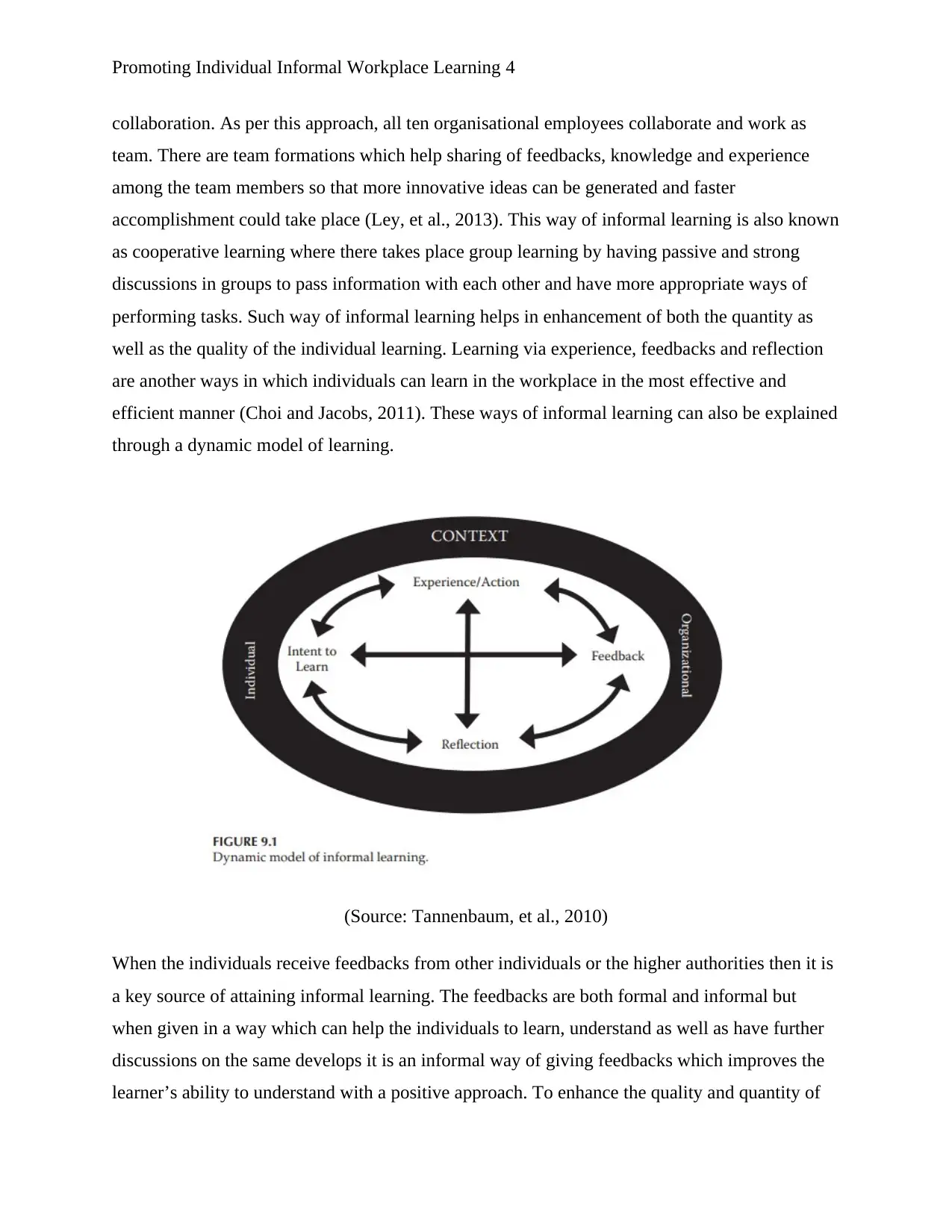
well as the quality of the individual learning. Learning via experience, feedbacks and reflection
are another ways in which individuals can learn in the workplace in the most effective and
efficient manner (Choi and Jacobs, 2011). These ways of informal learning can also be explained
through a dynamic model of learning.
(Source: Tannenbaum, et al., 2010)
When the individuals receive feedbacks from other individuals or the higher authorities then it is
a key source of attaining informal learning. The feedbacks are both formal and informal but
when given in a way which can help the individuals to learn, understand as well as have further
discussions on the same develops it is an informal way of giving feedbacks which improves the
learner’s ability to understand with a positive approach. To enhance the quality and quantity of
collaboration. As per this approach, all ten organisational employees collaborate and work as
team. There are team formations which help sharing of feedbacks, knowledge and experience
among the team members so that more innovative ideas can be generated and faster
accomplishment could take place (Ley, et al., 2013). This way of informal learning is also known
as cooperative learning where there takes place group learning by having passive and strong
discussions in groups to pass information with each other and have more appropriate ways of
performing tasks. Such way of informal learning helps in enhancement of both the quantity as
well as the quality of the individual learning. Learning via experience, feedbacks and reflection
are another ways in which individuals can learn in the workplace in the most effective and
efficient manner (Choi and Jacobs, 2011). These ways of informal learning can also be explained
through a dynamic model of learning.
(Source: Tannenbaum, et al., 2010)
When the individuals receive feedbacks from other individuals or the higher authorities then it is
a key source of attaining informal learning. The feedbacks are both formal and informal but
when given in a way which can help the individuals to learn, understand as well as have further
discussions on the same develops it is an informal way of giving feedbacks which improves the
learner’s ability to understand with a positive approach. To enhance the quality and quantity of
Paraphrase This Document
Need a fresh take? Get an instant paraphrase of this document with our AI Paraphraser
Promoting Individual Informal Workplace Learning 5
individual learning, the best way is reflection as self-reflection is when one learns from oneself
(Webb, 2006). Reflections helps in analysing one’s own performance with critical lenses which
help the individuals in analysing what has learned with the task, what are the limitations and
what all can be improved (Hager, 2011). With such an informal learning, the individuals trend to
understand their weaker segments of performance by themselves that both enhances their
motivation as well as learning power. The next most significant and vital informal learning way
are experiences i.e. learning from others’ work or experience as in at the workplace there are
several other senior employees or peers who have experience a similar situation in the past
working experience and they can help the new learners or other individuals by sharing their
experiences with them. This results in effective flow of communication among the employees
and achieving more improved informal learning (Eraut, 2004).
Factors enabling or constraining informal workplace learning
There are several factors at the workplaces that enable or constrain the informal workplace
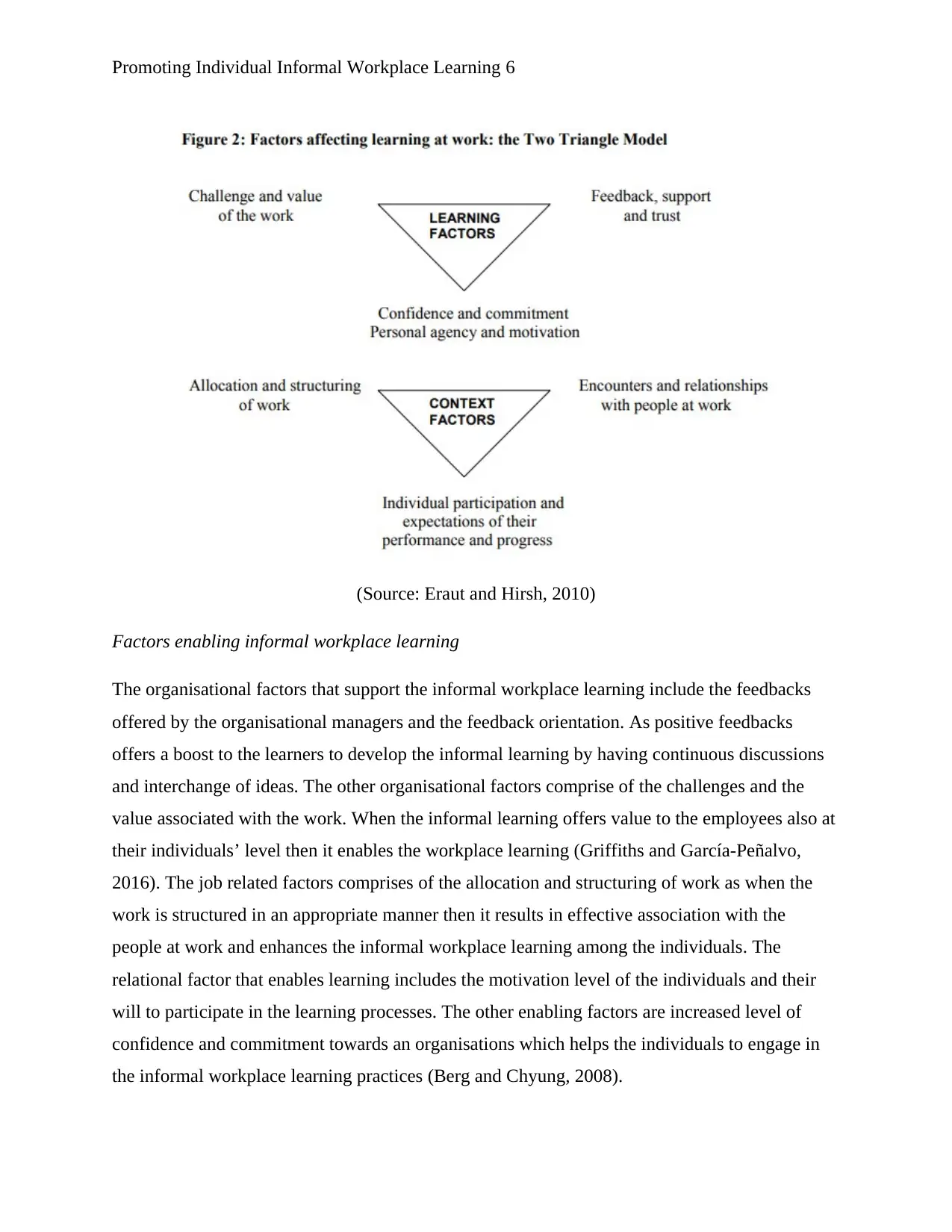
learning. These factors can be either intrinsic or extrinsic. The learning and the context factors
that influences the informal workplace learning can be broadly categorized in three segments i.e.
the organisational factors, relational factor and job related factors. All these factors affect the
effectiveness of the informal learning (Tynjälä, 2008).
individual learning, the best way is reflection as self-reflection is when one learns from oneself
(Webb, 2006). Reflections helps in analysing one’s own performance with critical lenses which
help the individuals in analysing what has learned with the task, what are the limitations and
what all can be improved (Hager, 2011). With such an informal learning, the individuals trend to
understand their weaker segments of performance by themselves that both enhances their
motivation as well as learning power. The next most significant and vital informal learning way
are experiences i.e. learning from others’ work or experience as in at the workplace there are
several other senior employees or peers who have experience a similar situation in the past
working experience and they can help the new learners or other individuals by sharing their
experiences with them. This results in effective flow of communication among the employees
and achieving more improved informal learning (Eraut, 2004).
Factors enabling or constraining informal workplace learning
There are several factors at the workplaces that enable or constrain the informal workplace
learning. These factors can be either intrinsic or extrinsic. The learning and the context factors
that influences the informal workplace learning can be broadly categorized in three segments i.e.
the organisational factors, relational factor and job related factors. All these factors affect the
effectiveness of the informal learning (Tynjälä, 2008).
Promoting Individual Informal Workplace Learning 6
(Source: Eraut and Hirsh, 2010)
Factors enabling informal workplace learning
The organisational factors that support the informal workplace learning include the feedbacks
offered by the organisational managers and the feedback orientation. As positive feedbacks
offers a boost to the learners to develop the informal learning by having continuous discussions
and interchange of ideas. The other organisational factors comprise of the challenges and the
value associated with the work. When the informal learning offers value to the employees also at
their individuals’ level then it enables the workplace learning (Griffiths and García-Peñalvo,
2016). The job related factors comprises of the allocation and structuring of work as when the
work is structured in an appropriate manner then it results in effective association with the
people at work and enhances the informal workplace learning among the individuals. The
relational factor that enables learning includes the motivation level of the individuals and their
will to participate in the learning processes. The other enabling factors are increased level of
confidence and commitment towards an organisations which helps the individuals to engage in
the informal workplace learning practices (Berg and Chyung, 2008).
(Source: Eraut and Hirsh, 2010)
Factors enabling informal workplace learning
The organisational factors that support the informal workplace learning include the feedbacks
offered by the organisational managers and the feedback orientation. As positive feedbacks
offers a boost to the learners to develop the informal learning by having continuous discussions
and interchange of ideas. The other organisational factors comprise of the challenges and the
value associated with the work. When the informal learning offers value to the employees also at
their individuals’ level then it enables the workplace learning (Griffiths and García-Peñalvo,
2016). The job related factors comprises of the allocation and structuring of work as when the
work is structured in an appropriate manner then it results in effective association with the
people at work and enhances the informal workplace learning among the individuals. The
relational factor that enables learning includes the motivation level of the individuals and their
will to participate in the learning processes. The other enabling factors are increased level of
confidence and commitment towards an organisations which helps the individuals to engage in
the informal workplace learning practices (Berg and Chyung, 2008).
⊘ This is a preview!⊘
Do you want full access?
Subscribe today to unlock all pages.
Trusted by 1+ million students worldwide
Promoting Individual Informal Workplace Learning 7
Factors constraining informal workplace learning
There are also some of the factors that constrain the informal workplace learning such as the
negative organisational climate, insufficient timed to engage in such activities, less
encouragement ands support from the organisational key persons, decreased level of involvement
and motivation of the employees, decreased self-awareness regarding the important e of informal
workplace learning and fear of receiving a negative feedback which can deteriorate the public
image and self-esteem of the individuals (Noe, Tews and Marand, 2013).
Influence of individual characteristics on the effectiveness of informal workplace
learning
There is a strong influence of the personal characteristics of the individuals on the effectiveness
of informal workplace learning in the form of making decisions, communicating with others and
behaving in the organisations. The personal characteristics if the individuals comprises of
educational background, age, experience, motivational level, etc. All these factors influence the
degree of engagement of the individuals in the informal workplace learning (Le Clus, 2011). The
influence of age of the individuals can be analysed as it is identified that the younger ones in the
organisations are more likely to have their engagement in the formal learning rather than in the
informal learning because of the aspects such as they are new as well as want to gain more
knowledge through the formal trainings and coaching offered to them as the organisational
practices. On the other hand it is seen that, the older ones are more focused to have informal
learning in the organisations because of the reason that they have gained much experience from
the past working experiences and they want to share it with others as an informal learning. Thus,
from individual perspectives these factors affect the informal workplace learning (Tannenbaum,
et al., 2010). The other individual characteristics are gender, culture and educational background.
the individuals with enhanced level of qualification and high educational profile are much likely
to have an informal learning as a fact that they try to have discussions on several topics and
concerned areas of tasks but kin the other hand individuals with less knowledge proficiency try
to escape such discussion because of less involvement and they prefer the formal trainings more
in comparison with the informal workplace learning (Mezirow and Taylor, 2011). The diversity
in the culture also restrict individuals to have their participation in the informal learning as when
the individuals are of diverse culture then they have a sense of shyness or feel uncomfortable to
Factors constraining informal workplace learning
There are also some of the factors that constrain the informal workplace learning such as the
negative organisational climate, insufficient timed to engage in such activities, less
encouragement ands support from the organisational key persons, decreased level of involvement
and motivation of the employees, decreased self-awareness regarding the important e of informal
workplace learning and fear of receiving a negative feedback which can deteriorate the public
image and self-esteem of the individuals (Noe, Tews and Marand, 2013).
Influence of individual characteristics on the effectiveness of informal workplace
learning
There is a strong influence of the personal characteristics of the individuals on the effectiveness
of informal workplace learning in the form of making decisions, communicating with others and
behaving in the organisations. The personal characteristics if the individuals comprises of
educational background, age, experience, motivational level, etc. All these factors influence the
degree of engagement of the individuals in the informal workplace learning (Le Clus, 2011). The
influence of age of the individuals can be analysed as it is identified that the younger ones in the
organisations are more likely to have their engagement in the formal learning rather than in the
informal learning because of the aspects such as they are new as well as want to gain more
knowledge through the formal trainings and coaching offered to them as the organisational
practices. On the other hand it is seen that, the older ones are more focused to have informal
learning in the organisations because of the reason that they have gained much experience from
the past working experiences and they want to share it with others as an informal learning. Thus,
from individual perspectives these factors affect the informal workplace learning (Tannenbaum,
et al., 2010). The other individual characteristics are gender, culture and educational background.
the individuals with enhanced level of qualification and high educational profile are much likely
to have an informal learning as a fact that they try to have discussions on several topics and
concerned areas of tasks but kin the other hand individuals with less knowledge proficiency try
to escape such discussion because of less involvement and they prefer the formal trainings more
in comparison with the informal workplace learning (Mezirow and Taylor, 2011). The diversity
in the culture also restrict individuals to have their participation in the informal learning as when
the individuals are of diverse culture then they have a sense of shyness or feel uncomfortable to
Paraphrase This Document
Need a fresh take? Get an instant paraphrase of this document with our AI Paraphraser
Promoting Individual Informal Workplace Learning 8
involve in informal discussions at the workplaces and the reasons can be the language related
issue, etc. At few organisations, the one of the individual characteristic could also be gender
related factor as male employees also restrict them to have an informal learning or discussions
with female employees and vice versa. And thus, it results in barricades to the effective informal
workplace learning (Manuti, et al., 2015).
Potential benefits for individuals and the organisation of increased informal
workplace learning
The scope and significance of informal learning is widening day by day and specially in the
organisational workplaces. There are several potential benefits of informal workplace learning
which help the organisations to attain various competitive benefits. The first benefit of informal
learning is that it is less threatening and more relaxing for many of the individuals to learn
informally as they do not possess a threat of negative feedbacks or other unconstructive
comments of the performance evaluation (Noe, Clarke and Klein, 2014). In an informal
workplace learning, there is enhanced level of information sharing as people or the experts share
their knowledge and experience with the individuals which resolves the queries and issues of the
individuals which is not possible in the formal learning without having formal meetings or
learning sessions for the same. The most significant aspect of informal learning for all types of
organisations whether small, medium or large scale is that there are no cost and time related
barriers which restricts the learning practices to execute at the workplaces. Because of the
involvement and participation of the organisational employees only, there is no need of outside
trainings and thus the organisations do not have to invest capital on such trainings which saves
their lot of cost. Thus, even the small scale enterprises can also achieve competitive benefits and
effective learning by the means of informal workplace learning. Another benefit of informal
workplace learning is that it is faster and just-in-time. The informal learning can take placed
whenever required by the organisation or the individuals and have an immediate use (Marsick
and Watkins, 2015). Witching minutes the information is passed on and the work can be
continuing and this result in faster flow of information and accomplishment of the tasks. Other
potential benefits are that the informal workplace learning is customized as well as flexible in
nature as it is a self-directed aspect. For meeting the specific needs of the individuals informal
workplace learning is highly effective. It is customized as there are different requirement and
involve in informal discussions at the workplaces and the reasons can be the language related
issue, etc. At few organisations, the one of the individual characteristic could also be gender
related factor as male employees also restrict them to have an informal learning or discussions
with female employees and vice versa. And thus, it results in barricades to the effective informal
workplace learning (Manuti, et al., 2015).
Potential benefits for individuals and the organisation of increased informal
workplace learning
The scope and significance of informal learning is widening day by day and specially in the
organisational workplaces. There are several potential benefits of informal workplace learning
which help the organisations to attain various competitive benefits. The first benefit of informal
learning is that it is less threatening and more relaxing for many of the individuals to learn
informally as they do not possess a threat of negative feedbacks or other unconstructive
comments of the performance evaluation (Noe, Clarke and Klein, 2014). In an informal
workplace learning, there is enhanced level of information sharing as people or the experts share
their knowledge and experience with the individuals which resolves the queries and issues of the
individuals which is not possible in the formal learning without having formal meetings or
learning sessions for the same. The most significant aspect of informal learning for all types of
organisations whether small, medium or large scale is that there are no cost and time related
barriers which restricts the learning practices to execute at the workplaces. Because of the
involvement and participation of the organisational employees only, there is no need of outside
trainings and thus the organisations do not have to invest capital on such trainings which saves
their lot of cost. Thus, even the small scale enterprises can also achieve competitive benefits and
effective learning by the means of informal workplace learning. Another benefit of informal
workplace learning is that it is faster and just-in-time. The informal learning can take placed
whenever required by the organisation or the individuals and have an immediate use (Marsick
and Watkins, 2015). Witching minutes the information is passed on and the work can be
continuing and this result in faster flow of information and accomplishment of the tasks. Other
potential benefits are that the informal workplace learning is customized as well as flexible in
nature as it is a self-directed aspect. For meeting the specific needs of the individuals informal
workplace learning is highly effective. It is customized as there are different requirement and
Promoting Individual Informal Workplace Learning 9
need of different individuals and the informal learning try to meet all those needs through
tailored learning. Thus, all such benefits of informal workplace learning help both the employees
as well as the organisations to have more improved quantity and quality of learning through
work (De Grip, 2015).
Conclusion
Informal workplace learning is acknowledged and recognized as a more significant approach to
enhance the workplace learning from past few years. From the in-depth analysis and effective
evaluation of the practice of informal workplace learning, it can be concluded that it is one of the
best practices which can be implemented by the small scale organisations who cannot afford
much expensive formal trainings to be offered to the employees. The report has stated numerous
positive and potential advantages of informal workplace learning and also number of ways which
can be used by the individuals to learn at the workplace. All these factors are required to have a
positive approach to help the individuals to have their increased engagement in the informal
workplace learning. From the report, it has also concluded that there are factor that enables as
well as constrain the informal workplace learning and the organisations are required to have
focus on the implementation of the enabling factor and elimination of the constraining factor so
that more enhanced level of informal workplace learning could take place. It has also been
analysed and concluded that there is also a significant role of the personal characteristics in
having engagement in the learning practices and activities and thus it is essential that such
factors must also be considered accordingly while executive such informal workplace learning in
the organisations.
Recommendations
Based upon the analysis of the literature, there are few recommendations for enhancing informal
learning within the organisation:
Firstly it is recommended that the informal workplace learning must be aligned with
culture of the workplace. In the processes and the goals of workplace learning, the
challenges, opportunities, nature and the strategic direction of the businesses must be
reflected. It is also essential that the informal workplace learning must be resourced in
need of different individuals and the informal learning try to meet all those needs through
tailored learning. Thus, all such benefits of informal workplace learning help both the employees
as well as the organisations to have more improved quantity and quality of learning through
work (De Grip, 2015).
Conclusion
Informal workplace learning is acknowledged and recognized as a more significant approach to
enhance the workplace learning from past few years. From the in-depth analysis and effective
evaluation of the practice of informal workplace learning, it can be concluded that it is one of the
best practices which can be implemented by the small scale organisations who cannot afford
much expensive formal trainings to be offered to the employees. The report has stated numerous
positive and potential advantages of informal workplace learning and also number of ways which
can be used by the individuals to learn at the workplace. All these factors are required to have a
positive approach to help the individuals to have their increased engagement in the informal
workplace learning. From the report, it has also concluded that there are factor that enables as
well as constrain the informal workplace learning and the organisations are required to have
focus on the implementation of the enabling factor and elimination of the constraining factor so
that more enhanced level of informal workplace learning could take place. It has also been
analysed and concluded that there is also a significant role of the personal characteristics in
having engagement in the learning practices and activities and thus it is essential that such
factors must also be considered accordingly while executive such informal workplace learning in
the organisations.
Recommendations
Based upon the analysis of the literature, there are few recommendations for enhancing informal
learning within the organisation:
Firstly it is recommended that the informal workplace learning must be aligned with
culture of the workplace. In the processes and the goals of workplace learning, the
challenges, opportunities, nature and the strategic direction of the businesses must be
reflected. It is also essential that the informal workplace learning must be resourced in
⊘ This is a preview!⊘
Do you want full access?
Subscribe today to unlock all pages.
Trusted by 1+ million students worldwide
Promoting Individual Informal Workplace Learning 10
an adequate manner with right tools and right people so that it can execute in an
effective manner.
The second recommendation is that the informal workplace learning must be tailored
and customized. This is recommended because of the reason that the formal trainings
are single approached which has a common direction that is required to be followed by
all the employees. But in an organisation, there are diverse need and requirements and
thus for managing those specific learning requirements, it is essential that the informal
learning, must be customised and training must be offered as per the needs of the
individuals so that they can have faster learning and development (Vaughan, 2008).
The informal workplace learning must be based upon the idea of lifelong learning so
that whenever there is a need or requirement for any such learning, it can immediately
take place and having informal learning only for a period is not supportive s with more
experienced and time, there is essential need of the informal workplace learning to
develop a collaborative working environment where the peers or the experienced
individuals can share their experiences with the new joiners and make tem comfortable
with the new practices and organisational work. Thus, it is recommended that informal
workplace learning must be a continuous practice at the workplaces (Le Clus, 2011).
It is recommended that there must be taken use of adequate and right pedagogical
approaches while having informal workplace learning as well as there must be
individual support offered to the employees by the means of positive and enriched
feedbacks and open ended discussion where the individuals can also give their opinions
and participate effectively in the discussions. It is also essential that there must be an
integration of the formal and the informal learning as both the learning are equally
important for the organisations and thus, it is essential that the goals and objectives of
informal and formal must be same (Milligan, Littlejohn and Margaryan, 2014).
an adequate manner with right tools and right people so that it can execute in an
effective manner.
The second recommendation is that the informal workplace learning must be tailored
and customized. This is recommended because of the reason that the formal trainings
are single approached which has a common direction that is required to be followed by
all the employees. But in an organisation, there are diverse need and requirements and
thus for managing those specific learning requirements, it is essential that the informal
learning, must be customised and training must be offered as per the needs of the
individuals so that they can have faster learning and development (Vaughan, 2008).
The informal workplace learning must be based upon the idea of lifelong learning so
that whenever there is a need or requirement for any such learning, it can immediately
take place and having informal learning only for a period is not supportive s with more
experienced and time, there is essential need of the informal workplace learning to
develop a collaborative working environment where the peers or the experienced
individuals can share their experiences with the new joiners and make tem comfortable
with the new practices and organisational work. Thus, it is recommended that informal
workplace learning must be a continuous practice at the workplaces (Le Clus, 2011).
It is recommended that there must be taken use of adequate and right pedagogical
approaches while having informal workplace learning as well as there must be
individual support offered to the employees by the means of positive and enriched
feedbacks and open ended discussion where the individuals can also give their opinions
and participate effectively in the discussions. It is also essential that there must be an
integration of the formal and the informal learning as both the learning are equally
important for the organisations and thus, it is essential that the goals and objectives of
informal and formal must be same (Milligan, Littlejohn and Margaryan, 2014).
Paraphrase This Document
Need a fresh take? Get an instant paraphrase of this document with our AI Paraphraser
Promoting Individual Informal Workplace Learning 11
References
Berg, S. A., & Chyung, S. Y. (2008). Factors that influence informal learning in the
workplace. Journal of workplace learning, 20(4), 229-244.
Choi, W., & Jacobs, R. L. (2011). Influences of formal learning, personal learning orientation,
and supportive learning environment on informal learning. Human Resource
Development Quarterly, 22(3), 239-257.
Cross, J. (2011). Informal learning: Rediscovering the natural pathways that inspire innovation
and performance. John Wiley & Sons.
De Grip, A. (2015). The importance of informal learning at work. IZA World of Labor.
Ellström, P. E. (2011). Informal learning at work: Conditions, processes and logics. The Sage
handbook of workplace learning, 105-119.
Eraut*, M. (2004). Informal learning in the workplace. Studies in continuing education, 26(2),
247-273.
Eraut, M., & Hirsh, W. (2010). The significance of workplace learning for individuals, groups
and organisations.
Griffiths, D., & García-Peñalvo, F. J. (2016). Informal learning recognition and management.
Hager, P. (2011). Theories of workplace learning. The Sage handbook of workplace learning, 17-
31.
Le Clus, M. (2011). Informal learning in the workplace: a review of the literature. Australian
Journal of Adult Learning, 51(2), 355.
Ley, T., Cook, J., Dennerlein, S., Kravcik, M., Kunzmann, C., Laanpere, M., ... & Schmidt, A.
(2013, September). Scaling informal learning: An integrative systems view on
scaffolding at the workplace. In European Conference on Technology Enhanced
Learning (pp. 484-489). Springer, Berlin, Heidelberg.
References
Berg, S. A., & Chyung, S. Y. (2008). Factors that influence informal learning in the
workplace. Journal of workplace learning, 20(4), 229-244.
Choi, W., & Jacobs, R. L. (2011). Influences of formal learning, personal learning orientation,
and supportive learning environment on informal learning. Human Resource
Development Quarterly, 22(3), 239-257.
Cross, J. (2011). Informal learning: Rediscovering the natural pathways that inspire innovation
and performance. John Wiley & Sons.
De Grip, A. (2015). The importance of informal learning at work. IZA World of Labor.
Ellström, P. E. (2011). Informal learning at work: Conditions, processes and logics. The Sage
handbook of workplace learning, 105-119.
Eraut*, M. (2004). Informal learning in the workplace. Studies in continuing education, 26(2),
247-273.
Eraut, M., & Hirsh, W. (2010). The significance of workplace learning for individuals, groups
and organisations.
Griffiths, D., & García-Peñalvo, F. J. (2016). Informal learning recognition and management.
Hager, P. (2011). Theories of workplace learning. The Sage handbook of workplace learning, 17-
31.
Le Clus, M. (2011). Informal learning in the workplace: a review of the literature. Australian
Journal of Adult Learning, 51(2), 355.
Ley, T., Cook, J., Dennerlein, S., Kravcik, M., Kunzmann, C., Laanpere, M., ... & Schmidt, A.
(2013, September). Scaling informal learning: An integrative systems view on
scaffolding at the workplace. In European Conference on Technology Enhanced
Learning (pp. 484-489). Springer, Berlin, Heidelberg.
Promoting Individual Informal Workplace Learning 12
Manuti, A., Pastore, S., Scardigno, A. F., Giancaspro, M. L., & Morciano, D. (2015). Formal and
informal learning in the workplace: a research review. International Journal of Training
and Development, 19(1), 1-17.
Marsick, V. J., & Watkins, K. (2015). Informal and Incidental Learning in the Workplace
(Routledge Revivals). Routledge.
Mezirow, J., & Taylor, E. W. (Eds.). (2011). Transformative learning in practice: Insights from
community, workplace, and higher education. John Wiley & Sons.
Milligan, C., Littlejohn, A., & Margaryan, A. (2014). Workplace learning in informal
networks. Reusing Open Resources: Learning in Open Networks for Work, Life and
Education, 93.
Noe, R. A., Clarke, A. D., & Klein, H. J. (2014). Learning in the twenty-first-century
workplace. Annu. Rev. Organ. Psychol. Organ. Behav., 1(1), 245-275.
Noe, R. A., Tews, M. J., & Marand, A. D. (2013). Individual differences and informal learning in
the workplace. Journal of Vocational Behavior, 83(3), 327-335.
Tannenbaum, S. I., Beard, R. L., McNall, L. A., & Salas, E. (2010). Informal learning and
development in organizations. Learning, training, and development in organizations,
303-332.
Tynjälä, P. (2008). Perspectives into learning at the workplace. Educational research
review, 3(2), 130-154.
Vaughan, K. (2008). Workplace learning: A literature review.
Webb, L. (2006). Learning by doing. Development and Learning in Organizations: An
International Journal, 20(5).
Manuti, A., Pastore, S., Scardigno, A. F., Giancaspro, M. L., & Morciano, D. (2015). Formal and
informal learning in the workplace: a research review. International Journal of Training
and Development, 19(1), 1-17.
Marsick, V. J., & Watkins, K. (2015). Informal and Incidental Learning in the Workplace
(Routledge Revivals). Routledge.
Mezirow, J., & Taylor, E. W. (Eds.). (2011). Transformative learning in practice: Insights from
community, workplace, and higher education. John Wiley & Sons.
Milligan, C., Littlejohn, A., & Margaryan, A. (2014). Workplace learning in informal
networks. Reusing Open Resources: Learning in Open Networks for Work, Life and
Education, 93.
Noe, R. A., Clarke, A. D., & Klein, H. J. (2014). Learning in the twenty-first-century
workplace. Annu. Rev. Organ. Psychol. Organ. Behav., 1(1), 245-275.
Noe, R. A., Tews, M. J., & Marand, A. D. (2013). Individual differences and informal learning in
the workplace. Journal of Vocational Behavior, 83(3), 327-335.
Tannenbaum, S. I., Beard, R. L., McNall, L. A., & Salas, E. (2010). Informal learning and
development in organizations. Learning, training, and development in organizations,
303-332.
Tynjälä, P. (2008). Perspectives into learning at the workplace. Educational research
review, 3(2), 130-154.
Vaughan, K. (2008). Workplace learning: A literature review.
Webb, L. (2006). Learning by doing. Development and Learning in Organizations: An
International Journal, 20(5).
⊘ This is a preview!⊘
Do you want full access?
Subscribe today to unlock all pages.
Trusted by 1+ million students worldwide

1 out of 12


Related Documents


Your All-in-One AI-Powered Toolkit for Academic Success.
+13062052269
info@desklib.com
Available 24*7 on WhatsApp / Email
![[object Object]](/_next/static/media/star-bottom.7253800d.svg)
Unlock your academic potential
Copyright © 2020–2026 A2Z Services. All Rights Reserved. Developed and managed by ZUCOL.