Informal Learning and Workplace Development: A Report
VerifiedAdded on 2022/09/23
|15
|4027
|26
Report
AI Summary
This report delves into the multifaceted aspects of informal learning within a workplace context. It begins by defining informal learning and differentiating it from structured, formal learning environments, emphasizing its unstructured, self-directed nature. The report investigates various informal learning behaviors, including mentoring, networking, and job rotation, and explores theories such as situated, social, and experiential learning. It examines the influence of individual characteristics, such as age and personality traits, on informal learning processes. Furthermore, the report analyzes workplace factors like employee engagement, changes in work methods, and feedback mechanisms that enable and promote informal learning. The benefits of informal learning for both employees and organizations are discussed, along with its limitations. The report concludes with recommendations aimed at optimizing the implementation and effectiveness of informal learning strategies within organizations, based on the evaluated literature.
Running Head: INFORMAL LEARNING BEHAVIOUR 1
INFORMAL LEARNING BEHAVIOUR
Student Name:
Student Number:
INFORMAL LEARNING BEHAVIOUR
Student Name:
Student Number:

Paraphrase This Document
Need a fresh take? Get an instant paraphrase of this document with our AI Paraphraser
INFORMAL LEARNING BEHAVIOUR 2
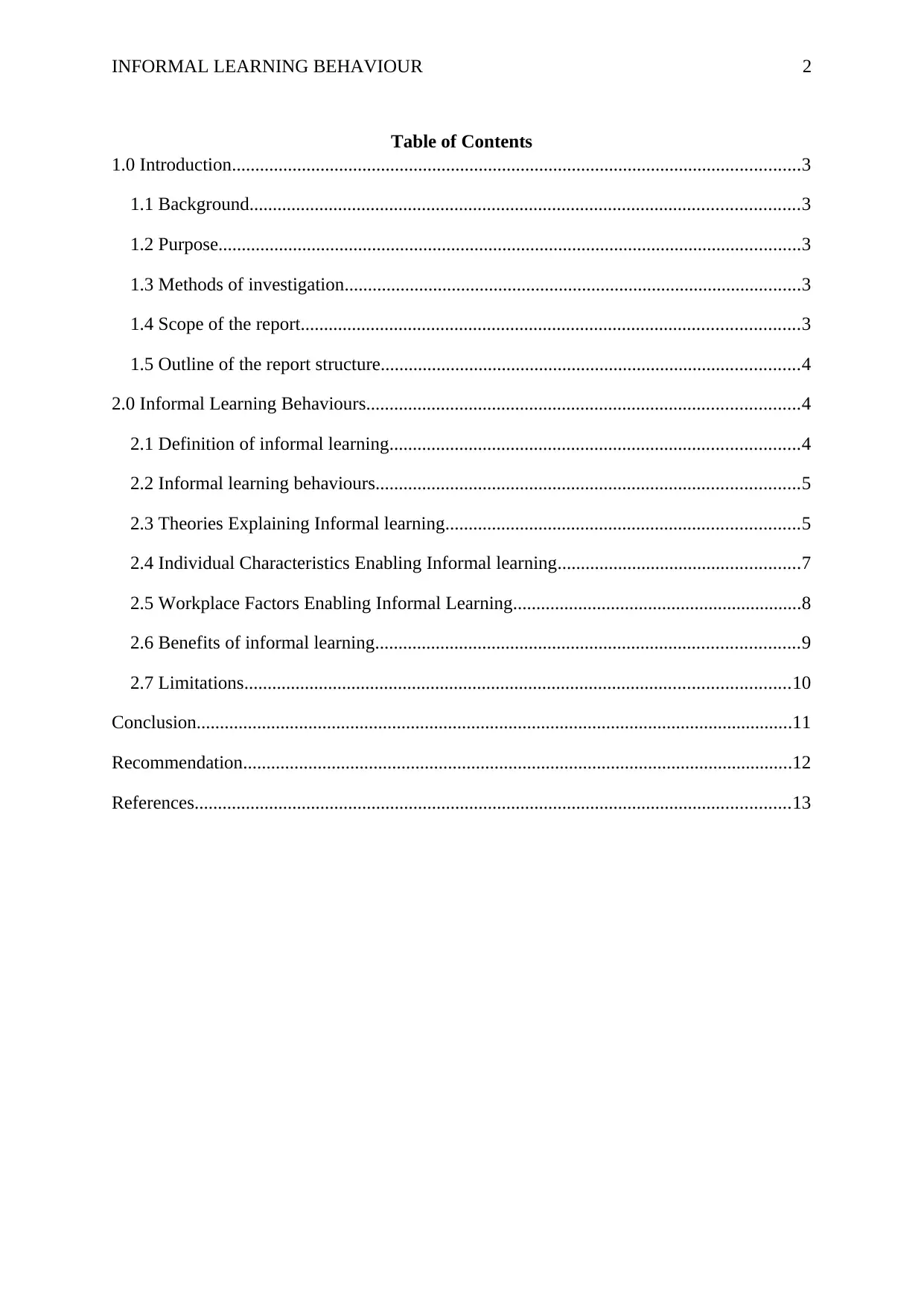
Table of Contents
1.0 Introduction..........................................................................................................................3
1.1 Background......................................................................................................................3
1.2 Purpose.............................................................................................................................3
1.3 Methods of investigation..................................................................................................3
1.4 Scope of the report...........................................................................................................3
1.5 Outline of the report structure..........................................................................................4
2.0 Informal Learning Behaviours.............................................................................................4
2.1 Definition of informal learning........................................................................................4
2.2 Informal learning behaviours...........................................................................................5
2.3 Theories Explaining Informal learning............................................................................5
2.4 Individual Characteristics Enabling Informal learning....................................................7
2.5 Workplace Factors Enabling Informal Learning..............................................................8
2.6 Benefits of informal learning...........................................................................................9
2.7 Limitations.....................................................................................................................10
Conclusion................................................................................................................................11
Recommendation......................................................................................................................12
References................................................................................................................................13
Table of Contents
1.0 Introduction..........................................................................................................................3
1.1 Background......................................................................................................................3
1.2 Purpose.............................................................................................................................3
1.3 Methods of investigation..................................................................................................3
1.4 Scope of the report...........................................................................................................3
1.5 Outline of the report structure..........................................................................................4
2.0 Informal Learning Behaviours.............................................................................................4
2.1 Definition of informal learning........................................................................................4
2.2 Informal learning behaviours...........................................................................................5
2.3 Theories Explaining Informal learning............................................................................5
2.4 Individual Characteristics Enabling Informal learning....................................................7
2.5 Workplace Factors Enabling Informal Learning..............................................................8
2.6 Benefits of informal learning...........................................................................................9
2.7 Limitations.....................................................................................................................10
Conclusion................................................................................................................................11
Recommendation......................................................................................................................12
References................................................................................................................................13
INFORMAL LEARNING BEHAVIOUR 3
1.0 Introduction
1.1 Background
Informal Learning is referred to the unstructured learnings that are unplanned and often
self-directed by the learner. The informal learnings are different from traditional and
educative classroom environments that require the time and expenses of the learner and the
organization. Informal learning is not structured like formal education learning programs. In
many scenarios, the individuals initiate learning through self-studying articles, viewing
videos, participating in forums. In informal learning, the goals and objectives are often set by
learners by itself.
1.2 Purpose
The purpose of the report aims to study the overall aspects of informal learning for
analyzing the impact of such learning outcomes on individuals and organizations. Informal
learning is cost-effective thus, its study will help the organizations using such a learning
method on employees for better performance. Informal learning behaviors include theories,
individual characteristics that further enable this type of learning (Galanis et al 2016). The
purpose of the report also aims to analyze workplace factors and benefits of informal learning
to employees and organizations. After the discussions on various aspects of the informal
learning, limitations and recommendations will also be given to obtaining an overall idea
about Informal learning in organizations.
1.3 Methods of investigation
This paper will undertake investigation of the topic by evaluating various literature
sources for the same. Each topic have been
1.4 Scope of the report
The report will discuss different aspects of informal learning that are definitions, theories,
factors like workplace and individual characteristics. The report will also analyze the
1.0 Introduction
1.1 Background
Informal Learning is referred to the unstructured learnings that are unplanned and often
self-directed by the learner. The informal learnings are different from traditional and
educative classroom environments that require the time and expenses of the learner and the
organization. Informal learning is not structured like formal education learning programs. In
many scenarios, the individuals initiate learning through self-studying articles, viewing
videos, participating in forums. In informal learning, the goals and objectives are often set by
learners by itself.
1.2 Purpose
The purpose of the report aims to study the overall aspects of informal learning for
analyzing the impact of such learning outcomes on individuals and organizations. Informal
learning is cost-effective thus, its study will help the organizations using such a learning
method on employees for better performance. Informal learning behaviors include theories,
individual characteristics that further enable this type of learning (Galanis et al 2016). The
purpose of the report also aims to analyze workplace factors and benefits of informal learning
to employees and organizations. After the discussions on various aspects of the informal
learning, limitations and recommendations will also be given to obtaining an overall idea
about Informal learning in organizations.
1.3 Methods of investigation
This paper will undertake investigation of the topic by evaluating various literature
sources for the same. Each topic have been
1.4 Scope of the report
The report will discuss different aspects of informal learning that are definitions, theories,
factors like workplace and individual characteristics. The report will also analyze the
⊘ This is a preview!⊘
Do you want full access?
Subscribe today to unlock all pages.

Trusted by 1+ million students worldwide
INFORMAL LEARNING BEHAVIOUR 4
limitations while recommendations will also be given for the negative impacts of informal
learning.
1.5 Outline of the report structure
The report will undertake literature evaluation to arrive at findings regarding information
learning behaviours. First exploration of definition of information learning will be undertaken
followed by theories exploration related to informal learning and individual characteristics
and workplace behaviour related to information learning have been established. Then
conclusion from all the theories have been drawn on the topic.
2.0 Informal Learning Behaviours
2.1 Definition of informal learning
Informal learning refers to unstructured learning through which the individuals develop
several skills. This type of learning does not comprise a formal structured curriculum that
includes instructors, exams and assignments (Boileau, 2017). It is a type of learning, that
occurs unconsciously each day during work hours. The informal learning helps us to learn
new things coping with dynamic work structure. It is often noticed that 90% of the thought
process is developed through the organic, unstructured and learner-driven learning initiative.
In recent times, many organizations are investing in the education of the employees.
However, the companies address that investing in formal education is expensive and time-
consuming. The formal training is limited to textual study or summary of the situation, thus
educative class learning cannot cope with the changing dynamic needs of the organizations.
Thus, informal learning may be defined as learning that takes place in the workplace relating
to the performance of their employability. The employer does not formalize it in an organized
curriculum or program and may not encourage the employee in this process. Thus, the
learning that takes place above the school walls can be termed as informal learning.
limitations while recommendations will also be given for the negative impacts of informal
learning.
1.5 Outline of the report structure
The report will undertake literature evaluation to arrive at findings regarding information
learning behaviours. First exploration of definition of information learning will be undertaken
followed by theories exploration related to informal learning and individual characteristics
and workplace behaviour related to information learning have been established. Then
conclusion from all the theories have been drawn on the topic.
2.0 Informal Learning Behaviours
2.1 Definition of informal learning
Informal learning refers to unstructured learning through which the individuals develop
several skills. This type of learning does not comprise a formal structured curriculum that
includes instructors, exams and assignments (Boileau, 2017). It is a type of learning, that
occurs unconsciously each day during work hours. The informal learning helps us to learn
new things coping with dynamic work structure. It is often noticed that 90% of the thought
process is developed through the organic, unstructured and learner-driven learning initiative.
In recent times, many organizations are investing in the education of the employees.
However, the companies address that investing in formal education is expensive and time-
consuming. The formal training is limited to textual study or summary of the situation, thus
educative class learning cannot cope with the changing dynamic needs of the organizations.
Thus, informal learning may be defined as learning that takes place in the workplace relating
to the performance of their employability. The employer does not formalize it in an organized
curriculum or program and may not encourage the employee in this process. Thus, the
learning that takes place above the school walls can be termed as informal learning.
Paraphrase This Document
Need a fresh take? Get an instant paraphrase of this document with our AI Paraphraser
INFORMAL LEARNING BEHAVIOUR 5
2.2 Informal learning behaviours
In the works of Wielenga-Meijer et al (2010), it was stated that job characteristics often
impact the learning processes of the employee. Thus, the author aimed to research on the
relationships among learning antecedents, learning processes and outcomes. It is crucial to
understand the factors that affect learning processes and outcomes need to be understood in
an appropriate manner. Therefore, after studying 85 articles the author concludes that
positive relationships prevailed amongst job autonomy, demands and metacognitive-
motivational learning processes. It was also established that learning outcomes had a positive
relationship with learning processes.
Many organizations work smartly and allow the employee to obtain knowledge through
informal learning and training at the workplace. Thus, working in a workplace with little
guidance helps the workforce to be responsible and independent that further raises the
performance. In this regard, mentoring is the most powerful informal training methods. It was
noticed that the employee who is mentored and supervised are 20% more productive than the
normal workforce. Additionally, networking has also been a successful method. In the
organization’s social media intranet and other networking channels help the employee in
sharing the knowledge. This promotes a healthy working environment while developing
expertise. In some organizations job rotation has been adopted for the overall development of
the employee. The workforce is given different job roles that help in obtaining knowledge
about various functions of the organizations.
2.3 Theories Explaining Informal learning
Many theories have been developed in recent times including situated, social and
experiential forms of learning. Situated learning is defined as learning from self. In this
regard, it can be said, individual as a whole, social communities become the part of the
learning process that involves participation in new activities, tasks, understandings that help
2.2 Informal learning behaviours
In the works of Wielenga-Meijer et al (2010), it was stated that job characteristics often
impact the learning processes of the employee. Thus, the author aimed to research on the
relationships among learning antecedents, learning processes and outcomes. It is crucial to
understand the factors that affect learning processes and outcomes need to be understood in
an appropriate manner. Therefore, after studying 85 articles the author concludes that
positive relationships prevailed amongst job autonomy, demands and metacognitive-
motivational learning processes. It was also established that learning outcomes had a positive
relationship with learning processes.
Many organizations work smartly and allow the employee to obtain knowledge through
informal learning and training at the workplace. Thus, working in a workplace with little
guidance helps the workforce to be responsible and independent that further raises the
performance. In this regard, mentoring is the most powerful informal training methods. It was
noticed that the employee who is mentored and supervised are 20% more productive than the
normal workforce. Additionally, networking has also been a successful method. In the
organization’s social media intranet and other networking channels help the employee in
sharing the knowledge. This promotes a healthy working environment while developing
expertise. In some organizations job rotation has been adopted for the overall development of
the employee. The workforce is given different job roles that help in obtaining knowledge
about various functions of the organizations.
2.3 Theories Explaining Informal learning
Many theories have been developed in recent times including situated, social and
experiential forms of learning. Situated learning is defined as learning from self. In this
regard, it can be said, individual as a whole, social communities become the part of the
learning process that involves participation in new activities, tasks, understandings that help
INFORMAL LEARNING BEHAVIOUR 6
to broaden the learning environment of the individuals. Mattar (2018) discussed situated
cognition included the importance of context and interaction process in the construction of
knowledge. Aspects like thinking, knowing and learning are situated in physical and social
contexts. Thus, knowledge is gained from the situation that arises which are partly supported
by the social interaction amongst the individuals. it is also said that that formal education
does not provide a solution to problems and crises (Lin and Lee, 2014). It can only learn
through the situations.
Situated involves concrete learning thus emphasizing the networks of social arrangements
and activities that include authentic practice. Thus, knowledge is located in the communities
which further deepens the learning process of individuals (Che and Ibrahim 2018). In this
context, we can say the learning process in the organizations depends on the participation of
employees in the working curriculum that further develops competency.
Social learning involves the knowledge gained from the social interaction amongst the
individuals in the community or the workplace. Gaining knowledge itself is a social process.
When individuals interact with each other they share information about their experiences in
life or work. This helps to gain information that is helpful in future situations. Social learning
is often self-driven involving the values like mutual respect and search for truth. It is noted
that socializing is an important tool for the well- being of humans while it also fosters
learning unconsciously. In the works of Che and Ibrahim (2018), it was discussed that in the
technology-driven world, social media tools contribute to the learning process of the
individual. However, it might be noted that interaction on digital platforms may not tailor the
person in the right direction.
Experiential learning focuses on the importance of the experiences in the construction of
knowledge. Thus, real-life experiences at the workplace and community drive the teaching
to broaden the learning environment of the individuals. Mattar (2018) discussed situated
cognition included the importance of context and interaction process in the construction of
knowledge. Aspects like thinking, knowing and learning are situated in physical and social
contexts. Thus, knowledge is gained from the situation that arises which are partly supported
by the social interaction amongst the individuals. it is also said that that formal education
does not provide a solution to problems and crises (Lin and Lee, 2014). It can only learn
through the situations.
Situated involves concrete learning thus emphasizing the networks of social arrangements
and activities that include authentic practice. Thus, knowledge is located in the communities
which further deepens the learning process of individuals (Che and Ibrahim 2018). In this
context, we can say the learning process in the organizations depends on the participation of
employees in the working curriculum that further develops competency.
Social learning involves the knowledge gained from the social interaction amongst the
individuals in the community or the workplace. Gaining knowledge itself is a social process.
When individuals interact with each other they share information about their experiences in
life or work. This helps to gain information that is helpful in future situations. Social learning
is often self-driven involving the values like mutual respect and search for truth. It is noted
that socializing is an important tool for the well- being of humans while it also fosters
learning unconsciously. In the works of Che and Ibrahim (2018), it was discussed that in the
technology-driven world, social media tools contribute to the learning process of the
individual. However, it might be noted that interaction on digital platforms may not tailor the
person in the right direction.
Experiential learning focuses on the importance of the experiences in the construction of
knowledge. Thus, real-life experiences at the workplace and community drive the teaching
⊘ This is a preview!⊘
Do you want full access?
Subscribe today to unlock all pages.
Trusted by 1+ million students worldwide
INFORMAL LEARNING BEHAVIOUR 7
and learning processes. The practical knowledge serves as the central ingredient to the
education of the individuals (Delahaye and Choy, 2018). Thus, in the educative environment
of the school simulation should provide valuable experiences that increase student
engagement while promoting deeper learning.
It can be noted that high expert knowledge can be gained through the everyday experience
from work, family, and community. To develop competency domain-specific knowledge that
forms the base of the learning experience at work (Chapter 3: Adult Learning). Thus, the
knowledge and experience are the learning process that is informal, unstructured and social.
2.4 Individual Characteristics Enabling Informal learning
The workplace comprises of the various individual with varied characteristics. It often
noted that demographic factor influences the informal learning process in the organizations.
Cerasoli et al (2018) stated that 70 to 90 % of ten organizational learning is an outcome of the
informal and learning. The author conducted primary research in which he analyzed the
Informal learning behaviors through research questions and outcomes using random-
effects meta-analysis (Tannenbaum et al,2010). Thus, it was noticed that personal and
situational antecedent factors proved to the positive predictive of informal learning behaviors.
In this regard, individual characteristics influence the learning process. For instance, the
younger generation of from aged 20 to 35 can capture new learnings easier than the middle-
aged humans. In the organizational set- up, the young employee is often energetic to learn
new aspects of their job. They socialize to gain expertise in the work. They are open new
experiments and thereby enhance their learning. Thus, it is seen that many of the managers at
the hierarchy level are young and motivating.
Noe, Tews, and Marand (2013) argued that informal learning in recent days is important
due to a dynamic and competitive business environment. Thus, the authors examined the
and learning processes. The practical knowledge serves as the central ingredient to the
education of the individuals (Delahaye and Choy, 2018). Thus, in the educative environment
of the school simulation should provide valuable experiences that increase student
engagement while promoting deeper learning.
It can be noted that high expert knowledge can be gained through the everyday experience
from work, family, and community. To develop competency domain-specific knowledge that
forms the base of the learning experience at work (Chapter 3: Adult Learning). Thus, the
knowledge and experience are the learning process that is informal, unstructured and social.
2.4 Individual Characteristics Enabling Informal learning
The workplace comprises of the various individual with varied characteristics. It often
noted that demographic factor influences the informal learning process in the organizations.
Cerasoli et al (2018) stated that 70 to 90 % of ten organizational learning is an outcome of the
informal and learning. The author conducted primary research in which he analyzed the
Informal learning behaviors through research questions and outcomes using random-
effects meta-analysis (Tannenbaum et al,2010). Thus, it was noticed that personal and
situational antecedent factors proved to the positive predictive of informal learning behaviors.
In this regard, individual characteristics influence the learning process. For instance, the
younger generation of from aged 20 to 35 can capture new learnings easier than the middle-
aged humans. In the organizational set- up, the young employee is often energetic to learn
new aspects of their job. They socialize to gain expertise in the work. They are open new
experiments and thereby enhance their learning. Thus, it is seen that many of the managers at
the hierarchy level are young and motivating.
Noe, Tews, and Marand (2013) argued that informal learning in recent days is important
due to a dynamic and competitive business environment. Thus, the authors examined the
Paraphrase This Document
Need a fresh take? Get an instant paraphrase of this document with our AI Paraphraser
INFORMAL LEARNING BEHAVIOUR 8
informal learning process on the individual’s characteristics through the Big five personality
factors, generalized self-efficacy, and zest. The research was conducted through the
collection of primary data on 180 managers. The participant's managers owned and operated
casual theme restaurants and participated in online tests on individual differences and
informal learning. The results stated that individual difference has a significant relationship
with informal methods of learning. It was noted that when all the individual difference was
analyzed generalized zest was the significant analytical of informal learning. Another study
by Lai and Wu (2011) investigated informal learning involving Taiwanese adults aged 16-97.
The participants were selected and examined considering the socio-demographic
characteristics. The research was conducted on 10000 adults of Taiwan and the results
showed that informal learning differed among various age groups of the people. The adults in
Taiwan preferred informal learning in the workplace through interpersonal communications
and sharing of knowledge.
2.5 Workplace Factors Enabling Informal Learning
The individual working in the individual often expertise through informal training. Many
of the small business units with low capital cannot invest in structured formal education thus
adopt informal education for its employees (Skule, 2004). In the work of Billett (2004), was
the concept of formal learning was argued. It was said that apart from the schools and
structured formal learning. Informal learning from organizations should also be considered.
The organizations have a set of rules and norms for their survival in the industry. The
individual workers also adopt practices to follow these rules. Thus, the workplace as a
learning environment is considered to be complex while putting a question for the learner’s
participation in the work activities.
Individual engagement is one of the factors for enabling informal learning. Individuals are
engaged in work activities that promote learning. Many of the organizations do not practice
informal learning process on the individual’s characteristics through the Big five personality
factors, generalized self-efficacy, and zest. The research was conducted through the
collection of primary data on 180 managers. The participant's managers owned and operated
casual theme restaurants and participated in online tests on individual differences and
informal learning. The results stated that individual difference has a significant relationship
with informal methods of learning. It was noted that when all the individual difference was
analyzed generalized zest was the significant analytical of informal learning. Another study
by Lai and Wu (2011) investigated informal learning involving Taiwanese adults aged 16-97.
The participants were selected and examined considering the socio-demographic
characteristics. The research was conducted on 10000 adults of Taiwan and the results
showed that informal learning differed among various age groups of the people. The adults in
Taiwan preferred informal learning in the workplace through interpersonal communications
and sharing of knowledge.
2.5 Workplace Factors Enabling Informal Learning
The individual working in the individual often expertise through informal training. Many
of the small business units with low capital cannot invest in structured formal education thus
adopt informal education for its employees (Skule, 2004). In the work of Billett (2004), was
the concept of formal learning was argued. It was said that apart from the schools and
structured formal learning. Informal learning from organizations should also be considered.
The organizations have a set of rules and norms for their survival in the industry. The
individual workers also adopt practices to follow these rules. Thus, the workplace as a
learning environment is considered to be complex while putting a question for the learner’s
participation in the work activities.
Individual engagement is one of the factors for enabling informal learning. Individuals are
engaged in work activities that promote learning. Many of the organizations do not practice
INFORMAL LEARNING BEHAVIOUR 9
formal education but support the employee in informal learning. Organizations either help
the employee either mentorship or through social interactions in the form of training, external
duties to different branches and others. These facilities help the employee to grasp the skill
much faster than the formal structured classes. Nikolova (2014) discussed that exposure to
changes also thrifts informal learning in the workplace. In this case, the firms frequently
change their working method, products or technology. This enables the employee to adjust in
alignment with the business requirements. However, this method of informal learning some
of the employees with high intellect will be able to expertise while others may struggle to
learn new methods.
It is said that feedback is important for improving the current scenario and move towards
the path of growth. Thus, some firm’s feedback from the supervisor is also graded for each
task performed. This motivates the workforce as they get the results of their hard work.
Coetzer, Kock, and Wallo (2017) also said that incentives and rewards are also helpful in
fostering informal learning in the workplace. To achieve the incentive, the employee works
out different methods for the achievement of the target, thus instead of incentive, learning is
fostered.
The participation of the employee in the external opportunities of organizations like trade
fairs conferences, professional forums dealing with clients and other occupational networks
also results in informal learning. Thus, it can be said that in the workplace scenario, the
workers are engaged in several environments through which they learn to survive in various
situation s. The employee may not acknowledge the conscious learning accompanied by the
experience and participation in the workplace activities.
2.6 Benefits of informal learning
Conducted secondary research in the learning potential of the workplace which provides
solid evidence for the significance of the learning in the workplace scenario. It has been said
formal education but support the employee in informal learning. Organizations either help
the employee either mentorship or through social interactions in the form of training, external
duties to different branches and others. These facilities help the employee to grasp the skill
much faster than the formal structured classes. Nikolova (2014) discussed that exposure to
changes also thrifts informal learning in the workplace. In this case, the firms frequently
change their working method, products or technology. This enables the employee to adjust in
alignment with the business requirements. However, this method of informal learning some
of the employees with high intellect will be able to expertise while others may struggle to
learn new methods.
It is said that feedback is important for improving the current scenario and move towards
the path of growth. Thus, some firm’s feedback from the supervisor is also graded for each
task performed. This motivates the workforce as they get the results of their hard work.
Coetzer, Kock, and Wallo (2017) also said that incentives and rewards are also helpful in
fostering informal learning in the workplace. To achieve the incentive, the employee works
out different methods for the achievement of the target, thus instead of incentive, learning is
fostered.
The participation of the employee in the external opportunities of organizations like trade
fairs conferences, professional forums dealing with clients and other occupational networks
also results in informal learning. Thus, it can be said that in the workplace scenario, the
workers are engaged in several environments through which they learn to survive in various
situation s. The employee may not acknowledge the conscious learning accompanied by the
experience and participation in the workplace activities.
2.6 Benefits of informal learning
Conducted secondary research in the learning potential of the workplace which provides
solid evidence for the significance of the learning in the workplace scenario. It has been said
⊘ This is a preview!⊘
Do you want full access?
Subscribe today to unlock all pages.
Trusted by 1+ million students worldwide
INFORMAL LEARNING BEHAVIOUR 10
that many years of working individual is spent in the organizational work. Thus, the firm
offers several situations or workplace activities that thrift informal learning amongst the
employee. Informal learning is beneficial to the organization as well to the employee.
The informal learning is self-driven that is what and how to learn depends on the
individuals. Thus, without any mental stress or pressure to learn, the individual’s employee
can learn the content or the skills according to his/her interest. In other words, the learning is
not structured so the employee finds it interesting about new skills and working methods
(Galanis et al 2016). The informal learning process also helps the employee to broaden the
knowledge. In this scenario, if the employee researches themselves, they discover new
processes, thoughts, and learnings of the content, subject or work process. It is inexpensive
and has a long-lasting impact on the workers. The company does not invest in the formal
training session while allows the worker to learn through their job. This saves time and
money while the employee also retains the learnings as he has learned by himself.
To benefit the employee from participating in the learning process, the workplace is
designed in a way that thrifts learning. In such cases, forums, chat desk or face to face
interactions builds learning environment. In many cases, the mentors increase the
responsibility of the employee while guide and support them to complete the task (Zhang et
al 2018). Many multinational organizations under the employee's strengths and offer job
rotation according to their skill set. This helps the employee in understanding other functions
apart from his designated job that further increase his knowledge about the work process. It
has been noticed that changing job roles, work performance is boosted as the employee take
an interest in learning new paradigms.
2.7 Limitations
There are a few limitations to informal learning in organizations. It is mentioned that the
organizations should provide time for socialization for thrifting the culture of learning. Since
that many years of working individual is spent in the organizational work. Thus, the firm
offers several situations or workplace activities that thrift informal learning amongst the
employee. Informal learning is beneficial to the organization as well to the employee.
The informal learning is self-driven that is what and how to learn depends on the
individuals. Thus, without any mental stress or pressure to learn, the individual’s employee
can learn the content or the skills according to his/her interest. In other words, the learning is
not structured so the employee finds it interesting about new skills and working methods
(Galanis et al 2016). The informal learning process also helps the employee to broaden the
knowledge. In this scenario, if the employee researches themselves, they discover new
processes, thoughts, and learnings of the content, subject or work process. It is inexpensive
and has a long-lasting impact on the workers. The company does not invest in the formal
training session while allows the worker to learn through their job. This saves time and
money while the employee also retains the learnings as he has learned by himself.
To benefit the employee from participating in the learning process, the workplace is
designed in a way that thrifts learning. In such cases, forums, chat desk or face to face
interactions builds learning environment. In many cases, the mentors increase the
responsibility of the employee while guide and support them to complete the task (Zhang et
al 2018). Many multinational organizations under the employee's strengths and offer job
rotation according to their skill set. This helps the employee in understanding other functions
apart from his designated job that further increase his knowledge about the work process. It
has been noticed that changing job roles, work performance is boosted as the employee take
an interest in learning new paradigms.
2.7 Limitations
There are a few limitations to informal learning in organizations. It is mentioned that the
organizations should provide time for socialization for thrifting the culture of learning. Since
Paraphrase This Document
Need a fresh take? Get an instant paraphrase of this document with our AI Paraphraser
INFORMAL LEARNING BEHAVIOUR 11
employees of various mindsets are present, they might misuse the time for personal use. In
the mentorship form of learning, the employee may not abide by the techniques and guidance
given. On the other hand, their many employees who are reluctant to share the knowledge
thus, they might not help other employees in specializing right skills for the work.
The formal training processes are important in the initial days of joining as the company,
its norms and working process are new to the employee. In the initial days, informal learning
may result in grasping faulty techniques or the wrong information due to which the firm may
incur a loss. Additionally, the individual characteristic of each employee is different, thus few
may take more time to learn while others may succeed fast. In some cases, employees with a
low learning pace may be terminated or acknowledge by the firm for his efforts. In many
small organizations, the target is set high and delay in learning processes incurs a loss to the
firms. Thus, employers may not acknowledge the efforts of slow learners. This may lead to
workplace stress among the employee.
Conclusion
The formal learning processes involve the time, money and resources of the organization.
It becomes difficult for the employee to prepare for the exams, classes to be part of the formal
education. On the contrary, informal learning where not given importance earlier. In the
development of the world economy, the organization's requirements have become dynamic.
Thus, the importance of informal learning has been recognized by many researchers and
organizations. Informal learning is unstructured and self-driven. Informal learning depends
on situations, social interactions, and experiences of the individual. There are many
workplace factors like incentive policy, employee engagement and other factors that thrift
informal learning amongst the individual. Informal learning is inexpensive and self- driven
thus benefitting organizations. However, there are few limitations which state that some
employees of various mindsets are present, they might misuse the time for personal use. In
the mentorship form of learning, the employee may not abide by the techniques and guidance
given. On the other hand, their many employees who are reluctant to share the knowledge
thus, they might not help other employees in specializing right skills for the work.
The formal training processes are important in the initial days of joining as the company,
its norms and working process are new to the employee. In the initial days, informal learning
may result in grasping faulty techniques or the wrong information due to which the firm may
incur a loss. Additionally, the individual characteristic of each employee is different, thus few
may take more time to learn while others may succeed fast. In some cases, employees with a
low learning pace may be terminated or acknowledge by the firm for his efforts. In many
small organizations, the target is set high and delay in learning processes incurs a loss to the
firms. Thus, employers may not acknowledge the efforts of slow learners. This may lead to
workplace stress among the employee.
Conclusion
The formal learning processes involve the time, money and resources of the organization.
It becomes difficult for the employee to prepare for the exams, classes to be part of the formal
education. On the contrary, informal learning where not given importance earlier. In the
development of the world economy, the organization's requirements have become dynamic.
Thus, the importance of informal learning has been recognized by many researchers and
organizations. Informal learning is unstructured and self-driven. Informal learning depends
on situations, social interactions, and experiences of the individual. There are many
workplace factors like incentive policy, employee engagement and other factors that thrift
informal learning amongst the individual. Informal learning is inexpensive and self- driven
thus benefitting organizations. However, there are few limitations which state that some
INFORMAL LEARNING BEHAVIOUR 12
individual might take misuse of the time given for socialization and self-learning. Moreover,
informal learning is long term, thus, it is favored by many organizations
Recommendation
The individual in the organizations should be time to learn and expertise grasping the skill
set that will benefit the firm in the long run. Many organizations do not favor self-learning as
its time consuming as the business suffers. In such a scenario, the employee should be
guidance and tips through self-learning is fostered. Additionally, it is suggested that
employees should be given external duties for the employee to gain expertise in client
handling. The external work of the employee can be tracked and outcomes can be measured.
The organizations are suggested to help the employee in acquiring knowledge through
informal learning that further raises the performance and profitability of the business unit.
individual might take misuse of the time given for socialization and self-learning. Moreover,
informal learning is long term, thus, it is favored by many organizations
Recommendation
The individual in the organizations should be time to learn and expertise grasping the skill
set that will benefit the firm in the long run. Many organizations do not favor self-learning as
its time consuming as the business suffers. In such a scenario, the employee should be
guidance and tips through self-learning is fostered. Additionally, it is suggested that
employees should be given external duties for the employee to gain expertise in client
handling. The external work of the employee can be tracked and outcomes can be measured.
The organizations are suggested to help the employee in acquiring knowledge through
informal learning that further raises the performance and profitability of the business unit.
⊘ This is a preview!⊘
Do you want full access?
Subscribe today to unlock all pages.
Trusted by 1+ million students worldwide

1 out of 15


Related Documents


Your All-in-One AI-Powered Toolkit for Academic Success.
+13062052269
info@desklib.com
Available 24*7 on WhatsApp / Email
![[object Object]](/_next/static/media/star-bottom.7253800d.svg)
Unlock your academic potential
Copyright © 2020–2026 A2Z Services. All Rights Reserved. Developed and managed by ZUCOL.