Human Resource Management: Informal Learning in the Workplace Report
VerifiedAdded on 2022/09/14
|20
|6421
|17
Report
AI Summary
This report, prepared for the CEO of a medium-sized company, investigates the significance of informal learning in the workplace. It contrasts informal learning with formal methods, highlighting its importance in employee skill development and organizational competitiveness. The report addresses key questions about informal learning, including its definition, how individuals acquire knowledge through it, enabling and constraining factors, individual characteristics influencing its effectiveness, potential benefits for both employees and the organization, and finally, recommendations for improvement. The report emphasizes the need for companies to promote informal learning through various methods like online coaching, social networking, and real-time support to foster employee growth and adapt to dynamic business environments. It concludes with actionable recommendations to enhance informal learning practices within the organization, aiming to create a more productive, dynamic, and efficient workforce.
Running Head : HUMAN RESOURCE MANAGEMENT
0
Developing individuals, leaders and organisations
Report
Student
9/16/2019
0
Developing individuals, leaders and organisations
Report
Student
9/16/2019

Paraphrase This Document
Need a fresh take? Get an instant paraphrase of this document with our AI Paraphraser
HUMAN RESOURCE MANAGEMENT
1
Executive Summary
The following report is based on the establishment and the critical analyses of the informal
learning in the workplace of an organization. In the report the significance of informal education in
the contrast of formal education has been discussed so that brief idea regarding its position in the
workplace learning can be made. Beside this, for providing brief explanation of informal learning, 6
different question has been addressed, following the recommendation for effective application of this
concept.
1
Executive Summary
The following report is based on the establishment and the critical analyses of the informal
learning in the workplace of an organization. In the report the significance of informal education in
the contrast of formal education has been discussed so that brief idea regarding its position in the
workplace learning can be made. Beside this, for providing brief explanation of informal learning, 6
different question has been addressed, following the recommendation for effective application of this
concept.
HUMAN RESOURCE MANAGEMENT
2
Contents
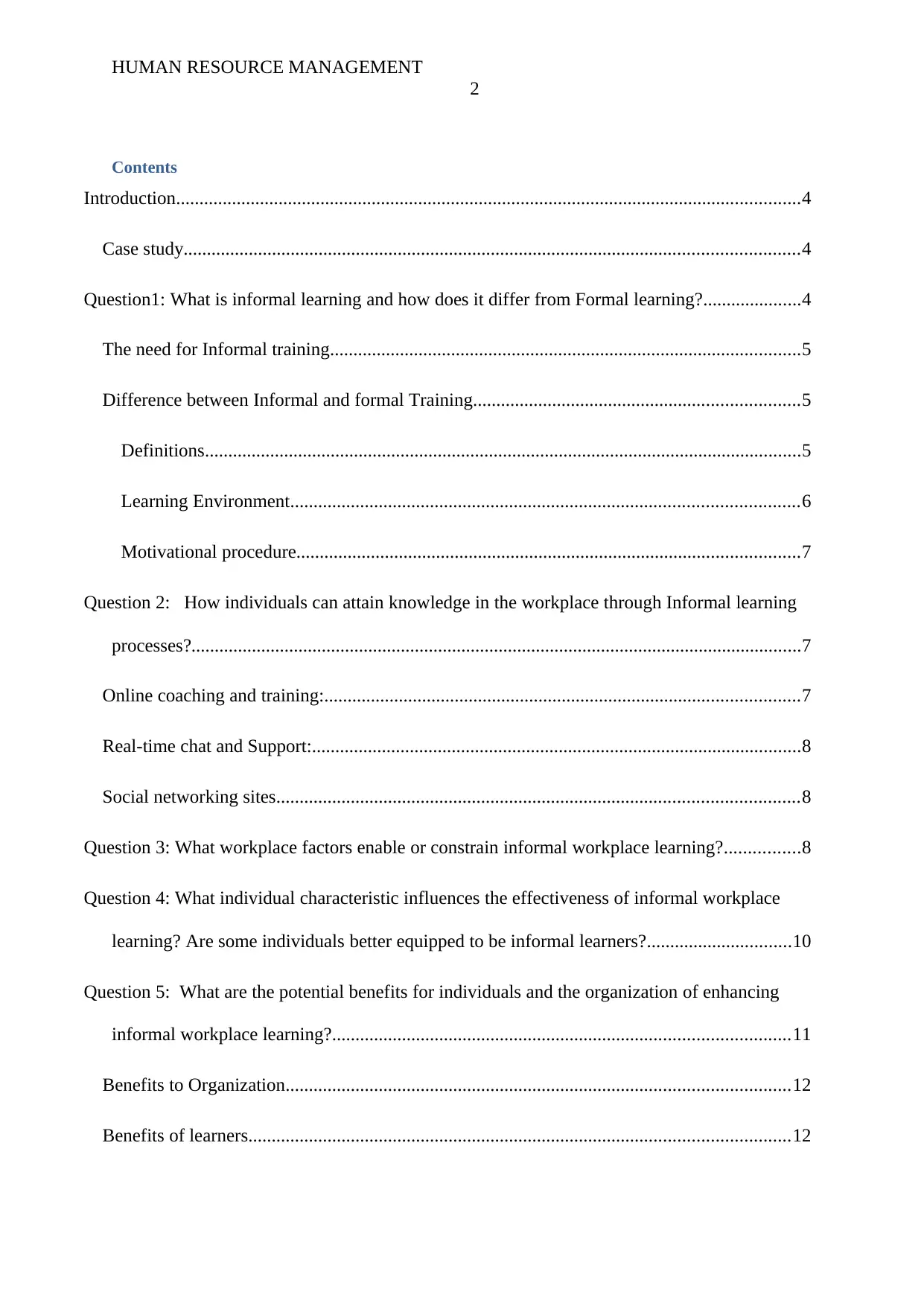
Introduction......................................................................................................................................4
Case study....................................................................................................................................4
Question1: What is informal learning and how does it differ from Formal learning?.....................4
The need for Informal training.....................................................................................................5
Difference between Informal and formal Training......................................................................5
Definitions................................................................................................................................5
Learning Environment.............................................................................................................6
Motivational procedure............................................................................................................7
Question 2: How individuals can attain knowledge in the workplace through Informal learning
processes?...................................................................................................................................7
Online coaching and training:......................................................................................................7
Real-time chat and Support:.........................................................................................................8
Social networking sites................................................................................................................8
Question 3: What workplace factors enable or constrain informal workplace learning?................8
Question 4: What individual characteristic influences the effectiveness of informal workplace
learning? Are some individuals better equipped to be informal learners?...............................10
Question 5: What are the potential benefits for individuals and the organization of enhancing
informal workplace learning?..................................................................................................11
Benefits to Organization............................................................................................................12
Benefits of learners....................................................................................................................12
2
Contents
Introduction......................................................................................................................................4
Case study....................................................................................................................................4
Question1: What is informal learning and how does it differ from Formal learning?.....................4
The need for Informal training.....................................................................................................5
Difference between Informal and formal Training......................................................................5
Definitions................................................................................................................................5
Learning Environment.............................................................................................................6
Motivational procedure............................................................................................................7
Question 2: How individuals can attain knowledge in the workplace through Informal learning
processes?...................................................................................................................................7
Online coaching and training:......................................................................................................7
Real-time chat and Support:.........................................................................................................8
Social networking sites................................................................................................................8
Question 3: What workplace factors enable or constrain informal workplace learning?................8
Question 4: What individual characteristic influences the effectiveness of informal workplace
learning? Are some individuals better equipped to be informal learners?...............................10
Question 5: What are the potential benefits for individuals and the organization of enhancing
informal workplace learning?..................................................................................................11
Benefits to Organization............................................................................................................12
Benefits of learners....................................................................................................................12
⊘ This is a preview!⊘
Do you want full access?
Subscribe today to unlock all pages.

Trusted by 1+ million students worldwide
HUMAN RESOURCE MANAGEMENT
3
Question 6: Recommendations for improving informal learning within the organizations...........13
Conclusion......................................................................................................................................15
Bibliography...................................................................................................................................16
3
Question 6: Recommendations for improving informal learning within the organizations...........13
Conclusion......................................................................................................................................15
Bibliography...................................................................................................................................16
Paraphrase This Document
Need a fresh take? Get an instant paraphrase of this document with our AI Paraphraser
HUMAN RESOURCE MANAGEMENT
4
Introduction
In this assignment, the emphasized has been placed over the “promotion of the informal
learning in an organization” as it can be analyzed that with the emergence of globalization and
commercialization, the competition on the international scale has been increased which has led to the
demand of productive, dynamic as well as an efficient employees. In this competitive and dynamic
business environment, Learning has become an integral part of the organizations. To impart the
knowledge and provide effective training, various emerging companies are adopting the route of
informal learning at the workplace. This self- directed method has become crucial to empower and
promote the importance of learning among the workers so that they can attain new skills and enhance
their performance. Through this report, a piece of detailed information about informal learning and its
significance can be accessed. Moreover, with the help of the case study, readers can perceive in-depth
knowledge of this learning procedure.
Case study
In this case, it has been discussed that the CEO of the medium-sized company has appointed
Human Resources Advisor to research the current ongoing practices of informal learning.
It has been observed that the CEO of the company values education and wants his staff to
attain knowledge. However, due to a lack of funds, they are finding it difficult to implement formal
education. Therefore, the company selected the informal learning pattern. Moreover, the Superior
authority had very limited knowledge about the informal learning practices, so he communicated to
the advisor to conduct the research, prepare and address certain questions that can provide detail
information about the informal learning at the workplace.
Question1: What is informal learning and how does it differ from Formal learning?
As a Human Resources Advisor, an in-depth study has been conducted to plan the outline of
the learning process to provide training to the workforce. It had been determined that Informal
learning is a trending and popular method of providing training to the employees. Informal Training
means learning or knowledge gained by the individual from his /her surroundings, new experiences
that cannot be gained at a well-structured and restricted environment like a university, and skill
development and training school (Carliner, 2014). In the workplace, it is a never-ending procedure,
which is provided to the employees at every organizational level.
There is no definite structure for obtaining this kind of knowledge and developing skills. It
can be acquired through self-study, by reading articles and actively participating in the field activities,
4
Introduction
In this assignment, the emphasized has been placed over the “promotion of the informal
learning in an organization” as it can be analyzed that with the emergence of globalization and
commercialization, the competition on the international scale has been increased which has led to the
demand of productive, dynamic as well as an efficient employees. In this competitive and dynamic
business environment, Learning has become an integral part of the organizations. To impart the
knowledge and provide effective training, various emerging companies are adopting the route of
informal learning at the workplace. This self- directed method has become crucial to empower and
promote the importance of learning among the workers so that they can attain new skills and enhance
their performance. Through this report, a piece of detailed information about informal learning and its
significance can be accessed. Moreover, with the help of the case study, readers can perceive in-depth
knowledge of this learning procedure.
Case study
In this case, it has been discussed that the CEO of the medium-sized company has appointed
Human Resources Advisor to research the current ongoing practices of informal learning.
It has been observed that the CEO of the company values education and wants his staff to
attain knowledge. However, due to a lack of funds, they are finding it difficult to implement formal
education. Therefore, the company selected the informal learning pattern. Moreover, the Superior
authority had very limited knowledge about the informal learning practices, so he communicated to
the advisor to conduct the research, prepare and address certain questions that can provide detail
information about the informal learning at the workplace.
Question1: What is informal learning and how does it differ from Formal learning?
As a Human Resources Advisor, an in-depth study has been conducted to plan the outline of
the learning process to provide training to the workforce. It had been determined that Informal
learning is a trending and popular method of providing training to the employees. Informal Training
means learning or knowledge gained by the individual from his /her surroundings, new experiences
that cannot be gained at a well-structured and restricted environment like a university, and skill
development and training school (Carliner, 2014). In the workplace, it is a never-ending procedure,
which is provided to the employees at every organizational level.
There is no definite structure for obtaining this kind of knowledge and developing skills. It
can be acquired through self-study, by reading articles and actively participating in the field activities,
HUMAN RESOURCE MANAGEMENT
5
forums, discussion. It is considered as a form of Asynchronous learning which an independent method
of learning done by using available learning material, which can be obtained through online libraries
and educational sites. It is self-motivating and flexible learning, where the learners set objectives
according to their competencies and capabilities. Informal learning is an impulsive method, which
can be, performed at any point in time irrespective of its location ( Malloch, Cairns, Evans, &
O'Connor, 2010). The significance of this topic can be understood with the help of an example: if a
newly joined employee is facing difficulties in operating the copy machine, then the existing
employees can demonstrate its working to him/her. Such incidents and moments are counted as part
of informal training ( Lee, Yoo, Lee , Park, & Yoon, 2019).
The need for Informal training
Employees are considered as an important asset for the companies and retaining them is the
highest priority of the company. Therefore, many companies are adopting this procedure for providing
learning to the employees. It is considered as one of the best method of learning as it not only saves
the cost of organization during the implementation learning procedure and obtaining knowledge
from other people which also includes their personal experience but also involves practical learning in
the workplace (Tannenbaum, Beard, McNall, & Salas, 2010).
It can occur during the time of coaching and mentoring. Moreover, with global changes,
learning is not confined to a particular learning environment. In other words, learning can be
conducted at any point in time. With the introduction of this method of learning, the learners have
become more focused, as with fun, employees are learning through their experiences, there as less
burden as they can set their own goals. Besides, this informal learning has great significance when the
main objective of the company becomes the overall development of the employees ( Manuti, Pastore,
Scardingo, Giancaspro, & Morciano, 2015).
Difference between Informal and formal Training
With the introduction of advanced learning methods, the scope of workplace learning has
become vast, which has assisted employees to enhance their skills and avail opportunities. Today
learning has become a never-ending process, where the learners and experts can work together as a
team and acquire new competencies through the exclusive methods other than the traditional method
that is formal learning. In the contemporary business world, to generate productive results, workplace
learning is conducted either by providing formal learning or by informal learning. However, both
methods of learning have contradictory implications, which will be discussed ( Malloch, Cairns,
Evans, & O'Connor, 2010).
5
forums, discussion. It is considered as a form of Asynchronous learning which an independent method
of learning done by using available learning material, which can be obtained through online libraries
and educational sites. It is self-motivating and flexible learning, where the learners set objectives
according to their competencies and capabilities. Informal learning is an impulsive method, which
can be, performed at any point in time irrespective of its location ( Malloch, Cairns, Evans, &
O'Connor, 2010). The significance of this topic can be understood with the help of an example: if a
newly joined employee is facing difficulties in operating the copy machine, then the existing
employees can demonstrate its working to him/her. Such incidents and moments are counted as part
of informal training ( Lee, Yoo, Lee , Park, & Yoon, 2019).
The need for Informal training
Employees are considered as an important asset for the companies and retaining them is the
highest priority of the company. Therefore, many companies are adopting this procedure for providing
learning to the employees. It is considered as one of the best method of learning as it not only saves
the cost of organization during the implementation learning procedure and obtaining knowledge
from other people which also includes their personal experience but also involves practical learning in
the workplace (Tannenbaum, Beard, McNall, & Salas, 2010).
It can occur during the time of coaching and mentoring. Moreover, with global changes,
learning is not confined to a particular learning environment. In other words, learning can be
conducted at any point in time. With the introduction of this method of learning, the learners have
become more focused, as with fun, employees are learning through their experiences, there as less
burden as they can set their own goals. Besides, this informal learning has great significance when the
main objective of the company becomes the overall development of the employees ( Manuti, Pastore,
Scardingo, Giancaspro, & Morciano, 2015).
Difference between Informal and formal Training
With the introduction of advanced learning methods, the scope of workplace learning has
become vast, which has assisted employees to enhance their skills and avail opportunities. Today
learning has become a never-ending process, where the learners and experts can work together as a
team and acquire new competencies through the exclusive methods other than the traditional method
that is formal learning. In the contemporary business world, to generate productive results, workplace
learning is conducted either by providing formal learning or by informal learning. However, both
methods of learning have contradictory implications, which will be discussed ( Malloch, Cairns,
Evans, & O'Connor, 2010).
⊘ This is a preview!⊘
Do you want full access?
Subscribe today to unlock all pages.
Trusted by 1+ million students worldwide
HUMAN RESOURCE MANAGEMENT
6
Definitions
It is well-organized learning, which is a specific as well as the systematic structure of
education adopted by the management to provide a learning environment to the employees. In the
corporate culture, this kind of learning is most probably practiced “off the job”, and in the educational
rooms. In this training technique, learning has been conducted through advance technologies like
mobile phones, e-learning like, and videos. In addition to this, personnel is delivered materials, so that
they can manually understand the operations and apply them in working. This traditional method is
conducted in the format so the knowledge obtained by the workers can remain present with them until
the end of his/her professional life. This type of learning is provided with an objective for preparing
the workforce for achieving high targets (Eraut , Informal learning in the workplace, 2004).
Whereas, informal learning is an upcoming form of education that is limitless and contradicts
the ideology of a traditional formal learning atmosphere like university and school. Here, an
education perceived from the different situations is considered as learning, which goes parallel to the
day-to-day routine or learning activities are undertaken by the employees to teach ourselves. This
training procedure majorly emphasizes the regular experiences undergone by the employees, which
are greatly influenced by factors like the workplace, family expectations, and social pressure.
Learning Environment
To promote workplace learning, there is a vast variety of learning methods and tools available
and can be adopted by the experts or the management. In the formal learning method, knowledge is
offered through an assembly-line instruction style. In the business environment, these traditional
methods are comprised of a planned organized set of learning activities, which is practiced to generate
productive outcomes (Susomrith, Coetzer, & Ampofo, 2019). The main motive of adopting this
technique is to guide the workforce so that they can specialize in a particular field of knowledge,
acquire skills and gains insights regarding further development in the field. To provide formal
education to the employees, management experts organize learning programs, which cover the entire
process of training and development. In other words, knowledge has been provided outside the work
culture (Choi & Jacobs, 2011). It is a well- planned system, which is developed to improve the
performance of the employees. Here the targets are pre-determined according to the deadlines. Formal
training is provided at the basic level so that new and amateur employees can acquire skills in a
particular period (Delahaye & Choi, 2018).
On the other part, informal learning involves the acquisition of skills in a random and
unsystematic way, where the company does not organize any particular event to impart the knowledge
to the learners. Here, the learning is conducted at any particular moment during the operations, which
can be employed during the practice. In the comparison of formal learning, informal education is
provided in the actual business environment irrespective of the prevailing situation. It is a blend of
6
Definitions
It is well-organized learning, which is a specific as well as the systematic structure of
education adopted by the management to provide a learning environment to the employees. In the
corporate culture, this kind of learning is most probably practiced “off the job”, and in the educational
rooms. In this training technique, learning has been conducted through advance technologies like
mobile phones, e-learning like, and videos. In addition to this, personnel is delivered materials, so that
they can manually understand the operations and apply them in working. This traditional method is
conducted in the format so the knowledge obtained by the workers can remain present with them until
the end of his/her professional life. This type of learning is provided with an objective for preparing
the workforce for achieving high targets (Eraut , Informal learning in the workplace, 2004).
Whereas, informal learning is an upcoming form of education that is limitless and contradicts
the ideology of a traditional formal learning atmosphere like university and school. Here, an
education perceived from the different situations is considered as learning, which goes parallel to the
day-to-day routine or learning activities are undertaken by the employees to teach ourselves. This
training procedure majorly emphasizes the regular experiences undergone by the employees, which
are greatly influenced by factors like the workplace, family expectations, and social pressure.
Learning Environment
To promote workplace learning, there is a vast variety of learning methods and tools available
and can be adopted by the experts or the management. In the formal learning method, knowledge is
offered through an assembly-line instruction style. In the business environment, these traditional
methods are comprised of a planned organized set of learning activities, which is practiced to generate
productive outcomes (Susomrith, Coetzer, & Ampofo, 2019). The main motive of adopting this
technique is to guide the workforce so that they can specialize in a particular field of knowledge,
acquire skills and gains insights regarding further development in the field. To provide formal
education to the employees, management experts organize learning programs, which cover the entire
process of training and development. In other words, knowledge has been provided outside the work
culture (Choi & Jacobs, 2011). It is a well- planned system, which is developed to improve the
performance of the employees. Here the targets are pre-determined according to the deadlines. Formal
training is provided at the basic level so that new and amateur employees can acquire skills in a
particular period (Delahaye & Choi, 2018).
On the other part, informal learning involves the acquisition of skills in a random and
unsystematic way, where the company does not organize any particular event to impart the knowledge
to the learners. Here, the learning is conducted at any particular moment during the operations, which
can be employed during the practice. In the comparison of formal learning, informal education is
provided in the actual business environment irrespective of the prevailing situation. It is a blend of
Paraphrase This Document
Need a fresh take? Get an instant paraphrase of this document with our AI Paraphraser
HUMAN RESOURCE MANAGEMENT
7
individual experiences, mental capabilities, ambitions, enthusiasm, and willingness to learn. This
learning technique revolves around the life of the employees and focuses on real-life experiences,
with no specific goals (Cerasoli, Alliger, Donsbach, Mathieu, Tannenbaum, & Orvis, 2018).
.
Motivational procedure
At the beginning of the formal training program, subordinates are observed to highly
enthusiastic and motivated to learn and apply their knowledge in the operations. However, in the
absence of effective procedures and due to limited skills enhancement activities, employees might
find the programs inadequate and start losing their interest to excel. In contrast to formal, informal
students are always motivated and keep themselves updated in the context of the new techniques
(Grip, 2015). They are ready to acquire new skills and are adaptable. Since they perceived the
knowledge in the prevailing environment, they like to gain in-depth of the subject they like to study
Question 2: How individuals can attain knowledge in the workplace through Informal learning
processes?
Today, many companies are promoting the professional growth of the employees so that they
can adapt themselves according to the dynamic business environment and enhance their competencies
to foster revolution and advancement. In promoting their interest, workplace learning has a critical
role in it. In this development and learning procedure, informal learning has outperformed formal
learning and has become a popular method for attaining and developing the knowledge that is crucial
for the organization to stay competitive and maintain the position in the industry (Grip, 2015).
Employees’ informal education involves non-private data like professional material to
commence effective learning and e-learning. It also involves social and interpersonal sources like
colleagues, managers, and people from the administrative body. In the existing corporate culture, the
focus has been placed over the improvement of the skills and performance by specializing in a
particular field. Employees need to only update their skills according to their current job perspective
but also need to prepare for future opportunities. In the informal learning feedback from the mangers
and top management plays a vital role as through its utilization, performance can be improved, which
will eventually create a positive impact on the employees. This learning will maximize the overall
satisfaction of the employees which improves employee engagement and active learning.
Attributing to the above-discussed information, Companies can promote and encourage informal
education in the working environment by implementing digital learning such as conversation
applications, interaction over social networking and other online aspects. In online learning things,
which are included, are:
7
individual experiences, mental capabilities, ambitions, enthusiasm, and willingness to learn. This
learning technique revolves around the life of the employees and focuses on real-life experiences,
with no specific goals (Cerasoli, Alliger, Donsbach, Mathieu, Tannenbaum, & Orvis, 2018).
.
Motivational procedure
At the beginning of the formal training program, subordinates are observed to highly
enthusiastic and motivated to learn and apply their knowledge in the operations. However, in the
absence of effective procedures and due to limited skills enhancement activities, employees might
find the programs inadequate and start losing their interest to excel. In contrast to formal, informal
students are always motivated and keep themselves updated in the context of the new techniques
(Grip, 2015). They are ready to acquire new skills and are adaptable. Since they perceived the
knowledge in the prevailing environment, they like to gain in-depth of the subject they like to study
Question 2: How individuals can attain knowledge in the workplace through Informal learning
processes?
Today, many companies are promoting the professional growth of the employees so that they
can adapt themselves according to the dynamic business environment and enhance their competencies
to foster revolution and advancement. In promoting their interest, workplace learning has a critical
role in it. In this development and learning procedure, informal learning has outperformed formal
learning and has become a popular method for attaining and developing the knowledge that is crucial
for the organization to stay competitive and maintain the position in the industry (Grip, 2015).
Employees’ informal education involves non-private data like professional material to
commence effective learning and e-learning. It also involves social and interpersonal sources like
colleagues, managers, and people from the administrative body. In the existing corporate culture, the
focus has been placed over the improvement of the skills and performance by specializing in a
particular field. Employees need to only update their skills according to their current job perspective
but also need to prepare for future opportunities. In the informal learning feedback from the mangers
and top management plays a vital role as through its utilization, performance can be improved, which
will eventually create a positive impact on the employees. This learning will maximize the overall
satisfaction of the employees which improves employee engagement and active learning.
Attributing to the above-discussed information, Companies can promote and encourage informal
education in the working environment by implementing digital learning such as conversation
applications, interaction over social networking and other online aspects. In online learning things,
which are included, are:
HUMAN RESOURCE MANAGEMENT
8
Online coaching and training: Company mangers or the leaders can provide mentoring to the new
employees as well as existing employees so that learners can get precise knowledge regarding the
working of the business and learn about the processes in the company.
Real-time chat and Support: Experienced professionals can share their knowledge or expertise with
their colleagues and other subordinates through online chat and another support system. It is one of
the best methods of connecting many people at the same time. Besides this, it is considered as an
interactive method as with this method a good an interactive session can be conducted.
Social networking sites: Social and business web sources such as LinkedIn, Facebook and Instagram
have been regarded as knowledge centers for attaining accurate information of the industry. By
connecting through these sites Employees can become more update and training insights relate to
recent activities of the companies and latest trends ( Lee, Yoo, Lee , Park, & Yoon, 2019).
Informal learning at the workplace can be boost through many other methods like Encouraging peers
to participate in the training program, which will automatically improve the procedure of training, as
it will be imparted according to the capabilities of the employees.
In the modern corporate culture, companies are promoting both informal and formal learning so that
learners can receive the best training experiences. Moreover, it has been observed that informal
training and formal training working in collaboration as it initiates the learning programs without
pressure as it balances the positive as wells limitations of the learning. By conducting an open
discussion with the subordinates, experts can encourage learners to share their experiences with them.
Moreover, through the reward system, informal learning activities can be more fun and participating.
Question 3: What workplace factors enable or constrain informal workplace learning?
Today the learning has become independent, open and informal. Learners are experimenting
and opening their options to choose the period, place of learning, matter, and material to be covered
according to them. Besides, it is very important to evaluate the goals as these factors influence
informal learning. With the emergence of advanced technology, informal learning has recognition as
through this kind of learning has promoted the value of the training of new skills among the people
any time without hindrances. In the business environment, it has become necessary to understand
informal learning is a spontaneous and motivational method of learning as it encourages independent
learning through online materials and collected (Messmann, Segers, & Dochy, 2018). In other words,
it can be expressed as a major influencer over informal education at the workplace. Despite this, there
are certain limitations to the use of online resources. This means the information that is available on
social sites are limited to a certain limit. Besides this social media, three other factors which majorly
influences informal learning are:
8
Online coaching and training: Company mangers or the leaders can provide mentoring to the new
employees as well as existing employees so that learners can get precise knowledge regarding the
working of the business and learn about the processes in the company.
Real-time chat and Support: Experienced professionals can share their knowledge or expertise with
their colleagues and other subordinates through online chat and another support system. It is one of
the best methods of connecting many people at the same time. Besides this, it is considered as an
interactive method as with this method a good an interactive session can be conducted.
Social networking sites: Social and business web sources such as LinkedIn, Facebook and Instagram
have been regarded as knowledge centers for attaining accurate information of the industry. By
connecting through these sites Employees can become more update and training insights relate to
recent activities of the companies and latest trends ( Lee, Yoo, Lee , Park, & Yoon, 2019).
Informal learning at the workplace can be boost through many other methods like Encouraging peers
to participate in the training program, which will automatically improve the procedure of training, as
it will be imparted according to the capabilities of the employees.
In the modern corporate culture, companies are promoting both informal and formal learning so that
learners can receive the best training experiences. Moreover, it has been observed that informal
training and formal training working in collaboration as it initiates the learning programs without
pressure as it balances the positive as wells limitations of the learning. By conducting an open
discussion with the subordinates, experts can encourage learners to share their experiences with them.
Moreover, through the reward system, informal learning activities can be more fun and participating.
Question 3: What workplace factors enable or constrain informal workplace learning?
Today the learning has become independent, open and informal. Learners are experimenting
and opening their options to choose the period, place of learning, matter, and material to be covered
according to them. Besides, it is very important to evaluate the goals as these factors influence
informal learning. With the emergence of advanced technology, informal learning has recognition as
through this kind of learning has promoted the value of the training of new skills among the people
any time without hindrances. In the business environment, it has become necessary to understand
informal learning is a spontaneous and motivational method of learning as it encourages independent
learning through online materials and collected (Messmann, Segers, & Dochy, 2018). In other words,
it can be expressed as a major influencer over informal education at the workplace. Despite this, there
are certain limitations to the use of online resources. This means the information that is available on
social sites are limited to a certain limit. Besides this social media, three other factors which majorly
influences informal learning are:
⊘ This is a preview!⊘
Do you want full access?
Subscribe today to unlock all pages.
Trusted by 1+ million students worldwide
HUMAN RESOURCE MANAGEMENT
9
I. Informal learning actions
II. An organizational learning environment that influences the informal learning
III. Factors that influences the participation of self –directed educational activities in the
working environment
IV. Various corporative aspects that affect and obstruct the functioning of informal
learning. All these factors will be explained in the precise form.
Incorporate culture, there are various organizational factors, which have a great impact on the
practice of informal learning in the company, in which the activities, which are performed during the
accomplishment of the informal education, have a great influenced over it. Working environment
learning involves the delivery of knowledge that is conducted by the employees themselves which not
only promotes self-confidence among the employees but also improves their professional expertise
and skills. In the effective commencement of this procedure, there many organizational activities that
support informal learning at the workplace (Wielenga-Meijer, Taris, & Kompier, 2010). This
involves giving direction, illustrating and demonstrating the usage of technology. Informal learning
activities can be planned as well as organized (Cerasoli, Alliger, Donsbach, Mathieu, Tannenbaum, &
Orvis, 2018). Some experts describe that purposeful informal learning activities are stress-free, can
be performed without hindrance and involves intensive research than those that unplanned learning
activities and more integrated into other tasks. Some of the calculated informal educational activities
in the working environment include self-guided learning and coaching.
Informal learning at the workplace is also influenced by Organizational activities like learning
form demanding and challenging jobs that stimulate learning at every stage. This can be regarded as a
part of learning situations. All these factors considered as an exposure to revolution, that also
provides insights into upcoming changes in the demand and needs of customers, colleagues, and
superiors. In informal learning, factors like the responsibilities of managers , effective
interpersonal skills and excessive socializing, delivering useful feedback to the subordinates and new
joined employees, empowering managers for learning new skills and technology so that knowledge
can be provided to amateur learners, promoting the rewarding system by distribution interesting
challenges and tasks has a great significance. Researchers examined that optimistic and productive
learning conditions encourage consistent constructive years of development. A study has been
identified which states that educational related activities and prevailing learning conditions majorly
influences the occurrence of informal learning. However, due to continuous learning programs
without any proper plan causes ambiguity, which might become a blockage in the efficient
implementation of informal learning. It has been identified that practices of providing performance
reviews, attainment of knowledge and communication are the key areas that can overlap between the
learning activities and educational environment ( Malloch, Cairns, Evans, & O'Connor, 2010).
9
I. Informal learning actions
II. An organizational learning environment that influences the informal learning
III. Factors that influences the participation of self –directed educational activities in the
working environment
IV. Various corporative aspects that affect and obstruct the functioning of informal
learning. All these factors will be explained in the precise form.
Incorporate culture, there are various organizational factors, which have a great impact on the
practice of informal learning in the company, in which the activities, which are performed during the
accomplishment of the informal education, have a great influenced over it. Working environment
learning involves the delivery of knowledge that is conducted by the employees themselves which not
only promotes self-confidence among the employees but also improves their professional expertise
and skills. In the effective commencement of this procedure, there many organizational activities that
support informal learning at the workplace (Wielenga-Meijer, Taris, & Kompier, 2010). This
involves giving direction, illustrating and demonstrating the usage of technology. Informal learning
activities can be planned as well as organized (Cerasoli, Alliger, Donsbach, Mathieu, Tannenbaum, &
Orvis, 2018). Some experts describe that purposeful informal learning activities are stress-free, can
be performed without hindrance and involves intensive research than those that unplanned learning
activities and more integrated into other tasks. Some of the calculated informal educational activities
in the working environment include self-guided learning and coaching.
Informal learning at the workplace is also influenced by Organizational activities like learning
form demanding and challenging jobs that stimulate learning at every stage. This can be regarded as a
part of learning situations. All these factors considered as an exposure to revolution, that also
provides insights into upcoming changes in the demand and needs of customers, colleagues, and
superiors. In informal learning, factors like the responsibilities of managers , effective
interpersonal skills and excessive socializing, delivering useful feedback to the subordinates and new
joined employees, empowering managers for learning new skills and technology so that knowledge
can be provided to amateur learners, promoting the rewarding system by distribution interesting
challenges and tasks has a great significance. Researchers examined that optimistic and productive
learning conditions encourage consistent constructive years of development. A study has been
identified which states that educational related activities and prevailing learning conditions majorly
influences the occurrence of informal learning. However, due to continuous learning programs
without any proper plan causes ambiguity, which might become a blockage in the efficient
implementation of informal learning. It has been identified that practices of providing performance
reviews, attainment of knowledge and communication are the key areas that can overlap between the
learning activities and educational environment ( Malloch, Cairns, Evans, & O'Connor, 2010).
Paraphrase This Document
Need a fresh take? Get an instant paraphrase of this document with our AI Paraphraser
HUMAN RESOURCE MANAGEMENT
10
Besides this informal learning is also affected by the self-direction and involvement of the
individuals. Personal profile of the employees, like age factors, educational as well as family
background influences procedure of informal learning. As per the study conducted, it has been
observed that the probability of amateur and optimistic workers are more participative in the informal
learning whereas professional as well as more experienced workers are least interested to get
themselves involves in the learning process This study varies according to person to person (Noe,
Tews, & Marand, 2013). However, some potential factors hinder the effective completion of informal
learning. Self-directed learning, attaining the knowledge from social media, coaching from
professional experts are considered as predominant strategies (Skule, 2004).
Many experts have expressed their opinion and stated that experts have become more reactive
than productive. Moreover the various environmental hurdles, like limited time for constructive
learning, due to inadequate time, there is pressure to complete the learning session before time
(Messmann, Segers, & Dochy, 2018).
Besides this, there is a lack of motivation as there is no proper structure or system tom
conduct a rewarding ceremony. Due to such events, learners are losing their focus on learning new
things and excel. Work pressure is one of the biggest factors which has hindered the path of providing
informal education to learners as it makes people work fast and hard over new things every day, due
to which there are loads of confusion and uncertainties not only among the leaners but also with the
experts (Jeske & Roßnagel , 2016).
Question 4: What individual characteristic influences the effectiveness of informal workplace
learning? Are some individuals better equipped to be informal learners?
The personal profile of the mangers plays an essential role in determining the outcomes and
meaningful results of informal learning. The personal characteristics of the learners involved. They
are various multiple factors that determine the learning potential the workplace which are applied over
occupational settings ( Nikolova, Ruysseveldt, Witte, & Syroit, 2014).
Age factors: The generations or the age groups of the learners determines the kind of informal
learner the subordinate is involved in. In the literature of training and development, the age of the
learners are divided into old-timer and newcomers where both these terms depict old age professional
learner and other new and young optimistic workers. There is a great difference in their method of
acquiring knowledge, where the old and existing workers prefer an individual informal form of
education and new workers like to gain knowledge in the social environment, where along with the
discussions workers can attain informal learning (Tannenbaum, Beard, McNall, & Salas, 2010).
10
Besides this informal learning is also affected by the self-direction and involvement of the
individuals. Personal profile of the employees, like age factors, educational as well as family
background influences procedure of informal learning. As per the study conducted, it has been
observed that the probability of amateur and optimistic workers are more participative in the informal
learning whereas professional as well as more experienced workers are least interested to get
themselves involves in the learning process This study varies according to person to person (Noe,
Tews, & Marand, 2013). However, some potential factors hinder the effective completion of informal
learning. Self-directed learning, attaining the knowledge from social media, coaching from
professional experts are considered as predominant strategies (Skule, 2004).
Many experts have expressed their opinion and stated that experts have become more reactive
than productive. Moreover the various environmental hurdles, like limited time for constructive
learning, due to inadequate time, there is pressure to complete the learning session before time
(Messmann, Segers, & Dochy, 2018).
Besides this, there is a lack of motivation as there is no proper structure or system tom
conduct a rewarding ceremony. Due to such events, learners are losing their focus on learning new
things and excel. Work pressure is one of the biggest factors which has hindered the path of providing
informal education to learners as it makes people work fast and hard over new things every day, due
to which there are loads of confusion and uncertainties not only among the leaners but also with the
experts (Jeske & Roßnagel , 2016).
Question 4: What individual characteristic influences the effectiveness of informal workplace
learning? Are some individuals better equipped to be informal learners?
The personal profile of the mangers plays an essential role in determining the outcomes and
meaningful results of informal learning. The personal characteristics of the learners involved. They
are various multiple factors that determine the learning potential the workplace which are applied over
occupational settings ( Nikolova, Ruysseveldt, Witte, & Syroit, 2014).
Age factors: The generations or the age groups of the learners determines the kind of informal
learner the subordinate is involved in. In the literature of training and development, the age of the
learners are divided into old-timer and newcomers where both these terms depict old age professional
learner and other new and young optimistic workers. There is a great difference in their method of
acquiring knowledge, where the old and existing workers prefer an individual informal form of
education and new workers like to gain knowledge in the social environment, where along with the
discussions workers can attain informal learning (Tannenbaum, Beard, McNall, & Salas, 2010).
HUMAN RESOURCE MANAGEMENT
11
Personal characteristics: These factors involve “aspiration for independence, social –advocacy,
acceptance adaptable to a dynamic environment, optimistic attitude and risk-taking nature of the
workers can be linked to better performance and constructive results. Personal skills and qualities of
the worker is a key element of informal pattern of delivering knowledge as it includes how individuals
understand the importance of informal learning through their intellectual level and how much they
value workplace learning. It involves
1. Learning Orientation: It is part of personal qualities that denotes that if an individual has been
dedicated and has a good learning capacity then that individual is genuinely interested in
learning new skills. People with strong determination are independent and set their targets
2. Gender factors: In informal learning, gender has a limited significance. Its importance can be
observed in the level of education. For example, the male segment has more job opportunities
than women who have higher educational levels (Growth Engineering, 2015).
Individuals equipped to be a part of the informal learning method
The effective completion of informal learning highly depends upon the individuals, whether they are
ready for perceiving new skills or not. There are certain qualities, which must be possessed by the
individuals ( Raemdonck, Gijbels, & Groen, 2014).
Confidence level: The learning attitude of the workers defines the successful completion of informal
education. A confident and dedicated attitude of the learners will generate positive outcomes. This can
be illustrated through an example where the learners are confident about their career decisions where
both type of learning that is informal, as well as formal learning, are crucial for their professional
growth (Cerasoli, Alliger, Donsbach, Mathieu, Tannenbaum, & Orvis, 2018).
Optimistic and motivated: New, as well as existing workers, must have an inner desire to excel in
informal learning and attain new skills that challenge their capabilities. Motivation is considered an
integral part of professional success (Cerasoli, Alliger, Donsbach, Mathieu, Tannenbaum, & Orvis,
2018).
Social Behaviour: Learners must have effective interpersonal skills and should be socially active.
Such a positive and interactive attitude of the workers will help them interact with the other workers
of different domains having a wide range of expertise. This will help the learners in exploring
different fields and attaining new skills. In addition to this, it encourages them to become visionary
and apply those skills in the accomplishment of the organizational goals.
11
Personal characteristics: These factors involve “aspiration for independence, social –advocacy,
acceptance adaptable to a dynamic environment, optimistic attitude and risk-taking nature of the
workers can be linked to better performance and constructive results. Personal skills and qualities of
the worker is a key element of informal pattern of delivering knowledge as it includes how individuals
understand the importance of informal learning through their intellectual level and how much they
value workplace learning. It involves
1. Learning Orientation: It is part of personal qualities that denotes that if an individual has been
dedicated and has a good learning capacity then that individual is genuinely interested in
learning new skills. People with strong determination are independent and set their targets
2. Gender factors: In informal learning, gender has a limited significance. Its importance can be
observed in the level of education. For example, the male segment has more job opportunities
than women who have higher educational levels (Growth Engineering, 2015).
Individuals equipped to be a part of the informal learning method
The effective completion of informal learning highly depends upon the individuals, whether they are
ready for perceiving new skills or not. There are certain qualities, which must be possessed by the
individuals ( Raemdonck, Gijbels, & Groen, 2014).
Confidence level: The learning attitude of the workers defines the successful completion of informal
education. A confident and dedicated attitude of the learners will generate positive outcomes. This can
be illustrated through an example where the learners are confident about their career decisions where
both type of learning that is informal, as well as formal learning, are crucial for their professional
growth (Cerasoli, Alliger, Donsbach, Mathieu, Tannenbaum, & Orvis, 2018).
Optimistic and motivated: New, as well as existing workers, must have an inner desire to excel in
informal learning and attain new skills that challenge their capabilities. Motivation is considered an
integral part of professional success (Cerasoli, Alliger, Donsbach, Mathieu, Tannenbaum, & Orvis,
2018).
Social Behaviour: Learners must have effective interpersonal skills and should be socially active.
Such a positive and interactive attitude of the workers will help them interact with the other workers
of different domains having a wide range of expertise. This will help the learners in exploring
different fields and attaining new skills. In addition to this, it encourages them to become visionary
and apply those skills in the accomplishment of the organizational goals.
⊘ This is a preview!⊘
Do you want full access?
Subscribe today to unlock all pages.
Trusted by 1+ million students worldwide

1 out of 20


Related Documents


Your All-in-One AI-Powered Toolkit for Academic Success.
+13062052269
info@desklib.com
Available 24*7 on WhatsApp / Email
![[object Object]](/_next/static/media/star-bottom.7253800d.svg)
Unlock your academic potential
Copyright © 2020–2026 A2Z Services. All Rights Reserved. Developed and managed by ZUCOL.