Essay on Education: Promoting Child Development in Early Years
VerifiedAdded on 2020/05/28
|19
|5559
|152
Essay
AI Summary
This essay explores the crucial roles and responsibilities of practitioners in fostering children's growth and development, particularly within the framework of the Early Years Foundation Stage (EYFS). It emphasizes the importance of creating safe, stimulating, and challenging learning environments that promote children's cognitive, social, emotional, and physical development. The essay delves into the significance of play, the impact of positive teacher-student relationships, and the application of concepts like Sustained Shared Thinking and scaffolding to support learning. It also highlights the need for practitioners to provide resources, encourage interaction, and collaborate with families to ensure each child reaches their full potential. Furthermore, the essay underscores the importance of secure attachments and the role of adults in supporting children's social, emotional, and physical well-being during their early years, setting the foundation for future success.

Running head: EDUCATION
Education
Name of the Student
Name of the University
Author note
Education
Name of the Student
Name of the University
Author note

Paraphrase This Document
Need a fresh take? Get an instant paraphrase of this document with our AI Paraphraser
1EDUCATION
Introduction
The purpose of this essay is to highlight the roles and responsibilities of a practitioner in
promoting, providing and prescribing for children’s growth or development by supporting the
various characteristics of effective learning. Everyone has the right to have the best possible start
in their life in order to grow with their fullest potential. As stated by McLaughlin, Sheridan &
Lambert, (2014) it is a fact that children grow much rapidly within the time of birth to five years
of age. Thus these five years have immense importance in the life of a child. In these years a
child needs a happy and secure domestic life and good parenting is necessary in this phase. In
this phase, a child needs quality early learning that can provide a good foundation of education
for the children and would allow them to grow with their full potential. In this context, The Early
Years Foundation Stage has set the standards where it is stated that all the providers of early
years must make it sure that the children learn and develop in a safe and healthy manner. As
stated by Hair et al., (2015) these set of standards allow the children to develop a wider range of
skills and knowledge that would help them to grow in future. It is seen that the EYFS aims to
provide a consistent and of high quality early year setting to allow the child to experience a good
progress in life. Apart from that, EYFS provides a foundation by providing learning and
developmental opportunities that are planned according to the interests and needs of individual
children and those are assessed or evaluated in a regular interval. The EYFS specifically
highlights the requirements regarding the development and learning regarding securing the
children and to promote their welfare.
Introduction
The purpose of this essay is to highlight the roles and responsibilities of a practitioner in
promoting, providing and prescribing for children’s growth or development by supporting the
various characteristics of effective learning. Everyone has the right to have the best possible start
in their life in order to grow with their fullest potential. As stated by McLaughlin, Sheridan &
Lambert, (2014) it is a fact that children grow much rapidly within the time of birth to five years
of age. Thus these five years have immense importance in the life of a child. In these years a
child needs a happy and secure domestic life and good parenting is necessary in this phase. In
this phase, a child needs quality early learning that can provide a good foundation of education
for the children and would allow them to grow with their full potential. In this context, The Early
Years Foundation Stage has set the standards where it is stated that all the providers of early
years must make it sure that the children learn and develop in a safe and healthy manner. As
stated by Hair et al., (2015) these set of standards allow the children to develop a wider range of
skills and knowledge that would help them to grow in future. It is seen that the EYFS aims to
provide a consistent and of high quality early year setting to allow the child to experience a good
progress in life. Apart from that, EYFS provides a foundation by providing learning and
developmental opportunities that are planned according to the interests and needs of individual
children and those are assessed or evaluated in a regular interval. The EYFS specifically
highlights the requirements regarding the development and learning regarding securing the
children and to promote their welfare.
2EDUCATION
Promoting
It is important to create a safe, secure yet challenging environment for promoting
children’s learning through play. As disclosed by McLaughlin, Sheridan & Lambert, (2014), As
early childhood education is a major thing for the growth and development of the children,
learning through play has a major influence behind the development of a child. While planning
to provide play environments for children for learning purposes, the useful components will
include lighting, various resources, acoustics and relevant furniture. For an example, a reading
lamp that is attached to a table for learning might help the child to be able to focus more. In this
way, various provocations for learning would bring in sensory exploration and investigation by
using a variety of resources, technologies and media. For an example, it can be said that a
lovable collection of non-fiction books on the shelves can provoke the children’s interest to learn
more. As highlighted by McLaughlin, Sheridan & Lambert, (2014) beauty or the aesthetics of the
room for the children can attract children to learn more. In this scenario, the positioning of the
resources and the equipments are also important. As stated by Hair et al., (2015) as if the
positioning of the items isgood, then it would allow the pupils to access them in a safe and secure
manner and the children will be able to access them more swiftly and that would allow them to
learn quickly. The practitioner should provide necessary equipment and resources so that the
pupils can use them safely with respect to their agency and competency. Apart from that the
practitioners should collaborate with the families of the children and others to evaluate the
development of the children on a regular interval.
An incessant support from the practitioners by positive interactions allows a good basis
for a learning environment that is emotionally supported for the children. As stated by
McLaughlin, Sheridan & Lambert, (2014), under this type of environment children’s physical,
Promoting
It is important to create a safe, secure yet challenging environment for promoting
children’s learning through play. As disclosed by McLaughlin, Sheridan & Lambert, (2014), As
early childhood education is a major thing for the growth and development of the children,
learning through play has a major influence behind the development of a child. While planning
to provide play environments for children for learning purposes, the useful components will
include lighting, various resources, acoustics and relevant furniture. For an example, a reading
lamp that is attached to a table for learning might help the child to be able to focus more. In this
way, various provocations for learning would bring in sensory exploration and investigation by
using a variety of resources, technologies and media. For an example, it can be said that a
lovable collection of non-fiction books on the shelves can provoke the children’s interest to learn
more. As highlighted by McLaughlin, Sheridan & Lambert, (2014) beauty or the aesthetics of the
room for the children can attract children to learn more. In this scenario, the positioning of the
resources and the equipments are also important. As stated by Hair et al., (2015) as if the
positioning of the items isgood, then it would allow the pupils to access them in a safe and secure
manner and the children will be able to access them more swiftly and that would allow them to
learn quickly. The practitioner should provide necessary equipment and resources so that the
pupils can use them safely with respect to their agency and competency. Apart from that the
practitioners should collaborate with the families of the children and others to evaluate the
development of the children on a regular interval.
An incessant support from the practitioners by positive interactions allows a good basis
for a learning environment that is emotionally supported for the children. As stated by
McLaughlin, Sheridan & Lambert, (2014), under this type of environment children’s physical,
⊘ This is a preview!⊘
Do you want full access?
Subscribe today to unlock all pages.

Trusted by 1+ million students worldwide
3EDUCATION
social and emotional requirements gets satisfied. The adults make a warm caring environment
where the children learn and participate in parallel play with other children, and at the same time
acknowledge others achievements after recognizing their skills. In this way, the adults encourage
other children to interact with others and also to help one another to solve their difficulties with
the tasks. In this way a practitioner can provide opportunities for the children to develop in a
swift manner.
In the early childhood, the social skills of the children are the primary indicators of the
future success of that child. Like any other skills, social skills have an immense importance in
determining the future of the child. It is seen that the desired behaviors are learnt and taught by a
range of experiences gathered in the early years of the childhood. Between the age of 0 to 5,
children rapidly grow and develop than in any other stages of their lives. Thus to support and
provide the learning of the child the adults should enhance a positive teacher student relationship
and help the children to play and learn together.
Children’s development means the expansion of the cognitive, psychological, socio-
emotional and physical skills that canpotentially increase the autonomy, independence and
competence of them. The experiences of children in their early childhood are extremelyimportant
for their further growth. The influence of the adults is very important for the growth and
development of the children. As stated by Hair et al., (2015) the experiences of the adults are
immensely important for the further development of the children. Interventions to support and
protect early development of children ensure a great future of the children and the importance of
intervention is thus undoubted.
social and emotional requirements gets satisfied. The adults make a warm caring environment
where the children learn and participate in parallel play with other children, and at the same time
acknowledge others achievements after recognizing their skills. In this way, the adults encourage
other children to interact with others and also to help one another to solve their difficulties with
the tasks. In this way a practitioner can provide opportunities for the children to develop in a
swift manner.
In the early childhood, the social skills of the children are the primary indicators of the
future success of that child. Like any other skills, social skills have an immense importance in
determining the future of the child. It is seen that the desired behaviors are learnt and taught by a
range of experiences gathered in the early years of the childhood. Between the age of 0 to 5,
children rapidly grow and develop than in any other stages of their lives. Thus to support and
provide the learning of the child the adults should enhance a positive teacher student relationship
and help the children to play and learn together.
Children’s development means the expansion of the cognitive, psychological, socio-
emotional and physical skills that canpotentially increase the autonomy, independence and
competence of them. The experiences of children in their early childhood are extremelyimportant
for their further growth. The influence of the adults is very important for the growth and
development of the children. As stated by Hair et al., (2015) the experiences of the adults are
immensely important for the further development of the children. Interventions to support and
protect early development of children ensure a great future of the children and the importance of
intervention is thus undoubted.
Paraphrase This Document
Need a fresh take? Get an instant paraphrase of this document with our AI Paraphraser
4EDUCATION
To get a general idea of Sustained Shared Thinking, it is highly important to identify
that it is emerge as an analytical node or in the process of qualitative research. This information
can be gathered from various case study analyses. As stated by Nutbrown & Clough, (2014) the
term SST became popular as the research scholars and observers specially referred to the SST
and intended to sustain the nature of the interactions seen in the pre-school setting. Vygotsky
explained the process where the practitioners support children’s learning within their area of
proximal development.
In the last couple of decades, a huge number of educators or practitioners in this field
have used the idea of scaffolding as a metaphor to explain the role and responsibility of the
adults regarding guiding the children to help them to grow and develop (McLaughlin, Sheridan,
& Lambert, 2014). This approach highlights one of the essential features of children learning,
that is the need to structure learning opportunities. The metaphor of learning is applicable in
many areas of learning. For an example, characteristics of scaffolding is seen in lessons of
mathematics as well as it is seen in teaching how to read and write. However, on the other hand,
as stated by Hair et al., (2015), it can be said that scaffolding does not allow practitioners to get a
definite guideline regarding the ways of how to use it to successfully teach and guide someone.
Vygotsky’s ideas regarding teaching as co-construction of knowledge is contained by the
activities which are student-centered. Because of the metaphoric nature of the terminology, it
implies a general view of the adults as a mould of a passive child. Scaffolding intends to be seen
as a variation of direct instruction. Subsequently, when scaffolding is seen out of the theoretical
context, no richness of the original meaning can be found that is implied by the theories
regarding socio-cultural aspects. The Vygotskian notion of teaching as knowledge of co-
construction within the activities which are student centered. This type of view of scaffolding is
To get a general idea of Sustained Shared Thinking, it is highly important to identify
that it is emerge as an analytical node or in the process of qualitative research. This information
can be gathered from various case study analyses. As stated by Nutbrown & Clough, (2014) the
term SST became popular as the research scholars and observers specially referred to the SST
and intended to sustain the nature of the interactions seen in the pre-school setting. Vygotsky
explained the process where the practitioners support children’s learning within their area of
proximal development.
In the last couple of decades, a huge number of educators or practitioners in this field
have used the idea of scaffolding as a metaphor to explain the role and responsibility of the
adults regarding guiding the children to help them to grow and develop (McLaughlin, Sheridan,
& Lambert, 2014). This approach highlights one of the essential features of children learning,
that is the need to structure learning opportunities. The metaphor of learning is applicable in
many areas of learning. For an example, characteristics of scaffolding is seen in lessons of
mathematics as well as it is seen in teaching how to read and write. However, on the other hand,
as stated by Hair et al., (2015), it can be said that scaffolding does not allow practitioners to get a
definite guideline regarding the ways of how to use it to successfully teach and guide someone.
Vygotsky’s ideas regarding teaching as co-construction of knowledge is contained by the
activities which are student-centered. Because of the metaphoric nature of the terminology, it
implies a general view of the adults as a mould of a passive child. Scaffolding intends to be seen
as a variation of direct instruction. Subsequently, when scaffolding is seen out of the theoretical
context, no richness of the original meaning can be found that is implied by the theories
regarding socio-cultural aspects. The Vygotskian notion of teaching as knowledge of co-
construction within the activities which are student centered. This type of view of scaffolding is
5EDUCATION
a major step back to the traditional way of teaching (pre-Piagetian) that is somewhat adult driven
and based on the understanding of the teacher-children interaction as a one way process.
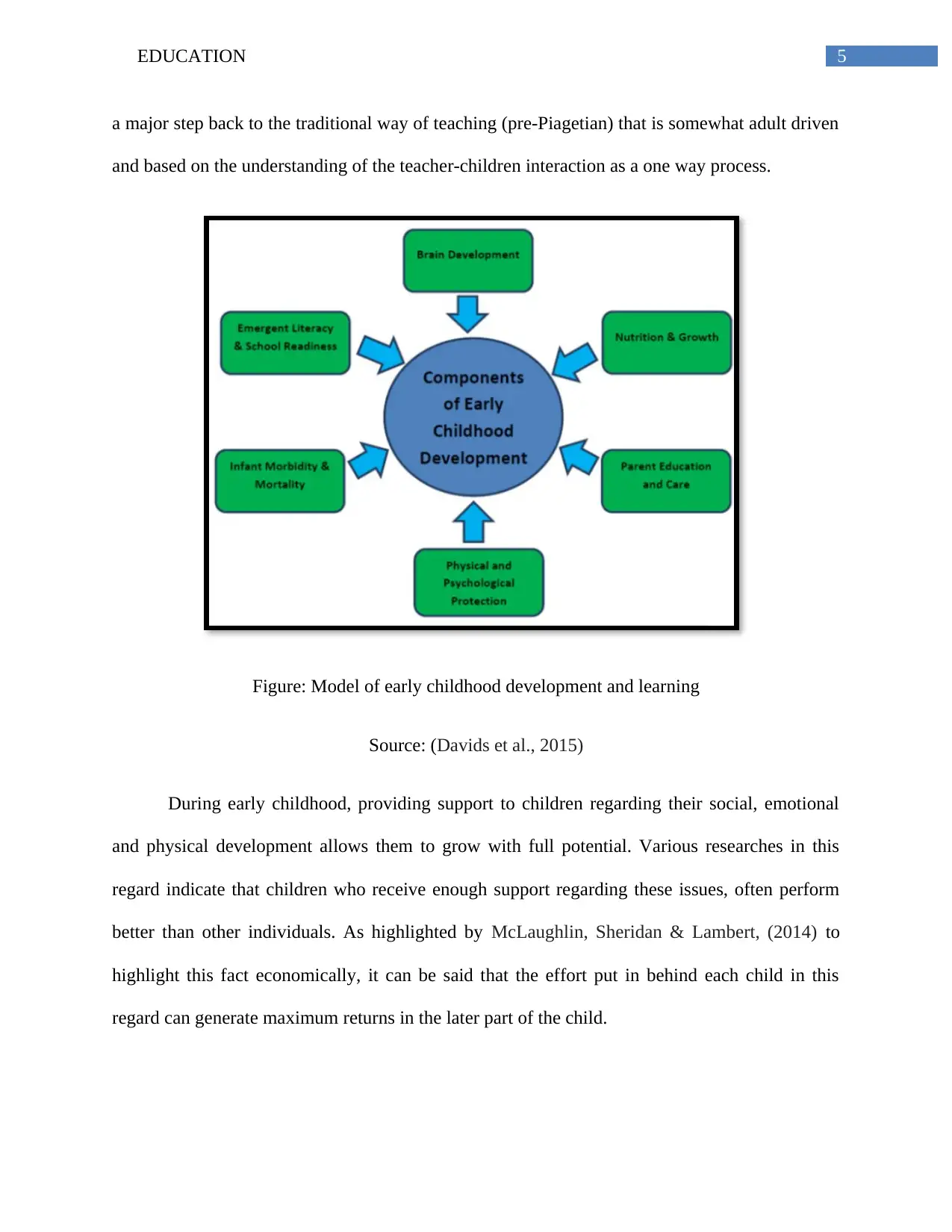
Figure: Model of early childhood development and learning
Source: (Davids et al., 2015)
During early childhood, providing support to children regarding their social, emotional
and physical development allows them to grow with full potential. Various researches in this
regard indicate that children who receive enough support regarding these issues, often perform
better than other individuals. As highlighted by McLaughlin, Sheridan & Lambert, (2014) to
highlight this fact economically, it can be said that the effort put in behind each child in this
regard can generate maximum returns in the later part of the child.
a major step back to the traditional way of teaching (pre-Piagetian) that is somewhat adult driven
and based on the understanding of the teacher-children interaction as a one way process.
Figure: Model of early childhood development and learning
Source: (Davids et al., 2015)
During early childhood, providing support to children regarding their social, emotional
and physical development allows them to grow with full potential. Various researches in this
regard indicate that children who receive enough support regarding these issues, often perform
better than other individuals. As highlighted by McLaughlin, Sheridan & Lambert, (2014) to
highlight this fact economically, it can be said that the effort put in behind each child in this
regard can generate maximum returns in the later part of the child.
⊘ This is a preview!⊘
Do you want full access?
Subscribe today to unlock all pages.
Trusted by 1+ million students worldwide
6EDUCATION
Providing
In most cases, the children are generally curious regarding their surroundings and they
want to take part in activities that would help him or her to learn. As stated by Devine & Hughes,
(2014) somehow, it might appear difficult to figure out what can possibly motivate them to get
engaged totally. When the teachers or the practitioners pay attention to what the children want to
do and want to convey, then only he or she would be able to understand what the individual
needs of those children are and what are the motivation that are driving them to get fully engaged
in learning activities. As stated by Nutbrown & Clough, (2014) the duty of the practitioner in this
context would be to identify a particular topic or a question that the children are interested to
investigate. These kinds of activities would immensely help the personnel to identify the
individual needs of the children. Every child is unique and their needs should be different. To
help them develop with their full potential, identifying their unique needs are much more
essential than anything.
In the age of 0 to 5 if a child gets to play with the peers along with the adults, it would
enable him or her to get many opportunities to learn. In this way, even the toddlers get the
emotional and cognitive benefit from interacting with other individuals. As McLaughlin,
Sheridan & Lambert, (2014) stated, the environment that is socially interactive would allow a
child to develop social intelligence, creative, language skills and of course confidence. In today’s
world, there are many specific environments that allow children to interact with others, like a
play date, organized activities, or in the home. It can be said that some of the best learning
activity would be spending time and interacting with an adult. This process can definitely help
the child to develop some strong social skills that would help him to develop further in teenage
(Davids et al., 2015). Apart from that, under an adult’s supervision, a child In most cases,
Providing
In most cases, the children are generally curious regarding their surroundings and they
want to take part in activities that would help him or her to learn. As stated by Devine & Hughes,
(2014) somehow, it might appear difficult to figure out what can possibly motivate them to get
engaged totally. When the teachers or the practitioners pay attention to what the children want to
do and want to convey, then only he or she would be able to understand what the individual
needs of those children are and what are the motivation that are driving them to get fully engaged
in learning activities. As stated by Nutbrown & Clough, (2014) the duty of the practitioner in this
context would be to identify a particular topic or a question that the children are interested to
investigate. These kinds of activities would immensely help the personnel to identify the
individual needs of the children. Every child is unique and their needs should be different. To
help them develop with their full potential, identifying their unique needs are much more
essential than anything.
In the age of 0 to 5 if a child gets to play with the peers along with the adults, it would
enable him or her to get many opportunities to learn. In this way, even the toddlers get the
emotional and cognitive benefit from interacting with other individuals. As McLaughlin,
Sheridan & Lambert, (2014) stated, the environment that is socially interactive would allow a
child to develop social intelligence, creative, language skills and of course confidence. In today’s
world, there are many specific environments that allow children to interact with others, like a
play date, organized activities, or in the home. It can be said that some of the best learning
activity would be spending time and interacting with an adult. This process can definitely help
the child to develop some strong social skills that would help him to develop further in teenage
(Davids et al., 2015). Apart from that, under an adult’s supervision, a child In most cases,
Paraphrase This Document
Need a fresh take? Get an instant paraphrase of this document with our AI Paraphraser

7EDUCATION
children tend to form attachments with the individuals who take care of them and children make
attachments with both male and female care givers. Children may have attachments with
multiple individuals. For an example, it can be said that in Africa, the father or mother of the
child may not be the primary individuals with whom the child can make attachments. Just like a
child who belongs to a joint extended family, can form attachments with people who are not his
or her parents, but members of the family (Aboud & Yousafzai, 2015). When a child is able to
form a secure attachment with some individuals within first 2 or 3 years of his or her life, then
the attachment can help the child to develop more swiftly and get the most benefits from the
situation. In this way, a child can happily accept all types of phases in their path of development,
and those are language, cognitive, moral, social and emotional skills. As disclosed by Devine &
Hughes, (2014) having a great attachment with individuals would enable a child to develop
strong self confidence and trust that would allow him to learn and examine more things and the
power to interact more with the peers and adults. In this way, the children can depend on the
adults at the time of any types of discomfort. When the children are at the toddler phase, they
show lesser undesired behaviors and generally gets along with the social norms and expectations
of the adults of the society.
When children does not get enough attachment with the adults, they would naturally get
inclined towards having trust issues with others and expect more negative responses from the
adults (Campbell et al., 2014). Various types of doubts would affect the motion of learning of the
children. In this way, a child might show undesired behavior even challenging behavior under
some circumstances and show lack of emotional control. As stated by Jones, Greenberg &
Crowley, (2015) it is a matter of fact that if a child majorly gets deprived of any kinds of
attachments with the adults, he or she would not be able to develop social and emotional skills
children tend to form attachments with the individuals who take care of them and children make
attachments with both male and female care givers. Children may have attachments with
multiple individuals. For an example, it can be said that in Africa, the father or mother of the
child may not be the primary individuals with whom the child can make attachments. Just like a
child who belongs to a joint extended family, can form attachments with people who are not his
or her parents, but members of the family (Aboud & Yousafzai, 2015). When a child is able to
form a secure attachment with some individuals within first 2 or 3 years of his or her life, then
the attachment can help the child to develop more swiftly and get the most benefits from the
situation. In this way, a child can happily accept all types of phases in their path of development,
and those are language, cognitive, moral, social and emotional skills. As disclosed by Devine &
Hughes, (2014) having a great attachment with individuals would enable a child to develop
strong self confidence and trust that would allow him to learn and examine more things and the
power to interact more with the peers and adults. In this way, the children can depend on the
adults at the time of any types of discomfort. When the children are at the toddler phase, they
show lesser undesired behaviors and generally gets along with the social norms and expectations
of the adults of the society.
When children does not get enough attachment with the adults, they would naturally get
inclined towards having trust issues with others and expect more negative responses from the
adults (Campbell et al., 2014). Various types of doubts would affect the motion of learning of the
children. In this way, a child might show undesired behavior even challenging behavior under
some circumstances and show lack of emotional control. As stated by Jones, Greenberg &
Crowley, (2015) it is a matter of fact that if a child majorly gets deprived of any kinds of
attachments with the adults, he or she would not be able to develop social and emotional skills
8EDUCATION
just like the other children develop with time. In this context, role of the adults in the life of the
infants are immense and irreplaceable. As highlighted by McLaughlin, Sheridan & Lambert,
(2014) the disruptions faced in the early life regarding the process of making attachments with
adults might have a major consequence and that child might not become a good example of adult
while making attachments with the children.
In this context, it is worth mentioning that when an infant is neglected and does not
develop attachment with adults, he or she would not be able to regulate his own feelings and will
surely show some challenging behaviors in the later part of his life (Davids et al., 2015). It is
seen that the ‘social’ part of the human brain starts developing at the age of 6 months and when a
child does not get any form of attention, the social part of his brain might not develop like others;
bringing in various issues for the child and for the family members of that child. According to
various statistics in this field it is seen that currently the 40% of the children are deprived of the
attachments with the adults and this situation is concerning (Bowes & Grace, 2014). Thus in this
context, it can be said that in order to change the society for good, it would be necessary to put in
extra effort to allow the children to develop more swiftly, as they are the future of the society.
As stated by Nutbrown & Clough, (2014) building play equipments and play
environments for children is necessary for them to develop the needed skills, like social,
emotional and physical skills. It is a fact that there are a range of opportunities in the
environment that would allow the children to receive a proper atmosphere to develop, provide
entertainment, information, rewards and most importantly education at all the levels appropriate
for children (Colombo, 2014). The prospects of designing suitable environment for the
development of children might be intimidating for many individuals, as in most cases they
themselves are not sure about how to start and how to carry on the activities. The development of
just like the other children develop with time. In this context, role of the adults in the life of the
infants are immense and irreplaceable. As highlighted by McLaughlin, Sheridan & Lambert,
(2014) the disruptions faced in the early life regarding the process of making attachments with
adults might have a major consequence and that child might not become a good example of adult
while making attachments with the children.
In this context, it is worth mentioning that when an infant is neglected and does not
develop attachment with adults, he or she would not be able to regulate his own feelings and will
surely show some challenging behaviors in the later part of his life (Davids et al., 2015). It is
seen that the ‘social’ part of the human brain starts developing at the age of 6 months and when a
child does not get any form of attention, the social part of his brain might not develop like others;
bringing in various issues for the child and for the family members of that child. According to
various statistics in this field it is seen that currently the 40% of the children are deprived of the
attachments with the adults and this situation is concerning (Bowes & Grace, 2014). Thus in this
context, it can be said that in order to change the society for good, it would be necessary to put in
extra effort to allow the children to develop more swiftly, as they are the future of the society.
As stated by Nutbrown & Clough, (2014) building play equipments and play
environments for children is necessary for them to develop the needed skills, like social,
emotional and physical skills. It is a fact that there are a range of opportunities in the
environment that would allow the children to receive a proper atmosphere to develop, provide
entertainment, information, rewards and most importantly education at all the levels appropriate
for children (Colombo, 2014). The prospects of designing suitable environment for the
development of children might be intimidating for many individuals, as in most cases they
themselves are not sure about how to start and how to carry on the activities. The development of
⊘ This is a preview!⊘
Do you want full access?
Subscribe today to unlock all pages.
Trusted by 1+ million students worldwide
9EDUCATION
children is directly related to the ability to have an interaction with the surrounding environment;
that will have a sustained interest for the children across time.
Very often many misunderstood children taking risks through playful activities in their
learning procedure. Aboud & Yousafzai, (2015) states that, such activities help children with
various opportunities for encountering or creating potential unpredictable hazards as a distinctive
part of their regular activities through playing. Devine & Hughes, (2014) highlighted, these do
not harm children, rather these hazards and risks in their learning process tend to engage and
further challenge their development, and therefore it supports their learning, growth and further
development. As stated by Jones, Greenberg & Crowley, (2015) taking risks may also include
loosing something which may provide them the opportunity of destroying and further creating
the constructions they have already made using their creativity, skill and imagination. However
the teachers and caregivers should ensure that children are not provided with bad risks which
may include sharp edges or pointed equipments which may hurt them eventually. As stated by
Nutbrown & Clough, (2014) it should also be noted that providing such situations with good
risks for enhancing the leaning abilities of children can vary from child to child; therefore the
teachers should identify their capabilities first for supporting them in taking suitable risks.
If children are provided risks at the early age through their learning and developmental
activities, they tend to identify the risks in their later life as well. Also they tend to develop the
capabilities of managing such risks as a significant part of their growing up. Through such
activities, children tend to learn about potential risks and using their initiatives for tackling them.
As stated by Campbell et al., (2014) if children are not being allowed for exploring and learning,
they may not learn how to judge these risks and managing on their own. They tend to develop
children is directly related to the ability to have an interaction with the surrounding environment;
that will have a sustained interest for the children across time.
Very often many misunderstood children taking risks through playful activities in their
learning procedure. Aboud & Yousafzai, (2015) states that, such activities help children with
various opportunities for encountering or creating potential unpredictable hazards as a distinctive
part of their regular activities through playing. Devine & Hughes, (2014) highlighted, these do
not harm children, rather these hazards and risks in their learning process tend to engage and
further challenge their development, and therefore it supports their learning, growth and further
development. As stated by Jones, Greenberg & Crowley, (2015) taking risks may also include
loosing something which may provide them the opportunity of destroying and further creating
the constructions they have already made using their creativity, skill and imagination. However
the teachers and caregivers should ensure that children are not provided with bad risks which
may include sharp edges or pointed equipments which may hurt them eventually. As stated by
Nutbrown & Clough, (2014) it should also be noted that providing such situations with good
risks for enhancing the leaning abilities of children can vary from child to child; therefore the
teachers should identify their capabilities first for supporting them in taking suitable risks.
If children are provided risks at the early age through their learning and developmental
activities, they tend to identify the risks in their later life as well. Also they tend to develop the
capabilities of managing such risks as a significant part of their growing up. Through such
activities, children tend to learn about potential risks and using their initiatives for tackling them.
As stated by Campbell et al., (2014) if children are not being allowed for exploring and learning,
they may not learn how to judge these risks and managing on their own. They tend to develop
Paraphrase This Document
Need a fresh take? Get an instant paraphrase of this document with our AI Paraphraser
10EDUCATION
skills through such activities and it may also form a powerful prevention in different other
situation where they are in serious risks.
It is also quite important that the children get regular and frequent opportunities for
exploring and leaning both in the outdoor and indoor environments. Provide essential and
significant opportunities for children mostly takes place in the outdoor environment, therefore it
should never be considered as something optional. As highlighted by McLaughlin, Sheridan &
Lambert, (2014) the recent cultural shift in the society has reduced chances for children going
outdoors, however with effective care and appropriate safety measures, the children can be
provided with numbers of opportunities and experiences in their outdoor learning environment as
well. Bowes & Grace, (2014) has indicated that the human beings tend to develop the
capabilities in some predictable situations all through their lives, therefore with the course of
time; new capabilities emerge along with their maturity. Therefore positive and frequent
interactions and providing different kinds of learning opportunities help them to develop a
unique personality (Devine & Hughes, 2014). There are also times when things are learnt best
from the practical experiences; therefore the developmental experiences are essential for
children. The practitioners should provide more opportunities and experiences for learning as it
would help them to interact with the natural world and it would further offer them more unique
experiences. As opined by Jones, Greenberg & Crowley, (2015) this would also help them to
develop and enhance their skills for problem solving and helps them by nurturing the creativities.
Along with that, these experiences also provide children rich opportunities for nurturing their
inventiveness, imagination and resourcefulness.
skills through such activities and it may also form a powerful prevention in different other
situation where they are in serious risks.
It is also quite important that the children get regular and frequent opportunities for
exploring and leaning both in the outdoor and indoor environments. Provide essential and
significant opportunities for children mostly takes place in the outdoor environment, therefore it
should never be considered as something optional. As highlighted by McLaughlin, Sheridan &
Lambert, (2014) the recent cultural shift in the society has reduced chances for children going
outdoors, however with effective care and appropriate safety measures, the children can be
provided with numbers of opportunities and experiences in their outdoor learning environment as
well. Bowes & Grace, (2014) has indicated that the human beings tend to develop the
capabilities in some predictable situations all through their lives, therefore with the course of
time; new capabilities emerge along with their maturity. Therefore positive and frequent
interactions and providing different kinds of learning opportunities help them to develop a
unique personality (Devine & Hughes, 2014). There are also times when things are learnt best
from the practical experiences; therefore the developmental experiences are essential for
children. The practitioners should provide more opportunities and experiences for learning as it
would help them to interact with the natural world and it would further offer them more unique
experiences. As opined by Jones, Greenberg & Crowley, (2015) this would also help them to
develop and enhance their skills for problem solving and helps them by nurturing the creativities.
Along with that, these experiences also provide children rich opportunities for nurturing their
inventiveness, imagination and resourcefulness.
11EDUCATION
Prescribing
It is quite essential for the educational practitioners to understand that each of the
students are unique, and their developmental activities should be drawn in accordance to their
unique skills and abilities (Chen, 2014). This is a major reason for making prescribing more
important. Through this procedure, the teachers tend to figure out the hindrances in the learning
procedure of a child and employ effective teaching methods which aim to deal with those issues.
With more intensified understanding of the learning disabilities and multiple intelligences, the
professional educators can find more applications of prescribed teaching.
The key of having an effectual response to the most important issues in the
developmental stages of a child only begins with a precise understanding and diagnosing the
major problems. If the educator has failed to diagnose the issues or makes a flawed diagnosis, it
is nearly impossible to make the effective prescription. If there is any child who has been
identified with some kind of learning disabilities by their teachers, there should be an effective
prescribed training and development session (Campbell et al., 2014). In order to do that, the
educators have to watch the children carefully and find out where exactly they are struggling and
what the easy ones for them are. They can also ask several questions for making the meta-
cognitive process of the children and keep a record of these observations. For making the right
prescribed teaching process, the educators should also have a profound understanding of the
learning mechanics of a specific subject and understand particular teaching tactics for dealing
with them. Some issues may seem to be quite simple; on the other hand, there are some
complicated obstructions in the learning procedure as well, such as, dysgraphia or dyslexia. In
such situations, the educators should do effective research for the educational pedagogies and
determine behavioral goals for students that can be measurable as well.
Prescribing
It is quite essential for the educational practitioners to understand that each of the
students are unique, and their developmental activities should be drawn in accordance to their
unique skills and abilities (Chen, 2014). This is a major reason for making prescribing more
important. Through this procedure, the teachers tend to figure out the hindrances in the learning
procedure of a child and employ effective teaching methods which aim to deal with those issues.
With more intensified understanding of the learning disabilities and multiple intelligences, the
professional educators can find more applications of prescribed teaching.
The key of having an effectual response to the most important issues in the
developmental stages of a child only begins with a precise understanding and diagnosing the
major problems. If the educator has failed to diagnose the issues or makes a flawed diagnosis, it
is nearly impossible to make the effective prescription. If there is any child who has been
identified with some kind of learning disabilities by their teachers, there should be an effective
prescribed training and development session (Campbell et al., 2014). In order to do that, the
educators have to watch the children carefully and find out where exactly they are struggling and
what the easy ones for them are. They can also ask several questions for making the meta-
cognitive process of the children and keep a record of these observations. For making the right
prescribed teaching process, the educators should also have a profound understanding of the
learning mechanics of a specific subject and understand particular teaching tactics for dealing
with them. Some issues may seem to be quite simple; on the other hand, there are some
complicated obstructions in the learning procedure as well, such as, dysgraphia or dyslexia. In
such situations, the educators should do effective research for the educational pedagogies and
determine behavioral goals for students that can be measurable as well.
⊘ This is a preview!⊘
Do you want full access?
Subscribe today to unlock all pages.
Trusted by 1+ million students worldwide

1 out of 19


Related Documents


Your All-in-One AI-Powered Toolkit for Academic Success.
+13062052269
info@desklib.com
Available 24*7 on WhatsApp / Email
![[object Object]](/_next/static/media/star-bottom.7253800d.svg)
Unlock your academic potential
Copyright © 2020–2026 A2Z Services. All Rights Reserved. Developed and managed by ZUCOL.