Management Report: Promoting Informal Learning in Work Organizations
VerifiedAdded on 2022/08/27
|15
|3656
|33
Report
AI Summary
This report, prepared for the CEO of a medium-sized company, investigates the promotion of informal learning within work organizations. It begins by defining informal learning and contrasting it with formal learning, then explores informal learning behaviors and relevant theories, including tacit and situated learning. The report also examines individual characteristics that enable informal learning, such as learning orientation and self-efficacy, as well as workplace factors that support it. Furthermore, it outlines the benefits of informal learning for both organizations and employees, such as increased productivity and employee satisfaction, while also acknowledging its limitations. The report concludes with recommendations for implementing effective informal learning strategies and is supported by references to high-quality literature, providing evidence-based practices for fostering a culture of continuous learning within the company, despite financial constraints on formal training programs.
Running head: MANAGEMENT
Developing Strategic Management and Leadership Skills
4/4/2020
Developing Strategic Management and Leadership Skills
4/4/2020

Paraphrase This Document
Need a fresh take? Get an instant paraphrase of this document with our AI Paraphraser
MANAGEMENT 1
Table of Contents
Introduction......................................................................................................................................2
Informal learning..........................................................................................................................2
Informal Learning Behavior.........................................................................................................3
Theories of Informal Learning Process........................................................................................4
Tacit Knowledge......................................................................................................................4
Situated Learning.....................................................................................................................5
Individual Characteristics that enable informal learning.............................................................5
Workplace factors enable informal learning................................................................................7
Benefits of Informal Learning for Organization..........................................................................7
Benefits of Informal Learning for Employees.............................................................................8
Limitations of informal learning..................................................................................................9
Recommendations......................................................................................................................10
Conclusion.....................................................................................................................................11
References......................................................................................................................................12
Table of Contents
Introduction......................................................................................................................................2
Informal learning..........................................................................................................................2
Informal Learning Behavior.........................................................................................................3
Theories of Informal Learning Process........................................................................................4
Tacit Knowledge......................................................................................................................4
Situated Learning.....................................................................................................................5
Individual Characteristics that enable informal learning.............................................................5
Workplace factors enable informal learning................................................................................7
Benefits of Informal Learning for Organization..........................................................................7
Benefits of Informal Learning for Employees.............................................................................8
Limitations of informal learning..................................................................................................9
Recommendations......................................................................................................................10
Conclusion.....................................................................................................................................11
References......................................................................................................................................12
MANAGEMENT 2
Introduction
The aim of this paper is to promote informal learning in the work organizations due to
which this report is being prepared such that the knowledge of the employees within the
company can be increased related to the topic and the same can be used in the successful
operation of the business. This report is comprised of different parts such as the concept of
informal learning, information learning behaviors, and theories for explaining the procedure of
informal learning. Besides this, the paper is also discussing the individual characteristics that
allow information learning and factors at the workplace that enables information learning. In the
end, the report is also highlighting the informal learning benefits for the employees and
organizations and the limitations of the same such that it can be properly applied and followed in
the business. In order to identify all this information, the use of secondary data has been done in
order to identify the theoretical background of the topic that has been already published in
different sources like books, journals, websites, and articles.
Informal learning
It is a learning that is unstructured and occurs away from the setting of the formal
learning or traditional learning such as a classroom. This type of learning does not have specific
objectives because it is mostly unplanned as well as directed by the learner only. In other words,
informal learning is the one that is done away from the formal classroom environment (Training
Industry, 2020). This learning comes in diverse forms like self-study, chat rooms, and forums,
viewing videos, games and coaching sessions, performance support, etc. Informal learning is
called to be one form of asynchronous learning. It is a learning style in which the objectives and
goals are set by the learner. There are some hallmarks of the informal learning that helps in
differentiating it from formal learning (Callanan, Cervantes & Loomis, 2011). One of the keys is
Introduction
The aim of this paper is to promote informal learning in the work organizations due to
which this report is being prepared such that the knowledge of the employees within the
company can be increased related to the topic and the same can be used in the successful
operation of the business. This report is comprised of different parts such as the concept of
informal learning, information learning behaviors, and theories for explaining the procedure of
informal learning. Besides this, the paper is also discussing the individual characteristics that
allow information learning and factors at the workplace that enables information learning. In the
end, the report is also highlighting the informal learning benefits for the employees and
organizations and the limitations of the same such that it can be properly applied and followed in
the business. In order to identify all this information, the use of secondary data has been done in
order to identify the theoretical background of the topic that has been already published in
different sources like books, journals, websites, and articles.
Informal learning
It is a learning that is unstructured and occurs away from the setting of the formal
learning or traditional learning such as a classroom. This type of learning does not have specific
objectives because it is mostly unplanned as well as directed by the learner only. In other words,
informal learning is the one that is done away from the formal classroom environment (Training
Industry, 2020). This learning comes in diverse forms like self-study, chat rooms, and forums,
viewing videos, games and coaching sessions, performance support, etc. Informal learning is
called to be one form of asynchronous learning. It is a learning style in which the objectives and
goals are set by the learner. There are some hallmarks of the informal learning that helps in
differentiating it from formal learning (Callanan, Cervantes & Loomis, 2011). One of the keys is
⊘ This is a preview!⊘
Do you want full access?
Subscribe today to unlock all pages.

Trusted by 1+ million students worldwide
MANAGEMENT 3
that it is not planned. It takes place naturally when the learner hesitates with the learning
situation. Informal learning is one of the effective strategies at workplace that aid in increasing
the knowledge of the employees.
Informal Learning Behavior
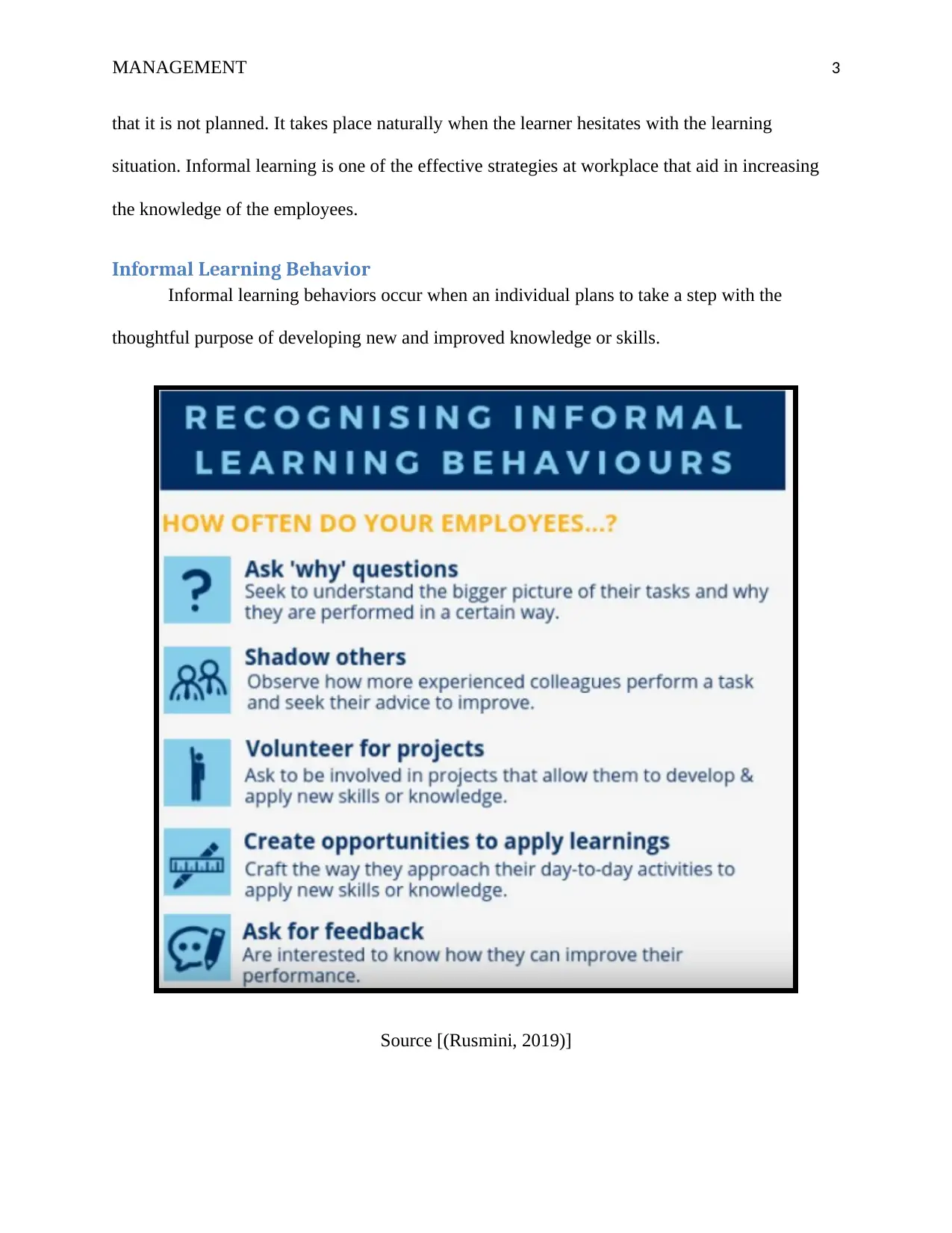
Informal learning behaviors occur when an individual plans to take a step with the
thoughtful purpose of developing new and improved knowledge or skills.
Source [(Rusmini, 2019)]
that it is not planned. It takes place naturally when the learner hesitates with the learning
situation. Informal learning is one of the effective strategies at workplace that aid in increasing
the knowledge of the employees.
Informal Learning Behavior
Informal learning behaviors occur when an individual plans to take a step with the
thoughtful purpose of developing new and improved knowledge or skills.
Source [(Rusmini, 2019)]
Paraphrase This Document
Need a fresh take? Get an instant paraphrase of this document with our AI Paraphraser
MANAGEMENT 4
As per the research conducted by Cerosoli and colleagues identified that individuals who
work to take edge to get involve in the informal learning behaviors may get improved skills and
better knowledge (Rusmini, 2019). Due to the cross-sectional nature of most of the studies
related to this topic, it cannot be assumed that the informal learning behavior leads to improved
performance but it can be concluded that individuals who are high performer plan to take their
own actions for skill development beyond formal learning sessions (Cerasoli, et al, 2018).
Theories of Informal Learning Process
Tacit Knowledge
The path of this theory shows the concept of informal learning as implicit learning. This
results in the tacit knowledge which means an individual knows but cannot tell. The discussion
presented by Eraut related to informal learning is related to recognizing diverse types of
circumstances in which the tacit knowledge can be used or gained. There are six situations;
Knowledge gained by implicit learning and the knower is unaware;
Knowledge is developed from the combination of episodes in the long-run memory;
Knowledge inferred by the observers in order to be accomplished of representation as
implicit theories of action, schemas, personal constructs, etc.;
The knowledge that allows quick, instinctive knowledge or response;
Knowledge involved in transmitting knowledge from one to another situation;
Knowledge entrenched in taken-for-granted actions, insights, and standards (Eraut,
2004).
Tacit knowledge offers a foundation for the way people communicate with the situations and
other people. It has been believed that people have a habit of ‘taken-for-granted’ of others. This
is because it is not investigated in any clear manner and this knowledge could be self-
As per the research conducted by Cerosoli and colleagues identified that individuals who
work to take edge to get involve in the informal learning behaviors may get improved skills and
better knowledge (Rusmini, 2019). Due to the cross-sectional nature of most of the studies
related to this topic, it cannot be assumed that the informal learning behavior leads to improved
performance but it can be concluded that individuals who are high performer plan to take their
own actions for skill development beyond formal learning sessions (Cerasoli, et al, 2018).
Theories of Informal Learning Process
Tacit Knowledge
The path of this theory shows the concept of informal learning as implicit learning. This
results in the tacit knowledge which means an individual knows but cannot tell. The discussion
presented by Eraut related to informal learning is related to recognizing diverse types of
circumstances in which the tacit knowledge can be used or gained. There are six situations;
Knowledge gained by implicit learning and the knower is unaware;
Knowledge is developed from the combination of episodes in the long-run memory;
Knowledge inferred by the observers in order to be accomplished of representation as
implicit theories of action, schemas, personal constructs, etc.;
The knowledge that allows quick, instinctive knowledge or response;
Knowledge involved in transmitting knowledge from one to another situation;
Knowledge entrenched in taken-for-granted actions, insights, and standards (Eraut,
2004).
Tacit knowledge offers a foundation for the way people communicate with the situations and
other people. It has been believed that people have a habit of ‘taken-for-granted’ of others. This
is because it is not investigated in any clear manner and this knowledge could be self-
MANAGEMENT 5
perpetuating and result in the behavior that is not suitable, or unproductive. This is considered to
be a convincing argument for the examination of implicit learning. The time it is revealed it can
be developed and tested. Not unexpectedly, there are main problems with this procedure (Infed,
2019).
It is also important to identify the reverse procedure that is of developing explicit
knowledge tacit. At this place, people can learn practices and habits for dealing with the
circumstances. This can lead to emerging capabilities to touch-type to be capable of responding
to the circumstances quickly – for instance dealing with the medical emergency.
Situated Learning
Under this theory, informal learning is observed as the expression of situated learning.
This grabs the attention towards learning being the internal or in the skin of an individual.
Learning encompasses the person and it is not a relation to particular activities. It is a relation
with the community which implies it becoming a complete participant a person. According to
this viewpoint, learning partially and mostly incidentally implies becoming capable to be
comprised of new activities, for performing new functions as well as tasks, to direct new
understandings. Understandings, functions, tasks, and activities are not available in the isolation,
they are considered to be a portion of the wider system of relations with meaning (Infed, 2019).
Individual Characteristics that enable informal learning
As per the recent empirical study on informal learning, the topic got progress on
understanding the personal and work environment characteristics that focus on promoting the
inhibit engagement in the activities of informal learning. As per the statement presented by
Manuti, Pastore, Scardigno, Giancaspro & Morciano, 2015), there are seven characteristics like
the love of learning, professional commitment, self-efficacy, nurturing personality, interest in the
perpetuating and result in the behavior that is not suitable, or unproductive. This is considered to
be a convincing argument for the examination of implicit learning. The time it is revealed it can
be developed and tested. Not unexpectedly, there are main problems with this procedure (Infed,
2019).
It is also important to identify the reverse procedure that is of developing explicit
knowledge tacit. At this place, people can learn practices and habits for dealing with the
circumstances. This can lead to emerging capabilities to touch-type to be capable of responding
to the circumstances quickly – for instance dealing with the medical emergency.
Situated Learning
Under this theory, informal learning is observed as the expression of situated learning.
This grabs the attention towards learning being the internal or in the skin of an individual.
Learning encompasses the person and it is not a relation to particular activities. It is a relation
with the community which implies it becoming a complete participant a person. According to
this viewpoint, learning partially and mostly incidentally implies becoming capable to be
comprised of new activities, for performing new functions as well as tasks, to direct new
understandings. Understandings, functions, tasks, and activities are not available in the isolation,
they are considered to be a portion of the wider system of relations with meaning (Infed, 2019).
Individual Characteristics that enable informal learning
As per the recent empirical study on informal learning, the topic got progress on
understanding the personal and work environment characteristics that focus on promoting the
inhibit engagement in the activities of informal learning. As per the statement presented by
Manuti, Pastore, Scardigno, Giancaspro & Morciano, 2015), there are seven characteristics like
the love of learning, professional commitment, self-efficacy, nurturing personality, interest in the
⊘ This is a preview!⊘
Do you want full access?
Subscribe today to unlock all pages.
Trusted by 1+ million students worldwide
MANAGEMENT 6
profession, and the outgoing personality inspire the motivation to get involved in the informal
learning. The factors of environment like organizational culture, inaccessibility to the subject
experts, less time to learn, and limitation of immediacy to others’ work areas are identified as the
inhibitors for the professionals to get involved in the informal learning.
Individual characteristics are determined as the personality, interest, traits, and abilities
about development and learning activities. Some of the major individual characteristics are
learning orientation, self-efficacy, and motivation.
The influence of motivation to engage in informal learning has yet not been explored, in
spite of the plentiful knowledge resultant from lessons about formal learning. But, Tannenbaum,
Beard, McNall & Salas (2010), recommends that people with high motivation and curiosity for
learning are considered to be more involved in self-directed learning.
Self-efficacy is determined as the judgment of an individual about his or her capability to
prosper in a challenge or task. Self-efficacy has also been identified to be positively associated
with actual contribution and purposes in the activities related to self-development. Self-efficacy
has gained continuous attention at learning at the workplace and considered to be the relevant
personal characteristic of the activities of informal learning.
Learning goal orientation is determined as the purpose to involve in the activities that are
challenging, keenness to enhance oneself, and a propensity to make use of the past performance
as the standard criteria for assessing the present performance. It is also theorized as an important
mental framework that is adopted by individuals to understand and act in the activities that are
learning-oriented (Raemdonck, Gijbels & van Groen, 2014).
profession, and the outgoing personality inspire the motivation to get involved in the informal
learning. The factors of environment like organizational culture, inaccessibility to the subject
experts, less time to learn, and limitation of immediacy to others’ work areas are identified as the
inhibitors for the professionals to get involved in the informal learning.
Individual characteristics are determined as the personality, interest, traits, and abilities
about development and learning activities. Some of the major individual characteristics are
learning orientation, self-efficacy, and motivation.
The influence of motivation to engage in informal learning has yet not been explored, in
spite of the plentiful knowledge resultant from lessons about formal learning. But, Tannenbaum,
Beard, McNall & Salas (2010), recommends that people with high motivation and curiosity for
learning are considered to be more involved in self-directed learning.
Self-efficacy is determined as the judgment of an individual about his or her capability to
prosper in a challenge or task. Self-efficacy has also been identified to be positively associated
with actual contribution and purposes in the activities related to self-development. Self-efficacy
has gained continuous attention at learning at the workplace and considered to be the relevant
personal characteristic of the activities of informal learning.
Learning goal orientation is determined as the purpose to involve in the activities that are
challenging, keenness to enhance oneself, and a propensity to make use of the past performance
as the standard criteria for assessing the present performance. It is also theorized as an important
mental framework that is adopted by individuals to understand and act in the activities that are
learning-oriented (Raemdonck, Gijbels & van Groen, 2014).
Paraphrase This Document
Need a fresh take? Get an instant paraphrase of this document with our AI Paraphraser
MANAGEMENT 7
Workplace factors enable informal learning
Work environment factors are defined as the insight of the practices in a company that is
likely to inhibit the engagement in the activities of workplace learning. The apparent work
environment factors are evaluated by the use of variables that are job characteristics, support of a
supervisor, and organizational support.
Organizational support is determined as the apparent support from the company for the
activities of informal learning regarding the policies, processes, and practices. Organizational
support is comprised of things like policies of the organization, rewards, suppliers, materials,
value of learning (Ellinger, 2005).
Supervisor support is determined as the apparent support from the managers for the
activities of workplace learning. The manager or the supervisor support is comprised of things
like heartening contribution in the activities of learning, allocating the projects or task for using
the skills or knowledge that are learned from the preceding activities of learning, offering
information about the learning activities, and organizing the work schedules for the learning.
Job characteristics are determined as the opinion related to the degree to which the
features entrenched in the job that enable activities of informal learning that are needed to
perform the job, comprising requirement to update the skills and knowledge, struggle in taking
part in the activities of learning, the meaning of proportional presentation, and the connection of
learning with the job performance (Choi & Jacobs, 2011).
Benefits of Informal Learning for Organization
Training – By providing access to the correct sources, an informal learner can most of
the time identify some good things on their own. They can get involved in mentoring and
training to their coworkers at the workplace. Assistance at the workplace is not just beneficial for
Workplace factors enable informal learning
Work environment factors are defined as the insight of the practices in a company that is
likely to inhibit the engagement in the activities of workplace learning. The apparent work
environment factors are evaluated by the use of variables that are job characteristics, support of a
supervisor, and organizational support.
Organizational support is determined as the apparent support from the company for the
activities of informal learning regarding the policies, processes, and practices. Organizational
support is comprised of things like policies of the organization, rewards, suppliers, materials,
value of learning (Ellinger, 2005).
Supervisor support is determined as the apparent support from the managers for the
activities of workplace learning. The manager or the supervisor support is comprised of things
like heartening contribution in the activities of learning, allocating the projects or task for using
the skills or knowledge that are learned from the preceding activities of learning, offering
information about the learning activities, and organizing the work schedules for the learning.
Job characteristics are determined as the opinion related to the degree to which the
features entrenched in the job that enable activities of informal learning that are needed to
perform the job, comprising requirement to update the skills and knowledge, struggle in taking
part in the activities of learning, the meaning of proportional presentation, and the connection of
learning with the job performance (Choi & Jacobs, 2011).
Benefits of Informal Learning for Organization
Training – By providing access to the correct sources, an informal learner can most of
the time identify some good things on their own. They can get involved in mentoring and
training to their coworkers at the workplace. Assistance at the workplace is not just beneficial for
MANAGEMENT 8
the business but it also develops a supportive work environment among colleagues. Businesses
can make use of this in order to increase productivity (Eraut, 2007).
Cheap in nature – Informal learning is not provided for free, it is a bit time consuming
for grabbing improved skill. However, the cost and resources that are used are lesser in
comparison to those that are used informal learning. In relation to the growth of the employees, it
is considered an investment with low-risk (Lynch, 2018).
It is empowering – If the employees in a company are allowed to investigate their
interest areas, they definitely get involved in good work. This was one of the famous theories of
Google that are 20% policy that was encouraging for the employees to offer their one day in a
week that needs to be contributed to a side project. After Google adopted this policy there is a
number of businesses that also adopted the same at their workplace.
Reinforces formal learning – Informal learning is not considered to be the substitute for
the formal learning. In its place, both the learnings go hand in hand. An employee who is
involved in the course of formal learning will undoubtedly identify information that is valuable
(Nikolova, Van Ruysseveldt, De Witte & Syroit, 2014).
Benefits of Informal Learning for Employees
Satisfies curiosity – Informal learning is most of the time considered as a distraction.
However, an individual with the habit of looking for the answers to the questions quickly feels
deadening in order to set that instinct aside until later. In fact, it has been identified that doing
this may add a mental pressure that impacts productivity in place of encouraging it (Skule,
2004).
the business but it also develops a supportive work environment among colleagues. Businesses
can make use of this in order to increase productivity (Eraut, 2007).
Cheap in nature – Informal learning is not provided for free, it is a bit time consuming
for grabbing improved skill. However, the cost and resources that are used are lesser in
comparison to those that are used informal learning. In relation to the growth of the employees, it
is considered an investment with low-risk (Lynch, 2018).
It is empowering – If the employees in a company are allowed to investigate their
interest areas, they definitely get involved in good work. This was one of the famous theories of
Google that are 20% policy that was encouraging for the employees to offer their one day in a
week that needs to be contributed to a side project. After Google adopted this policy there is a
number of businesses that also adopted the same at their workplace.
Reinforces formal learning – Informal learning is not considered to be the substitute for
the formal learning. In its place, both the learnings go hand in hand. An employee who is
involved in the course of formal learning will undoubtedly identify information that is valuable
(Nikolova, Van Ruysseveldt, De Witte & Syroit, 2014).
Benefits of Informal Learning for Employees
Satisfies curiosity – Informal learning is most of the time considered as a distraction.
However, an individual with the habit of looking for the answers to the questions quickly feels
deadening in order to set that instinct aside until later. In fact, it has been identified that doing
this may add a mental pressure that impacts productivity in place of encouraging it (Skule,
2004).
⊘ This is a preview!⊘
Do you want full access?
Subscribe today to unlock all pages.
Trusted by 1+ million students worldwide
MANAGEMENT 9
Informal learning is learner-driven and self-directed - As per the adult learning
theory, adults flourish at the time when learning is self-directed and controllable. Informal
learning provides control. They have the choice to choose the subjects of learning and hold a
greater chance of involving with the content because it is interesting and application to them.
Relaxed Experience – The type of formal learning is important but not always easy for
the learner. With the due dates, mandatory courses, assignments, and exams, it increases the
stress level for the workforce. However, informal learning is considered to be a laissez-faire
procedure and less likely to be a pain or tension for the learner (Carliner, 2012).
Expand the reference and knowledge of the employees – Offering required knowledge to the
workforce by the way of formal training is great. But, the time it is executed by the subject,
exports it is a myopic and only focus on particular points. The time an employee gets involved in
the research himself, he or she possibly explore new theories, procedures, and thoughts that
widen their knowledge.
Limitations of informal learning
Employees may get involve in wasting time – If the employees in the company are
allowed to learn according and provided the freedom to get involved in socialization, use the
internet, or look for the guidance of their superiors, they may lose the route or vision of their
objective and get involved in wasting their time (HR Development Info., 2020).
Knowledge is not shared – There are many chances that the workers may be unwilling
to share their skills they have gained by the experiences of informal learning.
No Evaluation or Goals – The integral meaning of informal learning is to have no
outlined particular and measured objectives. This leads to limiting the efficiency of the employee
Informal learning is learner-driven and self-directed - As per the adult learning
theory, adults flourish at the time when learning is self-directed and controllable. Informal
learning provides control. They have the choice to choose the subjects of learning and hold a
greater chance of involving with the content because it is interesting and application to them.
Relaxed Experience – The type of formal learning is important but not always easy for
the learner. With the due dates, mandatory courses, assignments, and exams, it increases the
stress level for the workforce. However, informal learning is considered to be a laissez-faire
procedure and less likely to be a pain or tension for the learner (Carliner, 2012).
Expand the reference and knowledge of the employees – Offering required knowledge to the
workforce by the way of formal training is great. But, the time it is executed by the subject,
exports it is a myopic and only focus on particular points. The time an employee gets involved in
the research himself, he or she possibly explore new theories, procedures, and thoughts that
widen their knowledge.
Limitations of informal learning
Employees may get involve in wasting time – If the employees in the company are
allowed to learn according and provided the freedom to get involved in socialization, use the
internet, or look for the guidance of their superiors, they may lose the route or vision of their
objective and get involved in wasting their time (HR Development Info., 2020).
Knowledge is not shared – There are many chances that the workers may be unwilling
to share their skills they have gained by the experiences of informal learning.
No Evaluation or Goals – The integral meaning of informal learning is to have no
outlined particular and measured objectives. This leads to limiting the efficiency of the employee
Paraphrase This Document
Need a fresh take? Get an instant paraphrase of this document with our AI Paraphraser
MANAGEMENT 10
training because the supervisor does not have an existing knowledge of the planned results, other
than just supporting the employees to learn about the job. Then, deprived of specified objectives,
evaluating the outcomes of the training is very tough. For instance, if the objective is to grow the
employee to a specific point where he or she can meet a specific sales target on a monthly basis
then the results can be measured. Deprived of goals, the manager will not be able to measure
success or progress (Kokemuller, 2017).
Recommendations
Considering the above discussion, it can be said that informal learning at the workplace is
beneficial but also holds some limitations for the employees as well as the organization. In the
case of a medium-sized company that has 150 staff members can adopt informal learning
activities in order to successfully educate its employees regarding the changing workplace. The
company can adopt informal learning at its place by allowing its employees to develop their
knowledge that can be beneficial for organizational development. This can help in identifying
new growth ideas and the employee’s development at a limited cost.
The medium-sized company can enhance informal learning at its workplace by adopting
Enterprise social media. ESM features endorse construction and recognition of the pertinent
information (Toure, Michel & Marty, 2020). Comments received over the social media platform
are a symbolic form of expression and also a tool of communication for the users to efficiently
judge the information quality and simply take part in the content construction. Certainly,
information that is gathered through the tools of informal learning changes and with time
becomes outdated.
training because the supervisor does not have an existing knowledge of the planned results, other
than just supporting the employees to learn about the job. Then, deprived of specified objectives,
evaluating the outcomes of the training is very tough. For instance, if the objective is to grow the
employee to a specific point where he or she can meet a specific sales target on a monthly basis
then the results can be measured. Deprived of goals, the manager will not be able to measure
success or progress (Kokemuller, 2017).
Recommendations
Considering the above discussion, it can be said that informal learning at the workplace is
beneficial but also holds some limitations for the employees as well as the organization. In the
case of a medium-sized company that has 150 staff members can adopt informal learning
activities in order to successfully educate its employees regarding the changing workplace. The
company can adopt informal learning at its place by allowing its employees to develop their
knowledge that can be beneficial for organizational development. This can help in identifying
new growth ideas and the employee’s development at a limited cost.
The medium-sized company can enhance informal learning at its workplace by adopting
Enterprise social media. ESM features endorse construction and recognition of the pertinent
information (Toure, Michel & Marty, 2020). Comments received over the social media platform
are a symbolic form of expression and also a tool of communication for the users to efficiently
judge the information quality and simply take part in the content construction. Certainly,
information that is gathered through the tools of informal learning changes and with time
becomes outdated.
MANAGEMENT 11
Conclusion
The above report has provided a detailed analysis of the informal learning along with its
advantages and limitations to the organization as well as employees. From the analysis, it has
been identified that informal learning is unstructured and occurs away from formal learning or
traditional learning settings such as a classroom. However, in today’s changing business
environment informal learning is considered to be very effective for the growth of the business
as well as of employees. It has been noticed that informal learning helps an employee to train his
or her coworker. Besides this, it is cheaper in comparison to the formal learning courses. The
informal learning can be provided at less cost however, it lacks in specific objective and goal that
is required to evaluate the outcome of the learning. In an informal learning, there are specific
objectives and goals that help in measuring the performance, but in informal learning, it is
missing due to which the employee can lose his or her vision. The individual informal learning
characteristics are self-efficacy, motivation, and learning goal orientation. In addition to this, the
report has also highlighted the workplace factors that allow informal learning that are
organizational structure, job characteristics, and supervisor support. At the end of the report, the
recommendation is provided related to improving informal learning. The report has
recommended that medium-sized companies can enhance informal learning at its workplace by
adopting Enterprise social media. This has been recommended because the symbols and signs
that are used over social media platforms effectively help in judging the quality of the
information.
Conclusion
The above report has provided a detailed analysis of the informal learning along with its
advantages and limitations to the organization as well as employees. From the analysis, it has
been identified that informal learning is unstructured and occurs away from formal learning or
traditional learning settings such as a classroom. However, in today’s changing business
environment informal learning is considered to be very effective for the growth of the business
as well as of employees. It has been noticed that informal learning helps an employee to train his
or her coworker. Besides this, it is cheaper in comparison to the formal learning courses. The
informal learning can be provided at less cost however, it lacks in specific objective and goal that
is required to evaluate the outcome of the learning. In an informal learning, there are specific
objectives and goals that help in measuring the performance, but in informal learning, it is
missing due to which the employee can lose his or her vision. The individual informal learning
characteristics are self-efficacy, motivation, and learning goal orientation. In addition to this, the
report has also highlighted the workplace factors that allow informal learning that are
organizational structure, job characteristics, and supervisor support. At the end of the report, the
recommendation is provided related to improving informal learning. The report has
recommended that medium-sized companies can enhance informal learning at its workplace by
adopting Enterprise social media. This has been recommended because the symbols and signs
that are used over social media platforms effectively help in judging the quality of the
information.
⊘ This is a preview!⊘
Do you want full access?
Subscribe today to unlock all pages.
Trusted by 1+ million students worldwide

1 out of 15


Related Documents


Your All-in-One AI-Powered Toolkit for Academic Success.
+13062052269
info@desklib.com
Available 24*7 on WhatsApp / Email
![[object Object]](/_next/static/media/star-bottom.7253800d.svg)
Unlock your academic potential
Copyright © 2020–2026 A2Z Services. All Rights Reserved. Developed and managed by ZUCOL.