Promoting Individual Informal Workplace Learning: System04121 Report
VerifiedAdded on 2022/10/09
|23
|5970
|22
Report
AI Summary
This report delves into the realm of informal workplace learning, exploring its significance and various forms, including self-study, video viewing, and reading articles. The report investigates how individuals acquire knowledge in the workplace through methods such as stretch assignments, Quora, mentoring, networking, job rotation, and gamification. It analyzes factors that either facilitate or hinder informal learning, such as time constraints and organizational culture. Furthermore, it examines the impact of individual characteristics like age and experience on learning effectiveness, while also outlining potential benefits for both employees and the organization. Finally, the report provides actionable recommendations to enhance informal learning, including goal-oriented strategies, microlearning repositories, active manager involvement, online mentoring programs, dedicated social media groups, corporate eLearning blogs, and real-world activity consolidation. The report concludes by emphasizing the importance of fostering a culture of continuous learning within the workplace.
Running Head: INFORMAL LEARNING IN A WORKPLACE
0
Promoting Individual
Informal Workplace
Learning
System04121
9/28/2019
0
Promoting Individual
Informal Workplace
Learning
System04121
9/28/2019

Paraphrase This Document
Need a fresh take? Get an instant paraphrase of this document with our AI Paraphraser
INFORMAL LEARNING IN A WORKPLACE
1
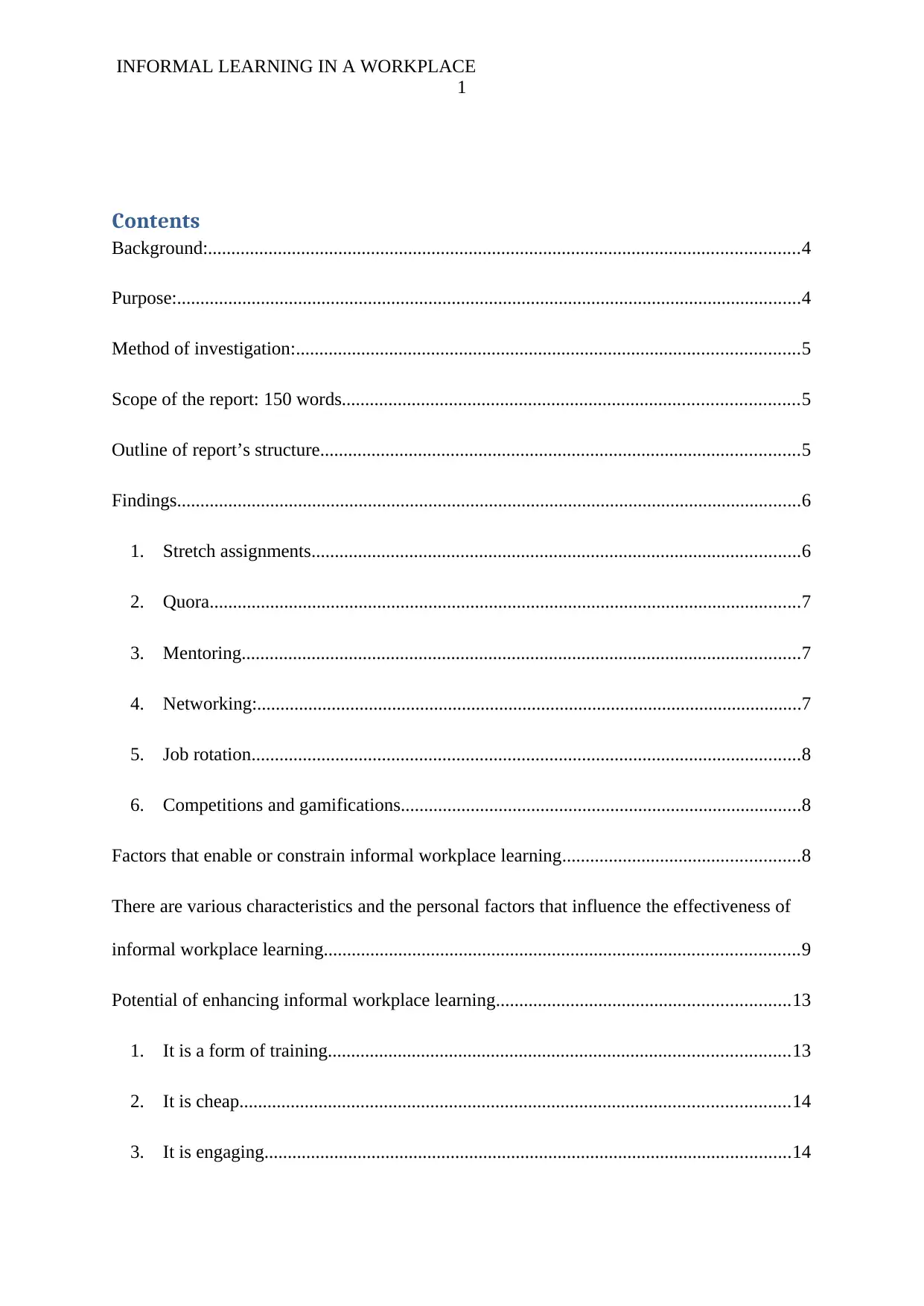
Contents
Background:...............................................................................................................................4
Purpose:......................................................................................................................................4
Method of investigation:............................................................................................................5
Scope of the report: 150 words..................................................................................................5
Outline of report’s structure.......................................................................................................5
Findings......................................................................................................................................6
1. Stretch assignments.........................................................................................................6
2. Quora...............................................................................................................................7
3. Mentoring........................................................................................................................7
4. Networking:.....................................................................................................................7
5. Job rotation......................................................................................................................8
6. Competitions and gamifications......................................................................................8
Factors that enable or constrain informal workplace learning...................................................8
There are various characteristics and the personal factors that influence the effectiveness of
informal workplace learning......................................................................................................9
Potential of enhancing informal workplace learning...............................................................13
1. It is a form of training...................................................................................................13
2. It is cheap......................................................................................................................14
3. It is engaging.................................................................................................................14
1
Contents
Background:...............................................................................................................................4
Purpose:......................................................................................................................................4
Method of investigation:............................................................................................................5
Scope of the report: 150 words..................................................................................................5
Outline of report’s structure.......................................................................................................5
Findings......................................................................................................................................6
1. Stretch assignments.........................................................................................................6
2. Quora...............................................................................................................................7
3. Mentoring........................................................................................................................7
4. Networking:.....................................................................................................................7
5. Job rotation......................................................................................................................8
6. Competitions and gamifications......................................................................................8
Factors that enable or constrain informal workplace learning...................................................8
There are various characteristics and the personal factors that influence the effectiveness of
informal workplace learning......................................................................................................9
Potential of enhancing informal workplace learning...............................................................13
1. It is a form of training...................................................................................................13
2. It is cheap......................................................................................................................14
3. It is engaging.................................................................................................................14
INFORMAL LEARNING IN A WORKPLACE
2
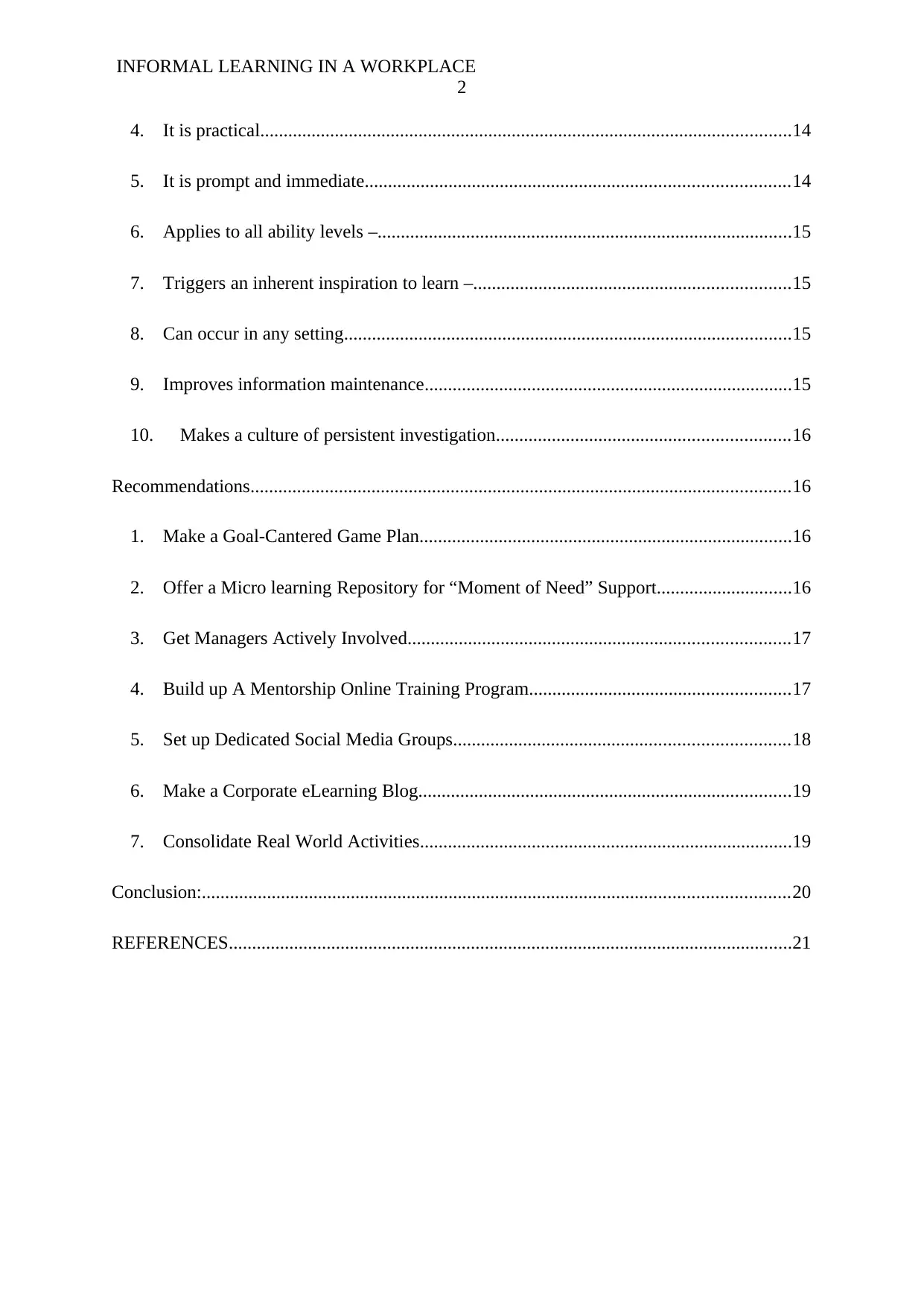
4. It is practical..................................................................................................................14
5. It is prompt and immediate...........................................................................................14
6. Applies to all ability levels –.........................................................................................15
7. Triggers an inherent inspiration to learn –....................................................................15
8. Can occur in any setting................................................................................................15
9. Improves information maintenance...............................................................................15
10. Makes a culture of persistent investigation...............................................................16
Recommendations....................................................................................................................16
1. Make a Goal-Cantered Game Plan................................................................................16
2. Offer a Micro learning Repository for “Moment of Need” Support.............................16
3. Get Managers Actively Involved..................................................................................17
4. Build up A Mentorship Online Training Program........................................................17
5. Set up Dedicated Social Media Groups........................................................................18
6. Make a Corporate eLearning Blog................................................................................19
7. Consolidate Real World Activities................................................................................19
Conclusion:..............................................................................................................................20
REFERENCES.........................................................................................................................21
2
4. It is practical..................................................................................................................14
5. It is prompt and immediate...........................................................................................14
6. Applies to all ability levels –.........................................................................................15
7. Triggers an inherent inspiration to learn –....................................................................15
8. Can occur in any setting................................................................................................15
9. Improves information maintenance...............................................................................15
10. Makes a culture of persistent investigation...............................................................16
Recommendations....................................................................................................................16
1. Make a Goal-Cantered Game Plan................................................................................16
2. Offer a Micro learning Repository for “Moment of Need” Support.............................16
3. Get Managers Actively Involved..................................................................................17
4. Build up A Mentorship Online Training Program........................................................17
5. Set up Dedicated Social Media Groups........................................................................18
6. Make a Corporate eLearning Blog................................................................................19
7. Consolidate Real World Activities................................................................................19
Conclusion:..............................................................................................................................20
REFERENCES.........................................................................................................................21
⊘ This is a preview!⊘
Do you want full access?
Subscribe today to unlock all pages.

Trusted by 1+ million students worldwide
INFORMAL LEARNING IN A WORKPLACE
3
Background:
Informal learning denotes to the learning that occurs from away through a formal,
structures and a formal environment. The informal have various different forms which
includes self-study, viewing the videos, reading article’s and etc. the informal learning is also
known as asynchronous learning. Informal learning is a particular flair of learning under
which the learners set their individual objectives and the goals. Apart from this the informal
learning is significant for the spontaneous form of the learning and it is sustained, driven and
triggered by the motivation and passion of a learner, it has various elements that also include
various kind of learning from reflection, evaluation and practice for the new aspects of the
interest. The informal learning is something that is very important for the performance of the
workers, it is more important than the formal learning and the training given to the
employees. Learning by doing is an automatic way of doing a creative way. New hires have
a sheer routine upsurge in their first year of work. Information spill overs among peers in the
workstation contribute to the productivity of the firm. This report will help in concentrating
on the informal learning and various ways in which it is important in a workplace.
Purpose:
The tenacity of this report is to find out as to how persons study in the workplace
through the processes of informal learning
To find out the workplace issues those allows or compel informal workplace learning?
To find out the individual features (e.g., personality characteristics) that influences the
effectiveness of informal workplace knowledge
To find out if some individuals are better equipped to be informal learners
3
Background:
Informal learning denotes to the learning that occurs from away through a formal,
structures and a formal environment. The informal have various different forms which
includes self-study, viewing the videos, reading article’s and etc. the informal learning is also
known as asynchronous learning. Informal learning is a particular flair of learning under
which the learners set their individual objectives and the goals. Apart from this the informal
learning is significant for the spontaneous form of the learning and it is sustained, driven and
triggered by the motivation and passion of a learner, it has various elements that also include
various kind of learning from reflection, evaluation and practice for the new aspects of the
interest. The informal learning is something that is very important for the performance of the
workers, it is more important than the formal learning and the training given to the
employees. Learning by doing is an automatic way of doing a creative way. New hires have
a sheer routine upsurge in their first year of work. Information spill overs among peers in the
workstation contribute to the productivity of the firm. This report will help in concentrating
on the informal learning and various ways in which it is important in a workplace.
Purpose:
The tenacity of this report is to find out as to how persons study in the workplace
through the processes of informal learning
To find out the workplace issues those allows or compel informal workplace learning?
To find out the individual features (e.g., personality characteristics) that influences the
effectiveness of informal workplace knowledge
To find out if some individuals are better equipped to be informal learners
Paraphrase This Document
Need a fresh take? Get an instant paraphrase of this document with our AI Paraphraser
INFORMAL LEARNING IN A WORKPLACE
4
To find out the potential aids of persons and the organisation for increasing informal
workplace learning.
Method of investigation:
Data collection is a kind of technique, which is also an exercise to access and collect the
facts regarding the research. There are various kinds of research methods which can be used
to collect the facts and figures and those methods are secondary and primary methods of data
gathering. In this report the secondary method is used for gathering relevancy about the
informal learning in the workplace. The secondary data is gathered from different internal
and the external sources like websites, journals, newspaper, books and articles (García-
Peñalvo, Colomo-Palacios, & Lytras, 2012).
Scope of the report: 150 words
To analyse the human behaviour
To analyse various workplaces
To analyse the how humans learn informal learning in the workplace
To find the difference amongst formal and informal learning
To find out the importance of informal learning
Outline of report’s structure
The report will first talk about the importance and the meaning of informal learning;
further the report will discuss the conducts in which the people learn informal learning in the
workplace. Moving ahead the report will discuss the various different issues that can permit
or obliges of informal workplace learning. The next thing that the report will discuss would
4
To find out the potential aids of persons and the organisation for increasing informal
workplace learning.
Method of investigation:
Data collection is a kind of technique, which is also an exercise to access and collect the
facts regarding the research. There are various kinds of research methods which can be used
to collect the facts and figures and those methods are secondary and primary methods of data
gathering. In this report the secondary method is used for gathering relevancy about the
informal learning in the workplace. The secondary data is gathered from different internal
and the external sources like websites, journals, newspaper, books and articles (García-
Peñalvo, Colomo-Palacios, & Lytras, 2012).
Scope of the report: 150 words
To analyse the human behaviour
To analyse various workplaces
To analyse the how humans learn informal learning in the workplace
To find the difference amongst formal and informal learning
To find out the importance of informal learning
Outline of report’s structure
The report will first talk about the importance and the meaning of informal learning;
further the report will discuss the conducts in which the people learn informal learning in the
workplace. Moving ahead the report will discuss the various different issues that can permit
or obliges of informal workplace learning. The next thing that the report will discuss would
INFORMAL LEARNING IN A WORKPLACE
5
be the individual features that affect the efficiency of the informal; earning in the workplace
and at the report will debate the aids to the people and the organization through informal
learning and the commendations to improve the informal knowledge.
Findings
It is often seen that the formal learning and its training play an significant role in the
workplace. After a research it was found out that in today’s workplace learning formal
learning plays 20% role whereas the informal learning plays an important role with around
80% of the importance in the workplace. Following are some of the customs through which
the employees study through informal learning in the workplace:
1. Stretch assignments
This is a kind of task or a project which is allocated to the employees and usually such
tasks are beyond their level of experience and their current competency. This is
basically done to make the employees move out of their comfort zone as by this way
they are strained and forces to adjust the situations around them by learning the new
and growing skills. For example: a stretch task for a junior staff would be to perform
as a management intern and to develop the leadership skills for the first time. The
example of this can be when a manager is given a challenging stretch assignment for
executing a particular mission which is very important for the company (Coetzer,
Kock, & Wallo, 2017).
2. Quora
This a discussion and a forum board which stand alone and it is a kind of social
network comments and discussion board and it is one of the high flat of informal
5
be the individual features that affect the efficiency of the informal; earning in the workplace
and at the report will debate the aids to the people and the organization through informal
learning and the commendations to improve the informal knowledge.
Findings
It is often seen that the formal learning and its training play an significant role in the
workplace. After a research it was found out that in today’s workplace learning formal
learning plays 20% role whereas the informal learning plays an important role with around
80% of the importance in the workplace. Following are some of the customs through which
the employees study through informal learning in the workplace:
1. Stretch assignments
This is a kind of task or a project which is allocated to the employees and usually such
tasks are beyond their level of experience and their current competency. This is
basically done to make the employees move out of their comfort zone as by this way
they are strained and forces to adjust the situations around them by learning the new
and growing skills. For example: a stretch task for a junior staff would be to perform
as a management intern and to develop the leadership skills for the first time. The
example of this can be when a manager is given a challenging stretch assignment for
executing a particular mission which is very important for the company (Coetzer,
Kock, & Wallo, 2017).
2. Quora
This a discussion and a forum board which stand alone and it is a kind of social
network comments and discussion board and it is one of the high flat of informal
⊘ This is a preview!⊘
Do you want full access?
Subscribe today to unlock all pages.
Trusted by 1+ million students worldwide
INFORMAL LEARNING IN A WORKPLACE
6
learning stage. Quora is a Quasi academic grade, Q and A forum which is also an
informal learning platform which the members use to pride themselves on asking
various challenging questions. This platform is one of the best things for the
informal learner and can search and find various already prepared answers to all the
tough queries they may have. This platform is highly operative and very powerful
which helps in adding the new values to the informal learning space (Coetzer,
Susomrith, & Ampofo, 2019).
3. Mentoring
This is one of the most powerful forms of informal learning although it is incorrectly
ignored by many people. Through a research done by Sun Microsystems it was found
out that the employees who were mentored were 20 per cent more to get raise then
those employees who were not mentored. It is seen that the formal mentoring program
can help in fast informal learning. Mentoring is something that provides informing
learning opportunities for the mentors and it also help the employees to learn about
various new skills and the best performs that helps in prevailing with the younger
groups.
4. Networking:
This is one of the most actual channels of the informal learning and it is one of the
most important opportunity which helps in knowledge sharing whereas the knowledge
searchers are linked together with the specialists of the subjects. Networking and
informal learning both go hand in hand and both can be actively promoted in the
workplace or any organization through the breakout spaces and informal meeting
spaces
6
learning stage. Quora is a Quasi academic grade, Q and A forum which is also an
informal learning platform which the members use to pride themselves on asking
various challenging questions. This platform is one of the best things for the
informal learner and can search and find various already prepared answers to all the
tough queries they may have. This platform is highly operative and very powerful
which helps in adding the new values to the informal learning space (Coetzer,
Susomrith, & Ampofo, 2019).
3. Mentoring
This is one of the most powerful forms of informal learning although it is incorrectly
ignored by many people. Through a research done by Sun Microsystems it was found
out that the employees who were mentored were 20 per cent more to get raise then
those employees who were not mentored. It is seen that the formal mentoring program
can help in fast informal learning. Mentoring is something that provides informing
learning opportunities for the mentors and it also help the employees to learn about
various new skills and the best performs that helps in prevailing with the younger
groups.
4. Networking:
This is one of the most actual channels of the informal learning and it is one of the
most important opportunity which helps in knowledge sharing whereas the knowledge
searchers are linked together with the specialists of the subjects. Networking and
informal learning both go hand in hand and both can be actively promoted in the
workplace or any organization through the breakout spaces and informal meeting
spaces
Paraphrase This Document
Need a fresh take? Get an instant paraphrase of this document with our AI Paraphraser
INFORMAL LEARNING IN A WORKPLACE
7
5. Job rotation
Experience in the job is one of the best way to learn the new skills that is why it is
important for the organizations to use the job rotation method as this method is
totally focused to the informal learning and also this is one of the most powerful tool
for the development of the employees. For example: the production staffs are only
focused internally and the manger wants them to progress commercial acumen and
customer understanding than a manger can send them to informal training course.
6. Competitions and gamifications
Children have been frolicking the educational games for years now that is a place
where they play games that services both use the acquire new skills and the existing
skills in the course.
Gamifications are a resources of informal learning and it is something which is now
being introduced in the work place as well. An organization or a company does not
have to use technology in order to gamify the work always, but is can helps the
company. For example: if an organization wants the staff to understand and read the
safety and employment regulation document. In such situation the manager can create
a test or a quiz based on the content of the course and could reward the best
performers this will make it an encouraging learning in a fun manner
Factors that constrain or enable informal workplace learning
1. The things that allow informal workplace learning includes management not being
committed enough to the process of learning, absence of time due to job pressure and
the lack of meaningful rewards. Through various researches it was found that one of
7
5. Job rotation
Experience in the job is one of the best way to learn the new skills that is why it is
important for the organizations to use the job rotation method as this method is
totally focused to the informal learning and also this is one of the most powerful tool
for the development of the employees. For example: the production staffs are only
focused internally and the manger wants them to progress commercial acumen and
customer understanding than a manger can send them to informal training course.
6. Competitions and gamifications
Children have been frolicking the educational games for years now that is a place
where they play games that services both use the acquire new skills and the existing
skills in the course.
Gamifications are a resources of informal learning and it is something which is now
being introduced in the work place as well. An organization or a company does not
have to use technology in order to gamify the work always, but is can helps the
company. For example: if an organization wants the staff to understand and read the
safety and employment regulation document. In such situation the manager can create
a test or a quiz based on the content of the course and could reward the best
performers this will make it an encouraging learning in a fun manner
Factors that constrain or enable informal workplace learning
1. The things that allow informal workplace learning includes management not being
committed enough to the process of learning, absence of time due to job pressure and
the lack of meaningful rewards. Through various researches it was found that one of
INFORMAL LEARNING IN A WORKPLACE
8
the main influences that permit informal learning includes the absence of time due to
pressure in work.
2. Few of the researchers like Loham found out that information technology
professionals reported that there are around 6 environmental influences that hinders
the process of informal learning which are the lack of time, lack of closeness among
the colleagues and the areas if work, unsupportive organizational culture,
unapproachability of others, lack of technology and equipment and the lack of work
space/Meeting. It is also seen that the lack of computer technology was one of
environmental inhibitor that enables the informal learning in the workplace. Work
pressure mainly means the extent the workers feel they have to work fast and hard.
Work pressure is something that seriously impacts the informal learning. Due to the
high level of work pressure in the organization, the employees do not pay much
attention to the work related learning as they just focus on working hard and fast to
complete their projects and tasks on time. Some of the studies done by the researchers
shows that the less younger participants look towards other sources in order to get the
information regarding informal learning and whereas the old learners engage more
in the informal learning activities (Coetzer, Wallo, & Kock, 2019).
There are various characteristics and the personal factors that
influence the effectiveness of informal workplace learning
1. The individual factors such as educational background, age and etc. can influence the
level of engagement in the informal learning. However it is seen that the more
experienced and young workers engage more towards the informal learning. While on
the other hand the more experienced and older workers were less likely to engage in
8
the main influences that permit informal learning includes the absence of time due to
pressure in work.
2. Few of the researchers like Loham found out that information technology
professionals reported that there are around 6 environmental influences that hinders
the process of informal learning which are the lack of time, lack of closeness among
the colleagues and the areas if work, unsupportive organizational culture,
unapproachability of others, lack of technology and equipment and the lack of work
space/Meeting. It is also seen that the lack of computer technology was one of
environmental inhibitor that enables the informal learning in the workplace. Work
pressure mainly means the extent the workers feel they have to work fast and hard.
Work pressure is something that seriously impacts the informal learning. Due to the
high level of work pressure in the organization, the employees do not pay much
attention to the work related learning as they just focus on working hard and fast to
complete their projects and tasks on time. Some of the studies done by the researchers
shows that the less younger participants look towards other sources in order to get the
information regarding informal learning and whereas the old learners engage more
in the informal learning activities (Coetzer, Wallo, & Kock, 2019).
There are various characteristics and the personal factors that
influence the effectiveness of informal workplace learning
1. The individual factors such as educational background, age and etc. can influence the
level of engagement in the informal learning. However it is seen that the more
experienced and young workers engage more towards the informal learning. While on
the other hand the more experienced and older workers were less likely to engage in
⊘ This is a preview!⊘
Do you want full access?
Subscribe today to unlock all pages.
Trusted by 1+ million students worldwide
INFORMAL LEARNING IN A WORKPLACE
9
the happenings of informal learning and they also thought informal learning as an
activity which is less related to their work (Noe, Tews, & Marand, 2013).
2. It was also seen through a research that that the younger employees are more
reliant on their workplace supervisors for the information regarding the informal
learning and they are the one who are more satisfied their learning than their older
colleagues
3. A researcher named kwakman examined the factors disturbing engagement in the
informal learning doings and it surveyed 542 secondary teachers in the Netherlands.
The finding of the survey revealed that there are particularly four personal
characteristics which include the professional attitude, appraisals of feasibility of
learning activities, appraisals of learning activities, loss of personal accomplishment
and etc.
4. There are manly the five personality dimensions which include agreeableness,
conscientiousness and emotional stability all of these things have emerged to become
a dominant framework in order to examine the role of personality in the workplace
behaviours and attitudes (Tannenbaum, Beard, McNall, & Salas, 2010).
5. The term agreeableness means extents, to which a person can be polite, tolerant,
flexible and trusting, conscientiousness means the extent to which a person can be
responsible, organized, self-disciplined and behave in the manner which helps to
reach the expectations of the others. All these kind of individuals have a very high
want and need of achievement and success, set diverse work goals and they are the
people who are also highly motivated to achieve them
6. Emotional stability simply denotes to the level to which a person is secure, calm and
confident and also feel in control of the surroundings around them
9
the happenings of informal learning and they also thought informal learning as an
activity which is less related to their work (Noe, Tews, & Marand, 2013).
2. It was also seen through a research that that the younger employees are more
reliant on their workplace supervisors for the information regarding the informal
learning and they are the one who are more satisfied their learning than their older
colleagues
3. A researcher named kwakman examined the factors disturbing engagement in the
informal learning doings and it surveyed 542 secondary teachers in the Netherlands.
The finding of the survey revealed that there are particularly four personal
characteristics which include the professional attitude, appraisals of feasibility of
learning activities, appraisals of learning activities, loss of personal accomplishment
and etc.
4. There are manly the five personality dimensions which include agreeableness,
conscientiousness and emotional stability all of these things have emerged to become
a dominant framework in order to examine the role of personality in the workplace
behaviours and attitudes (Tannenbaum, Beard, McNall, & Salas, 2010).
5. The term agreeableness means extents, to which a person can be polite, tolerant,
flexible and trusting, conscientiousness means the extent to which a person can be
responsible, organized, self-disciplined and behave in the manner which helps to
reach the expectations of the others. All these kind of individuals have a very high
want and need of achievement and success, set diverse work goals and they are the
people who are also highly motivated to achieve them
6. Emotional stability simply denotes to the level to which a person is secure, calm and
confident and also feel in control of the surroundings around them
Paraphrase This Document
Need a fresh take? Get an instant paraphrase of this document with our AI Paraphraser
INFORMAL LEARNING IN A WORKPLACE
10
7. Extraversion is another kind of personality trait that denotes to the level to which
individuals are gregarious, assertive, sociable, active and ambitious
8. Finally, the openness to experience imitates to if individuals are broadminded,
curious, creative, and cultured.
It can be seen that all these traits conscientiousness, emotional stability, extraversion, and
openness to experience have significant effects in learning contexts. Extraversion,
Conscientiousness, and openness to experience are stated to be the traits that relate in a
positive manner to motivation, to learn and helps the participation in the self-development
activities and active learning
Moving ahead the term Emotional stability is a kind of anxiety, which relates negatively
to the diversity of learning outcomes, which includes affective skill acquisition, reactions to
training and knowledge. Through various studies that have been done by various researchers
it is seen that The agreeableness is not linked or related to the participation and training
proficiency in the formal development activities
As discussed above the Big Five traits will always have a very important influence on the
informal learning. Apart from this the trait agreeableness will be very much relevant of the
informal learning as informal learning mainly emphases on interacting with the other [people
in order to gain skills and knowledge. the agreeable individuals are those who are more
friendly and cooperative in nature and they can be those people who can approach the other
people to enhance the informal learning (Kyndt, & Baert, 2013).
Moving ahead the informal learning includes opening up to the others and also possibly
illuminating the lack of potential. The people with high agreeableness nature can more likely
involve in these kind of ignorance as they are more trustable for the other people
10
7. Extraversion is another kind of personality trait that denotes to the level to which
individuals are gregarious, assertive, sociable, active and ambitious
8. Finally, the openness to experience imitates to if individuals are broadminded,
curious, creative, and cultured.
It can be seen that all these traits conscientiousness, emotional stability, extraversion, and
openness to experience have significant effects in learning contexts. Extraversion,
Conscientiousness, and openness to experience are stated to be the traits that relate in a
positive manner to motivation, to learn and helps the participation in the self-development
activities and active learning
Moving ahead the term Emotional stability is a kind of anxiety, which relates negatively
to the diversity of learning outcomes, which includes affective skill acquisition, reactions to
training and knowledge. Through various studies that have been done by various researchers
it is seen that The agreeableness is not linked or related to the participation and training
proficiency in the formal development activities
As discussed above the Big Five traits will always have a very important influence on the
informal learning. Apart from this the trait agreeableness will be very much relevant of the
informal learning as informal learning mainly emphases on interacting with the other [people
in order to gain skills and knowledge. the agreeable individuals are those who are more
friendly and cooperative in nature and they can be those people who can approach the other
people to enhance the informal learning (Kyndt, & Baert, 2013).
Moving ahead the informal learning includes opening up to the others and also possibly
illuminating the lack of potential. The people with high agreeableness nature can more likely
involve in these kind of ignorance as they are more trustable for the other people
INFORMAL LEARNING IN A WORKPLACE
11
The Agreeableness nature or trait basically links to the positives to informal learning.
While on the other hand Conscientiousness is a trait that relates definitely to the participation
in informal learning as it is known to be something that predict various workplace criteria
which also includes the performance of the job. Proficiency of the training, self-development
and participation in the workplace or the organization based development activities
The people in the workplace with high conscientiousness mainly achieve the success in the
workplace as they are the people who are inherently motivated to do and also these people
engage more in the procedure of informal learning as they desire to achieve success in their
workplace and therefore they also value the skill and knowledge growth. They try to more in
informal learning as it helps them to reach their goals, create new career opportunities , and.
perform better at their jobs (Lee, Yoo, Lee, Park, & Yoon, 2019).
Emotional stability is something that influences the informal learning in 2 ways. The
first one is that the individuals with more level of emotional stability have less stress and
fear about knowledge the new things and gaining the benefit from new endeavours and the
second thing is that the emotionally stable people are more engaged towards the informal
learning as they are able to distract their attention away from performing their
responsibilities of the job also the Individuals with high emotional stability are more
engaged in the informal learning as they are less disposed to to practise anxiety around
learning and have better emotional resources to direct toward such efforts.
From the above discussion it can be expected that extraversion will affect informal
learning. Since extraverts regularly display more prominent positive effect and vitality (they
might be progressively well-suited to take part in informal learning since they have the
enthusiastic assets to do as such, Additionally, extraverts might be bound to participate in
informal learning , especially gaining from others, since they become energized through close
11
The Agreeableness nature or trait basically links to the positives to informal learning.
While on the other hand Conscientiousness is a trait that relates definitely to the participation
in informal learning as it is known to be something that predict various workplace criteria
which also includes the performance of the job. Proficiency of the training, self-development
and participation in the workplace or the organization based development activities
The people in the workplace with high conscientiousness mainly achieve the success in the
workplace as they are the people who are inherently motivated to do and also these people
engage more in the procedure of informal learning as they desire to achieve success in their
workplace and therefore they also value the skill and knowledge growth. They try to more in
informal learning as it helps them to reach their goals, create new career opportunities , and.
perform better at their jobs (Lee, Yoo, Lee, Park, & Yoon, 2019).
Emotional stability is something that influences the informal learning in 2 ways. The
first one is that the individuals with more level of emotional stability have less stress and
fear about knowledge the new things and gaining the benefit from new endeavours and the
second thing is that the emotionally stable people are more engaged towards the informal
learning as they are able to distract their attention away from performing their
responsibilities of the job also the Individuals with high emotional stability are more
engaged in the informal learning as they are less disposed to to practise anxiety around
learning and have better emotional resources to direct toward such efforts.
From the above discussion it can be expected that extraversion will affect informal
learning. Since extraverts regularly display more prominent positive effect and vitality (they
might be progressively well-suited to take part in informal learning since they have the
enthusiastic assets to do as such, Additionally, extraverts might be bound to participate in
informal learning , especially gaining from others, since they become energized through close
⊘ This is a preview!⊘
Do you want full access?
Subscribe today to unlock all pages.
Trusted by 1+ million students worldwide

1 out of 23


Related Documents


Your All-in-One AI-Powered Toolkit for Academic Success.
+13062052269
info@desklib.com
Available 24*7 on WhatsApp / Email
![[object Object]](/_next/static/media/star-bottom.7253800d.svg)
Unlock your academic potential
Copyright © 2020–2026 A2Z Services. All Rights Reserved. Developed and managed by ZUCOL.