Report on Promoting Language Development in Early Childhood Education
VerifiedAdded on 2019/12/04
|14
|4299
|343
Report
AI Summary
This report provides an in-depth analysis of language development, covering various aspects from the difference between language and a language to the factors influencing children's language use. It explores the uses of language in terms of underlying values, feelings, and beliefs, and details the development of communication abilities from birth to 8 years. The report also examines the relationship between symbolic play and language development, highlighting the role of key adults in children's communication learning. Furthermore, it presents activities to promote communication development and evaluates their effectiveness. The report emphasizes the importance of language as a tool for communication and the various stages of its evolution, making it a comprehensive resource for understanding language development in children.
Promoting Language
Development
Development

Paraphrase This Document
Need a fresh take? Get an instant paraphrase of this document with our AI Paraphraser
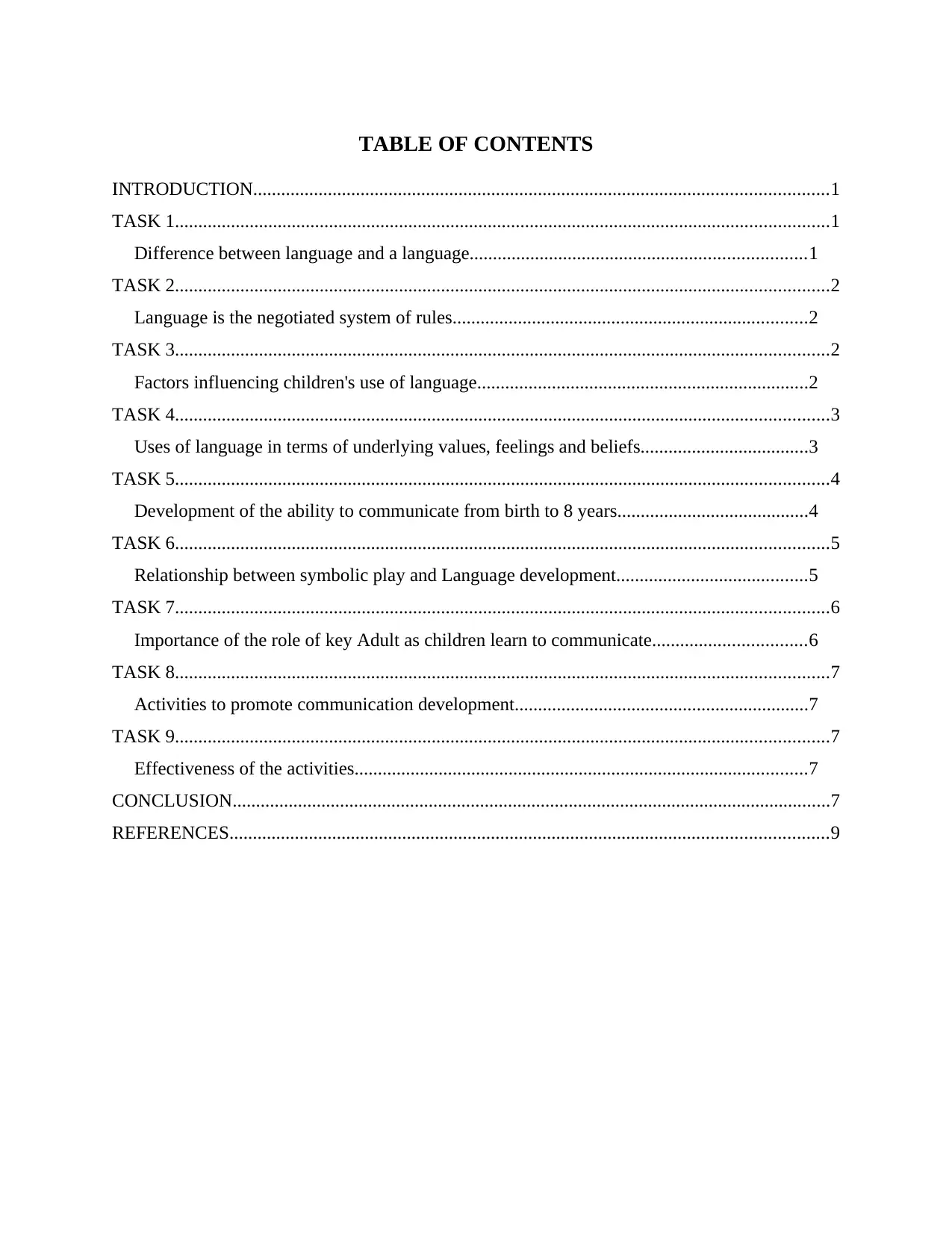
TABLE OF CONTENTS
INTRODUCTION...........................................................................................................................1
TASK 1............................................................................................................................................1
Difference between language and a language........................................................................1
TASK 2............................................................................................................................................2
Language is the negotiated system of rules............................................................................2
TASK 3............................................................................................................................................2
Factors influencing children's use of language.......................................................................2
TASK 4............................................................................................................................................3
Uses of language in terms of underlying values, feelings and beliefs....................................3
TASK 5............................................................................................................................................4
Development of the ability to communicate from birth to 8 years.........................................4
TASK 6............................................................................................................................................5
Relationship between symbolic play and Language development.........................................5
TASK 7............................................................................................................................................6
Importance of the role of key Adult as children learn to communicate.................................6
TASK 8............................................................................................................................................7
Activities to promote communication development...............................................................7
TASK 9............................................................................................................................................7
Effectiveness of the activities.................................................................................................7
CONCLUSION................................................................................................................................7
REFERENCES................................................................................................................................9
INTRODUCTION...........................................................................................................................1
TASK 1............................................................................................................................................1
Difference between language and a language........................................................................1
TASK 2............................................................................................................................................2
Language is the negotiated system of rules............................................................................2
TASK 3............................................................................................................................................2
Factors influencing children's use of language.......................................................................2
TASK 4............................................................................................................................................3
Uses of language in terms of underlying values, feelings and beliefs....................................3
TASK 5............................................................................................................................................4
Development of the ability to communicate from birth to 8 years.........................................4
TASK 6............................................................................................................................................5
Relationship between symbolic play and Language development.........................................5
TASK 7............................................................................................................................................6
Importance of the role of key Adult as children learn to communicate.................................6
TASK 8............................................................................................................................................7
Activities to promote communication development...............................................................7
TASK 9............................................................................................................................................7
Effectiveness of the activities.................................................................................................7
CONCLUSION................................................................................................................................7
REFERENCES................................................................................................................................9
INTRODUCTION
Language is the tool of communication used by human to exchange their verbal and non
verbal utterances. It has been evolved over time going through different stages of diversification.
There are thousands of languages used around the world including both natural and modified.
Natural language are spoken and signed whereas secondary are those which are created through
some modifications in encoding such as Braille and graphic writing (Hoff, 2013).
Communication being an important part, language development is a crucial for human. Language
development is and indispensable section in the growth and development of an individual, It
encompasses into it different aspects related to it. The report discusses in-depth understanding of
the concept, factors affecting in its modifications, influencing agents impacting the children's
language development and many others.
TASK 1
Difference between language and a language
Language is the tool used by human to communicate their thoughts and messages to the
other person in different forms such as through verbal methods, phonetics and writing methods.
On the other hand, a language is the subset of language. It is specific form of communication
method in which there are certain rules and method through which the information is exchanged.
In generic context, the language is regarded as the way of communication in different
forms. It is not confined to any rules and regulation or any medium. It can be spoken, written or
through phonetic that is through signs (Harris, 2013). On the other hand, a language is created
with certain set of rules and norms. With some specifications, it is created and formulated that is
used in different forms of transmission of knowledge and information.
In language there are no limitations and restriction for any mode of transmission such as
different mediums are sounds and symbols, spoken language, written language, body language,
gestures, facial expression and many others. It also includes the secondary form such as Braille.
On the other hand, a language is confined to the specific domain used for particular purpose such
as English, Spanish and French
1
Language is the tool of communication used by human to exchange their verbal and non
verbal utterances. It has been evolved over time going through different stages of diversification.
There are thousands of languages used around the world including both natural and modified.
Natural language are spoken and signed whereas secondary are those which are created through
some modifications in encoding such as Braille and graphic writing (Hoff, 2013).
Communication being an important part, language development is a crucial for human. Language
development is and indispensable section in the growth and development of an individual, It
encompasses into it different aspects related to it. The report discusses in-depth understanding of
the concept, factors affecting in its modifications, influencing agents impacting the children's
language development and many others.
TASK 1
Difference between language and a language
Language is the tool used by human to communicate their thoughts and messages to the
other person in different forms such as through verbal methods, phonetics and writing methods.
On the other hand, a language is the subset of language. It is specific form of communication
method in which there are certain rules and method through which the information is exchanged.
In generic context, the language is regarded as the way of communication in different
forms. It is not confined to any rules and regulation or any medium. It can be spoken, written or
through phonetic that is through signs (Harris, 2013). On the other hand, a language is created
with certain set of rules and norms. With some specifications, it is created and formulated that is
used in different forms of transmission of knowledge and information.
In language there are no limitations and restriction for any mode of transmission such as
different mediums are sounds and symbols, spoken language, written language, body language,
gestures, facial expression and many others. It also includes the secondary form such as Braille.
On the other hand, a language is confined to the specific domain used for particular purpose such
as English, Spanish and French
1
⊘ This is a preview!⊘
Do you want full access?
Subscribe today to unlock all pages.

Trusted by 1+ million students worldwide
TASK 2
Language is the negotiated system of rules
A language is the structured and systematic way of communication used for interaction
between human. It organised and produced through socially produced and reformulated systems
of rules (Richards, 2015). A language is formed due to the influence of several external factors.
It is transformed and interpreted in the wide range of ways. It is affected by the factors such as
historical influences, geographical interpretations, foreign impacts and globalisation.
In a country the language development has the inextricable impact of history on it. Such
as different forms of communication tolls formed by rulers or ancient scholars. Such as India
inherited its script from Sanskrit which was formed by forefathers.
Earlier when there were no geographical boundaries, there was free movement of people
with different dialects and speaking. In that way language get influenced by the ways of
communication of foreign people who leave their imprints on natives. Hence, in this way it can
be stated that wide range of languages exists in India.
Lastly, in the modern times when people are eager in the process of acquisition of
knowledge and skills (Lederberg, Schick and Spencer, 2013). The interaction between people
belonging to different countries come closer and exchanging their ideas, views and languages. In
this way the hybrid language is formed with many influences.
TASK 3
Factors influencing children's use of language
Child from his early life starts learning the expression of his thoughts and thinking. It
undergoes different stages that is facial expression, babbling, one phrase and non reduplicated
sentences. It begins with the acquisition of speech pattern of mother in fetus. Further, after his
birth there are many factors that affect the language development in a child. Linguistic scientists
based on different school of thoughts have given several theories and views with respect to it. In
an integrated manner it is stated that that prominent influencers of children's language
development are social interaction, cognitive and medical process and Education implications.
Social Interaction: In this factor the child imbibe communication habits in himself through the
process of perceiving text or signs given by the caregiver at early stage (Cangelosi and Parisi,
2012). After that in later stage children grasp words and manner of speaking through the people
2
Language is the negotiated system of rules
A language is the structured and systematic way of communication used for interaction
between human. It organised and produced through socially produced and reformulated systems
of rules (Richards, 2015). A language is formed due to the influence of several external factors.
It is transformed and interpreted in the wide range of ways. It is affected by the factors such as
historical influences, geographical interpretations, foreign impacts and globalisation.
In a country the language development has the inextricable impact of history on it. Such
as different forms of communication tolls formed by rulers or ancient scholars. Such as India
inherited its script from Sanskrit which was formed by forefathers.
Earlier when there were no geographical boundaries, there was free movement of people
with different dialects and speaking. In that way language get influenced by the ways of
communication of foreign people who leave their imprints on natives. Hence, in this way it can
be stated that wide range of languages exists in India.
Lastly, in the modern times when people are eager in the process of acquisition of
knowledge and skills (Lederberg, Schick and Spencer, 2013). The interaction between people
belonging to different countries come closer and exchanging their ideas, views and languages. In
this way the hybrid language is formed with many influences.
TASK 3
Factors influencing children's use of language
Child from his early life starts learning the expression of his thoughts and thinking. It
undergoes different stages that is facial expression, babbling, one phrase and non reduplicated
sentences. It begins with the acquisition of speech pattern of mother in fetus. Further, after his
birth there are many factors that affect the language development in a child. Linguistic scientists
based on different school of thoughts have given several theories and views with respect to it. In
an integrated manner it is stated that that prominent influencers of children's language
development are social interaction, cognitive and medical process and Education implications.
Social Interaction: In this factor the child imbibe communication habits in himself through the
process of perceiving text or signs given by the caregiver at early stage (Cangelosi and Parisi,
2012). After that in later stage children grasp words and manner of speaking through the people
2
Paraphrase This Document
Need a fresh take? Get an instant paraphrase of this document with our AI Paraphraser
in surrounding such as parents who are the immediate communicators, friends and relatives who
are in frequent interaction.
Cognitive and medical process: There is innate language acquisition devise in human through
which they receive information and adopt in their other process of speaking and writing. It is
based on the skills possessed by human through which they acquire the ways of communication.
Educational implications: In the present time, ability to communicate and adopt in the operation
is referred as the key determining factor for success (Gallagher, 2013). In this respect educational
institutes inculcates linguistics in their coursework. In this way children's language development
is largely affected by the formal academic credentials.
TASK 4
Uses of language in terms of underlying values, feelings and beliefs
Language that is the means of communication play vital role in terms of underlying
values, feeling and beliefs. Communication refers to the process to intimidating the thoughts and
opinions t the other person in a certain manner through any medium. In that process different
types of language fulfil the purpose in the most lucrative manner (Lantolf, Thorne and Poehner,
2015). Such as language is the organised and complex structure which inculcates into it the
different modes of transmission and sharing of information and knowledge with the other one.
Since the beginning of the interaction between the human there were different ways used
by people to express their feelings and thoughts. Before the use of structured and systematic
way, different signs were used to signal the idea possessed by them. Then with the gradual
evolution, the approaches got advanced and more appropriate. With the set of norms and certain
prepositions' language were created among the group of people to interact with eath other. With
the passage of time it got more specified and clears (Paradis, Genesee and Crago, 2011).
Language styles and method of sharing ideas and beliefs were initially confined to the
domain differentiating on the basis of geographical locations. Further, the linguistic art
developed and it became easier to bring higher degree of interactions between people living
beyond boundaries. At present time, there are many modifications made with respect to the
language development. Such as in order to rectify the impairment the use of different
communication modes are adopted. Few examples are Braille which is the way of interaction
3
are in frequent interaction.
Cognitive and medical process: There is innate language acquisition devise in human through
which they receive information and adopt in their other process of speaking and writing. It is
based on the skills possessed by human through which they acquire the ways of communication.
Educational implications: In the present time, ability to communicate and adopt in the operation
is referred as the key determining factor for success (Gallagher, 2013). In this respect educational
institutes inculcates linguistics in their coursework. In this way children's language development
is largely affected by the formal academic credentials.
TASK 4
Uses of language in terms of underlying values, feelings and beliefs
Language that is the means of communication play vital role in terms of underlying
values, feeling and beliefs. Communication refers to the process to intimidating the thoughts and
opinions t the other person in a certain manner through any medium. In that process different
types of language fulfil the purpose in the most lucrative manner (Lantolf, Thorne and Poehner,
2015). Such as language is the organised and complex structure which inculcates into it the
different modes of transmission and sharing of information and knowledge with the other one.
Since the beginning of the interaction between the human there were different ways used
by people to express their feelings and thoughts. Before the use of structured and systematic
way, different signs were used to signal the idea possessed by them. Then with the gradual
evolution, the approaches got advanced and more appropriate. With the set of norms and certain
prepositions' language were created among the group of people to interact with eath other. With
the passage of time it got more specified and clears (Paradis, Genesee and Crago, 2011).
Language styles and method of sharing ideas and beliefs were initially confined to the
domain differentiating on the basis of geographical locations. Further, the linguistic art
developed and it became easier to bring higher degree of interactions between people living
beyond boundaries. At present time, there are many modifications made with respect to the
language development. Such as in order to rectify the impairment the use of different
communication modes are adopted. Few examples are Braille which is the way of interaction
3
that is understanding words for the visually impaired persons, oral and sign language is used by
the people who are challenges due to hearing or speaking impairments (Hoff, 2013).
There are different ways in which children demonstrate the use of language in terms of
underlying values, beliefs and feelings. It is well implied for the children belonging to age group
of 0 to 12 years when children express them in different manner at different levels of their age.
For instance at early age when they are unable to speak properly, they use body language and
sign language to communicate about their feelings. After growing up, children express their
feelings through certain gestures through body and facial expressions. For instance, different
types of feelings like pain, joy, hunger, anger tiredness and others are conveyed through varied
forms of languages by the children.
TASK 5
Development of the ability to communicate from birth to 8 years
The early years of the child's development are very crucial. At this stage they begin to
become aware about happenings around them and make their place in the world. This process
starts with recognizing their care takers and giving responses to the physical stimuli such as
smiles and other facial expressions. Communication through non verbal utterances starts at this
stage only by recognizing the soothing voice of parents and responding for the same.
Birth to six months
This is the stage of rapid development in children, they are very attentive to the activities
of their parents and other key adults (Harris, 2013). Along with its basic means of
communication that is crying it starts responding and reacting through other ways as well. The
process starts with recognizing the mother's voice and smiling in response to when they are
spoken. When talked by others, they start cooing in responses and making sounds to show
pleasure.
Six months to 1 years
Reaching to this stage begins with experimenting with their own sounds. They begin to
recognize their names. Along with this Babbling and gurgling starts at this stage. Further, they
imitate intonation and express their moods through different body signals and signs.
1 year to 3 year
4
the people who are challenges due to hearing or speaking impairments (Hoff, 2013).
There are different ways in which children demonstrate the use of language in terms of
underlying values, beliefs and feelings. It is well implied for the children belonging to age group
of 0 to 12 years when children express them in different manner at different levels of their age.
For instance at early age when they are unable to speak properly, they use body language and
sign language to communicate about their feelings. After growing up, children express their
feelings through certain gestures through body and facial expressions. For instance, different
types of feelings like pain, joy, hunger, anger tiredness and others are conveyed through varied
forms of languages by the children.
TASK 5
Development of the ability to communicate from birth to 8 years
The early years of the child's development are very crucial. At this stage they begin to
become aware about happenings around them and make their place in the world. This process
starts with recognizing their care takers and giving responses to the physical stimuli such as
smiles and other facial expressions. Communication through non verbal utterances starts at this
stage only by recognizing the soothing voice of parents and responding for the same.
Birth to six months
This is the stage of rapid development in children, they are very attentive to the activities
of their parents and other key adults (Harris, 2013). Along with its basic means of
communication that is crying it starts responding and reacting through other ways as well. The
process starts with recognizing the mother's voice and smiling in response to when they are
spoken. When talked by others, they start cooing in responses and making sounds to show
pleasure.
Six months to 1 years
Reaching to this stage begins with experimenting with their own sounds. They begin to
recognize their names. Along with this Babbling and gurgling starts at this stage. Further, they
imitate intonation and express their moods through different body signals and signs.
1 year to 3 year
4
⊘ This is a preview!⊘
Do you want full access?
Subscribe today to unlock all pages.
Trusted by 1+ million students worldwide
Initially beginning with recognizing their names, having small instruction, this is the
stage when language and literacy development of child takes place. With step by step process
children learns to speak and understands languages such as starting with pronouncing intelligible
syllables, understanding and uttering two letter words chattering and imitating and forming
sentences with words (Miramontes, Nadeau and Commins, 2011). Significant amount of
vocabulary is acquired by children by the age of three years that enables them to describe what
they say, express their pain and ability to answer.
3 year to 5 year
By the age of 3 years children enters preschool and verbalize extensively. With the
predominance of verbs in their speech, children start having fluent speaking. They start telling
stories and their experiences (Bishop and Leonard, 2014). Ask number of curious questions with
the use of detailed six to eight words sentences. At this stage they start communicating with
other in the clear manner.
5 year to 8 year
The grown up kids of age between 5 to years started having formal language
development training at their schools. Starting knowing the technicalities of speaking and
writing, understands vowels and consonants and started using correct grammar. Along with this
they use compound and complex sentences.
TASK 6
Relationship between symbolic play and Language development
Language development is the complex structure which encompasses several components
in it. It has been evolved by going through different stages of development and processes. There
are three phases described by the scholars with respect to the language development. They are
ancient phase, the middle phase and the modern approach. Ancient phase refers to the time when
there was the use of conventional approaches and children used to learn naturally with the
articulation from the surroundings (Hammer, Jia and Uchikoshi, 2011). At that time children's
language enhancement process in pure form. In middle age it is the amalgamation of several
components due to globalisation. At this stage the effectiveness decreased in the context of
losing its authenticity. Further, at the present stage adopting the modern approach major
transition took place. In this scientific methods are being adopted such as sensorimotor play,
5
stage when language and literacy development of child takes place. With step by step process
children learns to speak and understands languages such as starting with pronouncing intelligible
syllables, understanding and uttering two letter words chattering and imitating and forming
sentences with words (Miramontes, Nadeau and Commins, 2011). Significant amount of
vocabulary is acquired by children by the age of three years that enables them to describe what
they say, express their pain and ability to answer.
3 year to 5 year
By the age of 3 years children enters preschool and verbalize extensively. With the
predominance of verbs in their speech, children start having fluent speaking. They start telling
stories and their experiences (Bishop and Leonard, 2014). Ask number of curious questions with
the use of detailed six to eight words sentences. At this stage they start communicating with
other in the clear manner.
5 year to 8 year
The grown up kids of age between 5 to years started having formal language
development training at their schools. Starting knowing the technicalities of speaking and
writing, understands vowels and consonants and started using correct grammar. Along with this
they use compound and complex sentences.
TASK 6
Relationship between symbolic play and Language development
Language development is the complex structure which encompasses several components
in it. It has been evolved by going through different stages of development and processes. There
are three phases described by the scholars with respect to the language development. They are
ancient phase, the middle phase and the modern approach. Ancient phase refers to the time when
there was the use of conventional approaches and children used to learn naturally with the
articulation from the surroundings (Hammer, Jia and Uchikoshi, 2011). At that time children's
language enhancement process in pure form. In middle age it is the amalgamation of several
components due to globalisation. At this stage the effectiveness decreased in the context of
losing its authenticity. Further, at the present stage adopting the modern approach major
transition took place. In this scientific methods are being adopted such as sensorimotor play,
5
Paraphrase This Document
Need a fresh take? Get an instant paraphrase of this document with our AI Paraphraser
symbolic play and games with rules. Among the mentioned, symbolic play an indispensable role
in children's language development.
Symbolic play is the process in which a child represents another objects with the use of
symbols. With these substitutions, the learning of the child get enhances. It enables the child to
develop the vocabulary, relation between different objects and imbibing some habits into their
personality (Vernon-Feagans and et.al, 2012). When along with symbolizing objects, child starts
imagining roles for others by assigning different roles to them the process of their socialisation
begins. In this way it develops the talent of creativity and also maintaining connectivity with
others.
Symbolic play has become the crucial part of teaching that enables language development
in children. It is the integrated approach that covers different elements of teaching and growth of
child. For instance, with the enhancement of creativity and thinking ability through symbolic
play, it is found that child is able to make sentences in the better way. Further, this with the
increase in concentration and critical thinking makes the child to learn new words in fast manner
and make better use of it.
TASK 7
Importance of the role of key Adult as children learn to communicate
There are different key workers at different ages such as in early years key workers are
parents, in the growing age both parents and teachers act as the key worker and later no the
domain increases with the involvement of society along with relatives, parents and teachers who
act as the key worker.
In the overall development of a child the key adults are both of his parents who are
closely connected to him for longer period of lime. They play vital role at every stage of
development of language learning in a child. At each step, their contribution is inextricable from
the children's efficiency of communicating.
Early years of learning are very crucial for children's learning hence parents and other
close relatives are supposed to pay attention more at the time of child's age from birth to 3 years.
Some events have direct impact on child's learning that is to taken care such as interaction in
social situation, greetings, addressing and expressions (Conti-Ramsden and Durkin, 2012). Such
as talking with the kids enable them to be more attentive and more responsive. The frequent
6
in children's language development.
Symbolic play is the process in which a child represents another objects with the use of
symbols. With these substitutions, the learning of the child get enhances. It enables the child to
develop the vocabulary, relation between different objects and imbibing some habits into their
personality (Vernon-Feagans and et.al, 2012). When along with symbolizing objects, child starts
imagining roles for others by assigning different roles to them the process of their socialisation
begins. In this way it develops the talent of creativity and also maintaining connectivity with
others.
Symbolic play has become the crucial part of teaching that enables language development
in children. It is the integrated approach that covers different elements of teaching and growth of
child. For instance, with the enhancement of creativity and thinking ability through symbolic
play, it is found that child is able to make sentences in the better way. Further, this with the
increase in concentration and critical thinking makes the child to learn new words in fast manner
and make better use of it.
TASK 7
Importance of the role of key Adult as children learn to communicate
There are different key workers at different ages such as in early years key workers are
parents, in the growing age both parents and teachers act as the key worker and later no the
domain increases with the involvement of society along with relatives, parents and teachers who
act as the key worker.
In the overall development of a child the key adults are both of his parents who are
closely connected to him for longer period of lime. They play vital role at every stage of
development of language learning in a child. At each step, their contribution is inextricable from
the children's efficiency of communicating.
Early years of learning are very crucial for children's learning hence parents and other
close relatives are supposed to pay attention more at the time of child's age from birth to 3 years.
Some events have direct impact on child's learning that is to taken care such as interaction in
social situation, greetings, addressing and expressions (Conti-Ramsden and Durkin, 2012). Such
as talking with the kids enable them to be more attentive and more responsive. The frequent
6
“give and take” in conversation provides them the opportunities to respond in different forms
such as through smiles and body gestures. Children at this stage at more responsive to high
pitched voice and in singsong way is the effective way of language development in children. At
this stage singing song, using animated objects in combination with the spoken words make the
learning faster and long lasting.
When child reaches to the age of 3 years, after that the leaning of child become a bit
advanced and more precise (Brauer and et.al, 2013). At this stage along with developing
speaking, in the language development devise the process of vocabulary building become faster.
Child begins to go to school, where teachers are the next key adults of the child who contribute
in their development. Both parents and teachers are supposed to make their interaction more
appropriate. They through different ways such as encouraging them to speak and motivating
them to read more develop language. Reading books with pictures, rhymes, repetitive lines and
words develops their minds and brings creativity in them.
Along with these measures there are some cases where language development gets
hindered due to some impairments. It can be identified at early stage by the key adults through
paying proper attention and identifying signs such as non recognition of objects by children,
avoidance of eye contact, inability to pay attention and improper articulation.
Key workers at all stages play different roles such as parents helping child in the listening
and understanding part in his early stage, secondly teachers at their schools provides them formal
coaching and training about the language development and lastly the society, relatives and
teachers in an integrated manner helps in developing the overall language structure.
TASK 8
Activities to promote communication development
Communication development is the process implemented for three areas thar are
speaking, listening and writing (May-Mederake, 2012). For the development of these skills
different innovative methods are adopted. In that regard three activities are conducted.
Activity 1:: Treasure Hunt
This activity focus on the identification of objects and the speaking. With the inculcation
of different props and items there is the set of activities organised. In this different types of
7
such as through smiles and body gestures. Children at this stage at more responsive to high
pitched voice and in singsong way is the effective way of language development in children. At
this stage singing song, using animated objects in combination with the spoken words make the
learning faster and long lasting.
When child reaches to the age of 3 years, after that the leaning of child become a bit
advanced and more precise (Brauer and et.al, 2013). At this stage along with developing
speaking, in the language development devise the process of vocabulary building become faster.
Child begins to go to school, where teachers are the next key adults of the child who contribute
in their development. Both parents and teachers are supposed to make their interaction more
appropriate. They through different ways such as encouraging them to speak and motivating
them to read more develop language. Reading books with pictures, rhymes, repetitive lines and
words develops their minds and brings creativity in them.
Along with these measures there are some cases where language development gets
hindered due to some impairments. It can be identified at early stage by the key adults through
paying proper attention and identifying signs such as non recognition of objects by children,
avoidance of eye contact, inability to pay attention and improper articulation.
Key workers at all stages play different roles such as parents helping child in the listening
and understanding part in his early stage, secondly teachers at their schools provides them formal
coaching and training about the language development and lastly the society, relatives and
teachers in an integrated manner helps in developing the overall language structure.
TASK 8
Activities to promote communication development
Communication development is the process implemented for three areas thar are
speaking, listening and writing (May-Mederake, 2012). For the development of these skills
different innovative methods are adopted. In that regard three activities are conducted.
Activity 1:: Treasure Hunt
This activity focus on the identification of objects and the speaking. With the inculcation
of different props and items there is the set of activities organised. In this different types of
7
⊘ This is a preview!⊘
Do you want full access?
Subscribe today to unlock all pages.
Trusted by 1+ million students worldwide
objects are places at different places having a certain kind of linkages in them. Further, through
asking questions related to them, the activity is processed.
Activity 2: Story challenge
It is the activity in which through the narration of different types of stories children are
able to respond in that manner effectively. Further, in imbibe the skills of intonation of different
sounds (Thorne and Smith, 2011).
Activity 3: Role play
Role play is focussed on enhancing the writing skills and creating enabling them to
portray different stories and enhance vocabulary.
Activity 1
For listening
Listening is an essential part of the language development, hence in order to enhance this
it is imperative to develop the attention skills along with listening abilities. It was facilitated by
enabling them to play in environment free from distractions, encouraging to share their focus and
increasing their interaction with family members. Further, through symbolic sounds and
motivating sound games has helped significantly.
Evaluation: It has increased the attention of the kid and became responsive. Such as they are able
understand the meaning of more number of words and make better use of it. Listening plays
important part in the children's language development process. It is to be effectively developed
for ensuring the adequate amount and efficient growth and upliftlent. The activity used will help
in developing the listening ability with the manner adopted through scientific approach. In this
way he is able to learn new things.
Activity 2
For speaking
Good modelling and communication temptations are the effective activities that
encourage good speaking. Such as good modelling refers to providing good speech for children,
enabling the child to pronounce the work correctly. Further, communication temptation refers to
initiating children to speak new words.
Evaluation: An effective measure to develop good speaking. The vocabulary of children has
found to be increased with the better making of sentences and the appropriate use of them.
Speaking is the part of child's language development that includes different sections such as
8
asking questions related to them, the activity is processed.
Activity 2: Story challenge
It is the activity in which through the narration of different types of stories children are
able to respond in that manner effectively. Further, in imbibe the skills of intonation of different
sounds (Thorne and Smith, 2011).
Activity 3: Role play
Role play is focussed on enhancing the writing skills and creating enabling them to
portray different stories and enhance vocabulary.
Activity 1
For listening
Listening is an essential part of the language development, hence in order to enhance this
it is imperative to develop the attention skills along with listening abilities. It was facilitated by
enabling them to play in environment free from distractions, encouraging to share their focus and
increasing their interaction with family members. Further, through symbolic sounds and
motivating sound games has helped significantly.
Evaluation: It has increased the attention of the kid and became responsive. Such as they are able
understand the meaning of more number of words and make better use of it. Listening plays
important part in the children's language development process. It is to be effectively developed
for ensuring the adequate amount and efficient growth and upliftlent. The activity used will help
in developing the listening ability with the manner adopted through scientific approach. In this
way he is able to learn new things.
Activity 2
For speaking
Good modelling and communication temptations are the effective activities that
encourage good speaking. Such as good modelling refers to providing good speech for children,
enabling the child to pronounce the work correctly. Further, communication temptation refers to
initiating children to speak new words.
Evaluation: An effective measure to develop good speaking. The vocabulary of children has
found to be increased with the better making of sentences and the appropriate use of them.
Speaking is the part of child's language development that includes different sections such as
8
Paraphrase This Document
Need a fresh take? Get an instant paraphrase of this document with our AI Paraphraser
vocabulary section, pronunciation and clarity in words used by them. With the use of this activity
it is ensured that child develops the efficient speaking skills that proves to be influential.
Activity 3
For writing
It can be encouraged through creating climate to foster writing among children. It
includes writing along with them and building their confidence at their attempt. Further,
speaking new words increases their vocabulary.
Evaluation: It has helped children in using correct spelling and appropriate words. It enhances
writing abilities. Learning the different forms of writing along with better drawing of words is
found among children. Writing the important section of language development is improved with
the practice. With the better making of letters and alphabets it is also ensured that statement
formation is correct while writing. Accompanied with the other sections of language
development it completes the child's language development through this activity.
TASK 9
Effectiveness of the activities
From the above activities undertaken it is inferred that all the activities proves to very
effectual in enhancing the communication skills. Among the above all activity 3 is very effective
and impact lasting. It has the ability to enhance the lateral thinking in the minds of children
leading towards development of their language. Activity 2 focussing on the listening skills is a
bit complex in nature. In order to make it more effective it requires to be fragmented in
segments. Further, activity 1 with the creative approach to enable the thinking of children with
the approach to enable learning object identification and speaking make the child's language
developed (Icommunication, 2016). There are different techniques to observe language
development in children in different aspects of learning. For instance, in speaking it is observed
through clarity of words, pronunciation, number of new words used and better delivery of
sentences. In writing, it is observed through their writing styles and manner of making letters.
Further, along with this other forms of language that is body language facial expressions can be
observed through the preciseness and clarity of manner in which message and feelings are
expressed.
9
it is ensured that child develops the efficient speaking skills that proves to be influential.
Activity 3
For writing
It can be encouraged through creating climate to foster writing among children. It
includes writing along with them and building their confidence at their attempt. Further,
speaking new words increases their vocabulary.
Evaluation: It has helped children in using correct spelling and appropriate words. It enhances
writing abilities. Learning the different forms of writing along with better drawing of words is
found among children. Writing the important section of language development is improved with
the practice. With the better making of letters and alphabets it is also ensured that statement
formation is correct while writing. Accompanied with the other sections of language
development it completes the child's language development through this activity.
TASK 9
Effectiveness of the activities
From the above activities undertaken it is inferred that all the activities proves to very
effectual in enhancing the communication skills. Among the above all activity 3 is very effective
and impact lasting. It has the ability to enhance the lateral thinking in the minds of children
leading towards development of their language. Activity 2 focussing on the listening skills is a
bit complex in nature. In order to make it more effective it requires to be fragmented in
segments. Further, activity 1 with the creative approach to enable the thinking of children with
the approach to enable learning object identification and speaking make the child's language
developed (Icommunication, 2016). There are different techniques to observe language
development in children in different aspects of learning. For instance, in speaking it is observed
through clarity of words, pronunciation, number of new words used and better delivery of
sentences. In writing, it is observed through their writing styles and manner of making letters.
Further, along with this other forms of language that is body language facial expressions can be
observed through the preciseness and clarity of manner in which message and feelings are
expressed.
9
CONCLUSION
Language is the set of certain norms and rules which is used for the communication. It is
through this medium the ideas, beliefs, feelings and thoughts are transmitted from one person to
the other. From the above case study it has been articulated that it is the series of planned and
formulated strategies to make the children's learning of language more appropriate.
10
Language is the set of certain norms and rules which is used for the communication. It is
through this medium the ideas, beliefs, feelings and thoughts are transmitted from one person to
the other. From the above case study it has been articulated that it is the series of planned and
formulated strategies to make the children's learning of language more appropriate.
10
⊘ This is a preview!⊘
Do you want full access?
Subscribe today to unlock all pages.
Trusted by 1+ million students worldwide

1 out of 14


Related Documents


Your All-in-One AI-Powered Toolkit for Academic Success.
+13062052269
info@desklib.com
Available 24*7 on WhatsApp / Email
![[object Object]](/_next/static/media/star-bottom.7253800d.svg)
Unlock your academic potential
Copyright © 2020–2026 A2Z Services. All Rights Reserved. Developed and managed by ZUCOL.