Real Estate Valuation and Appraisal Report: Case Study Analysis
VerifiedAdded on 2020/05/28
|14
|3224
|194
Report
AI Summary
This report evaluates a property investment in a UK business district, focusing on the valuation and appraisal of corporate offices. The analysis includes market valuation using term and reversion and hardcore methods, followed by investment appraisal techniques such as NPV and IRR calculations. The report also calculates expected net and gross of tax returns on equity. Risk analysis is conducted, and recommendations are provided. The report assesses the property's lease terms, market rent, and potential yield, considering factors like business rates and rental growth. Financial models are employed to determine the investment value, utilizing discounted cash flow and the time value of money concepts. The findings provide insights into the investment's profitability and risk profile, offering a comprehensive assessment for informed decision-making.

REAL ESTATE VALUATION
AND APPRAISAL
TABLE OF CONTENT
AND APPRAISAL
TABLE OF CONTENT

Paraphrase This Document
Need a fresh take? Get an instant paraphrase of this document with our AI Paraphraser

S
Case Background........................................................................................................1
Market Valuation.........................................................................................................1
Term and reversion..................................................................................................2
Layer/hardcore.........................................................................................................3
Investment Appraisal...................................................................................................4
Calculate NPV and IRR for the investment and also calculate Expected net of tax
and gross of tax returns on equity............................................................................6
Risk analysis...............................................................................................................8
Recommendations......................................................................................................9
REFERENCES..........................................................................................................10
Case Background........................................................................................................1
Market Valuation.........................................................................................................1
Term and reversion..................................................................................................2
Layer/hardcore.........................................................................................................3
Investment Appraisal...................................................................................................4
Calculate NPV and IRR for the investment and also calculate Expected net of tax
and gross of tax returns on equity............................................................................6
Risk analysis...............................................................................................................8
Recommendations......................................................................................................9
REFERENCES..........................................................................................................10
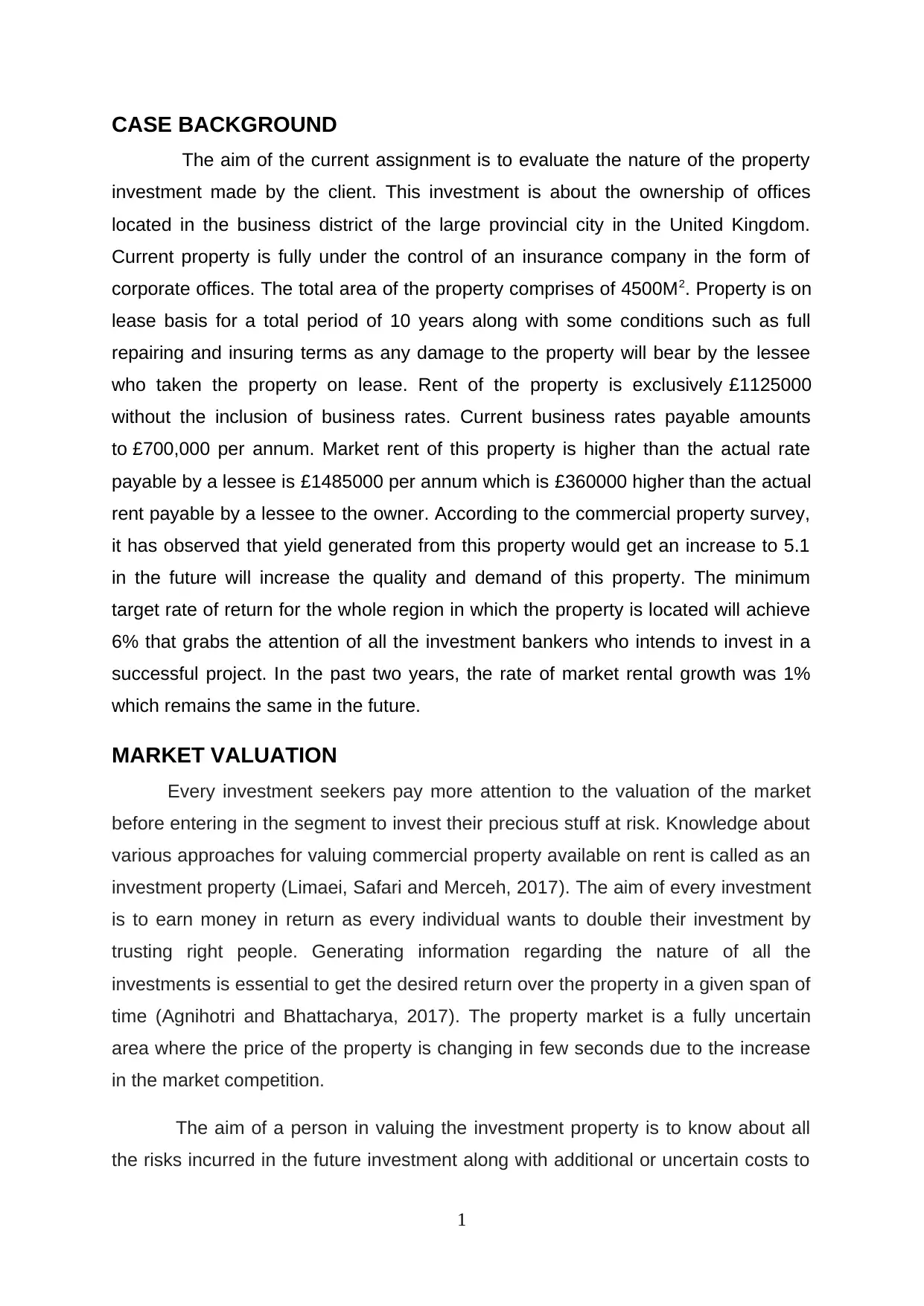
CASE BACKGROUND
The aim of the current assignment is to evaluate the nature of the property
investment made by the client. This investment is about the ownership of offices
located in the business district of the large provincial city in the United Kingdom.
Current property is fully under the control of an insurance company in the form of
corporate offices. The total area of the property comprises of 4500M2. Property is on
lease basis for a total period of 10 years along with some conditions such as full
repairing and insuring terms as any damage to the property will bear by the lessee
who taken the property on lease. Rent of the property is exclusively £1125000
without the inclusion of business rates. Current business rates payable amounts
to £700,000 per annum. Market rent of this property is higher than the actual rate
payable by a lessee is £1485000 per annum which is £360000 higher than the actual
rent payable by a lessee to the owner. According to the commercial property survey,
it has observed that yield generated from this property would get an increase to 5.1
in the future will increase the quality and demand of this property. The minimum
target rate of return for the whole region in which the property is located will achieve
6% that grabs the attention of all the investment bankers who intends to invest in a
successful project. In the past two years, the rate of market rental growth was 1%
which remains the same in the future.
MARKET VALUATION
Every investment seekers pay more attention to the valuation of the market
before entering in the segment to invest their precious stuff at risk. Knowledge about
various approaches for valuing commercial property available on rent is called as an
investment property (Limaei, Safari and Merceh, 2017). The aim of every investment
is to earn money in return as every individual wants to double their investment by
trusting right people. Generating information regarding the nature of all the
investments is essential to get the desired return over the property in a given span of
time (Agnihotri and Bhattacharya, 2017). The property market is a fully uncertain
area where the price of the property is changing in few seconds due to the increase
in the market competition.
The aim of a person in valuing the investment property is to know about all
the risks incurred in the future investment along with additional or uncertain costs to
1
The aim of the current assignment is to evaluate the nature of the property
investment made by the client. This investment is about the ownership of offices
located in the business district of the large provincial city in the United Kingdom.
Current property is fully under the control of an insurance company in the form of
corporate offices. The total area of the property comprises of 4500M2. Property is on
lease basis for a total period of 10 years along with some conditions such as full
repairing and insuring terms as any damage to the property will bear by the lessee
who taken the property on lease. Rent of the property is exclusively £1125000
without the inclusion of business rates. Current business rates payable amounts
to £700,000 per annum. Market rent of this property is higher than the actual rate
payable by a lessee is £1485000 per annum which is £360000 higher than the actual
rent payable by a lessee to the owner. According to the commercial property survey,
it has observed that yield generated from this property would get an increase to 5.1
in the future will increase the quality and demand of this property. The minimum
target rate of return for the whole region in which the property is located will achieve
6% that grabs the attention of all the investment bankers who intends to invest in a
successful project. In the past two years, the rate of market rental growth was 1%
which remains the same in the future.
MARKET VALUATION
Every investment seekers pay more attention to the valuation of the market
before entering in the segment to invest their precious stuff at risk. Knowledge about
various approaches for valuing commercial property available on rent is called as an
investment property (Limaei, Safari and Merceh, 2017). The aim of every investment
is to earn money in return as every individual wants to double their investment by
trusting right people. Generating information regarding the nature of all the
investments is essential to get the desired return over the property in a given span of
time (Agnihotri and Bhattacharya, 2017). The property market is a fully uncertain
area where the price of the property is changing in few seconds due to the increase
in the market competition.
The aim of a person in valuing the investment property is to know about all
the risks incurred in the future investment along with additional or uncertain costs to
1
⊘ This is a preview!⊘
Do you want full access?
Subscribe today to unlock all pages.

Trusted by 1+ million students worldwide

be borne by the investor. Financial advisors or investment bankers provide legal,
financial and economic suggestion to an investor to invest their money in right
products (Mervelskemper and Streit, 2017). Return on every property depends on
the growth of the product with the passage of time. Time value of money concept is
used to know about the future by applying present resources available to an
individual. According to this concept, the initial investment is multiplied by the
discounting rate to know about the present value of the investments in the future.
Term and reversion
Term
Rent passing- £1125000
YP 7years@3%- 33.95
Term value= Rent passing*Years purchase
=£1125000*33.95
=£38193750
Reversion
Market Rent-£1485000
YP Perpetuity@3%- 33.33
PV 7 years @3%- 0.81
Reversion value= Market Rent*YP Perp*PV
= £38193750
Valuation- £38193750+ £40090990.5
= £78284740.5
Market Value = £78284740.5/6.0
= £13047456
It is one of the methods of valuing the investment property by knowing about
the risks and returns associated with the same. The focus of the investors is more on
2
financial and economic suggestion to an investor to invest their money in right
products (Mervelskemper and Streit, 2017). Return on every property depends on
the growth of the product with the passage of time. Time value of money concept is
used to know about the future by applying present resources available to an
individual. According to this concept, the initial investment is multiplied by the
discounting rate to know about the present value of the investments in the future.
Term and reversion
Term
Rent passing- £1125000
YP 7years@3%- 33.95
Term value= Rent passing*Years purchase
=£1125000*33.95
=£38193750
Reversion
Market Rent-£1485000
YP Perpetuity@3%- 33.33
PV 7 years @3%- 0.81
Reversion value= Market Rent*YP Perp*PV
= £38193750
Valuation- £38193750+ £40090990.5
= £78284740.5
Market Value = £78284740.5/6.0
= £13047456
It is one of the methods of valuing the investment property by knowing about
the risks and returns associated with the same. The focus of the investors is more on
2
Paraphrase This Document
Need a fresh take? Get an instant paraphrase of this document with our AI Paraphraser
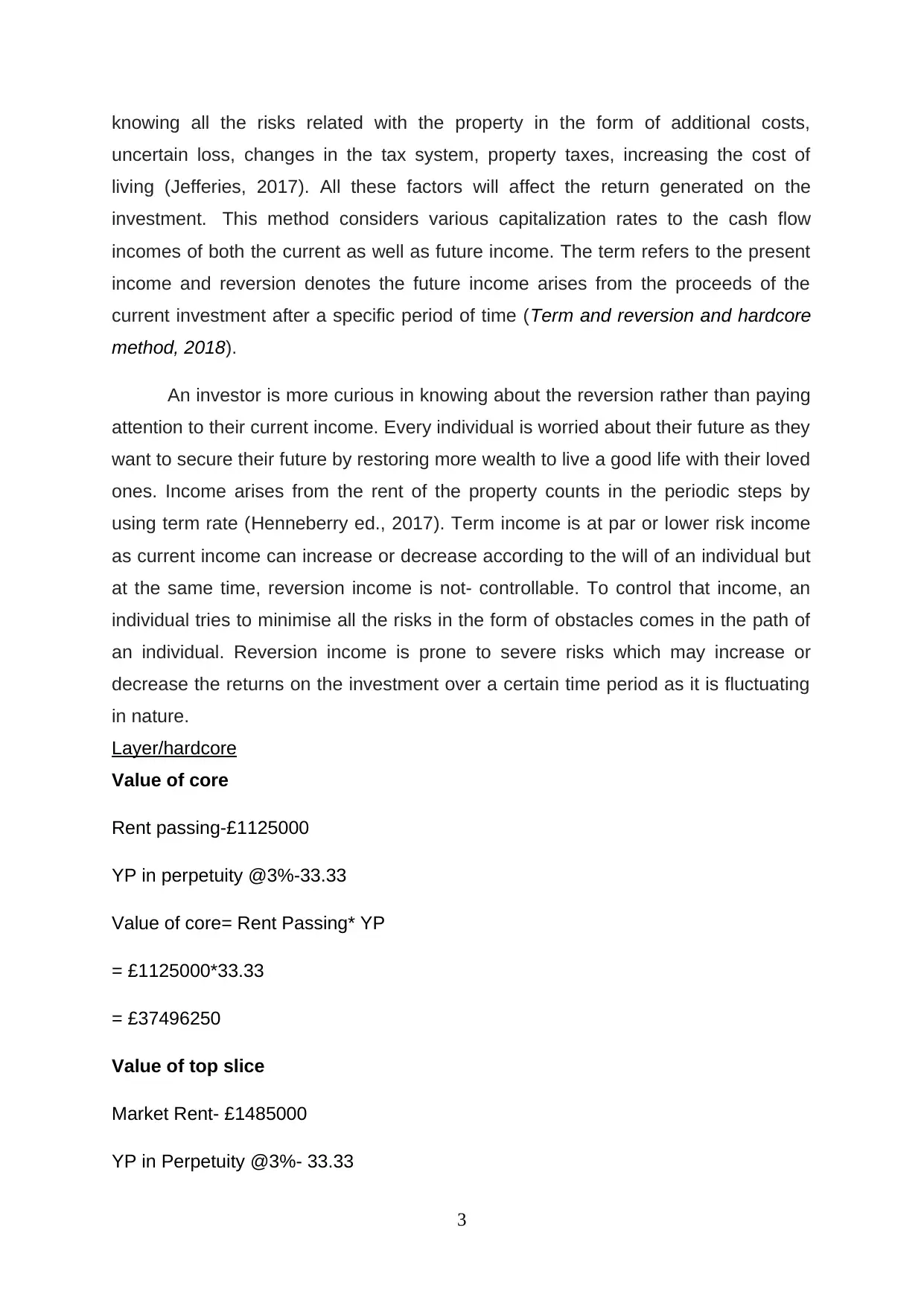
knowing all the risks related with the property in the form of additional costs,
uncertain loss, changes in the tax system, property taxes, increasing the cost of
living (Jefferies, 2017). All these factors will affect the return generated on the
investment. This method considers various capitalization rates to the cash flow
incomes of both the current as well as future income. The term refers to the present
income and reversion denotes the future income arises from the proceeds of the
current investment after a specific period of time (Term and reversion and hardcore
method, 2018).
An investor is more curious in knowing about the reversion rather than paying
attention to their current income. Every individual is worried about their future as they
want to secure their future by restoring more wealth to live a good life with their loved
ones. Income arises from the rent of the property counts in the periodic steps by
using term rate (Henneberry ed., 2017). Term income is at par or lower risk income
as current income can increase or decrease according to the will of an individual but
at the same time, reversion income is not- controllable. To control that income, an
individual tries to minimise all the risks in the form of obstacles comes in the path of
an individual. Reversion income is prone to severe risks which may increase or
decrease the returns on the investment over a certain time period as it is fluctuating
in nature.
Layer/hardcore
Value of core
Rent passing-£1125000
YP in perpetuity @3%-33.33
Value of core= Rent Passing* YP
= £1125000*33.33
= £37496250
Value of top slice
Market Rent- £1485000
YP in Perpetuity @3%- 33.33
3
uncertain loss, changes in the tax system, property taxes, increasing the cost of
living (Jefferies, 2017). All these factors will affect the return generated on the
investment. This method considers various capitalization rates to the cash flow
incomes of both the current as well as future income. The term refers to the present
income and reversion denotes the future income arises from the proceeds of the
current investment after a specific period of time (Term and reversion and hardcore
method, 2018).
An investor is more curious in knowing about the reversion rather than paying
attention to their current income. Every individual is worried about their future as they
want to secure their future by restoring more wealth to live a good life with their loved
ones. Income arises from the rent of the property counts in the periodic steps by
using term rate (Henneberry ed., 2017). Term income is at par or lower risk income
as current income can increase or decrease according to the will of an individual but
at the same time, reversion income is not- controllable. To control that income, an
individual tries to minimise all the risks in the form of obstacles comes in the path of
an individual. Reversion income is prone to severe risks which may increase or
decrease the returns on the investment over a certain time period as it is fluctuating
in nature.
Layer/hardcore
Value of core
Rent passing-£1125000
YP in perpetuity @3%-33.33
Value of core= Rent Passing* YP
= £1125000*33.33
= £37496250
Value of top slice
Market Rent- £1485000
YP in Perpetuity @3%- 33.33
3
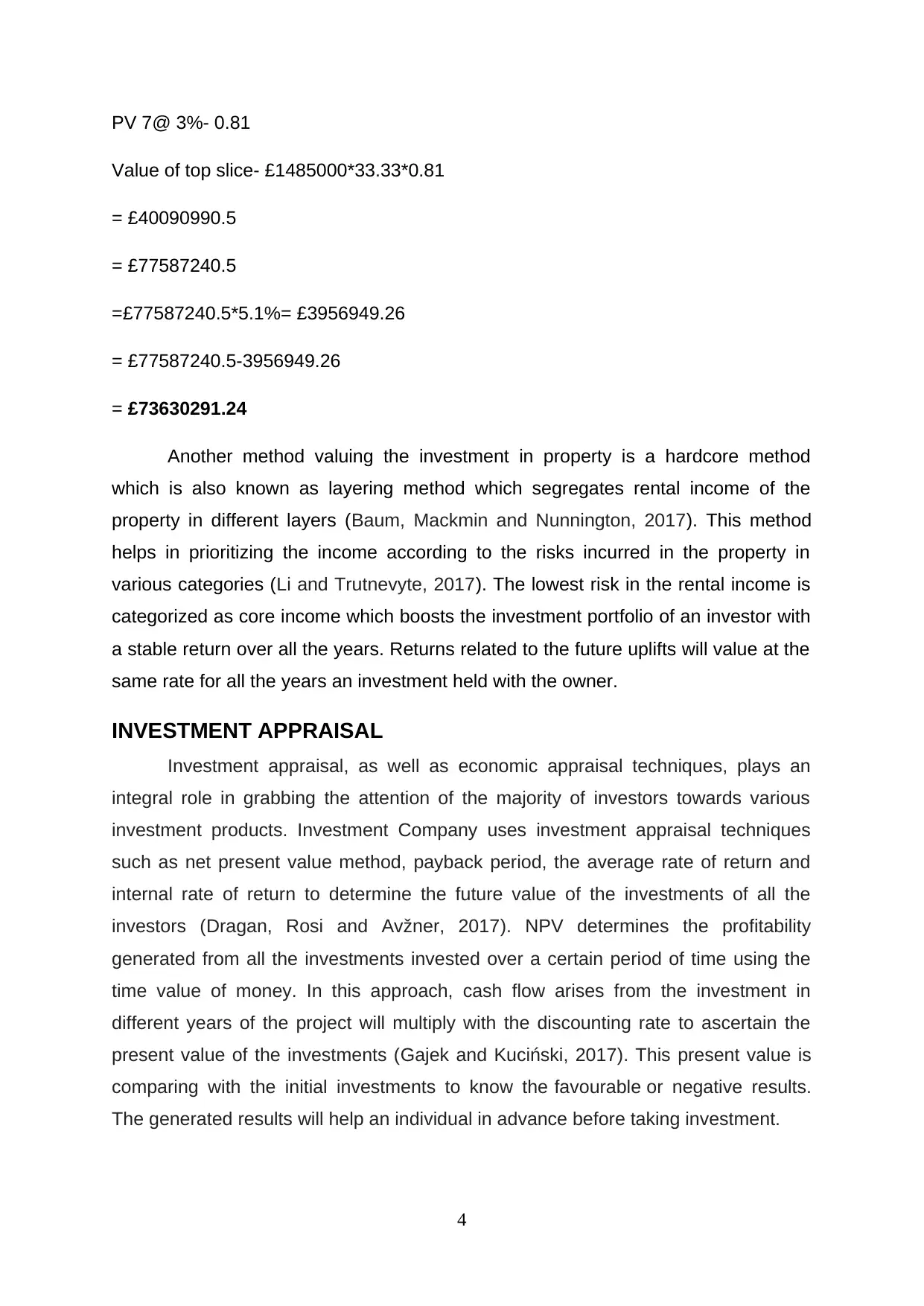
PV 7@ 3%- 0.81
Value of top slice- £1485000*33.33*0.81
= £40090990.5
= £77587240.5
=£77587240.5*5.1%= £3956949.26
= £77587240.5-3956949.26
= £73630291.24
Another method valuing the investment in property is a hardcore method
which is also known as layering method which segregates rental income of the
property in different layers (Baum, Mackmin and Nunnington, 2017). This method
helps in prioritizing the income according to the risks incurred in the property in
various categories (Li and Trutnevyte, 2017). The lowest risk in the rental income is
categorized as core income which boosts the investment portfolio of an investor with
a stable return over all the years. Returns related to the future uplifts will value at the
same rate for all the years an investment held with the owner.
INVESTMENT APPRAISAL
Investment appraisal, as well as economic appraisal techniques, plays an
integral role in grabbing the attention of the majority of investors towards various
investment products. Investment Company uses investment appraisal techniques
such as net present value method, payback period, the average rate of return and
internal rate of return to determine the future value of the investments of all the
investors (Dragan, Rosi and Avžner, 2017). NPV determines the profitability
generated from all the investments invested over a certain period of time using the
time value of money. In this approach, cash flow arises from the investment in
different years of the project will multiply with the discounting rate to ascertain the
present value of the investments (Gajek and Kuciński, 2017). This present value is
comparing with the initial investments to know the favourable or negative results.
The generated results will help an individual in advance before taking investment.
4
Value of top slice- £1485000*33.33*0.81
= £40090990.5
= £77587240.5
=£77587240.5*5.1%= £3956949.26
= £77587240.5-3956949.26
= £73630291.24
Another method valuing the investment in property is a hardcore method
which is also known as layering method which segregates rental income of the
property in different layers (Baum, Mackmin and Nunnington, 2017). This method
helps in prioritizing the income according to the risks incurred in the property in
various categories (Li and Trutnevyte, 2017). The lowest risk in the rental income is
categorized as core income which boosts the investment portfolio of an investor with
a stable return over all the years. Returns related to the future uplifts will value at the
same rate for all the years an investment held with the owner.
INVESTMENT APPRAISAL
Investment appraisal, as well as economic appraisal techniques, plays an
integral role in grabbing the attention of the majority of investors towards various
investment products. Investment Company uses investment appraisal techniques
such as net present value method, payback period, the average rate of return and
internal rate of return to determine the future value of the investments of all the
investors (Dragan, Rosi and Avžner, 2017). NPV determines the profitability
generated from all the investments invested over a certain period of time using the
time value of money. In this approach, cash flow arises from the investment in
different years of the project will multiply with the discounting rate to ascertain the
present value of the investments (Gajek and Kuciński, 2017). This present value is
comparing with the initial investments to know the favourable or negative results.
The generated results will help an individual in advance before taking investment.
4
⊘ This is a preview!⊘
Do you want full access?
Subscribe today to unlock all pages.
Trusted by 1+ million students worldwide
Payback period is that technique in which greater emphasizes lies on the
time duration of the project as this shows the effectiveness of the project by
generating returns in the lesser period. An individual can select the best suitable
project that generates higher return lesser time period to save their time to invest in
more suitable tasks (Novak Pintarič and Kravanja, 2017). An internal rate of return
concept is similar to the break-even concept in which an individual will earn higher at
a specific rate of return to equalize the initial investment with the generated returns
from the projects.
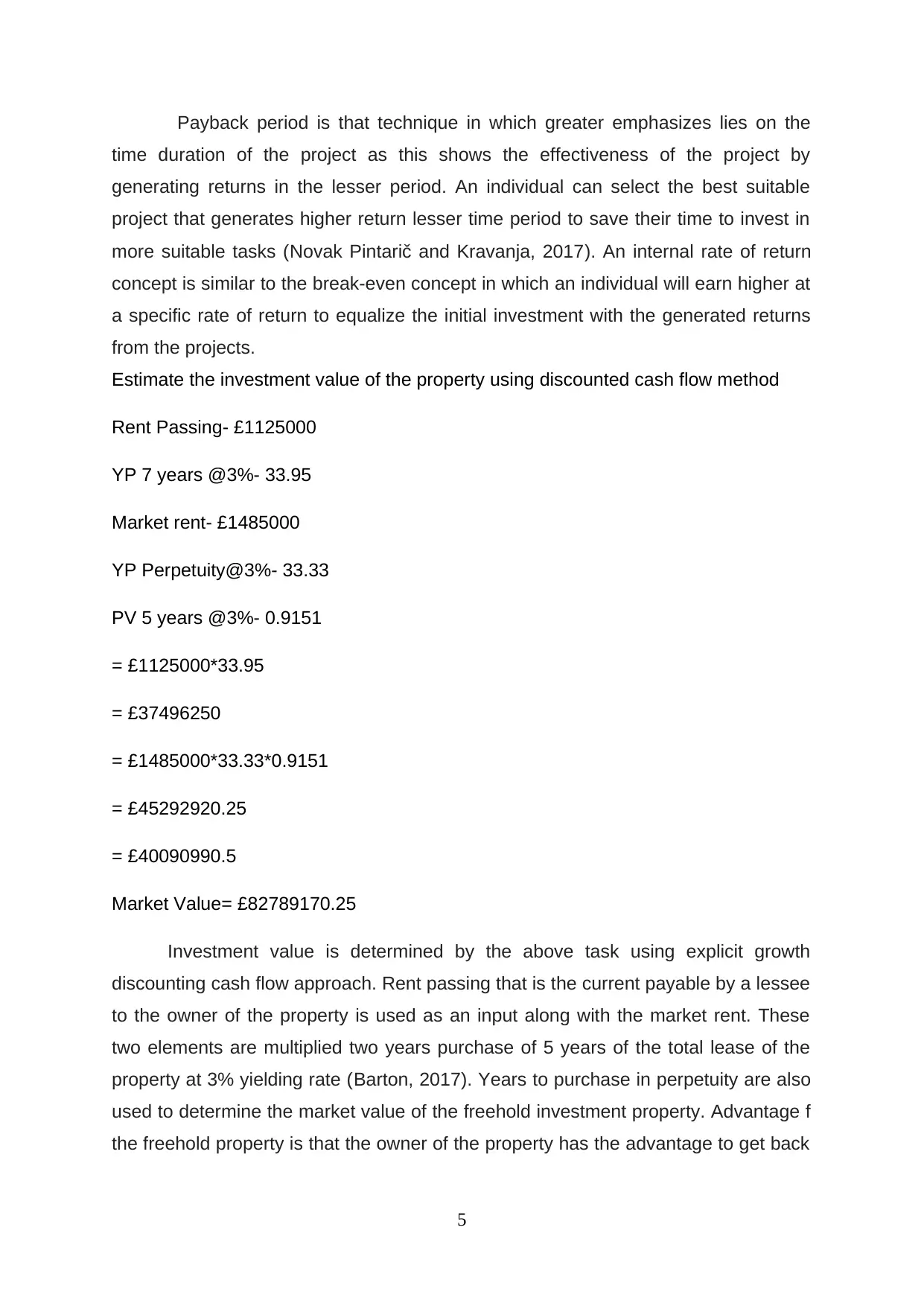
Estimate the investment value of the property using discounted cash flow method
Rent Passing- £1125000
YP 7 years @3%- 33.95
Market rent- £1485000
YP Perpetuity@3%- 33.33
PV 5 years @3%- 0.9151
= £1125000*33.95
= £37496250
= £1485000*33.33*0.9151
= £45292920.25
= £40090990.5
Market Value= £82789170.25
Investment value is determined by the above task using explicit growth
discounting cash flow approach. Rent passing that is the current payable by a lessee
to the owner of the property is used as an input along with the market rent. These
two elements are multiplied two years purchase of 5 years of the total lease of the
property at 3% yielding rate (Barton, 2017). Years to purchase in perpetuity are also
used to determine the market value of the freehold investment property. Advantage f
the freehold property is that the owner of the property has the advantage to get back
5
time duration of the project as this shows the effectiveness of the project by
generating returns in the lesser period. An individual can select the best suitable
project that generates higher return lesser time period to save their time to invest in
more suitable tasks (Novak Pintarič and Kravanja, 2017). An internal rate of return
concept is similar to the break-even concept in which an individual will earn higher at
a specific rate of return to equalize the initial investment with the generated returns
from the projects.
Estimate the investment value of the property using discounted cash flow method
Rent Passing- £1125000
YP 7 years @3%- 33.95
Market rent- £1485000
YP Perpetuity@3%- 33.33
PV 5 years @3%- 0.9151
= £1125000*33.95
= £37496250
= £1485000*33.33*0.9151
= £45292920.25
= £40090990.5
Market Value= £82789170.25
Investment value is determined by the above task using explicit growth
discounting cash flow approach. Rent passing that is the current payable by a lessee
to the owner of the property is used as an input along with the market rent. These
two elements are multiplied two years purchase of 5 years of the total lease of the
property at 3% yielding rate (Barton, 2017). Years to purchase in perpetuity are also
used to determine the market value of the freehold investment property. Advantage f
the freehold property is that the owner of the property has the advantage to get back
5
Paraphrase This Document
Need a fresh take? Get an instant paraphrase of this document with our AI Paraphraser
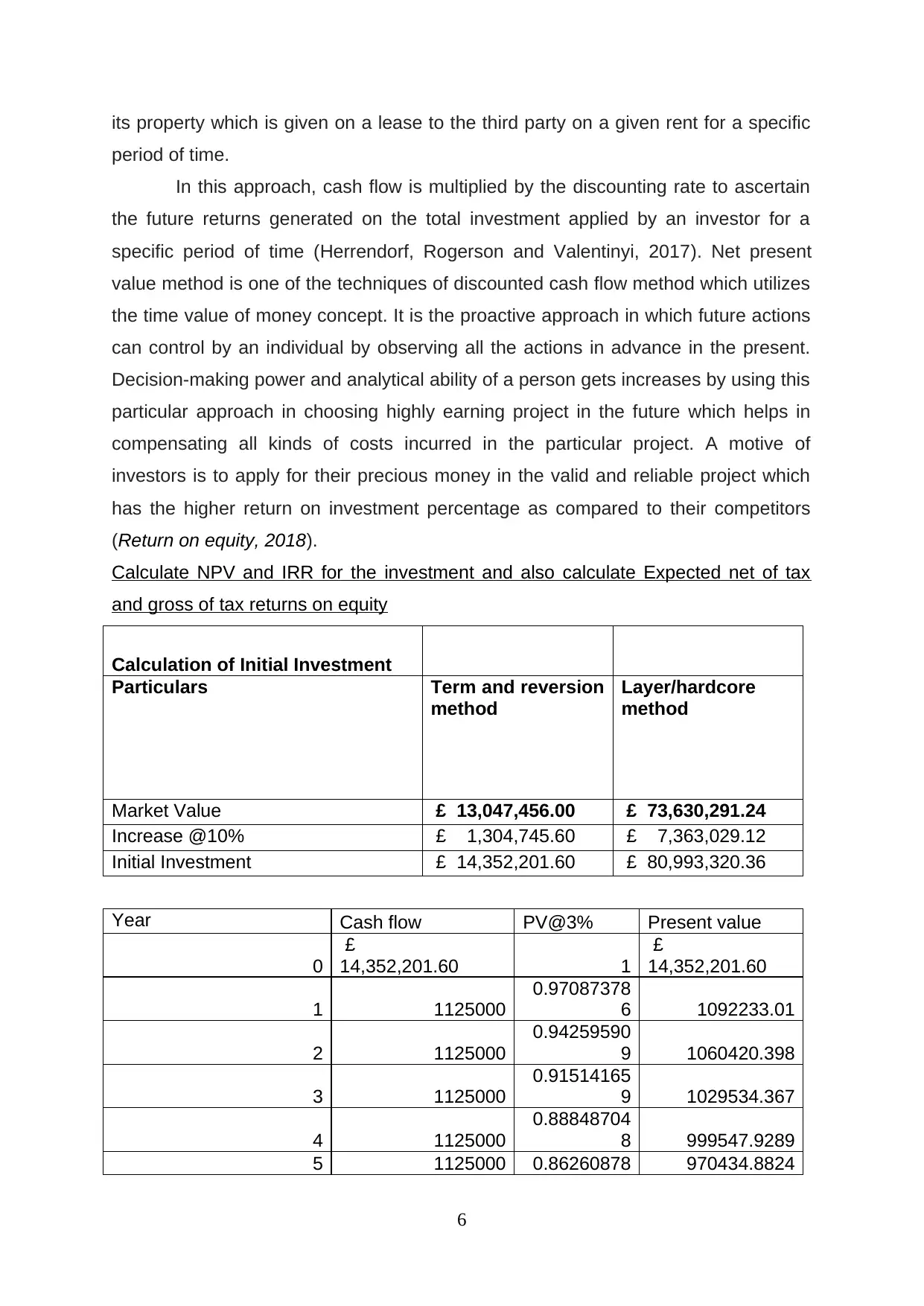
its property which is given on a lease to the third party on a given rent for a specific
period of time.
In this approach, cash flow is multiplied by the discounting rate to ascertain
the future returns generated on the total investment applied by an investor for a
specific period of time (Herrendorf, Rogerson and Valentinyi, 2017). Net present
value method is one of the techniques of discounted cash flow method which utilizes
the time value of money concept. It is the proactive approach in which future actions
can control by an individual by observing all the actions in advance in the present.
Decision-making power and analytical ability of a person gets increases by using this
particular approach in choosing highly earning project in the future which helps in
compensating all kinds of costs incurred in the particular project. A motive of
investors is to apply for their precious money in the valid and reliable project which
has the higher return on investment percentage as compared to their competitors
(Return on equity, 2018).
Calculate NPV and IRR for the investment and also calculate Expected net of tax
and gross of tax returns on equity
Calculation of Initial Investment
Particulars Term and reversion
method
Layer/hardcore
method
Market Value £ 13,047,456.00 £ 73,630,291.24
Increase @10% £ 1,304,745.60 £ 7,363,029.12
Initial Investment £ 14,352,201.60 £ 80,993,320.36
Year Cash flow PV@3% Present value
0
£
14,352,201.60 1
£
14,352,201.60
1 1125000
0.97087378
6 1092233.01
2 1125000
0.94259590
9 1060420.398
3 1125000
0.91514165
9 1029534.367
4 1125000
0.88848704
8 999547.9289
5 1125000 0.86260878 970434.8824
6
period of time.
In this approach, cash flow is multiplied by the discounting rate to ascertain
the future returns generated on the total investment applied by an investor for a
specific period of time (Herrendorf, Rogerson and Valentinyi, 2017). Net present
value method is one of the techniques of discounted cash flow method which utilizes
the time value of money concept. It is the proactive approach in which future actions
can control by an individual by observing all the actions in advance in the present.
Decision-making power and analytical ability of a person gets increases by using this
particular approach in choosing highly earning project in the future which helps in
compensating all kinds of costs incurred in the particular project. A motive of
investors is to apply for their precious money in the valid and reliable project which
has the higher return on investment percentage as compared to their competitors
(Return on equity, 2018).
Calculate NPV and IRR for the investment and also calculate Expected net of tax
and gross of tax returns on equity
Calculation of Initial Investment
Particulars Term and reversion
method
Layer/hardcore
method
Market Value £ 13,047,456.00 £ 73,630,291.24
Increase @10% £ 1,304,745.60 £ 7,363,029.12
Initial Investment £ 14,352,201.60 £ 80,993,320.36
Year Cash flow PV@3% Present value
0
£
14,352,201.60 1
£
14,352,201.60
1 1125000
0.97087378
6 1092233.01
2 1125000
0.94259590
9 1060420.398
3 1125000
0.91514165
9 1029534.367
4 1125000
0.88848704
8 999547.9289
5 1125000 0.86260878 970434.8824
6
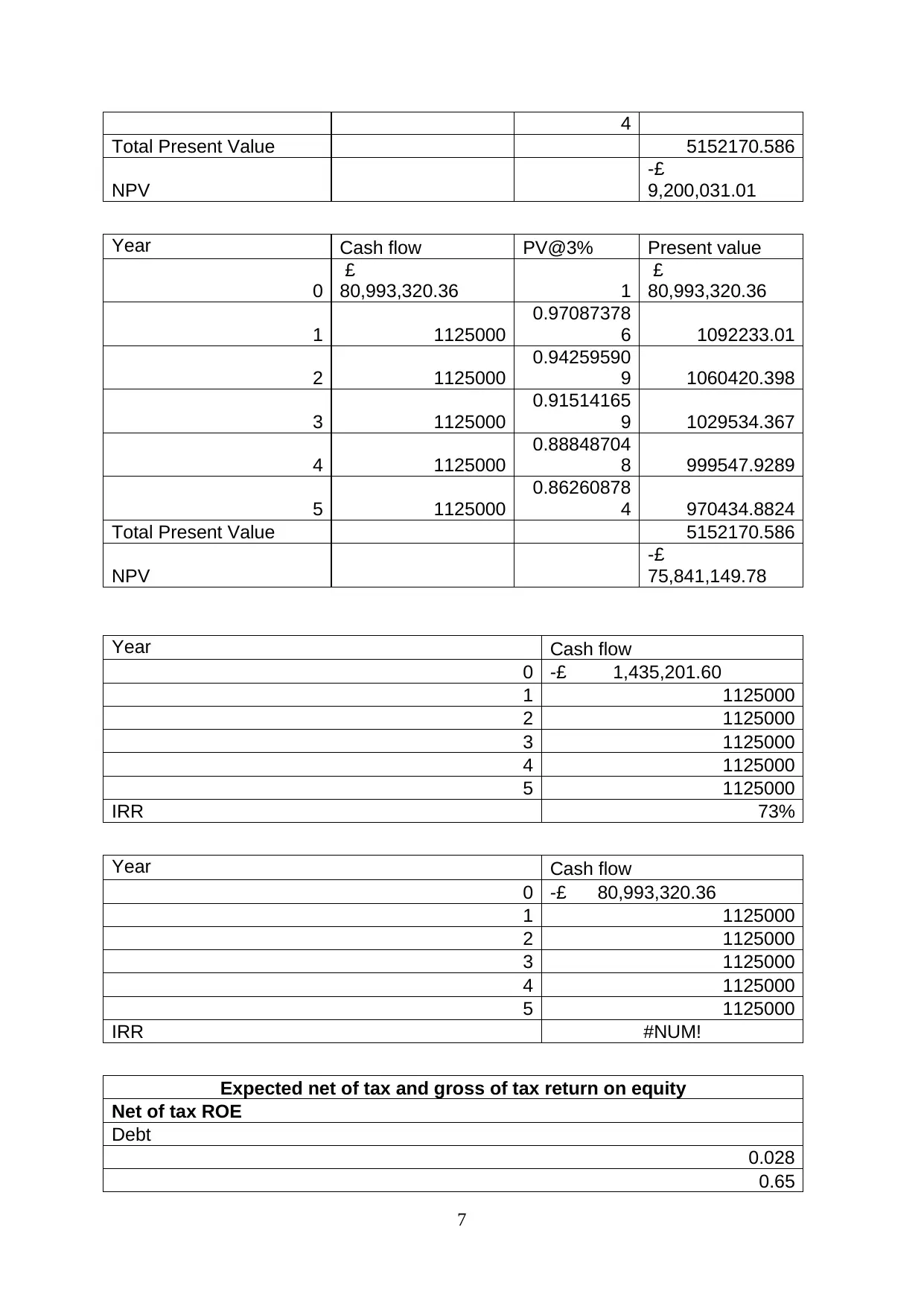
4
Total Present Value 5152170.586
NPV
-£
9,200,031.01
Year Cash flow PV@3% Present value
0
£
80,993,320.36 1
£
80,993,320.36
1 1125000
0.97087378
6 1092233.01
2 1125000
0.94259590
9 1060420.398
3 1125000
0.91514165
9 1029534.367
4 1125000
0.88848704
8 999547.9289
5 1125000
0.86260878
4 970434.8824
Total Present Value 5152170.586
NPV
-£
75,841,149.78
Year Cash flow
0 -£ 1,435,201.60
1 1125000
2 1125000
3 1125000
4 1125000
5 1125000
IRR 73%
Year Cash flow
0 -£ 80,993,320.36
1 1125000
2 1125000
3 1125000
4 1125000
5 1125000
IRR #NUM!
Expected net of tax and gross of tax return on equity
Net of tax ROE
Debt
0.028
0.65
7
Total Present Value 5152170.586
NPV
-£
9,200,031.01
Year Cash flow PV@3% Present value
0
£
80,993,320.36 1
£
80,993,320.36
1 1125000
0.97087378
6 1092233.01
2 1125000
0.94259590
9 1060420.398
3 1125000
0.91514165
9 1029534.367
4 1125000
0.88848704
8 999547.9289
5 1125000
0.86260878
4 970434.8824
Total Present Value 5152170.586
NPV
-£
75,841,149.78
Year Cash flow
0 -£ 1,435,201.60
1 1125000
2 1125000
3 1125000
4 1125000
5 1125000
IRR 73%
Year Cash flow
0 -£ 80,993,320.36
1 1125000
2 1125000
3 1125000
4 1125000
5 1125000
IRR #NUM!
Expected net of tax and gross of tax return on equity
Net of tax ROE
Debt
0.028
0.65
7
⊘ This is a preview!⊘
Do you want full access?
Subscribe today to unlock all pages.
Trusted by 1+ million students worldwide
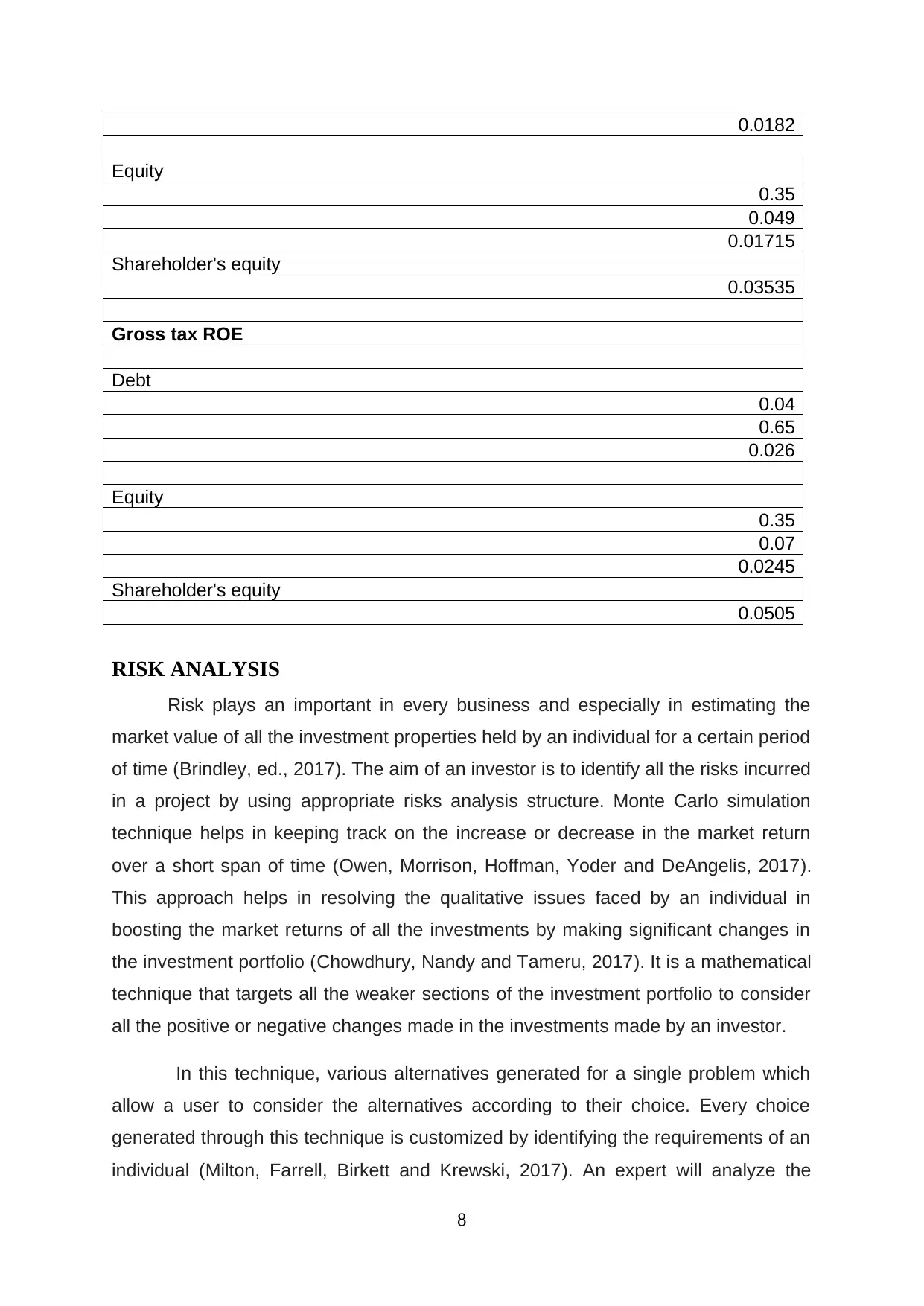
0.0182
Equity
0.35
0.049
0.01715
Shareholder's equity
0.03535
Gross tax ROE
Debt
0.04
0.65
0.026
Equity
0.35
0.07
0.0245
Shareholder's equity
0.0505
RISK ANALYSIS
Risk plays an important in every business and especially in estimating the
market value of all the investment properties held by an individual for a certain period
of time (Brindley, ed., 2017). The aim of an investor is to identify all the risks incurred
in a project by using appropriate risks analysis structure. Monte Carlo simulation
technique helps in keeping track on the increase or decrease in the market return
over a short span of time (Owen, Morrison, Hoffman, Yoder and DeAngelis, 2017).
This approach helps in resolving the qualitative issues faced by an individual in
boosting the market returns of all the investments by making significant changes in
the investment portfolio (Chowdhury, Nandy and Tameru, 2017). It is a mathematical
technique that targets all the weaker sections of the investment portfolio to consider
all the positive or negative changes made in the investments made by an investor.
In this technique, various alternatives generated for a single problem which
allow a user to consider the alternatives according to their choice. Every choice
generated through this technique is customized by identifying the requirements of an
individual (Milton, Farrell, Birkett and Krewski, 2017). An expert will analyze the
8
Equity
0.35
0.049
0.01715
Shareholder's equity
0.03535
Gross tax ROE
Debt
0.04
0.65
0.026
Equity
0.35
0.07
0.0245
Shareholder's equity
0.0505
RISK ANALYSIS
Risk plays an important in every business and especially in estimating the
market value of all the investment properties held by an individual for a certain period
of time (Brindley, ed., 2017). The aim of an investor is to identify all the risks incurred
in a project by using appropriate risks analysis structure. Monte Carlo simulation
technique helps in keeping track on the increase or decrease in the market return
over a short span of time (Owen, Morrison, Hoffman, Yoder and DeAngelis, 2017).
This approach helps in resolving the qualitative issues faced by an individual in
boosting the market returns of all the investments by making significant changes in
the investment portfolio (Chowdhury, Nandy and Tameru, 2017). It is a mathematical
technique that targets all the weaker sections of the investment portfolio to consider
all the positive or negative changes made in the investments made by an investor.
In this technique, various alternatives generated for a single problem which
allow a user to consider the alternatives according to their choice. Every choice
generated through this technique is customized by identifying the requirements of an
individual (Milton, Farrell, Birkett and Krewski, 2017). An expert will analyze the
8
Paraphrase This Document
Need a fresh take? Get an instant paraphrase of this document with our AI Paraphraser
investment profile of a user in keeping track on all the favourable and non-favourable
aspects related to the client’s investment. The current problem faced by an individual
is of negative net present value due to lower returns as compared to the total initial
investment applied by the firm. This is one of the macroeconomic tools helps an
individual in making their choice to select the suitable option. Reliability of the two
investments is judged by an entity before investing a single penny in two of the
investments.
Monte Carlo simulation is one of the risk analysis tools which come in the
form of probability distribution platform which shows the probability of both success
and failure (Monte Carlo Simulation, 2017). An individual can get the idea of positive
or negative aspects of a single element to take the best suitable decisions which
differ from one situation to another.
RECOMMENDATIONS
It is recommended to the owner of the freehold office premise property to
value their property using hardcore or layer method as the market value of the
property is higher in this approach as compared to the term and reversion method.
Market value in this approach is £73630291.24 as under this method year to
purchase is valued in perpetuity instead of using the same rate. This method
determines the total market return by summing up the returns of the two layers such
as core and top slice. Market value in term and reversion is lesser in relation to layer
method as in the first method total return is divided by minimum target return in
ascertaining the total market return.
Three techniques of the investments such as NPV, IRR, and return on equity
highlight the major issue in the selection of the investment projects. Net present
value method shows the negative amount in both the projects which can’t select by
the investor as this will increase the burden of costs. IRR shows the positive
inclination towards the first project as they generate 73% return as against the other
project which is not defined. Net tax and gross tax return on equity are higher in
gross tax with 5% and 4% in net tax show the burden of the tax imposed on an
individual in reducing their investment return.
9
aspects related to the client’s investment. The current problem faced by an individual
is of negative net present value due to lower returns as compared to the total initial
investment applied by the firm. This is one of the macroeconomic tools helps an
individual in making their choice to select the suitable option. Reliability of the two
investments is judged by an entity before investing a single penny in two of the
investments.
Monte Carlo simulation is one of the risk analysis tools which come in the
form of probability distribution platform which shows the probability of both success
and failure (Monte Carlo Simulation, 2017). An individual can get the idea of positive
or negative aspects of a single element to take the best suitable decisions which
differ from one situation to another.
RECOMMENDATIONS
It is recommended to the owner of the freehold office premise property to
value their property using hardcore or layer method as the market value of the
property is higher in this approach as compared to the term and reversion method.
Market value in this approach is £73630291.24 as under this method year to
purchase is valued in perpetuity instead of using the same rate. This method
determines the total market return by summing up the returns of the two layers such
as core and top slice. Market value in term and reversion is lesser in relation to layer
method as in the first method total return is divided by minimum target return in
ascertaining the total market return.
Three techniques of the investments such as NPV, IRR, and return on equity
highlight the major issue in the selection of the investment projects. Net present
value method shows the negative amount in both the projects which can’t select by
the investor as this will increase the burden of costs. IRR shows the positive
inclination towards the first project as they generate 73% return as against the other
project which is not defined. Net tax and gross tax return on equity are higher in
gross tax with 5% and 4% in net tax show the burden of the tax imposed on an
individual in reducing their investment return.
9

10
⊘ This is a preview!⊘
Do you want full access?
Subscribe today to unlock all pages.
Trusted by 1+ million students worldwide

1 out of 14


Related Documents


Your All-in-One AI-Powered Toolkit for Academic Success.
+13062052269
info@desklib.com
Available 24*7 on WhatsApp / Email
![[object Object]](/_next/static/media/star-bottom.7253800d.svg)
Unlock your academic potential
Copyright © 2020–2026 A2Z Services. All Rights Reserved. Developed and managed by ZUCOL.