Property Millionaire: Governance, Ethics, and Risk Assessment
VerifiedAdded on 2023/04/21
|12
|2753
|281
Report
AI Summary
This report presents a risk assessment of Property Millionaire, a company specializing in real estate investments and mentoring services. It examines pressure points stemming from growth, culture, and information management. The analysis delves into factors such as pressure for performance, rate of expansion, and inexperience of key employees, evaluating their impact on the business. The report also explores cultural aspects like rewards for risk-taking, executive resistance to bad news, and internal competition. Furthermore, it assesses information management challenges including transaction complexity, gaps in diagnostic performance, and decentralized decision-making. The study provides insights into the company's risk exposure and suggests strategies to mitigate potential risks.

Governance Ethics and Sustainability

Paraphrase This Document
Need a fresh take? Get an instant paraphrase of this document with our AI Paraphraser
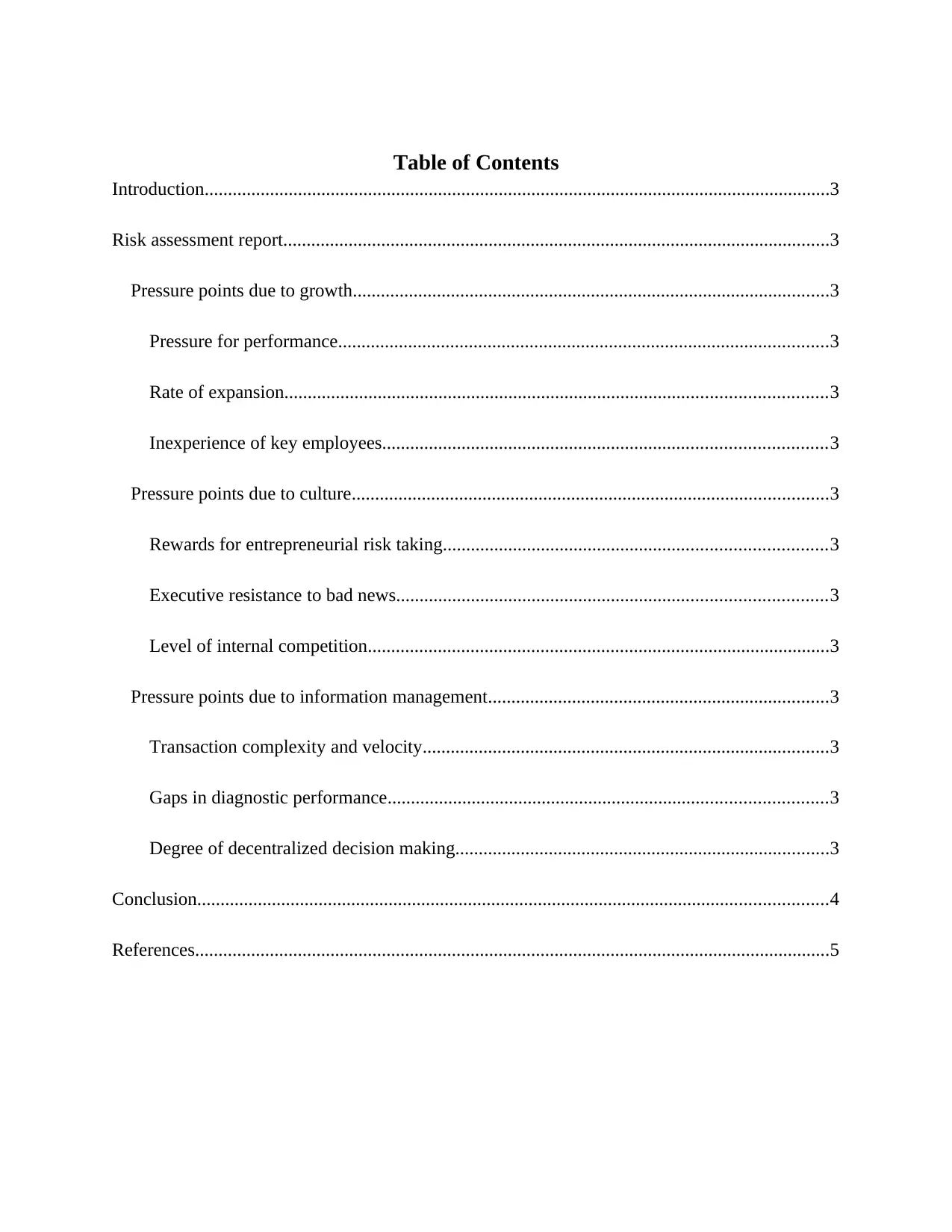
Table of Contents
Introduction......................................................................................................................................3
Risk assessment report.....................................................................................................................3
Pressure points due to growth......................................................................................................3
Pressure for performance.........................................................................................................3
Rate of expansion....................................................................................................................3
Inexperience of key employees...............................................................................................3
Pressure points due to culture......................................................................................................3
Rewards for entrepreneurial risk taking..................................................................................3
Executive resistance to bad news............................................................................................3
Level of internal competition...................................................................................................3
Pressure points due to information management.........................................................................3
Transaction complexity and velocity.......................................................................................3
Gaps in diagnostic performance..............................................................................................3
Degree of decentralized decision making................................................................................3
Conclusion.......................................................................................................................................4
References........................................................................................................................................5
Introduction......................................................................................................................................3
Risk assessment report.....................................................................................................................3
Pressure points due to growth......................................................................................................3
Pressure for performance.........................................................................................................3
Rate of expansion....................................................................................................................3
Inexperience of key employees...............................................................................................3
Pressure points due to culture......................................................................................................3
Rewards for entrepreneurial risk taking..................................................................................3
Executive resistance to bad news............................................................................................3
Level of internal competition...................................................................................................3
Pressure points due to information management.........................................................................3
Transaction complexity and velocity.......................................................................................3
Gaps in diagnostic performance..............................................................................................3
Degree of decentralized decision making................................................................................3
Conclusion.......................................................................................................................................4
References........................................................................................................................................5
INTRODUCTION
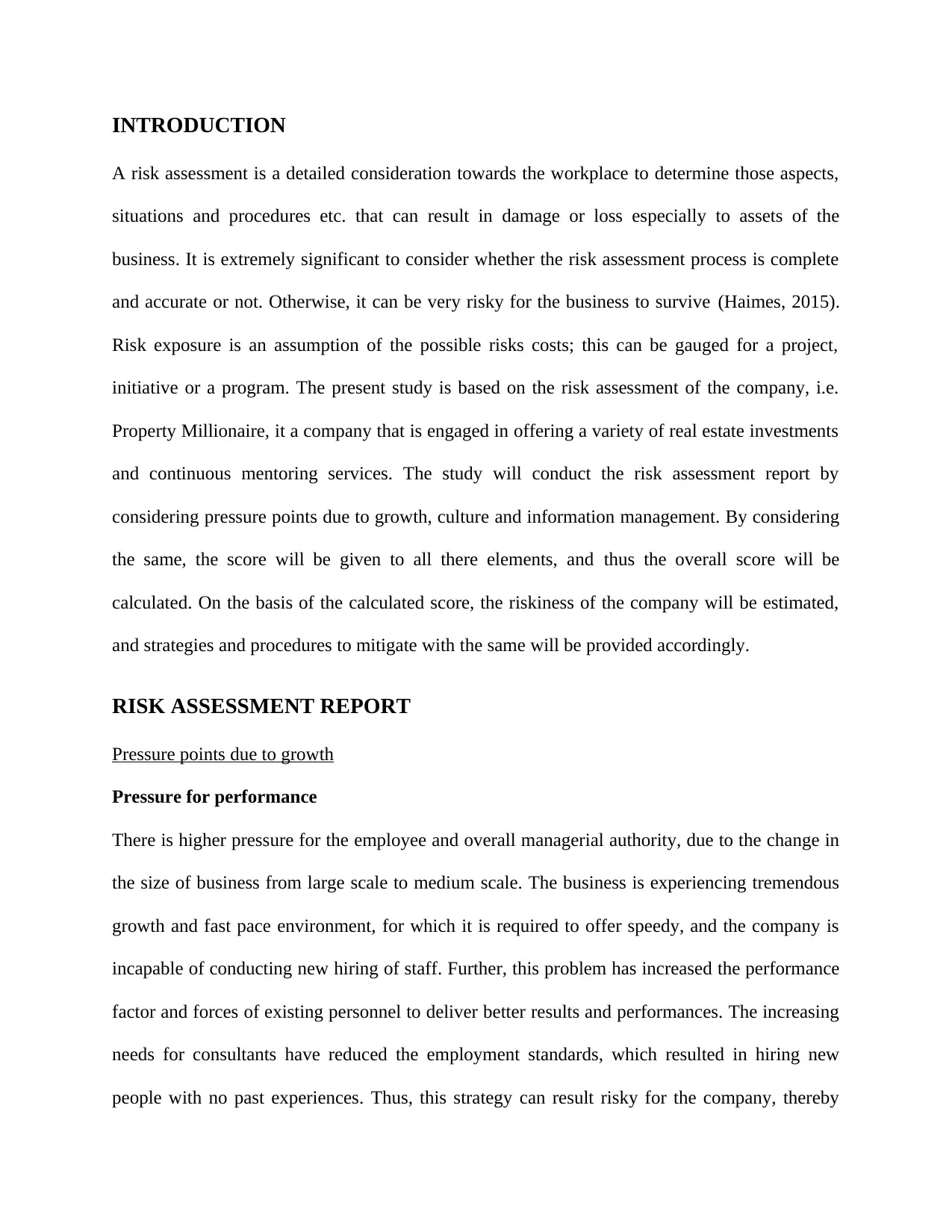
A risk assessment is a detailed consideration towards the workplace to determine those aspects,
situations and procedures etc. that can result in damage or loss especially to assets of the
business. It is extremely significant to consider whether the risk assessment process is complete
and accurate or not. Otherwise, it can be very risky for the business to survive (Haimes, 2015).
Risk exposure is an assumption of the possible risks costs; this can be gauged for a project,
initiative or a program. The present study is based on the risk assessment of the company, i.e.
Property Millionaire, it a company that is engaged in offering a variety of real estate investments
and continuous mentoring services. The study will conduct the risk assessment report by
considering pressure points due to growth, culture and information management. By considering
the same, the score will be given to all there elements, and thus the overall score will be
calculated. On the basis of the calculated score, the riskiness of the company will be estimated,
and strategies and procedures to mitigate with the same will be provided accordingly.
RISK ASSESSMENT REPORT
Pressure points due to growth
Pressure for performance
There is higher pressure for the employee and overall managerial authority, due to the change in
the size of business from large scale to medium scale. The business is experiencing tremendous
growth and fast pace environment, for which it is required to offer speedy, and the company is
incapable of conducting new hiring of staff. Further, this problem has increased the performance
factor and forces of existing personnel to deliver better results and performances. The increasing
needs for consultants have reduced the employment standards, which resulted in hiring new
people with no past experiences. Thus, this strategy can result risky for the company, thereby
A risk assessment is a detailed consideration towards the workplace to determine those aspects,
situations and procedures etc. that can result in damage or loss especially to assets of the
business. It is extremely significant to consider whether the risk assessment process is complete
and accurate or not. Otherwise, it can be very risky for the business to survive (Haimes, 2015).
Risk exposure is an assumption of the possible risks costs; this can be gauged for a project,
initiative or a program. The present study is based on the risk assessment of the company, i.e.
Property Millionaire, it a company that is engaged in offering a variety of real estate investments
and continuous mentoring services. The study will conduct the risk assessment report by
considering pressure points due to growth, culture and information management. By considering
the same, the score will be given to all there elements, and thus the overall score will be
calculated. On the basis of the calculated score, the riskiness of the company will be estimated,
and strategies and procedures to mitigate with the same will be provided accordingly.
RISK ASSESSMENT REPORT
Pressure points due to growth
Pressure for performance
There is higher pressure for the employee and overall managerial authority, due to the change in
the size of business from large scale to medium scale. The business is experiencing tremendous
growth and fast pace environment, for which it is required to offer speedy, and the company is
incapable of conducting new hiring of staff. Further, this problem has increased the performance
factor and forces of existing personnel to deliver better results and performances. The increasing
needs for consultants have reduced the employment standards, which resulted in hiring new
people with no past experiences. Thus, this strategy can result risky for the company, thereby
⊘ This is a preview!⊘
Do you want full access?
Subscribe today to unlock all pages.

Trusted by 1+ million students worldwide
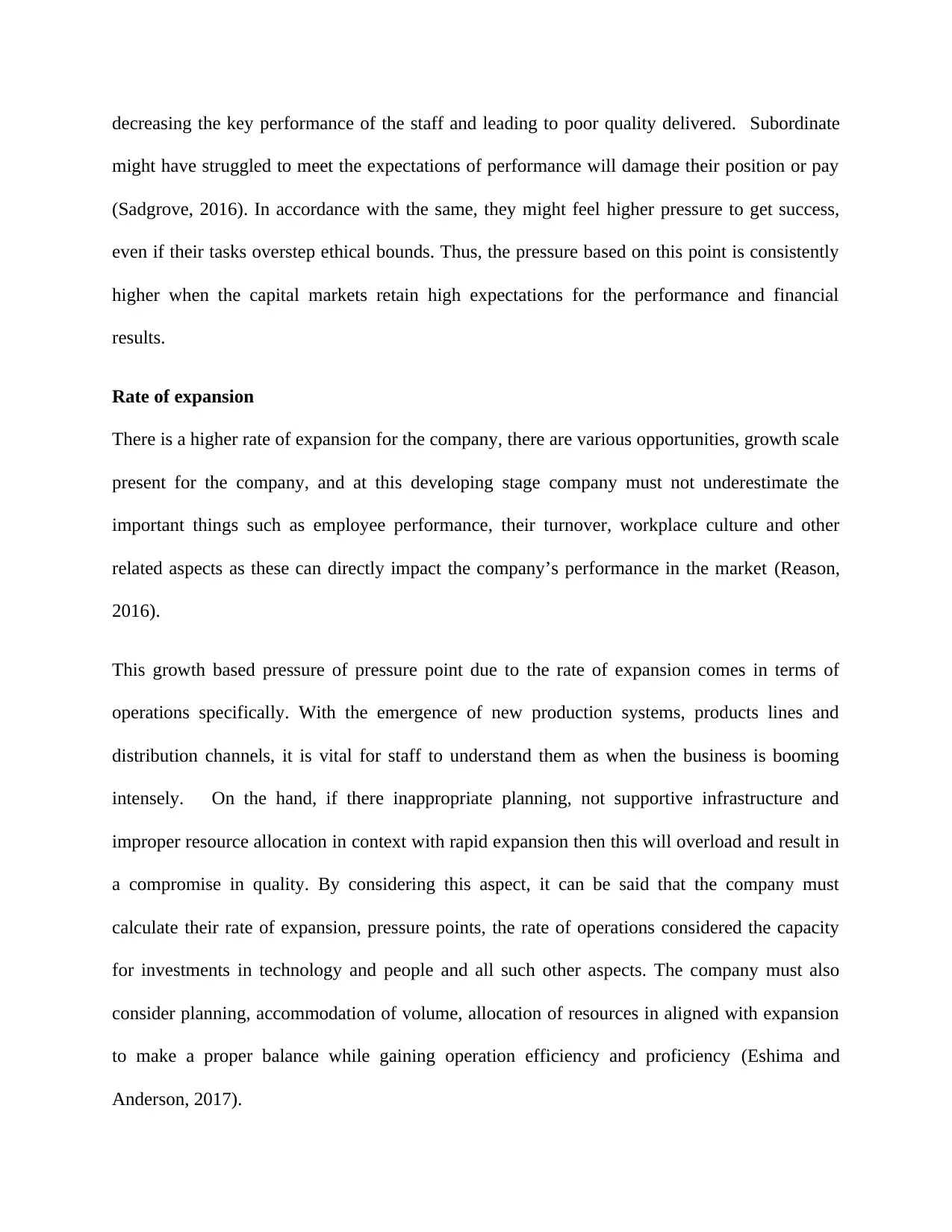
decreasing the key performance of the staff and leading to poor quality delivered. Subordinate
might have struggled to meet the expectations of performance will damage their position or pay
(Sadgrove, 2016). In accordance with the same, they might feel higher pressure to get success,
even if their tasks overstep ethical bounds. Thus, the pressure based on this point is consistently
higher when the capital markets retain high expectations for the performance and financial
results.
Rate of expansion
There is a higher rate of expansion for the company, there are various opportunities, growth scale
present for the company, and at this developing stage company must not underestimate the
important things such as employee performance, their turnover, workplace culture and other
related aspects as these can directly impact the company’s performance in the market (Reason,
2016).
This growth based pressure of pressure point due to the rate of expansion comes in terms of
operations specifically. With the emergence of new production systems, products lines and
distribution channels, it is vital for staff to understand them as when the business is booming
intensely. On the hand, if there inappropriate planning, not supportive infrastructure and
improper resource allocation in context with rapid expansion then this will overload and result in
a compromise in quality. By considering this aspect, it can be said that the company must
calculate their rate of expansion, pressure points, the rate of operations considered the capacity
for investments in technology and people and all such other aspects. The company must also
consider planning, accommodation of volume, allocation of resources in aligned with expansion
to make a proper balance while gaining operation efficiency and proficiency (Eshima and
Anderson, 2017).
might have struggled to meet the expectations of performance will damage their position or pay
(Sadgrove, 2016). In accordance with the same, they might feel higher pressure to get success,
even if their tasks overstep ethical bounds. Thus, the pressure based on this point is consistently
higher when the capital markets retain high expectations for the performance and financial
results.
Rate of expansion
There is a higher rate of expansion for the company, there are various opportunities, growth scale
present for the company, and at this developing stage company must not underestimate the
important things such as employee performance, their turnover, workplace culture and other
related aspects as these can directly impact the company’s performance in the market (Reason,
2016).
This growth based pressure of pressure point due to the rate of expansion comes in terms of
operations specifically. With the emergence of new production systems, products lines and
distribution channels, it is vital for staff to understand them as when the business is booming
intensely. On the hand, if there inappropriate planning, not supportive infrastructure and
improper resource allocation in context with rapid expansion then this will overload and result in
a compromise in quality. By considering this aspect, it can be said that the company must
calculate their rate of expansion, pressure points, the rate of operations considered the capacity
for investments in technology and people and all such other aspects. The company must also
consider planning, accommodation of volume, allocation of resources in aligned with expansion
to make a proper balance while gaining operation efficiency and proficiency (Eshima and
Anderson, 2017).
Paraphrase This Document
Need a fresh take? Get an instant paraphrase of this document with our AI Paraphraser
The inexperience of key employees
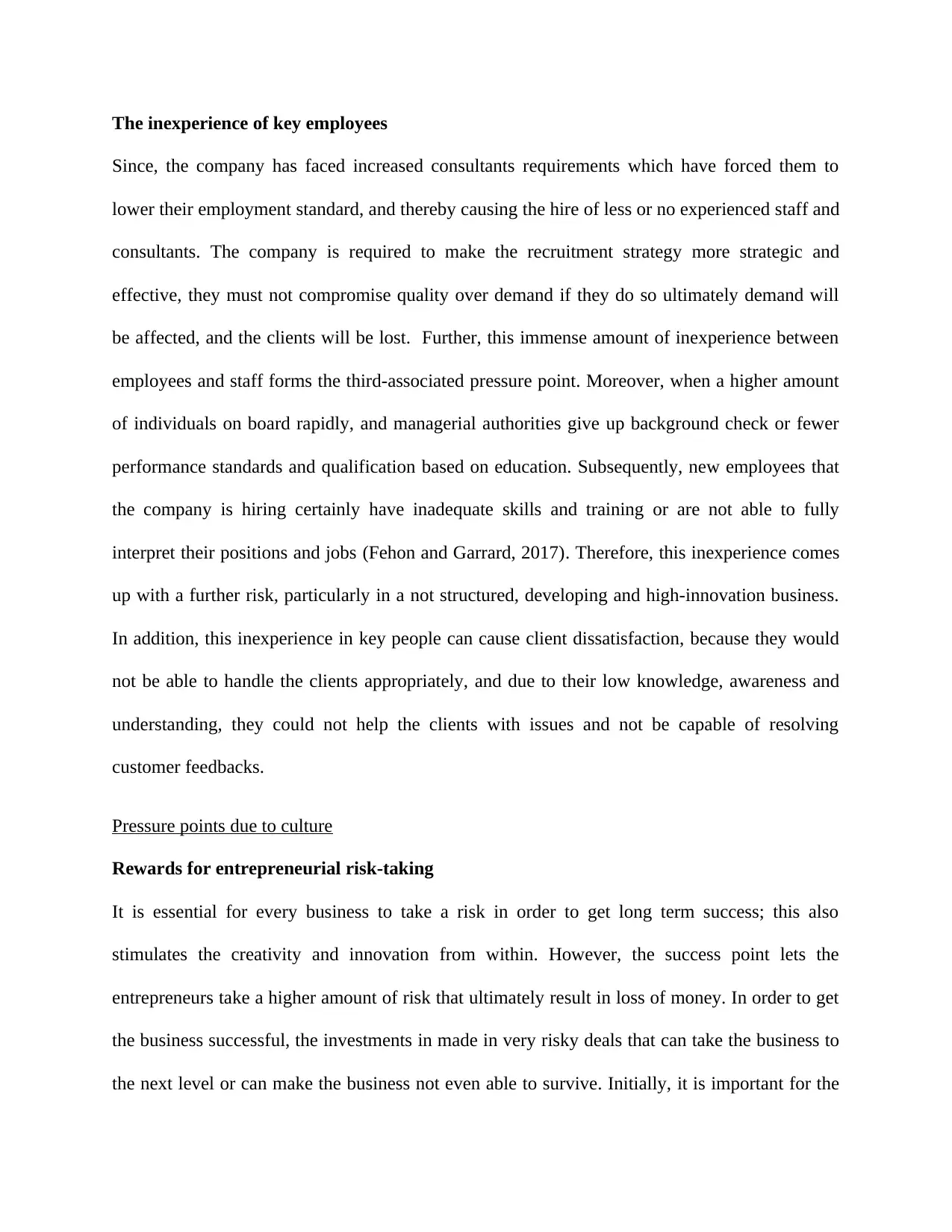
Since, the company has faced increased consultants requirements which have forced them to
lower their employment standard, and thereby causing the hire of less or no experienced staff and
consultants. The company is required to make the recruitment strategy more strategic and
effective, they must not compromise quality over demand if they do so ultimately demand will
be affected, and the clients will be lost. Further, this immense amount of inexperience between
employees and staff forms the third-associated pressure point. Moreover, when a higher amount
of individuals on board rapidly, and managerial authorities give up background check or fewer
performance standards and qualification based on education. Subsequently, new employees that
the company is hiring certainly have inadequate skills and training or are not able to fully
interpret their positions and jobs (Fehon and Garrard, 2017). Therefore, this inexperience comes
up with a further risk, particularly in a not structured, developing and high-innovation business.
In addition, this inexperience in key people can cause client dissatisfaction, because they would
not be able to handle the clients appropriately, and due to their low knowledge, awareness and
understanding, they could not help the clients with issues and not be capable of resolving
customer feedbacks.
Pressure points due to culture
Rewards for entrepreneurial risk-taking
It is essential for every business to take a risk in order to get long term success; this also
stimulates the creativity and innovation from within. However, the success point lets the
entrepreneurs take a higher amount of risk that ultimately result in loss of money. In order to get
the business successful, the investments in made in very risky deals that can take the business to
the next level or can make the business not even able to survive. Initially, it is important for the
Since, the company has faced increased consultants requirements which have forced them to
lower their employment standard, and thereby causing the hire of less or no experienced staff and
consultants. The company is required to make the recruitment strategy more strategic and
effective, they must not compromise quality over demand if they do so ultimately demand will
be affected, and the clients will be lost. Further, this immense amount of inexperience between
employees and staff forms the third-associated pressure point. Moreover, when a higher amount
of individuals on board rapidly, and managerial authorities give up background check or fewer
performance standards and qualification based on education. Subsequently, new employees that
the company is hiring certainly have inadequate skills and training or are not able to fully
interpret their positions and jobs (Fehon and Garrard, 2017). Therefore, this inexperience comes
up with a further risk, particularly in a not structured, developing and high-innovation business.
In addition, this inexperience in key people can cause client dissatisfaction, because they would
not be able to handle the clients appropriately, and due to their low knowledge, awareness and
understanding, they could not help the clients with issues and not be capable of resolving
customer feedbacks.
Pressure points due to culture
Rewards for entrepreneurial risk-taking
It is essential for every business to take a risk in order to get long term success; this also
stimulates the creativity and innovation from within. However, the success point lets the
entrepreneurs take a higher amount of risk that ultimately result in loss of money. In order to get
the business successful, the investments in made in very risky deals that can take the business to
the next level or can make the business not even able to survive. Initially, it is important for the
business to identify at what proportion their business is dependent on products that have been
produced by creativeness and risk-taking (Hoskisson and et al., 2017). The environment wherein
the risk takers are involved also considered, it is the main cause that decided the higher or lower
score of this point. Along with this, an increasing frequency in failed services, such as seminars
or failed deals can take the risk exposure higher, as in the case of Property Millionaire. The way
the consultants are handling seminars is not good, as they are only interacting and responding the
clients till the time they sign up for seminars and after that, they fail to respond to their phone
calls. This can make the risk exposure high, and the company would lose the grip of customers
if they do not make seminars more interactive and beneficial for clients.
Executive resistance to bad news
In the case of Property Millionaire, the regional managers do not act sensibly if any bad new
arise, they do not involve with consultants and leave the situations as they are not able to
interpret the complicated language of the consultation process. In addition, they have limited
accessibility to performance data and waste their time on attempting to resolve the flare-ups and
unexpected emergencies; they focus merely on sales figures of seminars to upper management
which not even submitted on time. In this case, the company must encourage them to surround
with people who share interest and price within the business and use confidence in arriving at
expected performance goals (Chen, Crossland and Luo, 2015). They must surround themselves
with yes people, and people who communicate better on barriers, problems, with frontlines
customers and all involved people. The company must inspire them to tell how much bad news
they hear and their resistance towards the same.
produced by creativeness and risk-taking (Hoskisson and et al., 2017). The environment wherein
the risk takers are involved also considered, it is the main cause that decided the higher or lower
score of this point. Along with this, an increasing frequency in failed services, such as seminars
or failed deals can take the risk exposure higher, as in the case of Property Millionaire. The way
the consultants are handling seminars is not good, as they are only interacting and responding the
clients till the time they sign up for seminars and after that, they fail to respond to their phone
calls. This can make the risk exposure high, and the company would lose the grip of customers
if they do not make seminars more interactive and beneficial for clients.
Executive resistance to bad news
In the case of Property Millionaire, the regional managers do not act sensibly if any bad new
arise, they do not involve with consultants and leave the situations as they are not able to
interpret the complicated language of the consultation process. In addition, they have limited
accessibility to performance data and waste their time on attempting to resolve the flare-ups and
unexpected emergencies; they focus merely on sales figures of seminars to upper management
which not even submitted on time. In this case, the company must encourage them to surround
with people who share interest and price within the business and use confidence in arriving at
expected performance goals (Chen, Crossland and Luo, 2015). They must surround themselves
with yes people, and people who communicate better on barriers, problems, with frontlines
customers and all involved people. The company must inspire them to tell how much bad news
they hear and their resistance towards the same.
⊘ This is a preview!⊘
Do you want full access?
Subscribe today to unlock all pages.
Trusted by 1+ million students worldwide
Level of internal competition
There is fierce and ruthless competition present within the Property Millionaire, as the company
culture is primarily based on rewarding those higher performing employees and they have given
special and royal treatment from the regional managers. Due to this treatment, consultants are
rutted against one another, and the low and medium performing employees are de-motivated
ending up by delivering reduced performance level. Further, the company must ensure workplace
equality and adopt anti-discrimination policies, while increasing employment standards as well.
The competition and horse race in the workplace and business environment can have unintended
side effects (Zinovieva and et al., 2016). These can lower down the performances from
consultants to senior management, as they no do collaborate and communicate with each other
effectively. Risks also arise when the rewards are not distributed evenly. Thus, it is necessary for
the business to consider the performance review, and ranking of employees in comparison with
others, and evaluation of their same based on their own merits.
Pressure points due to information management
Transaction complexity and velocity
The complexity of transactions can be increased by complex innovation, creativity in products
and services and sophisticated products, system and technologies. This all related with the
information flow in the companies, and in case there is an inadequacy in the system for
information then there is higher exposure to risks. There are only a few people who whole
interpret the risks nature that is created by these transactions and only they are eligible to control
and govern them (McMillan and Overall, 2016). It is essential that all the involved people in the
company optimally retain the leading obligations and reliant cash flows so that the risks
associated with the balance sheet can be fully uncovered and is understandable by the senior
There is fierce and ruthless competition present within the Property Millionaire, as the company
culture is primarily based on rewarding those higher performing employees and they have given
special and royal treatment from the regional managers. Due to this treatment, consultants are
rutted against one another, and the low and medium performing employees are de-motivated
ending up by delivering reduced performance level. Further, the company must ensure workplace
equality and adopt anti-discrimination policies, while increasing employment standards as well.
The competition and horse race in the workplace and business environment can have unintended
side effects (Zinovieva and et al., 2016). These can lower down the performances from
consultants to senior management, as they no do collaborate and communicate with each other
effectively. Risks also arise when the rewards are not distributed evenly. Thus, it is necessary for
the business to consider the performance review, and ranking of employees in comparison with
others, and evaluation of their same based on their own merits.
Pressure points due to information management
Transaction complexity and velocity
The complexity of transactions can be increased by complex innovation, creativity in products
and services and sophisticated products, system and technologies. This all related with the
information flow in the companies, and in case there is an inadequacy in the system for
information then there is higher exposure to risks. There are only a few people who whole
interpret the risks nature that is created by these transactions and only they are eligible to control
and govern them (McMillan and Overall, 2016). It is essential that all the involved people in the
company optimally retain the leading obligations and reliant cash flows so that the risks
associated with the balance sheet can be fully uncovered and is understandable by the senior
Paraphrase This Document
Need a fresh take? Get an instant paraphrase of this document with our AI Paraphraser
managers. For this aspect, the manager must foresee the information’s complexity, velocity and
volume timely, and their rise and fall with the rate so that they can be maintained properly.
Gaps in diagnostic performance
The expansion and success of the company also place pressure on the internal reporting system
that calculates the crucial performance variables that are return on capital, sales, quality of
products and services and order history (Schaltegger and Wagner, 2017). Managers generally
pore over facts and figures, when they attempt to know the major source of the problem at bad
times; on the other hand, the process is just slid by the managers at good times. The higher rate
of expansion generally delivers these systems insufficient and outdated to the new business
demand, and it is also because of human nature.
In a situation where the profits level up, the executives give no efforts in moulding and analyzing
data to make improvements, but when the profit decrease, all efforts are given which at the end
lead to mess up of data, as it is hard to find the correct data at a correct time. Further, where gaps
are acknowledged in the diagnostic performance measures, then gain information through phone
calls, and waste enough amount of time working on systems that should be done earlier.
The degree of decentralized decision making
When the expansion rate of the company is higher, the regional managers and senior
management teams are provided with greater autonomy to make business decisions, so in the
case of cited company. Of course, the senior management is engaged in the allocation of
resources and timely performance review; this decentralized decision making has many perks, it
allows a better response by managers to market demand while enabling creativity and
innovation, plus allowing motivation and job satisfaction. But if, the managers and team do not
volume timely, and their rise and fall with the rate so that they can be maintained properly.
Gaps in diagnostic performance
The expansion and success of the company also place pressure on the internal reporting system
that calculates the crucial performance variables that are return on capital, sales, quality of
products and services and order history (Schaltegger and Wagner, 2017). Managers generally
pore over facts and figures, when they attempt to know the major source of the problem at bad
times; on the other hand, the process is just slid by the managers at good times. The higher rate
of expansion generally delivers these systems insufficient and outdated to the new business
demand, and it is also because of human nature.
In a situation where the profits level up, the executives give no efforts in moulding and analyzing
data to make improvements, but when the profit decrease, all efforts are given which at the end
lead to mess up of data, as it is hard to find the correct data at a correct time. Further, where gaps
are acknowledged in the diagnostic performance measures, then gain information through phone
calls, and waste enough amount of time working on systems that should be done earlier.
The degree of decentralized decision making
When the expansion rate of the company is higher, the regional managers and senior
management teams are provided with greater autonomy to make business decisions, so in the
case of cited company. Of course, the senior management is engaged in the allocation of
resources and timely performance review; this decentralized decision making has many perks, it
allows a better response by managers to market demand while enabling creativity and
innovation, plus allowing motivation and job satisfaction. But if, the managers and team do not
act in a sensible manner In line with the corporate strategy and make decisions can come up with
a higher amount of risks (Brettel, Chomik and Flatten, 2015). If they do not have sufficient
information channel for sharing information can be a drawback also. In the case of Property
Millionaire, the senior management team do not act as a team, and develop their information
independently, without each other consultation, and only return to the group when they form
substantial value, and this result in increasing failure of new seminars. Thus, it the senior
executives must hear significant information, work with each other, share ideas and opinions,
communicate daily, and respond to each other’s problem to arrive at a mutual decision and create
a win-win situation.
By considering the above analysis, the risk exposure calculator is presented below:
Growth
Pressure for
performance
Rate of expansion The inexperience of
key employees
Score
4 4 5 13
Culture
Rewards for
entrepreneurial
risk-taking
Executive resistance
to bad news
Level of internal
competition
Score
3 4 5 12
a higher amount of risks (Brettel, Chomik and Flatten, 2015). If they do not have sufficient
information channel for sharing information can be a drawback also. In the case of Property
Millionaire, the senior management team do not act as a team, and develop their information
independently, without each other consultation, and only return to the group when they form
substantial value, and this result in increasing failure of new seminars. Thus, it the senior
executives must hear significant information, work with each other, share ideas and opinions,
communicate daily, and respond to each other’s problem to arrive at a mutual decision and create
a win-win situation.
By considering the above analysis, the risk exposure calculator is presented below:
Growth
Pressure for
performance
Rate of expansion The inexperience of
key employees
Score
4 4 5 13
Culture
Rewards for
entrepreneurial
risk-taking
Executive resistance
to bad news
Level of internal
competition
Score
3 4 5 12
⊘ This is a preview!⊘
Do you want full access?
Subscribe today to unlock all pages.
Trusted by 1+ million students worldwide
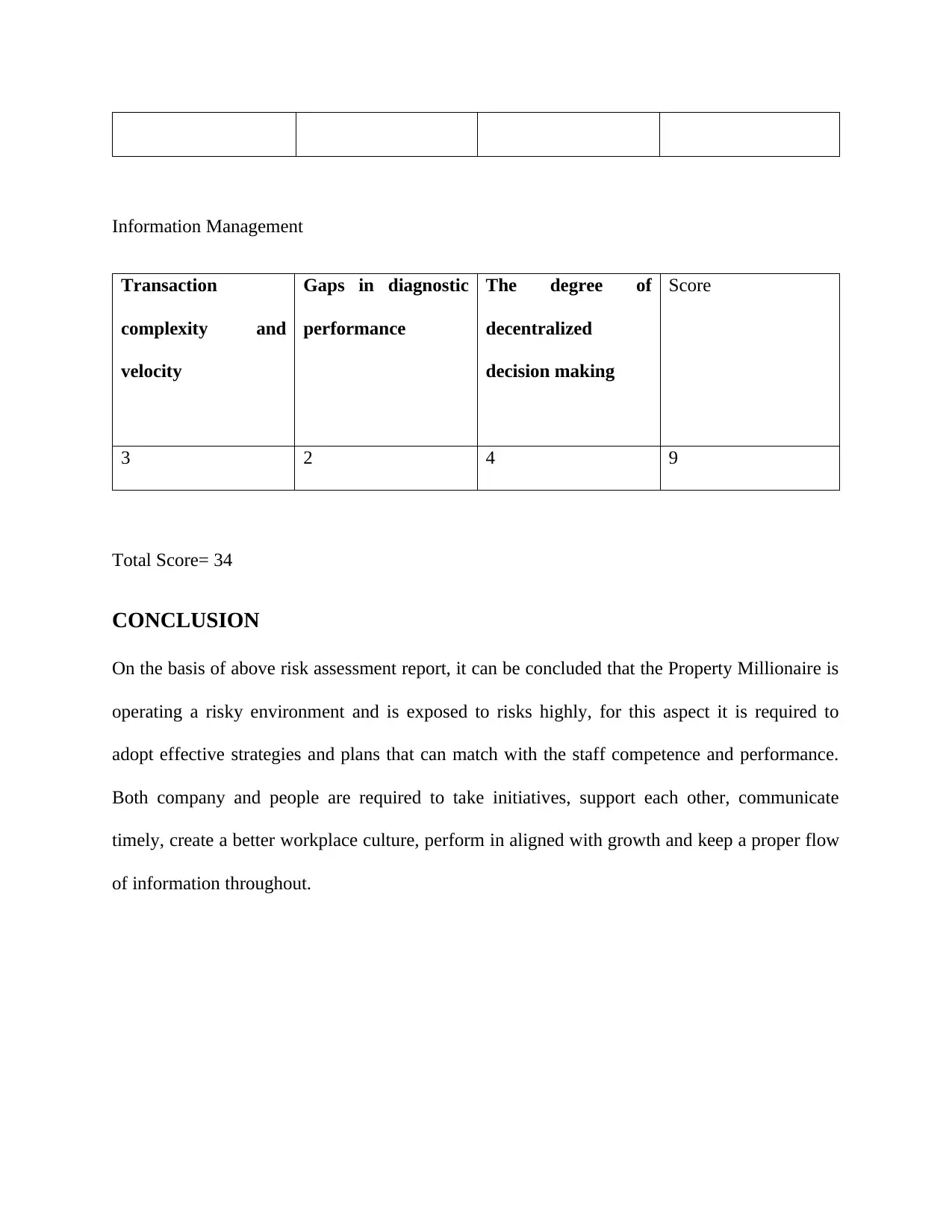
Information Management
Transaction
complexity and
velocity
Gaps in diagnostic
performance
The degree of
decentralized
decision making
Score
3 2 4 9
Total Score= 34
CONCLUSION
On the basis of above risk assessment report, it can be concluded that the Property Millionaire is
operating a risky environment and is exposed to risks highly, for this aspect it is required to
adopt effective strategies and plans that can match with the staff competence and performance.
Both company and people are required to take initiatives, support each other, communicate
timely, create a better workplace culture, perform in aligned with growth and keep a proper flow
of information throughout.
Transaction
complexity and
velocity
Gaps in diagnostic
performance
The degree of
decentralized
decision making
Score
3 2 4 9
Total Score= 34
CONCLUSION
On the basis of above risk assessment report, it can be concluded that the Property Millionaire is
operating a risky environment and is exposed to risks highly, for this aspect it is required to
adopt effective strategies and plans that can match with the staff competence and performance.
Both company and people are required to take initiatives, support each other, communicate
timely, create a better workplace culture, perform in aligned with growth and keep a proper flow
of information throughout.
Paraphrase This Document
Need a fresh take? Get an instant paraphrase of this document with our AI Paraphraser
REFERENCES
Brettel, M., Chomik, C. and Flatten, T.C., 2015. How organizational culture influences
innovativeness, proactiveness, and risk‐taking: Fostering entrepreneurial orientation in
SMEs. Journal of Small Business Management, 53(4), pp.868-885.
Chen, G., Crossland, C. and Luo, S., 2015. Making the same mistake all over again: CEO
overconfidence and corporate resistance to corrective feedback. Strategic Management
Journal, 36(10), pp.1513-1535.
Eshima, Y. and Anderson, B.S., 2017. Firm growth, adaptive capability, and entrepreneurial
orientation. Strategic Management Journal, 38(3), pp.770-779.
Fehon, M. and Garrard, W., 2017. Inexperienced, self-preserving or perhaps, just greedy? Why
the leaders of organisations are ignoring obvious ethical problems. Governance
Directions, 69(3), p.164.
Haimes, Y.Y., 2015. Risk modeling, assessment, and management. John Wiley & Sons.
Hoskisson, R.E., Chirico, F., Zyung, J. and Gambeta, E., 2017. Managerial risk taking: A
multitheoretical review and future research agenda. Journal of Management, 43(1), pp.137-169.
McMillan, C. and Overall, J., 2016. Wicked problems: turning strategic management upside
down. Journal of Business Strategy, 37(1), pp.34-43.
Reason, J., 2016. Managing the risks of organizational accidents. Routledge.
Sadgrove, K., 2016. The complete guide to business risk management. Routledge.
Brettel, M., Chomik, C. and Flatten, T.C., 2015. How organizational culture influences
innovativeness, proactiveness, and risk‐taking: Fostering entrepreneurial orientation in
SMEs. Journal of Small Business Management, 53(4), pp.868-885.
Chen, G., Crossland, C. and Luo, S., 2015. Making the same mistake all over again: CEO
overconfidence and corporate resistance to corrective feedback. Strategic Management
Journal, 36(10), pp.1513-1535.
Eshima, Y. and Anderson, B.S., 2017. Firm growth, adaptive capability, and entrepreneurial
orientation. Strategic Management Journal, 38(3), pp.770-779.
Fehon, M. and Garrard, W., 2017. Inexperienced, self-preserving or perhaps, just greedy? Why
the leaders of organisations are ignoring obvious ethical problems. Governance
Directions, 69(3), p.164.
Haimes, Y.Y., 2015. Risk modeling, assessment, and management. John Wiley & Sons.
Hoskisson, R.E., Chirico, F., Zyung, J. and Gambeta, E., 2017. Managerial risk taking: A
multitheoretical review and future research agenda. Journal of Management, 43(1), pp.137-169.
McMillan, C. and Overall, J., 2016. Wicked problems: turning strategic management upside
down. Journal of Business Strategy, 37(1), pp.34-43.
Reason, J., 2016. Managing the risks of organizational accidents. Routledge.
Sadgrove, K., 2016. The complete guide to business risk management. Routledge.
Schaltegger, S. and Wagner, M., 2017. Managing the business case for sustainability: The
integration of social, environmental and economic performance. Routledge.
Zinovieva, C.G., Kuznetsova, M.V., Dorfman, T.V., Limarev, P.V. and Limareva, J.A., 2016.
Study of external and internal factors affecting enterprise’s stability. Advances in Systems
Science and Applications, 16(1), pp.62-71.
integration of social, environmental and economic performance. Routledge.
Zinovieva, C.G., Kuznetsova, M.V., Dorfman, T.V., Limarev, P.V. and Limareva, J.A., 2016.
Study of external and internal factors affecting enterprise’s stability. Advances in Systems
Science and Applications, 16(1), pp.62-71.
⊘ This is a preview!⊘
Do you want full access?
Subscribe today to unlock all pages.
Trusted by 1+ million students worldwide

1 out of 12


Related Documents


Your All-in-One AI-Powered Toolkit for Academic Success.
+13062052269
info@desklib.com
Available 24*7 on WhatsApp / Email
![[object Object]](/_next/static/media/star-bottom.7253800d.svg)
Unlock your academic potential
Copyright © 2020–2026 A2Z Services. All Rights Reserved. Developed and managed by ZUCOL.