IT Networking Report: Proprietary vs. Open Source OS Comparison

Verified

Added on  2020/05/03

|2
|814
|102
Report
AI Summary
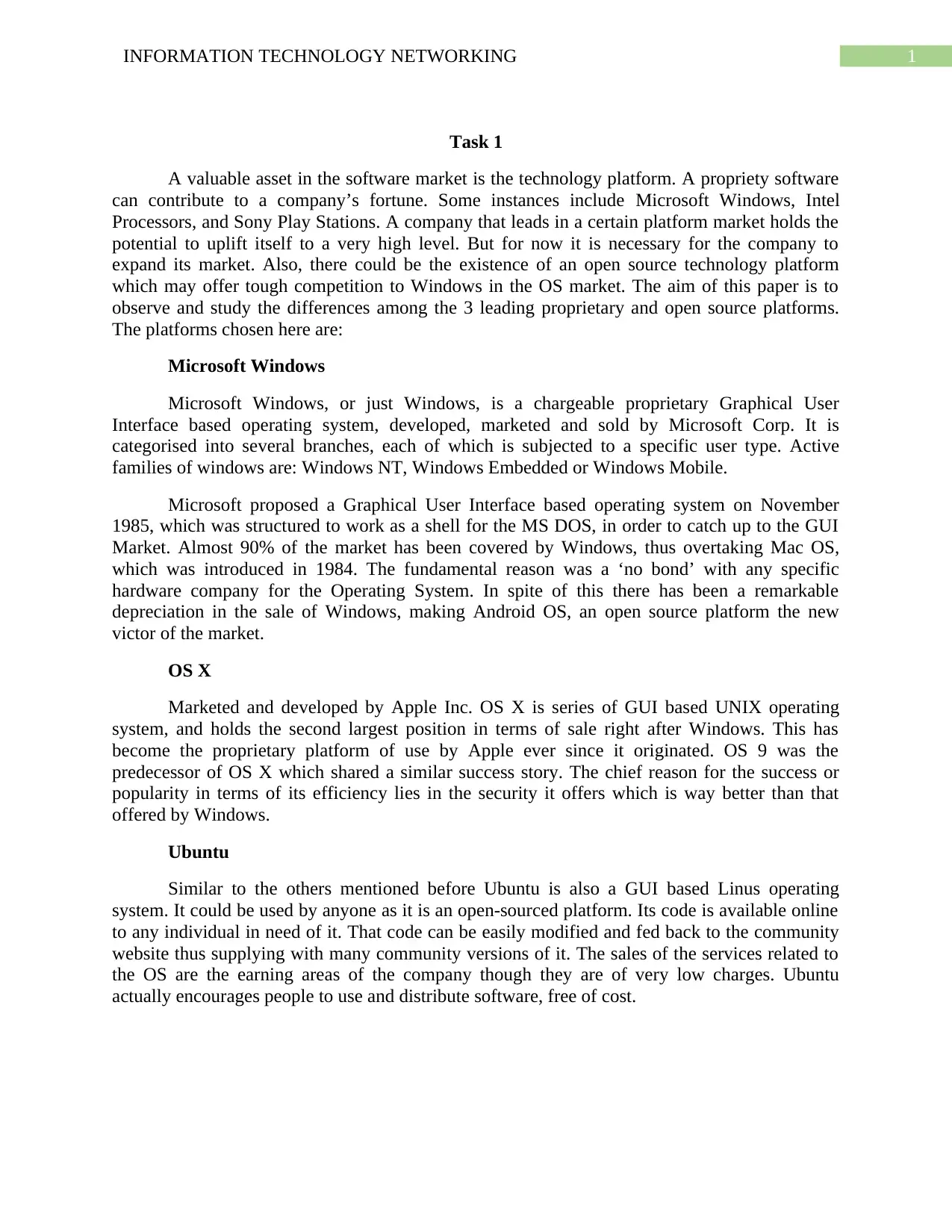
This report examines and contrasts three leading operating systems: Microsoft Windows, OS X (developed by Apple Inc.), and Ubuntu (an open-source platform). The report focuses on the differences between proprietary and open-source models, highlighting the market positions and characteristics of each. Windows, a dominant proprietary system, is compared with OS X, known for its security, and Ubuntu, which offers open-source accessibility and community-driven development. The analysis includes a discussion of the financial models associated with each platform, including software sales, licensing, and the role of community contributions in open-source systems. The report concludes by evaluating the optimal solutions for public usage, considering factors such as cost, security, and the impact of proprietary versus open-source models on software development and user experience. The study references sources discussing platform competition and the open-source movement.
Document Page
1INFORMATION TECHNOLOGY NETWORKING
Task 1
A valuable asset in the software market is the technology platform. A propriety software
can contribute to a company’s fortune. Some instances include Microsoft Windows, Intel
Processors, and Sony Play Stations. A company that leads in a certain platform market holds the
potential to uplift itself to a very high level. But for now it is necessary for the company to
expand its market. Also, there could be the existence of an open source technology platform
which may offer tough competition to Windows in the OS market. The aim of this paper is to
observe and study the differences among the 3 leading proprietary and open source platforms.
The platforms chosen here are:
Microsoft Windows
Microsoft Windows, or just Windows, is a chargeable proprietary Graphical User
Interface based operating system, developed, marketed and sold by Microsoft Corp. It is
categorised into several branches, each of which is subjected to a specific user type. Active
families of windows are: Windows NT, Windows Embedded or Windows Mobile.
Microsoft proposed a Graphical User Interface based operating system on November
1985, which was structured to work as a shell for the MS DOS, in order to catch up to the GUI
Market. Almost 90% of the market has been covered by Windows, thus overtaking Mac OS,
which was introduced in 1984. The fundamental reason was a ‘no bond’ with any specific
hardware company for the Operating System. In spite of this there has been a remarkable
depreciation in the sale of Windows, making Android OS, an open source platform the new
victor of the market.
OS X
Marketed and developed by Apple Inc. OS X is series of GUI based UNIX operating
system, and holds the second largest position in terms of sale right after Windows. This has
become the proprietary platform of use by Apple ever since it originated. OS 9 was the
predecessor of OS X which shared a similar success story. The chief reason for the success or
popularity in terms of its efficiency lies in the security it offers which is way better than that
offered by Windows.
Ubuntu
Similar to the others mentioned before Ubuntu is also a GUI based Linus operating
system. It could be used by anyone as it is an open-sourced platform. Its code is available online
to any individual in need of it. That code can be easily modified and fed back to the community
website thus supplying with many community versions of it. The sales of the services related to
the OS are the earning areas of the company though they are of very low charges. Ubuntu
actually encourages people to use and distribute software, free of cost.
tabler-icon-diamond-filled.svg

Paraphrase This Document

Need a fresh take? Get an instant paraphrase of this document with our AI Paraphraser
Document Page
2INFORMATION TECHNOLOGY NETWORKING
Conclusion
In this study, a contrast is pulled in between the ownership based operating systems and
open source ones in use these days. Here we try to learn the optimal solution for the usage of the
public. We have looked closely into three of the highest used operating systems in this paper.
Two of these are OS X and Windows which are under the ownership of Apple and Microsoft
respectively whereas the other one is available for public usage as it is an open-source platform.
A common feature among all the OS chosen here is that they are all on GUI based platforms.
This is done to give the comparison between the systems an equivalent footing. It is noteworthy
that when a company is selling a proprietary software then, not only is it gaining funds from the
selling the software itself but also from the software licenses which are lent to the application
developers for releasing new apps to the market. On the other hand, any individual is free to
change the code and deliver a new version of the open source systems, thus bringing in
customary usage and variety to the user community thus increasing diversity and software
production cost. Being free of cost most uses them and provides intellectual reviews helpful for
other apps as while, while some provide support for further production of such software which
are useful in day-to-day activities.
References:
1. https://wi-phye.com/blog/the-pros-and-cons-of-linux-windows-and-osx/
2. Rochet, J. C., J. Tirole. 2003. Platform competition in two-sided markets. J. Eur.
Econom. Assoc. 1(4) 990–1029.
3. Lerner, J., J. Tirole. 2001. The open source movement: Key research questions. Eur.
Econom. Rev. 45(4–6) 819–826.
chevron_up_icon
1 out of 2
circle_padding
hide_on_mobile
zoom_out_icon
[object Object]