University Philosophy Assignment: Protagoras vs. Socrates - Module X

Verified

Added on  2023/01/11

|3
|382
|50
Essay
AI Summary
This assignment explores the contrasting philosophies of Protagoras and Socrates, focusing on their differing perspectives on truth, knowledge, and the role of the individual. The assignment begins by outlining Protagoras's relativist view, where 'man is the measure of all things,' and the importance of societal norms. It contrasts this with Socrates' dialectic method, which emphasizes the importance of knowledge, education, and virtues such as temperance, courage, and justice in determining truth. The assignment highlights the core difference: Protagoras's view of truth as subjective, shaped by individual experiences, while Socrates emphasizes the objective nature of truth, accessible through reason and knowledge. The assignment also references key sources to support the analysis.
Document Page
Running head: Philosophy 1
Philosophy
Student Name
Institutional Affiliation
tabler-icon-diamond-filled.svg

Paraphrase This Document

Need a fresh take? Get an instant paraphrase of this document with our AI Paraphraser
Document Page
Philosophy 2
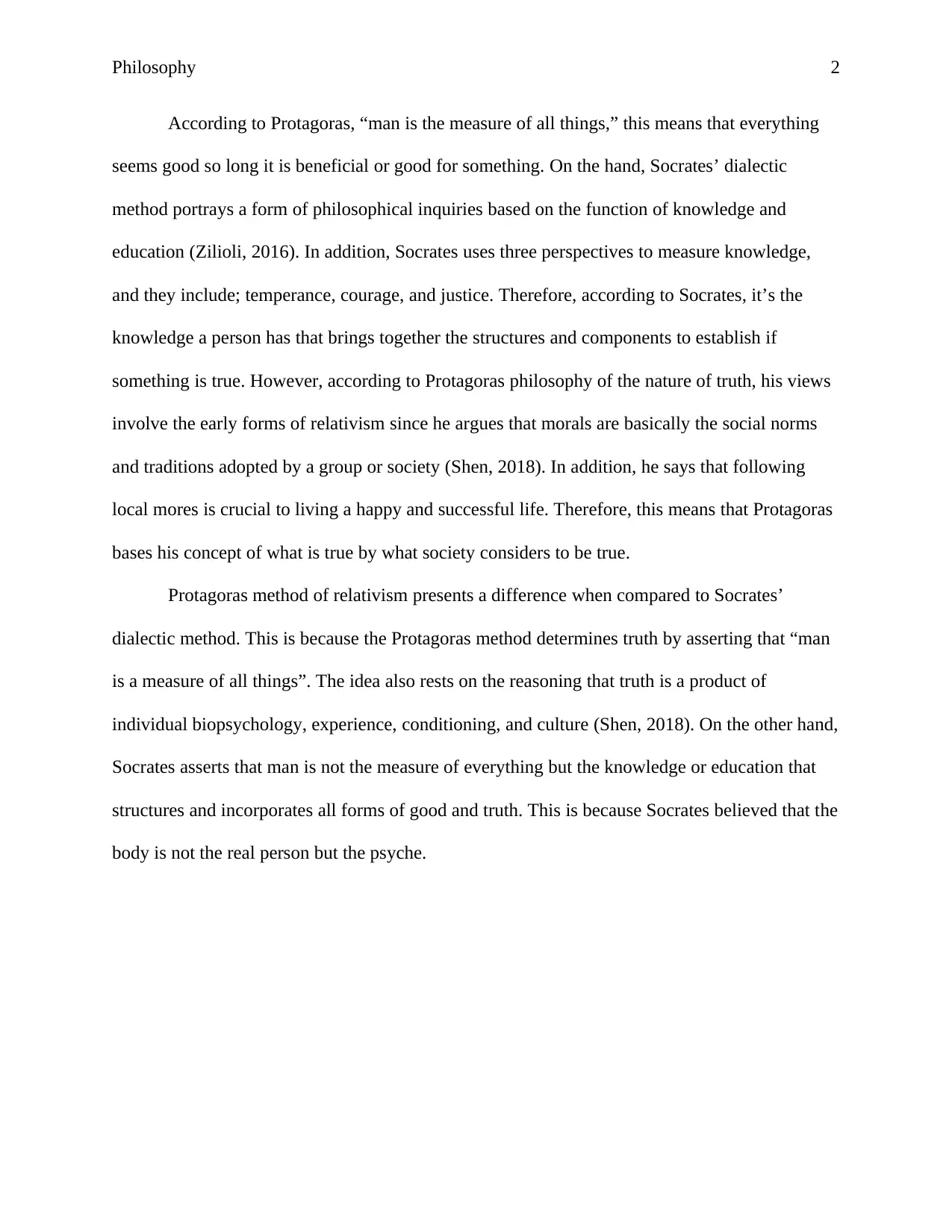
According to Protagoras, “man is the measure of all things,” this means that everything
seems good so long it is beneficial or good for something. On the hand, Socrates’ dialectic
method portrays a form of philosophical inquiries based on the function of knowledge and
education (Zilioli, 2016). In addition, Socrates uses three perspectives to measure knowledge,
and they include; temperance, courage, and justice. Therefore, according to Socrates, it’s the
knowledge a person has that brings together the structures and components to establish if
something is true. However, according to Protagoras philosophy of the nature of truth, his views
involve the early forms of relativism since he argues that morals are basically the social norms
and traditions adopted by a group or society (Shen, 2018). In addition, he says that following
local mores is crucial to living a happy and successful life. Therefore, this means that Protagoras
bases his concept of what is true by what society considers to be true.
Protagoras method of relativism presents a difference when compared to Socrates’
dialectic method. This is because the Protagoras method determines truth by asserting that “man
is a measure of all things”. The idea also rests on the reasoning that truth is a product of
individual biopsychology, experience, conditioning, and culture (Shen, 2018). On the other hand,
Socrates asserts that man is not the measure of everything but the knowledge or education that
structures and incorporates all forms of good and truth. This is because Socrates believed that the
body is not the real person but the psyche.
Document Page
Philosophy 3
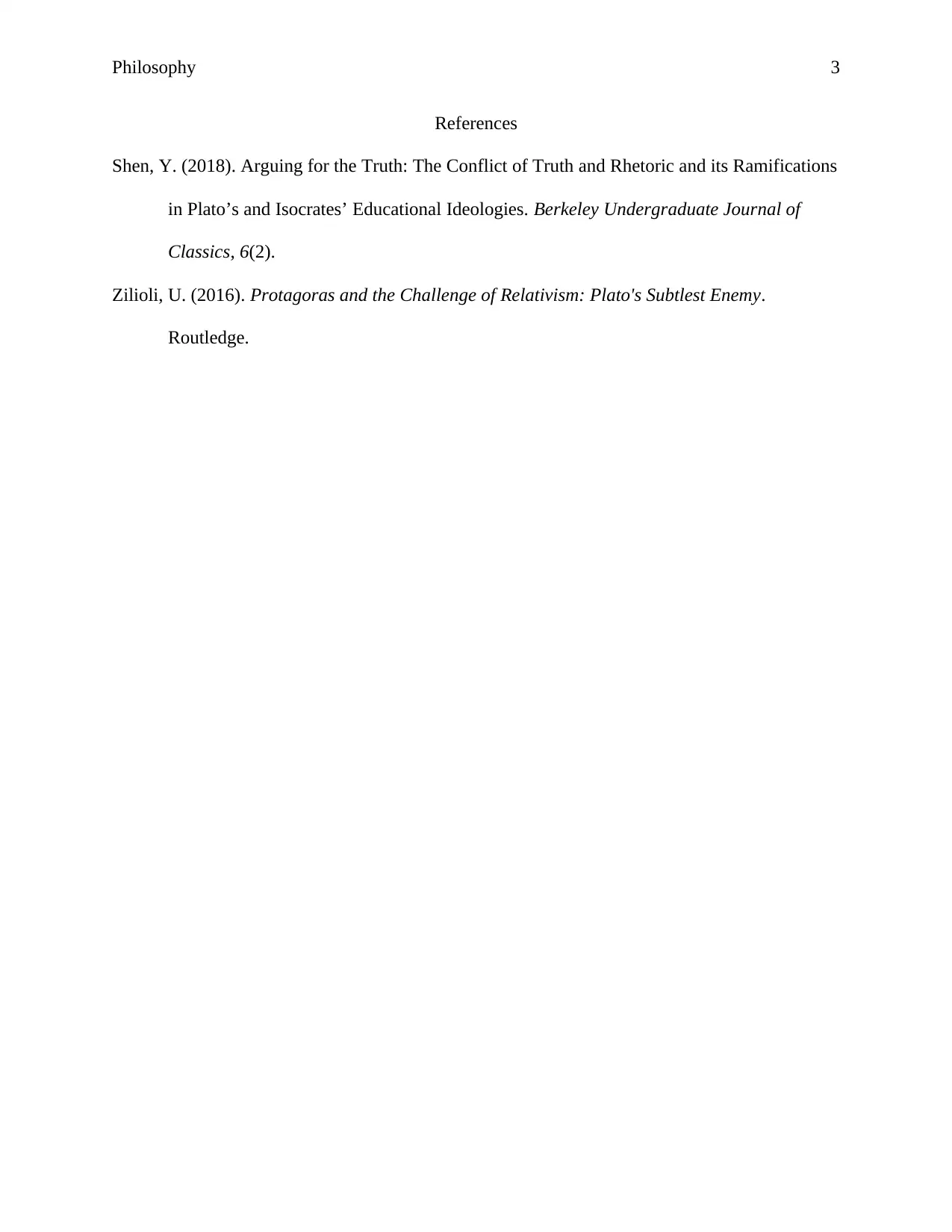
References
Shen, Y. (2018). Arguing for the Truth: The Conflict of Truth and Rhetoric and its Ramifications
in Plato’s and Isocrates’ Educational Ideologies. Berkeley Undergraduate Journal of
Classics, 6(2).
Zilioli, U. (2016). Protagoras and the Challenge of Relativism: Plato's Subtlest Enemy.
Routledge.
chevron_up_icon
1 out of 3
circle_padding
hide_on_mobile
zoom_out_icon
[object Object]