The Role of Ubiquitin in Protein Turnover: A Detailed Report

Verified

Added on  2020/10/05

|3
|566
|67
Report
AI Summary
This report provides an overview of protein turnover and the role of ubiquitin in the process. It explains the ubiquitin-proteasome pathway (UPP) as a primary mechanism for protein degradation, highlighting the roles of E1, E2, and E3 enzymes, and the 26S proteasome. The report details the conjugation process, where ubiquitin molecules tag proteins for degradation, and the subsequent degradation of tagged proteins. It also discusses the involvement of ATP hydrolysis and the function of the 19S and 20S subunits. Finally, it underscores the significance of UPP in regulating various cellular processes, supported by references to relevant research.

Document Page
Question
tabler-icon-diamond-filled.svg

Paraphrase This Document

Need a fresh take? Get an instant paraphrase of this document with our AI Paraphraser
Document Page
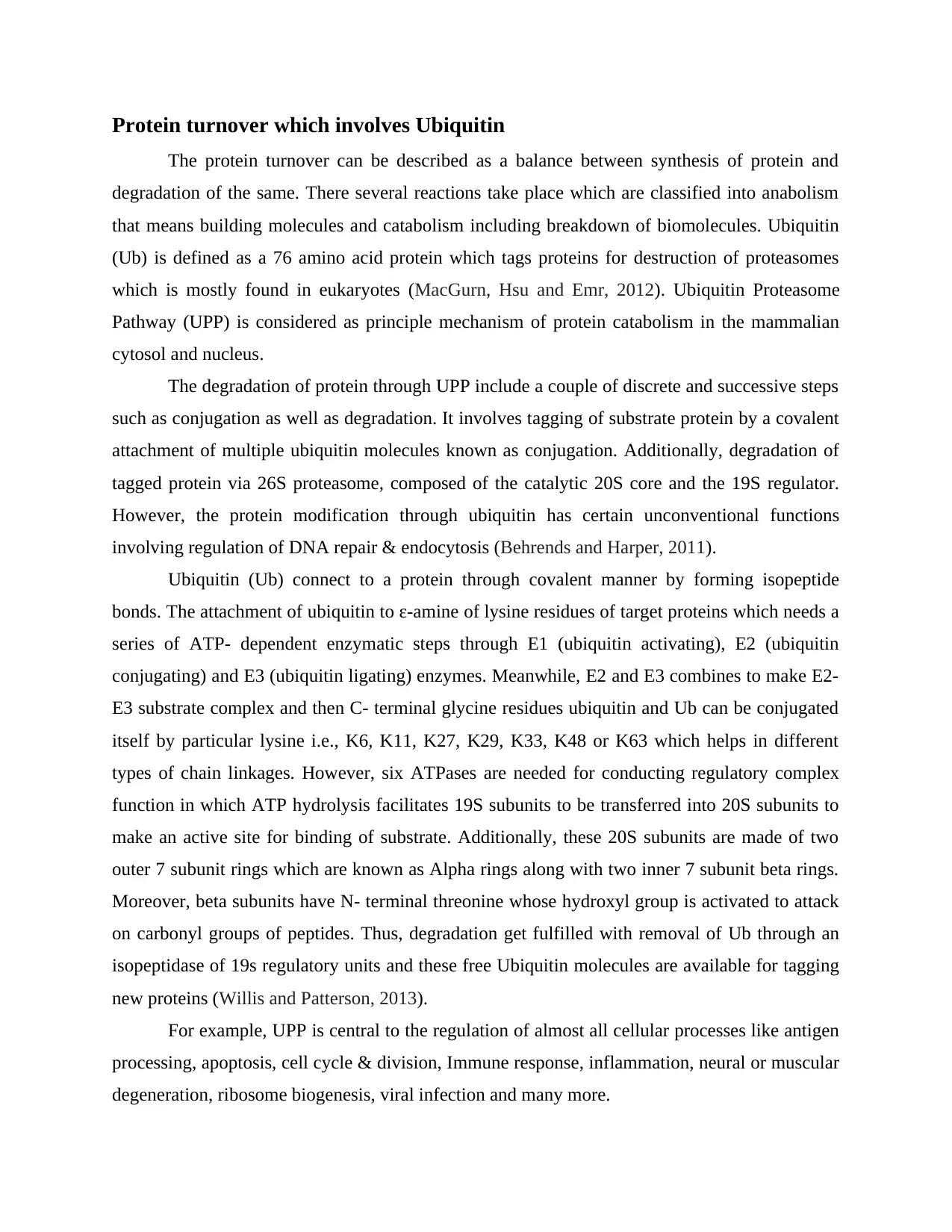
Protein turnover which involves Ubiquitin
The protein turnover can be described as a balance between synthesis of protein and
degradation of the same. There several reactions take place which are classified into anabolism
that means building molecules and catabolism including breakdown of biomolecules. Ubiquitin
(Ub) is defined as a 76 amino acid protein which tags proteins for destruction of proteasomes
which is mostly found in eukaryotes (MacGurn, Hsu and Emr, 2012). Ubiquitin Proteasome
Pathway (UPP) is considered as principle mechanism of protein catabolism in the mammalian
cytosol and nucleus.
The degradation of protein through UPP include a couple of discrete and successive steps
such as conjugation as well as degradation. It involves tagging of substrate protein by a covalent
attachment of multiple ubiquitin molecules known as conjugation. Additionally, degradation of
tagged protein via 26S proteasome, composed of the catalytic 20S core and the 19S regulator.
However, the protein modification through ubiquitin has certain unconventional functions
involving regulation of DNA repair & endocytosis (Behrends and Harper, 2011).
Ubiquitin (Ub) connect to a protein through covalent manner by forming isopeptide
bonds. The attachment of ubiquitin to ε-amine of lysine residues of target proteins which needs a
series of ATP- dependent enzymatic steps through E1 (ubiquitin activating), E2 (ubiquitin
conjugating) and E3 (ubiquitin ligating) enzymes. Meanwhile, E2 and E3 combines to make E2-
E3 substrate complex and then C- terminal glycine residues ubiquitin and Ub can be conjugated
itself by particular lysine i.e., K6, K11, K27, K29, K33, K48 or K63 which helps in different
types of chain linkages. However, six ATPases are needed for conducting regulatory complex
function in which ATP hydrolysis facilitates 19S subunits to be transferred into 20S subunits to
make an active site for binding of substrate. Additionally, these 20S subunits are made of two
outer 7 subunit rings which are known as Alpha rings along with two inner 7 subunit beta rings.
Moreover, beta subunits have N- terminal threonine whose hydroxyl group is activated to attack
on carbonyl groups of peptides. Thus, degradation get fulfilled with removal of Ub through an
isopeptidase of 19s regulatory units and these free Ubiquitin molecules are available for tagging
new proteins (Willis and Patterson, 2013).
For example, UPP is central to the regulation of almost all cellular processes like antigen
processing, apoptosis, cell cycle & division, Immune response, inflammation, neural or muscular
degeneration, ribosome biogenesis, viral infection and many more.
Document Page
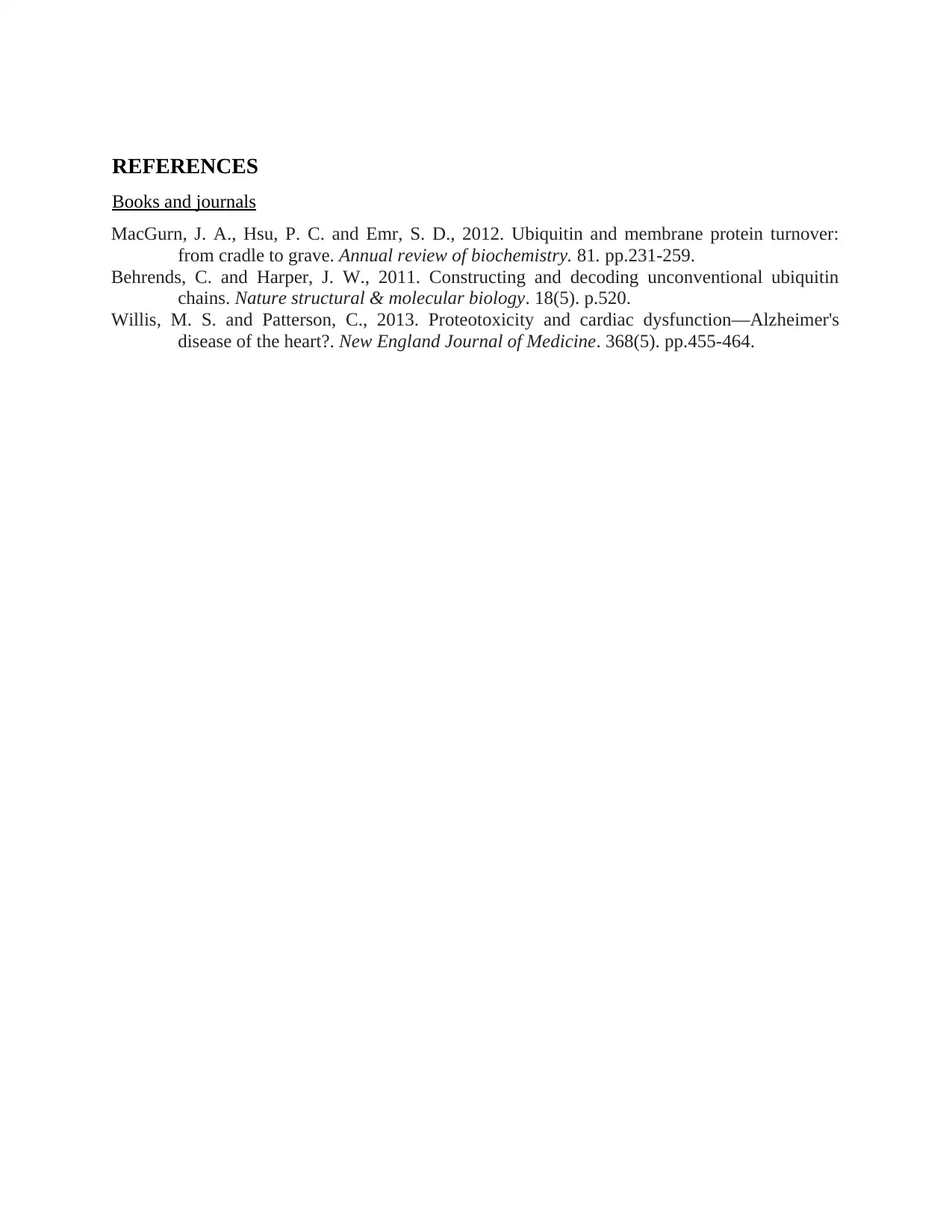
REFERENCES
Books and journals
MacGurn, J. A., Hsu, P. C. and Emr, S. D., 2012. Ubiquitin and membrane protein turnover:
from cradle to grave. Annual review of biochemistry. 81. pp.231-259.
Behrends, C. and Harper, J. W., 2011. Constructing and decoding unconventional ubiquitin
chains. Nature structural & molecular biology. 18(5). p.520.
Willis, M. S. and Patterson, C., 2013. Proteotoxicity and cardiac dysfunction—Alzheimer's
disease of the heart?. New England Journal of Medicine. 368(5). pp.455-464.
chevron_up_icon
1 out of 3
circle_padding
hide_on_mobile
zoom_out_icon
[object Object]