Case Study Analysis: Financial Performance and Strategies for Proton

Verified

Added on  2022/08/08

|10
|1676
|34
Case Study
AI Summary
This case study examines the financial performance of Proton, a major player in the Malaysian automotive market, analyzing its challenges and strategic responses. The analysis includes an overview of the automotive market in Malaysia, followed by an assessment of Proton's financial position using solvency, profitability, and efficiency ratios from 2007 to 2011. The study identifies key issues such as poor product quality and market competition, and evaluates Proton's strengths, weaknesses, opportunities, and threats (SWOT) to formulate strategic recommendations. The assignment suggests the implementation of Porter's generic strategies (cost leadership, differentiation, and focus) and outsourcing to improve the company's competitive advantage and financial health. References are included to support the analysis.

Document Page
Management
tabler-icon-diamond-filled.svg

Paraphrase This Document

Need a fresh take? Get an instant paraphrase of this document with our AI Paraphraser
Document Page
Finance 1
Question-Answers
1. Issues face by the company
According to the case study, it is observed that Proton faces the various
challenges due to some issues such as poor product quality and the others. Poor
product quality is the major issue that the company face as it is necessary for the
company to maintain the quality to satisfy the consumers and earns the high
revenue. The top management of the company has to be take care about the
quality of product in order to enhance the volume of sales to earn the high
revenue.
The other challenge that the company face is the competition in the market. There
are many companies that operate the business in the similar industry and offer the
similar services to gain the competitive advantage in the market.
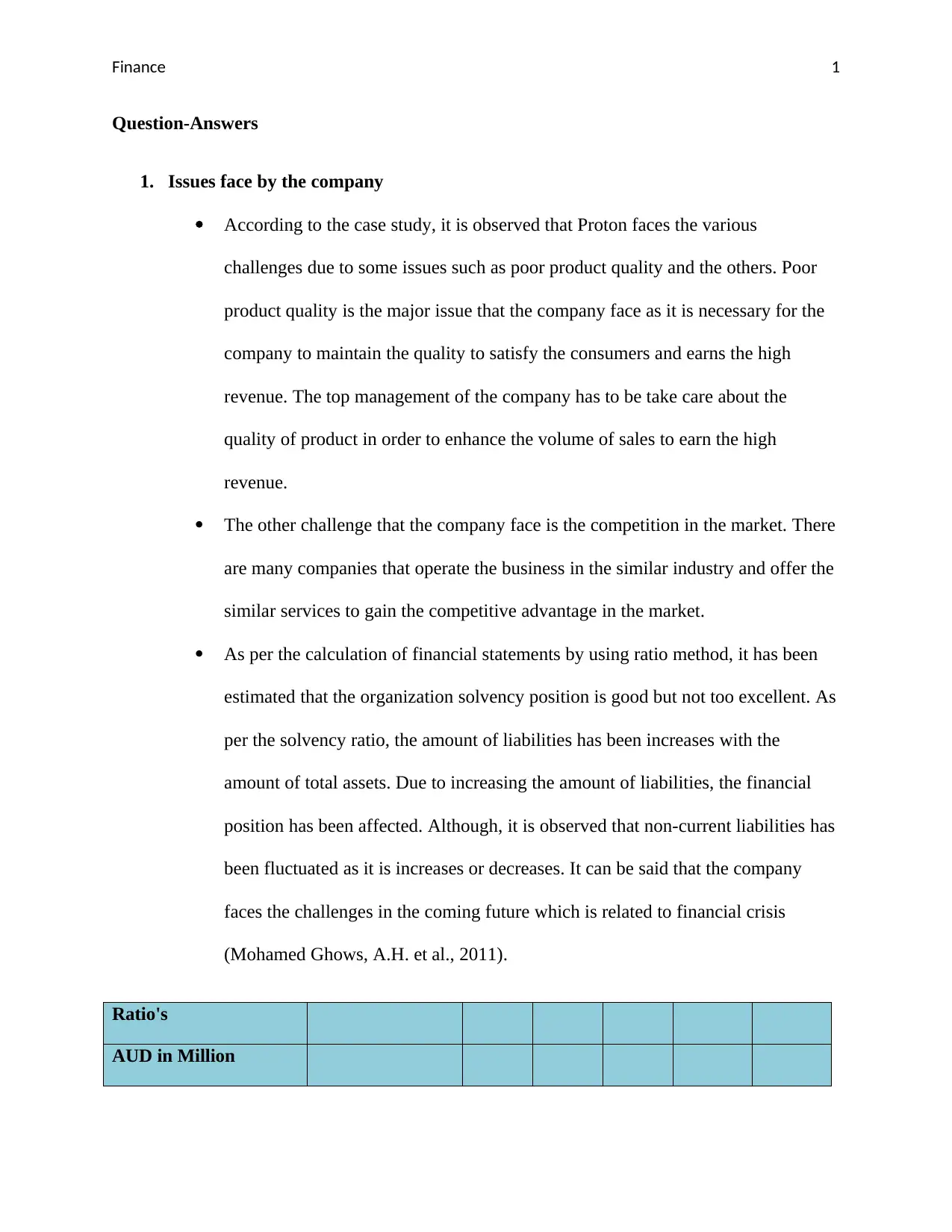
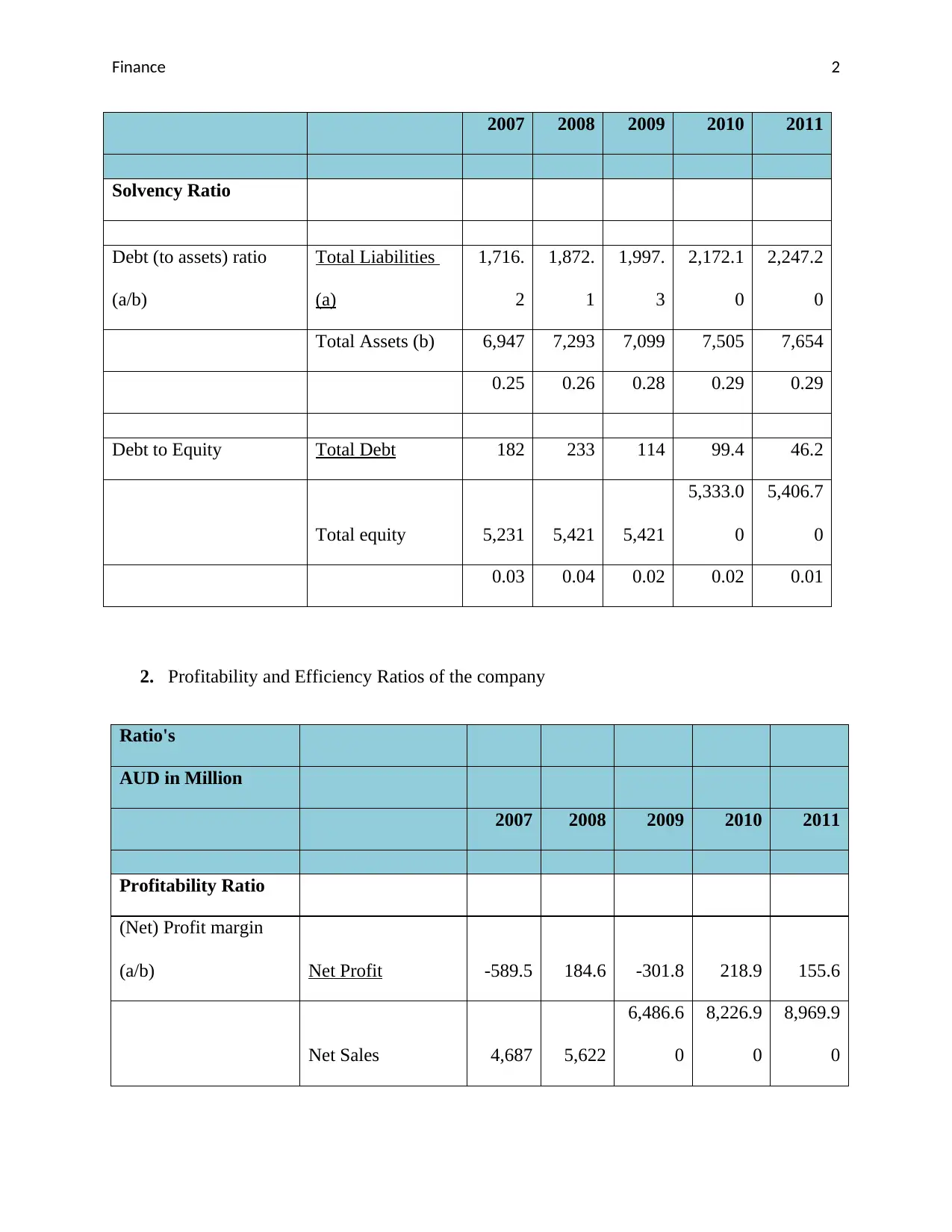
As per the calculation of financial statements by using ratio method, it has been
estimated that the organization solvency position is good but not too excellent. As
per the solvency ratio, the amount of liabilities has been increases with the
amount of total assets. Due to increasing the amount of liabilities, the financial
position has been affected. Although, it is observed that non-current liabilities has
been fluctuated as it is increases or decreases. It can be said that the company
faces the challenges in the coming future which is related to financial crisis
(Mohamed Ghows, A.H. et al., 2011).
Ratio's
AUD in Million
Document Page
Finance 2
2007 2008 2009 2010 2011
Solvency Ratio
Debt (to assets) ratio
(a/b)
Total Liabilities
(a)
1,716.
2
1,872.
1
1,997.
3
2,172.1
0
2,247.2
0
Total Assets (b) 6,947 7,293 7,099 7,505 7,654
0.25 0.26 0.28 0.29 0.29
Debt to Equity Total Debt 182 233 114 99.4 46.2
Total equity 5,231 5,421 5,421
5,333.0
0
5,406.7
0
0.03 0.04 0.02 0.02 0.01
2. Profitability and Efficiency Ratios of the company
Ratio's
AUD in Million
2007 2008 2009 2010 2011
Profitability Ratio
(Net) Profit margin
(a/b) Net Profit -589.5 184.6 -301.8 218.9 155.6
Net Sales 4,687 5,622
6,486.6
0
8,226.9
0
8,969.9
0
Document Page
Finance 3
-13% 3% -5% 3% 2%
Gross Profit Margin Gross Profit -618 144 -319.2 260.9 214.4
Net Sales 4,687.3 5,621.6 6,486.6 8,226.9 8,969.9
-13% 3% -5% 3% 2%
Return on Assets Net income
-
589.50 184.60 -301.80 218.90 155.60
Assets
6946.8
0
7293.3
0 7098.90 7505.10 7653.90
-8% 3% -4% 3% 2%
Efficiency Ratio
Asset turnover (a/b) Net Sales 4687.3 5621.6 6486.6 8226.9 8969.9
Average Total
Assets
7120.0
5 7196.1 7302 7579.5 7653.9
0.66 0.78 0.89 1.09 1.17
Days Debtors (a/b)
Receivables (a) 1,192 1,099 1,080 991.6
1,329.5
0
sales *365 (b) 4687.3 5621.6 6486.6 8226.9 8969.9
92.82 71.36 60.79 43.99 54.10
Days Creditors (a/b)
Payables (a) 1,367 1,524 1,571
1,918.4
0
1,826.6
0
tabler-icon-diamond-filled.svg

Paraphrase This Document

Need a fresh take? Get an instant paraphrase of this document with our AI Paraphraser
Document Page
Finance 4
Sales*365 (b) 4,687 5,622 6,487 8,227 8,970
106.46 98.95 88.42 85.11 74.33
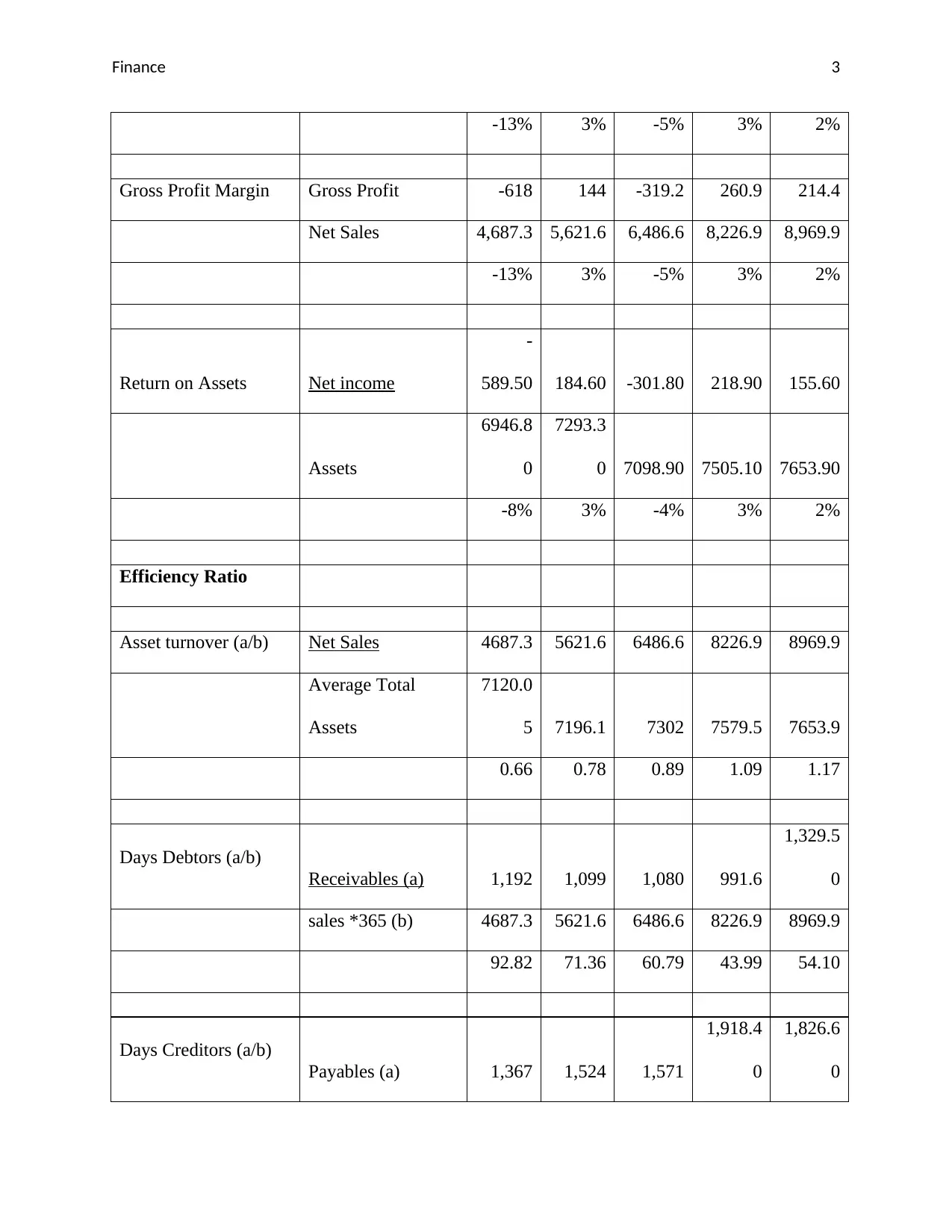
As per the financial ratio of the company, it has been evaluated that the company net
profit margin ratio has been increases in the last five years such as -13%, 3%, -5%, 3% and 2%
in the year 2007, 2008, 2009, 2010 and 2011 respectively. It has been seen that the net sales of
the corporation has been increases but its amount of net profit has been decreases which states
that the ability of the organization to create the profit has been increases. The gross profit margin
ratio of the firm is also increasing or decreasing in the last five years and it is also similar with
the net profit margin such as it is -13%, 3%, -5%, 3% and 2% in 2007, 2008, 2009, 2010 and
2011in respective manner (Gleeson, 2019). Return on Assets states the ability of the company to
generate the net income by using the total asset. According to the evaluation of Return of
Assets, it has been found that the firm has high amount of net income has been increases in the
year 2011 with the amount of total assets which states that the firm financial position is
improving. It states that the company has the enough funds to provide the high amount of return
which states it has the ability to generate the profit (Panalysis, 2019).
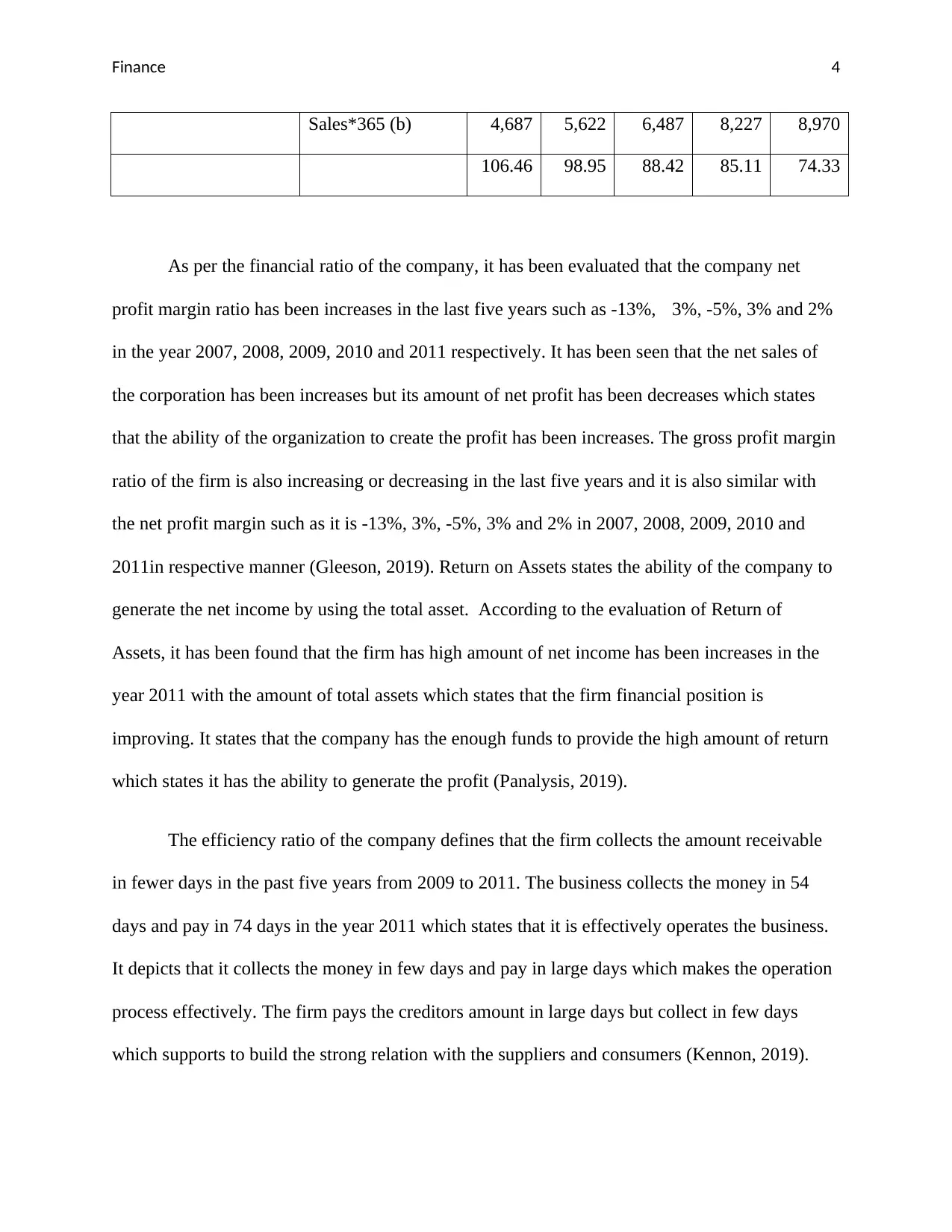
The efficiency ratio of the company defines that the firm collects the amount receivable
in fewer days in the past five years from 2009 to 2011. The business collects the money in 54
days and pay in 74 days in the year 2011 which states that it is effectively operates the business.
It depicts that it collects the money in few days and pay in large days which makes the operation
process effectively. The firm pays the creditors amount in large days but collect in few days
which supports to build the strong relation with the suppliers and consumers (Kennon, 2019).
Document Page
Finance 5
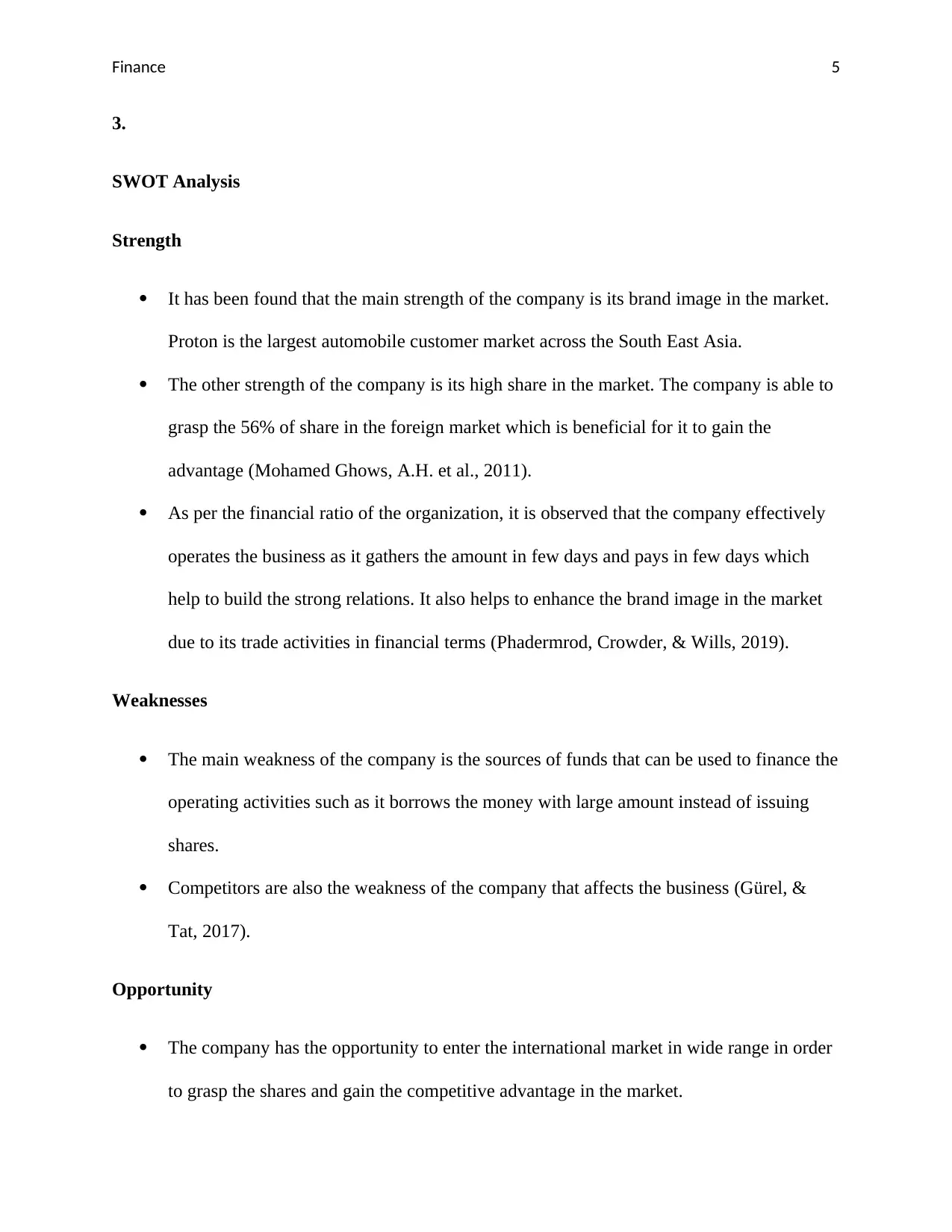
3.
SWOT Analysis
Strength
It has been found that the main strength of the company is its brand image in the market.
Proton is the largest automobile customer market across the South East Asia.
The other strength of the company is its high share in the market. The company is able to
grasp the 56% of share in the foreign market which is beneficial for it to gain the
advantage (Mohamed Ghows, A.H. et al., 2011).
As per the financial ratio of the organization, it is observed that the company effectively
operates the business as it gathers the amount in few days and pays in few days which
help to build the strong relations. It also helps to enhance the brand image in the market
due to its trade activities in financial terms (Phadermrod, Crowder, & Wills, 2019).
Weaknesses
The main weakness of the company is the sources of funds that can be used to finance the
operating activities such as it borrows the money with large amount instead of issuing
shares.
Competitors are also the weakness of the company that affects the business (Gürel, &
Tat, 2017).
Opportunity
The company has the opportunity to enter the international market in wide range in order
to grasp the shares and gain the competitive advantage in the market.
Document Page
Finance 6
It also has to launch the new models to increase the volume of sale.
Threat
It has been analyzed that there are various companies that operates the business in the
similar industry. Large number of companies enhances the threat of competitors for the
company. Competitors are the main threat of the company as it affects the business.
As the liability of the company has been increases due to which the threat of facing the
financial crisis has been increases (Mohamed Ghows, A.H. et al., 2011).
D. Strategies
As per the analysis, it is observed that the company has high level of threat of
competitors that is why; it is suggested it has to implement the porter’s generic strategy in order
to gain the competitive advantage. According to porter’s generic strategy, the company has to
implement the cost leadership strategy, differentiation strategy and focus strategy in order to beat
the competitors. Cost leadership strategy defines that the company has to set the cheap prices to
attract the consumers towards the services. Differentiation strategy defines that the company has
to provide the automobile product with the advance technology. And according to focus strategy,
it has to focus on core product in terms of its functions and advertising to make it creative that
helps to attract the more or more consumers towards it services (Firoz Suleman, Rashidirad, and
Firoz Suleman, 2019).
Apart from it, the company has to implement the outsourcing strategy so that it can add
new features. The company can hire the other company in order to transfer the assets or
employees from one firm to another. It is observed that the company can hire the employees
tabler-icon-diamond-filled.svg

Paraphrase This Document

Need a fresh take? Get an instant paraphrase of this document with our AI Paraphraser
Document Page
Finance 7
from different firm due to which it can easily get the new ideas to operate the business
effectively (Overby, 2017).
Document Page
Finance 8
References
Firoz Suleman, M., Rashidirad, M. and Firoz Suleman, S. (2019) The applicability of Porter's
generic strategies in pure online firms: A case study approach. Strategic Change, 28(3),
pp.167-176.
Gleeson, P. (2019). How to Calculate Gross Profit Margin Percentage. Retrieved From:
https://smallbusiness.chron.com/calculate-gross-profit-margin-percentage-4133.html
Kennon, J. (2019.) How to Calculate Inventory Turnover/Turns From the Balance Sheet.
Retrieved From: https://www.thebalance.com/calculate-inventory-turnover-357280
Overby, S. (2017). What is outsourcing? Definitions, best practices, challenges and advice.
Retrieved From: https://www.cio.com/article/2439495/outsourcing-outsourcing-
definition-and-solutions.html
Panalysis. (2019). How to Calculate Gross Margin Percentage. Retrieved From:
https://www.panalysis.com/how-to-calculate-gross-margin-percentage/
Gürel, E., & Tat, M. (2017). SWOT analysis: a theoretical review. Journal of International
Social Research, 10(51).
Phadermrod, B., Crowder, R. M., & Wills, G. B. (2019). Importance-performance analysis
based SWOT analysis. International Journal of Information Management, 44, 194-203.
Mohamed Ghows, A.H. et al. (2011) Proton – From Saga to Exora. Asian Journal of Case
Research, 4 (S), 61-77.
Document Page
Finance 9
chevron_up_icon
1 out of 10
circle_padding
hide_on_mobile
zoom_out_icon
[object Object]