PSY202: Evaluating and Comparing a Press Release Article on Psychology
VerifiedAdded on 2023/04/22
|13
|3191
|394
Report
AI Summary
This report consists of two parts. The first part evaluates and compares a press release titled “Black coffee drinkers more likely to be psychopaths: study” with the original research paper on bitter taste preferences and antisocial personality traits. It highlights discrepancies in participant numbers, methodology details, and the scope of conclusions drawn. The original paper's focus on correlations between bitter taste preference and malevolent personality traits, limitations, and real-world behavioral correlations are contrasted with the press release's simplified and potentially misleading statements. The second part introduces a press release based on research exploring the influence of gustatory disgust on moral judgments. It discusses the study's methodology, hypotheses, and findings, connecting it to the first journal article by highlighting similarities in taste criteria and differences in sample size and analytical approaches. Both articles explore the impact of taste on psychological traits, though with varying scopes and conclusions. Desklib provides a platform for students to access similar past papers and solved assignments.
Running Head: PSYCHOLOGY
Topic- Evaluation and comparison of press release article on psychology
Student name
University name
Author notes
Topic- Evaluation and comparison of press release article on psychology
Student name
University name
Author notes

Paraphrase This Document
Need a fresh take? Get an instant paraphrase of this document with our AI Paraphraser
2PSYCHOLOGY
PART 1
The original article on which the press release titled “Black coffee drinkers more likely to be
psychopaths: study” by Emma Prestwich and Jay W. Belle Isle is based on is
Title: “Individual differences in bitter taste preferences are associated with antisocial personality
traits”
Authors: Christina Sagioglou and Tobias Greitemeyer
Journal name: The Appetite (volume 96)
Year of publication: 2015
The comparison of the press release with the original article is provided below.
Firstly, the main research work of the original paper is based on the relationship between bitter
preference measurement and antisocial personality trait, not just black coffee and psychopaths.
The original study paper included 953 participants which includes high school students, college
graduates, Masters’ degree holders and PhD holders. While the press release mentions 1000
participants including only students and prison inmates which is not the fact.
Secondly, two independent studies were conducted in the original paper where in the first study
on personality and taste preference is carried out through MTurk the online labor marketplace
used for psychological researches and not mere questionnaires (Buckels, Jones & Paulhus,
2013). In the second study similar tool is used but the food item list was reduced from 40 to 20
items to access the preference for only sweet and bitter items. The press release has no mention
of the details of the methodology.
PART 1
The original article on which the press release titled “Black coffee drinkers more likely to be
psychopaths: study” by Emma Prestwich and Jay W. Belle Isle is based on is
Title: “Individual differences in bitter taste preferences are associated with antisocial personality
traits”
Authors: Christina Sagioglou and Tobias Greitemeyer
Journal name: The Appetite (volume 96)
Year of publication: 2015
The comparison of the press release with the original article is provided below.
Firstly, the main research work of the original paper is based on the relationship between bitter
preference measurement and antisocial personality trait, not just black coffee and psychopaths.
The original study paper included 953 participants which includes high school students, college
graduates, Masters’ degree holders and PhD holders. While the press release mentions 1000
participants including only students and prison inmates which is not the fact.
Secondly, two independent studies were conducted in the original paper where in the first study
on personality and taste preference is carried out through MTurk the online labor marketplace
used for psychological researches and not mere questionnaires (Buckels, Jones & Paulhus,
2013). In the second study similar tool is used but the food item list was reduced from 40 to 20
items to access the preference for only sweet and bitter items. The press release has no mention
of the details of the methodology.
3PSYCHOLOGY
Thirdly, in the original paper robust association was found among psychopathy and everyday
sadism, that is the result shows the preference of bitter food and taste with the personality
darkness. The more bitter tasting liking the more is the darkness of the personality. The ultimate
results in first study did not show any significant correlation between food-specific preference
for bitterness with antisocial personality traits (Chan et al., 2014). However, in the second study
Machiavellianism and narcissism are positively corelated with bitter taste preference and has
negative correlation with agreeableness, emotional stability and conscientiousness. The
hypothesis that bitter taste preference is linked to malevolent personality traits is confirmed at the
end of the study. But the trait aggression relationship is found to be inconclusive at the end of the
result discussion. To sum up all results it could be concluded that bitter taste preference is found
to be a robust predictor for Machiavellianism, narcissism, psychopathy and everyday sadism
(Eskine, Novreske & Richards, 2013). The press release did not provide such elaboration and
only stated just facts.
Thirdly, in the original paper method of coffee drinking habit based on sugar and milk intake
only is asked to participants and not with cream, black or with sugar. Sweet food preference and
agreeableness are positively correlated in a significant manner. Consistency checks were
conducted using Dark triad measure and the big five factors of personality. Bitter taste
preference has no negative association with big five traits except agreeableness. Psychopathy has
negative correlation with all personality measures but not with extraversion (Krizan & Johar,
2015). To draw general conclusion, it is found that not only bitterness but there might be more
food related factors that need to be considered to apprehend the antisocial personality
development and not just moral judgement and interpersonal hostility. Mention of some factors
like Dark triad measure went missing in the press release (Furnham, Richards & Paulhus, 2013).
Thirdly, in the original paper robust association was found among psychopathy and everyday
sadism, that is the result shows the preference of bitter food and taste with the personality
darkness. The more bitter tasting liking the more is the darkness of the personality. The ultimate
results in first study did not show any significant correlation between food-specific preference
for bitterness with antisocial personality traits (Chan et al., 2014). However, in the second study
Machiavellianism and narcissism are positively corelated with bitter taste preference and has
negative correlation with agreeableness, emotional stability and conscientiousness. The
hypothesis that bitter taste preference is linked to malevolent personality traits is confirmed at the
end of the study. But the trait aggression relationship is found to be inconclusive at the end of the
result discussion. To sum up all results it could be concluded that bitter taste preference is found
to be a robust predictor for Machiavellianism, narcissism, psychopathy and everyday sadism
(Eskine, Novreske & Richards, 2013). The press release did not provide such elaboration and
only stated just facts.
Thirdly, in the original paper method of coffee drinking habit based on sugar and milk intake
only is asked to participants and not with cream, black or with sugar. Sweet food preference and
agreeableness are positively correlated in a significant manner. Consistency checks were
conducted using Dark triad measure and the big five factors of personality. Bitter taste
preference has no negative association with big five traits except agreeableness. Psychopathy has
negative correlation with all personality measures but not with extraversion (Krizan & Johar,
2015). To draw general conclusion, it is found that not only bitterness but there might be more
food related factors that need to be considered to apprehend the antisocial personality
development and not just moral judgement and interpersonal hostility. Mention of some factors
like Dark triad measure went missing in the press release (Furnham, Richards & Paulhus, 2013).
⊘ This is a preview!⊘
Do you want full access?
Subscribe today to unlock all pages.

Trusted by 1+ million students worldwide
4PSYCHOLOGY
Fourthly, the actual paper is based mainly on hypothesis and correlation not just factual
statements as stated in the press release. The press release just stated facts that are mere co-
relation in the original paper and have not included all factors for consideration. The scope of the
original paper is much wider and has more real-world behavioral correlation with antisocial traits
of personality and is not a paper of black coffee and psychopaths.
Fifthly, the original paper has a number of limitations like invalidity of the selected bitter items
based on Meier and colleagues, lack of substantive research that links personality to real
happenings, world general and specified food agreeableness inconsistencies, speculations,
stereotyping, clash of self-report and hedonic methods of measurements and many such were
responsible for limiting the accurateness of the original study which is not mentioned in the press
release at all (Miller, Hannikainen & Cushman, 2014).
Lastly, the original paper is more comprehensive as it supports and backs arguments with data
analysis and interpretation. If the press release is thought to be a summary of the original paper
then also it is not a true replica of it, it has some misleading conclusions. As bitter taste
preference is positively related to malevolent personality traits especially everyday sadism it
does not mean that we will only learn to appreciate the bitter things in life and bitter taste foods
will only elicit the interpersonal hostility and moral judgements (Sagioglou & Greitemeyer,
2016). The original paper neither prove that people preferring bitter tasted black coffee are likely
to be vain, selfish, and manipulative nor did it mention about their being sadistic and psychopath
for the same reason. There are also a number of other factors that need to be considered which
remain unnoticed in the press release.
Fourthly, the actual paper is based mainly on hypothesis and correlation not just factual
statements as stated in the press release. The press release just stated facts that are mere co-
relation in the original paper and have not included all factors for consideration. The scope of the
original paper is much wider and has more real-world behavioral correlation with antisocial traits
of personality and is not a paper of black coffee and psychopaths.
Fifthly, the original paper has a number of limitations like invalidity of the selected bitter items
based on Meier and colleagues, lack of substantive research that links personality to real
happenings, world general and specified food agreeableness inconsistencies, speculations,
stereotyping, clash of self-report and hedonic methods of measurements and many such were
responsible for limiting the accurateness of the original study which is not mentioned in the press
release at all (Miller, Hannikainen & Cushman, 2014).
Lastly, the original paper is more comprehensive as it supports and backs arguments with data
analysis and interpretation. If the press release is thought to be a summary of the original paper
then also it is not a true replica of it, it has some misleading conclusions. As bitter taste
preference is positively related to malevolent personality traits especially everyday sadism it
does not mean that we will only learn to appreciate the bitter things in life and bitter taste foods
will only elicit the interpersonal hostility and moral judgements (Sagioglou & Greitemeyer,
2016). The original paper neither prove that people preferring bitter tasted black coffee are likely
to be vain, selfish, and manipulative nor did it mention about their being sadistic and psychopath
for the same reason. There are also a number of other factors that need to be considered which
remain unnoticed in the press release.
Paraphrase This Document
Need a fresh take? Get an instant paraphrase of this document with our AI Paraphraser
5PSYCHOLOGY
PART 2
PRESS RELEASE
Introduction
Can sweet taste substances trigger favorable moral judgement and kindness about other people?
what about bitter and disgusting substances?
Answering these questions will create dilemma in all who try to find the relationship between
physical disgust and moral disgust (Eskine, Kacinik, & Prinz, 2011). The area of morality in
conjunction with taste is still an area that remained unexplored. In order to put light on the area
Eskine, Kacinik, and Prinz carried out an evidence-based research on the influence of gustatory
disgust on moral judgements and found that bitter tasting participants are more likely to made
harsh moral judgements about a person or a situation (Hellmann, Thoben & Echterhoff, 2013).
The research work faced a lot of criticism but help explore some unknown areas of disgust and
moral psychology that needed attention to the earliest.
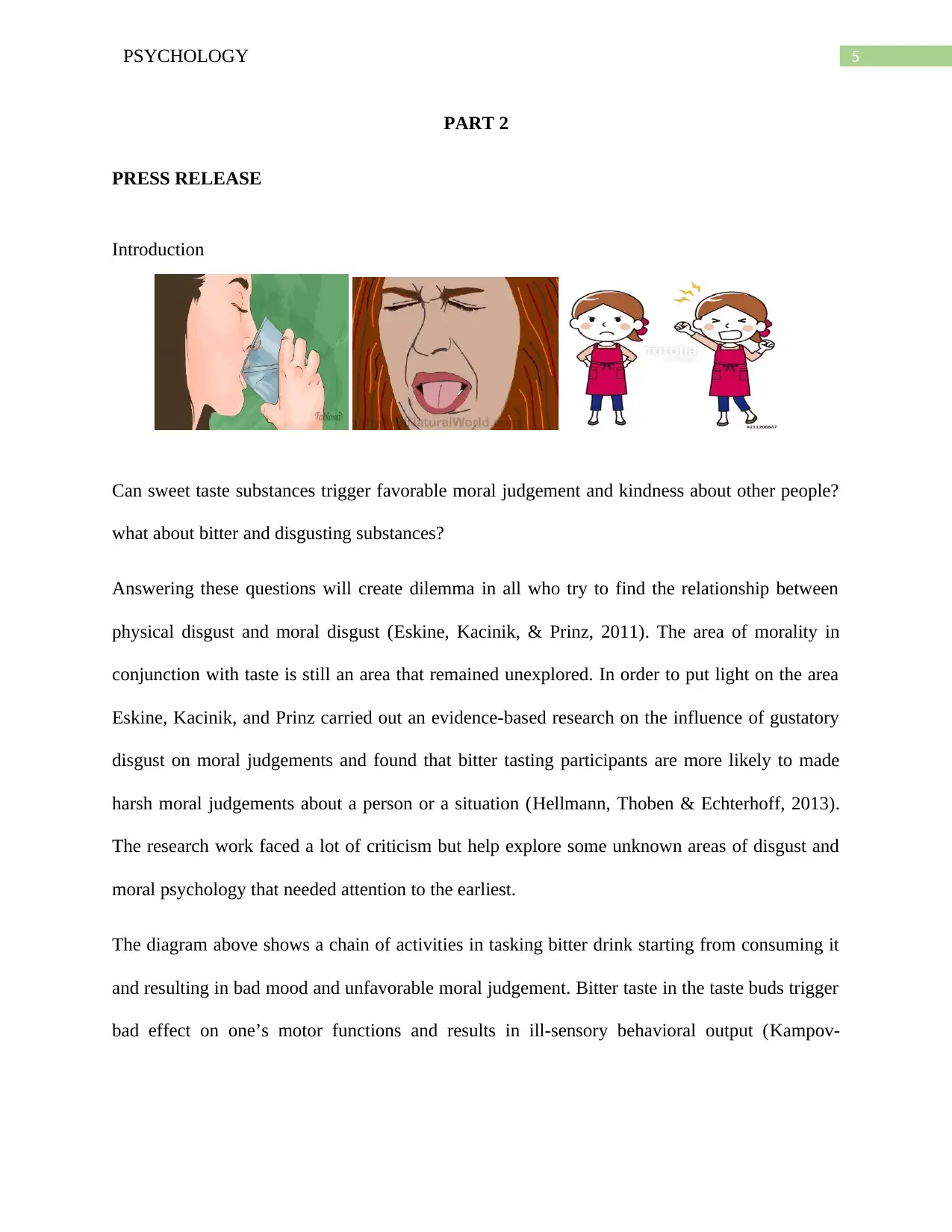
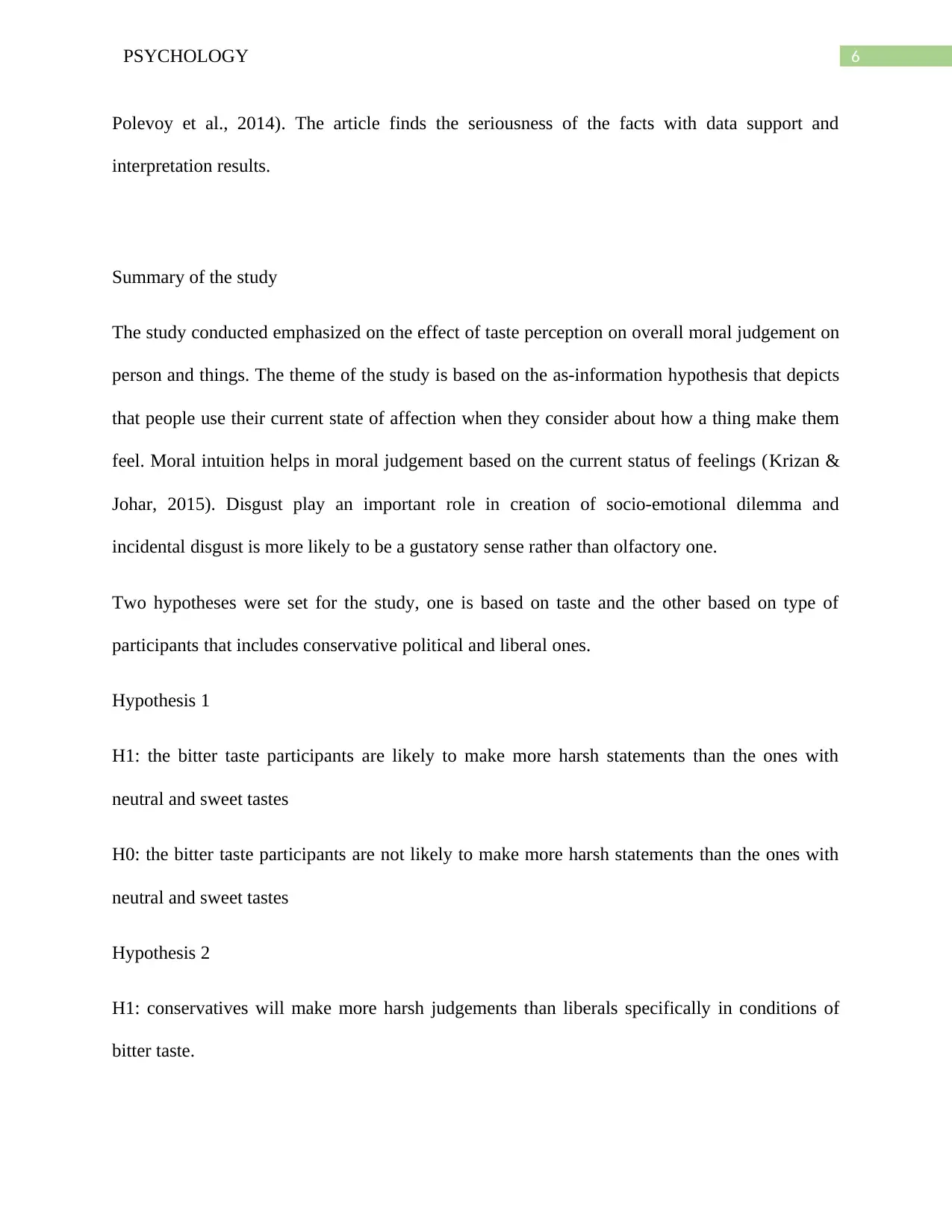
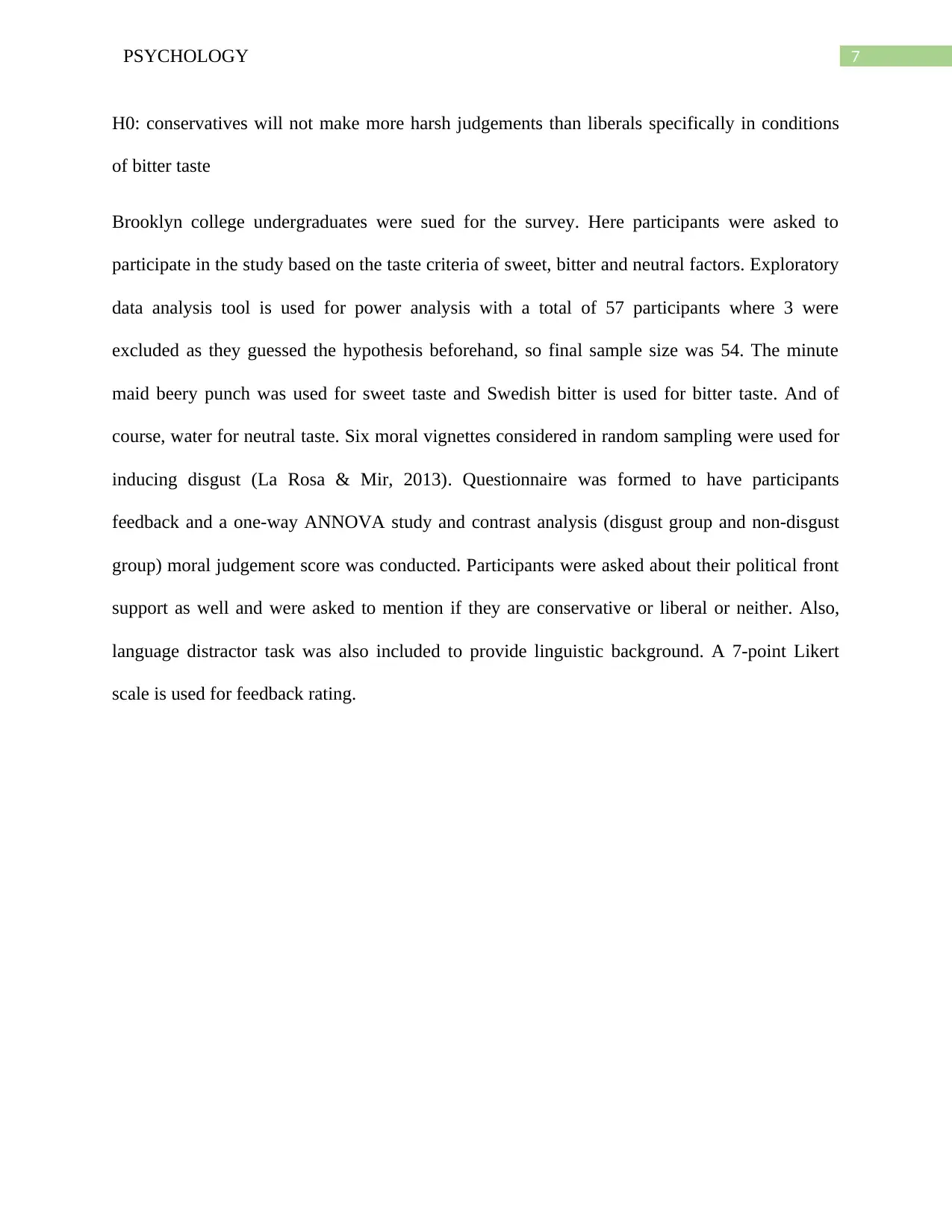
The diagram above shows a chain of activities in tasking bitter drink starting from consuming it
and resulting in bad mood and unfavorable moral judgement. Bitter taste in the taste buds trigger
bad effect on one’s motor functions and results in ill-sensory behavioral output (Kampov‐
PART 2
PRESS RELEASE
Introduction
Can sweet taste substances trigger favorable moral judgement and kindness about other people?
what about bitter and disgusting substances?
Answering these questions will create dilemma in all who try to find the relationship between
physical disgust and moral disgust (Eskine, Kacinik, & Prinz, 2011). The area of morality in
conjunction with taste is still an area that remained unexplored. In order to put light on the area
Eskine, Kacinik, and Prinz carried out an evidence-based research on the influence of gustatory
disgust on moral judgements and found that bitter tasting participants are more likely to made
harsh moral judgements about a person or a situation (Hellmann, Thoben & Echterhoff, 2013).
The research work faced a lot of criticism but help explore some unknown areas of disgust and
moral psychology that needed attention to the earliest.
The diagram above shows a chain of activities in tasking bitter drink starting from consuming it
and resulting in bad mood and unfavorable moral judgement. Bitter taste in the taste buds trigger
bad effect on one’s motor functions and results in ill-sensory behavioral output (Kampov‐
6PSYCHOLOGY
Polevoy et al., 2014). The article finds the seriousness of the facts with data support and
interpretation results.
Summary of the study
The study conducted emphasized on the effect of taste perception on overall moral judgement on
person and things. The theme of the study is based on the as-information hypothesis that depicts
that people use their current state of affection when they consider about how a thing make them
feel. Moral intuition helps in moral judgement based on the current status of feelings (Krizan &
Johar, 2015). Disgust play an important role in creation of socio-emotional dilemma and
incidental disgust is more likely to be a gustatory sense rather than olfactory one.
Two hypotheses were set for the study, one is based on taste and the other based on type of
participants that includes conservative political and liberal ones.
Hypothesis 1
H1: the bitter taste participants are likely to make more harsh statements than the ones with
neutral and sweet tastes
H0: the bitter taste participants are not likely to make more harsh statements than the ones with
neutral and sweet tastes
Hypothesis 2
H1: conservatives will make more harsh judgements than liberals specifically in conditions of
bitter taste.
Polevoy et al., 2014). The article finds the seriousness of the facts with data support and
interpretation results.
Summary of the study
The study conducted emphasized on the effect of taste perception on overall moral judgement on
person and things. The theme of the study is based on the as-information hypothesis that depicts
that people use their current state of affection when they consider about how a thing make them
feel. Moral intuition helps in moral judgement based on the current status of feelings (Krizan &
Johar, 2015). Disgust play an important role in creation of socio-emotional dilemma and
incidental disgust is more likely to be a gustatory sense rather than olfactory one.
Two hypotheses were set for the study, one is based on taste and the other based on type of
participants that includes conservative political and liberal ones.
Hypothesis 1
H1: the bitter taste participants are likely to make more harsh statements than the ones with
neutral and sweet tastes
H0: the bitter taste participants are not likely to make more harsh statements than the ones with
neutral and sweet tastes
Hypothesis 2
H1: conservatives will make more harsh judgements than liberals specifically in conditions of
bitter taste.
⊘ This is a preview!⊘
Do you want full access?
Subscribe today to unlock all pages.
Trusted by 1+ million students worldwide
7PSYCHOLOGY
H0: conservatives will not make more harsh judgements than liberals specifically in conditions
of bitter taste
Brooklyn college undergraduates were sued for the survey. Here participants were asked to
participate in the study based on the taste criteria of sweet, bitter and neutral factors. Exploratory
data analysis tool is used for power analysis with a total of 57 participants where 3 were
excluded as they guessed the hypothesis beforehand, so final sample size was 54. The minute
maid beery punch was used for sweet taste and Swedish bitter is used for bitter taste. And of
course, water for neutral taste. Six moral vignettes considered in random sampling were used for
inducing disgust (La Rosa & Mir, 2013). Questionnaire was formed to have participants
feedback and a one-way ANNOVA study and contrast analysis (disgust group and non-disgust
group) moral judgement score was conducted. Participants were asked about their political front
support as well and were asked to mention if they are conservative or liberal or neither. Also,
language distractor task was also included to provide linguistic background. A 7-point Likert
scale is used for feedback rating.
H0: conservatives will not make more harsh judgements than liberals specifically in conditions
of bitter taste
Brooklyn college undergraduates were sued for the survey. Here participants were asked to
participate in the study based on the taste criteria of sweet, bitter and neutral factors. Exploratory
data analysis tool is used for power analysis with a total of 57 participants where 3 were
excluded as they guessed the hypothesis beforehand, so final sample size was 54. The minute
maid beery punch was used for sweet taste and Swedish bitter is used for bitter taste. And of
course, water for neutral taste. Six moral vignettes considered in random sampling were used for
inducing disgust (La Rosa & Mir, 2013). Questionnaire was formed to have participants
feedback and a one-way ANNOVA study and contrast analysis (disgust group and non-disgust
group) moral judgement score was conducted. Participants were asked about their political front
support as well and were asked to mention if they are conservative or liberal or neither. Also,
language distractor task was also included to provide linguistic background. A 7-point Likert
scale is used for feedback rating.
Paraphrase This Document
Need a fresh take? Get an instant paraphrase of this document with our AI Paraphraser
8PSYCHOLOGY
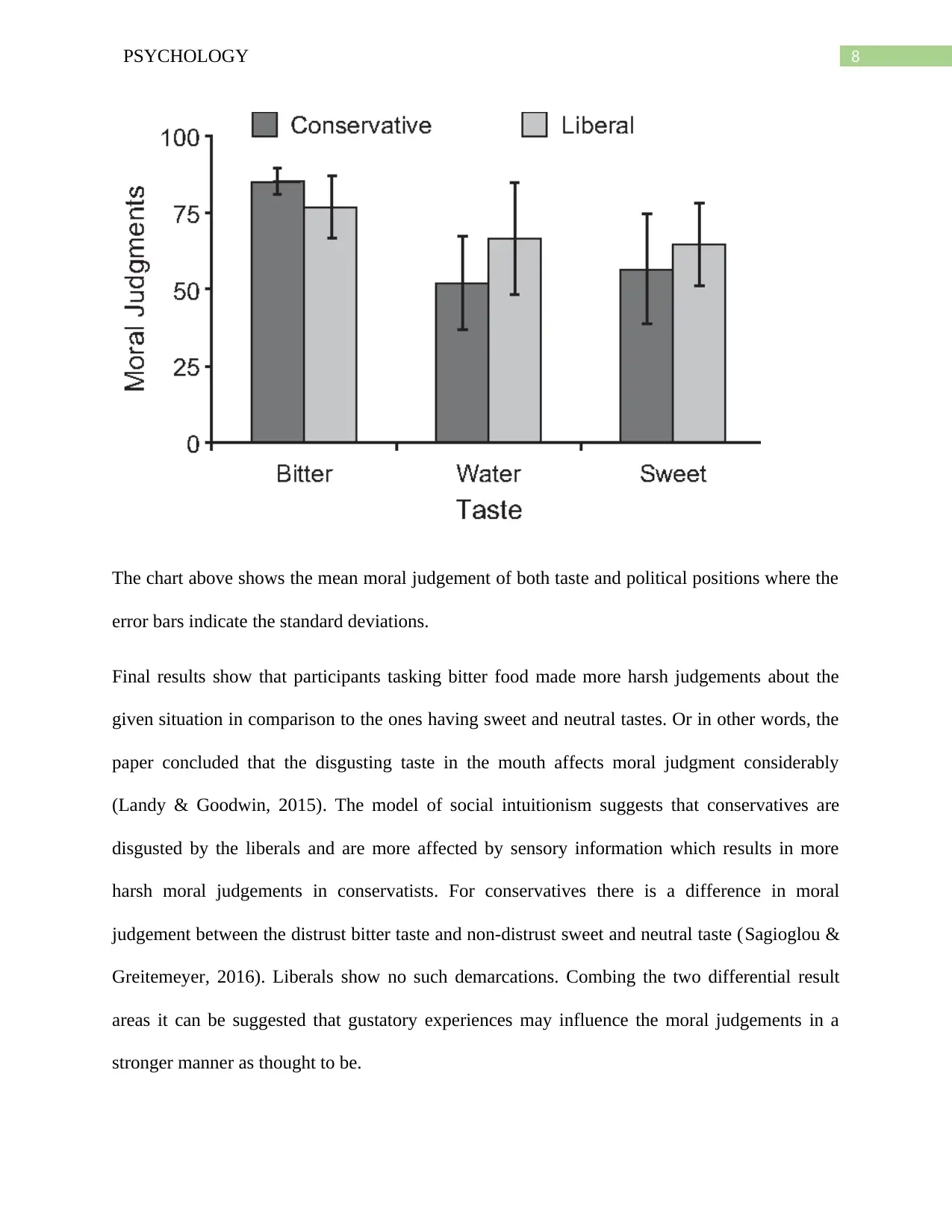
The chart above shows the mean moral judgement of both taste and political positions where the
error bars indicate the standard deviations.
Final results show that participants tasking bitter food made more harsh judgements about the
given situation in comparison to the ones having sweet and neutral tastes. Or in other words, the
paper concluded that the disgusting taste in the mouth affects moral judgment considerably
(Landy & Goodwin, 2015). The model of social intuitionism suggests that conservatives are
disgusted by the liberals and are more affected by sensory information which results in more
harsh moral judgements in conservatists. For conservatives there is a difference in moral
judgement between the distrust bitter taste and non-distrust sweet and neutral taste (Sagioglou &
Greitemeyer, 2016). Liberals show no such demarcations. Combing the two differential result
areas it can be suggested that gustatory experiences may influence the moral judgements in a
stronger manner as thought to be.
The chart above shows the mean moral judgement of both taste and political positions where the
error bars indicate the standard deviations.
Final results show that participants tasking bitter food made more harsh judgements about the
given situation in comparison to the ones having sweet and neutral tastes. Or in other words, the
paper concluded that the disgusting taste in the mouth affects moral judgment considerably
(Landy & Goodwin, 2015). The model of social intuitionism suggests that conservatives are
disgusted by the liberals and are more affected by sensory information which results in more
harsh moral judgements in conservatists. For conservatives there is a difference in moral
judgement between the distrust bitter taste and non-distrust sweet and neutral taste (Sagioglou &
Greitemeyer, 2016). Liberals show no such demarcations. Combing the two differential result
areas it can be suggested that gustatory experiences may influence the moral judgements in a
stronger manner as thought to be.
9PSYCHOLOGY
Research implications
Major implications include
The research indicates that perceptual and sensory information might play a more
important role in development of human conceptual architecture than thought to have
played (Tybur et al., 2013).
It supports the central ideas of both conceptual metaphor theory and perceptual symbol
system theory and explains how morality like abstract concept can be related to sensory
experiences.
It also shows how feelings and intuitions play important role in the processing of moral
judgements (Zuckerman, 2015).
Connection with first journal article
The first journal article considered antisocial personality traits for critical analysis with
individualistic difference in bitter taste preference. Whereas the second article is based on
gustatory disgust in influencing moral judgement (Skarlicki et al., 2013). Theme of the articles
are varied though the underlying implications have a fine line of similarity. In both articles two
hypothesis were formulated and have used bitter taste as one of the taste criteria for comparison
and evaluation.
The scope of analysis in the first article was wider due to use of larger sample size of 953
diversified participants including school students, college students, masters’ degree holders and
PhD holders. The second article only used 54 homogeneous participants comprising of Brooklyn
college undergraduates. The first article used a varied taste preference like sweet, salty, sour,
bitter etc. whereas the second article focuses only on sweet, neutral and bitter taste and only 3
Research implications
Major implications include
The research indicates that perceptual and sensory information might play a more
important role in development of human conceptual architecture than thought to have
played (Tybur et al., 2013).
It supports the central ideas of both conceptual metaphor theory and perceptual symbol
system theory and explains how morality like abstract concept can be related to sensory
experiences.
It also shows how feelings and intuitions play important role in the processing of moral
judgements (Zuckerman, 2015).
Connection with first journal article
The first journal article considered antisocial personality traits for critical analysis with
individualistic difference in bitter taste preference. Whereas the second article is based on
gustatory disgust in influencing moral judgement (Skarlicki et al., 2013). Theme of the articles
are varied though the underlying implications have a fine line of similarity. In both articles two
hypothesis were formulated and have used bitter taste as one of the taste criteria for comparison
and evaluation.
The scope of analysis in the first article was wider due to use of larger sample size of 953
diversified participants including school students, college students, masters’ degree holders and
PhD holders. The second article only used 54 homogeneous participants comprising of Brooklyn
college undergraduates. The first article used a varied taste preference like sweet, salty, sour,
bitter etc. whereas the second article focuses only on sweet, neutral and bitter taste and only 3
⊘ This is a preview!⊘
Do you want full access?
Subscribe today to unlock all pages.
Trusted by 1+ million students worldwide
10PSYCHOLOGY
drinks were provided to participants. In the first article 40 sample food taste was used. The first
article considered many psychological factors and was based on co-relation approach
(Strohminger, 2014). In contrast, the second article was a straight forward approach where
ANNOVA and contrast analysis was used for data interpretation. Conclusion of both articles was
different but in both null hypotheses was rejected and alternative hypothesis was accepted. In the
first article it was found that bitter taste preference is found to be a robust predictor for
Machiavellianism, narcissism, psychopathy and everyday sadism and the second article suggests
that feelings play a major role in moral behavioral processing and bitter taste induces the degree
of distrust (Miller, Hannikainen & Cushman, 2014). But it fails to mention the degree and time
frame of the impact. That is for how much time the influence will work or to what extent moral
judgment will be affected cannot be inferred from the results provided. The first article also had
its limitations and they have influenced the effectiveness of the end results. A novel insight of
the relationship between personality and eating and drinking behavior is provided in the first
article, whereas the second article includes both taste effect on moral judgement as well as on
conservative and liberal outlook which add to increased sensitivity to ultimate results
(Strohminger, 2014). Adding all points, it can be said that only a part of the first article is
supported in the second article.
Future directions
Future research in areas of behavioral and psychological areas can be highlighted by exploring
their sensorimotor relationship with gustatory and moral disgust. Also, areas of how taste can
influence other emotions can also be explored in future time (Tybur & de Vries, 2013). The
findings also focus on some practical questions that need future exploration. Should over
sweet/bitter food be avoided by judges before final verdict hearing? Should politicians have a
drinks were provided to participants. In the first article 40 sample food taste was used. The first
article considered many psychological factors and was based on co-relation approach
(Strohminger, 2014). In contrast, the second article was a straight forward approach where
ANNOVA and contrast analysis was used for data interpretation. Conclusion of both articles was
different but in both null hypotheses was rejected and alternative hypothesis was accepted. In the
first article it was found that bitter taste preference is found to be a robust predictor for
Machiavellianism, narcissism, psychopathy and everyday sadism and the second article suggests
that feelings play a major role in moral behavioral processing and bitter taste induces the degree
of distrust (Miller, Hannikainen & Cushman, 2014). But it fails to mention the degree and time
frame of the impact. That is for how much time the influence will work or to what extent moral
judgment will be affected cannot be inferred from the results provided. The first article also had
its limitations and they have influenced the effectiveness of the end results. A novel insight of
the relationship between personality and eating and drinking behavior is provided in the first
article, whereas the second article includes both taste effect on moral judgement as well as on
conservative and liberal outlook which add to increased sensitivity to ultimate results
(Strohminger, 2014). Adding all points, it can be said that only a part of the first article is
supported in the second article.
Future directions
Future research in areas of behavioral and psychological areas can be highlighted by exploring
their sensorimotor relationship with gustatory and moral disgust. Also, areas of how taste can
influence other emotions can also be explored in future time (Tybur & de Vries, 2013). The
findings also focus on some practical questions that need future exploration. Should over
sweet/bitter food be avoided by judges before final verdict hearing? Should politicians have a
Paraphrase This Document
Need a fresh take? Get an instant paraphrase of this document with our AI Paraphraser
11PSYCHOLOGY
well-planned diet chart? Should food preference be started from childhood to construct good
moral development in individuals? All theses areas of research are supported by this research
paper and thus its future directional impact is noteworthy.
References
Eskine, K.J., Kacinik, N.A., & Prinz, J.J. (2011). A Bad Taste in the Mouth: Gustatory Disgust
Influences Moral Judgment. Psychological Science, 22, 295-299.
Sagioglou C. & Greitemeyer T., Individual differences in bitter taste preferences are associated
with antisocial personality traits, Appetite (2015), doi: 10.1016/ j.appet.2015.09.031.
REFERENCES
Buckels, E. E., Jones, D. N., & Paulhus, D. L. (2013). Behavioral confirmation of everyday
sadism. Psychological Science, 24, 2201-2209.doi:10.1177/0956797613490749
Chan, C., Van Boven, L., Andrade, E. B., & Ariely, D. (2014). Moral violations reduce oral
consumption. Journal of Consumer Psychology, 24(3), 381-386.
Eskine, K. J., Kacinik, N. A., & Prinz, J. J. (2011). A bad taste in the mouth: Gustatory disgust
influences moral judgment. Psychological science, 22(3), 295-299.
Eskine, K. J., Novreske, A., & Richards, M. (2013). Moral contagion effects in everyday
interpersonal encounters. Journal of experimental social psychology, 49(5), 947-950.
well-planned diet chart? Should food preference be started from childhood to construct good
moral development in individuals? All theses areas of research are supported by this research
paper and thus its future directional impact is noteworthy.
References
Eskine, K.J., Kacinik, N.A., & Prinz, J.J. (2011). A Bad Taste in the Mouth: Gustatory Disgust
Influences Moral Judgment. Psychological Science, 22, 295-299.
Sagioglou C. & Greitemeyer T., Individual differences in bitter taste preferences are associated
with antisocial personality traits, Appetite (2015), doi: 10.1016/ j.appet.2015.09.031.
REFERENCES
Buckels, E. E., Jones, D. N., & Paulhus, D. L. (2013). Behavioral confirmation of everyday
sadism. Psychological Science, 24, 2201-2209.doi:10.1177/0956797613490749
Chan, C., Van Boven, L., Andrade, E. B., & Ariely, D. (2014). Moral violations reduce oral
consumption. Journal of Consumer Psychology, 24(3), 381-386.
Eskine, K. J., Kacinik, N. A., & Prinz, J. J. (2011). A bad taste in the mouth: Gustatory disgust
influences moral judgment. Psychological science, 22(3), 295-299.
Eskine, K. J., Novreske, A., & Richards, M. (2013). Moral contagion effects in everyday
interpersonal encounters. Journal of experimental social psychology, 49(5), 947-950.
12PSYCHOLOGY
Furnham, A., Richards, S. C., & Paulhus, D. L. (2013). The Dark Triad of personality: A 10 year
review. Social and Personality Psychology Compass, 7, 199-216. doi:10.1111/spc3.12018
Hellmann, J. H., Thoben, D. F., & Echterhoff, G. (2013). The sweet taste of revenge: Gustatory
experience induces metaphor-consistent judgments of a harmful act. Social
Cognition, 31(5), 531-542.
Kampov‐Polevoy, A., Lange, L., Bobashev, G., Eggleston, B., Root, T., & Garbutt, J. C. (2014).
Sweet‐Liking Is Associated with Transformation of Heavy Drinking into Alcohol‐
Related Problems in Young Adults with High Novelty Seeking. Alcoholism: Clinical and
Experimental Research, 38(7), 2119-2126.
Krizan, Z., & Johar, O. (2015). Narcissistic rage revisited. Journal of Personality and Social
Psychology, 108(5), 784.
La Rosa, A. O., & Mir, J. R. (2013). On the relationships between disgust and morality: a critical
review. Psicothema, 25(2), 222-226.
Landy, J. F., & Goodwin, G. P. (2015). Does incidental disgust amplify moral judgment? A
meta-analytic review of experimental evidence. Perspectives on Psychological
Science, 10(4), 518-536.
Miller, R. M., Hannikainen, I. A., & Cushman, F. A. (2014). Bad actions or bad outcomes?
Differentiating affective contributions to the moral condemnation of
harm. Emotion, 14(3), 573.
Sagioglou, C., & Greitemeyer, T. (2016). Individual differences in bitter taste preferences are
associated with antisocial personality traits. Appetite, 96, 299-308.
Furnham, A., Richards, S. C., & Paulhus, D. L. (2013). The Dark Triad of personality: A 10 year
review. Social and Personality Psychology Compass, 7, 199-216. doi:10.1111/spc3.12018
Hellmann, J. H., Thoben, D. F., & Echterhoff, G. (2013). The sweet taste of revenge: Gustatory
experience induces metaphor-consistent judgments of a harmful act. Social
Cognition, 31(5), 531-542.
Kampov‐Polevoy, A., Lange, L., Bobashev, G., Eggleston, B., Root, T., & Garbutt, J. C. (2014).
Sweet‐Liking Is Associated with Transformation of Heavy Drinking into Alcohol‐
Related Problems in Young Adults with High Novelty Seeking. Alcoholism: Clinical and
Experimental Research, 38(7), 2119-2126.
Krizan, Z., & Johar, O. (2015). Narcissistic rage revisited. Journal of Personality and Social
Psychology, 108(5), 784.
La Rosa, A. O., & Mir, J. R. (2013). On the relationships between disgust and morality: a critical
review. Psicothema, 25(2), 222-226.
Landy, J. F., & Goodwin, G. P. (2015). Does incidental disgust amplify moral judgment? A
meta-analytic review of experimental evidence. Perspectives on Psychological
Science, 10(4), 518-536.
Miller, R. M., Hannikainen, I. A., & Cushman, F. A. (2014). Bad actions or bad outcomes?
Differentiating affective contributions to the moral condemnation of
harm. Emotion, 14(3), 573.
Sagioglou, C., & Greitemeyer, T. (2016). Individual differences in bitter taste preferences are
associated with antisocial personality traits. Appetite, 96, 299-308.
⊘ This is a preview!⊘
Do you want full access?
Subscribe today to unlock all pages.
Trusted by 1+ million students worldwide

1 out of 13


Your All-in-One AI-Powered Toolkit for Academic Success.
+13062052269
info@desklib.com
Available 24*7 on WhatsApp / Email
![[object Object]](/_next/static/media/star-bottom.7253800d.svg)
Unlock your academic potential
Copyright © 2020–2026 A2Z Services. All Rights Reserved. Developed and managed by ZUCOL.