PSYC 101: Multi-Tasking Essay: Studying, Driving, and Attention

Verified

Added on  2022/09/08

|4
|605
|19
Essay
AI Summary
This essay, written for a PSYC 101 course, explores the concept of multi-tasking, examining its effects on studying and driving. The essay begins by presenting the student's experiment results from the textbook's "Try this Out" section, then delves into a discussion of whether multi-tasking is advisable in academic settings and while operating a vehicle, supported by research and concepts like divided attention and focused awareness. The author argues against multi-tasking in tasks requiring high concentration, while acknowledging that certain tasks can be performed simultaneously without significant detriment. The essay incorporates scholarly articles and applies principles related to consciousness and attention, offering recommendations based on general principles rather than strict guidelines, and adhering to APA format with a title page and reference list. The essay concludes by emphasizing the importance of understanding the cognitive demands of different activities to determine the appropriateness of multi-tasking.
Document Page
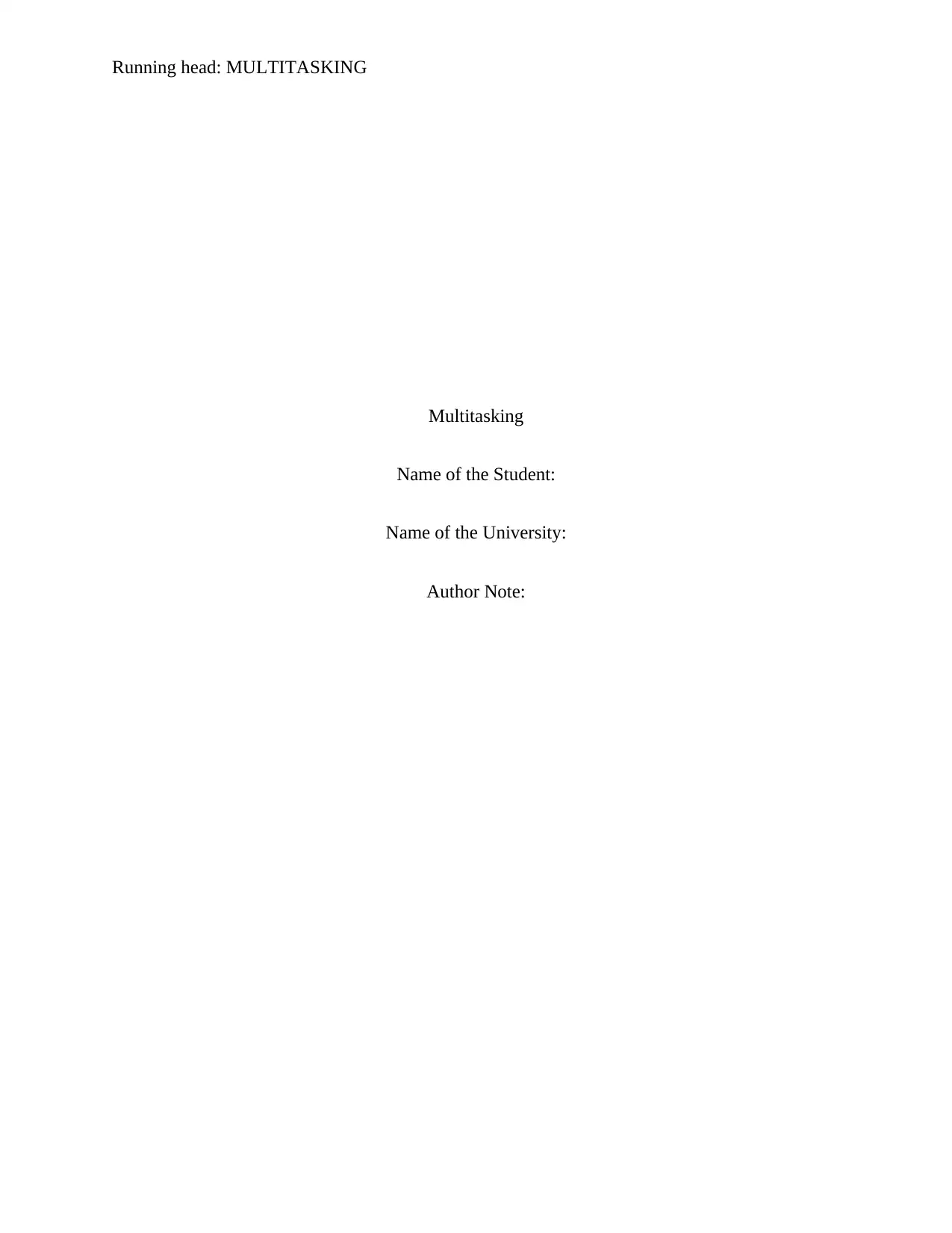
Running head: MULTITASKING
Multitasking
Name of the Student:
Name of the University:
Author Note:
tabler-icon-diamond-filled.svg

Paraphrase This Document

Need a fresh take? Get an instant paraphrase of this document with our AI Paraphraser
Document Page
1
MULTITASKING
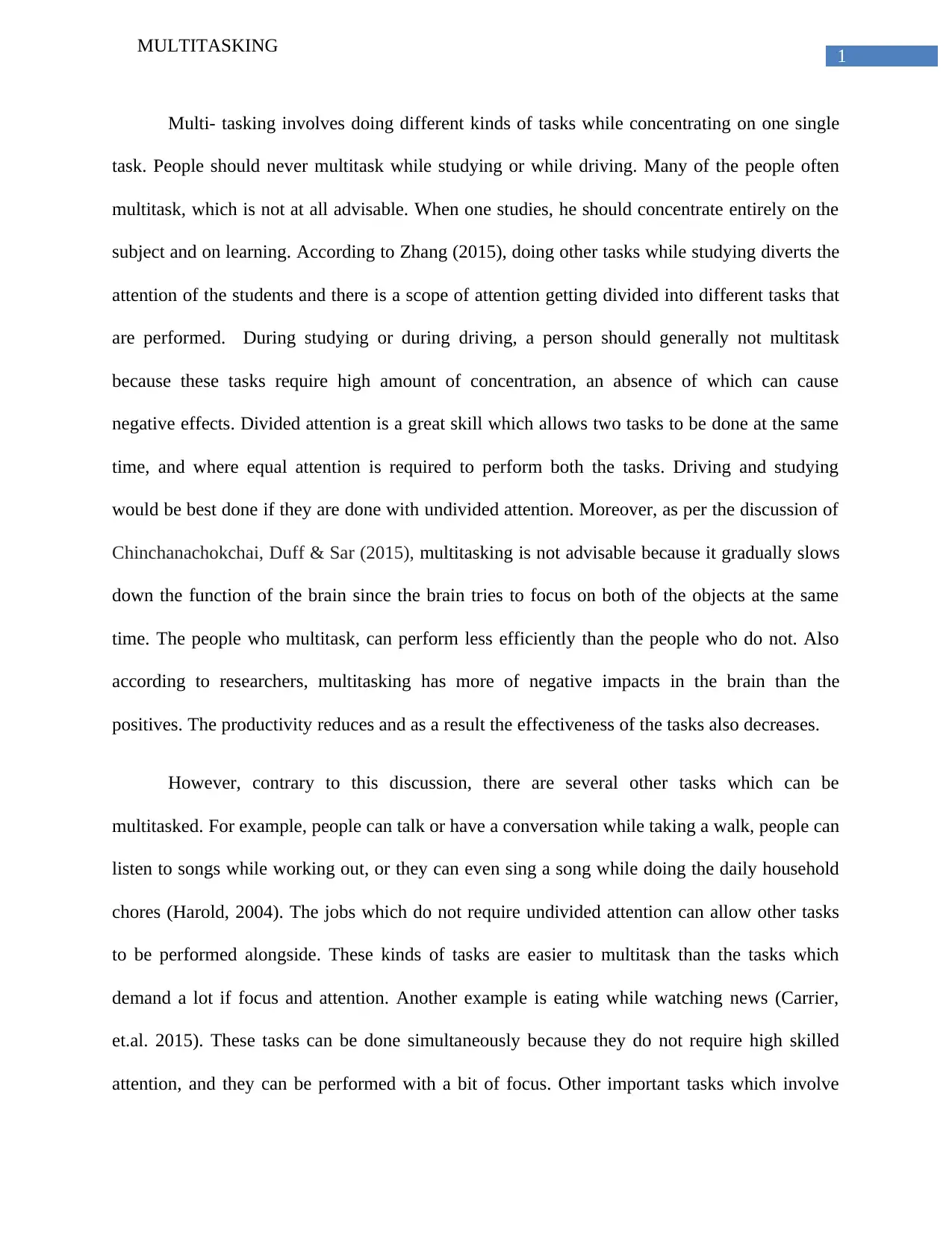
Multi- tasking involves doing different kinds of tasks while concentrating on one single
task. People should never multitask while studying or while driving. Many of the people often
multitask, which is not at all advisable. When one studies, he should concentrate entirely on the
subject and on learning. According to Zhang (2015), doing other tasks while studying diverts the
attention of the students and there is a scope of attention getting divided into different tasks that
are performed. During studying or during driving, a person should generally not multitask
because these tasks require high amount of concentration, an absence of which can cause
negative effects. Divided attention is a great skill which allows two tasks to be done at the same
time, and where equal attention is required to perform both the tasks. Driving and studying
would be best done if they are done with undivided attention. Moreover, as per the discussion of
Chinchanachokchai, Duff & Sar (2015), multitasking is not advisable because it gradually slows
down the function of the brain since the brain tries to focus on both of the objects at the same
time. The people who multitask, can perform less efficiently than the people who do not. Also
according to researchers, multitasking has more of negative impacts in the brain than the
positives. The productivity reduces and as a result the effectiveness of the tasks also decreases.
However, contrary to this discussion, there are several other tasks which can be
multitasked. For example, people can talk or have a conversation while taking a walk, people can
listen to songs while working out, or they can even sing a song while doing the daily household
chores (Harold, 2004). The jobs which do not require undivided attention can allow other tasks
to be performed alongside. These kinds of tasks are easier to multitask than the tasks which
demand a lot if focus and attention. Another example is eating while watching news (Carrier,
et.al. 2015). These tasks can be done simultaneously because they do not require high skilled
attention, and they can be performed with a bit of focus. Other important tasks which involve
Document Page
2
MULTITASKING
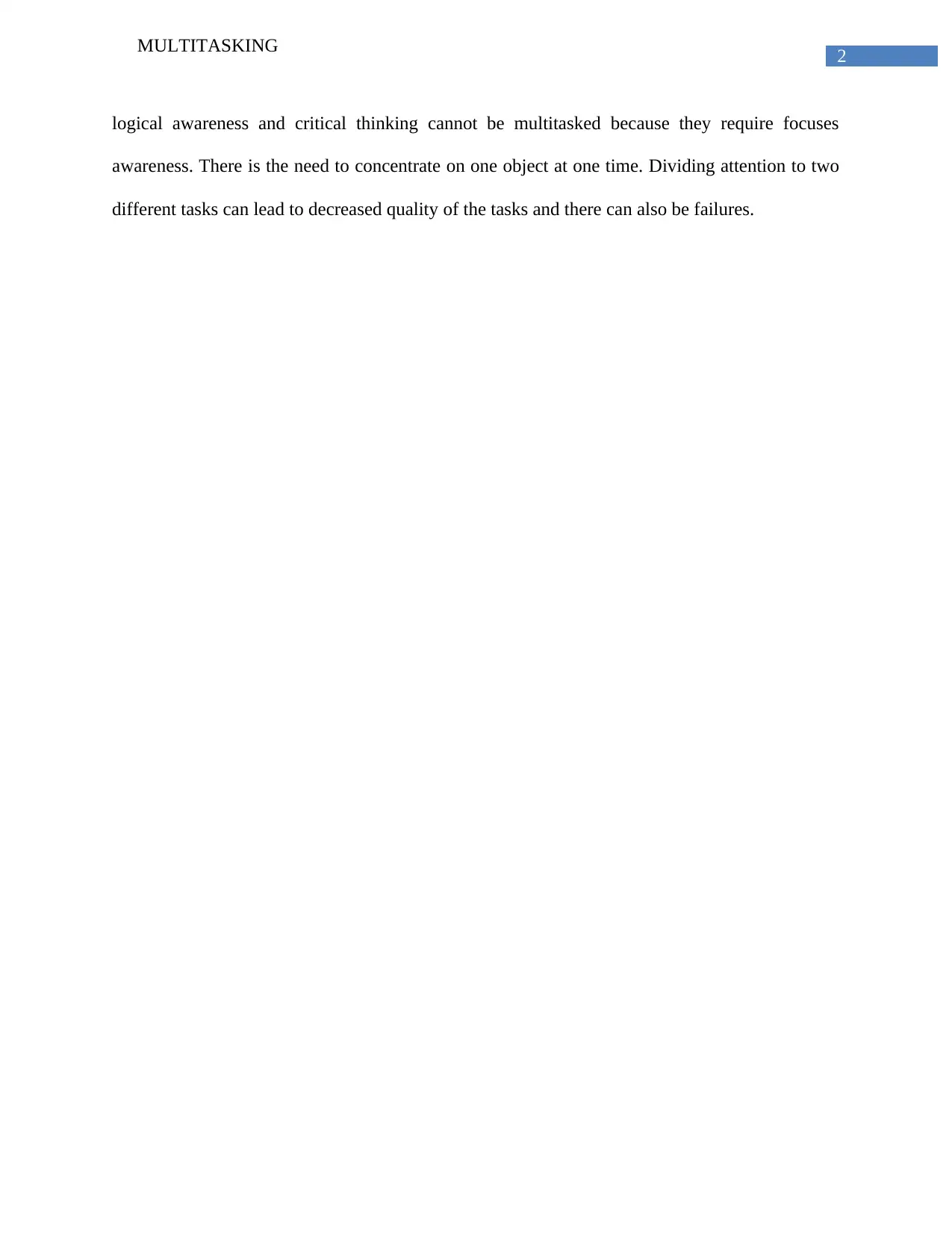
logical awareness and critical thinking cannot be multitasked because they require focuses
awareness. There is the need to concentrate on one object at one time. Dividing attention to two
different tasks can lead to decreased quality of the tasks and there can also be failures.
Document Page
3
MULTITASKING
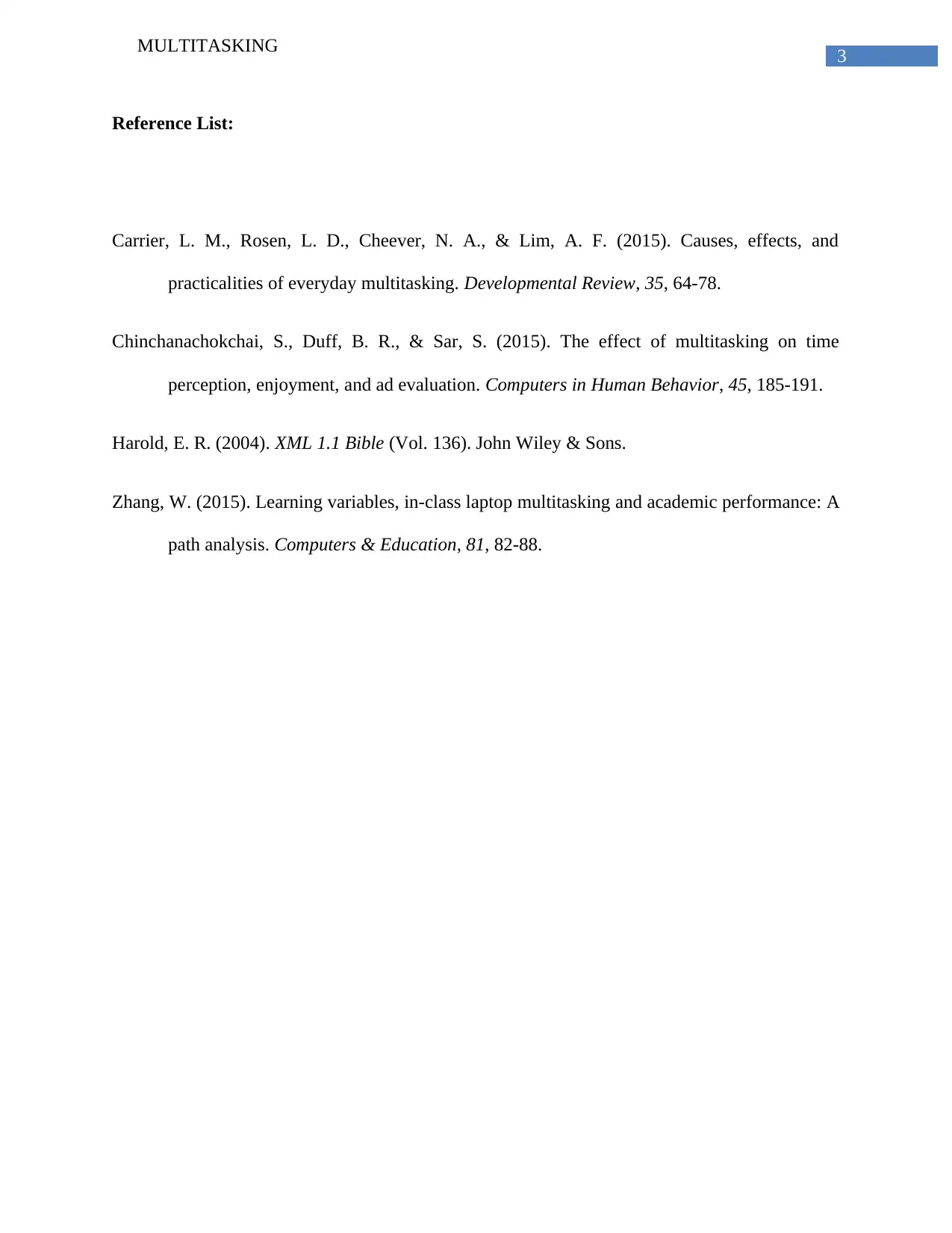
Reference List:
Carrier, L. M., Rosen, L. D., Cheever, N. A., & Lim, A. F. (2015). Causes, effects, and
practicalities of everyday multitasking. Developmental Review, 35, 64-78.
Chinchanachokchai, S., Duff, B. R., & Sar, S. (2015). The effect of multitasking on time
perception, enjoyment, and ad evaluation. Computers in Human Behavior, 45, 185-191.
Harold, E. R. (2004). XML 1.1 Bible (Vol. 136). John Wiley & Sons.
Zhang, W. (2015). Learning variables, in-class laptop multitasking and academic performance: A
path analysis. Computers & Education, 81, 82-88.
chevron_up_icon
1 out of 4
circle_padding
hide_on_mobile
zoom_out_icon
[object Object]