A Comparative Analysis: Psychoanalytic and Existential Theories
VerifiedAdded on 2022/10/17
|8
|1747
|11
Essay
AI Summary
This essay undertakes a comparative analysis of psychoanalytic and existential theories within the context of counseling. It begins by defining both theories, highlighting psychoanalytic theory's focus on investigating personality disorders and existential theory's emphasis on self-determination. The essay then contrasts their historical origins, key figures (Sigmund Freud, Friedrich Nietzsche), and central concepts, such as the role of the unconscious versus the interpretation of life changes. It explores the goals of each theory, with psychoanalytic theory aiming to uncover unconscious forces and existential theory promoting patient self-understanding. The essay further examines the practical application of both theories in counseling scenarios, such as addressing domestic violence or emotional trauma. It concludes by evaluating the plausibility and scope of each theory, suggesting that while both contribute to understanding personality issues, existential theory offers a broader scope and encourages patient empowerment, unlike psychoanalytic theory, which primarily focuses on the client's past experiences. The essay references several studies to support its claims.
1
COMPARISON BETWEEN PYSCHOANALYTIC AND EXISTENTIAL THEORY
COMPARISON BETWEEN PSYCHOANALYTIC AND EXISTENTIAL THEORY
Name
(Affiliation institution)
COMPARISON BETWEEN PYSCHOANALYTIC AND EXISTENTIAL THEORY
COMPARISON BETWEEN PSYCHOANALYTIC AND EXISTENTIAL THEORY
Name
(Affiliation institution)
Paraphrase This Document
Need a fresh take? Get an instant paraphrase of this document with our AI Paraphraser

2
COMPARISON BETWEEN PYSCHOANALYTIC AND EXISTENTIAL THEORY
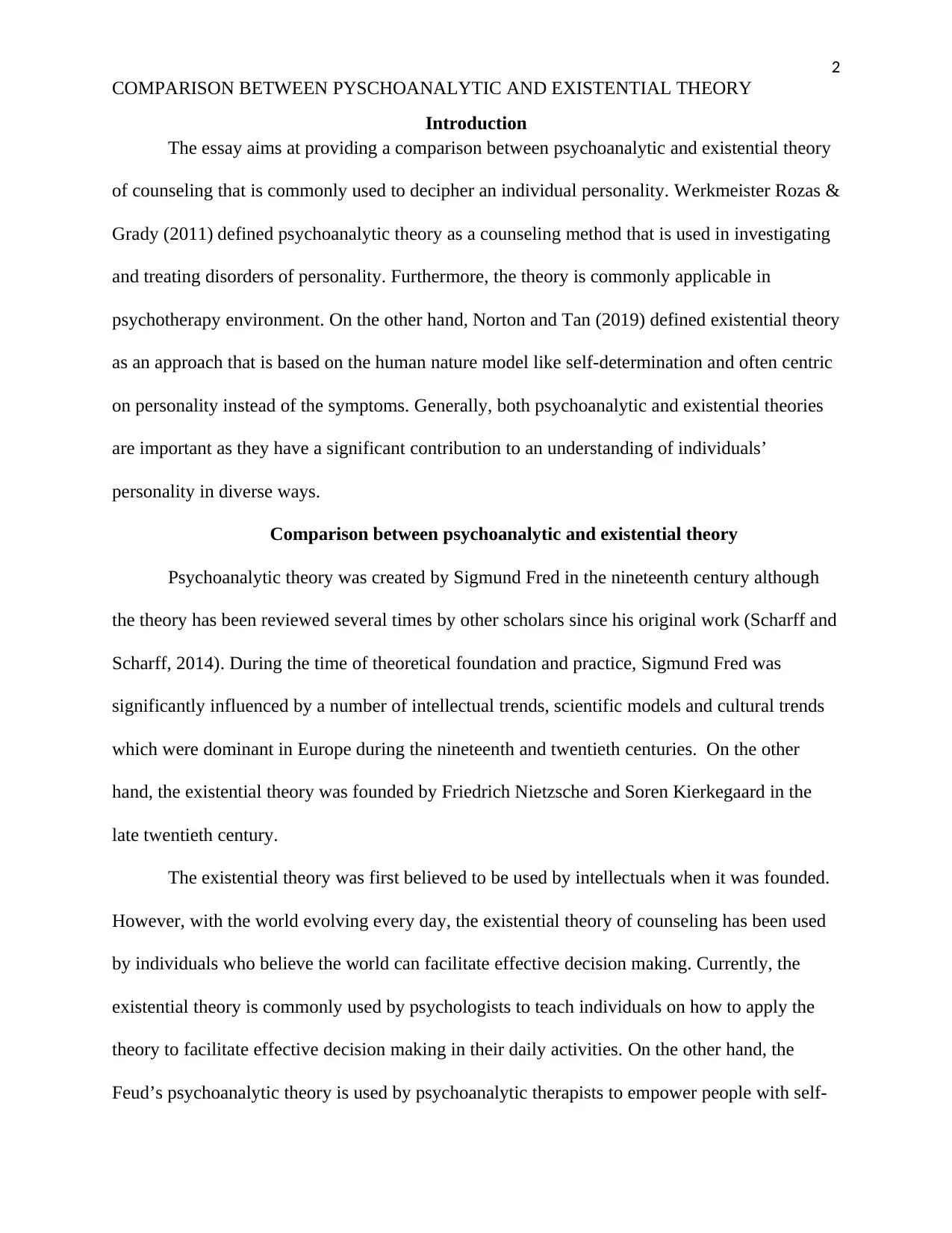
Introduction
The essay aims at providing a comparison between psychoanalytic and existential theory
of counseling that is commonly used to decipher an individual personality. Werkmeister Rozas &
Grady (2011) defined psychoanalytic theory as a counseling method that is used in investigating
and treating disorders of personality. Furthermore, the theory is commonly applicable in
psychotherapy environment. On the other hand, Norton and Tan (2019) defined existential theory
as an approach that is based on the human nature model like self-determination and often centric
on personality instead of the symptoms. Generally, both psychoanalytic and existential theories
are important as they have a significant contribution to an understanding of individuals’
personality in diverse ways.
Comparison between psychoanalytic and existential theory
Psychoanalytic theory was created by Sigmund Fred in the nineteenth century although
the theory has been reviewed several times by other scholars since his original work (Scharff and
Scharff, 2014). During the time of theoretical foundation and practice, Sigmund Fred was
significantly influenced by a number of intellectual trends, scientific models and cultural trends
which were dominant in Europe during the nineteenth and twentieth centuries. On the other
hand, the existential theory was founded by Friedrich Nietzsche and Soren Kierkegaard in the
late twentieth century.
The existential theory was first believed to be used by intellectuals when it was founded.
However, with the world evolving every day, the existential theory of counseling has been used
by individuals who believe the world can facilitate effective decision making. Currently, the
existential theory is commonly used by psychologists to teach individuals on how to apply the
theory to facilitate effective decision making in their daily activities. On the other hand, the
Feud’s psychoanalytic theory is used by psychoanalytic therapists to empower people with self-
COMPARISON BETWEEN PYSCHOANALYTIC AND EXISTENTIAL THEORY
Introduction
The essay aims at providing a comparison between psychoanalytic and existential theory
of counseling that is commonly used to decipher an individual personality. Werkmeister Rozas &
Grady (2011) defined psychoanalytic theory as a counseling method that is used in investigating
and treating disorders of personality. Furthermore, the theory is commonly applicable in
psychotherapy environment. On the other hand, Norton and Tan (2019) defined existential theory
as an approach that is based on the human nature model like self-determination and often centric
on personality instead of the symptoms. Generally, both psychoanalytic and existential theories
are important as they have a significant contribution to an understanding of individuals’
personality in diverse ways.
Comparison between psychoanalytic and existential theory
Psychoanalytic theory was created by Sigmund Fred in the nineteenth century although
the theory has been reviewed several times by other scholars since his original work (Scharff and
Scharff, 2014). During the time of theoretical foundation and practice, Sigmund Fred was
significantly influenced by a number of intellectual trends, scientific models and cultural trends
which were dominant in Europe during the nineteenth and twentieth centuries. On the other
hand, the existential theory was founded by Friedrich Nietzsche and Soren Kierkegaard in the
late twentieth century.
The existential theory was first believed to be used by intellectuals when it was founded.
However, with the world evolving every day, the existential theory of counseling has been used
by individuals who believe the world can facilitate effective decision making. Currently, the
existential theory is commonly used by psychologists to teach individuals on how to apply the
theory to facilitate effective decision making in their daily activities. On the other hand, the
Feud’s psychoanalytic theory is used by psychoanalytic therapists to empower people with self-

3
COMPARISON BETWEEN PYSCHOANALYTIC AND EXISTENTIAL THEORY
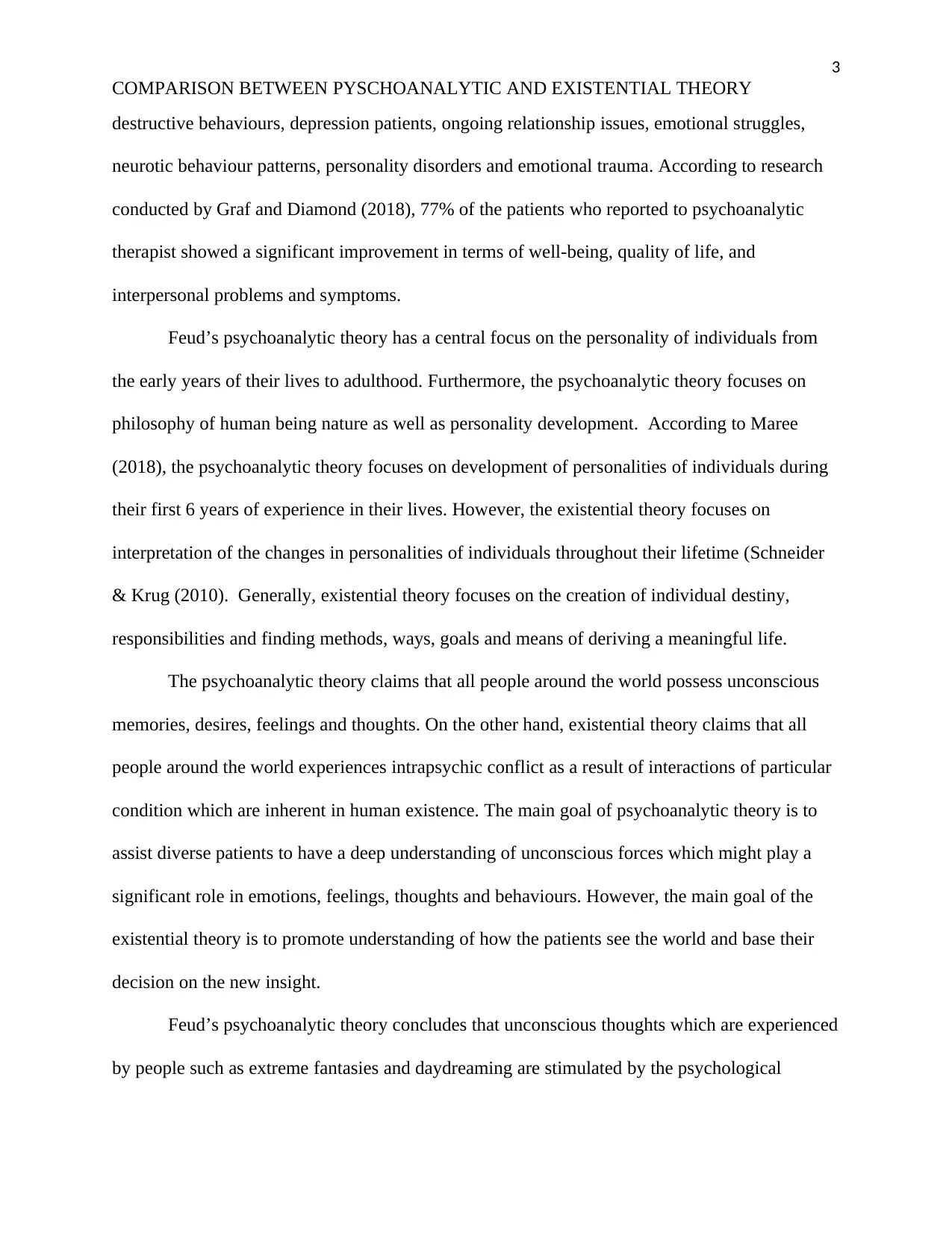
destructive behaviours, depression patients, ongoing relationship issues, emotional struggles,
neurotic behaviour patterns, personality disorders and emotional trauma. According to research
conducted by Graf and Diamond (2018), 77% of the patients who reported to psychoanalytic
therapist showed a significant improvement in terms of well-being, quality of life, and
interpersonal problems and symptoms.
Feud’s psychoanalytic theory has a central focus on the personality of individuals from
the early years of their lives to adulthood. Furthermore, the psychoanalytic theory focuses on
philosophy of human being nature as well as personality development. According to Maree
(2018), the psychoanalytic theory focuses on development of personalities of individuals during
their first 6 years of experience in their lives. However, the existential theory focuses on
interpretation of the changes in personalities of individuals throughout their lifetime (Schneider
& Krug (2010). Generally, existential theory focuses on the creation of individual destiny,
responsibilities and finding methods, ways, goals and means of deriving a meaningful life.
The psychoanalytic theory claims that all people around the world possess unconscious
memories, desires, feelings and thoughts. On the other hand, existential theory claims that all
people around the world experiences intrapsychic conflict as a result of interactions of particular
condition which are inherent in human existence. The main goal of psychoanalytic theory is to
assist diverse patients to have a deep understanding of unconscious forces which might play a
significant role in emotions, feelings, thoughts and behaviours. However, the main goal of the
existential theory is to promote understanding of how the patients see the world and base their
decision on the new insight.
Feud’s psychoanalytic theory concludes that unconscious thoughts which are experienced
by people such as extreme fantasies and daydreaming are stimulated by the psychological
COMPARISON BETWEEN PYSCHOANALYTIC AND EXISTENTIAL THEORY
destructive behaviours, depression patients, ongoing relationship issues, emotional struggles,
neurotic behaviour patterns, personality disorders and emotional trauma. According to research
conducted by Graf and Diamond (2018), 77% of the patients who reported to psychoanalytic
therapist showed a significant improvement in terms of well-being, quality of life, and
interpersonal problems and symptoms.
Feud’s psychoanalytic theory has a central focus on the personality of individuals from
the early years of their lives to adulthood. Furthermore, the psychoanalytic theory focuses on
philosophy of human being nature as well as personality development. According to Maree
(2018), the psychoanalytic theory focuses on development of personalities of individuals during
their first 6 years of experience in their lives. However, the existential theory focuses on
interpretation of the changes in personalities of individuals throughout their lifetime (Schneider
& Krug (2010). Generally, existential theory focuses on the creation of individual destiny,
responsibilities and finding methods, ways, goals and means of deriving a meaningful life.
The psychoanalytic theory claims that all people around the world possess unconscious
memories, desires, feelings and thoughts. On the other hand, existential theory claims that all
people around the world experiences intrapsychic conflict as a result of interactions of particular
condition which are inherent in human existence. The main goal of psychoanalytic theory is to
assist diverse patients to have a deep understanding of unconscious forces which might play a
significant role in emotions, feelings, thoughts and behaviours. However, the main goal of the
existential theory is to promote understanding of how the patients see the world and base their
decision on the new insight.
Feud’s psychoanalytic theory concludes that unconscious thoughts which are experienced
by people such as extreme fantasies and daydreaming are stimulated by the psychological
⊘ This is a preview!⊘
Do you want full access?
Subscribe today to unlock all pages.

Trusted by 1+ million students worldwide

4
COMPARISON BETWEEN PYSCHOANALYTIC AND EXISTENTIAL THEORY
defenses. Furthermore, the theory also concludes that the characteristics and personalities of all
the people are usually driven by instinctual forces and are further developed within the first six
years of life experiences. The existential theory concludes that all people around the world are
capable of making conscious decisions although how they make decisions are influenced by
environmental and biological conditions that impact on how they are creative and make choices
(Gurwitsch, 2010).
Generally, the psychoanalytic theory and existential theories are applicable during the
procedures of counseling. For example, the theories can be applied by a counselor dealing with
couples who have fallen victims of domestic violence or differences as a result of diversified
ethnic and cultural background. Feud’s psychoanalytic theory is applicable to situations where a
patient is depressed, psychological and emotional disturbed or fighting endless inner battles that
may result in trauma in the long run. For example, in the situation where one couple is depressed
as a result of domestic violence or differences, a counselor can use the psychoanalytical theory to
examine the reasons for the behaviour of the couple who is violent through formation of
questionnaires. The questionnaires can be used to determine the life experiences of the violent
couple at the age of 6 years which assist a counselor to develop an equality sense among the
couples and further eliminated the dominant role battle of the partners (Hill, Kline, Kivlighan,
Aaron and King (2019).
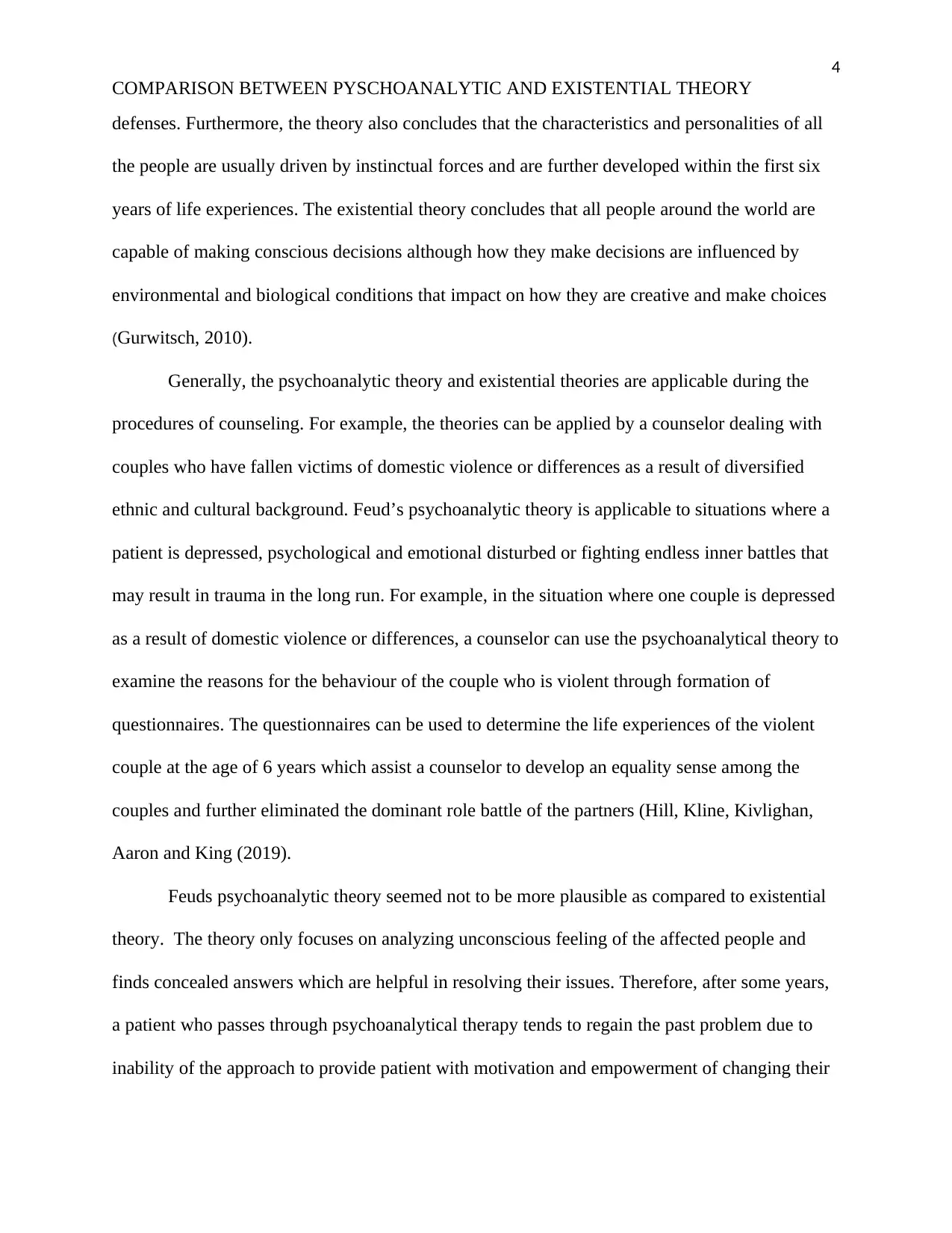
Feuds psychoanalytic theory seemed not to be more plausible as compared to existential
theory. The theory only focuses on analyzing unconscious feeling of the affected people and
finds concealed answers which are helpful in resolving their issues. Therefore, after some years,
a patient who passes through psychoanalytical therapy tends to regain the past problem due to
inability of the approach to provide patient with motivation and empowerment of changing their
COMPARISON BETWEEN PYSCHOANALYTIC AND EXISTENTIAL THEORY
defenses. Furthermore, the theory also concludes that the characteristics and personalities of all
the people are usually driven by instinctual forces and are further developed within the first six
years of life experiences. The existential theory concludes that all people around the world are
capable of making conscious decisions although how they make decisions are influenced by
environmental and biological conditions that impact on how they are creative and make choices
(Gurwitsch, 2010).
Generally, the psychoanalytic theory and existential theories are applicable during the
procedures of counseling. For example, the theories can be applied by a counselor dealing with
couples who have fallen victims of domestic violence or differences as a result of diversified
ethnic and cultural background. Feud’s psychoanalytic theory is applicable to situations where a
patient is depressed, psychological and emotional disturbed or fighting endless inner battles that
may result in trauma in the long run. For example, in the situation where one couple is depressed
as a result of domestic violence or differences, a counselor can use the psychoanalytical theory to
examine the reasons for the behaviour of the couple who is violent through formation of
questionnaires. The questionnaires can be used to determine the life experiences of the violent
couple at the age of 6 years which assist a counselor to develop an equality sense among the
couples and further eliminated the dominant role battle of the partners (Hill, Kline, Kivlighan,
Aaron and King (2019).
Feuds psychoanalytic theory seemed not to be more plausible as compared to existential
theory. The theory only focuses on analyzing unconscious feeling of the affected people and
finds concealed answers which are helpful in resolving their issues. Therefore, after some years,
a patient who passes through psychoanalytical therapy tends to regain the past problem due to
inability of the approach to provide patient with motivation and empowerment of changing their
Paraphrase This Document
Need a fresh take? Get an instant paraphrase of this document with our AI Paraphraser

5
COMPARISON BETWEEN PYSCHOANALYTIC AND EXISTENTIAL THEORY
lives. The existential theory is plausible as it encourages patients to have a maximum
contribution towards promotion of equality views as well as progress on the development of
social interests. In addition, through the existential theory of counseling, motivation of people is
enhanced causing a change towards improving state of emotions to the inferiors or marginalized
groups in the society.
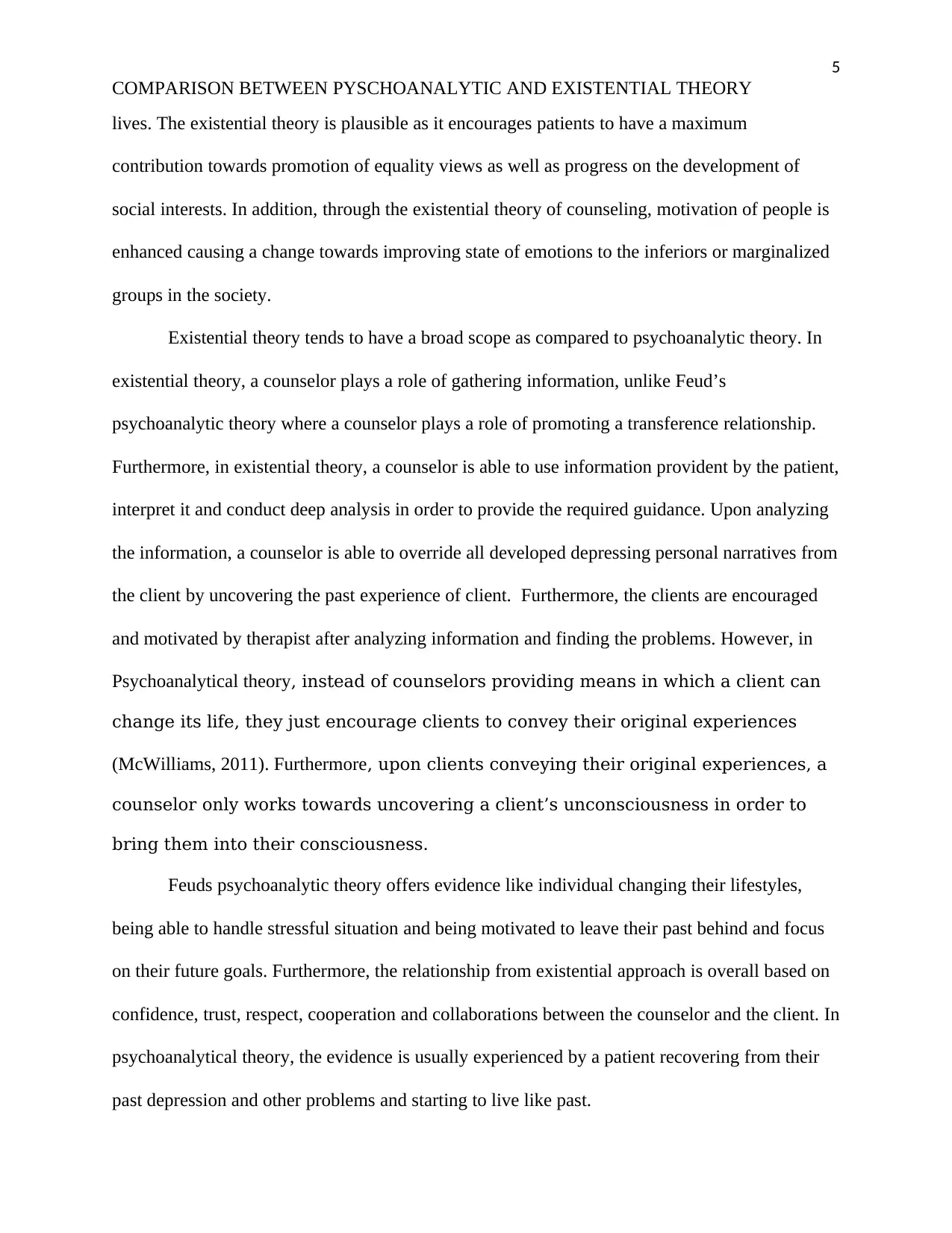
Existential theory tends to have a broad scope as compared to psychoanalytic theory. In
existential theory, a counselor plays a role of gathering information, unlike Feud’s
psychoanalytic theory where a counselor plays a role of promoting a transference relationship.
Furthermore, in existential theory, a counselor is able to use information provident by the patient,
interpret it and conduct deep analysis in order to provide the required guidance. Upon analyzing
the information, a counselor is able to override all developed depressing personal narratives from
the client by uncovering the past experience of client. Furthermore, the clients are encouraged
and motivated by therapist after analyzing information and finding the problems. However, in
Psychoanalytical theory, instead of counselors providing means in which a client can
change its life, they just encourage clients to convey their original experiences
(McWilliams, 2011). Furthermore, upon clients conveying their original experiences, a
counselor only works towards uncovering a client’s unconsciousness in order to
bring them into their consciousness.
Feuds psychoanalytic theory offers evidence like individual changing their lifestyles,
being able to handle stressful situation and being motivated to leave their past behind and focus
on their future goals. Furthermore, the relationship from existential approach is overall based on
confidence, trust, respect, cooperation and collaborations between the counselor and the client. In
psychoanalytical theory, the evidence is usually experienced by a patient recovering from their
past depression and other problems and starting to live like past.
COMPARISON BETWEEN PYSCHOANALYTIC AND EXISTENTIAL THEORY
lives. The existential theory is plausible as it encourages patients to have a maximum
contribution towards promotion of equality views as well as progress on the development of
social interests. In addition, through the existential theory of counseling, motivation of people is
enhanced causing a change towards improving state of emotions to the inferiors or marginalized
groups in the society.
Existential theory tends to have a broad scope as compared to psychoanalytic theory. In
existential theory, a counselor plays a role of gathering information, unlike Feud’s
psychoanalytic theory where a counselor plays a role of promoting a transference relationship.
Furthermore, in existential theory, a counselor is able to use information provident by the patient,
interpret it and conduct deep analysis in order to provide the required guidance. Upon analyzing
the information, a counselor is able to override all developed depressing personal narratives from
the client by uncovering the past experience of client. Furthermore, the clients are encouraged
and motivated by therapist after analyzing information and finding the problems. However, in
Psychoanalytical theory, instead of counselors providing means in which a client can
change its life, they just encourage clients to convey their original experiences
(McWilliams, 2011). Furthermore, upon clients conveying their original experiences, a
counselor only works towards uncovering a client’s unconsciousness in order to
bring them into their consciousness.
Feuds psychoanalytic theory offers evidence like individual changing their lifestyles,
being able to handle stressful situation and being motivated to leave their past behind and focus
on their future goals. Furthermore, the relationship from existential approach is overall based on
confidence, trust, respect, cooperation and collaborations between the counselor and the client. In
psychoanalytical theory, the evidence is usually experienced by a patient recovering from their
past depression and other problems and starting to live like past.

6
COMPARISON BETWEEN PYSCHOANALYTIC AND EXISTENTIAL THEORY
Conclusion
In conclusion, although both theories are important when it comes to the provision of
counseling and guidance to people in order to change their lives, people have a different
perspective on which theory is better than the other. Furthermore, despite the differences in the
concepts, aims, goals and central focus, all theories seek to address the personality problems
which are experienced by diverse individuals in the society.
COMPARISON BETWEEN PYSCHOANALYTIC AND EXISTENTIAL THEORY
Conclusion
In conclusion, although both theories are important when it comes to the provision of
counseling and guidance to people in order to change their lives, people have a different
perspective on which theory is better than the other. Furthermore, despite the differences in the
concepts, aims, goals and central focus, all theories seek to address the personality problems
which are experienced by diverse individuals in the society.
⊘ This is a preview!⊘
Do you want full access?
Subscribe today to unlock all pages.

Trusted by 1+ million students worldwide

7
COMPARISON BETWEEN PYSCHOANALYTIC AND EXISTENTIAL THEORY
References
Graf, E., & Diamond, D. (2018). 6 The significance of three evidence-based psychoanalytic
psychotherapies on psychotherapy research, psychoanalytic theory, and practice.
In Progress in Psychoanalysis (pp. 147-172). Routledge.
Gurwitsch, A. (2010). Husserl’s theory of the intentionality of consciousness in historical
perspective. In The Collected Works of Aron Gurwitsch (1901–1973) (pp. 351-381).
Springer, Dordrecht.
Hill, C. E., Kline, K. V., Kivlighan Jr, D. M., Aaron, Z., & King, S. (2019). Changes in meaning
in life across the course of psychodynamic psychotherapy. Counselling Psychology
Quarterly, 32(1), 1-17.
Maree, J. G. (2018). Promoting career development and life design in the early years of a
person’s life. Early Child Development and Care, 188(4), 425-436.
McWilliams, N. (2011). Psychoanalytic diagnosis: Understanding personality structure in the
clinical process. Guilford Press.
Norton, A. L., & Tan, T. X. (2019). The relationship between licensed mental health counselors’
political ideology and counseling theory preference. American Journal of
Orthopsychiatry, 89(1), 86.
Scharff, D.E. and Scharff, J.S. eds., 2014. Psychoanalytic couple therapy: Foundations of theory
and practice. Karnac Books.
Schneider, K. J., & Krug, O. T. (2010). Existential-humanistic therapy. Washington, DC:
American Psychological Association.
COMPARISON BETWEEN PYSCHOANALYTIC AND EXISTENTIAL THEORY
References
Graf, E., & Diamond, D. (2018). 6 The significance of three evidence-based psychoanalytic
psychotherapies on psychotherapy research, psychoanalytic theory, and practice.
In Progress in Psychoanalysis (pp. 147-172). Routledge.
Gurwitsch, A. (2010). Husserl’s theory of the intentionality of consciousness in historical
perspective. In The Collected Works of Aron Gurwitsch (1901–1973) (pp. 351-381).
Springer, Dordrecht.
Hill, C. E., Kline, K. V., Kivlighan Jr, D. M., Aaron, Z., & King, S. (2019). Changes in meaning
in life across the course of psychodynamic psychotherapy. Counselling Psychology
Quarterly, 32(1), 1-17.
Maree, J. G. (2018). Promoting career development and life design in the early years of a
person’s life. Early Child Development and Care, 188(4), 425-436.
McWilliams, N. (2011). Psychoanalytic diagnosis: Understanding personality structure in the
clinical process. Guilford Press.
Norton, A. L., & Tan, T. X. (2019). The relationship between licensed mental health counselors’
political ideology and counseling theory preference. American Journal of
Orthopsychiatry, 89(1), 86.
Scharff, D.E. and Scharff, J.S. eds., 2014. Psychoanalytic couple therapy: Foundations of theory
and practice. Karnac Books.
Schneider, K. J., & Krug, O. T. (2010). Existential-humanistic therapy. Washington, DC:
American Psychological Association.
Paraphrase This Document
Need a fresh take? Get an instant paraphrase of this document with our AI Paraphraser

8
COMPARISON BETWEEN PYSCHOANALYTIC AND EXISTENTIAL THEORY
Werkmeister Rozas, L., & Grady, M. D. (2011). Making room for dynamics in evidence-based
practice: The role of psychodynamic theory in client-centered approaches. Journal of
Teaching in Social Work, 31(2), 210-223.
COMPARISON BETWEEN PYSCHOANALYTIC AND EXISTENTIAL THEORY
Werkmeister Rozas, L., & Grady, M. D. (2011). Making room for dynamics in evidence-based
practice: The role of psychodynamic theory in client-centered approaches. Journal of
Teaching in Social Work, 31(2), 210-223.
1 out of 8
Your All-in-One AI-Powered Toolkit for Academic Success.
+13062052269
info@desklib.com
Available 24*7 on WhatsApp / Email
Unlock your academic potential
Copyright © 2020–2025 A2Z Services. All Rights Reserved. Developed and managed by ZUCOL.