Reflection: Psychodynamic Learning Theory and Facilitation

Verified

Added on  2023/06/04

|3
|676
|487
Report
AI Summary
This assignment explores the application of psychodynamic learning theory within the context of adult education, as reflected upon by a student. The core of the assignment involved creating a concept map that visually connects psychodynamic learning theory to a chosen facilitation model, illustrating the relationships between key concepts and facts, and demonstrating how different elements interact within the learning process. The student's reflection then delves into their understanding of facilitation, highlighting the impact of the mapping exercise on their comprehension of the subject matter. The reflection also addresses the practical implications of this understanding for their future work, emphasizing the importance of considering both conscious and unconscious aspects of the learning process in adult education. Key concepts discussed include the role of the ego, childhood experiences, and the influence of motivation and feelings on adult learning.
Document Page
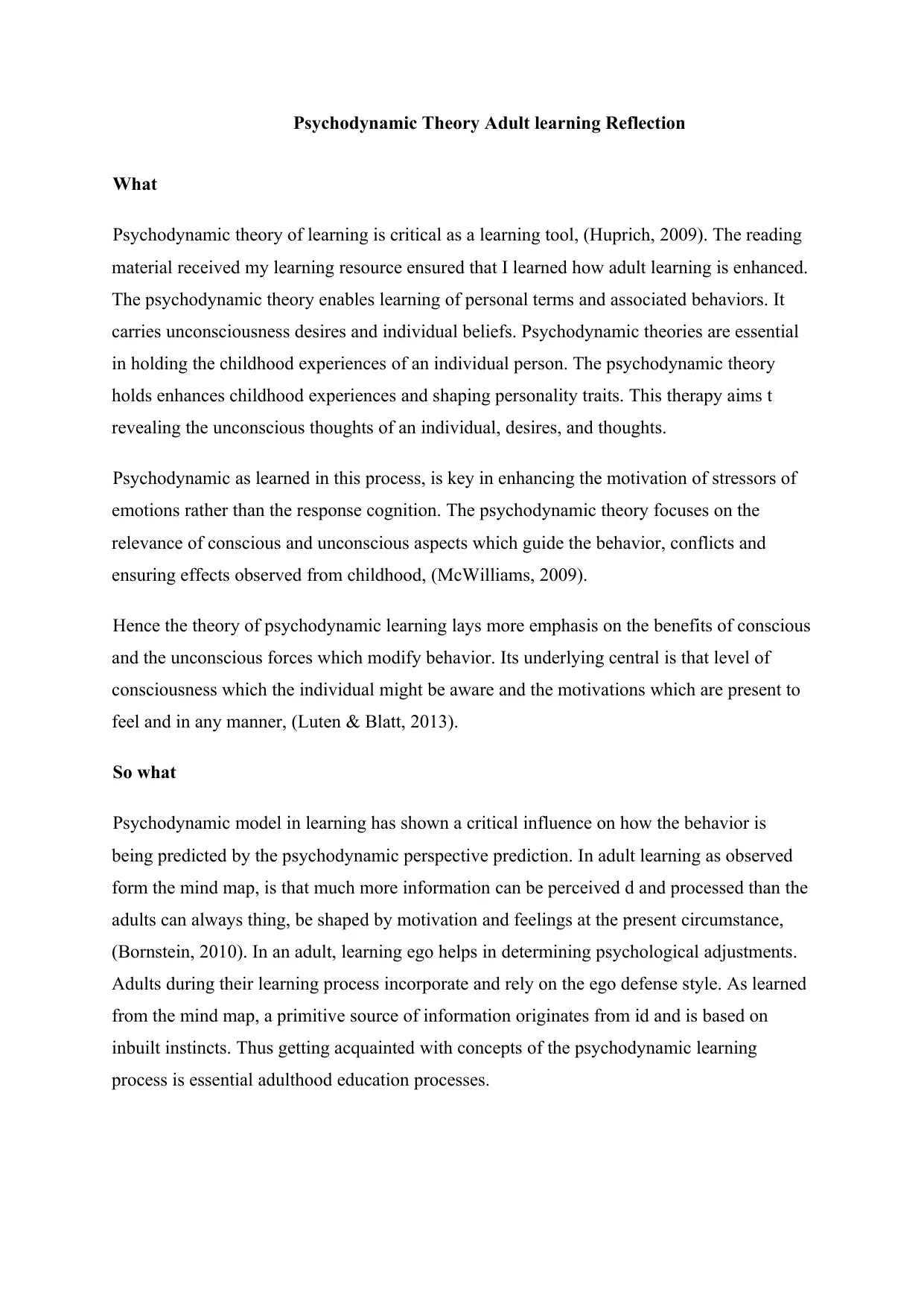
Psychodynamic Theory Adult learning Reflection
What
Psychodynamic theory of learning is critical as a learning tool, (Huprich, 2009). The reading
material received my learning resource ensured that I learned how adult learning is enhanced.
The psychodynamic theory enables learning of personal terms and associated behaviors. It
carries unconsciousness desires and individual beliefs. Psychodynamic theories are essential
in holding the childhood experiences of an individual person. The psychodynamic theory
holds enhances childhood experiences and shaping personality traits. This therapy aims t
revealing the unconscious thoughts of an individual, desires, and thoughts.
Psychodynamic as learned in this process, is key in enhancing the motivation of stressors of
emotions rather than the response cognition. The psychodynamic theory focuses on the
relevance of conscious and unconscious aspects which guide the behavior, conflicts and
ensuring effects observed from childhood, (McWilliams, 2009).
Hence the theory of psychodynamic learning lays more emphasis on the benefits of conscious
and the unconscious forces which modify behavior. Its underlying central is that level of
consciousness which the individual might be aware and the motivations which are present to
feel and in any manner, (Luten & Blatt, 2013).
So what
Psychodynamic model in learning has shown a critical influence on how the behavior is
being predicted by the psychodynamic perspective prediction. In adult learning as observed
form the mind map, is that much more information can be perceived d and processed than the
adults can always thing, be shaped by motivation and feelings at the present circumstance,
(Bornstein, 2010). In an adult, learning ego helps in determining psychological adjustments.
Adults during their learning process incorporate and rely on the ego defense style. As learned
from the mind map, a primitive source of information originates from id and is based on
inbuilt instincts. Thus getting acquainted with concepts of the psychodynamic learning
process is essential adulthood education processes.
tabler-icon-diamond-filled.svg

Paraphrase This Document

Need a fresh take? Get an instant paraphrase of this document with our AI Paraphraser
Document Page
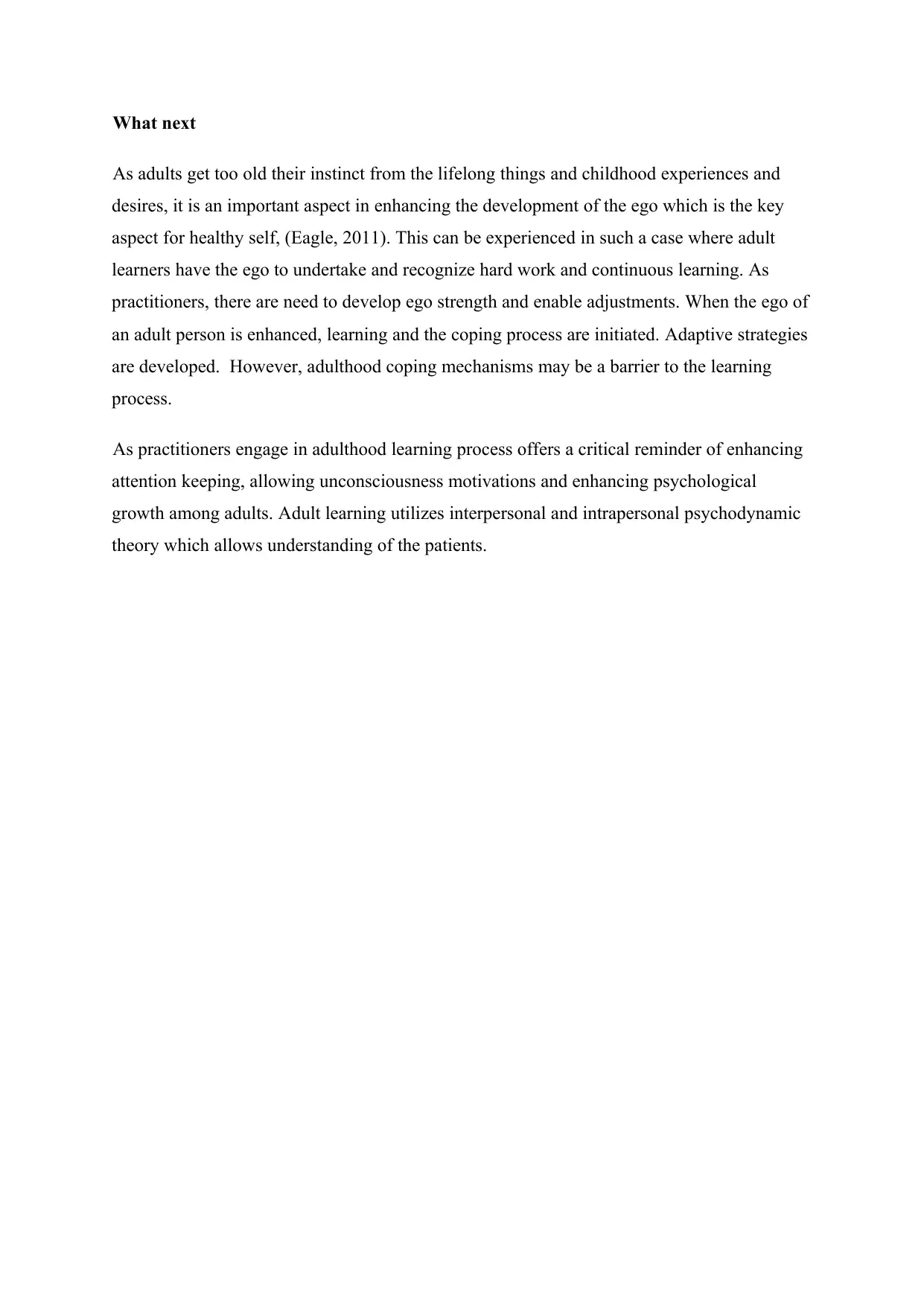
What next
As adults get too old their instinct from the lifelong things and childhood experiences and
desires, it is an important aspect in enhancing the development of the ego which is the key
aspect for healthy self, (Eagle, 2011). This can be experienced in such a case where adult
learners have the ego to undertake and recognize hard work and continuous learning. As
practitioners, there are need to develop ego strength and enable adjustments. When the ego of
an adult person is enhanced, learning and the coping process are initiated. Adaptive strategies
are developed. However, adulthood coping mechanisms may be a barrier to the learning
process.
As practitioners engage in adulthood learning process offers a critical reminder of enhancing
attention keeping, allowing unconsciousness motivations and enhancing psychological
growth among adults. Adult learning utilizes interpersonal and intrapersonal psychodynamic
theory which allows understanding of the patients.
Document Page
References
Bornstein, R. F. (2005). Reconnecting psychoanalysis to mainstream psychology: Challenges
and opportunities. Psychoanalytic Psychology, 22, 323-340.
Eagle, M. N. (2011). From classical to contemporary psychoanalysis: A critique and
integration. New York, NY: Taylor & Francis.
Huprich, S. K., McWilliams, N., Lingiardi, V., Bornstein, R. F., Gazzillo, F., & Gordon, R.
M. (2015). The Psychodynamic Diagnostic Manual (PDM) and the PDM-2:
Opportunities to significantly affect the profession. Psychoanalytic Inquiry, 35(sup1),
60-73.
Luyten, P., & Blatt, S. J. (2013). Interpersonal relatedness and self-definition in normal and
disrupted personality development. American Psychologist, 68, 172–183.
McWilliams, N. (2009). Psychoanalytic diagnosis (2nd ed.). New York, NY: Guilford Press.
chevron_up_icon
1 out of 3
circle_padding
hide_on_mobile
zoom_out_icon
[object Object]