A Psychological Analysis: Computers' Effects on Human Learning
VerifiedAdded on 2022/10/17
|30
|8837
|159
Report
AI Summary
This report delves into the psychological effects of computers on human learning, examining both positive and negative impacts. It begins by highlighting the increasing integration of computer technology in education, using the example of Singapore's early childhood education system, particularly the KIBO robotics program. The report explores sociological theories, such as alienation, to explain the potential downsides of excessive computer use, and then presents relevant psychological theories. It then reviews empirical research on the effects of computers on cognitive capacities, social interaction, and the potential for acquisition of violent behavior. The report concludes with a critical analysis of the preceding discussions, aiming to provide a comprehensive understanding of how computers shape the learning process from a psychological perspective, extending beyond academic pursuits.

Running head: PSYCHOLOGICAL EFFECT OF COMPUTERS ON LEARNING
PSYCHOLOGICAL EFFECT OF COMPUTERS ON LEARNING
Name of the Student
Name of the University
Author Note
PSYCHOLOGICAL EFFECT OF COMPUTERS ON LEARNING
Name of the Student
Name of the University
Author Note

Paraphrase This Document
Need a fresh take? Get an instant paraphrase of this document with our AI Paraphraser
PSYCHOLOGICAL EFFECT OF COMPUTERS ON LEARNING 1
ABSTRACT
In the contemporary world computers are indispensable. Apart from the professional
field, the academic field is also becoming increasingly technologically oriented. In some nations,
the system of education is focusing on inculcating computer technology right from the outset so
that the students are able to deal with the changing economic scenario which is highly contingent
upon the usage of technology. There are positive effects of making computers occupy a position
of centrality in the field of education which is contributing to the advancement and academic
prowess of the students, which is catering to the career prospects of the students in a positive
way. However the psychological effects of the extensive usage of computers on human learning
from a psychological perspective escapes the attention, which is occupied by the sociological and
the health related discussions. In this research project the focus of the discussion shall be upon
the effects of computers on the human learning process seen from a psychological perspective,
which is the central focus of the project. In view of this central focus the project will be focusing
upon three aspects, the first part shall be dealing with the theoretical aspect outlining both the
sociological and the psychological theories dealing with the effect of computers on human
learning. The second part shall be providing empirical research works that deals with the
psychological effects of computers on human learning from a psychological perspective. The
third and the final section shall be based upon a critical analysis of the discussions conducted in
the preceding sections. The aim of the research is to provide an understanding of learning in a
broad way without limiting it to just academic pursuits.
ABSTRACT
In the contemporary world computers are indispensable. Apart from the professional
field, the academic field is also becoming increasingly technologically oriented. In some nations,
the system of education is focusing on inculcating computer technology right from the outset so
that the students are able to deal with the changing economic scenario which is highly contingent
upon the usage of technology. There are positive effects of making computers occupy a position
of centrality in the field of education which is contributing to the advancement and academic
prowess of the students, which is catering to the career prospects of the students in a positive
way. However the psychological effects of the extensive usage of computers on human learning
from a psychological perspective escapes the attention, which is occupied by the sociological and
the health related discussions. In this research project the focus of the discussion shall be upon
the effects of computers on the human learning process seen from a psychological perspective,
which is the central focus of the project. In view of this central focus the project will be focusing
upon three aspects, the first part shall be dealing with the theoretical aspect outlining both the
sociological and the psychological theories dealing with the effect of computers on human
learning. The second part shall be providing empirical research works that deals with the
psychological effects of computers on human learning from a psychological perspective. The
third and the final section shall be based upon a critical analysis of the discussions conducted in
the preceding sections. The aim of the research is to provide an understanding of learning in a
broad way without limiting it to just academic pursuits.
PSYCHOLOGICAL EFFECT OF COMPUTERS ON LEARNING 2
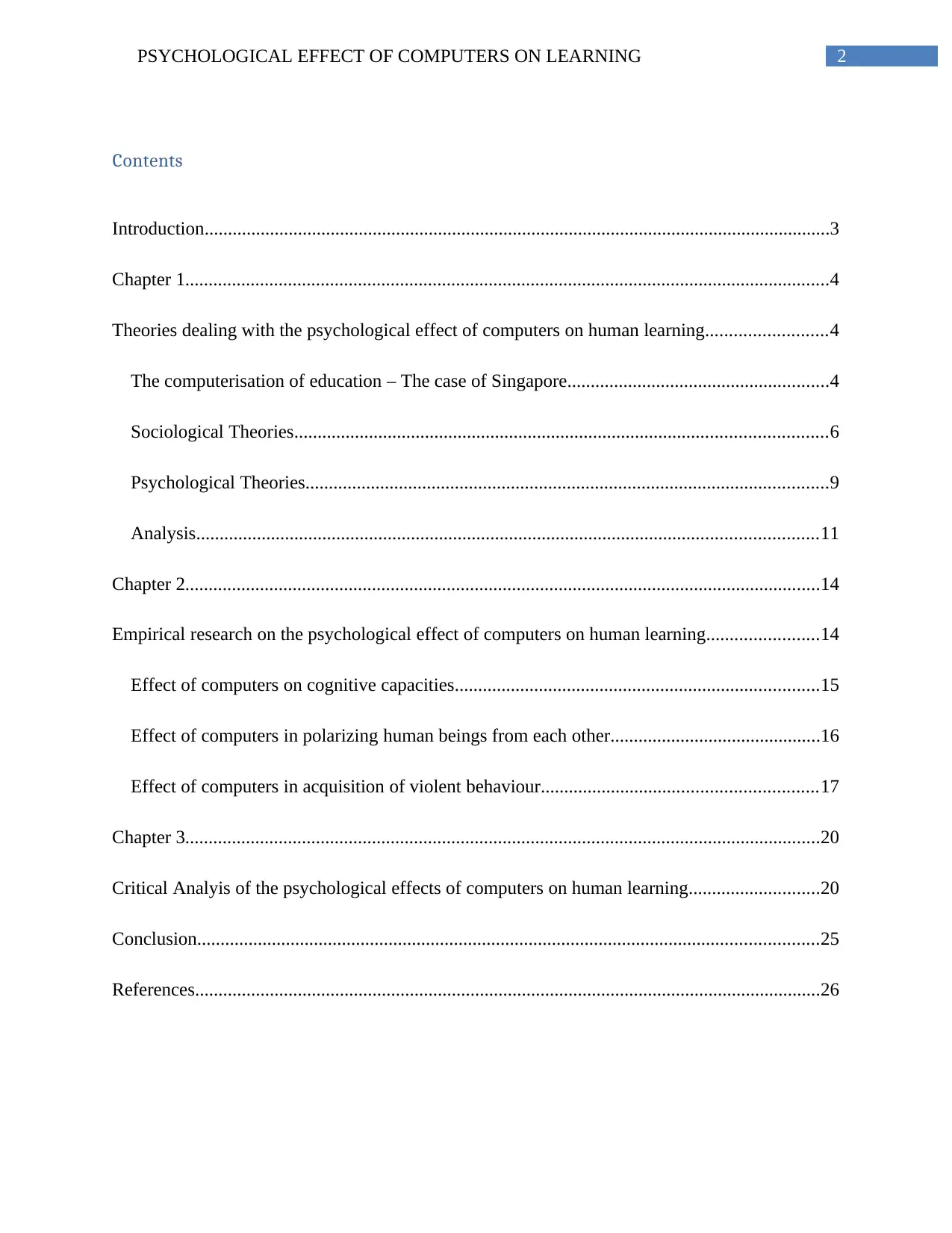
Contents
Introduction......................................................................................................................................3
Chapter 1..........................................................................................................................................4
Theories dealing with the psychological effect of computers on human learning..........................4
The computerisation of education – The case of Singapore........................................................4
Sociological Theories..................................................................................................................6
Psychological Theories................................................................................................................9
Analysis.....................................................................................................................................11
Chapter 2........................................................................................................................................14
Empirical research on the psychological effect of computers on human learning........................14
Effect of computers on cognitive capacities..............................................................................15
Effect of computers in polarizing human beings from each other.............................................16
Effect of computers in acquisition of violent behaviour...........................................................17
Chapter 3........................................................................................................................................20
Critical Analyis of the psychological effects of computers on human learning............................20
Conclusion.....................................................................................................................................25
References......................................................................................................................................26
Contents
Introduction......................................................................................................................................3
Chapter 1..........................................................................................................................................4
Theories dealing with the psychological effect of computers on human learning..........................4
The computerisation of education – The case of Singapore........................................................4
Sociological Theories..................................................................................................................6
Psychological Theories................................................................................................................9
Analysis.....................................................................................................................................11
Chapter 2........................................................................................................................................14
Empirical research on the psychological effect of computers on human learning........................14
Effect of computers on cognitive capacities..............................................................................15
Effect of computers in polarizing human beings from each other.............................................16
Effect of computers in acquisition of violent behaviour...........................................................17
Chapter 3........................................................................................................................................20
Critical Analyis of the psychological effects of computers on human learning............................20
Conclusion.....................................................................................................................................25
References......................................................................................................................................26
⊘ This is a preview!⊘
Do you want full access?
Subscribe today to unlock all pages.

Trusted by 1+ million students worldwide
PSYCHOLOGICAL EFFECT OF COMPUTERS ON LEARNING 3
Introduction
The dependence on technology is something which is inevitable in this post modern age
as for all purposes technology has provided the solution. With technology, the sphere of
education and entertainment has been revolutionized in a way which has made it unimaginable to
think about development in terms of education without resorting to technology and its uses, and
with technology the computer technology is being implied. The computers have become an
important part of the lives of the people that its vitality cannot be understood without taking into
account its effect on the human psychology. Several theorists from the psychological and the
sociological perspective have tried to explain the impact of computers on the effects on human
learning. For that purpose the definition of learning has to be expanded without limiting it to just
academic pursuits.
Introduction
The dependence on technology is something which is inevitable in this post modern age
as for all purposes technology has provided the solution. With technology, the sphere of
education and entertainment has been revolutionized in a way which has made it unimaginable to
think about development in terms of education without resorting to technology and its uses, and
with technology the computer technology is being implied. The computers have become an
important part of the lives of the people that its vitality cannot be understood without taking into
account its effect on the human psychology. Several theorists from the psychological and the
sociological perspective have tried to explain the impact of computers on the effects on human
learning. For that purpose the definition of learning has to be expanded without limiting it to just
academic pursuits.
Paraphrase This Document
Need a fresh take? Get an instant paraphrase of this document with our AI Paraphraser
PSYCHOLOGICAL EFFECT OF COMPUTERS ON LEARNING 4
Chapter 1
Theories dealing with the psychological effect of computers on human learning
In this postmodern age when the importance of technology seems to have taken over
science, the discipline which creates itself, it is extremely necessary that children are introduced
to the technological advancements right from the outset (Karuppiah, 2015). The culture,
economy and the production process is increasingly being designed in a way which is causing
the minimization of the employment of human labor power and the replacement of human labor
power with robotic technology (Toh et al., 2016). Not just in the field of science and disciplinary
studies, the employment of the technological advancements in the creative fields such as fine
arts, music, culinary arts, et cetera are heavily dependent on the usage of technology for the
purpose of implementing finesse, perfection and also for the purpose of increasing the level of
productivity within a short span of time (McClure et al., 2017).
In this part of the research project the focus of the discussion shall be upon the theoretical
perspectives which deal with the aspect of the effect of the high degree of dependence of the
students on their learning and cognitive capacities. The discussion in this particular chapter shall
be focusing on three particular aspects, namely the effects of computer on learning and cognitive
capabilities, the sociological theories dealing with the effect of computers on learning and
cognitive capabilities and the psychological theories dealing with the effect of computers on
learning and cognitive capabilities
Chapter 1
Theories dealing with the psychological effect of computers on human learning
In this postmodern age when the importance of technology seems to have taken over
science, the discipline which creates itself, it is extremely necessary that children are introduced
to the technological advancements right from the outset (Karuppiah, 2015). The culture,
economy and the production process is increasingly being designed in a way which is causing
the minimization of the employment of human labor power and the replacement of human labor
power with robotic technology (Toh et al., 2016). Not just in the field of science and disciplinary
studies, the employment of the technological advancements in the creative fields such as fine
arts, music, culinary arts, et cetera are heavily dependent on the usage of technology for the
purpose of implementing finesse, perfection and also for the purpose of increasing the level of
productivity within a short span of time (McClure et al., 2017).
In this part of the research project the focus of the discussion shall be upon the theoretical
perspectives which deal with the aspect of the effect of the high degree of dependence of the
students on their learning and cognitive capacities. The discussion in this particular chapter shall
be focusing on three particular aspects, namely the effects of computer on learning and cognitive
capabilities, the sociological theories dealing with the effect of computers on learning and
cognitive capabilities and the psychological theories dealing with the effect of computers on
learning and cognitive capabilities
PSYCHOLOGICAL EFFECT OF COMPUTERS ON LEARNING 5
The computerisation of education – The case of Singapore
In the modern world, the need for computers is inevitable for the sake of ensuring that the
processes go smoothly and with accuracy. Modern classrooms tend to have smart board facilities
which are computerized versions of the traditional chalk duster and blackboard method which
used to be followed in the yesteryears. However, the use of highly sophisticated machinery and
computerized technology in the classroom environment is still a distant dream for many students
in many parts of the world since the use of computer technology in the classroom environment is
a costly process and is naturally beyond the reach of the nations which are not as developed as
for example Singapore (Bers, 2017).
Singapore is an example where the need for inculcating the vitality of computers in the
education system right from the childhood itself. In the article ‘Dancing robots: integrating art,
music, and robotics in Singapore’s early childhood centers’ co authored by Amanda Sullivan and
Marina Umaschi Bers, they showcase the upsurge that has taken place in the recent years with
regard to the inculcation of a technology oriented curriculum in the early education plan in
Singapore and the importance devoted to it by the government of the nation (Sullivan & Bers,
2018). The disciplines oriented towards the teaching of technology and engineering to the
students pursuing their education right from the early childhood level is seen as a matter of
national importance. The most innovative and novel initiative of the programme envisaged has
been the introduction of the Playmaker Programme which tends to devote adequate amount of
focus on the teaching of robotics and coding oriented subject right from the preschool level
(Chatterji, 2016).
For the purpose of disseminating technologically advanced education, the logistical
support building system to enable teaching of robotics and coding oriented subjects have been
The computerisation of education – The case of Singapore
In the modern world, the need for computers is inevitable for the sake of ensuring that the
processes go smoothly and with accuracy. Modern classrooms tend to have smart board facilities
which are computerized versions of the traditional chalk duster and blackboard method which
used to be followed in the yesteryears. However, the use of highly sophisticated machinery and
computerized technology in the classroom environment is still a distant dream for many students
in many parts of the world since the use of computer technology in the classroom environment is
a costly process and is naturally beyond the reach of the nations which are not as developed as
for example Singapore (Bers, 2017).
Singapore is an example where the need for inculcating the vitality of computers in the
education system right from the childhood itself. In the article ‘Dancing robots: integrating art,
music, and robotics in Singapore’s early childhood centers’ co authored by Amanda Sullivan and
Marina Umaschi Bers, they showcase the upsurge that has taken place in the recent years with
regard to the inculcation of a technology oriented curriculum in the early education plan in
Singapore and the importance devoted to it by the government of the nation (Sullivan & Bers,
2018). The disciplines oriented towards the teaching of technology and engineering to the
students pursuing their education right from the early childhood level is seen as a matter of
national importance. The most innovative and novel initiative of the programme envisaged has
been the introduction of the Playmaker Programme which tends to devote adequate amount of
focus on the teaching of robotics and coding oriented subject right from the preschool level
(Chatterji, 2016).
For the purpose of disseminating technologically advanced education, the logistical
support building system to enable teaching of robotics and coding oriented subjects have been
⊘ This is a preview!⊘
Do you want full access?
Subscribe today to unlock all pages.
Trusted by 1+ million students worldwide
PSYCHOLOGICAL EFFECT OF COMPUTERS ON LEARNING 6
designed very skillfully which involves the inculcation of the KIBO robotics curriculum as a part
of the STEAM (Science, Technology, Engineering, Arts, and Mathematics) programme (Sullivan
& Bers, 2018). This particular set up has been deemed as the most important part of the
classroom set up meant for disseminating technologically advanced education through
technologically advanced means. It has been named as ‘Dances from Around the World’, and the
robotic kit which has been designed for the purpose is called KIBO. The actions or the
functioning process of which has been programmed with the help of tangible programming
blocks which tend to eliminate the need for screen time meant for suiting the need of the children
(Dell, Newton & Petroff, 2016).
With regard to the programming concepts that the preschool children learn and gain
expertise on the KIBO model of education. KIBO derives its name from the Kinderlab Robotics
technology company that designs the equipments meant for disseminating the model of
education. It is related to coding and robotics technology and various other basic technological
aspects related to computer technology and engineering. The students also tend to gain a lot of
expertise in the field of programming of the computer which tends to increase their cognitive and
reasoning skills by means of the KIBO model of learning (Sullivan & Bers, 2018).
However at the same time there have been certain disadvantages of the newly developed
system which accounts for the missing of the humane element in the engagement of the school
community as a collectivity comprising of human elements and not machines. The polarization
of the students within the school environment by the increased use of technology has been
manifested in the newly developed programme. Thus the turning of students into robots and lack
of engagement of the students with other students and the teachers is a serious problem which is
being faced by the students (Sullivan & Bers, 2018).
designed very skillfully which involves the inculcation of the KIBO robotics curriculum as a part
of the STEAM (Science, Technology, Engineering, Arts, and Mathematics) programme (Sullivan
& Bers, 2018). This particular set up has been deemed as the most important part of the
classroom set up meant for disseminating technologically advanced education through
technologically advanced means. It has been named as ‘Dances from Around the World’, and the
robotic kit which has been designed for the purpose is called KIBO. The actions or the
functioning process of which has been programmed with the help of tangible programming
blocks which tend to eliminate the need for screen time meant for suiting the need of the children
(Dell, Newton & Petroff, 2016).
With regard to the programming concepts that the preschool children learn and gain
expertise on the KIBO model of education. KIBO derives its name from the Kinderlab Robotics
technology company that designs the equipments meant for disseminating the model of
education. It is related to coding and robotics technology and various other basic technological
aspects related to computer technology and engineering. The students also tend to gain a lot of
expertise in the field of programming of the computer which tends to increase their cognitive and
reasoning skills by means of the KIBO model of learning (Sullivan & Bers, 2018).
However at the same time there have been certain disadvantages of the newly developed
system which accounts for the missing of the humane element in the engagement of the school
community as a collectivity comprising of human elements and not machines. The polarization
of the students within the school environment by the increased use of technology has been
manifested in the newly developed programme. Thus the turning of students into robots and lack
of engagement of the students with other students and the teachers is a serious problem which is
being faced by the students (Sullivan & Bers, 2018).
Paraphrase This Document
Need a fresh take? Get an instant paraphrase of this document with our AI Paraphraser
PSYCHOLOGICAL EFFECT OF COMPUTERS ON LEARNING 7
Sociological Theories
In the discussion above, it can be seen that the predominance of computer technology has
both positive and negative effects, which can be explained by means of using the sociological
theoretical premises of socialization and alienation respectively. The sociological theory of
alienation directly corresponds to the discussion that focuses on the KIBO model of studying as
it has been introduced in the school curriculum. There has been an increase that has taken place
in the current years with regard to the introduction of technology-oriented curriculum in the early
education plan in Singapore. A great deal of importance has been given to it by the government
of Singapore. The disciplines teach of technology and engineering to the students pursuing their
education right from the early childhood level had been has been a part of the plan being
envisaged as a matter of national importance (Nichols 2016). It thus becomes clear that the
children of Singapore are right from the childhood indoctrinated into the system of being quite
accustomed to the usage of computers right from the childhood. The process of acculturation is
the main factor that exemplifies the usage of computer by the students of Singapore. Through the
social process of acculturation the students of Singapore are psychologically being moulded into
being favourably disposed towards the idea of being comfortable with a computerized education
system (Sayers, 2003).
With regard to the effects of the usage of computer technology in the system of
education, two kinds of effect on the learning has been observed, one is positive and the other
one is negative. The positive effect on learning accounts for the fact that the students of
Singapore who tend to take the KIBO model of dissemination of education gain a lot of expertise
in the field of programming of the computer. Also it must be said that with regard to the
programming concepts that the preschool children tend to learn and gain expertise on being
Sociological Theories
In the discussion above, it can be seen that the predominance of computer technology has
both positive and negative effects, which can be explained by means of using the sociological
theoretical premises of socialization and alienation respectively. The sociological theory of
alienation directly corresponds to the discussion that focuses on the KIBO model of studying as
it has been introduced in the school curriculum. There has been an increase that has taken place
in the current years with regard to the introduction of technology-oriented curriculum in the early
education plan in Singapore. A great deal of importance has been given to it by the government
of Singapore. The disciplines teach of technology and engineering to the students pursuing their
education right from the early childhood level had been has been a part of the plan being
envisaged as a matter of national importance (Nichols 2016). It thus becomes clear that the
children of Singapore are right from the childhood indoctrinated into the system of being quite
accustomed to the usage of computers right from the childhood. The process of acculturation is
the main factor that exemplifies the usage of computer by the students of Singapore. Through the
social process of acculturation the students of Singapore are psychologically being moulded into
being favourably disposed towards the idea of being comfortable with a computerized education
system (Sayers, 2003).
With regard to the effects of the usage of computer technology in the system of
education, two kinds of effect on the learning has been observed, one is positive and the other
one is negative. The positive effect on learning accounts for the fact that the students of
Singapore who tend to take the KIBO model of dissemination of education gain a lot of expertise
in the field of programming of the computer. Also it must be said that with regard to the
programming concepts that the preschool children tend to learn and gain expertise on being
PSYCHOLOGICAL EFFECT OF COMPUTERS ON LEARNING 8
introduced to the KIBO model of education, they are related to coding and robotics technology
and various other basic technological aspects related to computer technology and engineering
(Nichols et al., 2016). These tend to reflect a positive image of the effect of socialization of the
children right from childhood to be accustomed to computerized education. However all the
effects of the computerized education system had not been very positive and the reported
negative effect has been that the learning of social skills and the building of social relationships
has been compromised severely. In other words, the system alienated students from each other
(Wendling, 2009).
There have been certain disadvantages of the newly developed system which accounts for
the missing of the humane element in the engagement of the school community as a collectivity
comprising of human elements and not machines. The polarization of the students within the
school environment by the increased use of technology has been manifested in the newly
developed programme. Thus the turning of students into robots and lack of engagement of the
students with other students and the teachers is a serious problem which is being faced by the
students. This inference could be derived from the case study provided by Amanda Sullivan and
Marina Umaschi Bers on the KIBO model of education in Singapore. Alienation as a theoretical
premise was used by Marx to explain the exploitation that was perpetrated upon the proletariat in
the industries where the products produced by the workers were used to gain profit by the
capitalists but the wages of the workers remained fixed and they are deprived of their due share
of economic remuneration which they are supposed to receive as a against their contribution to
the capitalists in enriching their share of profit (Seeman, 1959). Marx argued that workers were
alienated from the products of their labour. The theorization of Marx was economically
deterministic while in the case of the KIBO model of education the dynamics of alienation as a
introduced to the KIBO model of education, they are related to coding and robotics technology
and various other basic technological aspects related to computer technology and engineering
(Nichols et al., 2016). These tend to reflect a positive image of the effect of socialization of the
children right from childhood to be accustomed to computerized education. However all the
effects of the computerized education system had not been very positive and the reported
negative effect has been that the learning of social skills and the building of social relationships
has been compromised severely. In other words, the system alienated students from each other
(Wendling, 2009).
There have been certain disadvantages of the newly developed system which accounts for
the missing of the humane element in the engagement of the school community as a collectivity
comprising of human elements and not machines. The polarization of the students within the
school environment by the increased use of technology has been manifested in the newly
developed programme. Thus the turning of students into robots and lack of engagement of the
students with other students and the teachers is a serious problem which is being faced by the
students. This inference could be derived from the case study provided by Amanda Sullivan and
Marina Umaschi Bers on the KIBO model of education in Singapore. Alienation as a theoretical
premise was used by Marx to explain the exploitation that was perpetrated upon the proletariat in
the industries where the products produced by the workers were used to gain profit by the
capitalists but the wages of the workers remained fixed and they are deprived of their due share
of economic remuneration which they are supposed to receive as a against their contribution to
the capitalists in enriching their share of profit (Seeman, 1959). Marx argued that workers were
alienated from the products of their labour. The theorization of Marx was economically
deterministic while in the case of the KIBO model of education the dynamics of alienation as a
⊘ This is a preview!⊘
Do you want full access?
Subscribe today to unlock all pages.
Trusted by 1+ million students worldwide
PSYCHOLOGICAL EFFECT OF COMPUTERS ON LEARNING 9
process is happening in a different way which is social in nature. The government of Singapore
has developed a system of education that socialized the children into getting accustomed to the
computerized method of education and they have benefitted academically but they tended to get
alienated from their fellow students (Ebbeck & Waniganayake, 2017). The conclusion from the
observation and enquiry about the KIBO model of education on the basis of the feedback
received from the teachers disseminating the curriculum which has been found out tends to
indicate that the students had exhibited a great degree of isolation from each other and they
tended to reduce the level of socialization significantly but they however did not cease
socialization in totality. This reduced level of socialization among the students with each other
has been a matter of concern among the teachers since the warmth of human interaction was
missing and that could further more lead to the students becoming much more atomized in a
social setting and that can harm the social fabric in the long run (Ebbeck & Waniganayake,
2017). Thus the learning of the social skills tended to suffer as a result of computerization of
education.
Psychological Theories
The Behaviourist Theory of Learning has been provided by Ivan Pavlov in the year 1927.
The basic premise of his theorization is that repetition and acculturation when combined tends to
be a profound facilitator of the process of learning. Pavlov had reached the conclusion on the
basis of an experiment which he had conducted on dogs. He had trained his dogs to salivate on
hearing the ringing of the bells, which had become the indication that the time had arrived for the
dogs to get their meals. He had subjected his dogs to this repetitive process and they had become
accustomed to salivating at the sound of the ringing of the bells. Pavlov had changed the method
of feeding his dogs, even then they tended to salivate at the sound of the ringing of the bells. The
process is happening in a different way which is social in nature. The government of Singapore
has developed a system of education that socialized the children into getting accustomed to the
computerized method of education and they have benefitted academically but they tended to get
alienated from their fellow students (Ebbeck & Waniganayake, 2017). The conclusion from the
observation and enquiry about the KIBO model of education on the basis of the feedback
received from the teachers disseminating the curriculum which has been found out tends to
indicate that the students had exhibited a great degree of isolation from each other and they
tended to reduce the level of socialization significantly but they however did not cease
socialization in totality. This reduced level of socialization among the students with each other
has been a matter of concern among the teachers since the warmth of human interaction was
missing and that could further more lead to the students becoming much more atomized in a
social setting and that can harm the social fabric in the long run (Ebbeck & Waniganayake,
2017). Thus the learning of the social skills tended to suffer as a result of computerization of
education.
Psychological Theories
The Behaviourist Theory of Learning has been provided by Ivan Pavlov in the year 1927.
The basic premise of his theorization is that repetition and acculturation when combined tends to
be a profound facilitator of the process of learning. Pavlov had reached the conclusion on the
basis of an experiment which he had conducted on dogs. He had trained his dogs to salivate on
hearing the ringing of the bells, which had become the indication that the time had arrived for the
dogs to get their meals. He had subjected his dogs to this repetitive process and they had become
accustomed to salivating at the sound of the ringing of the bells. Pavlov had changed the method
of feeding his dogs, even then they tended to salivate at the sound of the ringing of the bells. The
Paraphrase This Document
Need a fresh take? Get an instant paraphrase of this document with our AI Paraphraser
PSYCHOLOGICAL EFFECT OF COMPUTERS ON LEARNING 10
inference that could be derived from this particular experiment was that repetitive occurrence of
a phenomenon facilitates and expedites the process of learning (Illeris, 2018). The pattern of
behaviour that is imbibed by human beings are a result of repetitive experiencing of a particular
sequence of events and that is how according to Pavlov human beings get accustomed to
behaving in a particular way. This phenomenon has been termed as Classical Conditioning. The
case study provided about Singapore Government to introduce computer technology right from
the beginning to the school students show that the element of Classical Conditioning, by means
of indoctrinating the school students to be “tech-savy” is very much immanent (Hilgard &
Bower, 1966).
The series of experiments conducted by Albert Bandura in the 1960s also tend to show
that the element of indoctrination is very much relevant in the context of explaining the effect of
computers on the learning pattern of the students. Albert Bandura had through his experiments
concluded his social learning theory which tended to hint at the fact aggression is a learned
behaviour and learning to be aggressive in an environment which makes learning aggression
conducive. Bandura had taken 72 children in total as his sample for the experiment, grouped into
three control groups consisting of equal proportion of boys and girls. The first group of children
consisting of 24 children, out of which 12 were boys and 12 were girls were exposed to an
aggressive video showing a Bobo Doll being attacked aggressively by adult models. The second
group of children consisting of 24 children, out of which 12 were boys and 12 were girls were
exposed to a video which showed that an adult model indulged in a harmonious behaviour and
the model completely ignored the Bobo Doll. The third group of children consisting of 24
children, out of which 12 were boys and 12 were girls were not at all exposed to any video at all.
In the second phase of the experiment, all the children were exposed to mild arousal of
inference that could be derived from this particular experiment was that repetitive occurrence of
a phenomenon facilitates and expedites the process of learning (Illeris, 2018). The pattern of
behaviour that is imbibed by human beings are a result of repetitive experiencing of a particular
sequence of events and that is how according to Pavlov human beings get accustomed to
behaving in a particular way. This phenomenon has been termed as Classical Conditioning. The
case study provided about Singapore Government to introduce computer technology right from
the beginning to the school students show that the element of Classical Conditioning, by means
of indoctrinating the school students to be “tech-savy” is very much immanent (Hilgard &
Bower, 1966).
The series of experiments conducted by Albert Bandura in the 1960s also tend to show
that the element of indoctrination is very much relevant in the context of explaining the effect of
computers on the learning pattern of the students. Albert Bandura had through his experiments
concluded his social learning theory which tended to hint at the fact aggression is a learned
behaviour and learning to be aggressive in an environment which makes learning aggression
conducive. Bandura had taken 72 children in total as his sample for the experiment, grouped into
three control groups consisting of equal proportion of boys and girls. The first group of children
consisting of 24 children, out of which 12 were boys and 12 were girls were exposed to an
aggressive video showing a Bobo Doll being attacked aggressively by adult models. The second
group of children consisting of 24 children, out of which 12 were boys and 12 were girls were
exposed to a video which showed that an adult model indulged in a harmonious behaviour and
the model completely ignored the Bobo Doll. The third group of children consisting of 24
children, out of which 12 were boys and 12 were girls were not at all exposed to any video at all.
In the second phase of the experiment, all the children were exposed to mild arousal of
PSYCHOLOGICAL EFFECT OF COMPUTERS ON LEARNING 11
aggression and then they were individually taken to a room consisting of both violent and non
violent toys and also the Bobo Doll, in order to observe their behaviour and the inclination,
whether violent or non violent they are likely to exude after being exposed to both aggressive,
non aggressive and neutral behaviour. The results indicated that aggressive behaviour is acquired
human beings, which makes the element of Classical Conditioning as concluded by Ivan Pavlov.
However the Bobo Doll Experiment also has other implications and that goes beyond academic
learning (Bandura, 1961).
Computers are not just used for academic purposes but also for entertainment purposes,
and video games being one of the most important example to explain the psychological effect of
computers on learning. For this purpose, the example of violent video games shall be taken up
for analysis, the ones which involve graphic images of sheer violence such as killing and
attacking. Bandura had concluded that there is a slight discrepancy between male and female
pattern of learned aggressive behaviour though both male and female are susceptible to learning
aggressive behaviour in equal intensity (Artino Jr, 2007). Bandura had concluded that both males
and females were likely to imitate male aggressive behaviour and the males were more likely
than females to indulge in physically aggressive behaviour, while the females were more inclined
towards verbal abuse. The violent computer video games are more popular among the males than
the females and that the violence and aggression displayed in the graphic images of the computer
video games are also likely to influence aggressive behaviour among the males in social set up,
and that reinstates the conclusion of Bandura that violent behaviour is acquired and that is
manifested in the behaviour of human beings (Cherry, 2012). The relation between learning of
violence and videogames shall in the subsequent section of the research essay be provided.
aggression and then they were individually taken to a room consisting of both violent and non
violent toys and also the Bobo Doll, in order to observe their behaviour and the inclination,
whether violent or non violent they are likely to exude after being exposed to both aggressive,
non aggressive and neutral behaviour. The results indicated that aggressive behaviour is acquired
human beings, which makes the element of Classical Conditioning as concluded by Ivan Pavlov.
However the Bobo Doll Experiment also has other implications and that goes beyond academic
learning (Bandura, 1961).
Computers are not just used for academic purposes but also for entertainment purposes,
and video games being one of the most important example to explain the psychological effect of
computers on learning. For this purpose, the example of violent video games shall be taken up
for analysis, the ones which involve graphic images of sheer violence such as killing and
attacking. Bandura had concluded that there is a slight discrepancy between male and female
pattern of learned aggressive behaviour though both male and female are susceptible to learning
aggressive behaviour in equal intensity (Artino Jr, 2007). Bandura had concluded that both males
and females were likely to imitate male aggressive behaviour and the males were more likely
than females to indulge in physically aggressive behaviour, while the females were more inclined
towards verbal abuse. The violent computer video games are more popular among the males than
the females and that the violence and aggression displayed in the graphic images of the computer
video games are also likely to influence aggressive behaviour among the males in social set up,
and that reinstates the conclusion of Bandura that violent behaviour is acquired and that is
manifested in the behaviour of human beings (Cherry, 2012). The relation between learning of
violence and videogames shall in the subsequent section of the research essay be provided.
⊘ This is a preview!⊘
Do you want full access?
Subscribe today to unlock all pages.
Trusted by 1+ million students worldwide

1 out of 30


Related Documents


Your All-in-One AI-Powered Toolkit for Academic Success.
+13062052269
info@desklib.com
Available 24*7 on WhatsApp / Email
![[object Object]](/_next/static/media/star-bottom.7253800d.svg)
Unlock your academic potential
Copyright © 2020–2026 A2Z Services. All Rights Reserved. Developed and managed by ZUCOL.