Psychology Essay: A Summary of Gable & Haidt on Positive Psychology
VerifiedAdded on 2023/04/07
|5
|1023
|146
Essay
AI Summary
This essay provides a comprehensive summary of the article 'What (and why) is Positive Psychology?' by Shelly L. Gable and Jonathan Haidt. The article explores the core tenets of positive psychology, emphasizing its role in enhancing the well-being and functionality of individuals, groups, and organizations. Gable and Haidt highlight the historical neglect of positive psychology research, noting the disproportionate focus on negative aspects of human experience such as mental illness and cognitive impairments. They advocate for a shift towards studying positive traits like gratitude, hope, and empathy, while acknowledging criticisms of the positive psychology movement, including concerns that it may diminish the importance of addressing dysfunction and pathology. The authors call for a balanced approach that integrates the study of both positive and negative aspects of human life, ultimately aiming for a more complete understanding of human potential and resilience.
Running head: PSYCHOLOGY ASSESSMENT
PSYCHOLOGY ASSESSMENT
Name of the Student
Name of the University
Author’s Note:
PSYCHOLOGY ASSESSMENT
Name of the Student
Name of the University
Author’s Note:
Paraphrase This Document
Need a fresh take? Get an instant paraphrase of this document with our AI Paraphraser

1PSYCHOLOGY ASSESSMENT
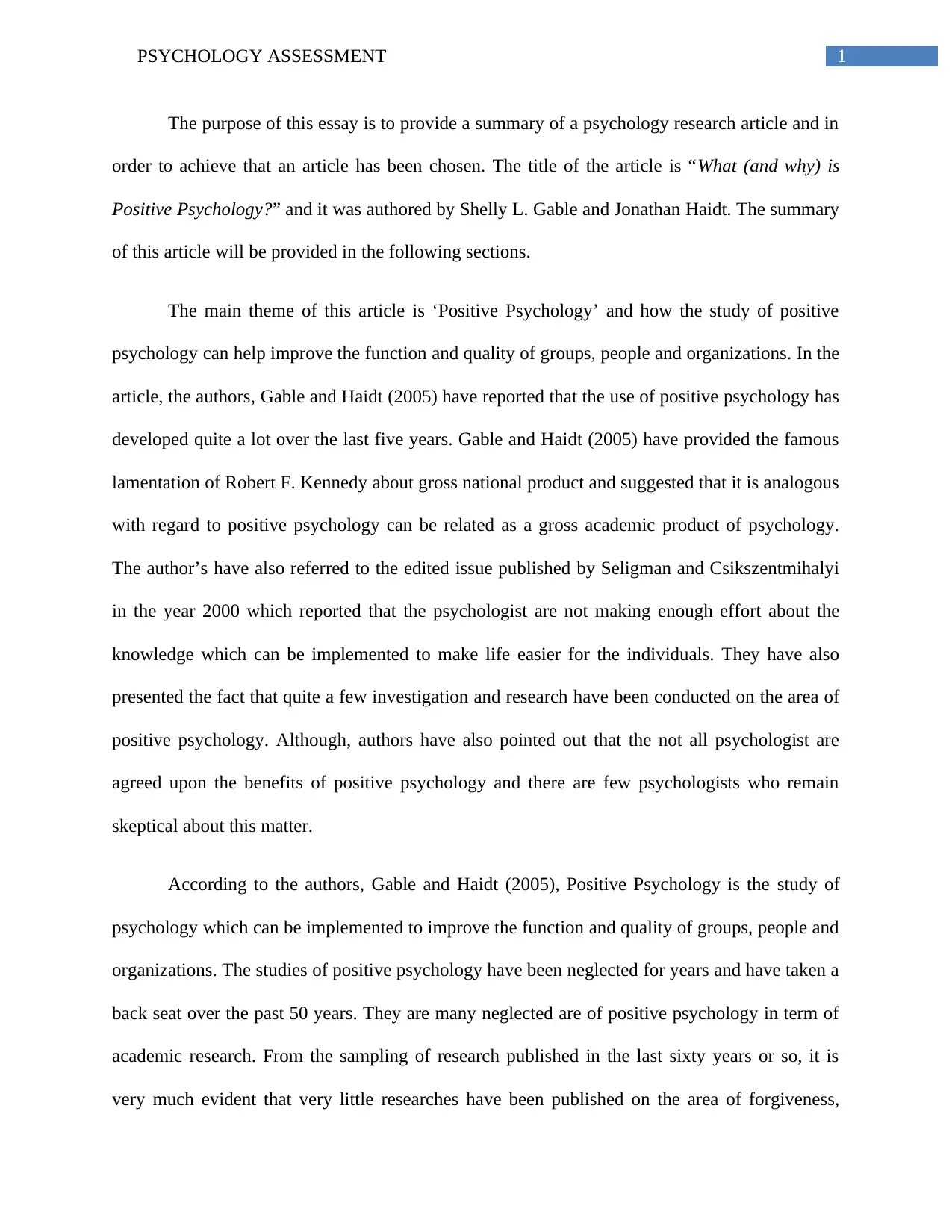
The purpose of this essay is to provide a summary of a psychology research article and in
order to achieve that an article has been chosen. The title of the article is “What (and why) is
Positive Psychology?” and it was authored by Shelly L. Gable and Jonathan Haidt. The summary
of this article will be provided in the following sections.
The main theme of this article is ‘Positive Psychology’ and how the study of positive
psychology can help improve the function and quality of groups, people and organizations. In the
article, the authors, Gable and Haidt (2005) have reported that the use of positive psychology has
developed quite a lot over the last five years. Gable and Haidt (2005) have provided the famous
lamentation of Robert F. Kennedy about gross national product and suggested that it is analogous
with regard to positive psychology can be related as a gross academic product of psychology.
The author’s have also referred to the edited issue published by Seligman and Csikszentmihalyi
in the year 2000 which reported that the psychologist are not making enough effort about the
knowledge which can be implemented to make life easier for the individuals. They have also
presented the fact that quite a few investigation and research have been conducted on the area of
positive psychology. Although, authors have also pointed out that the not all psychologist are
agreed upon the benefits of positive psychology and there are few psychologists who remain
skeptical about this matter.
According to the authors, Gable and Haidt (2005), Positive Psychology is the study of
psychology which can be implemented to improve the function and quality of groups, people and
organizations. The studies of positive psychology have been neglected for years and have taken a
back seat over the past 50 years. They are many neglected are of positive psychology in term of
academic research. From the sampling of research published in the last sixty years or so, it is
very much evident that very little researches have been published on the area of forgiveness,
The purpose of this essay is to provide a summary of a psychology research article and in
order to achieve that an article has been chosen. The title of the article is “What (and why) is
Positive Psychology?” and it was authored by Shelly L. Gable and Jonathan Haidt. The summary
of this article will be provided in the following sections.
The main theme of this article is ‘Positive Psychology’ and how the study of positive
psychology can help improve the function and quality of groups, people and organizations. In the
article, the authors, Gable and Haidt (2005) have reported that the use of positive psychology has
developed quite a lot over the last five years. Gable and Haidt (2005) have provided the famous
lamentation of Robert F. Kennedy about gross national product and suggested that it is analogous
with regard to positive psychology can be related as a gross academic product of psychology.
The author’s have also referred to the edited issue published by Seligman and Csikszentmihalyi
in the year 2000 which reported that the psychologist are not making enough effort about the
knowledge which can be implemented to make life easier for the individuals. They have also
presented the fact that quite a few investigation and research have been conducted on the area of
positive psychology. Although, authors have also pointed out that the not all psychologist are
agreed upon the benefits of positive psychology and there are few psychologists who remain
skeptical about this matter.
According to the authors, Gable and Haidt (2005), Positive Psychology is the study of
psychology which can be implemented to improve the function and quality of groups, people and
organizations. The studies of positive psychology have been neglected for years and have taken a
back seat over the past 50 years. They are many neglected are of positive psychology in term of
academic research. From the sampling of research published in the last sixty years or so, it is
very much evident that very little researches have been published on the area of forgiveness,

2PSYCHOLOGY ASSESSMENT
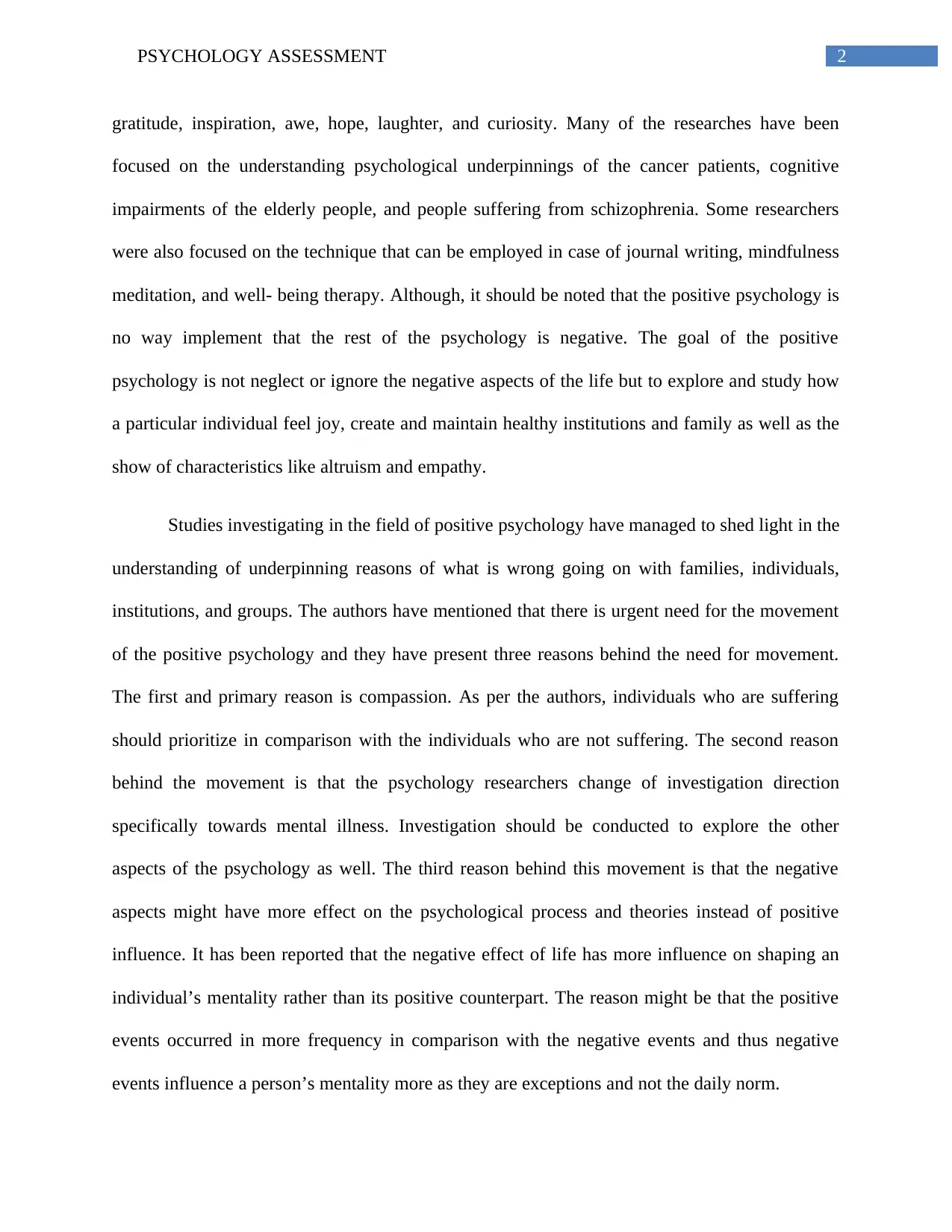
gratitude, inspiration, awe, hope, laughter, and curiosity. Many of the researches have been
focused on the understanding psychological underpinnings of the cancer patients, cognitive
impairments of the elderly people, and people suffering from schizophrenia. Some researchers
were also focused on the technique that can be employed in case of journal writing, mindfulness
meditation, and well- being therapy. Although, it should be noted that the positive psychology is
no way implement that the rest of the psychology is negative. The goal of the positive
psychology is not neglect or ignore the negative aspects of the life but to explore and study how
a particular individual feel joy, create and maintain healthy institutions and family as well as the
show of characteristics like altruism and empathy.
Studies investigating in the field of positive psychology have managed to shed light in the
understanding of underpinning reasons of what is wrong going on with families, individuals,
institutions, and groups. The authors have mentioned that there is urgent need for the movement
of the positive psychology and they have present three reasons behind the need for movement.
The first and primary reason is compassion. As per the authors, individuals who are suffering
should prioritize in comparison with the individuals who are not suffering. The second reason
behind the movement is that the psychology researchers change of investigation direction
specifically towards mental illness. Investigation should be conducted to explore the other
aspects of the psychology as well. The third reason behind this movement is that the negative
aspects might have more effect on the psychological process and theories instead of positive
influence. It has been reported that the negative effect of life has more influence on shaping an
individual’s mentality rather than its positive counterpart. The reason might be that the positive
events occurred in more frequency in comparison with the negative events and thus negative
events influence a person’s mentality more as they are exceptions and not the daily norm.
gratitude, inspiration, awe, hope, laughter, and curiosity. Many of the researches have been
focused on the understanding psychological underpinnings of the cancer patients, cognitive
impairments of the elderly people, and people suffering from schizophrenia. Some researchers
were also focused on the technique that can be employed in case of journal writing, mindfulness
meditation, and well- being therapy. Although, it should be noted that the positive psychology is
no way implement that the rest of the psychology is negative. The goal of the positive
psychology is not neglect or ignore the negative aspects of the life but to explore and study how
a particular individual feel joy, create and maintain healthy institutions and family as well as the
show of characteristics like altruism and empathy.
Studies investigating in the field of positive psychology have managed to shed light in the
understanding of underpinning reasons of what is wrong going on with families, individuals,
institutions, and groups. The authors have mentioned that there is urgent need for the movement
of the positive psychology and they have present three reasons behind the need for movement.
The first and primary reason is compassion. As per the authors, individuals who are suffering
should prioritize in comparison with the individuals who are not suffering. The second reason
behind the movement is that the psychology researchers change of investigation direction
specifically towards mental illness. Investigation should be conducted to explore the other
aspects of the psychology as well. The third reason behind this movement is that the negative
aspects might have more effect on the psychological process and theories instead of positive
influence. It has been reported that the negative effect of life has more influence on shaping an
individual’s mentality rather than its positive counterpart. The reason might be that the positive
events occurred in more frequency in comparison with the negative events and thus negative
events influence a person’s mentality more as they are exceptions and not the daily norm.
⊘ This is a preview!⊘
Do you want full access?
Subscribe today to unlock all pages.

Trusted by 1+ million students worldwide

3PSYCHOLOGY ASSESSMENT
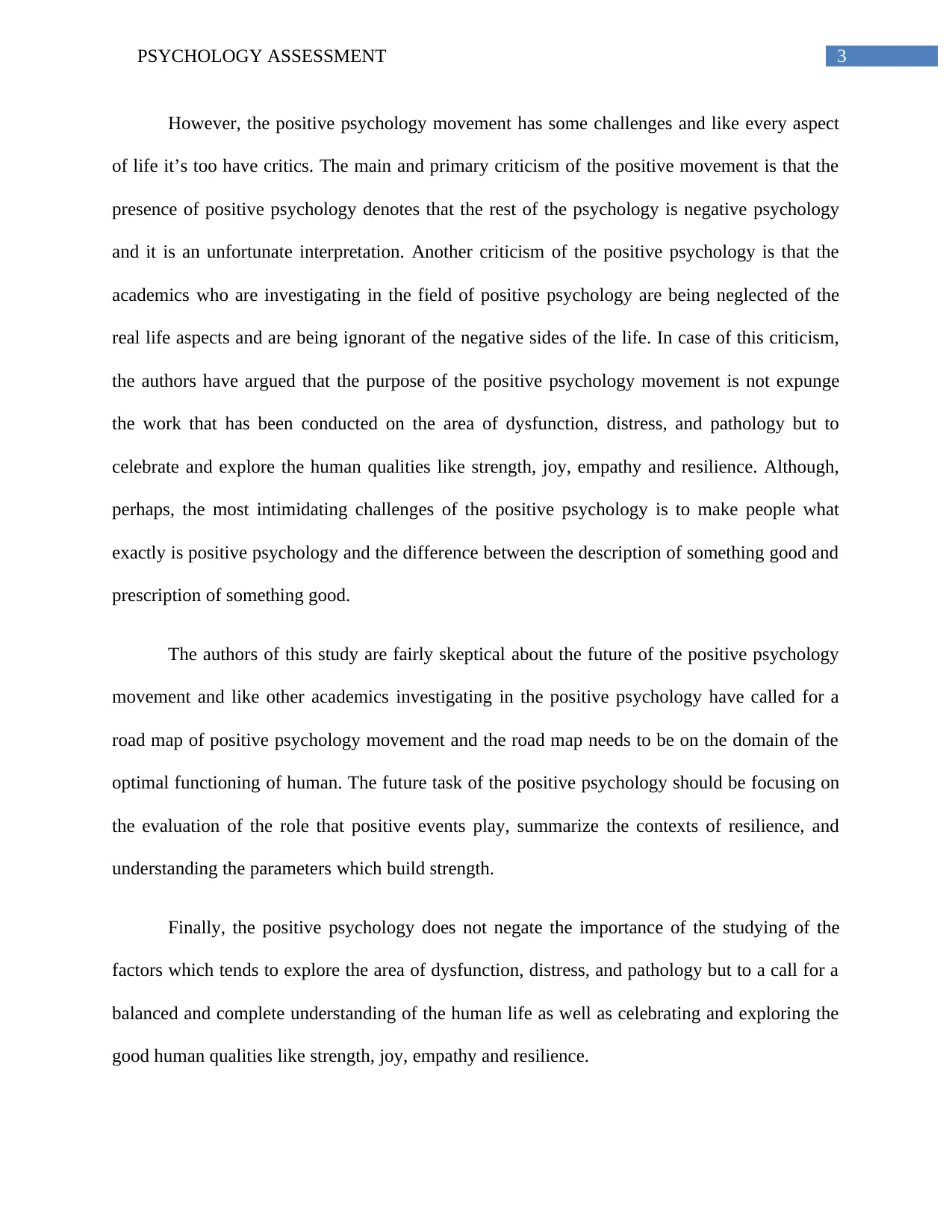
However, the positive psychology movement has some challenges and like every aspect
of life it’s too have critics. The main and primary criticism of the positive movement is that the
presence of positive psychology denotes that the rest of the psychology is negative psychology
and it is an unfortunate interpretation. Another criticism of the positive psychology is that the
academics who are investigating in the field of positive psychology are being neglected of the
real life aspects and are being ignorant of the negative sides of the life. In case of this criticism,
the authors have argued that the purpose of the positive psychology movement is not expunge
the work that has been conducted on the area of dysfunction, distress, and pathology but to
celebrate and explore the human qualities like strength, joy, empathy and resilience. Although,
perhaps, the most intimidating challenges of the positive psychology is to make people what
exactly is positive psychology and the difference between the description of something good and
prescription of something good.
The authors of this study are fairly skeptical about the future of the positive psychology
movement and like other academics investigating in the positive psychology have called for a
road map of positive psychology movement and the road map needs to be on the domain of the
optimal functioning of human. The future task of the positive psychology should be focusing on
the evaluation of the role that positive events play, summarize the contexts of resilience, and
understanding the parameters which build strength.
Finally, the positive psychology does not negate the importance of the studying of the
factors which tends to explore the area of dysfunction, distress, and pathology but to a call for a
balanced and complete understanding of the human life as well as celebrating and exploring the
good human qualities like strength, joy, empathy and resilience.
However, the positive psychology movement has some challenges and like every aspect
of life it’s too have critics. The main and primary criticism of the positive movement is that the
presence of positive psychology denotes that the rest of the psychology is negative psychology
and it is an unfortunate interpretation. Another criticism of the positive psychology is that the
academics who are investigating in the field of positive psychology are being neglected of the
real life aspects and are being ignorant of the negative sides of the life. In case of this criticism,
the authors have argued that the purpose of the positive psychology movement is not expunge
the work that has been conducted on the area of dysfunction, distress, and pathology but to
celebrate and explore the human qualities like strength, joy, empathy and resilience. Although,
perhaps, the most intimidating challenges of the positive psychology is to make people what
exactly is positive psychology and the difference between the description of something good and
prescription of something good.
The authors of this study are fairly skeptical about the future of the positive psychology
movement and like other academics investigating in the positive psychology have called for a
road map of positive psychology movement and the road map needs to be on the domain of the
optimal functioning of human. The future task of the positive psychology should be focusing on
the evaluation of the role that positive events play, summarize the contexts of resilience, and
understanding the parameters which build strength.
Finally, the positive psychology does not negate the importance of the studying of the
factors which tends to explore the area of dysfunction, distress, and pathology but to a call for a
balanced and complete understanding of the human life as well as celebrating and exploring the
good human qualities like strength, joy, empathy and resilience.
Paraphrase This Document
Need a fresh take? Get an instant paraphrase of this document with our AI Paraphraser

4PSYCHOLOGY ASSESSMENT
Bibliography:
Gable, S. L., & Haidt, J. (2005). What (and why) is positive psychology?. Review of general
psychology, 9(2), 103-110.
Bibliography:
Gable, S. L., & Haidt, J. (2005). What (and why) is positive psychology?. Review of general
psychology, 9(2), 103-110.
1 out of 5
Related Documents
Your All-in-One AI-Powered Toolkit for Academic Success.
+13062052269
info@desklib.com
Available 24*7 on WhatsApp / Email
Unlock your academic potential
Copyright © 2020–2025 A2Z Services. All Rights Reserved. Developed and managed by ZUCOL.