University of East London: SY4015 Psychology Self Reflexive Commentary

Verified

Added on  2022/08/17

|6
|907
|28
Homework Assignment
AI Summary
This assignment is a self-reflexive commentary on a case study of a child, Omari, focusing on psychosocial work within a community setting. It explores the difficulties faced by Omari, particularly social isolation, and identifies his needs, such as proper care and support. The assignment analyzes Omari's strengths, including his enjoyment of creative activities, and identifies potential vulnerabilities and risks, such as separation anxiety. It then discusses how to establish rapport and maintain professional boundaries with service users, emphasizing the importance of horizontal communication and ethical considerations. The commentary also reflects on the author's personal similarities and differences with the case, and how these might impact the relationship with the service user. The assignment references relevant literature to support its analysis and recommendations.
Document Page
Running head: PSYCHOLOGY
Self Reflexive Commentary
Name of the Student:
Name of the University:
Author’s Note:
tabler-icon-diamond-filled.svg

Paraphrase This Document

Need a fresh take? Get an instant paraphrase of this document with our AI Paraphraser
Document Page
2SELF REFLEXIVE COMMENTRY
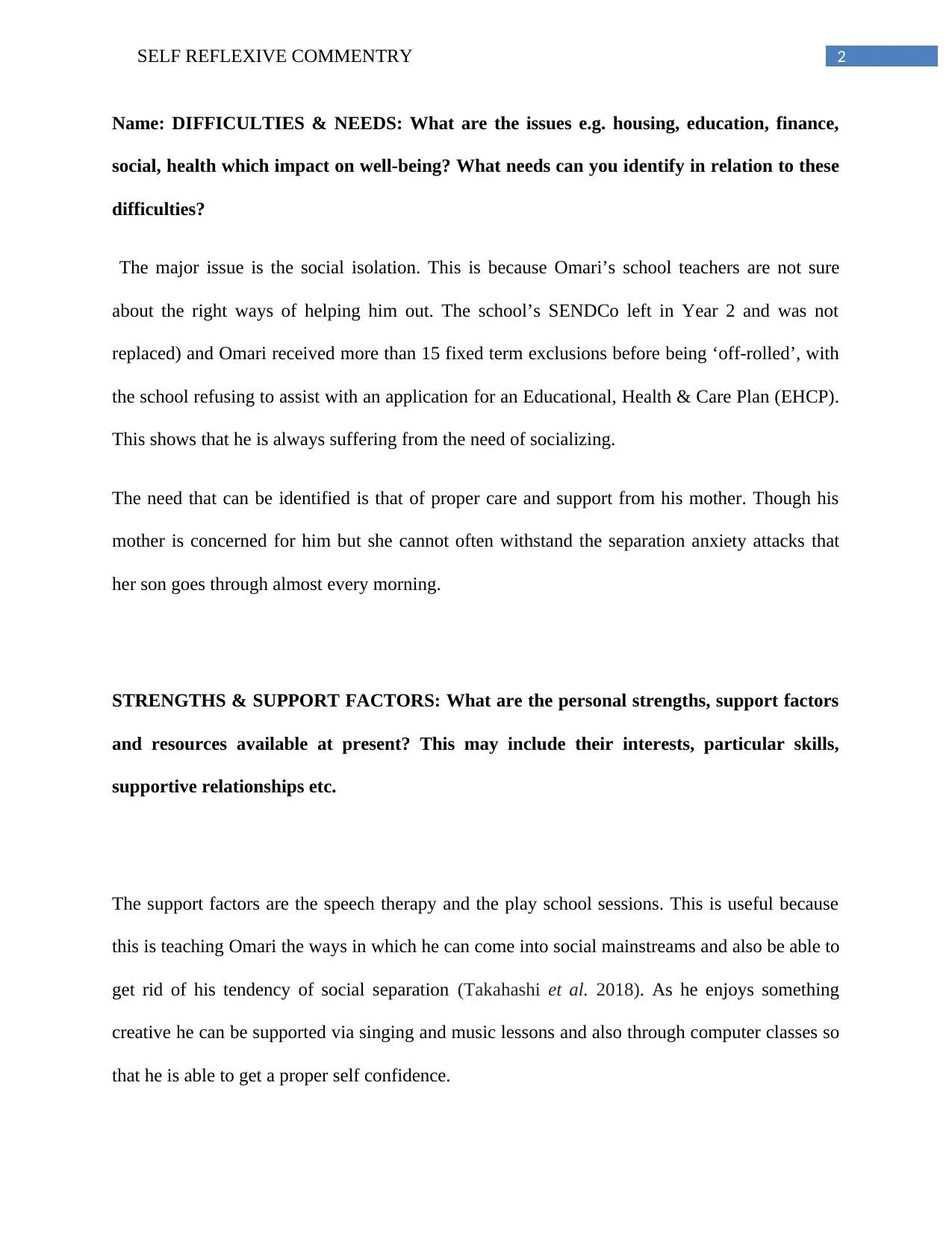
Name: DIFFICULTIES & NEEDS: What are the issues e.g. housing, education, finance,
social, health which impact on well-being? What needs can you identify in relation to these
difficulties?
The major issue is the social isolation. This is because Omari’s school teachers are not sure
about the right ways of helping him out. The school’s SENDCo left in Year 2 and was not
replaced) and Omari received more than 15 fixed term exclusions before being ‘off-rolled’, with
the school refusing to assist with an application for an Educational, Health & Care Plan (EHCP).
This shows that he is always suffering from the need of socializing.
The need that can be identified is that of proper care and support from his mother. Though his
mother is concerned for him but she cannot often withstand the separation anxiety attacks that
her son goes through almost every morning.
STRENGTHS & SUPPORT FACTORS: What are the personal strengths, support factors
and resources available at present? This may include their interests, particular skills,
supportive relationships etc.
The support factors are the speech therapy and the play school sessions. This is useful because
this is teaching Omari the ways in which he can come into social mainstreams and also be able to
get rid of his tendency of social separation (Takahashi et al. 2018). As he enjoys something
creative he can be supported via singing and music lessons and also through computer classes so
that he is able to get a proper self confidence.
Document Page
3SELF REFLEXIVE COMMENTRY
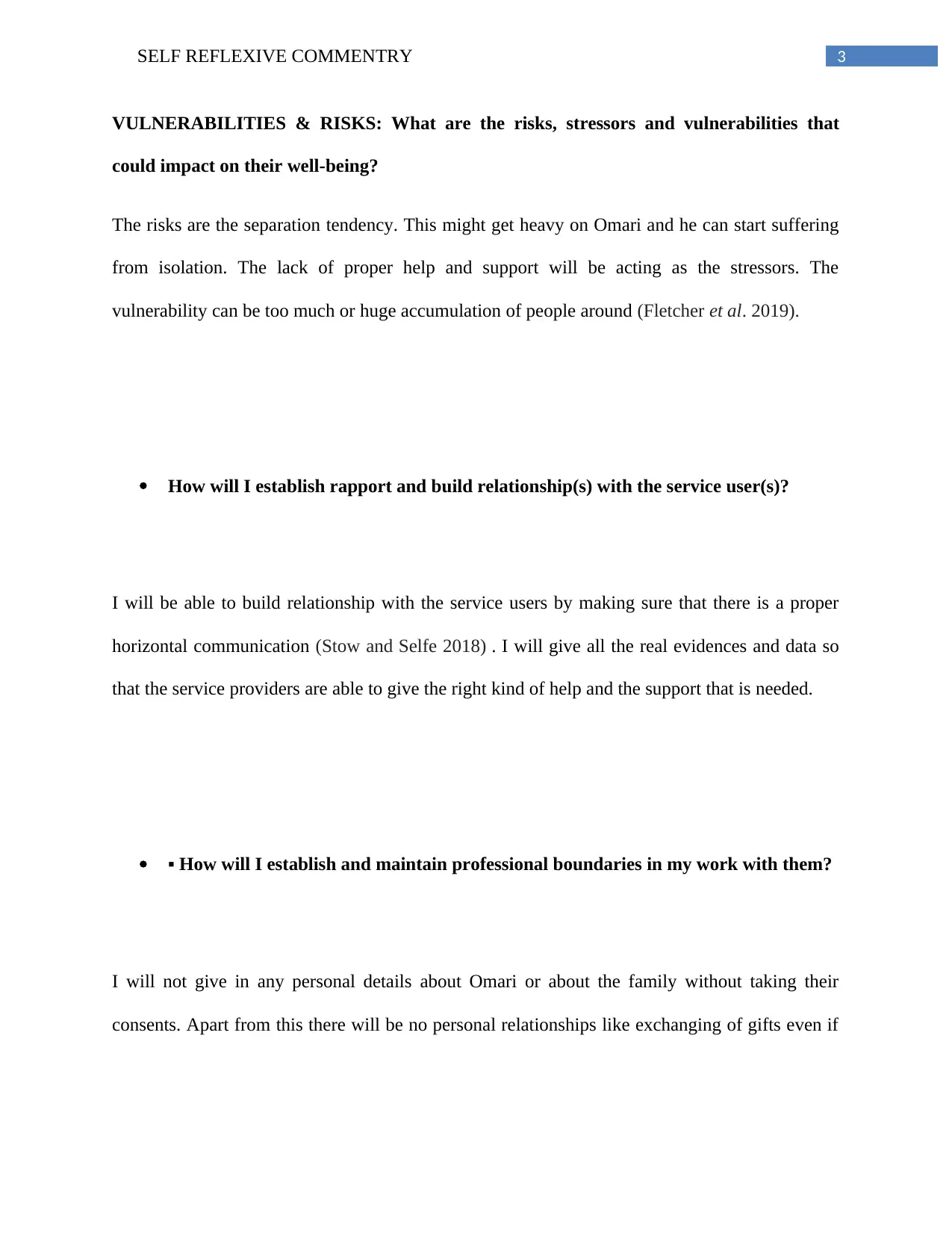
VULNERABILITIES & RISKS: What are the risks, stressors and vulnerabilities that
could impact on their well-being?
The risks are the separation tendency. This might get heavy on Omari and he can start suffering
from isolation. The lack of proper help and support will be acting as the stressors. The
vulnerability can be too much or huge accumulation of people around (Fletcher et al. 2019).
How will I establish rapport and build relationship(s) with the service user(s)?
I will be able to build relationship with the service users by making sure that there is a proper
horizontal communication (Stow and Selfe 2018) . I will give all the real evidences and data so
that the service providers are able to give the right kind of help and the support that is needed.
▪ How will I establish and maintain professional boundaries in my work with them?
I will not give in any personal details about Omari or about the family without taking their
consents. Apart from this there will be no personal relationships like exchanging of gifts even if
Document Page
4SELF REFLEXIVE COMMENTRY
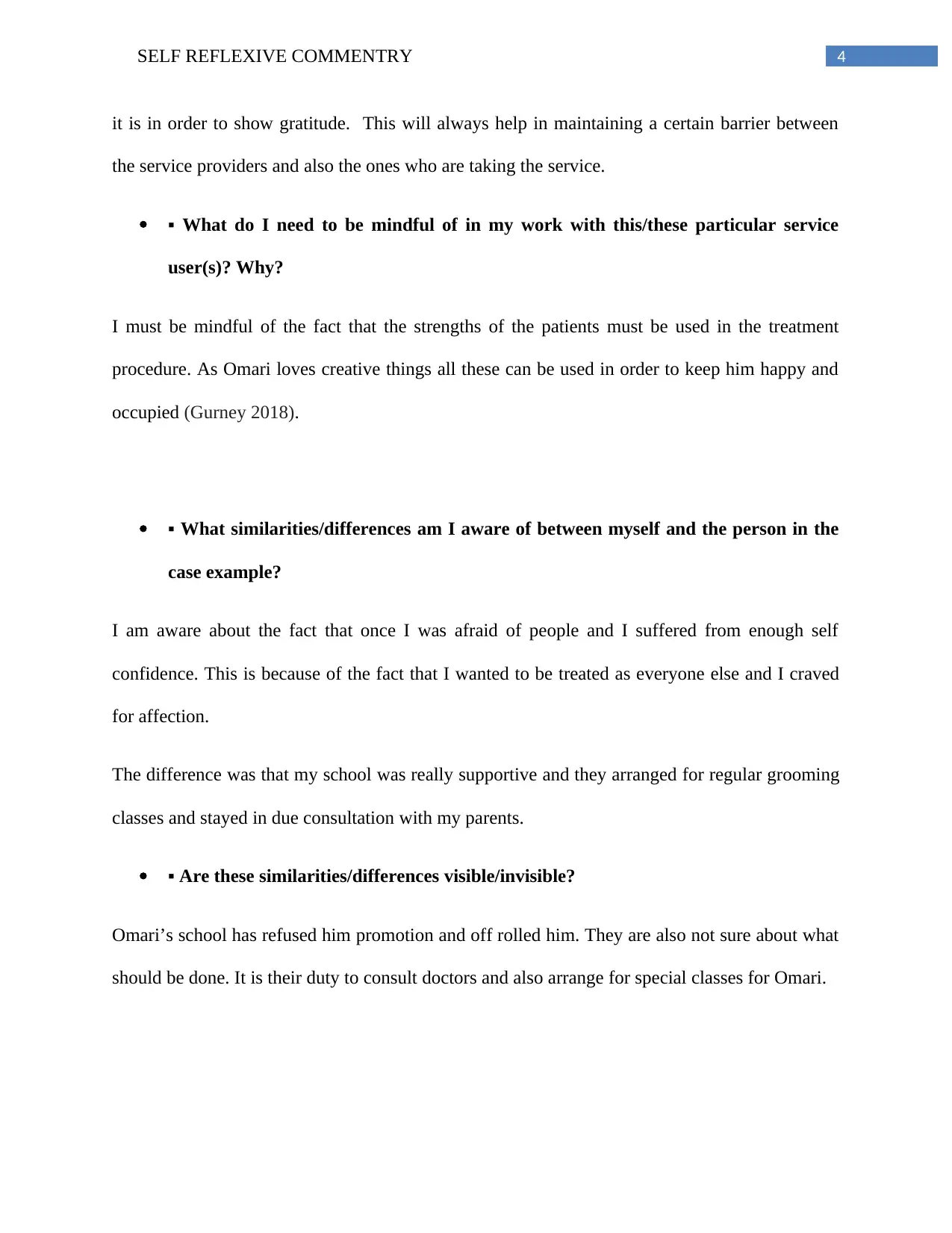
it is in order to show gratitude. This will always help in maintaining a certain barrier between
the service providers and also the ones who are taking the service.
▪ What do I need to be mindful of in my work with this/these particular service
user(s)? Why?
I must be mindful of the fact that the strengths of the patients must be used in the treatment
procedure. As Omari loves creative things all these can be used in order to keep him happy and
occupied (Gurney 2018).
▪ What similarities/differences am I aware of between myself and the person in the
case example?
I am aware about the fact that once I was afraid of people and I suffered from enough self
confidence. This is because of the fact that I wanted to be treated as everyone else and I craved
for affection.
The difference was that my school was really supportive and they arranged for regular grooming
classes and stayed in due consultation with my parents.
▪ Are these similarities/differences visible/invisible?
Omari’s school has refused him promotion and off rolled him. They are also not sure about what
should be done. It is their duty to consult doctors and also arrange for special classes for Omari.
tabler-icon-diamond-filled.svg

Paraphrase This Document

Need a fresh take? Get an instant paraphrase of this document with our AI Paraphraser
Document Page
5SELF REFLEXIVE COMMENTRY
▪ How might these similarities/differences impact on my relationship with the
service user(s) and the work?
I feel that this will help me to develop my relationship with the service users as I will be able to
give them moral support at every step.
Document Page
6SELF REFLEXIVE COMMENTRY
References
Fletcher, T.S., Sherman, M.L., Lawrence, J.M. and Parrish, J.L., 2019. Serving theatregoing
children with special needs: Implications for inter-professional collaboration. Youth Theatre
Journal, pp.1-12.
Gurney, P.W., 2018. Self-esteem in children with special educational needs. Routledge.
Stow, L. and Selfe, L., 2018. Understanding children with special needs. Routledge.
Takahashi, I., Oki, M., Bourreau, B., Kitahara, I. and Suzuki, K., 2018. FUTUREGYM: A
gymnasium with interactive floor projection for children with special needs. International
Journal of Child-Computer Interaction, 15, pp.37-47.
chevron_up_icon
1 out of 6
circle_padding
hide_on_mobile
zoom_out_icon
[object Object]