Psychology Discussion 3: Transgender Inmates & Risk Factors
VerifiedAdded on 2022/07/27
|6
|1266
|22
Discussion Board Post
AI Summary
This psychology discussion delves into several key areas. Section A explores learning disabilities, their neurological basis, and their impact on behavior, including a discussion on the higher prevalence of learning disabilities in offender populations. It also examines the three categories of ADHD (combined, impulsive/hyperactive, and inattentive), their effects on the brain, and the role of neurotransmitters and brain regions. Furthermore, it analyzes Prendergast's coping patterns for children who have experienced sexual abuse, differentiating between active-cognitive, active-behavioral, and avoidant strategies, and discusses factors for assessing the risk of re-offending in adolescents who sexually harm. Section B focuses on the challenges faced by correctional staff when dealing with transgender inmates, specifically addressing victimization risks, classification issues, and medical concerns, including the lack of specific policies. The discussion also emphasizes the importance of assessing these risk factors for offender and prison unit safety and for making recommendations for resources and support to ensure a secure environment for all inmates. The assignment references several research papers and reports to support its arguments.

Running head: DISCUSSION 1
Discussion
Name
Institutional Affiliation
Discussion
Name
Institutional Affiliation
Paraphrase This Document
Need a fresh take? Get an instant paraphrase of this document with our AI Paraphraser

DISCUSSION 2
DISCUSSION
SECTION A
Q1: a. Learning disability:
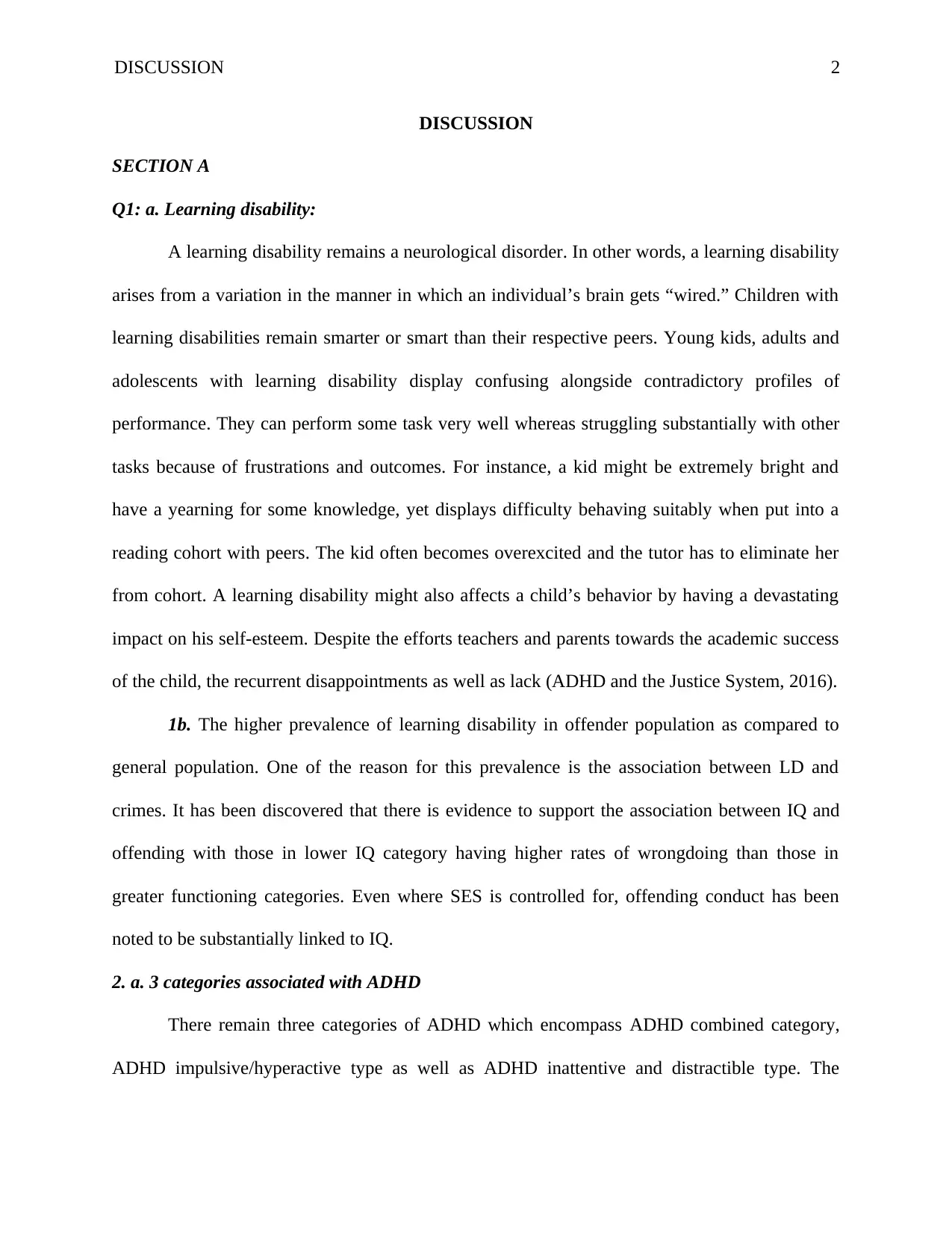
A learning disability remains a neurological disorder. In other words, a learning disability
arises from a variation in the manner in which an individual’s brain gets “wired.” Children with
learning disabilities remain smarter or smart than their respective peers. Young kids, adults and
adolescents with learning disability display confusing alongside contradictory profiles of
performance. They can perform some task very well whereas struggling substantially with other
tasks because of frustrations and outcomes. For instance, a kid might be extremely bright and
have a yearning for some knowledge, yet displays difficulty behaving suitably when put into a
reading cohort with peers. The kid often becomes overexcited and the tutor has to eliminate her
from cohort. A learning disability might also affects a child’s behavior by having a devastating
impact on his self-esteem. Despite the efforts teachers and parents towards the academic success
of the child, the recurrent disappointments as well as lack (ADHD and the Justice System, 2016).
1b. The higher prevalence of learning disability in offender population as compared to
general population. One of the reason for this prevalence is the association between LD and
crimes. It has been discovered that there is evidence to support the association between IQ and
offending with those in lower IQ category having higher rates of wrongdoing than those in
greater functioning categories. Even where SES is controlled for, offending conduct has been
noted to be substantially linked to IQ.
2. a. 3 categories associated with ADHD
There remain three categories of ADHD which encompass ADHD combined category,
ADHD impulsive/hyperactive type as well as ADHD inattentive and distractible type. The
DISCUSSION
SECTION A
Q1: a. Learning disability:
A learning disability remains a neurological disorder. In other words, a learning disability
arises from a variation in the manner in which an individual’s brain gets “wired.” Children with
learning disabilities remain smarter or smart than their respective peers. Young kids, adults and
adolescents with learning disability display confusing alongside contradictory profiles of
performance. They can perform some task very well whereas struggling substantially with other
tasks because of frustrations and outcomes. For instance, a kid might be extremely bright and
have a yearning for some knowledge, yet displays difficulty behaving suitably when put into a
reading cohort with peers. The kid often becomes overexcited and the tutor has to eliminate her
from cohort. A learning disability might also affects a child’s behavior by having a devastating
impact on his self-esteem. Despite the efforts teachers and parents towards the academic success
of the child, the recurrent disappointments as well as lack (ADHD and the Justice System, 2016).
1b. The higher prevalence of learning disability in offender population as compared to
general population. One of the reason for this prevalence is the association between LD and
crimes. It has been discovered that there is evidence to support the association between IQ and
offending with those in lower IQ category having higher rates of wrongdoing than those in
greater functioning categories. Even where SES is controlled for, offending conduct has been
noted to be substantially linked to IQ.
2. a. 3 categories associated with ADHD
There remain three categories of ADHD which encompass ADHD combined category,
ADHD impulsive/hyperactive type as well as ADHD inattentive and distractible type. The

DISCUSSION 3
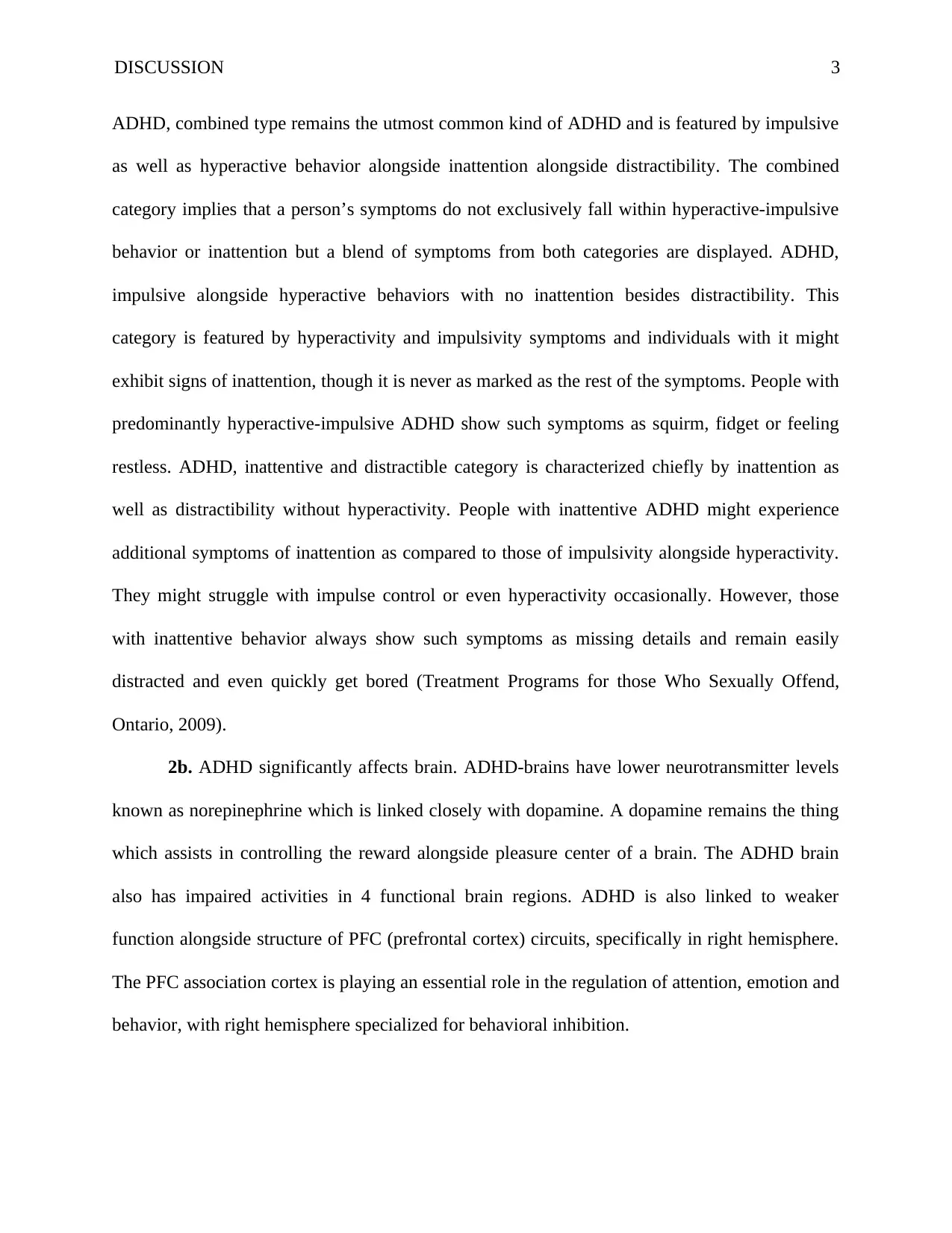
ADHD, combined type remains the utmost common kind of ADHD and is featured by impulsive
as well as hyperactive behavior alongside inattention alongside distractibility. The combined
category implies that a person’s symptoms do not exclusively fall within hyperactive-impulsive
behavior or inattention but a blend of symptoms from both categories are displayed. ADHD,
impulsive alongside hyperactive behaviors with no inattention besides distractibility. This
category is featured by hyperactivity and impulsivity symptoms and individuals with it might
exhibit signs of inattention, though it is never as marked as the rest of the symptoms. People with
predominantly hyperactive-impulsive ADHD show such symptoms as squirm, fidget or feeling
restless. ADHD, inattentive and distractible category is characterized chiefly by inattention as
well as distractibility without hyperactivity. People with inattentive ADHD might experience
additional symptoms of inattention as compared to those of impulsivity alongside hyperactivity.
They might struggle with impulse control or even hyperactivity occasionally. However, those
with inattentive behavior always show such symptoms as missing details and remain easily
distracted and even quickly get bored (Treatment Programs for those Who Sexually Offend,
Ontario, 2009).
2b. ADHD significantly affects brain. ADHD-brains have lower neurotransmitter levels
known as norepinephrine which is linked closely with dopamine. A dopamine remains the thing
which assists in controlling the reward alongside pleasure center of a brain. The ADHD brain
also has impaired activities in 4 functional brain regions. ADHD is also linked to weaker
function alongside structure of PFC (prefrontal cortex) circuits, specifically in right hemisphere.
The PFC association cortex is playing an essential role in the regulation of attention, emotion and
behavior, with right hemisphere specialized for behavioral inhibition.
ADHD, combined type remains the utmost common kind of ADHD and is featured by impulsive
as well as hyperactive behavior alongside inattention alongside distractibility. The combined
category implies that a person’s symptoms do not exclusively fall within hyperactive-impulsive
behavior or inattention but a blend of symptoms from both categories are displayed. ADHD,
impulsive alongside hyperactive behaviors with no inattention besides distractibility. This
category is featured by hyperactivity and impulsivity symptoms and individuals with it might
exhibit signs of inattention, though it is never as marked as the rest of the symptoms. People with
predominantly hyperactive-impulsive ADHD show such symptoms as squirm, fidget or feeling
restless. ADHD, inattentive and distractible category is characterized chiefly by inattention as
well as distractibility without hyperactivity. People with inattentive ADHD might experience
additional symptoms of inattention as compared to those of impulsivity alongside hyperactivity.
They might struggle with impulse control or even hyperactivity occasionally. However, those
with inattentive behavior always show such symptoms as missing details and remain easily
distracted and even quickly get bored (Treatment Programs for those Who Sexually Offend,
Ontario, 2009).
2b. ADHD significantly affects brain. ADHD-brains have lower neurotransmitter levels
known as norepinephrine which is linked closely with dopamine. A dopamine remains the thing
which assists in controlling the reward alongside pleasure center of a brain. The ADHD brain
also has impaired activities in 4 functional brain regions. ADHD is also linked to weaker
function alongside structure of PFC (prefrontal cortex) circuits, specifically in right hemisphere.
The PFC association cortex is playing an essential role in the regulation of attention, emotion and
behavior, with right hemisphere specialized for behavioral inhibition.
⊘ This is a preview!⊘
Do you want full access?
Subscribe today to unlock all pages.

Trusted by 1+ million students worldwide

DISCUSSION 4
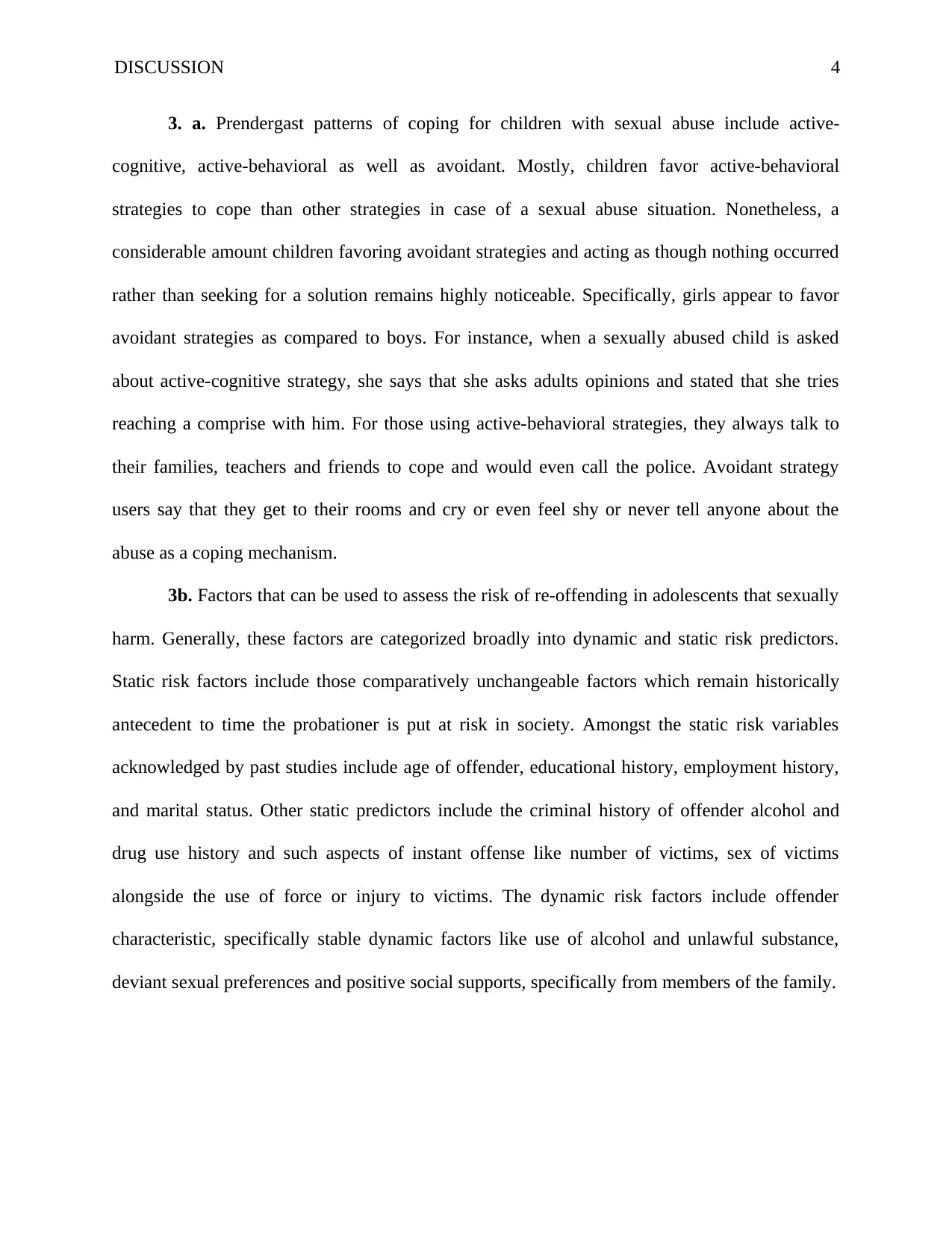
3. a. Prendergast patterns of coping for children with sexual abuse include active-
cognitive, active-behavioral as well as avoidant. Mostly, children favor active-behavioral
strategies to cope than other strategies in case of a sexual abuse situation. Nonetheless, a
considerable amount children favoring avoidant strategies and acting as though nothing occurred
rather than seeking for a solution remains highly noticeable. Specifically, girls appear to favor
avoidant strategies as compared to boys. For instance, when a sexually abused child is asked
about active-cognitive strategy, she says that she asks adults opinions and stated that she tries
reaching a comprise with him. For those using active-behavioral strategies, they always talk to
their families, teachers and friends to cope and would even call the police. Avoidant strategy
users say that they get to their rooms and cry or even feel shy or never tell anyone about the
abuse as a coping mechanism.
3b. Factors that can be used to assess the risk of re-offending in adolescents that sexually
harm. Generally, these factors are categorized broadly into dynamic and static risk predictors.
Static risk factors include those comparatively unchangeable factors which remain historically
antecedent to time the probationer is put at risk in society. Amongst the static risk variables
acknowledged by past studies include age of offender, educational history, employment history,
and marital status. Other static predictors include the criminal history of offender alcohol and
drug use history and such aspects of instant offense like number of victims, sex of victims
alongside the use of force or injury to victims. The dynamic risk factors include offender
characteristic, specifically stable dynamic factors like use of alcohol and unlawful substance,
deviant sexual preferences and positive social supports, specifically from members of the family.
3. a. Prendergast patterns of coping for children with sexual abuse include active-
cognitive, active-behavioral as well as avoidant. Mostly, children favor active-behavioral
strategies to cope than other strategies in case of a sexual abuse situation. Nonetheless, a
considerable amount children favoring avoidant strategies and acting as though nothing occurred
rather than seeking for a solution remains highly noticeable. Specifically, girls appear to favor
avoidant strategies as compared to boys. For instance, when a sexually abused child is asked
about active-cognitive strategy, she says that she asks adults opinions and stated that she tries
reaching a comprise with him. For those using active-behavioral strategies, they always talk to
their families, teachers and friends to cope and would even call the police. Avoidant strategy
users say that they get to their rooms and cry or even feel shy or never tell anyone about the
abuse as a coping mechanism.
3b. Factors that can be used to assess the risk of re-offending in adolescents that sexually
harm. Generally, these factors are categorized broadly into dynamic and static risk predictors.
Static risk factors include those comparatively unchangeable factors which remain historically
antecedent to time the probationer is put at risk in society. Amongst the static risk variables
acknowledged by past studies include age of offender, educational history, employment history,
and marital status. Other static predictors include the criminal history of offender alcohol and
drug use history and such aspects of instant offense like number of victims, sex of victims
alongside the use of force or injury to victims. The dynamic risk factors include offender
characteristic, specifically stable dynamic factors like use of alcohol and unlawful substance,
deviant sexual preferences and positive social supports, specifically from members of the family.
Paraphrase This Document
Need a fresh take? Get an instant paraphrase of this document with our AI Paraphraser

DISCUSSION 5
SECTION B:
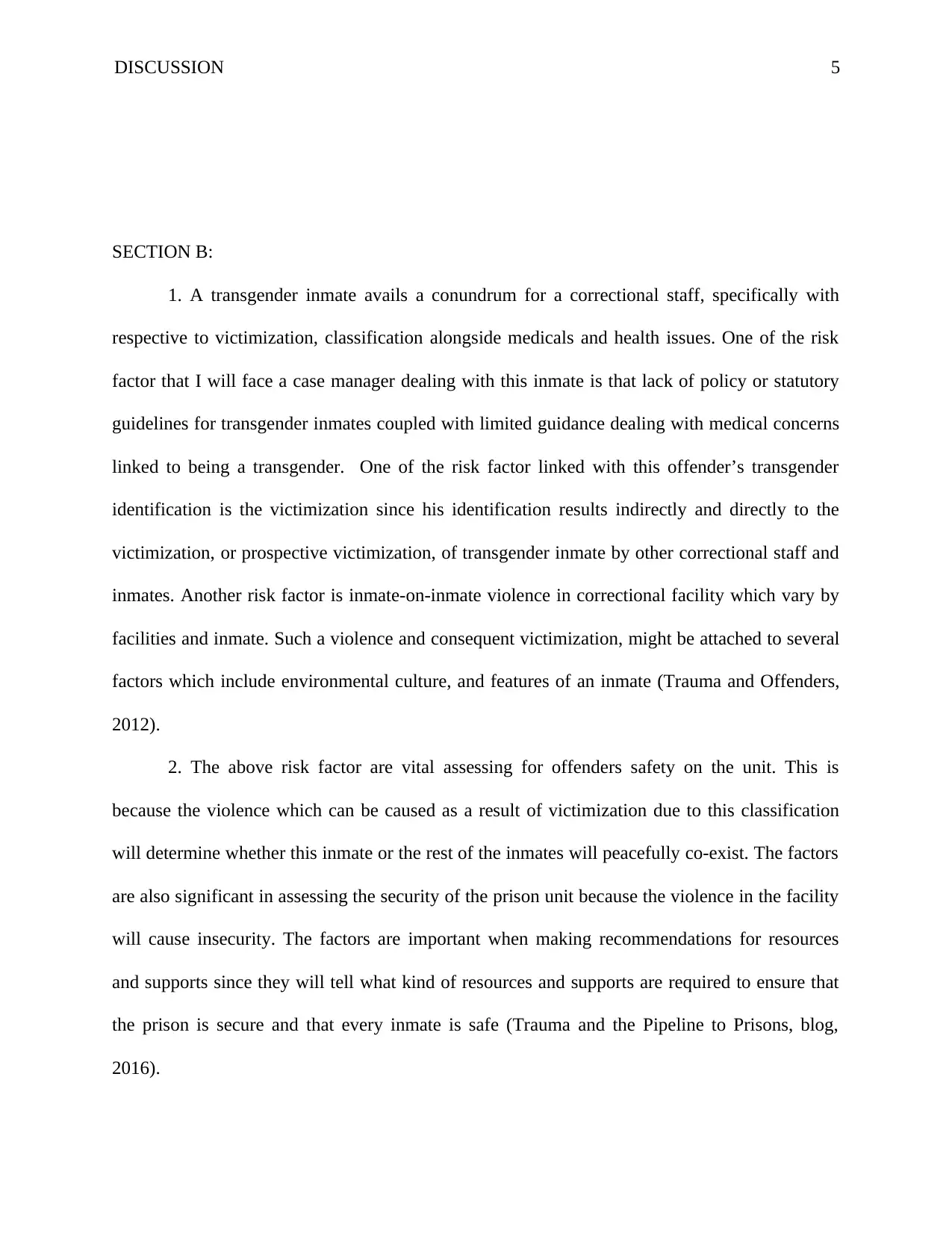
1. A transgender inmate avails a conundrum for a correctional staff, specifically with
respective to victimization, classification alongside medicals and health issues. One of the risk
factor that I will face a case manager dealing with this inmate is that lack of policy or statutory
guidelines for transgender inmates coupled with limited guidance dealing with medical concerns
linked to being a transgender. One of the risk factor linked with this offender’s transgender
identification is the victimization since his identification results indirectly and directly to the
victimization, or prospective victimization, of transgender inmate by other correctional staff and
inmates. Another risk factor is inmate-on-inmate violence in correctional facility which vary by
facilities and inmate. Such a violence and consequent victimization, might be attached to several
factors which include environmental culture, and features of an inmate (Trauma and Offenders,
2012).
2. The above risk factor are vital assessing for offenders safety on the unit. This is
because the violence which can be caused as a result of victimization due to this classification
will determine whether this inmate or the rest of the inmates will peacefully co-exist. The factors
are also significant in assessing the security of the prison unit because the violence in the facility
will cause insecurity. The factors are important when making recommendations for resources
and supports since they will tell what kind of resources and supports are required to ensure that
the prison is secure and that every inmate is safe (Trauma and the Pipeline to Prisons, blog,
2016).
SECTION B:
1. A transgender inmate avails a conundrum for a correctional staff, specifically with
respective to victimization, classification alongside medicals and health issues. One of the risk
factor that I will face a case manager dealing with this inmate is that lack of policy or statutory
guidelines for transgender inmates coupled with limited guidance dealing with medical concerns
linked to being a transgender. One of the risk factor linked with this offender’s transgender
identification is the victimization since his identification results indirectly and directly to the
victimization, or prospective victimization, of transgender inmate by other correctional staff and
inmates. Another risk factor is inmate-on-inmate violence in correctional facility which vary by
facilities and inmate. Such a violence and consequent victimization, might be attached to several
factors which include environmental culture, and features of an inmate (Trauma and Offenders,
2012).
2. The above risk factor are vital assessing for offenders safety on the unit. This is
because the violence which can be caused as a result of victimization due to this classification
will determine whether this inmate or the rest of the inmates will peacefully co-exist. The factors
are also significant in assessing the security of the prison unit because the violence in the facility
will cause insecurity. The factors are important when making recommendations for resources
and supports since they will tell what kind of resources and supports are required to ensure that
the prison is secure and that every inmate is safe (Trauma and the Pipeline to Prisons, blog,
2016).

DISCUSSION 6
References
Trauma and Offenders, 2012: https://www.ncbi.nlm.nih.gov/pmc/articles/PMC/pdf/EJPT-3-.pdf
Trauma and the Pipeline to Prisons, blog, 2016: https://www.acesconnection.com/g/aces-in-
criminal-justice/blog/pipeline-to-prison-may-start-with-childhood-trauma
ADHD and the Justice System,
2016: http://www.caddac.ca/2016/CADDAC_ADHDintheJusticeSystem_
%20FINALOct.pdf
Treatment Programs for those Who Sexually Offend, Ontario, 2009:
https://www.attorneygeneral.jus.gov.on.ca/inquiries/cornwall/en/report/
research_papers/Action_RP/
1_Cornwall_Community_Hospital_Assault_and_Sexual_Abuse_Program_en.pdf
References
Trauma and Offenders, 2012: https://www.ncbi.nlm.nih.gov/pmc/articles/PMC/pdf/EJPT-3-.pdf
Trauma and the Pipeline to Prisons, blog, 2016: https://www.acesconnection.com/g/aces-in-
criminal-justice/blog/pipeline-to-prison-may-start-with-childhood-trauma
ADHD and the Justice System,
2016: http://www.caddac.ca/2016/CADDAC_ADHDintheJusticeSystem_
%20FINALOct.pdf
Treatment Programs for those Who Sexually Offend, Ontario, 2009:
https://www.attorneygeneral.jus.gov.on.ca/inquiries/cornwall/en/report/
research_papers/Action_RP/
1_Cornwall_Community_Hospital_Assault_and_Sexual_Abuse_Program_en.pdf
⊘ This is a preview!⊘
Do you want full access?
Subscribe today to unlock all pages.

Trusted by 1+ million students worldwide
1 out of 6
Your All-in-One AI-Powered Toolkit for Academic Success.
+13062052269
info@desklib.com
Available 24*7 on WhatsApp / Email
Unlock your academic potential
Copyright © 2020–2026 A2Z Services. All Rights Reserved. Developed and managed by ZUCOL.