Case Study: Analyzing Zoe's Development Using Two Theories
VerifiedAdded on 2023/04/25
|9
|1972
|259
Case Study
AI Summary
This case study analyzes the situation of an 8-year-old girl named Zoe, who is struggling to adjust to a new school and environment after her family's relocation. The assignment applies two prominent developmental theories: Jean Piaget's Concrete Operational stage and Erik Erikson's Industry vs. Inferiority stage, to understand Zoe's behaviors, thoughts, and their impact on her mental health and well-being. The analysis explores how Zoe's logical thinking, concerns about social perception, and feelings of inadequacy are related to these developmental stages. The study also discusses intervention strategies, such as empathetic communication and establishing realistic academic goals, to support Zoe's emotional and social development. The assignment uses scholarly articles to support its analysis and provides a conclusion on the interplay of significant life events and developmental stages in children.
Running head: APPLICATION OF DEVELOPMENTAL THEORIES
APPLICATION OF DEVELOPMENTAL THEORIES
Name of the Student:
Name of the University:
Author note:
APPLICATION OF DEVELOPMENTAL THEORIES
Name of the Student:
Name of the University:
Author note:

Paraphrase This Document
Need a fresh take? Get an instant paraphrase of this document with our AI Paraphraser
1APPLICATION OF DEVELOPMENTAL THEORIES
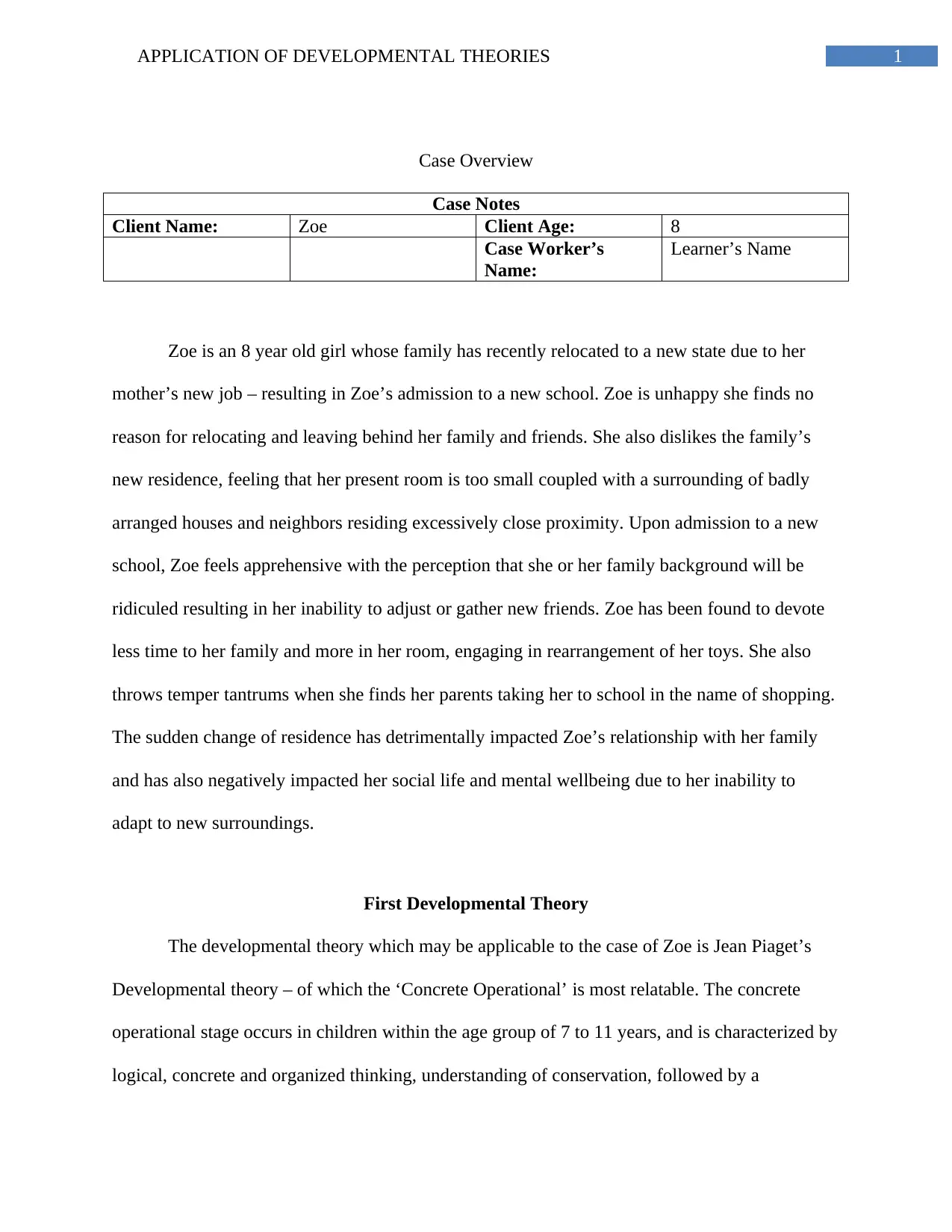
Case Overview
Case Notes
Client Name: Zoe Client Age: 8
Case Worker’s
Name:
Learner’s Name
Zoe is an 8 year old girl whose family has recently relocated to a new state due to her
mother’s new job – resulting in Zoe’s admission to a new school. Zoe is unhappy she finds no
reason for relocating and leaving behind her family and friends. She also dislikes the family’s
new residence, feeling that her present room is too small coupled with a surrounding of badly
arranged houses and neighbors residing excessively close proximity. Upon admission to a new
school, Zoe feels apprehensive with the perception that she or her family background will be
ridiculed resulting in her inability to adjust or gather new friends. Zoe has been found to devote
less time to her family and more in her room, engaging in rearrangement of her toys. She also
throws temper tantrums when she finds her parents taking her to school in the name of shopping.
The sudden change of residence has detrimentally impacted Zoe’s relationship with her family
and has also negatively impacted her social life and mental wellbeing due to her inability to
adapt to new surroundings.
First Developmental Theory
The developmental theory which may be applicable to the case of Zoe is Jean Piaget’s
Developmental theory – of which the ‘Concrete Operational’ is most relatable. The concrete
operational stage occurs in children within the age group of 7 to 11 years, and is characterized by
logical, concrete and organized thinking, understanding of conservation, followed by a
Case Overview
Case Notes
Client Name: Zoe Client Age: 8
Case Worker’s
Name:
Learner’s Name
Zoe is an 8 year old girl whose family has recently relocated to a new state due to her
mother’s new job – resulting in Zoe’s admission to a new school. Zoe is unhappy she finds no
reason for relocating and leaving behind her family and friends. She also dislikes the family’s
new residence, feeling that her present room is too small coupled with a surrounding of badly
arranged houses and neighbors residing excessively close proximity. Upon admission to a new
school, Zoe feels apprehensive with the perception that she or her family background will be
ridiculed resulting in her inability to adjust or gather new friends. Zoe has been found to devote
less time to her family and more in her room, engaging in rearrangement of her toys. She also
throws temper tantrums when she finds her parents taking her to school in the name of shopping.
The sudden change of residence has detrimentally impacted Zoe’s relationship with her family
and has also negatively impacted her social life and mental wellbeing due to her inability to
adapt to new surroundings.
First Developmental Theory
The developmental theory which may be applicable to the case of Zoe is Jean Piaget’s
Developmental theory – of which the ‘Concrete Operational’ is most relatable. The concrete
operational stage occurs in children within the age group of 7 to 11 years, and is characterized by
logical, concrete and organized thinking, understanding of conservation, followed by a
2APPLICATION OF DEVELOPMENTAL THEORIES
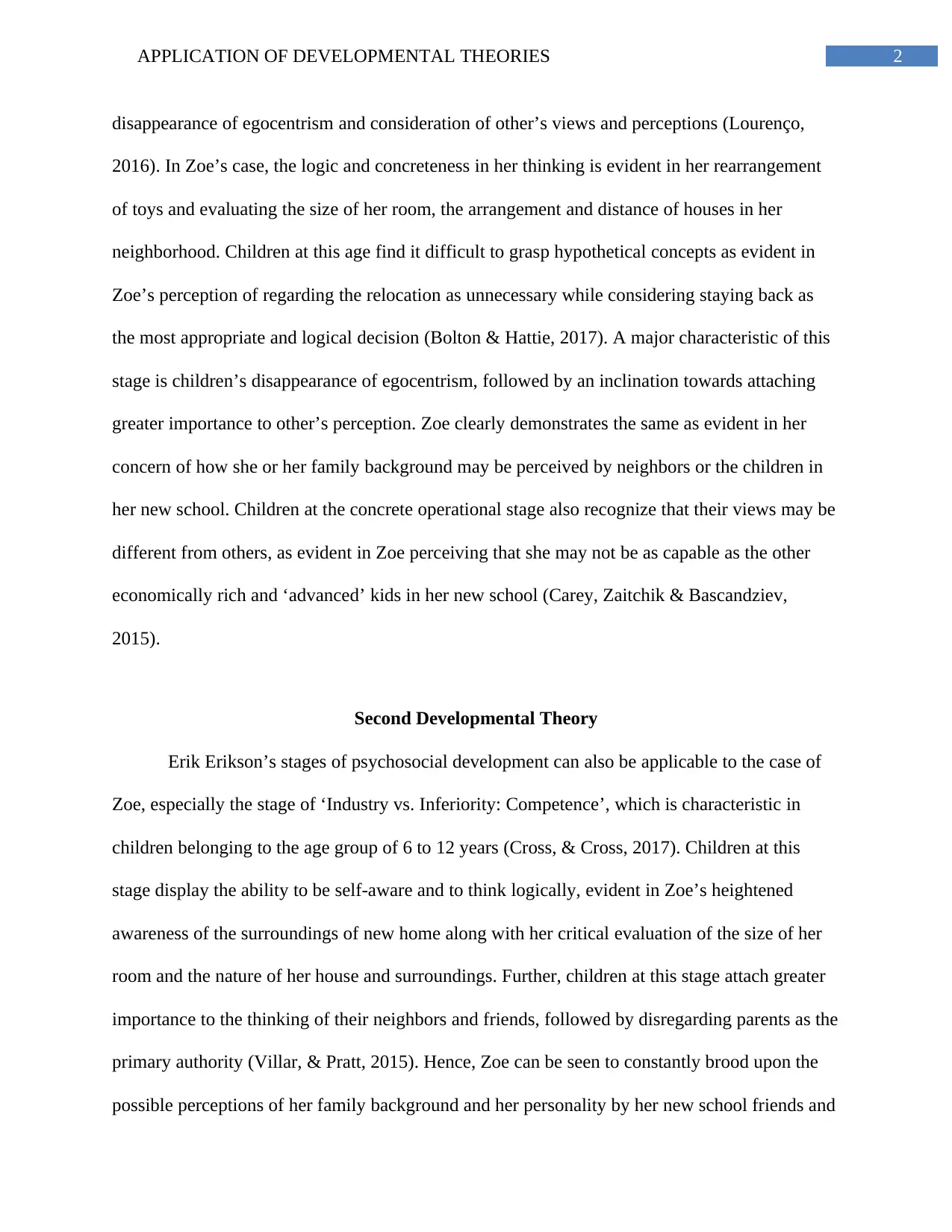
disappearance of egocentrism and consideration of other’s views and perceptions (Lourenço,
2016). In Zoe’s case, the logic and concreteness in her thinking is evident in her rearrangement
of toys and evaluating the size of her room, the arrangement and distance of houses in her
neighborhood. Children at this age find it difficult to grasp hypothetical concepts as evident in
Zoe’s perception of regarding the relocation as unnecessary while considering staying back as
the most appropriate and logical decision (Bolton & Hattie, 2017). A major characteristic of this
stage is children’s disappearance of egocentrism, followed by an inclination towards attaching
greater importance to other’s perception. Zoe clearly demonstrates the same as evident in her
concern of how she or her family background may be perceived by neighbors or the children in
her new school. Children at the concrete operational stage also recognize that their views may be
different from others, as evident in Zoe perceiving that she may not be as capable as the other
economically rich and ‘advanced’ kids in her new school (Carey, Zaitchik & Bascandziev,
2015).
Second Developmental Theory
Erik Erikson’s stages of psychosocial development can also be applicable to the case of
Zoe, especially the stage of ‘Industry vs. Inferiority: Competence’, which is characteristic in
children belonging to the age group of 6 to 12 years (Cross, & Cross, 2017). Children at this
stage display the ability to be self-aware and to think logically, evident in Zoe’s heightened
awareness of the surroundings of new home along with her critical evaluation of the size of her
room and the nature of her house and surroundings. Further, children at this stage attach greater
importance to the thinking of their neighbors and friends, followed by disregarding parents as the
primary authority (Villar, & Pratt, 2015). Hence, Zoe can be seen to constantly brood upon the
possible perceptions of her family background and her personality by her new school friends and
disappearance of egocentrism and consideration of other’s views and perceptions (Lourenço,
2016). In Zoe’s case, the logic and concreteness in her thinking is evident in her rearrangement
of toys and evaluating the size of her room, the arrangement and distance of houses in her
neighborhood. Children at this age find it difficult to grasp hypothetical concepts as evident in
Zoe’s perception of regarding the relocation as unnecessary while considering staying back as
the most appropriate and logical decision (Bolton & Hattie, 2017). A major characteristic of this
stage is children’s disappearance of egocentrism, followed by an inclination towards attaching
greater importance to other’s perception. Zoe clearly demonstrates the same as evident in her
concern of how she or her family background may be perceived by neighbors or the children in
her new school. Children at the concrete operational stage also recognize that their views may be
different from others, as evident in Zoe perceiving that she may not be as capable as the other
economically rich and ‘advanced’ kids in her new school (Carey, Zaitchik & Bascandziev,
2015).
Second Developmental Theory
Erik Erikson’s stages of psychosocial development can also be applicable to the case of
Zoe, especially the stage of ‘Industry vs. Inferiority: Competence’, which is characteristic in
children belonging to the age group of 6 to 12 years (Cross, & Cross, 2017). Children at this
stage display the ability to be self-aware and to think logically, evident in Zoe’s heightened
awareness of the surroundings of new home along with her critical evaluation of the size of her
room and the nature of her house and surroundings. Further, children at this stage attach greater
importance to the thinking of their neighbors and friends, followed by disregarding parents as the
primary authority (Villar, & Pratt, 2015). Hence, Zoe can be seen to constantly brood upon the
possible perceptions of her family background and her personality by her new school friends and
⊘ This is a preview!⊘
Do you want full access?
Subscribe today to unlock all pages.

Trusted by 1+ million students worldwide
3APPLICATION OF DEVELOPMENTAL THEORIES
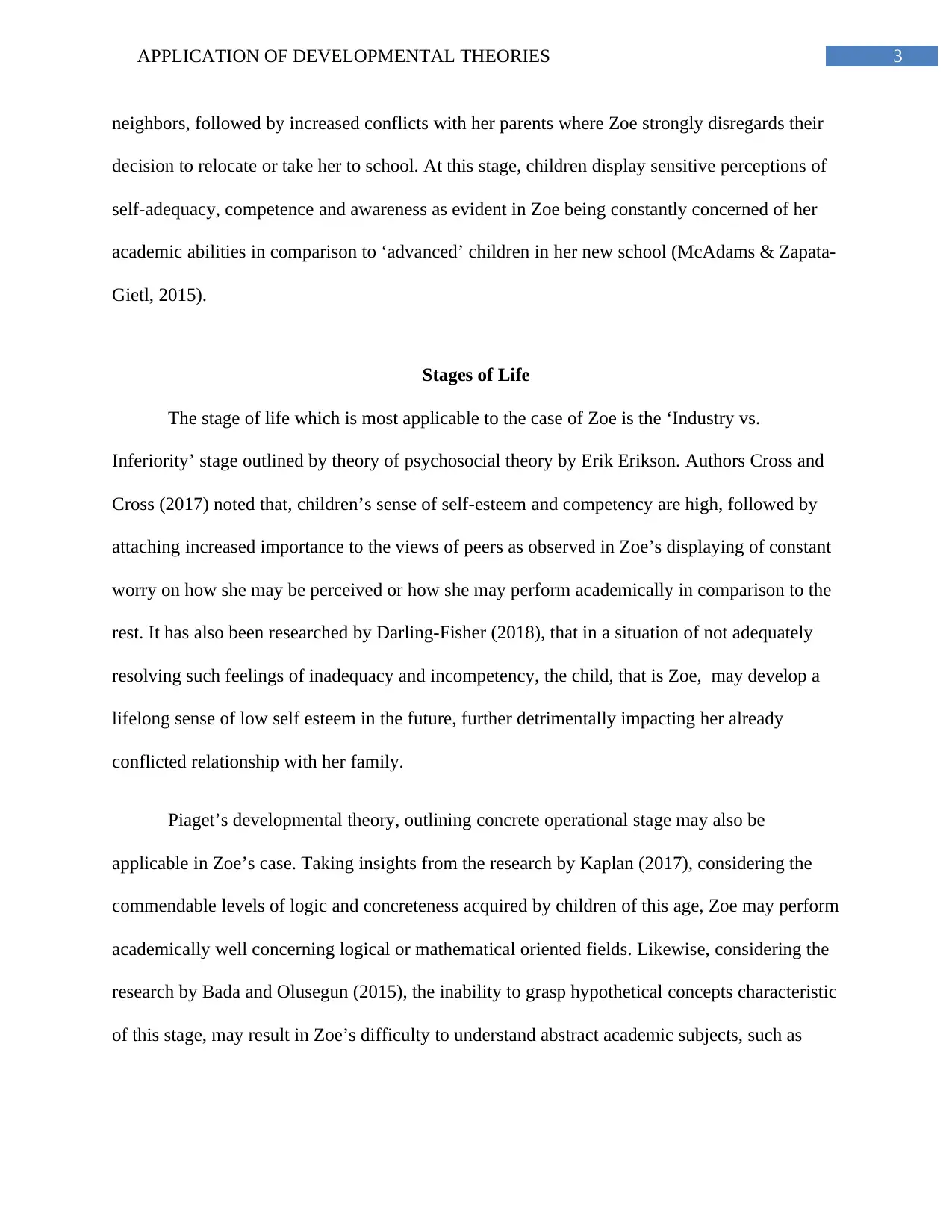
neighbors, followed by increased conflicts with her parents where Zoe strongly disregards their
decision to relocate or take her to school. At this stage, children display sensitive perceptions of
self-adequacy, competence and awareness as evident in Zoe being constantly concerned of her
academic abilities in comparison to ‘advanced’ children in her new school (McAdams & Zapata-
Gietl, 2015).
Stages of Life
The stage of life which is most applicable to the case of Zoe is the ‘Industry vs.
Inferiority’ stage outlined by theory of psychosocial theory by Erik Erikson. Authors Cross and
Cross (2017) noted that, children’s sense of self-esteem and competency are high, followed by
attaching increased importance to the views of peers as observed in Zoe’s displaying of constant
worry on how she may be perceived or how she may perform academically in comparison to the
rest. It has also been researched by Darling-Fisher (2018), that in a situation of not adequately
resolving such feelings of inadequacy and incompetency, the child, that is Zoe, may develop a
lifelong sense of low self esteem in the future, further detrimentally impacting her already
conflicted relationship with her family.
Piaget’s developmental theory, outlining concrete operational stage may also be
applicable in Zoe’s case. Taking insights from the research by Kaplan (2017), considering the
commendable levels of logic and concreteness acquired by children of this age, Zoe may perform
academically well concerning logical or mathematical oriented fields. Likewise, considering the
research by Bada and Olusegun (2015), the inability to grasp hypothetical concepts characteristic
of this stage, may result in Zoe’s difficulty to understand abstract academic subjects, such as
neighbors, followed by increased conflicts with her parents where Zoe strongly disregards their
decision to relocate or take her to school. At this stage, children display sensitive perceptions of
self-adequacy, competence and awareness as evident in Zoe being constantly concerned of her
academic abilities in comparison to ‘advanced’ children in her new school (McAdams & Zapata-
Gietl, 2015).
Stages of Life
The stage of life which is most applicable to the case of Zoe is the ‘Industry vs.
Inferiority’ stage outlined by theory of psychosocial theory by Erik Erikson. Authors Cross and
Cross (2017) noted that, children’s sense of self-esteem and competency are high, followed by
attaching increased importance to the views of peers as observed in Zoe’s displaying of constant
worry on how she may be perceived or how she may perform academically in comparison to the
rest. It has also been researched by Darling-Fisher (2018), that in a situation of not adequately
resolving such feelings of inadequacy and incompetency, the child, that is Zoe, may develop a
lifelong sense of low self esteem in the future, further detrimentally impacting her already
conflicted relationship with her family.
Piaget’s developmental theory, outlining concrete operational stage may also be
applicable in Zoe’s case. Taking insights from the research by Kaplan (2017), considering the
commendable levels of logic and concreteness acquired by children of this age, Zoe may perform
academically well concerning logical or mathematical oriented fields. Likewise, considering the
research by Bada and Olusegun (2015), the inability to grasp hypothetical concepts characteristic
of this stage, may result in Zoe’s difficulty to understand abstract academic subjects, such as
Paraphrase This Document
Need a fresh take? Get an instant paraphrase of this document with our AI Paraphraser
4APPLICATION OF DEVELOPMENTAL THEORIES
literature, which may further re-administer feelings of inadequacy, resulting in a lack of social or
emotional wellbeing in her.
Intervention Strategies
As researched by Willock et al. (2018), considering the high sense of self awareness and
competency , followed by disregarding parental authority, displayed by Zoe, establishing
empathetic, patient and compassionate communication by Zoe’s parents will prove to be
beneficial in resolving her unresolved sense of inadequacy. Further, as observed by Robino and
Foster (2018), Zoe’s parents must also consider discussing decisions collectively with Zoe as
well and consider her preferences, which will not only alleviate conflict but will also make Zoe
perceive that her needs are given equal importance and trust.
Considering the research by Marley and Carbonneau (2015), in order to further improve
her self-esteem, Zoe’s teachers must establish simple and realistic academic goals for all students
and provide positive feedback whenever Zoe or any of the children display commendable
performance. As examined by Nussbaum and Asterhan (2016), this will result in lasting positive
impacts in Zoe’s sense of self esteem in the future.
Conclusion
Hence, it can be concluded that significant life events, coupled with a growing sense of
cognition and self esteem, can administer conflicts in the emotional and social wellbeing of
children. Zoe’s growing needs of feeling adequate, competent and important must be resolved as
highlighting in the development theories by Erikson and Piaget. Likewise, compassionate and
literature, which may further re-administer feelings of inadequacy, resulting in a lack of social or
emotional wellbeing in her.
Intervention Strategies
As researched by Willock et al. (2018), considering the high sense of self awareness and
competency , followed by disregarding parental authority, displayed by Zoe, establishing
empathetic, patient and compassionate communication by Zoe’s parents will prove to be
beneficial in resolving her unresolved sense of inadequacy. Further, as observed by Robino and
Foster (2018), Zoe’s parents must also consider discussing decisions collectively with Zoe as
well and consider her preferences, which will not only alleviate conflict but will also make Zoe
perceive that her needs are given equal importance and trust.
Considering the research by Marley and Carbonneau (2015), in order to further improve
her self-esteem, Zoe’s teachers must establish simple and realistic academic goals for all students
and provide positive feedback whenever Zoe or any of the children display commendable
performance. As examined by Nussbaum and Asterhan (2016), this will result in lasting positive
impacts in Zoe’s sense of self esteem in the future.
Conclusion
Hence, it can be concluded that significant life events, coupled with a growing sense of
cognition and self esteem, can administer conflicts in the emotional and social wellbeing of
children. Zoe’s growing needs of feeling adequate, competent and important must be resolved as
highlighting in the development theories by Erikson and Piaget. Likewise, compassionate and
5APPLICATION OF DEVELOPMENTAL THEORIES
empathetic interventions by Zoe’s teachers and parents will result in positive emotional and
social wellbeing in Zoe.
empathetic interventions by Zoe’s teachers and parents will result in positive emotional and
social wellbeing in Zoe.
⊘ This is a preview!⊘
Do you want full access?
Subscribe today to unlock all pages.
Trusted by 1+ million students worldwide
6APPLICATION OF DEVELOPMENTAL THEORIES
References
Bada, S. O., & Olusegun, S. (2015). Constructivism learning theory: A paradigm for teaching
and learning. Journal of Research & Method in Education, 5(6), 66-70. doi:
10.9790/7388-05616670.
Bolton, S., & Hattie, J. (2017). Cognitive and brain development: Executive function, piaget, and
the prefrontal cortex. Archives of Psychology, 1(3). Retrieved from
https://archivesofpsychology.org/index.php/aop/article/view/30.
Carey, S., Zaitchik, D., & Bascandziev, I. (2015). Theories of development: In dialog with Jean
Piaget. Developmental Review, 38, 36-54. doi: https://doi.org/10.1016/j.dr.2015.07.003.
Cross, T. L., & Cross, J. R. (2017). Maximizing potential: A school-based conception of
psychosocial development. High Ability Studies, 28(1), 43-58. doi:
https://doi.org/10.1080/13598139.2017.1292896.
Cross, T. L., & Cross, J. R. (2017). Social and emotional development of gifted students:
Introducing the school-based psychosocial curriculum model. Gifted Child Today, 40(3),
178-182. doi: https://doi.org/10.1177%2F1076217517713784.
Darling-Fisher, C. S. (2018). Application of the Modified Erikson Psychosocial Stage Inventory:
25 Years in Review. Western journal of nursing research, 0193945918770457. doi:
https://doi.org/10.1177%2F0193945918770457.
Kaplan, D. E. (2018). Piagetian Theory in Online Teacher Education. Creative Education, 9(06),
831. doi: https://doi.org/10.4236/ce.2018.96061.
References
Bada, S. O., & Olusegun, S. (2015). Constructivism learning theory: A paradigm for teaching
and learning. Journal of Research & Method in Education, 5(6), 66-70. doi:
10.9790/7388-05616670.
Bolton, S., & Hattie, J. (2017). Cognitive and brain development: Executive function, piaget, and
the prefrontal cortex. Archives of Psychology, 1(3). Retrieved from
https://archivesofpsychology.org/index.php/aop/article/view/30.
Carey, S., Zaitchik, D., & Bascandziev, I. (2015). Theories of development: In dialog with Jean
Piaget. Developmental Review, 38, 36-54. doi: https://doi.org/10.1016/j.dr.2015.07.003.
Cross, T. L., & Cross, J. R. (2017). Maximizing potential: A school-based conception of
psychosocial development. High Ability Studies, 28(1), 43-58. doi:
https://doi.org/10.1080/13598139.2017.1292896.
Cross, T. L., & Cross, J. R. (2017). Social and emotional development of gifted students:
Introducing the school-based psychosocial curriculum model. Gifted Child Today, 40(3),
178-182. doi: https://doi.org/10.1177%2F1076217517713784.
Darling-Fisher, C. S. (2018). Application of the Modified Erikson Psychosocial Stage Inventory:
25 Years in Review. Western journal of nursing research, 0193945918770457. doi:
https://doi.org/10.1177%2F0193945918770457.
Kaplan, D. E. (2018). Piagetian Theory in Online Teacher Education. Creative Education, 9(06),
831. doi: https://doi.org/10.4236/ce.2018.96061.
Paraphrase This Document
Need a fresh take? Get an instant paraphrase of this document with our AI Paraphraser
7APPLICATION OF DEVELOPMENTAL THEORIES
Lourenço, O. M. (2016). Developmental stages, Piagetian stages in particular: A critical
review. New Ideas in Psychology, 40, 123-137. doi:
https://doi.org/10.1016/j.newideapsych.2015.08.002.
Marley, S. C., & Carbonneau, K. J. (2015). How psychological research with instructional
manipulatives can inform classroom learning. Scholarship of Teaching and Learning in
Psychology, 1(4), 412. doi: https://psycnet.apa.org/doi/10.1037/stl0000047.
McAdams, D. P., & Zapata-Gietl, C. (2015). Three strands of identity development across the
human life course: Reading Erik Erikson in full. The Oxford handbook of identity
development, 81-94. Retrieved from: https://books.google.co.in/books?
hl=en&lr=&id=QXLDBAAAQBAJ&oi=fnd&pg=PA81&dq=erik+erikson+psychosocial
+development&ots=DIdW7KCwPk&sig=soxKml0e_TZU6Bm0jKI84NwuMDo#v=onep
age&q=erik%20erikson%20psychosocial%20development&f=false.
Nussbaum, E. M., & Asterhan, C. S. (2016). The psychology of far transfer from classroom
argumentation. J. Woods (Series Ed.), Studies in Logic & Argumentation, F. Paglieri, L.
Bonelli, & S. Felletti (Eds.), The psychology of argumentation: Cognitive approaches to
argumentation and persuasion, 407-423. Retrieved from:
https://s3.amazonaws.com/academia.edu.documents/44281030/23-
nussbaum_asterhan_REV_PageProofs.PDF?
AWSAccessKeyId=AKIAIWOWYYGZ2Y53UL3A&Expires=1549010651&Signature=
SZyqFAsF19vLGzDpjWGMlyEFFtE%3D&response-content-disposition=inline%3B
%20filename%3DThe_psychology_of_far_transfer_from_clas.pdf.
Lourenço, O. M. (2016). Developmental stages, Piagetian stages in particular: A critical
review. New Ideas in Psychology, 40, 123-137. doi:
https://doi.org/10.1016/j.newideapsych.2015.08.002.
Marley, S. C., & Carbonneau, K. J. (2015). How psychological research with instructional
manipulatives can inform classroom learning. Scholarship of Teaching and Learning in
Psychology, 1(4), 412. doi: https://psycnet.apa.org/doi/10.1037/stl0000047.
McAdams, D. P., & Zapata-Gietl, C. (2015). Three strands of identity development across the
human life course: Reading Erik Erikson in full. The Oxford handbook of identity
development, 81-94. Retrieved from: https://books.google.co.in/books?
hl=en&lr=&id=QXLDBAAAQBAJ&oi=fnd&pg=PA81&dq=erik+erikson+psychosocial
+development&ots=DIdW7KCwPk&sig=soxKml0e_TZU6Bm0jKI84NwuMDo#v=onep
age&q=erik%20erikson%20psychosocial%20development&f=false.
Nussbaum, E. M., & Asterhan, C. S. (2016). The psychology of far transfer from classroom
argumentation. J. Woods (Series Ed.), Studies in Logic & Argumentation, F. Paglieri, L.
Bonelli, & S. Felletti (Eds.), The psychology of argumentation: Cognitive approaches to
argumentation and persuasion, 407-423. Retrieved from:
https://s3.amazonaws.com/academia.edu.documents/44281030/23-
nussbaum_asterhan_REV_PageProofs.PDF?
AWSAccessKeyId=AKIAIWOWYYGZ2Y53UL3A&Expires=1549010651&Signature=
SZyqFAsF19vLGzDpjWGMlyEFFtE%3D&response-content-disposition=inline%3B
%20filename%3DThe_psychology_of_far_transfer_from_clas.pdf.
8APPLICATION OF DEVELOPMENTAL THEORIES
Robino, A., & Foster, T. (2018). Psychosocial Predictors of Wellness in College
Students. Adultspan Journal, 17(1), 3-13. doi: https://doi.org/10.1002/adsp.12049.
Villar, F., & Pratt, M. W. (2015). Psychosocial Development. The Encyclopedia of Adulthood
and Aging, 1-5. doi: https://doi.org/10.1002/9781118521373.wbeaa158.
Willock, B. (2018). Erik Erikson’s Place in Relational Psychoanalysis: Discussion of “Some
Thoughts on Trust and Betrayal”. Psychoanalytic Dialogues, 28(5), 569-580. doi:
https://doi.org/10.1080/10481885.2018.1506228.
Robino, A., & Foster, T. (2018). Psychosocial Predictors of Wellness in College
Students. Adultspan Journal, 17(1), 3-13. doi: https://doi.org/10.1002/adsp.12049.
Villar, F., & Pratt, M. W. (2015). Psychosocial Development. The Encyclopedia of Adulthood
and Aging, 1-5. doi: https://doi.org/10.1002/9781118521373.wbeaa158.
Willock, B. (2018). Erik Erikson’s Place in Relational Psychoanalysis: Discussion of “Some
Thoughts on Trust and Betrayal”. Psychoanalytic Dialogues, 28(5), 569-580. doi:
https://doi.org/10.1080/10481885.2018.1506228.
⊘ This is a preview!⊘
Do you want full access?
Subscribe today to unlock all pages.
Trusted by 1+ million students worldwide

1 out of 9


Your All-in-One AI-Powered Toolkit for Academic Success.
+13062052269
info@desklib.com
Available 24*7 on WhatsApp / Email
![[object Object]](/_next/static/media/star-bottom.7253800d.svg)
Unlock your academic potential
Copyright © 2020–2026 A2Z Services. All Rights Reserved. Developed and managed by ZUCOL.