The Impact of Dopamine on Human Behavior: A Psychology Essay
VerifiedAdded on 2023/06/08
|11
|2551
|467
Essay
AI Summary
This essay provides a critical analysis of the role of dopamine, a key neurotransmitter, on human behavior. It begins by outlining the basic mechanisms of dopamine, including its site of expression and its impact on mood elevation and the treatment of depression. The essay then explores the dopamine receptors and their downstream signaling, which modulate behavior. It highlights the influence of dopamine on various mental health conditions, such as schizophrenia, ADHD, and Parkinson's disease, and how disruptions in dopamine signaling can lead to mood swings and behavioral changes. The discussion also considers the role of other neurotransmitters, such as serotonin, GABA, and acetylcholine, in regulating behavior. Ultimately, the essay concludes that dopamine plays a significant role in controlling and coordinating mood and behavior, along with the interplay of other neurotransmitters. This detailed analysis helps in understanding the complex relationship between dopamine and various aspects of human behavior.
Running head: PSYCHOLOGY
Using Research Evidence, Critically Discuss the Role of the Neurotransmitter Dopamine
upon Behaviour
Name of the Student
Name of the University
Author Note
Using Research Evidence, Critically Discuss the Role of the Neurotransmitter Dopamine
upon Behaviour
Name of the Student
Name of the University
Author Note

Paraphrase This Document
Need a fresh take? Get an instant paraphrase of this document with our AI Paraphraser
1
PSYCHOLOGY
Introduction
Dopamine (DA) is an organic chemical compound belonging to the family of the
catecholamine and phenethylamine which play an important role in controlling mood and
behaviour (Moran et al., 2012). According to Baixauli Gallego (2017), dopamine is a
hormone which has inherent relation with happiness and regulation of the mood. When a
person feels physically attracted to another person, activation of the dopamine occurs, which
in turn leads to the increase in the level of secretion of oxytocin. Hormone oxytocin decreases
pain and increases the perception of the emotional connection and thereby helping to elevate
mood and behavioural changes (Baixauli Gallego, 2017). The below discussion is mainly
based on dopamine as a neurotransmitter in behavioural effect.
The following essay aims to critically analyse the role of the dopamine
neurotransmitter upon behaviour of individuals. In doing the critical analysis, the essay will
initiate with the basic mechanism of mechanism of dopamine, its site of expression and who
it is helpful in elevating the mode or treating the depression. On the second part of the critical
analysis, the essay will highlight the how the action of dopamine is successful in treating
several mental health complications via eliciting elevation in overall state of mind and
goodness of mood.
PSYCHOLOGY
Introduction
Dopamine (DA) is an organic chemical compound belonging to the family of the
catecholamine and phenethylamine which play an important role in controlling mood and
behaviour (Moran et al., 2012). According to Baixauli Gallego (2017), dopamine is a
hormone which has inherent relation with happiness and regulation of the mood. When a
person feels physically attracted to another person, activation of the dopamine occurs, which
in turn leads to the increase in the level of secretion of oxytocin. Hormone oxytocin decreases
pain and increases the perception of the emotional connection and thereby helping to elevate
mood and behavioural changes (Baixauli Gallego, 2017). The below discussion is mainly
based on dopamine as a neurotransmitter in behavioural effect.
The following essay aims to critically analyse the role of the dopamine
neurotransmitter upon behaviour of individuals. In doing the critical analysis, the essay will
initiate with the basic mechanism of mechanism of dopamine, its site of expression and who
it is helpful in elevating the mode or treating the depression. On the second part of the critical
analysis, the essay will highlight the how the action of dopamine is successful in treating
several mental health complications via eliciting elevation in overall state of mind and
goodness of mood.
2
PSYCHOLOGY
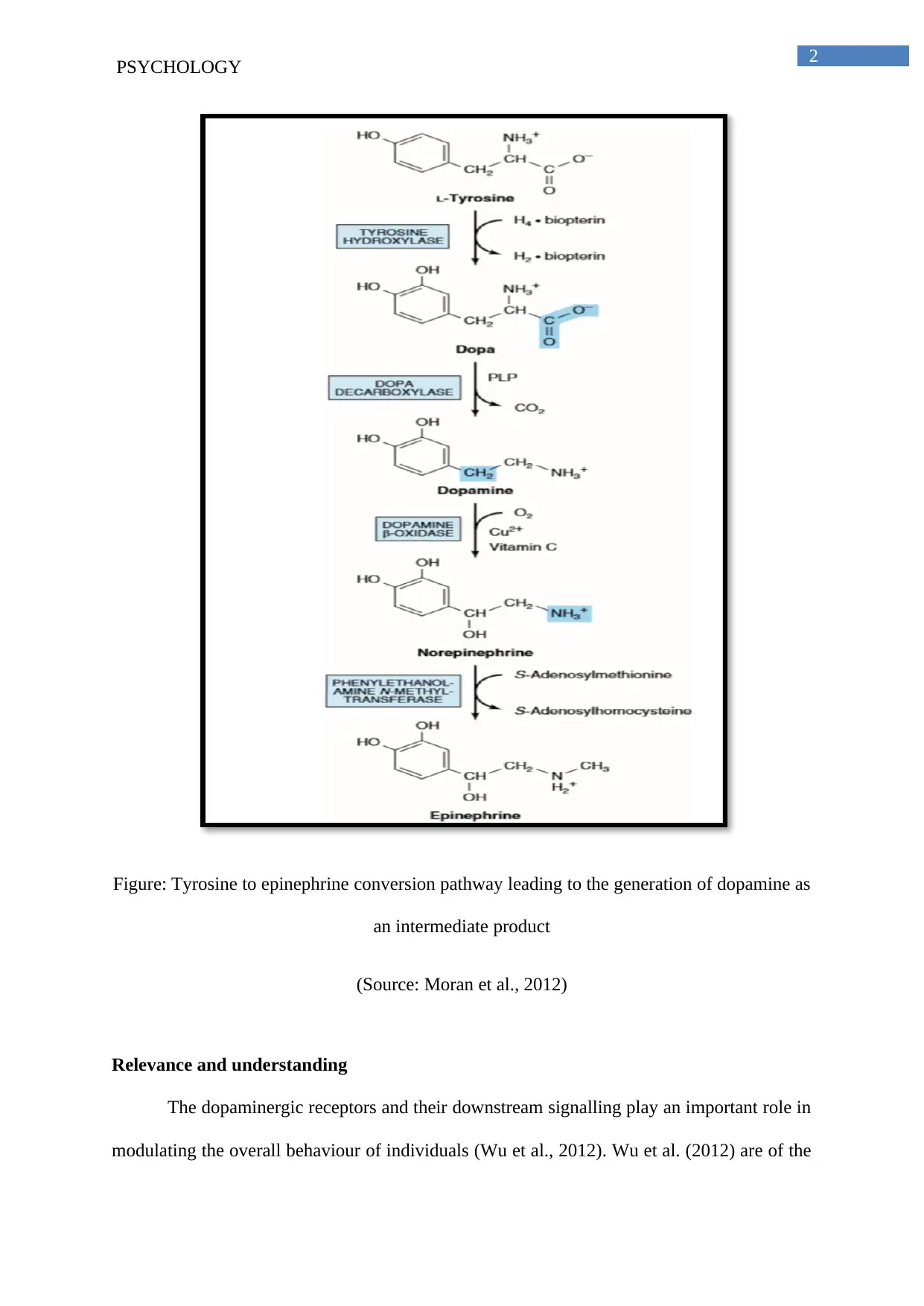
Figure: Tyrosine to epinephrine conversion pathway leading to the generation of dopamine as
an intermediate product
(Source: Moran et al., 2012)
Relevance and understanding
The dopaminergic receptors and their downstream signalling play an important role in
modulating the overall behaviour of individuals (Wu et al., 2012). Wu et al. (2012) are of the
PSYCHOLOGY
Figure: Tyrosine to epinephrine conversion pathway leading to the generation of dopamine as
an intermediate product
(Source: Moran et al., 2012)
Relevance and understanding
The dopaminergic receptors and their downstream signalling play an important role in
modulating the overall behaviour of individuals (Wu et al., 2012). Wu et al. (2012) are of the
⊘ This is a preview!⊘
Do you want full access?
Subscribe today to unlock all pages.

Trusted by 1+ million students worldwide
3
PSYCHOLOGY
opinion that DA plays an important role in controlling neuronal motor control, emotion,
cognition, vascular function and prediction of events. The effect of dopamine on the
behaviour of an individual in mainly co-ordinated by the dopamine D1 receptor (Porras et al.,
2012). It is the most abundant subtype receptor of the brain and mainly regulates via adenyl
cyclise activation followed by phosphoinositide hydrolysis along with coupling of the
heterotrimeric G protein couple receptors. D1 receptor is expressed highly in brain with
special mention to striatum, cerebral cortex, olfactory blub and to smaller extent to the
amygdale and hippocampus of the brain (Gangarossa et al., 2012). This high concentration of
the dopamine receptor (D1) in the brain further strengthens the role of dopamine in
controlling the behaviour of an individual. At cellular level, the dopamine receptors is located
at the axon terminal and dendrites which facilitates the faster transmission of the neuronal
impulses of dopamine and there promoting more prominent effect of dopamine
neurotransmitter over the behaviour. Not only the D1 receptor of dopamine, the D2 receptor
of dopamine also plays an important role in controlling and co-ordinating the behavioural
responses of an individual. The research undertaken by Gangarossa et al. (2012) highlighted
that the D2 knockout mice are more hyperactive but show poor performance in the slower
learning ability in the Morris water maze task. As per the neurophysical studies, both D1 and
D2 are highly expressed in the prefrontal cortex (PFC) and striatum of the brain (Frederick et
al., 2015). According to Warden et al. (2012) PFC is thought to participate in high level
control of behaviours like decision to execute actions. Warden et al. (2012) stated that the
defects in the PFC of the brain as evident from the magnetic resonance imaging technique
(MRI) highlighted that the lesion in the PFC lead to the defects in the proper downstream
signalling of the dopamine neurotransmitter leading to the generation of impulsive states
along with an increased tendency to initiate actions. The hamper in the downstream signalling
in the dopamine neurotransmitter also creates a-motivational states which is defined by
PSYCHOLOGY
opinion that DA plays an important role in controlling neuronal motor control, emotion,
cognition, vascular function and prediction of events. The effect of dopamine on the
behaviour of an individual in mainly co-ordinated by the dopamine D1 receptor (Porras et al.,
2012). It is the most abundant subtype receptor of the brain and mainly regulates via adenyl
cyclise activation followed by phosphoinositide hydrolysis along with coupling of the
heterotrimeric G protein couple receptors. D1 receptor is expressed highly in brain with
special mention to striatum, cerebral cortex, olfactory blub and to smaller extent to the
amygdale and hippocampus of the brain (Gangarossa et al., 2012). This high concentration of
the dopamine receptor (D1) in the brain further strengthens the role of dopamine in
controlling the behaviour of an individual. At cellular level, the dopamine receptors is located
at the axon terminal and dendrites which facilitates the faster transmission of the neuronal
impulses of dopamine and there promoting more prominent effect of dopamine
neurotransmitter over the behaviour. Not only the D1 receptor of dopamine, the D2 receptor
of dopamine also plays an important role in controlling and co-ordinating the behavioural
responses of an individual. The research undertaken by Gangarossa et al. (2012) highlighted
that the D2 knockout mice are more hyperactive but show poor performance in the slower
learning ability in the Morris water maze task. As per the neurophysical studies, both D1 and
D2 are highly expressed in the prefrontal cortex (PFC) and striatum of the brain (Frederick et
al., 2015). According to Warden et al. (2012) PFC is thought to participate in high level
control of behaviours like decision to execute actions. Warden et al. (2012) stated that the
defects in the PFC of the brain as evident from the magnetic resonance imaging technique
(MRI) highlighted that the lesion in the PFC lead to the defects in the proper downstream
signalling of the dopamine neurotransmitter leading to the generation of impulsive states
along with an increased tendency to initiate actions. The hamper in the downstream signalling
in the dopamine neurotransmitter also creates a-motivational states which is defined by
Paraphrase This Document
Need a fresh take? Get an instant paraphrase of this document with our AI Paraphraser
4
PSYCHOLOGY
symptoms like reduced activity hopelessness and overall decrease in mood (Warden et al.,
2012).
The influence of the dopamine on the overall behaviour of an individual is also
evident from the effect of dopamine in controlling depression or other depressive symptoms.
The results reported by Tye et al. (2013) highlighted that the major depression is
characterised by a diverse group of debilitating symptoms which encompass anhedonia and
hopelessness. The main role of the dopaminergic neurones is to motivation. This motivation
creates a positive behavioural approach and thereby helping to uplift the overall behaviour of
an individual. Tye et al. (2013) further highlighted that the role dopamine in controlling and
elevating mood of an individual is also evident the mode of actions of the anti-depressant.
The antidepressants used are to treat mood swings mainly acts via modification in the
downstream signalling of the dopamine signalling pathways. The antidepressant mainly
promotes bidirectional control over the dopaminergic neurons which in turn helps to relieves
depression and stress (Tye et al., 2013).
The effect of dopamine neurotransmitter on behaviour of an individual is further
explained by its role in controlling the depression. According to Argyropoulos and Nutt
(2013) adhedonia, a medicine which is used to treat depression, mainly works via modulating
the downstream signalling pathway of dopamine. The research undertaken by McCabe et al.
(2011) showed adhedonia mainly works via the manipulation of dopamine transmission at the
ventral striatum and this leads to a concurrent change in the overall mood of individual.
Discussion and Critique
The roe of the dopamine in modulating the behaviour of an individual can further be
explained by the effect of dopamine in extreme mood disorder disease like schizophrenia.
According to Brisch et al. (2014), inhibitory neurotransmitter, dopamine is involved in the
PSYCHOLOGY
symptoms like reduced activity hopelessness and overall decrease in mood (Warden et al.,
2012).
The influence of the dopamine on the overall behaviour of an individual is also
evident from the effect of dopamine in controlling depression or other depressive symptoms.
The results reported by Tye et al. (2013) highlighted that the major depression is
characterised by a diverse group of debilitating symptoms which encompass anhedonia and
hopelessness. The main role of the dopaminergic neurones is to motivation. This motivation
creates a positive behavioural approach and thereby helping to uplift the overall behaviour of
an individual. Tye et al. (2013) further highlighted that the role dopamine in controlling and
elevating mood of an individual is also evident the mode of actions of the anti-depressant.
The antidepressants used are to treat mood swings mainly acts via modification in the
downstream signalling of the dopamine signalling pathways. The antidepressant mainly
promotes bidirectional control over the dopaminergic neurons which in turn helps to relieves
depression and stress (Tye et al., 2013).
The effect of dopamine neurotransmitter on behaviour of an individual is further
explained by its role in controlling the depression. According to Argyropoulos and Nutt
(2013) adhedonia, a medicine which is used to treat depression, mainly works via modulating
the downstream signalling pathway of dopamine. The research undertaken by McCabe et al.
(2011) showed adhedonia mainly works via the manipulation of dopamine transmission at the
ventral striatum and this leads to a concurrent change in the overall mood of individual.
Discussion and Critique
The roe of the dopamine in modulating the behaviour of an individual can further be
explained by the effect of dopamine in extreme mood disorder disease like schizophrenia.
According to Brisch et al. (2014), inhibitory neurotransmitter, dopamine is involved in the
5
PSYCHOLOGY
pathology of schizophrenia. Among the schizophrenia patients there occurs abnormality in
the dopamine secretion in the mesolimbic and from the prefrontal brain regions. This defects
in the dopamine secretion leads to hallucination, frequent change in mood and thereby
causing an overall change in the behaviour of an individual. Brisch et al. (2014) highlighted
that the receptors of dopamine are G-protein coupled receptors whose expression are
decreased in the PFC of the brain of the schizophrenia patients leading to frequent mood
swings. Wu et al. (2012) highlighted that dysfunctional dopaminergic system in children with
ADHD. This is one of the reasons behind their frequent mood fluctuations and hyperactivity.
On discussing, the role of the dopamine in Parkinson’s disease Dirkx et al. (2017) highlighted
that proper dosage of dopamine helps to control tremor common in the Parkinson’s disease.
However, tremor is not directly related to the change in the mood or behavior but Segura‐
Aguilar et al. (2014) are of the opinion that there is certain relation of the tremor in the mood
disorder. For example, tremor is classified as form of neurological defects and this neurologic
defects cause irritation results in behavioral orders.
However, in relation to dopamine and its relation to behaviour of an individual,
Brisch et al. (2014) are of the opinion the apart from dopamine, GABA (gamma- amino
butyric acid), acetylcholine and serotonin also plays an important role in regulating the
behaviour or mod of an individual. It is the effective interplay of serotonin, GABA, dopamine
and acetylcholine that complete co-ordination of the mood of an individual occurs. Brisch et
al. (2014) further stated that serotonin receptors plays more prominent role in controlling the
behaviour of an individual. Mahar et al. (2014) presented a completely different opinion in
the behavioural control. According to them, it is the serotonin which plays a critical role in
controlling the mood swings and the behavioural problems. Chronic stressful life events are
the major risk factors for the development of depression and its pathophysiology is inherently
linked with the impairment of the serotonin neurotransmission. Lack of proper serotonin
PSYCHOLOGY
pathology of schizophrenia. Among the schizophrenia patients there occurs abnormality in
the dopamine secretion in the mesolimbic and from the prefrontal brain regions. This defects
in the dopamine secretion leads to hallucination, frequent change in mood and thereby
causing an overall change in the behaviour of an individual. Brisch et al. (2014) highlighted
that the receptors of dopamine are G-protein coupled receptors whose expression are
decreased in the PFC of the brain of the schizophrenia patients leading to frequent mood
swings. Wu et al. (2012) highlighted that dysfunctional dopaminergic system in children with
ADHD. This is one of the reasons behind their frequent mood fluctuations and hyperactivity.
On discussing, the role of the dopamine in Parkinson’s disease Dirkx et al. (2017) highlighted
that proper dosage of dopamine helps to control tremor common in the Parkinson’s disease.
However, tremor is not directly related to the change in the mood or behavior but Segura‐
Aguilar et al. (2014) are of the opinion that there is certain relation of the tremor in the mood
disorder. For example, tremor is classified as form of neurological defects and this neurologic
defects cause irritation results in behavioral orders.
However, in relation to dopamine and its relation to behaviour of an individual,
Brisch et al. (2014) are of the opinion the apart from dopamine, GABA (gamma- amino
butyric acid), acetylcholine and serotonin also plays an important role in regulating the
behaviour or mod of an individual. It is the effective interplay of serotonin, GABA, dopamine
and acetylcholine that complete co-ordination of the mood of an individual occurs. Brisch et
al. (2014) further stated that serotonin receptors plays more prominent role in controlling the
behaviour of an individual. Mahar et al. (2014) presented a completely different opinion in
the behavioural control. According to them, it is the serotonin which plays a critical role in
controlling the mood swings and the behavioural problems. Chronic stressful life events are
the major risk factors for the development of depression and its pathophysiology is inherently
linked with the impairment of the serotonin neurotransmission. Lack of proper serotonin
⊘ This is a preview!⊘
Do you want full access?
Subscribe today to unlock all pages.
Trusted by 1+ million students worldwide
6
PSYCHOLOGY
secretion leads to the generation of the depressive behaviours and this in turn leads to mood
swings. Here comes the importance of the selective serotonin reuptake inhibitors (SSRI)
which are one of the most popular antidepressants. SSRIs reduce the chronicity of depression
via increase the level of secretion of serotonin in the brain. SSRIs mainly block the re-
absorption or reuptake or serotonin in the brain and thereby making serotonin available in the
body fluid. This promotes the downstream signalling of the serotonin and thereby reducing
the state of depression. SSRIs are mainly called selective because they specifically effect on
the serotonin and not other inhibitors. Serotonin also helps in the treatment of other mood
disorders like anxiety (Mead et al., 2013).
Conclusion
Thus from the above discussion, it can be concluded that dopamine plays an important
role in control and co-ordination of mood and behaviour of individuals. This control of
dopamine over behaviour is mainly achieved expression of the dopamine in brain, expression
of the G-protein coupled receptor of dopamine and proper downstream signalling of
dopamine neurotransmitter. The role of dopamine on behaviour control is mainly exhibited
the effect of dopamine in controlling depression and mood swings. Moreover, several studies
have highlighted that the complex mood disorders like the AHDH, schizophrenia and
Parkinson’s show significant malfunction in the dopamine expression and signalling. On
contrary other studies are of the opinion that it is serotonin which plays a pivotal role mood,
depression and depression control. However, it can further be said that the overall control of
behaviour of an individual is not solely dependent on dopamine expression but is also
dependent on the active control and co-ordination of serotonin, GABA acetylcholine and
dopamine.
PSYCHOLOGY
secretion leads to the generation of the depressive behaviours and this in turn leads to mood
swings. Here comes the importance of the selective serotonin reuptake inhibitors (SSRI)
which are one of the most popular antidepressants. SSRIs reduce the chronicity of depression
via increase the level of secretion of serotonin in the brain. SSRIs mainly block the re-
absorption or reuptake or serotonin in the brain and thereby making serotonin available in the
body fluid. This promotes the downstream signalling of the serotonin and thereby reducing
the state of depression. SSRIs are mainly called selective because they specifically effect on
the serotonin and not other inhibitors. Serotonin also helps in the treatment of other mood
disorders like anxiety (Mead et al., 2013).
Conclusion
Thus from the above discussion, it can be concluded that dopamine plays an important
role in control and co-ordination of mood and behaviour of individuals. This control of
dopamine over behaviour is mainly achieved expression of the dopamine in brain, expression
of the G-protein coupled receptor of dopamine and proper downstream signalling of
dopamine neurotransmitter. The role of dopamine on behaviour control is mainly exhibited
the effect of dopamine in controlling depression and mood swings. Moreover, several studies
have highlighted that the complex mood disorders like the AHDH, schizophrenia and
Parkinson’s show significant malfunction in the dopamine expression and signalling. On
contrary other studies are of the opinion that it is serotonin which plays a pivotal role mood,
depression and depression control. However, it can further be said that the overall control of
behaviour of an individual is not solely dependent on dopamine expression but is also
dependent on the active control and co-ordination of serotonin, GABA acetylcholine and
dopamine.
Paraphrase This Document
Need a fresh take? Get an instant paraphrase of this document with our AI Paraphraser
7
PSYCHOLOGY
References
Argyropoulos, S. V., & Nutt, D. J. (2013). Anhedonia revisited: is there a role for dopamine-
targeting drugs for depression?. Journal of Psychopharmacology, 27(10), 869-877.
Baixauli Gallego, E. (2017). Happiness: role of dopamine and serotonin on mood and
negative emotions. Emergency Medicine (Los Angeles), 2017, vol. 6, num. 2, p. 33-51.
Brisch, R., Saniotis, A., Wolf, R., Bielau, H., Bernstein, H. G., Steiner, J., ... & Henneberg,
M. (2014). The role of dopamine in schizophrenia from a neurobiological and
evolutionary perspective: old fashioned, but still in vogue. Frontiers in psychiatry, 5,
47.
Dirkx, M. F., den Ouden, H. E., Aarts, E., Timmer, M. H., Bloem, B. R., Toni, I., & Helmich,
R. C. (2017). Dopamine controls Parkinson’s tremor by inhibiting the cerebellar
thalamus. Brain, 140(3), 721-734.
Frederick, A. L., Yano, H., Trifilieff, P., Vishwasrao, H. D., Biezonski, D., Mészáros, J., ... &
Graham, D. L. (2015). Evidence against dopamine D1/D2 receptor
heteromers. Molecular psychiatry, 20(11), 1373.
Gangarossa, G., Longueville, S., De Bundel, D., Perroy, J., Hervé, D., Girault, J. A., &
Valjent, E. (2012). Characterization of dopamine D1 and D2 receptor‐expressing
neurons in the mouse hippocampus. Hippocampus, 22(12), 2199-2207.
Mahar, I., Bambico, F. R., Mechawar, N., & Nobrega, J. N. (2014). Stress, serotonin, and
hippocampal neurogenesis in relation to depression and antidepressant
effects. Neuroscience & Biobehavioral Reviews, 38, 173-192.
PSYCHOLOGY
References
Argyropoulos, S. V., & Nutt, D. J. (2013). Anhedonia revisited: is there a role for dopamine-
targeting drugs for depression?. Journal of Psychopharmacology, 27(10), 869-877.
Baixauli Gallego, E. (2017). Happiness: role of dopamine and serotonin on mood and
negative emotions. Emergency Medicine (Los Angeles), 2017, vol. 6, num. 2, p. 33-51.
Brisch, R., Saniotis, A., Wolf, R., Bielau, H., Bernstein, H. G., Steiner, J., ... & Henneberg,
M. (2014). The role of dopamine in schizophrenia from a neurobiological and
evolutionary perspective: old fashioned, but still in vogue. Frontiers in psychiatry, 5,
47.
Dirkx, M. F., den Ouden, H. E., Aarts, E., Timmer, M. H., Bloem, B. R., Toni, I., & Helmich,
R. C. (2017). Dopamine controls Parkinson’s tremor by inhibiting the cerebellar
thalamus. Brain, 140(3), 721-734.
Frederick, A. L., Yano, H., Trifilieff, P., Vishwasrao, H. D., Biezonski, D., Mészáros, J., ... &
Graham, D. L. (2015). Evidence against dopamine D1/D2 receptor
heteromers. Molecular psychiatry, 20(11), 1373.
Gangarossa, G., Longueville, S., De Bundel, D., Perroy, J., Hervé, D., Girault, J. A., &
Valjent, E. (2012). Characterization of dopamine D1 and D2 receptor‐expressing
neurons in the mouse hippocampus. Hippocampus, 22(12), 2199-2207.
Mahar, I., Bambico, F. R., Mechawar, N., & Nobrega, J. N. (2014). Stress, serotonin, and
hippocampal neurogenesis in relation to depression and antidepressant
effects. Neuroscience & Biobehavioral Reviews, 38, 173-192.
8
PSYCHOLOGY
McCabe, C., Huber, A., Harmer, C. J., & Cowen, P. J. (2011). The D2 antagonist sulpiride
modulates the neural processing of both rewarding and aversive stimuli in healthy
volunteers. Psychopharmacology, 217(2), 271.
Mead, G. E., Hsieh, C. F., Lee, R., Kutlubaev, M. A., Claxton, A., Hankey, G. J., & Hacklett,
M. L. (2013). Selective serotonin reuptake inhibitors (SSRIs) for stroke recovery. Sao
Paulo Medical Journal, 131(3), 208-209.
Moran, L. A., Horton, H. R., Scrimgeour, K. G., & Perry, M. D. (2012). Principles of
biochemistry (pp. 433-435). Boston: Pearson.
Porras, G., Berthet, A., Dehay, B., Li, Q., Ladepeche, L., Normand, E., ... & Chuan, Q.
(2012). PSD-95 expression controls L-DOPA dyskinesia through dopamine D1
receptor trafficking. The Journal of clinical investigation, 122(11), 3977-3989.
Segura‐Aguilar, J., Paris, I., Muñoz, P., Ferrari, E., Zecca, L., & Zucca, F. A. (2014).
Protective and toxic roles of dopamine in Parkinson's disease. Journal of
neurochemistry, 129(6), 898-915.
Tye, K. M., Mirzabekov, J. J., Warden, M. R., Ferenczi, E. A., Tsai, H. C., Finkelstein, J., ...
& Gunaydin, L. A. (2013). Dopamine neurons modulate neural encoding and
expression of depression-related behaviour. Nature, 493(7433), 537.
Warden, M. R., Selimbeyoglu, A., Mirzabekov, J. J., Lo, M., Thompson, K. R., Kim, S. Y., ...
& Deisseroth, K. (2012). A prefrontal cortex–brainstem neuronal projection that
controls response to behavioural challenge. Nature, 492(7429), 428.
Wu, J., Xiao, H., Sun, H., Zou, L., & Zhu, L. Q. (2012). Role of dopamine receptors in
ADHD: a systematic meta-analysis. Molecular neurobiology, 45(3), 605-620.
PSYCHOLOGY
McCabe, C., Huber, A., Harmer, C. J., & Cowen, P. J. (2011). The D2 antagonist sulpiride
modulates the neural processing of both rewarding and aversive stimuli in healthy
volunteers. Psychopharmacology, 217(2), 271.
Mead, G. E., Hsieh, C. F., Lee, R., Kutlubaev, M. A., Claxton, A., Hankey, G. J., & Hacklett,
M. L. (2013). Selective serotonin reuptake inhibitors (SSRIs) for stroke recovery. Sao
Paulo Medical Journal, 131(3), 208-209.
Moran, L. A., Horton, H. R., Scrimgeour, K. G., & Perry, M. D. (2012). Principles of
biochemistry (pp. 433-435). Boston: Pearson.
Porras, G., Berthet, A., Dehay, B., Li, Q., Ladepeche, L., Normand, E., ... & Chuan, Q.
(2012). PSD-95 expression controls L-DOPA dyskinesia through dopamine D1
receptor trafficking. The Journal of clinical investigation, 122(11), 3977-3989.
Segura‐Aguilar, J., Paris, I., Muñoz, P., Ferrari, E., Zecca, L., & Zucca, F. A. (2014).
Protective and toxic roles of dopamine in Parkinson's disease. Journal of
neurochemistry, 129(6), 898-915.
Tye, K. M., Mirzabekov, J. J., Warden, M. R., Ferenczi, E. A., Tsai, H. C., Finkelstein, J., ...
& Gunaydin, L. A. (2013). Dopamine neurons modulate neural encoding and
expression of depression-related behaviour. Nature, 493(7433), 537.
Warden, M. R., Selimbeyoglu, A., Mirzabekov, J. J., Lo, M., Thompson, K. R., Kim, S. Y., ...
& Deisseroth, K. (2012). A prefrontal cortex–brainstem neuronal projection that
controls response to behavioural challenge. Nature, 492(7429), 428.
Wu, J., Xiao, H., Sun, H., Zou, L., & Zhu, L. Q. (2012). Role of dopamine receptors in
ADHD: a systematic meta-analysis. Molecular neurobiology, 45(3), 605-620.
⊘ This is a preview!⊘
Do you want full access?
Subscribe today to unlock all pages.
Trusted by 1+ million students worldwide

9
PSYCHOLOGY
PSYCHOLOGY
Paraphrase This Document
Need a fresh take? Get an instant paraphrase of this document with our AI Paraphraser

10
PSYCHOLOGY
PSYCHOLOGY

1 out of 11


Your All-in-One AI-Powered Toolkit for Academic Success.
+13062052269
info@desklib.com
Available 24*7 on WhatsApp / Email
![[object Object]](/_next/static/media/star-bottom.7253800d.svg)
Unlock your academic potential
Copyright © 2020–2026 A2Z Services. All Rights Reserved. Developed and managed by ZUCOL.