Comprehensive Report on Psychology of Emotions & Plutchik’s Wheel
VerifiedAdded on 2023/06/11
|13
|3812
|288
Report
AI Summary
This report delves into the psychology of emotions, emphasizing the significant role emotions play in human life, influencing thoughts, behaviors, and decisions. It highlights the three key components of emotions: subjective experience, psychological response, and expressive behavior. The report discusses the importance of emotions in motivation, survival, decision-making, and interpersonal understanding. It provides a detailed examination of Plutchik's Wheel of Emotions, outlining its ten postulates, elements (colors, layers, relations), and practical applications for understanding and managing complex emotional states. The report also includes a personal reflection on experiencing anger and sadness, relating these emotions to the wheel's framework. Desklib offers a variety of resources, including past papers and solved assignments, for students seeking to deepen their understanding of psychology and related subjects.
Running Head: Psychology
Psychology
Psychology of Emotions
Psychology
Psychology of Emotions

Paraphrase This Document
Need a fresh take? Get an instant paraphrase of this document with our AI Paraphraser
1
Psychology
Table of Contents
Introduction............................................................................................................................2
Importance of Emotions..........................................................................................................2
Plutchik’s Wheel of Emotions..................................................................................................4
Elements of the Wheel............................................................................................................5
Usage of the Wheel.................................................................................................................6
Opposite Gender’s Reaction to the situation...........................................................................8
Conclusion...............................................................................................................................8
References.............................................................................................................................10
Psychology
Table of Contents
Introduction............................................................................................................................2
Importance of Emotions..........................................................................................................2
Plutchik’s Wheel of Emotions..................................................................................................4
Elements of the Wheel............................................................................................................5
Usage of the Wheel.................................................................................................................6
Opposite Gender’s Reaction to the situation...........................................................................8
Conclusion...............................................................................................................................8
References.............................................................................................................................10
2
Psychology
Introduction
As the human beings live their daily life, they experience a different variety of emotions.
Emotions are the subjective state of being that is mostly described as feelings. There are times
when these words emotions and moods are used at different places and interchangeably too but
the psychologists use such words only for referring two different things (So, Achar, Agrawal, &
Duhachek, 2015). Characteristically, this word emotion refers to the subjective and affective
state which is comparably deep and occurs with response to something that human beings
experience. Mostly emotions are taken to be a conscious experience and it is intentional. On the
other hand, mood always refers to the long and less intense state which does not happens as the
outcome of something which is experienced by humans. The states of the mood might not be
recognized being conscious and they also do not carry the intentions that are linked with
emotions. One can feel a lot of emotions such as a lot of joy or depth of despair. One might
easily feel angry when he or she is betrayed or feel the fear when they are threatened etc. This
report will focus on a few of such emotions which are related to the psychology (Mesquita &
Janxin, 2014).
Importance of Emotions
Emotions are the feelings which can take an important place in human beings life. They play a
very significant role as to how a person think and behave. They can also compel us for taking
various actions whenever needed and emotions also manipulates the decision of the human
beings about one’s life irrespective of them being small or big (Mortari, 2015). There are three
significant components which are related to the emotions. These are required to be understood in
order to understand the importance of the emotions. Emotions of human beings can be of
subjective component which refers to the way humans experience emotions, psychological
component which refers to the reaction of the human bodies towards the emotions and expressive
component which refers to the behavior human response in towards the emotions (Pedragosa,
Biscaia, & Correia, 2015). There are very dissimilar elements which can be played in the
function and purpose of the emotional responses. The emotions of the human beings can be short
Psychology
Introduction
As the human beings live their daily life, they experience a different variety of emotions.
Emotions are the subjective state of being that is mostly described as feelings. There are times
when these words emotions and moods are used at different places and interchangeably too but
the psychologists use such words only for referring two different things (So, Achar, Agrawal, &
Duhachek, 2015). Characteristically, this word emotion refers to the subjective and affective
state which is comparably deep and occurs with response to something that human beings
experience. Mostly emotions are taken to be a conscious experience and it is intentional. On the
other hand, mood always refers to the long and less intense state which does not happens as the
outcome of something which is experienced by humans. The states of the mood might not be
recognized being conscious and they also do not carry the intentions that are linked with
emotions. One can feel a lot of emotions such as a lot of joy or depth of despair. One might
easily feel angry when he or she is betrayed or feel the fear when they are threatened etc. This
report will focus on a few of such emotions which are related to the psychology (Mesquita &
Janxin, 2014).
Importance of Emotions
Emotions are the feelings which can take an important place in human beings life. They play a
very significant role as to how a person think and behave. They can also compel us for taking
various actions whenever needed and emotions also manipulates the decision of the human
beings about one’s life irrespective of them being small or big (Mortari, 2015). There are three
significant components which are related to the emotions. These are required to be understood in
order to understand the importance of the emotions. Emotions of human beings can be of
subjective component which refers to the way humans experience emotions, psychological
component which refers to the reaction of the human bodies towards the emotions and expressive
component which refers to the behavior human response in towards the emotions (Pedragosa,
Biscaia, & Correia, 2015). There are very dissimilar elements which can be played in the
function and purpose of the emotional responses. The emotions of the human beings can be short
⊘ This is a preview!⊘
Do you want full access?
Subscribe today to unlock all pages.

Trusted by 1+ million students worldwide
3
Psychology
lived like a person being annoyed with the colleague but it was just a flash of anger or it can be
long lasting like sadness towards life or a lost relation (Stuhr, 2013).
There are several factors as to how emotions are important to human beings. They are as follows:
Motivation: When a person has had an exam which was nerve wrecking, he might have
had felt lots of anxiety as to if he will be able to perform nicely in that exam or not. As
these emotions are so dominating on the person’s mind, he or she would study even more
because of these emotions. Since, all these emotions were there in a person’s mind, he
was motivated to do better and for that he studies more (Olsson, 2003). This went to a
positive side that he wanted to score good in the exam. Sometimes, human beings can
take particular actions for experiencing the positive emotions and reducing the possibility
of feeling bad emotions. Example: One might seek for social activities or some new
hobbies which can give a sense of joy, satisfaction and enthusiasm. Whereas one would
possibly ignore the scenarios which may lead to boredom, grief loneliness and anxiety
(Ketonen, 2017).
Survive Thrive and Danger Avoidance: Charles Darwin who was the naturalist has this
belief that emotions are the alteration which allows animals and the humans for surviving
and reproduction. When humans are angry, they most likely for confrontation which is
the source of the irritation. When a person experience fear, he will most likely run from
the threat. Emotions serve as the adaptive role in the lives of the humans by motivating
people in acting quickly and take the actions which will increase the opportunity of the
survival and success (Kim, 2012).
Take up Decisions: The emotions of the human beings play a major role in the
influencing of the decisions they make from what exactly they decide to do. It can be
anything from having their breakfast to some major life decisions. Some researchers also
found out that human beings with particular types of brain damage which affects their
capability in experiencing emotions also have a reduced ability in making good decisions.
Even in the situations when a person believes the decisions are guided solely by logic and
rational has this significant role (Bayer & Hekimoglu , 2017).
Psychology
lived like a person being annoyed with the colleague but it was just a flash of anger or it can be
long lasting like sadness towards life or a lost relation (Stuhr, 2013).
There are several factors as to how emotions are important to human beings. They are as follows:
Motivation: When a person has had an exam which was nerve wrecking, he might have
had felt lots of anxiety as to if he will be able to perform nicely in that exam or not. As
these emotions are so dominating on the person’s mind, he or she would study even more
because of these emotions. Since, all these emotions were there in a person’s mind, he
was motivated to do better and for that he studies more (Olsson, 2003). This went to a
positive side that he wanted to score good in the exam. Sometimes, human beings can
take particular actions for experiencing the positive emotions and reducing the possibility
of feeling bad emotions. Example: One might seek for social activities or some new
hobbies which can give a sense of joy, satisfaction and enthusiasm. Whereas one would
possibly ignore the scenarios which may lead to boredom, grief loneliness and anxiety
(Ketonen, 2017).
Survive Thrive and Danger Avoidance: Charles Darwin who was the naturalist has this
belief that emotions are the alteration which allows animals and the humans for surviving
and reproduction. When humans are angry, they most likely for confrontation which is
the source of the irritation. When a person experience fear, he will most likely run from
the threat. Emotions serve as the adaptive role in the lives of the humans by motivating
people in acting quickly and take the actions which will increase the opportunity of the
survival and success (Kim, 2012).
Take up Decisions: The emotions of the human beings play a major role in the
influencing of the decisions they make from what exactly they decide to do. It can be
anything from having their breakfast to some major life decisions. Some researchers also
found out that human beings with particular types of brain damage which affects their
capability in experiencing emotions also have a reduced ability in making good decisions.
Even in the situations when a person believes the decisions are guided solely by logic and
rational has this significant role (Bayer & Hekimoglu , 2017).
Paraphrase This Document
Need a fresh take? Get an instant paraphrase of this document with our AI Paraphraser
4
Psychology
Allow humans to understand each other: When one interact with the other people or
society, it is significant to provide the clues which will help those people understand as to
how that person is feeling. Such clued may include emotional expressions via body
language like different facial expressions which are linked with the certain emotions that
one is experiencing. It some other cases, this includes the direct involvement stating as to
how humans feel. Certain self-emotions gives vital information to others, similarly,
expressions of those who are around us gives information of others (Haselton &
Ketelaar , 2005).
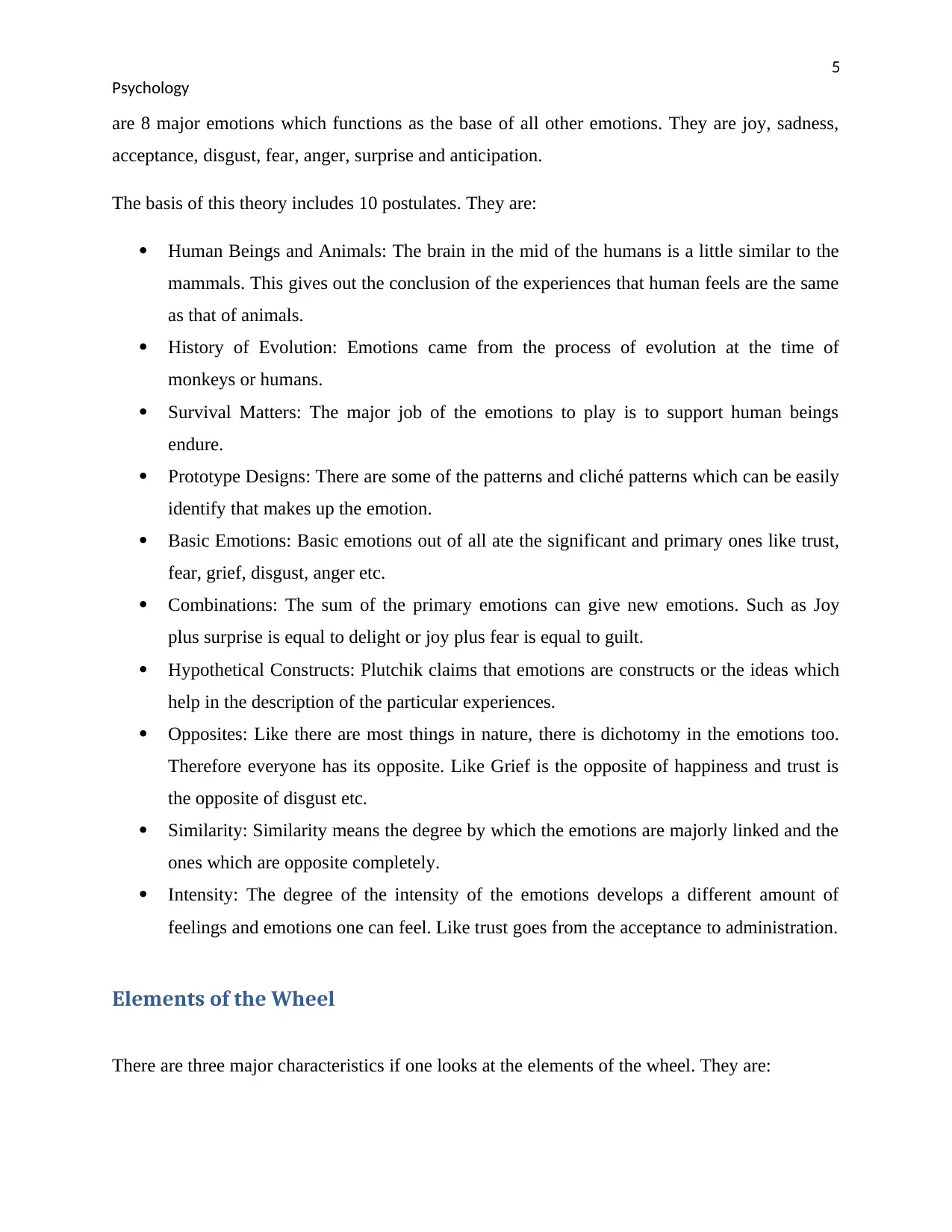
Plutchik’s Wheel of Emotions
Plutchik Wheel of Emotions
Source: (Positive psychology program, 2017)
There are approximately 34,000 emotions in the world which people an experience. This is a
huge number. Via years of studies, Plutchik who was an American Psychologist found that there
Psychology
Allow humans to understand each other: When one interact with the other people or
society, it is significant to provide the clues which will help those people understand as to
how that person is feeling. Such clued may include emotional expressions via body
language like different facial expressions which are linked with the certain emotions that
one is experiencing. It some other cases, this includes the direct involvement stating as to
how humans feel. Certain self-emotions gives vital information to others, similarly,
expressions of those who are around us gives information of others (Haselton &
Ketelaar , 2005).
Plutchik’s Wheel of Emotions
Plutchik Wheel of Emotions
Source: (Positive psychology program, 2017)
There are approximately 34,000 emotions in the world which people an experience. This is a
huge number. Via years of studies, Plutchik who was an American Psychologist found that there
5
Psychology
are 8 major emotions which functions as the base of all other emotions. They are joy, sadness,
acceptance, disgust, fear, anger, surprise and anticipation.
The basis of this theory includes 10 postulates. They are:
Human Beings and Animals: The brain in the mid of the humans is a little similar to the
mammals. This gives out the conclusion of the experiences that human feels are the same
as that of animals.
History of Evolution: Emotions came from the process of evolution at the time of
monkeys or humans.
Survival Matters: The major job of the emotions to play is to support human beings
endure.
Prototype Designs: There are some of the patterns and cliché patterns which can be easily
identify that makes up the emotion.
Basic Emotions: Basic emotions out of all ate the significant and primary ones like trust,
fear, grief, disgust, anger etc.
Combinations: The sum of the primary emotions can give new emotions. Such as Joy
plus surprise is equal to delight or joy plus fear is equal to guilt.
Hypothetical Constructs: Plutchik claims that emotions are constructs or the ideas which
help in the description of the particular experiences.
Opposites: Like there are most things in nature, there is dichotomy in the emotions too.
Therefore everyone has its opposite. Like Grief is the opposite of happiness and trust is
the opposite of disgust etc.
Similarity: Similarity means the degree by which the emotions are majorly linked and the
ones which are opposite completely.
Intensity: The degree of the intensity of the emotions develops a different amount of
feelings and emotions one can feel. Like trust goes from the acceptance to administration.
Elements of the Wheel
There are three major characteristics if one looks at the elements of the wheel. They are:
Psychology
are 8 major emotions which functions as the base of all other emotions. They are joy, sadness,
acceptance, disgust, fear, anger, surprise and anticipation.
The basis of this theory includes 10 postulates. They are:
Human Beings and Animals: The brain in the mid of the humans is a little similar to the
mammals. This gives out the conclusion of the experiences that human feels are the same
as that of animals.
History of Evolution: Emotions came from the process of evolution at the time of
monkeys or humans.
Survival Matters: The major job of the emotions to play is to support human beings
endure.
Prototype Designs: There are some of the patterns and cliché patterns which can be easily
identify that makes up the emotion.
Basic Emotions: Basic emotions out of all ate the significant and primary ones like trust,
fear, grief, disgust, anger etc.
Combinations: The sum of the primary emotions can give new emotions. Such as Joy
plus surprise is equal to delight or joy plus fear is equal to guilt.
Hypothetical Constructs: Plutchik claims that emotions are constructs or the ideas which
help in the description of the particular experiences.
Opposites: Like there are most things in nature, there is dichotomy in the emotions too.
Therefore everyone has its opposite. Like Grief is the opposite of happiness and trust is
the opposite of disgust etc.
Similarity: Similarity means the degree by which the emotions are majorly linked and the
ones which are opposite completely.
Intensity: The degree of the intensity of the emotions develops a different amount of
feelings and emotions one can feel. Like trust goes from the acceptance to administration.
Elements of the Wheel
There are three major characteristics if one looks at the elements of the wheel. They are:
⊘ This is a preview!⊘
Do you want full access?
Subscribe today to unlock all pages.
Trusted by 1+ million students worldwide
6
Psychology
Colors: The emotions which are considered primary are actually arranged by colors and
launch group of emotions which are similar. The emotions which are primary are located
in the second circle area. Emotions which do not have colors are actually the mixture of
two major emotions.
Layers: Moving towards the center of the circle, emotions are intensified. Hence, the
colors intensify too. For example: in the center of the wheel, the primary emotions alter
from: Anger to rage, anticipation to vigilance, happiness to ecstasy, trust to admiration,
fear to terror and surprise to amazement. When we move towards the outer layer, the
colors change to less saturated and the intensity of the colors also lowers.
Relations: Emotions which are exactly opposite to each other are found across from each
other. The spaces that they have in between them display the integration and the
combination one gets when the emotions which are primary are mixed. Hence one can
see the emergence of the emotions such as love, positivity, aggressiveness, remorse, awe,
disapproval etc.
Usage of the Wheel
The beauty that this tool has is that it has the ability to simplify concepts which are very
complex. To solve the dilemma, the first step is to understand them. Still when the question is
concerned with the emotions, the process which happens on the subconscious level, to identify
and verbalize things seems to be a big task. This is the reason as to why this tool seems to be
more useful. This gives the enablement to the user for visualizing the emotions and hence
understand as to which are the combinations of the emotions that were created and developed
from the outcome (Gomes, 2017).
Once the emotions are objectified and understood, one can get the grip on them and find the way
to channel emphasize on the path of emotions one actually wants to sense. There are majorly two
methods of using the wheel, either by a two dimensional circle or the three dimensional ellipse.
In case of the utilization is done by two dimensional circle, it will enable the person to go deep
into the emotions wheel and find out the primary emotions which they are sensing and the way to
combine for creating secondary emotions. In case of the three dimensional form is used, the
Psychology
Colors: The emotions which are considered primary are actually arranged by colors and
launch group of emotions which are similar. The emotions which are primary are located
in the second circle area. Emotions which do not have colors are actually the mixture of
two major emotions.
Layers: Moving towards the center of the circle, emotions are intensified. Hence, the
colors intensify too. For example: in the center of the wheel, the primary emotions alter
from: Anger to rage, anticipation to vigilance, happiness to ecstasy, trust to admiration,
fear to terror and surprise to amazement. When we move towards the outer layer, the
colors change to less saturated and the intensity of the colors also lowers.
Relations: Emotions which are exactly opposite to each other are found across from each
other. The spaces that they have in between them display the integration and the
combination one gets when the emotions which are primary are mixed. Hence one can
see the emergence of the emotions such as love, positivity, aggressiveness, remorse, awe,
disapproval etc.
Usage of the Wheel
The beauty that this tool has is that it has the ability to simplify concepts which are very
complex. To solve the dilemma, the first step is to understand them. Still when the question is
concerned with the emotions, the process which happens on the subconscious level, to identify
and verbalize things seems to be a big task. This is the reason as to why this tool seems to be
more useful. This gives the enablement to the user for visualizing the emotions and hence
understand as to which are the combinations of the emotions that were created and developed
from the outcome (Gomes, 2017).
Once the emotions are objectified and understood, one can get the grip on them and find the way
to channel emphasize on the path of emotions one actually wants to sense. There are majorly two
methods of using the wheel, either by a two dimensional circle or the three dimensional ellipse.
In case of the utilization is done by two dimensional circle, it will enable the person to go deep
into the emotions wheel and find out the primary emotions which they are sensing and the way to
combine for creating secondary emotions. In case of the three dimensional form is used, the
Paraphrase This Document
Need a fresh take? Get an instant paraphrase of this document with our AI Paraphraser
7
Psychology
person will be capable to see the emotional depth of the primary and the secondary emotions
both.
Plutchik said that emotions are raised because of the particular stimuli which are set off
particular patterns of behavior. There are some of the survival behaviors which drive the
emotions of people according to Plutchik. They are:
Protection: Withdrawal, Retreat which are activated by fear and terror.
Destruction: Removal of the obstacles to the contention of requirements which are
activated by anger and rage (Donaldson, 2017).
Incorporation: Ingesting nourishment which is activated by acceptance.
Rejection: Removal response to the dangerous material which are activated by disgust.
Reproduction: Approaches, contacts, genetics exchanges that activates by happiness and
ecstasy.
Reintegration: Action to the damage of nutrient product with grief and sadness.
Exploration: Investigating the atmosphere which activates by curiousness and
playfulness.
Orientation: Reaction to contact with the non familiar object triggered by surprise.
It means that in case when the emotions are triggered, they are done for eliciting one of
behaviors of survival. Obviously, it occurs at the level of sub consciousness level (Hershfield,
Scheibe, Sims, & Carstensen, 2012).
Recently I have felt anger and sadness both since a few days. Anger because I was feeling sad
from quite a few days and as it is generally known that when a person is sad, it usually turns into
the anger (ICP, 2016). I was angry with myself as I was unable to perform the tasks in office
place which were required to be done at a specific deadline. This situation was caused because I
was not feeling well for fifteen days. I had bad headaches and I was unable to do anything. This
caused an irritation in the starting but it soon changed into sadness as I had to hear a lot of things
due to this situation in my workplace and from my manager. Once can easily relate to my
situation but I was the one who was not really very happy as I am a very ambitious person and I
like to do things my way. Hence, these are the two emotions which I felt i.e. Anger and Sadness
(Tamir, Schwartz, Kim, & Oishi, 2017).
Psychology
person will be capable to see the emotional depth of the primary and the secondary emotions
both.
Plutchik said that emotions are raised because of the particular stimuli which are set off
particular patterns of behavior. There are some of the survival behaviors which drive the
emotions of people according to Plutchik. They are:
Protection: Withdrawal, Retreat which are activated by fear and terror.
Destruction: Removal of the obstacles to the contention of requirements which are
activated by anger and rage (Donaldson, 2017).
Incorporation: Ingesting nourishment which is activated by acceptance.
Rejection: Removal response to the dangerous material which are activated by disgust.
Reproduction: Approaches, contacts, genetics exchanges that activates by happiness and
ecstasy.
Reintegration: Action to the damage of nutrient product with grief and sadness.
Exploration: Investigating the atmosphere which activates by curiousness and
playfulness.
Orientation: Reaction to contact with the non familiar object triggered by surprise.
It means that in case when the emotions are triggered, they are done for eliciting one of
behaviors of survival. Obviously, it occurs at the level of sub consciousness level (Hershfield,
Scheibe, Sims, & Carstensen, 2012).
Recently I have felt anger and sadness both since a few days. Anger because I was feeling sad
from quite a few days and as it is generally known that when a person is sad, it usually turns into
the anger (ICP, 2016). I was angry with myself as I was unable to perform the tasks in office
place which were required to be done at a specific deadline. This situation was caused because I
was not feeling well for fifteen days. I had bad headaches and I was unable to do anything. This
caused an irritation in the starting but it soon changed into sadness as I had to hear a lot of things
due to this situation in my workplace and from my manager. Once can easily relate to my
situation but I was the one who was not really very happy as I am a very ambitious person and I
like to do things my way. Hence, these are the two emotions which I felt i.e. Anger and Sadness
(Tamir, Schwartz, Kim, & Oishi, 2017).
8
Psychology
Now after a few days of this feeling, I feel nothing at all. As soon as I felt good about my health,
I was able to complete the tasks my way before the deadline and all that grief and irritation has
gone. Now when I think about it, these emotions were of no use. In the end I would say that
people have their days. Some are good and some are bad (Zeelenberg, Nelissen, Breugelmans, &
Pieters, 2008).
Opposite Gender’s Reaction to the situation
It is said that Women are more patient than men but I have felt quite the opposite of this. I feel
like men do not panic in the situation like I have had when I felt anger and sadness. It is known
that if men are sick they will not at all even have the feeling for more than 19 hours of their
sickness. They will continue doing their work like as usual. If any man would have been in the
same situation like me, I do not think that he would have felt that low as I had felt. And also he
would not have hampered his productivity like mine came down. He might not have felt irritated
when he would go through the low productivity but even if he would have felt irritated, he would
have felt angry or sad (Purnamaningsih, 2017).
Anger is the emotion which is always secondary to the males which they use to hide other
emotions as a mask. For example there are particular emotions like fear and anxiety or
vulnerability or distress which can mostly produce the feeling of the humiliation is men. Now
men consider humiliation as a weakness. Most of the men think that showing their weakness
would be becoming vulnerable and open to the criticism. They think that they will invite
themselves to be attacked if they will show their vulnerability. And anger is the kind of defense
of that attack and also this may be a weapon for attacking others (Martinez & Du, 2012).
The similar is the case with the sadness in men. Men mostly do not show their emotions at all to
anybody. Hence, if a man would have been in my place he would not have hampered his
productivity but he definitely would have felt the anger in a way that it is not seen by others
(Kuppens, Realo, & Diener, 2008).
Conclusion
Psychology
Now after a few days of this feeling, I feel nothing at all. As soon as I felt good about my health,
I was able to complete the tasks my way before the deadline and all that grief and irritation has
gone. Now when I think about it, these emotions were of no use. In the end I would say that
people have their days. Some are good and some are bad (Zeelenberg, Nelissen, Breugelmans, &
Pieters, 2008).
Opposite Gender’s Reaction to the situation
It is said that Women are more patient than men but I have felt quite the opposite of this. I feel
like men do not panic in the situation like I have had when I felt anger and sadness. It is known
that if men are sick they will not at all even have the feeling for more than 19 hours of their
sickness. They will continue doing their work like as usual. If any man would have been in the
same situation like me, I do not think that he would have felt that low as I had felt. And also he
would not have hampered his productivity like mine came down. He might not have felt irritated
when he would go through the low productivity but even if he would have felt irritated, he would
have felt angry or sad (Purnamaningsih, 2017).
Anger is the emotion which is always secondary to the males which they use to hide other
emotions as a mask. For example there are particular emotions like fear and anxiety or
vulnerability or distress which can mostly produce the feeling of the humiliation is men. Now
men consider humiliation as a weakness. Most of the men think that showing their weakness
would be becoming vulnerable and open to the criticism. They think that they will invite
themselves to be attacked if they will show their vulnerability. And anger is the kind of defense
of that attack and also this may be a weapon for attacking others (Martinez & Du, 2012).
The similar is the case with the sadness in men. Men mostly do not show their emotions at all to
anybody. Hence, if a man would have been in my place he would not have hampered his
productivity but he definitely would have felt the anger in a way that it is not seen by others
(Kuppens, Realo, & Diener, 2008).
Conclusion
⊘ This is a preview!⊘
Do you want full access?
Subscribe today to unlock all pages.
Trusted by 1+ million students worldwide
9
Psychology
Emotions are complicated state of psychology which includes three of the components:
subjective experience, response in psychological manner and response in terms of behavior or
gestures. In 1980’s, Plutchik incepted new classification of emotions system which are known as
the Wheel of emotions (Andrieș, 2011). This wheel displayed the various emotions and they also
could easily be linked with each other to make a new emotion. Robert advised that there are
primary emotions which are 8 in number: joy vs sadness, anger vs fear, trust vs. disgust, and
surprise vs. anticipation. Now these primary emotions are linked with each other and make a new
emotions. For example, happiness and anticipation may conglomerate for creating excitement.
This report discusses the importance of the emotions that human beings have tinned their daily
lives. Emotions sometimes make people sad but then there are emotions which are also positive
such as surprise or joy etc. Hence, there is a lot of importance in the lives of the human beings of
emotions. Plutchik as discussed above created a wheel from which the emotions could be
decoded and some new emotions are also being generated from the help of that wheel. The
Wheel of Plutchik is discussed completely in this report. There is a reflection shared also in this
report which includes two emotions of anger and sadness that I felt in a few days and what
exactly are they of any importance now. Also, in case if a man would have in my place, how he
would have reacted to the situation which I faced is also discussed in this report. It can be
concluded that emotions are really significant as one expresses his or her feeling with the help of
these emotions. These are the things which gives the humans to express themselves.
Psychology
Emotions are complicated state of psychology which includes three of the components:
subjective experience, response in psychological manner and response in terms of behavior or
gestures. In 1980’s, Plutchik incepted new classification of emotions system which are known as
the Wheel of emotions (Andrieș, 2011). This wheel displayed the various emotions and they also
could easily be linked with each other to make a new emotion. Robert advised that there are
primary emotions which are 8 in number: joy vs sadness, anger vs fear, trust vs. disgust, and
surprise vs. anticipation. Now these primary emotions are linked with each other and make a new
emotions. For example, happiness and anticipation may conglomerate for creating excitement.
This report discusses the importance of the emotions that human beings have tinned their daily
lives. Emotions sometimes make people sad but then there are emotions which are also positive
such as surprise or joy etc. Hence, there is a lot of importance in the lives of the human beings of
emotions. Plutchik as discussed above created a wheel from which the emotions could be
decoded and some new emotions are also being generated from the help of that wheel. The
Wheel of Plutchik is discussed completely in this report. There is a reflection shared also in this
report which includes two emotions of anger and sadness that I felt in a few days and what
exactly are they of any importance now. Also, in case if a man would have in my place, how he
would have reacted to the situation which I faced is also discussed in this report. It can be
concluded that emotions are really significant as one expresses his or her feeling with the help of
these emotions. These are the things which gives the humans to express themselves.
Paraphrase This Document
Need a fresh take? Get an instant paraphrase of this document with our AI Paraphraser
10
Psychology
References
Andrieș, A. M. (2011). Positive And Negative Emotions Within The Organizational Context.
Global Journal of HUMAN SOCIAL SCIENCE , 11(9).
Bayer , V., & Hekimoglu , D. (2017). The Role of Emotions in Managerial Decision Making
Processes under Uncertainty. Retrieved June 27, 2018, from
http://lup.lub.lu.se/luur/download?
func=downloadFile&recordOId=8918459&fileOId=8918462
Donaldson, M. (2017). Plutchik’s Wheel of Emotions. Retrieved June 27, 2018, from
http://www.uvm.edu/~mjk/013%20Intro%20to%20Wildlife%20Tracking/Plutchik's
%20Wheel%20of%20Emotions%20-%202017%20Update%20_%20Six%20Seconds.pdf
Gomes, O. (2017). Plutchik and Economics: ‘… Disgust, Fear, and, Oh Yes, Love.’. Economic
Issues, 22(1).
Haselton , M. G., & Ketelaar , T. (2005). Irrational Emotions or Emotional Wisdom? The
Evolutionary Psychology of Emotions and Behavior. Affective influences on social
cognition and behavior.
Hershfield, H. E., Scheibe, S., Sims, T. L., & Carstensen, L. L. (2012). When Feeling Bad Can
Be Good: Mixed Emotions Benefit Physical Health Across Adulthood. Social
Psychological and Personality Science, 0(0), 1-8.
ICP. (2016). Emotion. International Journal Of Psychology.
Ketonen, E. (2017). The Role of Motivation and Academic Emotions in University Studies.
Retrieved June 27, 2018, from
https://helda.helsinki.fi/bitstream/handle/10138/228581/TheRoleo.pdf?sequence=1
Kim, K. H. (2012). Emotion and Strategic Decision-Making Behavior: Developing a Theoretical
Model. International Journal of Business and Social Science , 3(1).
Psychology
References
Andrieș, A. M. (2011). Positive And Negative Emotions Within The Organizational Context.
Global Journal of HUMAN SOCIAL SCIENCE , 11(9).
Bayer , V., & Hekimoglu , D. (2017). The Role of Emotions in Managerial Decision Making
Processes under Uncertainty. Retrieved June 27, 2018, from
http://lup.lub.lu.se/luur/download?
func=downloadFile&recordOId=8918459&fileOId=8918462
Donaldson, M. (2017). Plutchik’s Wheel of Emotions. Retrieved June 27, 2018, from
http://www.uvm.edu/~mjk/013%20Intro%20to%20Wildlife%20Tracking/Plutchik's
%20Wheel%20of%20Emotions%20-%202017%20Update%20_%20Six%20Seconds.pdf
Gomes, O. (2017). Plutchik and Economics: ‘… Disgust, Fear, and, Oh Yes, Love.’. Economic
Issues, 22(1).
Haselton , M. G., & Ketelaar , T. (2005). Irrational Emotions or Emotional Wisdom? The
Evolutionary Psychology of Emotions and Behavior. Affective influences on social
cognition and behavior.
Hershfield, H. E., Scheibe, S., Sims, T. L., & Carstensen, L. L. (2012). When Feeling Bad Can
Be Good: Mixed Emotions Benefit Physical Health Across Adulthood. Social
Psychological and Personality Science, 0(0), 1-8.
ICP. (2016). Emotion. International Journal Of Psychology.
Ketonen, E. (2017). The Role of Motivation and Academic Emotions in University Studies.
Retrieved June 27, 2018, from
https://helda.helsinki.fi/bitstream/handle/10138/228581/TheRoleo.pdf?sequence=1
Kim, K. H. (2012). Emotion and Strategic Decision-Making Behavior: Developing a Theoretical
Model. International Journal of Business and Social Science , 3(1).
11
Psychology
Kuppens, P., Realo, A., & Diener, E. (2008). The Role of Positive and Negative Emotions in
Life Satisfaction Judgment Across Nations. Journal of Personality and Social
Psychology, 95(1), 66-75.
Martinez, A., & Du, S. (2012). Model of the Perception of Facial Expressions of Emotion by
Humans: Research Overview and Perspectives. Journal of Machine Learning Research,
13, 1589-1608.
Mesquita, B., & Janxin, L. (2014). The cultural psychology of emotions. Research Gate.
Mortari, L. (2015). Emotion and Education: Reflecting on the Emotional Experience Emotion
and Education. European Journal of Educational Research, 4(4), 157-176.
Olsson, A. (2003). EMOTION AND MOTIVATION IN LEARNING: CURRENT RESEARCH,
FUTURE DIRECTIONS, AND PRACTICAL IMPLICATIONS. Lund University
Cognitive Studies .
Pedragosa, V., Biscaia, R., & Correia, A. (2015). The role of emotions on consumers’
satisfaction within the fitness context. Emotions on consumers´ satisfaction and fitness,
21(2), 116-124.
Purnamaningsih, E. H. (2017). Personality and Emotion Regulation Strategies. International
Journal of Psychological Research, 10(1), 53-60.
So, J., Achar, C., Agrawal, N., & Duhachek, A. (2015). The psychology of appraisal: Specific
emotions and decision-making. Journal of Consumer Psychology, 25(3), 359-371.
Stuhr, P. T. (2013). The Importance of Emotions in Teaching: Developing Positive Emotions in
Physical Education. International Journal of Human Movement Science, 7(1), 5-29.
Tamir, M., Schwartz, S. H., Kim, M. Y., & Oishi, S. (2017). The Secret to Happiness: Feeling
Good or Feeling Right? Journal of Experimental Psychology: General, 146(10), 1448-
1459.
Psychology
Kuppens, P., Realo, A., & Diener, E. (2008). The Role of Positive and Negative Emotions in
Life Satisfaction Judgment Across Nations. Journal of Personality and Social
Psychology, 95(1), 66-75.
Martinez, A., & Du, S. (2012). Model of the Perception of Facial Expressions of Emotion by
Humans: Research Overview and Perspectives. Journal of Machine Learning Research,
13, 1589-1608.
Mesquita, B., & Janxin, L. (2014). The cultural psychology of emotions. Research Gate.
Mortari, L. (2015). Emotion and Education: Reflecting on the Emotional Experience Emotion
and Education. European Journal of Educational Research, 4(4), 157-176.
Olsson, A. (2003). EMOTION AND MOTIVATION IN LEARNING: CURRENT RESEARCH,
FUTURE DIRECTIONS, AND PRACTICAL IMPLICATIONS. Lund University
Cognitive Studies .
Pedragosa, V., Biscaia, R., & Correia, A. (2015). The role of emotions on consumers’
satisfaction within the fitness context. Emotions on consumers´ satisfaction and fitness,
21(2), 116-124.
Purnamaningsih, E. H. (2017). Personality and Emotion Regulation Strategies. International
Journal of Psychological Research, 10(1), 53-60.
So, J., Achar, C., Agrawal, N., & Duhachek, A. (2015). The psychology of appraisal: Specific
emotions and decision-making. Journal of Consumer Psychology, 25(3), 359-371.
Stuhr, P. T. (2013). The Importance of Emotions in Teaching: Developing Positive Emotions in
Physical Education. International Journal of Human Movement Science, 7(1), 5-29.
Tamir, M., Schwartz, S. H., Kim, M. Y., & Oishi, S. (2017). The Secret to Happiness: Feeling
Good or Feeling Right? Journal of Experimental Psychology: General, 146(10), 1448-
1459.
⊘ This is a preview!⊘
Do you want full access?
Subscribe today to unlock all pages.
Trusted by 1+ million students worldwide

1 out of 13


Related Documents


Your All-in-One AI-Powered Toolkit for Academic Success.
+13062052269
info@desklib.com
Available 24*7 on WhatsApp / Email
![[object Object]](/_next/static/media/star-bottom.7253800d.svg)
Unlock your academic potential
Copyright © 2020–2025 A2Z Services. All Rights Reserved. Developed and managed by ZUCOL.